Thursday, September 6, 2012

Tables Turned on Bobby V.

 
How does it feel, Bobby Valentine, to have your effort unfairly criticized?
Another day, another loss, and more controversy in Red Sox Nation.

But what else is new?

Back in April Bobby Valentine questioned the dedication of Kevin Youkilis, one of the sport's most intense players with a reputation of wearing his heart on his sleeve, giving 110 percent all the time and treating every at-bat like it's life or death. 

"I don't think he's as physically or emotionally into the game as he has been in the past, for some reason," Valentine said of his third baseman, who at the time was mired in an early season slump.  Boy, that vote of confidence from the skipper must have felt swell.

We all know how that turned out.  Dustin Pedroia fired back, and Valentine apologized.  But Youkilis never forgave his manager for making those remarks, and their hostile relationship (combined with the emergence of rookie Will Middlebrooks) led Boston GM Ben Cherington to dump Youk on the White Sox for pennies on the dollar in late June.  The three time All-Star has since rescued his season, providing several clutch hits for first place Chicago.  Meanwhile, back in Boston, the Red Sox are a dozen games below .500 as they put the finishing touches on what will be their worst season in recent memory.

So today, when WEEI radio host Glenn Ordway asked Valentine if he had "checked out," Bobby V. nearly blew his stack. He was insulted that Ordway even had the nerve to ask him that.  Valentine, like Youkilis, is a fiery, passionate and proud baseball man who cares deeply about his job and works incredibly hard at it.  Say what you want about both men, but you can not question their effort.

After all, it's not Valentine's fault the team stinks (there's a long list of culprits headed by Josh Beckett, Jon Lester, and Daniel Bard, among others).  He deserves better.  But so did Youkilis, and that's why I don't feel an ounce of sympathy for the field general.  He got a dose of his own medicine, and frankly it's too damn bad that he doesn't like the taste. 

What goes around, comes around Bobby Valentine.  Hopefully you learned your lesson and remember to keep your big mouth shut from now on.

Wednesday, September 5, 2012

Uggla's Benching Unwarranted

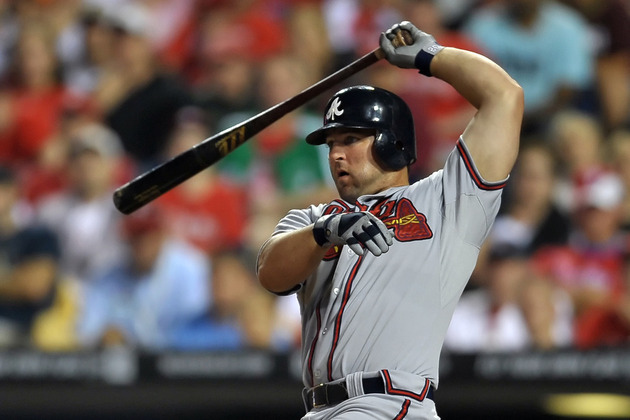
The sight of Uggla swinging and missing has become all too familiar in 2012  (SBNation)
Dan Uggla is hitting .208, his power is down, and he's striking out in over one-third of his at-bats.  He's 32 years old, struggling to bat his weight and enduring the worst year of his career by far.

But he does not deserve to ride the pine while Atlanta makes a push for the playoffs.

Over the weekend, Braves manager Fredi Gonzalez finally benched Uggla, a move some would call merciful given the latter's horrific summer swoon.  It goes without saying that the keystone slugger has been a massive disappointment this year.  The numbers--almost all of which will represent career lows--speak for themselves.  It's not quite the second coming of Adam Dunn's 2011, but it's in the same league as far as precipitous drop-offs are concerned. Over the past three months, Uggla's statistics are downright ugly, even worse than his brutal first half slump last season.  He's batted a pathetic .152/.304/.276 with 90 strikeouts in 243 at-bats and just three multi-hit performances.  His once steady power stroke disappeared, as he's accumulated only seven home runs and 27 RBI.  Because all of Uggla's value is tied up in his offense--he rates as a subpar defender and has no speed to speak of--when he's not hitting, he's not contributing.  The Wild Card leading Braves cannot afford such a black hole in their lineup as they try to avoid another September collapse with four weeks of pressure-packed baseball left to play.

But here's the thing; Uggla hasn't been that bad, especially relative to his peers at the position.  Among NL second baseman, Uggla ranks first in home runs (17), second in runs scored (72) behind Brandon Phillips, and third in RBI (64) after Phillips and Neil Walker.  His 80 walks pace the Senior Circuit, fueling a respectable .339 OBP.  And while his power figures have plummeted, his .164 ISO is still great for a middle infielder.  His 42.4 extra-base hit percentage (xbh/hits) is a near match with his career 43.3 percent mark, so although he had fewer hits he was still getting a good bang for his buck.  Even his 92 OPS+ and 96 wRC+ how his offensive production has been much closer to average than one would initially think.

But wait, there's more.  Enhanced by improved defense, Uggla's 1.7 bWAR indicate that he's played well enough to earn an everyday spot (remember that the average big league starter should record at least two bWAR over the course of a full season) and is actually right in line with his performance in 2007 (1.6), 2009 (1.8), and 2011 (1.6 again).  And while it seems like forever ago, Uggla enjoyed a strong start to the season.  Through the first week in June he had compiled a .276/.384/.492 batting line and was on pace to eclipse 30 home runs and reach the century mark in RBI, runs scored and walks.  A month later, he was the National League's starting second baseman at the All-Star Game in Kansas City, even though his triple slash stats had plunged to .221/.351/.395 and would only continue to deteriorate throughout the summer.

But lately Uggla had started to show some signs of life at the plate.  He'd notched hits in five consecutive games and swatted a pair of home runs, giving him five for the month of August along with 15 RBI, numbers that project to a 30-90 pace over the course of an entire season..  After sticking with him for that long, it would have made sense for Gonzalez to ride out the storm a little longer and see if his struggling second baseman was on the verge of a late season tear, perhaps an abbreviated version of his monster second half from 2011.  At this point, what do you have to lose?  With Martin Prado moving from left field to second, you can't tell me that a platoon of Jose Constanza and Reed Johnson in left is going to outproduce Uggla from this point forward.  I'd rather take my chances with the three time All-Star with five straight 30 homer seasons everyday of the week, and twice on Sundays.

Especially since he's making $13 million this year, and each of the next three, for that matter.

Tuesday, September 4, 2012

Red Sox Sliding

Boy, when Red Sox General Manager Ben Cherington conceded his team was getting "hard to watch," he wasn't kidding.

The slumping Sox have dropped a season worst seven games in a row--all on the road--falling to 62-74 on the season. It's been an ugly West Coast swing, to say the least.  First the Angels swept them aside, and then the surging A's followed suit with a lopsided three game sweep in which they bludgeoned the Bosox 33-5.  Last night in Seattle, Jason Vargas shut down Boston's ice cold bats and outdueled Clay Buchholz.  During this latest losing streak opponents have outscored them by 41 runs during that stretch, an average of nearly six runs per game.  Six! Granted, that number is somewhat inflated by the 20-2 beatdown they suffered in Oakland last Friday night, but in only one game was the margin of defeat less than three runs.  The simple explanation is that the pitching and hitting are struggling simultaneously.  It's going to be tough to win baseball games when when your pitchers get lit up for 8.3 runs per game, and by the same token is just as difficult when the slumbering offense produces just 2.3 runs per game.

It's been a hard fall from the top for a team that looked like World Series favorites as recently as last September.  Trades and injuries have reduced them to a glorified AAA ballclub.  It was safe to assume that the team would only get worse after trading away Josh Beckett, Carl Crawford and Adrian Gonzalez, but I don't think anybody expected it to get this bad.  After all, their lineup still features elite top of the order talent in Jacoby Ellsbury and Dustin Pedroia.  The rotation still has an effective lefty-righty punch with Jon Lester and Buchholz anchoring the staff.  And don't forget that Felix Doubront and 2009 AL Rookie of the Year Andrew Bailey recently returned from injuries.  Unlike, say, the Houston Astros, this roster hasn't been totally gutted.  It has an intact core with good players capable of winning ballgames.

Still, the fact remains that this club have been brutal for more than a month now.  Since the July 31st trading deadline, Boston's gone 9-23 (.281 winning percentage), a streak of futility reminiscent of their infamous 7-20 September swoon one year ago.  Over that span the Sox have strung together back-to-back wins just twice and have just one series win (against the Royals) in their past nine sets.

Tough to watch, indeed.  Some would say almost torturous.

Tonight Lester (8-11, 5.01 ERA) looks to stop the bleeding against Blake Beavan (9-8, 4.95 ERA).  Boston's struggling southpaw has finally started to pitch like the ace he's supposed to be.  In August he averaged more than seven innings per start, compiled a 3.59 ERA and permitted just two home runs.  The light-hitting Mariners, who rank dead last in the American League in numerous offensive categories such as runs, hits, batting average, OBP, SLG, OPS, and total bases, shouldn't pose much of a threat.  Boston's bats should come alive against Beavan, and I'm confident Lester will go out and get the job done.

Sunday, September 2, 2012

Moneyball Revisited

With the Oakland A's riding an eight game winning streak and poised to make the playoffs for the first time since 2006 (coolstandings.com gives them an 85.9 percent chance of reaching the postseason), I felt like taking a look back at Oakland's 2002 squad that was the focus of the Michael Lewis book and Oscar nominated film.

Interestingly, there are several parallels between the two teams.  Both underwent major personnel changes during the previous offseason; the '02 squad lost Jason Isringhausen, Jason Giambi and Johnny Damon to free agency, while the current version traded away Gio Gonzalez, Trevor Cahill, Guillermo Moscoso and Andrew Bailey.  Both teams started slow and appeared to be out of the race by Memorial Day, but went on furious summer rampages to leap back into contention by Labor Day.  Neither team was anything special offensively, and instead relied on top notch pitching to survive the grueling baseball season.

And while years of roster turnover have ensured that no players remain from that fabled '02 team, the man who constructed it--General Manager Billy Beane--is still there, trying to bring a World Series championship to Oakland for the first time since Mark McGwire, Jose Canseco, Rickey Henderson and Dennis Eckersley raised the trophy in 1989.

Here are some interesting facts about the Moneyball team:

  • The Athletics began the year with a payroll just shy of $40 million.  Only the cash-strapped Expos and Devil Rays spent less money.  On the bright side, Oakland's payroll spiked almost $6 million from Opening Day, 2001, representing an 18 percent boost.
  • Oakland won 103 games after winning 102 the previous year, becoming the first Athletics team with consecutive 100 win seasons since the 1929-'31 dynasty days of Jimmie Foxx, Al Simmons, Mickey Cochrane, and Lefty Grove.
  • Oakland outperformed their expected W-L record by seven games.
  • Won one more game than the '01 squad despite scoring 84 fewer runs and giving up nine additional runs.
  • Were six games under .500 (20-26) and in last place as late as May 23rd. From that point forward they went 83-33, winning at an almost inhuman .716 pace.  I'm guessing the AL record 20 game winning streak probably played a small part in that surge.
  • The A's ranked eighth among the fourteen AL teams in attendance.  No surprise there; they haven't finishEd Higher than seventh in 20 years.  
  • 54-27 record at home, 49-32 on the road.
  • Dominated their National League foes by going 16-2 during interleague play and outscoring opponents 103-52.
  • Oakland produced the AL MVP (Miguel Tejada) and AL Cy Young (Barry Zito), the first time an American League team had both award winners since the 1993 Chicago White Sox (Frank Thomas and Jack McDowell).  It has since been achieved by the 2006 Minnesota Twins (Justin Morneau and Johan Santana) and last year's Detroit Tigers (Justin Verlander won both).
  • Tejada and Zito were the team's only All-Star representatives.  Both were first time All-Stars.
  • Eric Chavez was the only member to receive a Gold Glove award (his second).  He was also the only one to win a Silver Slugger (his first and only).
  • Zito led the team in bWAR, with 6.8.  He would go on to lead the team again with 4.1 in 2006, his contract year, before inking a seven year, $126 million deal with the San Francisco Giants.  In the six seasons since he has been worth a combined 3.7 bWAR.
  • Tejada and Terrence Long played in all 162 games.  The tandem appeared in all 162 the year before, too.
  • The A's featured an average offensive attack that failed to lead the American League in any hitting categories.  Their pitching staff, on the other hand, was dominant and paced the AL in wins, ERA, shutouts, and fewest home runs allowed.
  • Although the Coliseum is a notorious pitcher's park, the A's posted an .813 OPS there compared to .731 everywhere else.
  • Beane's elder free agent pickups Scott Hatteberg and David Justice walked more than they struck out, the only hitters with at least 15 plate appearances to do so.
  • What a left side of the infield! Tejada and Chavez both slugged 34 home runs (tied for team lead), knocked in more than 100 and posted nearly identical OPS numbers, with Tejada's .861 barely edging out Chavy's .860 mark.  In recent years, perhaps the only better SS-3B combo has been Alex Rodriguez and Derek Jeter.
  • The Big Three of Tim Hudson, Mark Mulder and Barry Zito combined to go 57-21 with  3.05 ERA in 675 quality innings.
  • Closer Billy Koch received MVP consideration after going 11-4 with a 3.27 ERA and 44 saves.  His 84 appearances led the American League and his 79 games finished were tops among all big league pitchers.
  • Despite guiding the A's to back-to-back 100 win seasons and three consecutive playoff appearances, skipper Art Howe was replaced by Ken Macha in the offseason.
  • Although he was met with initial resistance to his baseball philosophy, Beane and his ideas were ultimately embraced by the team on the field.  The A's finished third in walks and fifth in OBP.  They did not take chances on the basepaths (only 27 stolen base attempts) and did not give away outs, either, with just 20 sacrifice hits all year.
  • Forgotten players from the team include Aaron Harang, Cory Lidle, Ted Lilly, Eric Byrnes, Ray Durham, Ramon Hernandez, Mark Ellis, and Carlos Pena
The A's won 103 regular season games but were eliminated by Minnesota in the ALDS 


Saturday, September 1, 2012

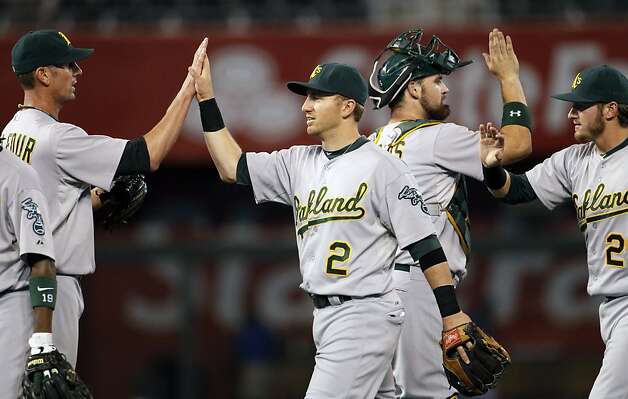
Oakland On a Roll

I admit it; I was wrong.

Back during the dark days of February, when I put together my 2012 season projections, I awarded the Oakland Athletics last place in the American League West. 

I won't make you go back into the archives and dig it up.  On February 22nd I stated, in no uncertain terms, that "Oakland has given away all its current talent and is poised to run away with last place." I didn't stop there, either.  I compared them to the Houston Astros, projected them to lose 98 games and deemed Cuban import Yoenis Cespedes to be a "surefire bust" in his hyped MLB debut.

Whoops.

But hindisght is 20/20.  In retrospect, I was clearly being too harsh on them.  My pessimistic prediction resembled more of a worst case scenario, but still accurately reflected how little I thought ot them at the time.  Surely I wasn't the only one lacking faith in them; six months ago, who in their right mind believed these A's would be leading the AL Wild Card at the end of August, 17 games above .500 with the third best record in the American League? If everything broke right, they might win more games than they lost for the first time since 2006.  Maybe. But nobody, and I mean nobody, believed they had this type of season in them. Not even the most optimistic and enthusiastic Athletics fans could have seen their team's magical midseason run coming.

Not in their wildest dreams.

Because six months ago, Oakland's front office readily admitted that they had gone into rebuilding mode, and teams in that state rarely, if ever, contend right away.  Just ask the Houston Astros.  Or the Chicago Cubs.  Rebuilding typically means "don't expect us to make the playoffs anytime soon, but stick with us.  All we need is some rain, sunshine, and a little bit of luck, hopefully we'll be good a few years from now."  Sacrificing the present for the future.  It sucks, but almost every team has to go through it at some point (even the Red Sox and Phillies, to some degree) unless you're the Yankees and have enough money to field an All-Star team every year.

But the Oakland A's are not the New York Yankees.  In fact, they're on completely opposite ends of the spectrum, at least as far as money is concerned.  The Yanks have been outspending everyone else for years and began the season with a payroll scraping $200 million and a roster loaded with marquee talent.  The A's, on the other hand, have the lowest payroll in the American League with a bottom line of 55 million dollars and change.  So the A's are spending 28 cents for every dollar New York pours into their loaded roster, and yet their records are nearly identical.

Billy Beane has done it again.

In the wake of another disappointing season, Beane overhauled the roster last winter. He blew up the starting rotation by flipping starters Gio Gonzalez, Trevor Cahill and Guillermo Moscoso to the National League, shipped Ryan Sweeney and 2009 AL Rookie of the Year Andrew Bailey to Boston, and let his most productive hitter--Josh Willingham--leave via free agency.  In return he bolstered the farm system and netted a treasure chest of major league ready talent that has formed the nucleus of this year's ballclub.  Beane received rookies Jarrod Parker and Ryan Cook for Cahill, got Tommy Milone and top pitching prospect A.J. Cole for Gonzalez, and hit the jackpot with Josh Reddick (4.6 bWAR) in the Bailey/Sweeney trade.  He also scored incredible bargains with free agent signings Jonny Gomes (one-year, $1 million dollars, and an .842 OPS), Brandon Moss (.874 OPS) and Big Fat Bartolo Colon (one-year, $2 million dollars for an above average starting pitcher).

It was classic Billy Beane; picking people's pockets and finding cheap, undervalued talent on the free agent market.  Moneyballs philosophies at their finest.  And while his shoestring budget prevented him from making offers to Jose Reyes, C.J. Wilson, Albert Pujols and Prince Fielder he did splurge on raw, untested Yoenis Cespedes. Beane invested four years and 36 million dollars on the coveted Cuban outfielder, and so far it looks like money well spent.  His prodigious power manifested itself immediately, and after going through an adjustment period in the spring the freshman quickly developed into a tremendous hitter.  He's maintained his aggressive approach at the plate while simultaneously cutting down on his strikeouts, and is trading power for contact.  No longer swinging from his heels every time up, Cespedes has ditched the feast-or-famine reputation he built in April and has provided steady production all summer long.  Over the past three months he's batted .327/.384/.539, a stat line reminiscent of fellow free-swinger Vladimir Guerrero.  If not for Mike Trout's historic rookie campaign, Cespedes would likely be the favorite to take home AL Rookie of the Year honors despite spending most of May on the Disabled List and missing another two weeks in June.  Provided that he can stay healthy, the 26 year-old still has room to grow and seems poised for several more big seasons in an Oakland uniform.

As expected, it took awhile for the youngsters to hit their stride as the Athletics started slow out of the gate.  Oakland dropped three of four to the Mariners to open the season and treaded water early on. They hovered  around .500 through the season's first quarter before losing nine in a row from May 22nd through June 1st.  Their already slumbering bats went into hibernation, scoring just a dozen runs over that horrendous stretch and coming up empty four times (and this was not an isolated dry spell, either; during their first 54 games, exactly one-third of a season, the A's offense got blanked eleven times and averaged three runs per game).  On June 10th they bottomed out; Arizona swept them, their record plunged to 26-35 and they found themselves in last place. That explains why this team wasn't even considered for my surprise contenders post, published a few days prior.  All signs pointed to another dull summer of baseball for Oakland and their fans, and unfortunately football season was still three months away.

But with interleague play in full swing, the A's took advantage of the inferior NL competition.  They swept the Rockies, took two of three from the Padres, and then swept the Dodgers.  No one knew it at the time, but they were off and running, and when interleague play ended, they kept winning.  The Athletics finished the first half on a high note, climbing back up to .500 after going 6-1 in the week leading up to the All-Star Break.  They picked up where they left off after the Midsummer Classic by sweeping the Twins in Minnesota to kick off the second half.  The  A's were baseball's hottest team, in the midst of a sizzling four week stretch that saw them win 18 of 21 games from July 1st through the 28th. This surge was headlined by a jaw-dropping four game sweep of the Yankees from 7/19-7/22 in which the plucky underdogs prevailed by one run each time.

Oakland finally cooled off in the first two weeks of August, but didn't go away. Instead, they rattled off another remarkable run by going 13-2 over their past 15.  Instead of wearing down during the dog days of August, they've gained strength and become an uppstoppable late summer hurricane.  Brett Anderson has been magnificent since returning from Tommy John surgery and  A.J. Griffin comes back today.  Both hurlers arrived just in time for the crucial playoff push and will supply fresh arms for a rotation that just lost Colon to a positive drug test.

But they must contribute.  Skipper Bob Melvin is counting on his pitchers to hold up over the next month, because if they falter the offense doesn't have the firepower to outslug their opponents.  The anemic A's rate second to last in both batting average and on-base percentage, third to last in OPS and fourth to last in runs scored among AL teams.  The infield deserves the majority of the blame for this collective ineptitude.  Look at how each position has fared thus far in 2012:

C   .202/.257/.306
1B .231/.331/.451
2B .220/.300/.305
3B .220/.270/.387
SS  .191/.260/.291

Ouch. Catcher Kurt Suzuki (since traded to the Nationals) hit one home run in 278 plate appearances with a comically bad 49 OPS+.  Shortstop Cliff Pennington was just as ineffective with a 54 OPS+, necessitating a late summer trade for Stephen Drew (who looks headed down the same path of injury prone disappointment traveled by big brother J.D. Drew). Jemile Weeks has managed to hit even worse than his older brother Rickie Weeks by batting .220 with no power.  Brandon Inge had a big week in early May (overshadowed by Josh Hamilton's home run exploits) but has since returned to playing like, well, Brandon Inge.  Oakland's first basemen, mostly Moss, Chris Carter and Daric Barton, have at least managed to pop 25 home runs, more than Prince Fielder, Mark Teixeira and Adrian Gonzalez.

So with the infield hitting .213/.284/.347 as a whole, it's a miracle this team doesn't get shutout three times a week.  Thankfully the outfield is batting a much more potent .267/.334/.470, mainly because Cespedes (.864 OPS) and Reddick (28 home runs) have emerged as legitimate middle of the order threats. The revolving door of Designated Hitters has chipped in a solid .777 OPS as well.  There's just enough talent here to outproduce the Seattle Mariners. Overall, the lineup compensates for its glaring weaknesses by manufacturing runs.  They rank third in walks, fifth in steals, and rise to the occasion with timely hitting; as a team their OPS is .685 when the bases are empty, .799 with runners in scoring position, and pinch-hitters are batting .306/.408/.516--essentially Edgar Martinez's career triple slash stats.  It's also worth noting that the offense has ramped it up in the second half with a .778 OPS, more than 100 points higher than its .667 first half mark, and has averaged nearly five runs per game since the beginning of June.

Still, it's hardly a surprise that the key to their success has been run prevention.  Oakland's pitching staff, led by a strong rotation and deep bullpen, ranks second in the American League in ERA, behind only the Tampa Bay Rays.  The starters have thrived despite a 6.2 K/9 rate because they limit walks and home runs.  The relief corps doesn't feature a shutdown closer but has still thrived, holding opponents to a .208 batting average and maintaining a 2.82 ERA.  The defense is decent, too.  Reddick is the best defensive rightfielder in the league (better, even, than Ichiro Suzuki) with Inge, Pennington and Coco Crisp also rating as plus defenders at key positions.  Their fielding prowess is somewhat negated by atrocious glovework from Cespedes and Weeks, but every team has its share of defensive liabilities.  All in all, Billy Beane has built a balanced team.

While the A's have exceeded any reasonable expectation, their 74-57 Pythagorean record is identical to their real record, an indication their success is not a fluke.  The sad thing is, even with all this winning the Coliseum is still half full on most nights.  Attendance has jumped for the third consecutive year but only 20,348 fans show up for the typical game (seating capacity is 35,067), even with Oakland in the thick of a pennant race.  As recently as August 20th there were little more than 10,000 on hand for a series opener against the Twins.  Oakland ranks second to last among AL teams in attendance--only the Tampa Bay Rays draw fewer fans--and haven't finishEd Higher than twelfth since 2005.  No star power and constant roster turnover have taken their tolls, but the biggest culprit remains the Coliseum itself.  Even when you put a winning product on the field, it's not easy to put a lot of butts in the seats when the park around that field is a soulless, carvernous football stadium pushing 50 years old.  If winning baseball games isn't enough, then a new state of the art stadium in San Jose seems to be the only solution.

But can the A's keep winning?  After bludgeoning Boston 20-2 last night, coolstandings.com gives them an 83.3 percent chance of making the playoffs, better than every team not named the Yankees or Rangers, but a postseason berth is far from secure.  After this series with the Red Sox their September schedule gets brutal.  Seven games against the Angels, seven with the Rangers, three in Detroit, three versus the Orioles, and three more in New York.  That's 23 games against top teams, the cream of the American League crop.  And with Seattle on a second half roll of their own (28-17 dating back to July 16th), those six matchups against the Mariners don't look as appetizing as they did a few months ago.

When the going gets tough, the tough get going. We're going to find out what this Oakland team is made of in September, whether they are contenders or pretenders.  If the pitching holds steady and the offense doesn't revert to its April/May level of futility, they should be fine.  But if their young pitchers hit the wall and the bats cool off, they're going to get eaten alive.

The last time I looked into my crystal ball, I couldn't have been more wrong.  Like most people, I don't handle failure well.  So this time around, I'm going to keep my mouth shut