Tuesday, May 22, 2012

Leave Josh Beckett Alone

Beckett's taking more of a beating from fans and media than he is from opposing hitters
Josh Beckett, who I identified as one of the five most important Red Sox players heading into this season, has drawn the ire of many Red Sox fans for his arrogance, selfishness and off-the-field shenanigans.  Following what was arguably the best season of his career, during which he posted career bests in ERA, WHIP, H/9, and ERA+, that was marred by a subpar finish (he allowed six earned runs and took the loss against the lowly Baltimore Orioles in both of his final two starts as the sinking Red Sox were fighting for their playoffs lives) one would expect him to be on his best behavior.  You'd think he would be doing everything in his power to repair his damaged reputation, to get back in the fan's good graces, to prove that he learned his lesson from the historic collapse of 2011.  Instead, he's coming off as a huge jerk, and it seems that he couldn't care less about his deteriorating public image.

His PR nightmare has only been compounded by a subpar start...or has it?  People are under the false impression that Beckett hasn't pitched well so far, and a quick glance at his stats seem to confirm this. His 4-4 record (he's received a decision in each of his eight starts) screams pedestrian, and his 4.38 ERA is more than half a run above his 3.85 career mark. His velocity is down and his strikeout rate has dipped to 7.3/9, still solid but the lowest of his career by nearly a full batter.  As it stands his 1.6 HR/9 ratio would tie his 2006 rate, when he served up 36 gopher balls in his American League debut.  All troubling signs for a pitcher on the wrong side of 30 who's been very inconsistent throughout his career.

Truth be told, Beckett's been quite good.  He's thrown six quality starts in his eight appearances, and in such outings he's permitted ten earned runs in 42 and one-third innings (a sparkling 2,13 ERA).  Even more impressively, Beckett has been tagged for just two home runs and boasts a strong 35/12 K/BB rate.  For 75 percent of the season, he's been nothing short of spectacular, but his early season statistics have been skewed by two disastrous outings.  Detroit shelled him in his first outing of the season as Miguel Cabrera, Prince Fielder and Alex Avila blasted five home runs to lead the Tigers to a 10-0 blowout.  Many chalked his poor performance up to early season rust, and he put Boston fans at ease by finishing the month with four consecutive quality starts to end April.

 It also bears mentioning that he was the tough luck loser twice during that stretch, settling for the dreaded L next to his name in the box score despite quality starts. On April 18th at Fenway he turned in seven strong innings against the potent Texas Rangers, allowing three runs--two of which came on a Mike Napoli home run during the fourth inning. He walked just one one batter (Ian Kinsler) versus seven strikeouts, more or less matching Derek Holland but leaving on the wrong end of a 3-2 score. Franklin Morales relieved him and promptly blew up; after getting Elvis Andrus to fly out he allowed six consecutive batters to reach base and three runs to score. By the time Matt Albers came to the rescue and extinguished the fire with an inning ending double play, Texas had built a four run lead and put the game away. Boston managed to push one more run across the plate against Joe Nathan in the bottom of the ninth and had runners on the corners when Jarrod Saltalamacchia lined into a game-ending double play. Two starts later, on April 29th in Chicago, he was outdueled by Gavin Floyd. After allowing three runs (two scored on Adam Dunn's dinger) in the first, Beckett settled down and held the White Sox scoreless for the next six frames. He tossed 126 pitches, but had to give way to Scott Atchison when he loaded the bases in the bottom of the seventh (Atchison neutralized the threat by retiring Alex Rios). But Boston's bats failed to back him up with run support, as they scratched just three hits and one run off the trio of Floyd, Addison Reed and Matt Thornton.

But that's when he got in trouble off the field.  He missed his next start with a lat strain and wasn't available to pitch during the 17 inning marathon against the Orioles on April 6th, a game Baltimore won when Bobby Valentine brought in Darnell McDonald to pitch after burning through seven relievers.  When he was questioned about why he didn't make an appearance in the extra-inning affair, he bluntly replied, "Nobody asked me to."  Fair enough, it's not his job, but isn't that the type of situation where you recognize the magnitude of the situation and step up when your team needs you?  Like when Tim Wakefield volunteered for mop-up duty during Game 3 of the 2004 ALCS so Terry Francona could save his bullpen?  Boston had just dropped four in a row and was in danger of getting swept by the Orioles at Fenway, so it would have been nice to salvage a hard-fought win before getting on a plane to Kansas City.

It was then revealed that Beckett had been playing golf two days before his missed start when he should have been resting.  His explanation was that "I spend my off days the way I want to spend them...My off day is my off day."  With the team still struggling his round of golf sparked plenty of controversy amongst the agitated Boston fan base.  Perhaps Beckett just needed a wake-up call, and he got one during his return at Fenway for the series opener with Cleveland on May 10th. The Indians battered Beckett for seven runs and chased him from the game in the third inning.  The Fenway Faithful, understandably disgusted with their All-Star pitcher, unleashed a torrent of boos from the grandstand as he handed the ball to Valentine and disappeared into the dugout.  Since then, he's been excellent.  Beckett blanked the light-hitting Mariners over seven innings in his next start (his 32nd birthday), then proceeded to fire seven and two-thirds of one-run ball in Philly on Sunday, getting the best of Cliff Lee to help Boston take the rubber game of their first interleague series.

As for Beckett's All I'll say is this; I don't care about what Mr. Beckett decides to do on his off days. He's 32 years old, a big boy. He can do whatever he wants, so long as he's not jeopardizing his healthy or performance in any way.  Let's face it; if 85 year old senior citizens can handle 18 rounds without pulling something, then I think a professional athlete doesn't have too much to worry about.  In all honesty I'd rather see him working on his golf swing, getting some exercise and blowing off some steam instead of hanging out with John Lackey and Jon Lester, sitting on his butt eating fried chicken, drinking beer and playing videogames in the clubhouse. 

He'll make his next start this Saturday night against Jeremy Hellickson and the Tampa Bay Rays.  Last time out against Tampa, on Friday the 13th back in April, he limited the Rays to five hits and one run in eight innings as the Sox crushed David Price.

Boston has another off day on Thursday, and I have a feeling Josh Beckett won't be playing golf.

Sunday, May 20, 2012

Weird Year for Catchers

2012 has been a weird year for catchers.  What I mean by that is several established backstops have been nothing short of terrible, while relative no names have come out of nowhere and ranked among the best hitters at the position. A few big name backstops such as Yadier Molina, Buster Posey, Carlos Santana, and Matt Wieters have met or exceeded expectations, but for the most part it seems that everybody else has deviated wildly from their career norms.  Let's look at the overachievers, underachievers and the guys in between.

Pleasant surprises

J.P. Arencibia (.250/.285/.483)
More of the same from Arencibia; plenty of pop and strikeouts, with walks few and far between (sounds like Mark Trumbo).  But among AL catchers, only Wieters has more homers and A.J. Pierzynski is the only one with more runs batted in.  After an ice cold April Arencibia has caught fire in May along with Jose Bautista, bashing six of his seven home runs and posting a gaudy 1.083 OPS.  Enjoy it while it lasts, because it's only a matter of time before he endures another extended dry spell.

A.J. Ellis (.333/.460/.510)
He has a higher batting average than Andre Ethier and a better OBP than Matt Kemp.  Up until this year the 31 year-old was a backup catcher with about half a season of MLB experience under his belt, so he's making the most of the increased playing time.  His superb on base skills are nothing new, but you always have to be skeptical when a player dramatically improves in his early thirties.  Read: he'll fall back to Earth eventually.

Jonathan Lucroy (.330/.381/.496)
With most of Milwaukee's position players not named Ryan Braun or Corey Hart struggling, Lucroy's hot streak has been a pleasant surprise.  He's cut down on his strikeouts and despite not homering in May, he's batting a robust .377/.406/.525 for the month with hits in all but two games.  Now I can see why Matthew Berry likes him so much.

A.J. Pierzynski (.301/.338/.485)
He's hit .300 five times already in his career, so the nice batting average isn't a shocker.  But after averaging just nine home runs, 52 RBI, and a .397 SLG. over his past two seasons, it looked like his power was diminishing with age.  Now the 35 year-old is leading all AL backstops in ribbies.  Go figure.  For what it's worth, his career highs in the power categories are 18 big flies, 77 RBI and a .464 slugging, all of which are in range.

Carlos Ruiz (.358/.407/.600)
With Ryan Howard and Chase Utley on the shelf and Jimmy Rollins scuffling, Ruiz has picked up the slack for the fallen stars and then some.  He's leading all catchers in just about every category except for home runs, OBP steals and is on pace to smash his previous career highs.  Ruiz has always been overshadowed by his more talented teammates even though he's the only catcher in either league to receive MVP consideration in each of the past two seasons.  With fourteen hits in his past nine games, he's shown no signs of slowing down, but obviously he's not going to keep hitting like Mike Piazza for the rest of the year. 

Jarrod Saltalamacchia (.283/.308/.566)
Was mediocre at best in his Boston debut, but looks much more comfortable this year and has been on fire since the end of April.  At age 27, is he finally developing into the player many projected him to be?  His game calling skills are still questionable, but one thing's for sure; he's hitting a heck of a lot better than Jason Varitek would be if he decided to hang on for another year.  Catchers tend to develop at a slower pace than other position players, but this is going to be Salty's long-anticipated breakout campaign.

In the middle--These guys aren't playing as well as they could be, but at least they've been productive:

Brian McCann (.260/.336/.433)
All three triple slash stats are well below his career rates, but with six home runs and 24 RBI he's supplying his typically strong power numbers from the heart of Atlanta's order.  He also has more walks than strikeouts at the moment, something he's never been able to maintain over the course of a full season.

Miguel Montero (.260/.358/.351)
The power dropoff is concerning (just two home runs after smashing 18 a year ago), but he's walking more than ever before and has knocked in a team best 21 runs.  The Diamondbacks lineup has been crippled by Chris Young's injury and Justin Upton's slow start, so Montero's timely hitting is especially valuable.  The home runs will start to come during the hot Arizona summer.

Mike Napoli (.244/.333/.457)
An obvious regression candidate following his insane .320/.414/.631 performance last year (fueled by a monster second half), his numbers have returned to their 2006-'10 levels for now.  He's still hitting for plenty of power, though, and should approach the 30 home runs he cranked out last year if he stays healthy.  His stats should only improve throughout the summer once he can start taking advantage of the Arlington heat.

Disappointments

Alex Avila (/218/.298/.382)
Avila's breakout last season helped him make the All-Star team, win a Silver Slugger and finish twelfth in the MVP race ahead of more established stars such as CC Sabathia, Josh Hamilton, and Mark Teixeira, and effectively turning Victor Martinez into a full-time DH.  This year he's regressed to his 2010 levels (so has Jhnonny Peralta), when he batted .228/.316/.340 in 104 games.  With V-Mart out for the season his playing time is secure, and I think he'll eventually find the middle ground.

John Buck (.186/.307/.351)
Aside from his pit stop in Toronto two years ago, when he slugged 20 home runs and made the All-Star team, Buck has always been supbar with the bat because of his low OBP figures and high strikeout totals.  But he's never been this bad.  Just put him on the long list of struggling Miami Marlins with Jose Reyes, Hanley Ramirez, Gaby Sanchez, Logan Morrison, Josh Johnson and Heath Bell.  He's walking more, but he'll be hard-pressed to post decent power numbers in Miami's new ballpark

Nick Hundley (.170/.234/.277)
Was one of the few bright spots for a punchless Padres lineup last year when the then 27 year-old broke out by batting .288/.347/.477, good for a 132 OPS+ in half a season's worth of games.  San Diego still can't buy a run, only now Hundley isn't hitting, either.  Not to be confused with teammate Chase Headley, one of the few Padres who can hit.

Russell Martin (.170/.320/.320)
Martin was solid in his Yankees debut last year, when he replaced Jorge Posada as the everyday catcher, made the All-Star team and enjoyed his best season since 2008.  Typically a strong starter who fades during the summer, Martin has been uncharacteristically abysmal in the early going.  Lucky for him, Jesus Montero is over 3,000 miles away in Seattle, so he doesn't have to worry about losing playing time.  With Teixeira, Alex Rodriguez and Robinson Cano off to slow starts, too, Martin hasn't had to take too much heat from the press.

Joe Mauer (.275/.383/.380)
Mauer's numbers look eerily similar to the .287/.360/.368 line he put up last year while battling bilateral leg weakness.  He has just one home run so far and has already bounced into a major league leading nine double plays.  Mauer Power's been a shell of his former self since signing that eight year, $184 million contract extension he before last season, a deal that only looks worse with each passing day.  I thought he'd bounce back this year, but it just hasn't happened.  His track record is too excellent to ignore, though, so I wouldn't be surprised if he turns it around soon.

Miguel Olivo (.210/.229/.346)
From 2006 through 2011 he averaged 17 home runs, 57 RBI and a .433 slugging percentage, pretty decent power figures for a catcher.  With just three homers and seven RBI he's not hitting this year, and newcomer Jesus Montero (whose OPS is nearly 600 points higher when he catches instead of DH'es), eleven years his junior, is cutting into his playing time. 

Geovany Soto (.161/.250/.301)
Many were hoping that the 2008 NL Rookie of the Year would continue his every-other-year trend with a strong 2012 following a down 2011, but instead he's gotten even worse.  The only positive sign is that he's cut way down on his strikeouts, but it looks like Soto and the Cubbies are headed for another disappointing season in the Windy City. 

Kurt Suzuki (.224/.258/.288)
After averaging 14 home runs per season over the past three years, Suzuki has yet to go yard in 2012.  He may be suffering from the Russell Martin effect that follows overuse, since he played in 148 games in 2008, followed by 147 in '09.  His numbers have fallen off steeply ever since, and it's possible that he's already worn down at the age of 28.  Then again the A's don't hit, so he fits right in.

Also worthy of consideration; Jose Molina, Rod Barajas, Chris Ianetta

Saturday, May 19, 2012

Slow Starts I'm Not Worried About (NL)

To see the American League edition, go here

Justin Upton (.234/.342/.359)
This slump dates back to September 11th of last year, after which the younger Upton ended the season in an 8-for-48 rut.  Following a sluggish start in 2012 he seemed to be pulling out of it as April drew to a close, but then proceeded to struggle throughout much of May.  He dealt with a sore left thumb early on, an ailment that may have caused him to alter his swing.  His .289 BABiP doesn't look too bad, but it's 45 points below his career rate even though he's managing a career best in line drive rate.  He's taking more walks and chasing fewer pitches outside the zone, encouraging signs for a maturing hitter, and has reached base in each of his last ten games.  June and July are his best months, so a hot streak should be just around the corner. In the meantime at least his running game's improved; with six steals in seven attempts after finishing last year with an unspectacular 70 percent success rate.  Not sure if he winds up with the awesome statistics he put up last year, but he's too talented to keep underperforming much longer. I'd still rather have him than his older brother, B.J. Upton.  Oh, and he's still only 24.

Aramis Ramirez (.218/.289/.366)
Give Ramirez a few more weeks and he'll be
just fine
After inking a three year, $36 million dollar contract with Milwaukee during the winter to replace Casey McGehee at third and help soften the blow of Prince Fielder's impending departure, Ramirez has been a major disappointment thus far.  He's typically a slow starter, as April and May are his two worst months by far in terms of OPS (.779 and .770, respectively--he's the NL version of David Ortiz).  Like most power hitters, he's at his best during the summer months of July and August.  So far he's been following a similar path to 2010, when he had three home runs and an even worse .167/.234/.268 line through the middle of May, then got red hot in July and finished the season with 25 bombs in just 124 games.  He's hitting fly balls at the exact same pace as last year and has fifteen extra base hits, but his HR/FB rate is a measly 3.9 percent.  Expect more of those doubles to start clearing the fences as the weather heats up.  It's reasonable to assume that he's been pressing after switching teams and signing a new contract, but in reality he's not swinging as often at pitches in the strike zone.  If anything, he needs to start being more aggressive.  I think a repeat of 2010 is in order; a batting average in the .250-.260 range but with the standard 20+ home runs and good RBI figures.  Besides, you should have been expecting some regression after he left Wrigley Field, where his OPS is 86 points higher than it is everywhere else.

Brandon Phillips (.252/.290/.358)
Phillips sat out a week of games in April to rest his ailing hamstrings (which have limited him to just one stolen base in the early going), and the time off may have prevented him from getting in a groove.  Everything in his batted ball data checks out except for a middling home run to fly ball ratio and a fluky 20 percent infield fly rate. He's always lacked plate discipline but has been much too aggressive, chasing nearly 41 percent of pitches off the plate to date.  In order to turn it around he will have to be more selective.  To his credit he's been better as of late, though, with a .318 batting average since May 7th.  I think he's miscast as a cleanup hitter (Jay Bruce is the guy) and would probably be better suited batting out of the two hole.  I don't expect him to repeat last year's numbers, but he's better than this.

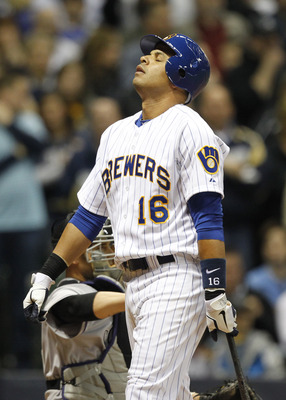
Rickie Weeks (.159/.297/.297)
It's been a rough year for Weeks and the Brew Crew
The Brewers are really struggling right now, but none are sputtering more than their second baseman.  Weeks has always been a streaky hitter, but he's looked lost at the plate over the past month and a half.  The league leader in strikeouts is whiffing way too much, but in fairness we're talking about a guy who fanned 184 times in 2010, easily the best season of his injury-checkered career.  He's walking more than ever before so he's still getting on base.  Aside from the high strikeout totals it's clear that he's not hitting the ball hard when he does make contact; look no further than his career low line drive rate and inflated infield fly ball rate.  Even more troubling is the fact that he's enjoyed only one multi-hit game since April 8th.  Considering he's averaged 108 games played since 2005, I'm just glad that he's played in 37 of Milwaukee's 39 games.  If he stays healthy, the numbers will bounce back.  I just have a gut feeling.

Danny Espinosa (.209/.293/.309)
Like Weeks, Espinosa whiffs a ton; he's second in the league with just one fewer strikeout than Weeks.  It's no surprise, then, that he's prone to lengthy droughts.  Right now he's stumbling through a sophomore slump primarily because he's just not making enough contact.  When he does he's hitting more line drives and fewer pop ups, if you're a glass half full kind of guy.  Washington's offense is in shambles, so Espinosa has plenty of company when it comes to underpforming hitters wearing Nationals uniforms.  His OPS has jumped almost 100 points in the past ten days, so perhaps he's finally breaking out.  I don't see any reason why he can't threaten 20/20 like he did last year.

Slow Starts I'm Not Worried About (AL)

Today I take a look at five players in the Junior Circuit who have struggled in the early going, but are likely to turn it around.  I'm examining players who have hit rock bottom, not guys like Adrian Gonzalez and Robinson Cano, who still have solid numbers.  But these players either endured some terrible luck lately or have shown signs of breaking out.  So if you have them on your fantasy team, don't sell low since you've already weathered the worst and will miss out on their best.  Patience is a virtue, and you'll want to reap the rewards.

Jose Bautista (.207/.329/.443)
Many are worried that Bautista's sluggish start is a continuation of last year's second half, when his numbers slid to .257/.419/.477 after the All-Star Break.  But he was bound to regress after that MVP worthy first half.  He didn't have much lineup protection, either, and as the season wore on he didn't get many pitches to hit--his walk rate jumped and he paced the majors with 132 free passes.  In all likelihood the pitchers have figured him out to some degree, but I think he's still an elite hitter.  All of his batted ball data and plate discipline stats match those from last year,  but a .178 BABiP is killing him.  No, he's not going to bat .302 again, but with better luck he should wind up around the .260 mark he posted in 2010, his breakout campaign.  Joey Bats has powered up as of late, too, with five home runs in his past seven games.  I think he'll finish with typical Adam Dunn statistics, but with about half as many strikeouts.

Albert Pujols (.214/.248/.325)
After 11 excellent seasons in St. Louis,
Pujols has been frustrated in LA
Has endured what might be the most publicized and analyzed slump of all time.  Players typically go through an adjustment period after signing big free agent contracts and/or switching leagues, and in this regard the Machine is merely human.  For a while there he looked like David Ortiz circa spring, 2009, but with home runs in back-to-back games and a six game hitting streak he seems to be breaking out of his funk here.  I'm concerned that he's not taking any walks and chasing too many pitches out of the zone, so I guess he's been pressing and is just trying to swing his way out of it.  It's clear that he's no longer the best hitter in the game, but he's still a force with the bat in his hands.  Recall that he struggled up until Memorial Day last year before busting out and still managed a fifth place finish in the National League MVP race.  Nobody works harder than him, and it's only a matter of time before he figures it out.  Don't be surprised if he goes on a tear against his former NL opponents when interleague play starts this weekend. 

Mark Teixeira (.228/.283/.386)
Wait, is Mark Teixeira off to another slow start? Color me surprised. Every year people start worrying when he struggles early on, and every year (eight in a row now) he ends up with more than 30 home runs and 100 RBI.  For the record, his career OPS in April is a full 128 points below his next lowest mark which comes in--you guessed it--May.  In fact, his OPS keeps increasing through August, so at least wait until summer before pressing the panic button.  Sure, the days of hitting .300 are long gone, especially since he hits everything into the shift, which is compounded by the fact that he's been hitting too many grounders and not enough fly balls.  But he's striking out less frequently, his line drive rate looks good and his 10.2 HR/FB rate is well below his career 18 percent mark, so expect a few more fly balls to start clearing the fences once the weather heats up.  Before going 0-for-4 yesterday he'd been riding a six game hitting streak.  He's been dealing with a bronchial infection, so cut him some slack.  With that lineup and park, he's going to produce.

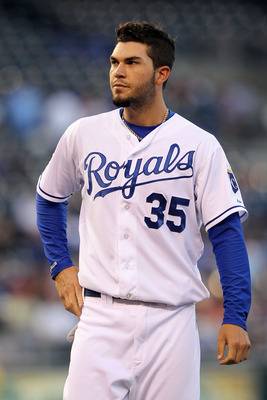
Eric Hosmer (.174/.237/.319)
Hosmer's been victimized by bad luck
The Royals are struggling, and Hosmer is no exception.  After finishing third in the AL Rookie of the Year voting last year, the 22 year-old superstar in the making seems to be mired in a brutal sophomore slump.  Manager Ned Yost has been moving the youngster around in the lineup to try to get him going by batting him third, fourth, moving him down to sixth, and recently moving him up to the two hole.  The same thing happened last year Hosmer finally settled in as the cleanup hitter during the second half, so don't read too much into it.  No matter where he hits in the order, he's going to turn it around. Hosmer's striking out less, walking more, and swinging at fewer pitches outside the zone, all signs that he's maturing as a hitter.  So why is he struggling?  Could be growing pains, but the more likely explanation is that he's getting burned by a .165 BABiP.  Hosmer won't provide the Joey Votto numbers everybody was hoping for during the preseason, but he won't tank and pull a Jason Heyward, either.  I see a repeat of last year's numbers, with a lower average but better power figures.

Alexei Ramirez (.209/.229/.268)
Is he going to pull an Alex Rios this year?  I don't think so.  Much like Teixeira, Ramirez is a perennial slow starter, with an April OPS that's 160 points below his next worst month (September).  He'll be fine.  There are warning signs with career worsts in walk and strikeout rate, but his contact rates are excellent. All of his batted ball splits look fine except for his anemic 2.3 HR/FB rate, which explains why he has just one home run so far and is bound to go up, especially since the Cell is such a homer friendly venue.  After a much needed day off earlier in the week to clear his head he's gone 5 for his last 17 (.294), so he may be poised for a hot streak.

Tuesday, May 15, 2012

Carlos Beltran's Forgotten Excellence

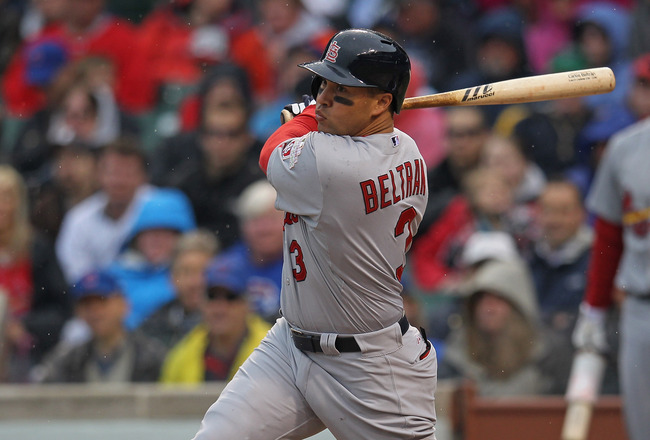
Beltran's been raking
Matt Kemp dominated the headlines during April, when his dozen dingers helped jumpstart the Dodgers to the best record in baseball.  Annointed by many as the best player in the game, the deserving 2011 NL MVP cooled off before landing on the disabled list with a strained left hammy.  By then he was old news, because the spotlight had swung to Josh Hamilton, the modern day Mickey Mantle who enjoyed his own monster April and is coming off a historic nine homer week for the top team in the American League.  Now everybody's talking about the potential for a triple crown season, the first since Carl Yastrzemski did it for the Impossible Dream Red Sox 45 years ago. 

As a result Carlos Beltran, off to his own remarkable start for the defending World Series champs, has gotten lost in the shuffle.  The talented centerfield tandem has overshadowed the former five-tool stud, who during his prime was every bit as good as Kemp and Hamilton are now.  The same night Josh Hamilton tee-ed off on Baltimore pitching, Beltran accounted for all six of the Cardinals' runs by taking Ian Kennedy deep twice in the first two innings, with a two-run shot in the first followed by a grand slam in the second.  Three days later he piled up 13 total bases against the Braves after recording a double, triple, and pair of big flies to fall a single short of the cycle.  On the back of those two remarkable performances he was named NL Player of the Week yesterday. In the process he vaulted over Kemp for the league lead in four-baggers, is now batting a robust .295/.403/.648 and has thrown his hat into the early season MVP discussion.

Beltran's surge has caught a lot of people off guard because as recently as last spring it seemed as though chronic knee injuries had derailed a once promising career, jeopardizing a body of work that looked Cooperstown worthy for much of the preceding decade.  Beltran had gone under the knife for knee surgery after missing half of the 2009 season, but when he returned to the field the following summer he was nothing more than a shell of his former self.  He sputtered through 64 lifeless games at the plate, lacked aggression on the basepaths, and saw his once stellar defense deteriorate.  Like Andruw Jones before him, he looked worn down and seemed incapable of staying on the field.  Angel Pagan took over in center, forcing Beltran to move over to right field where he could cover less ground and ease the strain on his legs.  The move paid off; after a strong first half last year, the cash-strapped Mets shipped him across the country to the offensively challenged San Francisco Giants, looking for a big bat to replace Buster Posey, for pitching prospect Zach Wheeler. The Giants ultimately faded down the stretch and missed the postseason, but Beltran finished the season strong in his new digs despite spending time on the DL in August. 

So coming off a strong rebound campaign in which he batted .300, whacked 67 extra base hits and posted a career best 155 OPS+ (in his contract year), Beltran was a fairly attractive free agent despite his age and recent injury history. Not as sexy as younger, flashier stars like Prince Fielder, Albert Pujols, and Jose Reyes, but he'd proved he still had plenty left in the tank. The St. Louis Cardinals, desperate to fill the gaping hole in their lineup after Pujols signed on with the Angels, inked the switch-hitter to a two year, $26 million deal.  Not quite the 7 year, $119 million contract the New York Mets handed him prior to the 2005 season (can you tell he's a Scott Boras client?), but a sizable chunk of change nonetheless for somebody who'd averaged just 96 games played during the previous three seasons.

Many regarded the signing as a steal at the time.  It looks even better now that Beltran, who just turned 35 last month, started hitting when he stroked two hits on Opening Day and hasn't stopped.  Without the weight of a massive contract on his shoulders, the crushing expectation, and the intense New York fans/media assaulting his psyche on a daily basis, Beltran can finally relax and play baseball.  Don't forget that he originally came up with Kansas City and rose to stardom there, so in a sense his career has come full circle by returning to its Missouri roots.  He must be enjoying the more relaxing atmosphere of the Midwest because he's thriving at home, where his OPS (1.293) is more than 400 points higher than it is everywhere else.  Aside from a brutal 3-for-32 slump from April 21st to May 1st, the six time All-Star has been unstoppable.  More importantly, he's been a force in the heart of the order during Lance Berkman's DL stint and Matt Holliday's slow start.  No, he's not the Gold Glove caliber defender he once was, but at least his running game has returned to some degree. He already has five steals after swiping just seven bases in the past two years combined. 

The question is--can he keep it up?  For what it's worth, he traditionally performs better in the second half, when his OPS has been 48 points higher than his first half figure.  But then again, I'm pretty confident that Beltran has never been so red-hot in the early going.  Despite his remarkable numbers, one has to expect some regression in the future.  His 33 strikeouts in 34 games are a cause for concern, especially because his K rate--22.9 percent--is more than seven percent above his career average.  He's not a huge strikeout guy, so I don't think that trend will continue unless he's decided to "swing for the fences" more often and wants to trade contact for power.  There's some evidence in the numbers that his might be the case. His contact rate is under 80 percent, the lowest it's been since 2002--the first year FanGraphs started tracking such information--mostly because he's missing more of the pitches that he's chasing outside of the zone.  Meanwhile, he's hitting more balls in the air, with his fly ball rate (46.1 percent) up to its highest level since 2006, when he smacked 41 home runs, slugged .594 and finished fourth in the NL MVP race.  However, his home run per fly ball rate is currently at an unsustainable 31.7 percent (twice his career rate), meaning almost one of every three fly balls he hits is clearing the fences. Accordingly, his line drive rate is way down at 13.5 percent, the lowest it's ever been (which explains why he has only two doubles), so it seems logical that as the season progresses he'll start trading in some fly balls for line drives.  That translates to fewer homers, but more singles and doubles, so one would expect his slugging percentage to fall but his batting average to push north of .300.

Now that Berkman's back and Holliday is coming around, Beltran should continue to get good pitches to hit and keep producing at a high level for the division leading Cardinals.  With Yadier Molina, Rafael Furcal, David Freese, Allen Craig and Jon Jay, St. Louis boasts one of the deepest lineups in baseball.  Beltran had little help/protection the last few years in New York and San Fran, but now can take advantage of abundant opportunities to score and drive in runs, two things he's been doing since his Rookie of the Year campaign in 1999.  I don't think he can duplicate his impressive 2006 season, but assuming he stays healthy enough to play around 140 games, I could see him approaching 30 home runs, 110 runs and the same number of RBI while batting close to .300 and stealing 15 bases.  Even though he's injury prone at this stage of his career and will probably find his way to the disabled list sooner or later, he should end up with numbers in the same neighborhood of what Lance Berkman provided for St. Louis in his Comeback Player of the Year season last year.

Not bad for a guy stuck with the "washed up" label 13 months ago.