Showing posts with label ALCS. Show all posts

Sunday, December 27, 2015

Henderson's Homer Remembered

Red Sox legend Dave Henderson passed away today at age 57 (NESN)
One strike away.

Two weeks before coming within one strike of winning the World Series, the 1986 Boston Red Sox were one strike away from getting booted out of the ALCS. Little-used outfielder Dave Henderson, a defensive replacement for the slugging Tony Armas, was at the plate. Donnie Moore, ace reliever of the California Angels, was on the mound. There were two outs, two balls, and two strikes--deuces were wild, as Don Orsillo likes to say.


Henderson was fated to be in that situation. He had switched teams for the first time that summer when Seattle, the team that drafted him a decade prior, sent him and Spike Owens to Boston in a late August trade. Though Hendu had been an everyday player with the Mariners, he was relegated to a bench role with the Sox. He played sparingly as Boston cruised to the AL East title, then continued to ride the pine as they went down 3-1 to California in the ALCS.

With the Red Sox trailing 5-2 in the top of the ninth, it looked as though Henderson's first postseason series would end without him making much of an impact. Then Boston rallied, closing the gap to one on Don Baylor's two-run homer off Mike Witt.

Witt got the second out of the inning, inducing Dwight Evans to pop up. But now, after 122 pitches and with Rich Gedman (3-for-3 on the day versus Witt) coming up, Witt was removed from the game. Gene Mauch, a chronic over-manager, substituted Gary Lucas, a southpaw, to neutralize Boston's lefty-hitting catcher once more (Lucas had fanned Gedman the night before).

Lucas, who had not hit a batter in over four years, promptly plunked Gedman with his first pitch. That prompted Mauch to bring in his closer, Moore, to take care of Henderson. Hendu wasn't much of a power-hitter, but Moore had a bit of a home run problem, having surrendered 19 of them over the previous two seasons.

It had all come down to Henderson, seeking redemption after Bobby Grich's fly ball bounced off his glove and over the wall for a two-run homer earlier in the game. The odds were against him, however, as Boston's chances of winning stood at just eight percent.

Moore's first pitch narrowly missed for a ball, but his second pitch zipped in for strike one. Henderson swung and missed badly on Moore's next offering, bringing the Red Sox to their last strike.

After missing wide to even the count at 2-2, Moore came back with a breaking ball, which Henderson tapped foul to stay alive. After a brief delay, Moore reared back and fired a heater, trying to blow Hendu away. He nearly succeeded, but Henderson caught a piece, fouling it straight back to the screen.

While the count was even, Moore was clearly winning the pitcher-hitter duel based on the quality of Henderson's swings. His next pitch caught too much of the plate, and Henderson swatted it into the left field bleachers. Channeling Carlton Fisk, Henderson leapt for joy as soon as the ball cleared the fence. He had turned Boston's one-run deficit into a one-run lead, shifting the momentum of the series in Boston's favor. The resurgent Red Sox went on to win on Henderson's sacrifice fly in the 11th, then routed the Angels in Games 6 and 7 back at Fenway.

Henderson had rescued Boston from the dead, willing them to the World Series the way David Ortiz would 18 years later. He nearly willed them to their first championship in 68 years, too, torching the Mets for 10 hits in 25 at-bats, including two homers and five RBI. His second dinger gave Boston the lead in the 11th inning of Game 6, bringing them to the cusp of breaking the Curse of the Bambino.

One strike away, the Red Sox were.

Wednesday, October 28, 2015

Hunter Hangs 'Em Up

Hunter is retiring after a nice final season with the Twins (MLive)
After a stellar and tremendously consistent 19-year career, Torii Hunter is calling it quits.

Hunter had returned to the Minnesota Twins--who drafted him out of high school and watched him develop into one of the best center fielders of his generation--on a one-year deal for 2015. While he didn't explicitly say so, it was assumed he intended to retire as a member of the Twins, whom he played for from 1997-2007. He was going to be 40 in July, and while he'd been productive the last couple years one get the sense that his career was winding down. Why else would he want to come home?

Especially since the Twins have been terrible the last few years. When guys get to be Hunter's age and haven't won a ring yet, they usually want to go where they'll have a chance to do so. A popular, respected player with some juice left in his bat like Hunter could have latched on almost anywhere, had he been willing to take a discount. In need of a bat and veteran leadership for its up-and-coming team, Minnesota paid him above market value to come back.

It seemed like a sentimental move more than anything else. Hunter had been replacement level in 2014 and figured to be worse in 2015. That's nobody's idea of a $10 million player. But if anyone could afford to give a former star one last victory lap, the Twins could. With so much young talent to break in, Minnesota wasn't ready to contend.

As it turned out, the team and Hunter were both much better than expected. The Twins surprised everyone by finishing second in the AL Central, pursuing a wild card berth until the season's final week. Hunter hit 22 home runs--his most in a season since 2011--and played 139 games.

It was a fitting farewell for Hunter, one of the best and most popular Twins of all-time. Drafted by Minnesota in 1993, he made the big club in 1997 alongside David Ortiz, who like Hunter kept hitting throughout his entire 30s.

Also like Ortiz, it took Hunter a few years to get going. He didn't break out until he was 25, by which point he was in his fifth season--but once he did he never looked back. He hit 27 home runs and won his first of nine straight Gold Gloves that year (2001), made his first All-Star team and finished sixth in the MVP vote the following year, and had his first 100 RBI season the year after that. Nicknamed "Spiderman" for his amazing catches, he was quietly one of the best players of the 2000s, racking up eight Gold Gloves and topping 20 homers eight times (11 in all).

By the end of the decade he was an Angel, having moved on after a big walk year in 2007. When Vladimir Guerrero departed he moved over to right, which no doubt extended his career. He'd shown signs of slowing down in his last season as an everyday center fielder, batting .262 with his worst slugging percentage in over a decade.

But before long LA's outfield became too crowded for him, with Mike Trout taking over in center and Josh Hamilton signing on. Hunter found a home in Detroit, where he had two near-identical offensive campaings in 2013 and 2014.

It was towards the end of his first year with the Tigers that he was involved in what may be the most memorable play of his career. It was Game 2 of the ALCS and Boston, and Detroit led 5-1 in the bottom of the eighth. The bases were loaded and David Ortiz, Hunter's old teammate, stood at the plate, facing fresh reliever (Joaquin Benoit) summoned to extinguish the flames.

Ortiz turned on Benoit's first pitch and belted it deep into the night. 37,000 cold, tired fans leapt from their seats as the ball rocketed towards the right field bullpen. Hunter raced back to the wall and leapt, his glove hand stretched as high as it could go. Hunter had robbed many a would-be home run before, and it looked like he might do so again. He timed his leap perfectly, but without time to set his feet  he slammed into the wall, then flipped over it as his momentum carried him out of play. The ball followed him into the bullpen, having just cleared his outstretched mitt.

The game was tied, and within a matter of hours, so was the series. The Red Sox went on to win in six, then proceeded to beat the Cardinals in the World Series. Had Hunter made the catch, Detroit would have won the game and probably the series. It could have been them celebrating after defeating St. Louis. And Hunter, of course, would have been the hero for robbing a would-be game-tying grand slam.

Instead, he retires with the best play of his career occurring in an All-Star Game. It was a superb play, to be sure, but I guarantee Hunter would trade it in a heartbeat for the ALCS grab, especially since he nearly killed himself trying to make it.

But not even that could slow him down. Nothing ever did.

Oh sure, he lost range over time as all mortals do. His defense inevitably slipped, forcing him over to right field and eventually DH. But even as he became a non-factor on the bases and a liability in the field, he remained a threat in the batter's box.

It's rare that centerfielders age as well as Hunter did. I think of Mickey Mantle, Dale Murphy, and Ken Griffey Jr., all of whom broke down in their 30s. Same goes for Andruw Jones, Vada Pinson, Fred Lynn, and Cesar Cedeno. Jim Edmonds couldn't stay healthy. All that running and crashing into walls usually catches up to you.

Not Hunter. He had pretty much the same season every year for 15 years. He'd bat around .280 with 20 homers, 20 steals, and 90 or so RBI. Like clockwork. There were a couple years where he got hurt--in 2005 he was limited to 98 games and in 2009 played only 119--but for the most part he was in the lineup everyday.

You know whose career Hunter's reminds me a lot of? Johnny Damon's. They were never really great, All-Star caliber players, let alone serious MVP candidates, but they were really good for a long time and held up surprisingly well. They played on some terrific teams and were usually in the postseason. They were pretty indestructible, too.

Hunter wasn't quite as good as Damon, but he had a better career than most people realize. His counting numbers are actually very similar to Jim Rice's. He surpassed 350 homers and fell just short of some other big round numbers like 2,500 hits, 500 doubles, 200 stolen bases, 1,400 RBI, and 1,300 runs. Not quite Hall of Fame numbers, but Hall of Very Good for sure.

Most impressively, Hunter went out on his own terms, not because of injury or as some washed up bum on a team he didn't care about. He got to retire as a healthy contributor for his original team after a year in which they almost made the postseason. It's not the perfect final chapter, but it's still a happy ending.

Saturday, October 17, 2015

ALCS a Heavyweight Showdown

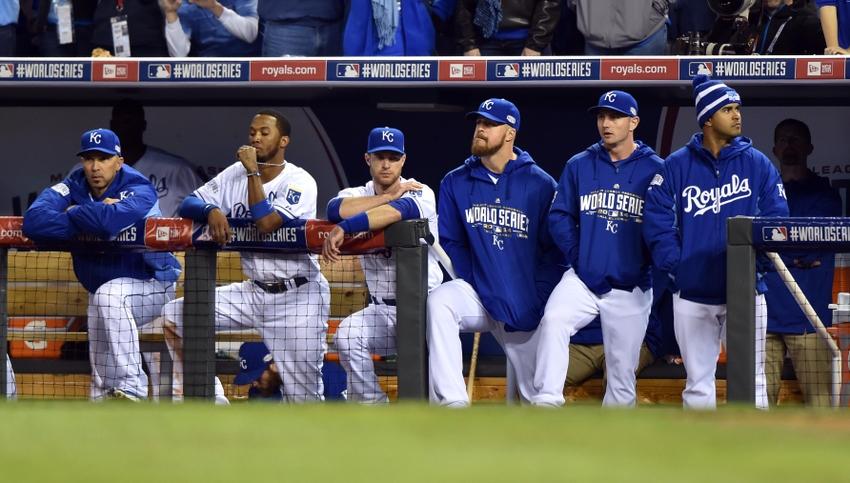
The reigning AL champs are itching to get back to the Series (Bleeding Royal Blue)
Because of baseball's division format, added wild card games, and the sheer randomness that ensues in a best-of-five series, it's become exceedingly rare that the two best teams (record-wise) meet up in the league championship series. This is only the fourth such time in the American League since the wild card era began in 1995.

But in a year where all but three American League teams finished within seven games of .500 (how's that for parity?), the Toronto Blue Jays and Kansas City Royals were head and shoulders above everyone else. The Royals had the league's best record (95-67), and the Blue Jays its top run-differential (+221). They were the only AL teams to top 90 wins this year.

How they got here is quite interesting. The defending AL champs appeared to take a step back over the winter, losing ace James Shields to free agency and making a host of questionable free agent signings. Experts thought they'd be lucky to crack .500, let alone return to the postseason. But Kansas City got off to a hot start and never looked back, spending just 19 days out of first and never a day below second. They took over first place for good on June 8th, running away with a middling AL Central. Two months later they'd built up a double-digit lead and maintained it the rest of the way, winning their division by a whopping 12 games.

But whereas Kansas City cruised through the regular season, Toronto spent most of the year playing catch-up. After an active offseason in which they traded for Josh Donaldson and signed Russell Martin, the Jays were a popular pick to make the playoffs, if not win the division.

So it was surprising when Toronto started slow, playing losing baseball for the first two months. They'd slipped to last in the AL East by Memorial Day and were still seven games below .500 one week later. They begin digging themselves out with a sizzling June, only to flounder again in July. Toronto limped into the break with a losing record, having dropped 10 of 14 leading up to the Midsummer Classic. Their struggles continued throughout the rest of July, only coming to an end when the team acquired David Price and Troy Tulowitzki just before the trade deadline.

When Troy Tulowitzki came over on July 28th, the Jays were still one game below .500. Supplemented by David Price two days later, they won 14 of their next 15 and began steamrolling the American League. The Blue Jays became the hottest team in baseball, winning 43 of their final 61 games, good for a ridiculous .705 winning percentage--this from a team that hadn't managed to win even half its games for four solid months.

Toronto wasn't the only team to land a pair of big names at the deadline, though. Kansas City also made waves, fetching an ace in Johnny Cueto and bolstering its lineup with Ben Zobrist.
Both teams instantly took on the look of World Series contenders, so it's only fitting that they're playing each other for the rights to be in the Fall Classic.

The Royals, of course, were just there last year, and would have won were it not for a herculean effort by Madison Bumgarner. After coming oh so close, Kansas City is determined not just to get back to the Series, but to win it.

So are the Blue Jays, who just snapped the longest active postseason drought in American professional sports. With Price a free agent at season's end and many of their best players about to join him soon, the time to win is now. This could be their last, best chance for awhile.
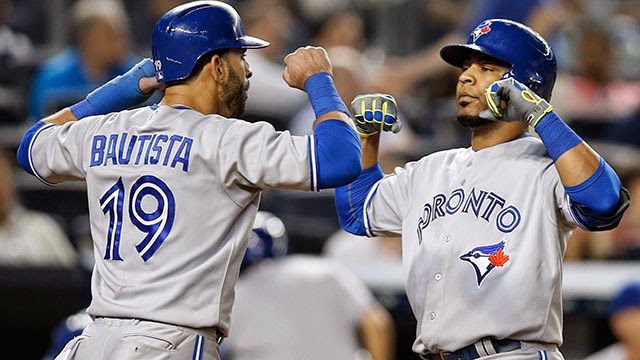
Toronto's power makes them a formidable opponent (Betting Talk)
A few days ago, it didn't look like either one would survive the ALDS. Both were on the cusp of losing to inferior teams, just one game away from elimination. Toronto went down 0-2, dropping the first two games to Texas at home. When the Jays lost Game 2, blowing an eighth-inning lead and losing in extra innings, it felt like Toronto's fans had just seen the last game at the Rogers Centre this year. The Blue Jays' season was about to end in disappointment.

But Texas, who recently failed to win a World Series despite being one strike away twice, was once again unable to finish the job. Toronto battled back, winning both games in Arlington to force Game 5 and return the series north of the border. Having burned through Price in Game 4 and facing Cole Hamels, however, the Jays appeared to be at a major disadvantage, especially after the Rangers grabbed an early lead and still led after the seventh-inning stretch. Once again, it looked like Toronto's season would end in tragedy.

Until the Rangers imploded, committing three straight errors and choking away the game in one of the craziest innings I've ever seen.

The Royals were in similarly dire straits, losing two of three to begin the series and staring down a four-run deficit in Game 4. With just six outs left in their season, the odds of them living to play another day were three percent.

But for the second year in a row, the Royals rallied from down four runs in a must-win elimination game, snatching victory from the jaws of defeat. They stunned Houston with a five-run frame, then tacked on two more in the ninth for good measure. Back in Kansas City, they won Game 5 two days later, overcoming another early deficit to send the Astros packing.

So now that they're here, who's the better team? The Royals were the American League's best team wire-to-wire, but the Blue Jays were the best team in baseball after the All-Star Break. We know momentum doesn't matter heading into a playoff series, but both teams have to be feeling pretty good about themselves after cheating death in the ALDS.

The Blue Jays were actually a much better regular season team than the Royals despite winning fewer games. They played in a tougher division and outscored Kansas City by 167 runs--more than one per game. Their run prevention was nearly as good, too, allowing only 29 more runs than Kansas City. According to Bill James's pythagorean model, which estimates how many games a team should have won based on its run differential, Toronto should have won 102 games this year--or nine more than they actually won. The Royals--winners of 95--would have been expected to win 90.

The gulf in talent becomes obvious after a quick comparison between the two rosters. Toronto boasts an All-Star lineup with Donaldson, Martin, Tulo, Jose Bautista, and Edwin Encarnacion. They also have the AL's best pitcher at the moment in Price, who might, as Bumgarner showed last year, win the series all by himself.

Which is why even though Kansas City sports the superior regular season record (and thus home field advantage), I sense that Toronto is the better team. This series won't prove that, of course, and the Royals are obviously good enough to win. I just think the Jays have more talent. I was originally going to say Toronto in six, but after Kansas City's Game 1 win I'm revising it to Toronto in seven.

Friday, October 18, 2013

One Game Away

The Boston Red Sox pulled to within one win of the World Series with their 4-3 win over the Detroit Tigers last night.

Mike Napoli, whose home run off Justin Verlander was the only run in Game 3, got the Sox on the board with an absolute bomb to dead center that traveled 445 feet. Well-placed hits combined with Detroit's shaky defense led to Boston scoring two more runs in the inning. Napoli, who went 3-for-4 in the game, scampered home on a wild pitch in the third to make Boston's lead four runs.

That was the extent of Boston's scoring in this one, and it turned out to be just enough to withstand the Tigers' gradual comeback (three runs--one in the fifth, sixth, and seventh). Jon Lester left the game with one out in the sixth after putting runners on first and second. Junichi Tazawa allowed one run to come in on Bryan Pena's RBI single before getting Austin Jackson to ground into an inning-ending double play.

Tazawa got another crucial double play the next inning after Jose Iglesias and Torii Hunter singled to put runners on the corners with nobody out. In what was probably the biggest moment of the game, Tazawa traded a run for two outs when Miguel Cabrera bounced into a rally-killing DP. That made the score 4-3, and that's the way it stayed thanks to Craig Breslow and Koji Uehara. The dynamic duo recorded the final seven outs without permitting a Tiger to reach base.

The Red Sox nearly added some much-needed insurance in the top of the ninth after getting two men into scoring position with only one out, but both Shane Victorino and Dustin Pedroia failed to deliver the big hit against Al Albuerquerque (probably the second-most fun baseball name to say--behind Jarrod Saltalamacchia, of course). Instead of giving Uehara some breathing room it went down as another missed opportunity by the Bosox, who've stranded a small army on the basepaths going back to the last two games of the Tampa Bay series. It's been incredibly frustrating to watch the best offense in baseball doing such a poor job of getting hits with RISP, but luckily they've been scoring just enough runs to win (all three W's in this series have been of the one-run variety). Obviously a win counts the same whether the score is 1-0 or 10-0, but I'd really like to see Boston's bats do more damage.

After an off-day today, the series will resume at Fenway Park tomorrow with Clay Buchholz and likely AL Cy Young winner Max Scherzer squaring off.

Over in the National League, the St. Louis Cardinals have a chance to polish off the Los Angeles Dodgers at home tonight. But in order to do that, they'll have to overcome Clayton Kershaw, only the best pitcher on the planet in the year 2013. The Redbirds will counter with Michael Wacha, their 22 year-old rookie phenom. Wacha may not be a household name yet, but don't underestimate him. He surrendered one run in his first two postseason starts combined after posting a 2.78 ERA during the regular season. Clearly LA has the edge here, but Wacha's not as overmatched as one might think and could surprise us all by outdueling Kershaw.

Friday, October 11, 2013

ALCS Preview

The two best (in my opinion) teams in the American League have survived the first round crapshoot that is the Division Series and made it to the ALCS. The Red Sox dispatched the Rays in four while the Tigers needed all five games to put away Billy Beane's Oakland A's.

The Red Sox fielded the best lineup in baseball during the regular season and swung the bats well against Tampa Bay in the ALDS. Jacoby Ellsbury and Shane Victorino fueled Boston's relentless hitting assault on David Price, Matt Moore and co. The Tigers have an elite offense as well, one that led all teams in batting average and finished second only to Boston in runs scored, OBP, slugging, OPS, and total bases.  However, much of that production came from likely MVP Miguel Cabrera, whom injuries have reduced to a shadow of his former self for over a month now. Even with a diminished Cabrera, Detroit still features plenty of firepower in Prince Fielder, Austin Jackson, Victor Martinez, Torii Hunter, and Jhonny Peralta, but that lineup becomes a lot less scary when Cabrera can't hit the ball out of the park.

On the mound the Tigers hold the edge, albeit a slight one, and only in the starting rotation where they have three top guns in Justin Verlander, Anibal Sanchez and probable Cy Young winner Max Scherzer. However, this advantage is mitigated by Boston's superiority in the bullpen as well as in the field, where the Tigers are atrocious. The defensively sharp Rays struggled mightily with Fenway Park's monstrous wall and quirky dimensions, so it's not much of a stretch to imagine the Tigers also enduring their share of difficulties.

Furthermore, the Red Sox have two additional advantages to take into account: home field advantage and rest. It's no secret that Boston hits and plays much better at home than they do on the road, and should the series come down to a Game 6 or 7 they'll be thankful to be playing those games at home. As for rest, the Sox haven't played since Tuesday and will hand the ball to Jon Lester (working with a full week's rest) in Game 1. With only one off-day squeezed between their do-or-die fifth game in Oakland and the series opener in Boston, Detroit cannot go with Scherzer or Verlander. Instead, they will counter with Sanchez, the American League ERA leader. It's worth noting (or not, depending on what you think of small sample sizes) that Lester did not pitch well in his two starts against the Tigers this year, surrendering 17 hits in 12 and 2/3 innings. Sanchez did not face the Red Sox this year which should work in his favor, at least the first time through the order.

Lastly, while the importance of managers is often overstated, both teams are in good hands with John Farrell running the Red Sox and Jim Leyland guiding Detroit. Leyland's the superior skipper due to his extra experience, particularly in the postseason.

Taking everything into account, this is going to be a hard-fought, entertaining series. Both teams are well-equipped to win the AL pennant, so picking a victor is essentially a toss-up. I'll say Red Sox in seven.