Showing posts with label Bobby Doerr. Show all posts

Friday, June 19, 2015

Doerr Defying Age

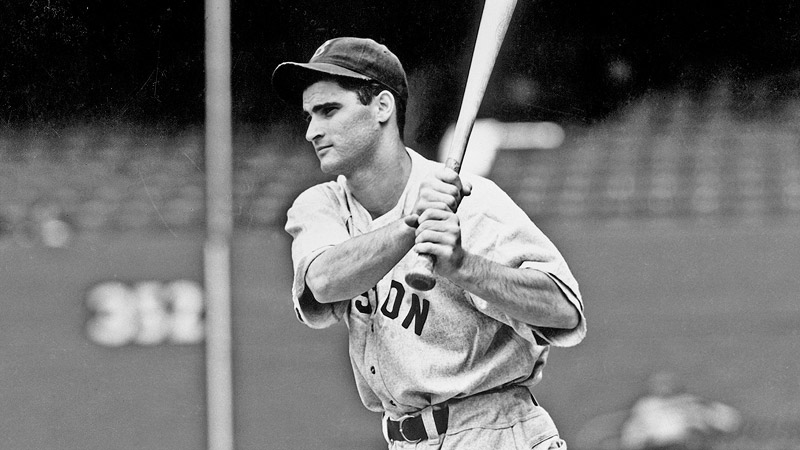
Doerr was elected to the Hall of Fame in 1986 (Boston Baseball History)
Having survived 97 years and 72 days, Bobby Doerr is officially the longest-living member of the Baseball Hall of Fame. He just passed former catcher and manager Al Lopez, who passed away on October 30th, 2005. Doerr, the oldest living former Red Sox, is also the only living person to have played a major league baseball game during the 1930s.

Pretty cool.

Doerr debuted on Opening Day 1937, not even two weeks past his 19th birthday. Under owner Tom Yawkey and player manager Joe Cronin, Boston was slowly returning to respectability after nearly two decades in the American League cellar. Doerr joined an infield with future Hall of Famers Jimmie Foxx at first and Cronin at short, plus All-Star Pinky Higgins at third. The outfield featured perennial All-Stars and .300 hitters Ben Chapman and Doc Cramer, while the rotation was anchored by Bobo Newsom, Wes Ferrell, and the indomitable Lefty Grove.  For Doerr to make such a star-studded roster out of spring training, less than a year after graduating high school, was exceedingly impressive.

Batting leadoff in Cronin's lineup card, he paced Boston's 11-5 rout of the Philadelphia A's with three hits. His next game he cracked two more hits, including a double. The game after that he slugged his first home run, a two-run shot that drove Yankee starter Bump Hadley from the game.

What was shaping up to be a phenomenal rookie season for Doerr was derailed in just his fourth big league game, when Ed Linke beaned him above the left ear his third time up. Doerr remained conscious and returned to the starting lineup for Boston's next game, but soon fell into a nasty slump. He was batting a lowly .232/.338/.319 when Cronin removed him from the starting lineup in favor of the veteran Eric McNair, who went on to enjoy a fine season by hitting .292 with 12 home runs, 10 steals and a .793 OPS. Doerr remained on the big club but played sparingly until September, by which point he was too rusty to be of much use. He finished his rookie year at .224/.313/.313 in 170 plate appearances--easily the worst figures of his career.

Doerr cracked the starting lineup for good the following year, earning the confidence of Cronin and settling in as the team's everyday second baseman. The consistency and added experience led to immediate improvements at the plate, where he batted .289 with a .363 OBP, 80 RBI, and 202 total bases. Boston improved by leaps and bounds too, jumping from 80 wins and fifth place in 1937 to 88 wins and second place in '38.

Both Doerr and the Sox continued to improve in 1939. The Red Sox received a boost in the form of Doerr's former minor league teammate Ted Williams, who was one of the best hitters in baseball upon arrival. Doerr, just four months older than Williams but already in his third big league season, batted a robust .318 and more than doubled his home run total from the previous season.

Williams and the Sox slipped in 1940, but Doerr didn't. He enjoyed his first 100 RBI season by driving in 105, something he would accomplish five more times over the remainder of the decade. He also clubbed 37 doubles, 10 triples, and 22 homers--all career highs to that point--while slugging .497 and racking up 296 total bases.

While Doerr was snubbed from the All-Star team in 1940 (Joe Gordon and Ray Mack were selected instead), he made the '41 squad despite seeing his production dip across the board. He was on hand for the American League's miracle comeback in the bottom of the ninth. Trailing by one and down to their final out, the AL walked off in shocking fashion on a three-run homer by Teddy Ballgame.
Doerr and Williams attended nine All-Star Games together (Padres Public)
Doerr was an All-Star again in 1942, and received MVP consideration for the first time after exceeding 100 RBI again and drastically improving his defense. His offense sagged a bit in 1943 with the deadened ball in use during the war years, but he rebounded to have his finest season in terms of rate stats in 1944, when he batted .325/.399/.528--all career highs. His season--for which he was named AL Player of the Year by the Sporting News--was cut short, however, by draft orders that required him to report for induction at the beginning of September. Doerr had previously been exempt because he was married and had a son, but with the war at its peak in 1944 that was no longer enough to keep him out of the service.

Doerr returned from the service in 1946 along with Williams and teammates Johnny Pesky, Dom DiMaggio, and Tex Hughson, who helped lead Boston to 104 wins and its first pennant since 1918. Doerr was an integral part of that team, what with his 18 homers, 116 RBI, and outstanding defense at second. He finished third in the MVP vote that year behind Williams and Hal Newhouser--the only time he ever polled in the top five. Though Boston lost the World Series to St. Louis in seven games, Doerr shined in his lone Fall Classic, batting .409 and leading the Red Sox with nine hits.

Though Boston was unable to replicate its successful 1946, narrowly missing out on several pennants, Doerr continued to be an elite run producer throughout the rest of the decade, driving in tons of runs because of his high batting averages and batting order position behind Peaky, DiMaggio, Williams, and later Vern Stephens--all on base machines. His defense remained strong as well, with he and Pesky teaming up to be one of the best double-play combinations in baseball.

A bad back ended Doerr's career prematurely after the 1951 season, even though he was just 33 and still near the top of his game. Accordingly, his career statistics are not particularly impressive, for he played only 14 seasons due to injury and war. Even so, he still amassed more than 1,000 runs, 2,000 hits, 1,200 RBI, and 200 homers--good numbers for a second baseman--and made nine All-Star teams. He was also, as mentioned, a strong defender and had great power for his position, with his 223 home runs ranking third among second basemen at the time of his retirement. From 1946-1950, only four players drove in more runs.

One can only wonder what Doerr would have accomplished had he not a) been plunked as a rookie, b) lost a prime season to World War II, and c) been forced to retire when he still seemed to have several good years in front of him. His numbers likely would have approached Jeff Kent's, although it's impossible to say how he would've aged, especially since most players back then were done by the age Doerr was when he retired.

Though many of Doerr's Red Sox records have since been broken by Williams and Carl Yastrzemski, he is still the only player in franchise history to hit for the cycle twice. Brock Holt might have something to say about that.

Friday, June 20, 2014

McCarthy's Miscues and the Red Sox Dynasty That Never Was

When World War II ended the Boston Red Sox were poised to overthrow the Yankees as the top dogs in the American League. The Yankees and Tigers, their top competition in the Junior Circuit, were graying teams with aging superstars. The up-and-coming Sox had been on the brink of a breakout before their stars went off to war, winning 93 games in 1942 to cap a run of six straight winning seasons. Boston's nucleus still mostly in its prime, the Sox seemed assured of multiple pennants before the decade was out. They had the pieces in place to end their championship drought, which at that point was coming up on three decades.

The Olde Towne Team signaled their dominance by running roughshod over the league in 1946, storming to 104 regular season wins in baseball's first postwar season. On the eve of Boston's World Series showdown with the St. Louis Cardinals, the future for the heavily-favored Red Sox was brighter than at any point since Harry Frazee sold Babe Ruth to the Yankees and effectively set his team back 15 years (or 86, depending on who you ask). 

St. Louis stunned Boston in seven, winning the final game on Enos Slaughter's improbable mad dash around the bases on Harry Walker's double--a play made possible, I might add, only because Dom DiMaggio came out of the game in the top half of the inning, leaving defensive replacement Leon Culberson to patrol center field in his stead. Culberson misplayed Walker's single into a double, thereby allowing Slaughter to score the go-ahead run that decided the series.

When the Red Sox returned home following their Series defeat, the first in franchise history, it seemed certain they would be back. If not next year, then the year after that. There appeared to be many more pennants in store for them.

Nobody could have guessed that it would be 21 more years before Boston made it back to the Fall Classic, and were it not for the September heroics of Carl Yastrzemski and Jim Lonborg in 1967, it would've taken almost 30. In 1947 the defending AL champs tumbled to 83 wins and third place as arm troubles devastated the pitching staff and several regulars--DiMaggio, Bobby Doerr, Rudy York, and even Ted Williams--saw their production decline to varying degrees. By the season's halfway point Joe Cronin's club was already 11.5 games behind New York, out of the race in mid-July. 

Boston bounced back in 1948 under former Yankee skipper Joe McCarthy, who made one of the more puzzling and oft-criticized decisions in baseball history by starting Denny Galehouse in the do-or-die tiebreaker game for the pennant against the Cleveland Indians. Galehouse, of course, got shelled in what turned out to be the final start of his major league career, and Boston lost 8-3, missing out on their one and only chance for an all-Boston World Series (the Braves won the National League flag by relying on Warren Spahn, Johnny Sain and two days of rain).

Winners of 96 games in 1948, the Sox won 96 again in '49, and again fell one win short of a trip to the World Series. McCarthy again proved to be Boston's undoing, overmanaging the last game of the season with the pennant on the line. With his team at bat but losing 1-0 in the top of the eighth, five outs from elimination, he lifted starting pitcher Ellis Kinder for pinch-hitter Tom Wright with nobody on (Wright walked, only to be wiped out by DiMaggio's double play). 

In hindsight, McCarthy's move to sub out Kinder doesn't look great but was certainly defensible. If Wright got on, which he did, then it was a good bet that DiMaggio (.404 OBP in '49 and .383 for his career) would also reach base. If DiMaggio didn't then it was still equally likely that Pesky (.407 OBP that year) would keep the inning alive for Ted Williams. Both DiMaggio and Pesky were .300 hitters as well, meaning they were more than capable of driving in a run with somebody in scoring position. That DiMaggio grounded into a double play, something he did only 10 times in 1949, was a most unlikely outcome and worst-case scenario. With eight round-trippers that year, he was nearly as likely to put one in the seats.

But he didn't, and so the game remained 1-0 heading into the bottom of the eighth. That's when McCarthy made his mortal error; bringing in Mel Parnell, who had to be exhausted from pitching the day before and a league-leading 295.1 innings that year (59.1 of which came after August 31st). Whereas McCarthy's greatest sin in 1948 had been passing over a rested Parnell in favor of Galehouse on the season's final day, here it was relying on Parnell to keep New York at bay when the young lefty simply had nothing left. 

It was immediately clear that Parnell had nothing, as he came in and promptly served up a leadoff home run to Tommy Henrich, then a single to Yogi Berra. McCarthy removed Parnell from the game, but by then, in the span of only two batters, Boston's win probability had been more than halved, from 14 percent at the start of the inning to just 5 percent when Parnell walked off the mound. 

McCarthy's next move was to bring in Tex Hughson, who hadn't pitched in three weeks and made only two appearances in the previous month. To his credit, Hughson induced a double play off the bat of Joe DiMaggio. The third out, however, proved to be elusive, as Hughson loaded the bases in what would be the final inning of his major league career. Rookie Jerry Coleman, the Yankee's number eight hitter, broke Boston's back by doubling to right on a ball that Al Zarilla caught, but lost control of when he slammed to the ground in the process of doing so. The bases-clearing double gave New York a five-run edge that would prove insurmountable, for Boston's three-run rally in the top of the ninth was not enough.

A prodigious drinker, McCarthy began hitting the bottle hard after that. He returned for the 1950 season but was often absent. When he did show up to the park, he was usually hung-over and disengaged. It took Red Sox ownership 59 games to dismiss him, with Boston barely above .500 at 31-28. 

Under new manager Steve O'Neill, the Sox won nearly two-thirds of their remaining games. On the morning of September 19th they had climbed to second place, only one game out of first with twelve to play. But, just as they had the previous two seasons, the Sox slumped at the season's most critical moment, losing four straight and six of their next eight to let another pennant slip away. They settled for third, four games off the pace. Had O'Neill been managing all along, or had Williams not missed two months after colliding with an outfield wall during the All-Star Game, the pennant probably would have been theirs.

1951 followed a similar script, with Boston taking control of first place for a while in late July and remaining near the top of the standings until the season's final week. On the morning of September 18th they were in second place, 2.5 out with 13 to play. They endured another epic collapse, winning only one game the rest of the way and finishing the year 11 back of the Yankees, who won their third straight pennant. With better play down the stretch, all three of those pennants could have gone to Boston. 

By 1952 the Red Sox championship window had closed. De facto team captain, Hall of Fame second baseman and key RBI man Bobby Doerr retired after the '51 season. DiMaggio, their stoic leadoff man, center fielder and on-base machine, was 35 and in his final full season. Pesky, less of a sparkplug at 33, would be traded in June after slumping at the start of the season. The indispensable Williams would play just six games before returning to war, this time in Korea. Slugging shortstop Vern Stephens' best days were behind him. With the team's core aging out, nobody in Boston's depleted lineup hit 20 home runs or knocked in 70 runs that year. The pitching staff, an odd mix of hurlers young and old, had only two post double digit win totals, led by Parnell's 12. 

Without Williams, the Lou Boudreau-led Sox stumbled to 76-78 that year, marking the end of their days as serious championship contenders. They wouldn't exceed 84 wins in a season until Dick Williams took over in 1967, by which point everyone from those halcyon days had long since retired. 

Looking back, it seems impossible to believe the great Sox teams of the late '40s and early '50s managed only one pennant. They certainly had the hitting, but never quite enough pitching, defense or speed. That they were run first by the incompetent Joe Cronin, then later by a washed-up alcoholic, did not help and can not be ignored. With a more capable skipper to steer them, the Red Sox could and should have won three or four pennants and at least one World Series. The Yankees and Dodgers owned the postwar decade, but the Red Sox wasn't far behind, only a few breaks away from building their own dynasty in Boston.

As fate would have it, those doomed teams were destined to be remembered for their near-misses than the one pennant they actually won. The optimism and high expectations engendered by their incredible 1946 season quickly gave way to misery and heartache, lending itself to writing several of Boston baseball's most painful chapters. These seasons brought about the first real heartbreaks in Red Sox history, the frustration of coming so close, of being right there, inches from the goal line, but not finishing the job. 

Unfortunately, it was a feeling which generations of Red Sox fans would become all too familiar with over the next half-century. 


Tuesday, December 10, 2013

Thoughts on Bobby Doerr


Was Doerr under-appreciated during his day?
All this Robinson Cano talk got me thinking about second basemen, and since I'm a Red Sox fan I naturally thought about the two greatest keystone defenders in franchise history: Dustin Pedroia and Bobby Doerr. Seeing as how I wrote at length about Pedroia over the summer, I decided to jot down a few thoughts on Doerr:
  1. Had a) Boston beaten St. Louis in the 1946 World Series and b) the World Series MVP award existed at the time, Doerr would have been a favorite to win it. Johnny Pesky's double play partner batted .409/.458/.591 in a losing cause for the Sox.
  2. How did Doerr not get more MVP consideration, especially in the five seasons after World War II? He finished third in '46, but Ted Williams was the runaway favorite that year, and never again finished in the top-15. I just don't get it. Doerr did everything that baseball writers loved to see during those days. He hit for good averages, drove in lots of runs, played a key position for winning ballclubs and was a respected team leader (He was also good at hitting into double plays, which maybe the writers held against him). Obviously having Williams on the same team didn't help, but then Derek Jeter's fared pretty well in the voting even though he was more of a really good complementary player. You have to figure that if the Red Sox hadn't unraveled at the end of 1948 and '49, Doerr would have seen a slight boost in his vote totals.
  3. Like Pedroia, the right-handed Doerr loved hitting at Fenway Park. He was a .315/.396/.533 hitter there compared to .261/.327/.389 on the road. Had he played anywhere else, he probably wouldn't be in the Hall of Fame.