Showing posts with label Hall of Fame. Show all posts

Monday, July 31, 2017

Bags, Rock & Pudge


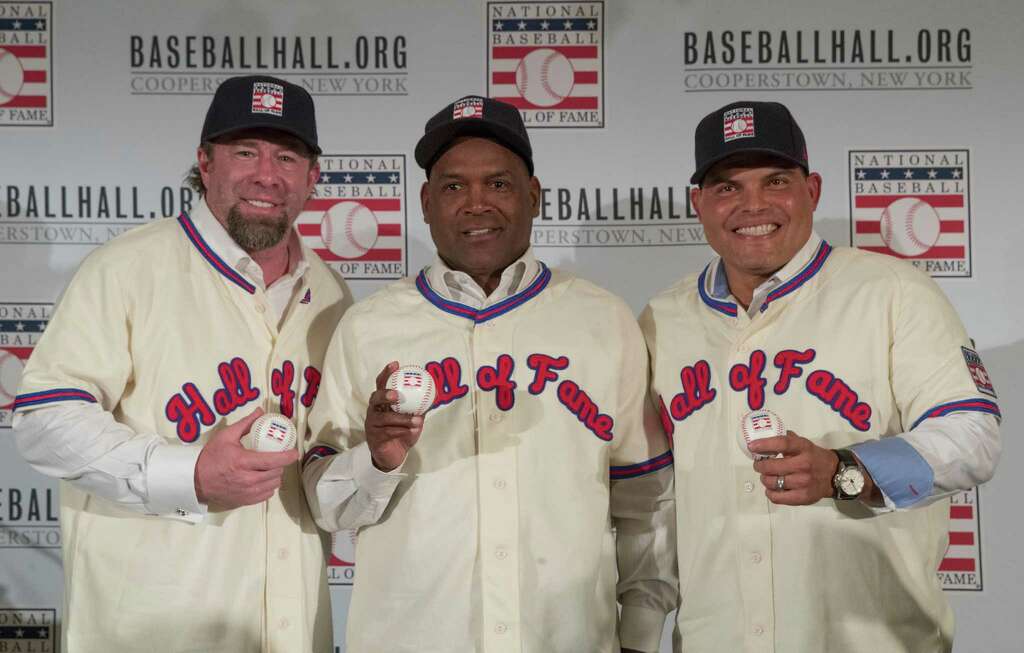
This weekend Ivan Rodriguez, Jeff Bagwell, and Tim Raines joined the Cooperstown ranks alongside executives Bud Selig and John Shuerholz. Trevor Hoffman and Vladimir Guerrero narrowly missed joining them, falling just a handful of votes short of election. Both are virtual locks to make it next year.

Even without the greatest closer not named Mariano Rivera and one of last decade's most exciting players, this year's class was a formidable one. It had arguably the greatest catcher of all-time (or at least the greatest since Johnny Bench), the greatest basestealer of all-time (in terms of success rate), and perhaps the greatest first baseman of the integrated era (or at least until Albert Pujols came along).

If  Rodriguez is not the greatest backstop of all-time, then he is certainly the best defensively. Both Baseball-Reference and FanGraphs have him leading the position easily in defensive WAR, with each putting him in the top 10 all-time for all positions. FanGraphs has him as the fourth-most valuable defender ever, ranking behind only Ozzie Smith, Brooks Robinson, and Mark Belanger. The drop-off between him and other backstops is so severe that it's hard to imagine anyone challenging his title, much less his record (for a catcher) of 13 Gold Gloves (Yadier Molina is still five away, in case you're wondering). Throw in his sizeable offensive contributions -- 311 home runs, 2,844 hits, a .296 lifetime average -- and it's clear that he's one of the three greatest catchers ever along with Bench and Yogi Berra.

It's hard to argue that Raines was the greatest base-stealer ever, especially since Rickey Henderson already claimed the title for himself. He never stole 100 bases in a season, which has been done 21 times throughout baseball history (he topped out at 90), and the difference in total thefts between him and Henderson is a whopping 598 -- more than all but 18 players have stolen in their entire careers. But Henderson got caught a lot more than Raines -- 189 times more, to be exact. As such, Raines' 84.7 percent success rate is considerably better than Henderson's 80.8 percent. It's also the highest of all-time for anyone who stole that many bases. So while Raines may not have been the most prolific base-robber of all-time, he was the best at combining volume and efficiency. And like Rodriguez, Raines brought a lot to the table with his bat, too, slashing .294/.385/.425 (123 OPS+) for his career with 2,605 hits and far more walks (1,330) than strikeouts (966). Add it all together and Raines was the second-greatest leadoff hitter of all-time, which somehow took the BBWAA 10 years to recognize.

And last but not least there's Bagwell, who was Pujols before Pujols. Check out their averages through their first 14 seasons:

Bagwell: 151 G 665 PA 108 R 32 HR 108 RBIs .297/.408/.542 (150 OPS+) 99 BB 110 K 14 SB
Pujols: 150 G 660 PA 108 R 37 HR 114 RBIs .317/.403/.588 (162 OPS+) 80 BB 65 K 7 SB

Pujols hit for a higher average and a bit more power while striking out less, but Bagwell walked more and stole twice as many bases. They were both good fielders, winning Gold Gloves for their play at first base, but the metrics say Pujols was better. Overall, you have to give the edge to Pujols, but it's close.

And yet, it took Bagwell seven tries to get into the Hall of Fame, whereas Pujols will be a slam-dunk as soon as he's eligible. The difference is that Bagwell played just 39 games in his 15th season and retired at 37, leaving him well short of several notable milestones such as 500 homers and 500 doubles. Pujols, whose contract runs until he's 42, has continued to play on through debilitating lower body injuries that have rendered him a full-time designated hitter. He's padding his career totals without adding much value on the field, socking his 600th homer this season in a year where he's been over a win below replacement level. A lifetime National Leaguer, Bagwell never had that option except during interleague games, playing a grand total of 10 games as a DH. Perhaps the DH would have lengthened his career, but we'll never know.

If nothing else, this year's class raises the bar for the average Hall of Famer. Next year we'll get Hoffman and Guerrero, along with likely newcomers Chipper Jones and Jim Thome. It's good to see the stars of the '90s and 2000s get the recognition they deserve. Now if we could only do something about the '70s and '80s...

Wednesday, June 28, 2017

Is Carlos Beltran a Hall of Famer?

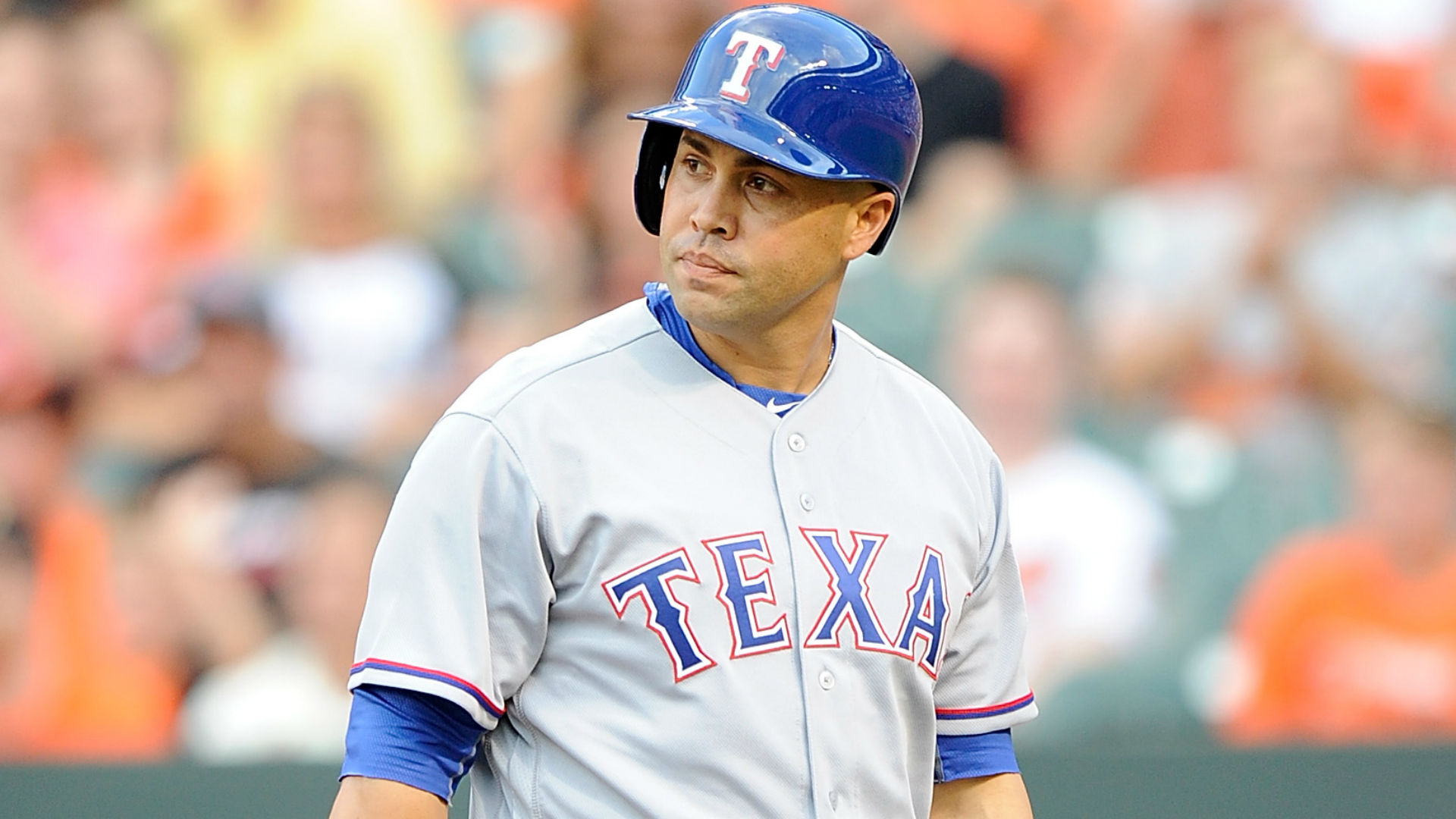
Beltran, pictured with the Rangers last season, is a worthy Hall of Famer (Sporting News)
A couple weeks ago when the Red Sox were playing the Astros, a friend asked me if Carlos Beltran is a Hall of Famer.

I answered in the affirmative, with the caveat that he won't get in on the first ballot and may need a few rounds of voting before receiving his plaque in Cooperstown. While Beltran is a clear Hall of Famer from a statistical standpoint, I can see why the support for his candidacy won't be overwhelming. His case has been built quietly over time, as he was never a player who could claim to be the best in baseball during any of his 20 seasons. He never dominated discussions or statistical leaderboards, and was never even a serious candidate for MVP. The fact that my friend posed this question in the first place reflects the doubt that exists among knowledgeable baseball fans who witnessed his entire career.

There shouldn't be much of a debate, however, as Beltran is one of the 10 greatest center fielders in baseball history by several measurements (Hall of Stats has him seventh, JAWs puts him eighth, and he's ninth in FanGraphs career WAR).  He's a near-perfect match for the average Hall of Famer at his position in terms of peak and career bWAR, with his career value almost evenly divided between peak (52%) and longevity (48%) per Hall of Stats. He's well above the Bill James Hall of Fame Monitor threshold as well, grading out a score of 126 when 100 gives a player a strong chance at induction.

All of that aligns with what Beltran produced on the field. For over a decade he was one of the best all-around players in baseball, routinely clearing 25 homers/steals and 100 runs/RBIs with a bat that was about 20 percent better than average after adjusting for league and park. His speed and smarts on the bases made him one of the 20 best baserunners of all time, helping him steal over 300 bases at a mind-bending 86.4 percent success rate (the highest ever for a player who spent at least a decade in the Major Leagues). He was also one of baseball's best defensive outfielders before knee surgery forced him to shift to right field in 2011, earning three consecutive Gold Gloves for his efforts. He might have won more had he not been so graceful, making difficult plays look easy.

Even after his defense and speed deteriorated in his mid-30s, he retained value until his 40th birthday as a slugging corner outfielder. That's what separates him from many borderline Hall of Famers who fell off in their early 30s, as lots of players have worthy peaks but lack the longevity needed to stand out. Beltran has both. There was a brief period at the start of the decade when his career appeared to be in decline, but he remained mostly healthy throughout the remainder of his 30s and had the kind of 20-homer, 2-3 WAR seasons that round out a Cooperstown resume. After appearing in just 145 games combined in his age-32 and 33 seasons, he averaged 138 games per year from ages 34-39 without suffering a drop-off in production:

Beltran 1999-2010: 134 G 23 HR 88 RBI .282/.359/.494 (119 OPS+)
Beltran 2011-2016: 138 G 24 HR 79 RBI .280/.343/.487 (126 OPS+)

Staying productive for so long enabled him to compiled some impressive career totals. By season's end, he'll have close to 1,600 runs and RBIs and more than 2,700 hits, which will include upwards of 550 doubles and 430 homers. Depending on which website you use, he'll either be just over or just under 70 career WAR -- squarely in the middle of the 60-80 range of most Hall of Famers. He's also one of only five players with at least 400 homers and 300 steals - a testament to his rare combination of elite speed and power.

While Beltran was never named MVP or led the league in any significant offensive category, he was consistently one of the baseball's top players for nearly two full decades, as evidenced by his nine All-Star selections. Since his Rookie of the Year campaign in 1999, Beltran has been the fifth-most valuable position player in terms of fWAR, trailing only Alex Rodriguez, Albert Pujols, Adrian Beltre, and Miguel Cabrera -- all of whom are surefire Hall of Famers. He was worth roughly eight more wins than Ichiro Suzuki -- another first-ballot Hall of Famer -- during that same span despite playing fewer games. While that works out to be only half a win per season, over time it adds up to be an additional MVP-caliber season that Beltran provided for his teams. And again, we're talking about a slam-dunk Hall of Famer in Ichiro.

So why won't Beltran get in right away? There's a couple reasons, I think. He bounced around a lot, suiting up for seven different teams and spending roughly half of his career in each league (when he gets in, he'll have a difficult choice to make about which hat to put on his plaque). As a result, he had several seasons that were split between two teams, including his near 40/40 season in 2004, when he switched leagues for the first time. '04 was the second-best season of his career after '06, but he only has a 12th place NL MVP vote to show for it because he spent the first half of the year in the Junior Circuit.

He was also doomed to be underrated for being great at everything rather than shining at one or two things, which is why his Baseball-Reference page is conspicuously devoid of black ink. He never had a signature season that stood out above the rest, as his career was defined more by sustained excellence than a brilliant peak (only one top-five MVP finish). Some of his brightest seasons occurred in relative obscurity with Kansas City in the early 2000s, when they were the laughingstock of baseball. Even though he won Rookie of the Year in '99, it took people a while to catch on, as he didn't draw MVP votes until 2003, wasn't named to an All-Star team until 2004, and didn't win his first Gold Glove until 2006. His Mets career is viewed as a mild disappointment, as his best years there were marred by late season collapses and playoff failure (the signature highlight of his career is not a game-winning homer or a spectacular catch, but the called strike three he took to end the 2006 NLCS). He also dealt with injuries and was traded away during the final year of his contract, after which he became a journeyman bat for hire.

He was a beast in October (David Ortiz-esque), but his team never won it all. That could change this year, as Beltran's Astros are looking like the Cubs from last year, albeit without much help from Beltran, who's suddenly showing his age at 40. That would be a nice way for Beltran to end his career, as his contract's up at the end of the season and he's unlikely to find work unless his hitting picks up in the second half. There would be nothing left for him to accomplish, anyways. He's already done enough -- more than enough -- to earn a plaque in baseball's Hall of Fame.

Wednesday, December 14, 2016

Pudge Deserves First Ballot

Rodriguez might be the best catcher ever (Century21 Riverpointe)
Nineteen former players are eligible to be inducted into baseball's Hall of Fame for the first time this year. While a couple should be slam-dunks based on their numbers alone (Manny Ramirez says hello), it's possible none of them will be elected, especially with holdovers Jeff Bagwell, Tim Raines, and Trevor Hoffman all coming off near-misses last year (each received at least 67 percent of the vote). As such, the BBWAA may continue clearing the backlog of deserving candidates rather than welcome anyone new this year, although it's possible one lucky newcomer will break through.

Ivan Rodriguez is easily the strongest addition to this year's ballot, and an inner-circle Hall of Famer by any measure. He won an MVP and a World Series, along with seven Silver Sluggers (six consecutively from 1994-1999) and 13 Gold Gloves -- the most ever by a pitch-caller. He leads the position in numerous statistics, including games caught, runs, hits, doubles, and weighted runs created.  Fourteen times he was an All-Star.

Rodriguez was the perfect catcher. He hit for power (311 career homers) and average (.296 lifetime). He had speed (127 steals). He was also, as you may have inferred from his Gold Glove total, the best defensive backstop the game has ever seen. Baseball-Reference and FanGraphs both have him ranked number one, and by a considerable margin. Although his bat declined in his later years, he remained a top-notch receiver until the very end, placing fifth among NL catchers in Total Zone Runs in his final season despite playing just 44 games. Even as a 39-year-old backup catcher who couldn't hit, he was still above replacement level.

Based on defense alone, Pudge is worthy of a place in Cooperstown, but it's his contributions with the stick that make him worthy of first-ballot induction. In addition to slashing .296/.334/.464 (104 wrC+) for his career, he also approached 3,000 hits and 600 doubles, settling at 2,844 and 572, respectively. He drove in and scored more than 1,300 runs. He was an offensive force in 1999 -- the year he edged Pedro Martinez for MVP honors -- and again the following year, when he had a 1.042 OPS before a fractured thumb ended his season in late July.

Put it all together, and Rodriguez has a legitimate case as the greatest catcher in baseball history. Jay Jaffe's JAWS metric, which combines career value with peak value, ranks him third behind Johnny Bench and Gary Carter. Pudge combined Bench's defense with the longevity and offense of the previous Pudge -- Carlton Fisk. He was remarkably durable and consistent for a catcher; according to FanGraphs, he was worth at least three wins every year from 1995 through 2005 (and worth 2.9 WAR in 2006, when he batted .300 for the final time and helped lead Detroit to a pennant).

And yet, despite all that, Rodriguez will likely be barred from the Hall this year due to rumors of steroid use during his career. He never tested positive, but Jose Canseco claimed Rodriguez juiced during their time together in Texas, and Canseco's been right about these things more often than not. Some may also see Rodriguez's slimmer physique and declining home run totals during the testing era as proof, but by that point he was in his early 30s and should have been declining naturally (his last season as an above average hitter came at 32). It is suspicious, however, that he was able to catch more games than anyone in history despite spending 13 seasons in the Texas heat. He seemed especially superhuman during the late '90s, when he was putting up monster offensive numbers while catching more than 140 games per year.

Based on what happened with similar cases (Bagwell and Mike Piazza), steroid suspicion will likely prevent Rodriguez from gaining entry on the first ballot. Now that Piazza's in, however, there's no legitimate reason for keeping Rodriguez out. He was a better defender and compiled superior counting stats, plus won an MVP and was a key leader on a World Series winner. The electorate has become more forgiving of PED-associated players in recent years, but my guess is that Rodriguez may fall just short of election this year. Hopefully they prove me wrong.

Monday, August 1, 2016

Why Didn't Griffey Get More MVPs?

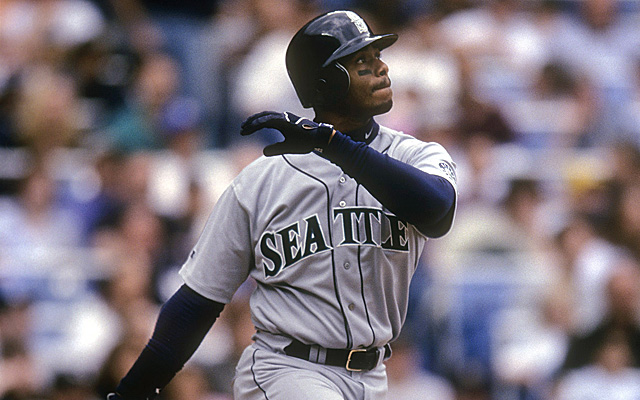
Griffey won a lot of his awards in his career. But only one MVP? (CBS Sports)
I don't envy the person who had to write Ken Griffey, Jr.'s Hall of Fame plaque. There's a lot to say and not nearly enough space to say it. How do you sum up a 22 year career into a single paragraph? You have to mention the 10 straight Gold Gloves--the most by a center fielder not named Willie Mays. You can't overlook the 13 All-Star appearances, including 11 in a row at one point. And there absolutely needs to be a line about his home run total--he hit 630 of them, after all, sixth-most in baseball history.

The inscription also had to say that Griffey was AL MVP in 1997 (but failed to mention he won unanimously). What it doesn't say is how many others Griffey could, or should, have won.

It's simply mind-boggling to me that a player as beloved and talented as Griffey won but a single MVP award. He was the face of baseball for an entire decade, the same way Mantle was the face of baseball for the '50s and Babe Ruth was during the '20s. Griffey wasn't just a star or even a superstar; he was a super-duper-star. He was everywhere, on everything from cereal boxes and videogames to commercials and movies. The only athlete more popular than Griffey during the '90s was Michael Jordan.

He was so good and so popular that you would have thought he was winning the MVP every year, or at least coming close. As it turns out, Griffey had two seasons in his 22 year career where he finished in the top three of his league's MVP voting. Two.

It's incomprehensible that among players who won MVPs during the '90s, Griffey has the same number as Terry Pendleton, Ken Caminiti, Dennis Eckersley, and Mo Vaughn. None of those players were anywhere close to the player Griffey was during his prime.

I can't get over it. How how did Griffey, the face of baseball and the best player in his league for a decade, a .300 hitter who slugged more home runs and drove in more runs than all but one player during the '90s, a dazzling defender who won the Gold Glove every year, who made the Mariners relevant for the first time, win just one MVP award when Juan Gonzalez--Juan Gonzalez--won two. It doesn't make any sense.

By my count, there were a half-dozen seasons during the '90s when Griffey had a legitimate MVP case. Only once--in 1997 when he led the league in WAR (for a position player), runs, homers, RBI, slugging, and total bases--did he actually win the darn thing. Even though everyone knew he had been the best player in the American League for several years by that point, it all had to come together (Seattle making the playoffs, him leading the league in almost everything) for the MVP to go his way.

In this regard, Griffey is like another tremendous all-around center fielder who preceded him by a few generations: Willie Mays. Starting when he won his first MVP at age 23, Mays was clearly the best player in the National League for more than a decade. And yet, voters kept finding reasons to give the MVP to someone else (it didn't help that Mays's teams only made the playoffs once from his age 24-39 seasons). As such, Mays didn't win again until 34, by which point he only had one more MVP-caliber season left in him. He retired with two MVPs when he easily could have had seven or eight.

Griffey, who ceased to be healthy after turning 30, wouldn't have won that many. But he should have more than one, right? I mean, there was a four-year stretch in the late '90s where he averaged 52 homers, 142 RBI, and a .996 OPS (152 OPS+) while winning the Gold Glove every year. Surely he deserved at least one, maybe two more?

Let's go back and find out...
Griffey was more than just a great hitter, he was a freak athlete (ESPN)
1993: Griffey finishes fifth, should have won
Griffey was a great player for the first few years of his career--an instant star--but it wasn't until his fifth year/age 23 season that he became a superstar. That was the year he cranked 45 homers--blowing away his previous career high of 27, and set a bunch of other personal bests. He batted .309/.408/.617 (171 OPS+), led the league in total bases and, for the only time in his career, walked more than he struck out. His 8.7 bWAR were the most by an American League position player, plus he helped the Mariners to a winning season--which was a big deal considering they'd lost 98 games the year before.

Still, being a star on an also-ran isn't going to get you much love from the BBWAA. Seattle finished fourth in the AL West, 12 games behind Chicago, who produced the league's unanimous MVP in Frank Thomas. In retrospect, it's puzzling to see how Thomas was a unanimous selection. His offensive stats (.317/.426/.607, 41 HR, 128 RBI) were almost identical to Griffey's, but he was a first baseman. Griffey was a Gold Glove-winning center fielder, not to mention a better baserunner (Thomas had four steals to Griffey's 17). All told, Griffey was much more valuable, holding a 2.5-win edge in WAR.

The same goes for the other three players who finished ahead of him; Paul Molitor, John Olerud, and Juan Gonzalez. Molitor was a DH with half as many homers and an OPS that was over 100 points lower than Griffey's. Olerud had better hitting stats but, like Thomas, played first and was a non-factor on the bases (0 steals). Gonzalez, a left fielder, basically had the same stats as Griffey except in OBP, where he trailed by 40 points. Griffey should have won his first MVP at 23, just like Mays, or at least deserved to be a close second.

1994: Griffey finishes second, right call
Few players got shortchanged more by the player's strike than Griffey, who already had 40 homers--most in the AL--when his year was cut short with 50 games remaining. He was wielding a red-hot bat at the time, with four home runs and 13 RBI in just 10 August games. Who knows what Griffey might have done with the rest of August and September--he might have been the first man to break Roger Maris's home run record.

As good as Griffey's numbers were, they weren't as good at the time as those of Frank Thomas (MVP again) and Albert Belle, who finished third. Thomas had 30 points of batting average, 85 in OBP and 55 in slugging on Griffey, with just two fewer homers but 11 more RBI. Belle also probably had a better case, as his slash stats were all about 35-40 points better than Griffey's. Of course, it's hard to hit .350 for a full season so maybe those numbers would have come down, but we'll never know.

1996: Griffey finishes fourth, deserves second
After an injury-plagued down year, Griffey came back with a vengeance in 1996, slamming 49 home runs and knocking in 140 in just 140 games. He also batted .303/.392/.628, stole 16 bases in 17 tries, and played the best center field of his career. Not surprisingly, Griffey led the league in bWAR with 9.7--which easily would have been a 10-win year had he not missed three weeks leading up to the All-Star Break.

This was the best year of Griffey's career to that point, but voters bypassed him and teammate Alex Rodriguez (who was actually more deserving) in favor of Juan Gonzalez, who helped Texas to a division title with slightly more impressive power numbers (47 homers, 144 RBI and a .643 slugging). Griffey and A-Rod were both much better all-around players and posted superior offensive numbers at more demanding positions, which is why B-R credits both with over nine wins while Gonzalez gets less than four.

Part of the problem was that Griffey and Rodriguez stole votes from each other, as A-Rod received 10 first-place votes and Griffey got four. Had all those first place votes gone to one Mariner, he would have exceeded Gonzalez's 11 and won the award. If only the baseball writers had co-ordinated which Seattle superstar they were voting for.
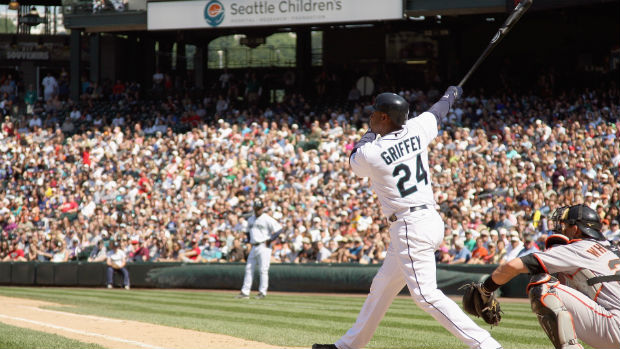
It took a home run barrage to win Griffey his first (and only) MVP (NY Daily News)
1997: Griffey wins! (finally)
Griffey had his best season and Seattle won the division, making him an easy choice for MVP (he won unanimously). Upon closer inspection, however, one finds that there was a player considerably more valuable than the Kid that year, and his name was Roger Clemens. The Rocket totaled an otherworldly 12.1 bWAR in his Blue Jays debut yet finished a distant tenth in the MVP race, failing to receive even a first place vote despite leading the majors in wins, innings, FIP, ERA+, and WAR. Clemens was undoubtedly hurt by the fact that Toronto finished last in the AL East, while Griffey clearly received much of the credit for leading the Mariners to a division title. When tasked with choosing between the game's best pitcher and the best position player for MVP honors the BBWAA, as they usually do, opted for the position player. I usually prefer the position player as well, so I won't argue here.

1998: Griffey finishes fourth, deserves top-three
Griffey was at it again in '98, blasting 56 homers for the second consecutive year as he give Roger Maris another run for his money. While the rest of his numbers dipped slightly, they were still almost identical to the ones he posted the previous season. And yet, he went from winning the MVP unanimously to finishing fourth, with nary a first place vote. Ahead of him finished Juan Gonzalez (again) and two superlative shortstops, Derek Jeter and Nomar Garciaparra. While both were phenomenal in helping their teams reach the playoffs, their power numbers were dwarfed by Griffey's. He ripped 21 more home runs than Garciaparra, for instance, and nearly three times as many as Jeter. He also knocked in more runs than either of them and, despite hitting 40 points lower, more than made up for this discrepancy with his power, which allowed him to out-OPS both of them.

While the most valuable player in the American League suited up for Seattle that year, his name wasn't Griffey. It was Alex Rodriguez, the league-leader in hits and bWAR who became the third player in baseball history (and still the only infielder) to go 40/40. However, his power numbers paled in comparison to Junior's and so he finished ninth. Both were also hurt by their team's lackluster record, which saw them go from division champs the year before to nine games below .500.

1999: Griffey finishes tenth, deserves higher
Griffey's final dominant season saw him finish 10th in the MVP voting despite winning his third straight home run title (and fourth overall) with 48, complemented by his typical gaudy runs/RBI totals as well as 24 steals--a career high. While his defense was slipping by this point, he still won another Gold Glove--his tenth in a row.

I'm not going to argue that Griffey deserved to win the last MVP of the '90s, because he didn't. Pedro Martinez, Ivan Rodriguez, Derek Jeter, Manny Ramirez, Roberto Alomar, and Nomar Garciaparra were all more deserving. Still, he definitely should have finished higher than Jason Giambi, Rafael Palmeiro, and Shawn Green.

So after all that, it appears Griffey deserved at least two MVP awards, maybe three if you give him '96 over A-Rod (had Griffey stayed healthy that year, it might have happened). Two is a good number of MVPs to win--that's as many as Frank Robinson, Ernie Banks, and Lou Gehrig, among others. When you win multiple MVPs, you're in pretty good company.

Like Mike Trout, Griffey had the misfortune of peaking when one of the greatest righthanded hitters in history was at his zenith (Miguel Cabrera's batting record is remarkably similar to Thomas's). Later on, his ridiculous run in the late '90s overlapped with the emergence of baseball's Holy Trinity at shortstop, not to mention some very short-sighted MVP votes. I mean, how crazy is it that a center fielder who averaged 52 homers, 142 RBI, and a .996 OPS (152 OPS+) for four years had one top-3 MVP finish? Probably about as crazy as a different center fielder leading his league in WAR every year for four years and winning just one MVP award.
Thursday, December 24, 2015

My 2016 Hall of Fame Ballot

Bonds and Clemens are the most deserving candidates on this year's ballot (CBS Sports)
Hall of Fame ballots were due Monday, and while I don't have a vote here is how I would have voted if I did. As has been the case the last few years, there are more qualified candidates than one is allowed to vote for, due to the Hall's arbitrary 10-player maximum. As such, my ballot reflects the 10 players I believe are most worthy of enshrinement, though several more (listed below) also deserve to have their name called in Cooperstown one day.

3. Ken Griffey, Jr.


Two ballots barely fits all the Hall-worthy candidates on this year's ballot. No wonder there's such a logjam to get into Cooperstown.

Wednesday, December 23, 2015

Boggs vs. Gwynn

Gwynn and Boggs, pictured at the 1987 All-Star Game in Oakland (SI Photos)
Both debuted in 1982, won multiple batting titles, and joined the 3,000 hit club in 1999. They were perennial All-Stars, multi-Gold Glove winners, and first-ballot Hall of Famers. They played 2,440 games apiece--all with the same team for one, all in the same division for the other.

Wade Boggs and Tony Gwynn, two of the greatest pure hitters who ever lived. Which one was better?

I don't mean as players, because WAR makes it pretty clear that Boggs was better (he has a 20-ish edge in bWAR, fWAR, and WARP). I mean as hitters, because they're career numbers are so darn close:

Boggs 1,513 R  3,010 H 578 2B 118 HR 1,014 RBI .328/.415/.443 (132 wRC+) 1,412 BB 745 K
Gwynn 1,383 R 3,141 H 543 2B 135 HR 1,138 RBI .338/.388/.459 (132 wRC+) 790 BB 434 K

As you can see, it's a virtual wash. Boggs scored more runs, but Gwynn knocked in more. Boggs stroked a few more doubles, while Gwynn socked a few more homers. Boggs walked twice as often, but also struck out twice as much. Boggs got on base more, but Gwynn had more hits and greater power.

I was hoping advanced metrics might reveal a significant difference, but once again it's really close:

Boggs: .302 tAVG  .381 wOBA  1,750 RC  479.7 BtRuns
Gwynn: .300 tAVG  .370 wOBA  1,636 RC  437.7 BtRuns

Boggs comes out on top, barely. His edge in adjusted batting runs is roughly two per season, while his advantage in runs created is about four per year. You're splitting hairs at that point, albeit in Boggs's favor.

But then, Boggs spent much of his playing days in hitter's parks--nobody took greater advantage of Fenway--whereas Gwynn spent his entire career in Qualcomm Stadium--the Petco Park of its time. Accordingly, when you neutralize their numbers, Gwynn's get better while Boggs's get worse:

Boggs .321/.407/.435  (.842 OPS)  1,664 RC
Gwynn .340/.391/.461  (.852 OPS)  1,735 RC

Now it's flipped, as ir's Gwynn who holds the slight edge. I think if you put him in Fenway Park, he probably hits .350 for his career. Meanwhile, had Boggs spent his whole career in San Diego, he wouldn't have come close to batting .328.

Boggs could hit anywhere--he batted .302/.387/.395 on the road--but that would have been a bad season for him. It also pales in comparison to what he did at home (.354/.443/.495). Most hitters benefit from their home parks, but not to the same degree that Boggs did (unless they play in Coors Field).

Gwynn, on the other hand, hit nearly as well on the road as he did at home. His .334/.384/.451 road averages are nearly identical to his .343/.393/.466 home record.  Gwynn would have been a .330 hitter no matter which team he played for, but Boggs might have batted closer to .300.

I went into this post thinking Boggs was the better hitter due to his gaudier on-base percentages and almost-even power, but after taking their environments into account it appears Gwynn was the superior batsman.

Tuesday, December 22, 2015

Sox to Retire Boggs's Number

Boston should have retired Boggs's number a long time ago (Scuffed Balls)
More than two decades after playing his last game for the Boston Red Sox, Wade Boggs will have his number 26 retired at Fenway Park next spring.

This honor has been a long time coming for Boggs, who was inducted into the Red Sox Hall of Fame in 2004 and the National Baseball Hall of Fame one year later. It's strange the Sox didn't retire his number when he was elected to Cooperstown in 2005, given that they retired the numbers of Jim Rice and Pedro Martinez the same summers they were enshrined. It's also weird that they didn't stop giving out his number after he left the Sox, as they did with Martinez's 45 and Roger Clemens's 21.

And yet, it's fitting that Boston took so long to give him his due, given that he was never properly appreciated during his time there. Like Ted Williams before him and Joey Votto nowadays, Boggs was frequently criticized for being too passive at the plate, especially with men on base. People viewed him as a selfish hitter because he won batting titles and took walks, but never hit for much power or drove in many runs. His unwillingness to expand the strike zone or swing from the heels when the situation called for it drove fans nuts, making him seem more interested in padding his own stats rather than helping the Red Sox win.

Of course, nothing could have been further from the truth. Boggs was the ideal table-setter, an on-base machine who often put himself in scoring position via doubles (he clubbed 578 for his career). His job was not to knock in runs but to score them, which he did exceptionally well by averaging 100 runs scored per 162 games and twice leading the majors.

Everyone knew Boggs was a tremendous hitter, but few understood his true worth as a ballplayer. His gaudy OBPs and plus defense at the hot corner (which wasn't recognized until later, when he won back-to-back Gold Gloves in his late 30s) made him incredibly valuable. Baseball-Reference defines an MVP-caliber season as one where a player accrues at least eight wins above replacement, which Boggs did every year from 1985 to 1989. But frustrated Bostonians weren't the only ones underrating Boggs, who never finished higher than fourth in MVP voting. Moneyball was still two decades away, and nobody had WAR to tell them he was the American League's top position player in 1986, 1987, and 1988.

Of course, Boggs may not have been had he played elsewhere. He was helped immensely by Fenway Park, whose Green Monster allowed him to wait back on pitches until the last possible second, at which point he would flick his wrists and stroke another double or single off the wall in left. Nobody did this better than Boggs, who holds the highest Fenway average of all-time at .369. That was especially true before the EMC Club--then called the 600 Club--was erected in 1989, altering the wind currents within the park and making it much less favorable for hitters. It's no coincidence that Boggs never won another batting title after 1988.

Age and the 600 Club caused Boggs to tail off a bit in the early '90s, but his final year in Boston--1992--was the worst of his career. He slumped to .259/.353/.358 as the Sox sunk to last place. His contract was up and Lou Gorman, Boston's general manager at the time, let the 34-year-old walk, even though he was just one year removed from a .332/.421/.460 campaign in which he was worth 6.4 bWAR.

That proved to be a terrible mistake, as Boggs found a second wind with Boston's arch-rivals, the New York Yankees. Boggs batted .313/.396/.407 in his five years in pinstripes, making four All-Star teams and helping the Bombers to a championship in 1996--10 years after his previous World Series bid ended in agony. Following his New York stint he returned home to finish out his playing days in Tampa Bay, where he ended his career on a high note by batting .301 and notching his 3,000th hit on his 118th, and final, home run.

Boggs retired in 1999 as one of the five best third basemen in baseball history. His .328 lifetime average is the second-highest of anyone's career who began after World War II, while his .415 OBP ranks fifth among players who have debuted since 1945 and appeared in at least 2,000 games. He was an eight-time Silver Slugger winner, a five-time batting champion, and an All-Star every year from 1985 to 1996. His most impressive accomplishment, however, was batting .401 over a 162-game span from June 9th, 1985 to June 6th, 1986.

The Red Sox have gotten better about hanging up numbers recently, with four of their nine retired numbers coming since 2008. Hopefully that means they'll be ready to add more to the right field roof deck in the near future, as there's no shortage of deserving candidates. Or space.

Thursday, November 12, 2015

2016 Hall of Fame Ballot Newcomers

Griffey's going into the Hall of Fame next summer (Yahoo Sports)
This year's Hall of Fame ballot was released on Monday, adding 15 newcomers to the list of 17 holdovers. While the incoming class isn't as strong as previous years, which saw three first-timers inducted in both 2014 (Greg Maddux, Tom Glavine, Frank Thomas) and 2015 (Randy Johnson, Pedro Martinez, John Smoltz), by my count there's still a pair of surefire Hall of Famers as well as a couple more with very strong cases for induction. Let's take a look:

Hall of Famers
How could you note vote Ken Griffey, Jr. into the Hall of Fame? For the first half of his career he was Willie Mays, and while he was more like Mickey Mantle in the second half (the late-career version of Mantle), he still did enough to wind up with tremendous counting stats. His 630 long balls and 1,836 RBI are second only to Mays among center fielders, and his 83.6 bWAR (77.7 by FanGraphs) place him comfortably above the Hall's standards.
Few players were ever as good as peak Griffey, a dazzling center fielder and .300 hitter with 50-homer power and 20-steal speed.  Looking at his numbers, especially the late '90s ones, it's hard to believe he won only one MVP (at least it was unanimous). Even so, he was one of the decade's most decorated players. An All-Star and Gold Glove winner every year during the '90s, he also won seven Silver Sluggers and that MVP in '97, which he won unanimously despite a 1.067 OPS from Frank Thomas and a 12-win season by Roger Clemens (wins above replacement, that is).
Griffey dominated the '90s, a decade in which he hit more home runs than anyone not named Mark McGwire, drove in more runs than anyone besides Albert Belle, and compiled more fWAR than every position player who wasn't Barry Bonds. Despite beginning the decade as a 20 year-old, losing time to the strike in '94 and getting hurt in '95, he still averaged 38 homers, 109 RBI, and 6.7 bWAR per season during the '90s. Junior was already a Hall of Famer before he left Seattle in 2000; the only question was whether he would be able to challenge Hank Aaron's home run record. Injuries and normal age-related decline prevented him from doing so, though he did end up with more dingers than all but five men in baseball history.
 
No, he wasn't Mariano Rivera, but there's no shame in being the second-greatest closer of the wild card era. A seven-time All-Star, Hoffman compiled a 2.87 ERA (141 ERA+) despite pitching his entire career during an inflated era for offense. That wasn't a fluke, either, as he punched out more than a batter per inning and maintained a 1.06 career WHIP.
 
While Hoffman had many great seasons, his best was undoubtedly 1998, when he finished runner-up to Tom Glavine in the NL Cy Young race (Hoff would also finish second in 2006, behind Brandon Webb). In the year that Mark McGwire smashed 70 homers, Sammy Sosa slugged 66, and balls were flying out of ballparks at dizzying rates, Hoffman had a microscopic 1.48 ERA (265 ERA+) and 0.85 WHIP to go along with his major-league leading 53 saves. Perhaps more impressively, he allowed just two home runs that year in 73 innings of work.
 
That was the middle year in a five-year stretch where Hoffman was the best reliever in baseball. He sustained his success nearly a decade beyond that, keeping his ERA under three in all but two seasons during the 2000s. He had his last great year in 2009, posting a 1.83 ERA (226 ERA+) and 0.91 WHIP at age 41. He hung on in 2010 to get his 600th save and retired as the all-time saves leader with 601, a record that lasted just one year before Rivera broke it. Still, there's no question Hoffman was one of the best relievers of all-time, and for that he deserves first-ballot induction.
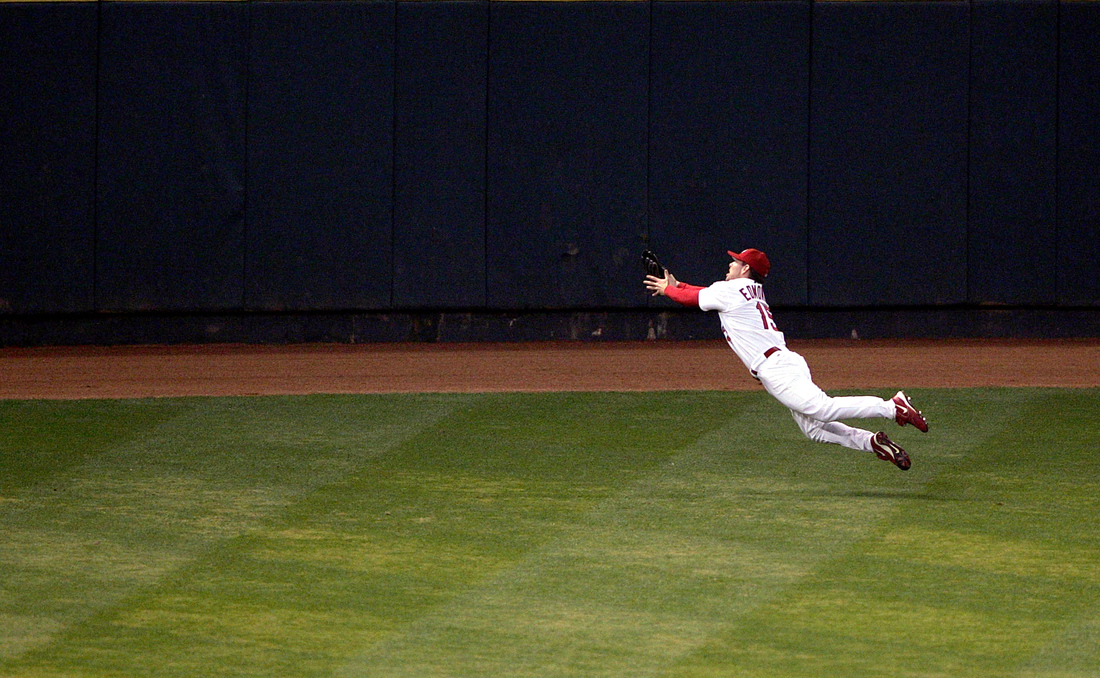
Edmonds made too many highlight-reel catches to count (SB Nation)
On the Fence
 
Edmonds has an interesting Hall case. With 60.3 bWAR and 64.5 fWAR, he's right on the bubble (60 WAR is the low end for a Hall of Famer). In fact, he has a very similar Hall case to another player on the ballot, a former teammate of his.

Jim Edmonds: 17 yrs 2,011 G 393 HR 1,199 RBI 132 OPS+ 64.5 fWAR
Larry Walker: 17 yrs 1,988 G 383 HR 1,301 RBI 141 OPS+ 68.7 fWAR

Edmonds earned eight Gold Gloves, Walker won seven. Walker made five All-Star teams, Edmonds four. Not surprisingly, Walker rates as Edmonds' seventh-most similar batter while Edmonds is Walker's fifth-closest comp.

Both had several phenomenal years and fantastic rate stats, but they rarely played full seasons and thus ended up with good-not-great counting stats. Both were excellent fielders, Edmonds more so since he played center, though Walker was a better baserunner. It would also seem that Walker was the better hitter since his raw OPS is 62 points higher, but I honestly believe that if Larry Walker had never played in Coors Field, he would have had the same career as Jim Edmonds.

Sure enough, if you neutralize Walker's numbers...

Walker 1,159 R 1,994 H 444 2B 348 HR 1,129 RBI .289/.373/.522 (.895 OPS) 1,325 RC

Then compare those to Edmonds' actual numbers:

Edmonds 1,251 R 1,949 H 437 2B 393 HR 1,199 RBI .284/.376/.527 (.903 OPS) 1,199 RC

There you have it. Edmonds is Walker, and Walker is Edmonds. I feel Walker's Hall-worthy, so therefore I feel that Edmonds is as well. Unfortunately, Walker's barely polled 10 percent the last two years, so that doesn't bode well for Edmonds. I think he'll get a little more credit since he was such a great center fielder, but I'd be shocked if he gets more than 15-20 percent.
 
When I first saw Wagner's name on the ballot, I immediately dismissed him as a serious candidate for Cooperstown. Then I took a closer look, and, well, I think he deserves a close examination
 
For starters, Wagner was way more dominant than Hoffman, with an ERA (2.31) that was more than a half run lower as well as a superior WHIP (1.00), strikeout rate (11.9), and K/BB ratio (3.99). Hoffman had more longevity, which helped him rack up 179 additional saves, but saves are a silly stat to begin with. Hoffman pitched about 180 more innings than Wagner, which amounts to roughly three extra seasons worth, but I'm guessing Wagner was so much better when he did pitch that his peak offsets Hoffman's longevity.
 
Lo and behold, Wagner's bWAR was 27.7, while Hoffman's was 28 on the nose. A vote for Hoffman is also a vote for Wagner, so I'd say yes to both.
 
We're Not Worthy:
 
Everyone Else. Jason Kendall had a Joe Mauer-ish start to his career but fell off a cliff after 30. Troy Glaus and Mike Sweeney had some huge seasons but not enough of them, kind of like Nomar Garciaparra. Mike Lowell was a very good player, but nobody's idea of a Hall of Famer. Garrett Anderson had a good run there in the early 2000s and a Tino Martinez-esque career, but that's not getting him into Cooperstown anytime soon. Luis Castillo and Randy Winn had better careers than you might remember, but they were nothing more than good complementary players. As for the rest, well, I guess you could say the same about them.

Monday, October 26, 2015

Expanding Cooperstown's Circle

Simmons really should be in the Hall of Fame (I70 Baseball)
Interesting piece over at the Hardball Times got me thinking about the Hall of Fame, which I usually don't do for a few more months (when the ballots come out). Anyways, I thought it was cool how balanced the Hall is in regards to the number of players represented at each position. John pointed out that two positions--catcher and third base--are significantly underrepresented in Cooperstown, however, with just 16 enshrined at each position compared to the 21-24 at every other position (excluding pitchers).

I guess that's not too surprising when you think about it. Backstops tend to have shorter careers and their counting numbers are suppressed due to the toll catching takes on their bodies. On top of that, they typically can't play full seasons due to the off-days catching demands. Plus, until recently, we didn't have a good way of measuring defense at the position beyond caught stealing rates and passed balls. Pitch framing data has completely changed the way we evaluate catchers, but for a long time all we had to go on was the eye test.

As for the hot corner, well, it's a tricky position. It's not as tough to play as second base or shortstop, but still considerably harder than first base. As such, the men who play it are generally better hitters than up-the-middle guys, but not as big and strong as corner outfielders and first basemen. A third baseman needs to be a good hitter and a good fielder, a pretty rare combination.

All this got me wondering, if we were to elect five more players at each spot to make at least 21 Hall of Famers at every position, who would/should go in? That is, who are the five most deserving players at each position who are eligible but have yet to be elected? I have ranked my choices in order from most deserving to least.

C
I feel very strongly that Piazza will be elected this year. It's his fourth time on the ballot, and after starting out at 57.8% he's risen to 62.2% and 69.9%. If he makes a similar jump this year--let's split the different and say six percent--he'll have just enough support to clear the 75% threshold. With his former team making the World Series this year, I think he'll get the requisite boost.

Honestly, though, it's a bit ridiculous that Piazza hasn't been elected already. I mean, he was the greatest hitting catcher of all-time. His numbers are outstanding for any position, but for a catcher they're off the charts. Sure, he played in the best era for offense since the Great Depression, but he also spent his entire career in brutal pitcher's parks. That's why, if you neutralize his numbers, they barely change, dipping ever so slightly from .308/.377/.545 to .304/.371/.537. The time has come to give Piazza--the fifth-best catcher by JAWs and sixth-best per fWAR--his due.

For the life of me, I still can't figure out why Simmons hasn't made the Hall of Fame, much less how he lasted just one year on the ballot. By JAWS and FanGraphs, he's one of the 10 best catchers ever. Only Ivan Rodriguez amassed more hits and doubles among backstops, and only Yogi Berra knocked in more runs. And Simmons wasn't just a compiler, either; from 1971-1980 he averaged .301/.367/.466 (131 OPS+) with 17 home runs and 90 RBI per season. The only reason I can think of for why he's been so criminally underrated are that he starred on terrible Cardinals teams in the 1970s, which also coincided with a golden age for catchers. People just forgot about him.

Throughout his 15-year career, Freehan was the pre-eminent catcher in the American League, if not all of baseball. He made 10 straight All-Star trips from 1964-1973, then added an 11th in 1975. He won five consecutive Gold Gloves to close out the '60s, earning a third-place MVP finish in 1967 and placing runner-up to teammate Denny McLain the following year. Freehan was everything you could want out of a catcher; durable, good defender, hit for power, and had a good batting eye. Had he not declined so rapidly after turning 30 he'd probably be in the Hall of Fame today.

Along with Alan Trammell and Lou Whitaker, Parrish is one of the forgotten stars from the great Detroit teams of the 1980s. He was well decorated during his playing days, making eight All-Star teams and winning three straight Gold Gloves. The six-time Silver Slugger recipient had phenomenal pop for a backstop, exceeding 20 homers in a season seven times and belting 19 two other times. He finished his career with 324 round-trippers in all--tied with Gary Carter for fifth all-time among catchers. He also knocked in over 1,000 runs, something 11 catchers have ever done. His numbers might look even better had he never suffered the sore back that cut short his 1986 season--which was shaping up to be one of his best--and hindered him for the rest of his career.

It seems pretty clear to me that Munson was on the Hall of Fame track before his life was tragically cut short in a plane crash. He'd been the American League's top catcher during the 1970s, making seven All-Star teams and winning three Gold Gloves along with two World Series rings. Had he not taken to the skies that fateful day, he likely would have finished his career with more than 2,000 hits (probably closer to 2,500, actually) and close to 60 bWAR. Unfortunately, we will never know.
Allen fell one vote shy of election in his most recent turn on the ballot (CSN Philly)
3B (I'm excluding Edgar Martinez because most people view him as a DH)
I've argued Allen's case too many times in this space to do so again, but basically it boils down to this; if he hadn't been such a jerk, I think he would have been inducted a long time ago. He was the Manny Ramirez or Albert Belle of the 1960s and '70s--unlikable, bad defense, sour attitude and a terrible teammate, but man, he was one hell of a hitter.

One of the best defensive third basemen of all-time, Nettles deserved to win more than two Gold Gloves. Alas, he spent the first half of his career in the shadow of Brooks Robinson, and the second half of it in Buddy Bell's. He was a much better hitter than both of them, though, slugging 390 home runs. He can also claim to be the best position player of the 1970s who never played for the Reds, ranking third in fWAR for the decade behind only Johnny Bench and Joe Morgan.

Boyer was basically Ron Santo before Ron Santo. Had he gotten an earlier start (military service delayed his career) or not completely fallen apart in his mid-30s (and thus remained an integral part of the 1967-'68 Cardinals squads), we'd probably hold him in higher regard. As it were he had nine wonderful seasons, but for most people that's not enough.

Buddy Bell
Bell was a ridiculously good defender, possibly the best at the hot corner not named Brooks Robinson. He was no slouch with the stick, either, accruing over 2,500 hits, 200 homers, and a 109 OPS+ for his career. He also had a better peak than most people realize, averaging just under six bWAR per season from 1978-1984. Bell wasn't a good baserunner and didn't have great power, finishing his career with a .127 ISO and more unsuccessful stolen base attempts than successful ones, but still cleared 60 career WAR for both B-R and FG.

Evans was the rare three-true outcomes type of third-sacker, blasting 414 home runs and logging a .361 OBP in spite of his .248 batting average. In that sense Evans was ahead of his time, for he surely would have been better appreciated today than he was during the '70s and '80s, when people griped about his low batting average. He actually didn't strike out that much--1,410 times in 21 seasons, which works out to be 67 per season. Nowadays guys strike out twice as often and hit half as many homers, so go figure.

Flex: Joe Torre
Torre's already in the Hall of Fame as a manager, but you could certainly make the case he deserved to go in as a player long ago. He had a sneaky good peak where he was one of the best players in baseball during the 1960s and early '70s. As with several others on this list, longevity was an issue, but he doesn't get anywhere close to the credit his playing record deserves.