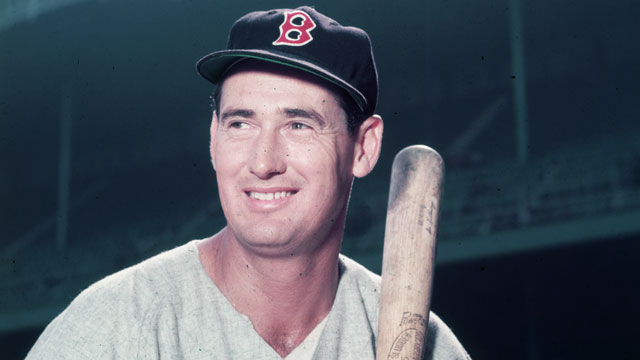
Showing posts with label Ted Williams. Show all posts

Thursday, July 27, 2017

Why Wasn't Williams Called Up?

Williams quickly proved too good for his Minor League assignment (Esquire)
Much has been made about all the games Ted Williams lost to World War II and Korea, which amounted to nearly five full seasons. But what about the time at the beginning of his career, before it even started?

By the time Williams arrived to the Major Leagues in 1939, he was already a finished product. Having destroyed American Association pitching the previous year, he promptly set fire to the Majors with one of the greatest rookie seasons ever. In addition to leading the loop in RBIs with 145, the 20-year-old Williams batted .327/.436/.609 with 31 home runs en route to a fourth-place MVP finish.

Williams had been ready for some time, however, and should have debuted in 1938. He didn't make the team out of Spring Training, unable to crack Boston's veteran outfield of Joe Vosmik, Ben Chapman, and Doc Cramer, all of whom would bat .300 that year. None of them could hit for much power, however, slugging just 15 homers between them, with Cramer hitting none. Williams had already showed his natural power stroke the year before with San Diego, swatting 23 home runs as a skinny 18-year-old in the Pacific Coast League, and would have added thump to a lineup that was starved for power beyond Jimmie Foxx.

Furthermore, the men Williams might have replaced in the outfield weren't fan favorites or established stars with the team, as none had spent more than two years with the Red Sox. While veterans are always given a chance to keep their jobs and rookies tend to be treated with kid gloves, nobody's feathers would have been ruffled had Joe Cronin benched one of them in favor of Williams.

While it's understandable that the Red Sox wanted Williams to get regular at-bats rather than sit on the bench behind the aforementioned trio, they should have called him up later in the season. By August they were out of the pennant race and it was clear that Williams had nothing more to learn with Minneapolis, where he won the league's Triple Crown with 43 homers, 142 RBIs and a .366 average. Chapman was months away from being traded and clearly wasn't in the club's long-term plans, so why not give the Kid a shot? With Foxx having a season for the ages, setting a then-franchise record with 50 homers, Boston already had the perfect lineup protection for Williams, who could have cut his teeth on a steady diet of fastballs hitting in front of Double X.

The Red Sox had other motivations for keeping Williams down on the farm longer than necessary, however, namely his maturity. He had rubbed many teammates and coaches the wrong way with his big mouth, and it was felt that he needed time in the Minors not just for seasoning, but to grow up. If Williams had been less of an annoyance, the Sox might have been willing to give him a chance. Instead, they may have hoped to humble him with the demotion.

It all worked out in the long run, however; as fate would have it, Rogers Hornsby was one of the Millers coaches that year. Williams learned a lot from the best right-handed hitter of all-time, namely "get a good pitch to hit." The Splendid Splinter took that to heart, walking more than 2,000 times in his career, but it's possible that he wouldn't have been so patient had he never come under Hornsby's tutelage.

Wednesday, July 26, 2017

Debunking Some Ted Williams Myths

The Boston press attacked Williams with invented weaknesses (SI.com)
Last week I got around to reading Impossible Dreams, an excellent anthology of Red Sox writing compiled by Glenn Stout that's well worth a look for all Sox fans. One of the sections centers on Ted Williams, of course, given that he inspired more copy than any athlete in Boston sports history--most of it overwhelmingly negative. 

The Boston press, which featured nine newspapers at the time, was hostile to him for most of his career. One such instance came at the beginning of the 1954 season when Williams, 35 and just back from Korea, was contemplating retirement. Although he had returned from the war zone with a bang the previous summer, batting .407/.509/.901 with 13 homers and 34 RBIs in 37 games, the writers were hardly begging him to stay. Instead, they dared him to quit, imploring him to hang up his spikes immediately rather than wait until season's end. Thankfully, Williams played out the season and several more, sticking around until 1960. 

Anyways, the 1954 piece I'm referring to (which was penned by either Dave Egan or Harold Kaese -- his two most vicious attackers) levelled several common criticisms of the day against Williams, namely that he struggled against the Yankees, tanked in the clutch, and was more concerned with his own statistics than helping the Red Sox win.

Writers rarely supported their arguments with statistics back then, but if they had they would have had no ground to stand on. Williams batted .345/.495/.608 against New York in his career, nearly identical to his overall .344/.482/.634 slash line. So how did writers get the notion that he wilted against the Yankees? Likely after the final days of the 1949 season, when Boston dropped its final two games at Yankee Stadium to blow the pennant while Williams went 1-for-5, losing the batting title to George Kell in the process. Williams did not choke, however, reaching base in four of his eight trips to the plate and scoring two of Boston's seven runs. The press, which had a long memory with Williams when it came to his failings but borderline amnesia regarding his successes, also apparently forgot that just one week before, Williams had led the Sox to a two-game sweep of the Yanks at Fenway Park by homering in each game. 

The last two games of '49 were lumped in with the 1948 pennant tiebreaker game against Cleveland (in which he went 1-for-4) and his poor World Series performance in 1946 as evidence that Williams couldn't perform when it counted most. In the 10 biggest games of his life, writers often reminded their readers, he was 7-for-34 (.206) with no extra-base hits and just one RBI. However, 10 games is much too small of a sample size to draw any meaningful conclusions from, especially since Williams was hurt during the Fall Classic and the other three contests came at the end of long, grueling pennant races. It was seldom mentioned that Boston wouldn't have gotten that far in the first place without Williams, who earned MVP honors in 1946 and '49 while finishing third in '48. But since the Red Sox always fell short in the end, their failures magnified those of Williams when people went searching for explanations.

Looking at Williams' overall body of work (and not cherry-picking 10 games from a career of 2,292), however, there's ample evidence that suggests he was actually pretty good in the clutch. In high leverage situations, for instance, he batted .329/.467/.607 -- not far off his career marks. When games were late and close, he performed at a .312/.449/.613 clip -- not quite his career levels, but still outstanding. And when there were two outs and runners in scoring position, he batted .315/.524/.647. 

That last stat line (note the on-base percentage) drew the ire of sportswriters who blasted Williams for refused to expand his strike zone with men on base. He was selfish, they said, because he would rather take a walk than help the team by driving in a run (which is often said about Joey Votto today). It's been proven, however, that the occasional RBI gained by swinging at balls is not worth the trade-off of making more outs. Besides, Williams drove in plenty of runs despite often being pitched around in such situations, leading the league four times and racking up 1,839 in all (130 per 162 games). He was hardly the only Boston batter capable of driving in runs, either, as he often had great RBI men behind him such as Jimmie Foxx, Bobby Doerr, Vern Stephens, and Jackie Jensen. The best thing a hitter can do to help his team is avoid making outs by getting on base, and no one in baseball history was better at that than Williams, whose .482 career OBP is still the highest of all time.

As a hitter, Williams was pretty much flawless. The press made up weaknesses so they'd have something to write about, and they got away with it because great sites like Baseball-Reference didn't exist yet. But now that they do, we can see how the Knights of the Keyboard exaggerated the few (but memorable) failures in Williams career to create these illusive shortcomings. 

Wednesday, May 31, 2017

Boston's Lucky Number Seven

Is 7 Boston's lucky number? (Slow Trav)
The last time a year ended with a seven, the Red Sox won the World Series. Heading into 2017, they were favored to win again, which would be their ninth in franchise history and fourth of this millennium. Here's how their seasons have played out in previous years ending in seven (a real mixed bag, with some great seasons offset by some terrible ones):

1907 (59-90, 7th place out of 8)
This was not a good year for the Boston Americans, who would change their name to the Red Sox the following year. A dark cloud hovered over the season following player-manager Chick Stahl's suicide in late March, which left the organization scrambling to replace him on the eve of Opening Day. A franchise-record four managers presided over the club's second straight underwhelming season, although it represented an improvement over their 105-loss last-place finish the year before. Boston's offense was abysmal, averaging 3.12 runs per game and ranking last in scoring, steals, average, OBP, and OPS as none of the regulars batted .290 or posted a .700 OPS. As a result, the pitching staff received little run support and every hurler besides Cy Young (21-15, 1.99 ERA), Cy Morgan (6-6, 1.97 ERA), and Beany Jacobson (two innings) ended up with a losing record. It would be 15 years before Boston endured another season so poor.

1917 (90-62, 2nd place out of 8)
After winning consecutive World Series in 1915-16, the Red Sox finished nine games out after battling the Chicago White Sox for much of the summer. Boston's offense was ordinary, ranking middle of the pack in most categories, but the pitching was phenomenal. 22-year-old Babe Ruth won 24 games and fashioned a 2.01 ERA while completing 35 of his 38 starts -- most in the Majors. He was joined by another 20-game winner in Carl Mays, who went 22-9 and had a slightly better season than Ruth in terms of run prevention (1.74 ERA). Despite all their talent, the Red Sox were unable to match the World Series-winning White Sox, who won another pennant two years later before forever going down in infamy as the Black Sox.

1927 (51-103, 8th place out of 8)
Everyone remembers this season for Ruth's 60 homers, but unfortunately none of them came for Boston. He was now entrenched with the Yankees and part of one of the greatest teams ever assembled in Murderer's Row. Boston, meanwhile, had been stripped for parts and lost over the 100 games for the third straight season. The lineup was once again last in scoring (plus all three rate stats) while none of the regular pitchers had an ERA under four. Unfortunately for the Red Sox, they would endure another half-decade of misery before Tom Yawkey purchased the club and began turning things around.

1937 (80-72, 5th place out of 8)
Boston's 80 wins were their most since 1917 as all of Yawkey's spending began to pay off. Having recently acquired stars such as Joe Cronin, Jimmie Foxx, and Lefty Grove, Boston was finally moving in the right direction. While an improvement over recent editions, the offense was only middle-of-the-road and the pitching staff was thoroughly mediocre aside from Grove and Jack Wilson. Most notable was the debut of 19-year-old second baseman Bobby Doerr, who struggled initially (.626 OPS) but quickly established himself as one of the team's most valuable position players over the next decade and a half, punching his ticket to Cooperstown in the process.

1947 (83-71, 3rd place out of 8)
Hopes were high for Boston following its World Series appearance in '46, but a wave of sore arms dashed any hopes for a repeat. Dave Ferriss, Tex Hughson, and Mickey Harris were all victims, causing the burden to fall on the shoulders of Joe Dobson (a fine pitcher, but no ace) and Denny Galehouse. The offense dropped off some as well, with several players like Doerr and Rudy York proving unable to sustain their '46 performance. One player who did was Johnny Pesky, who led the Majors in hits for the third straight year that he was active (excluding the war years of 1943-1945). Another was Ted Williams, who won his second Triple Crown but was denied a second straight MVP award, as voters inexplicably chose Dom DiMaggio's big brother from the pennant-winning Yanks.
Williams had superb individual seasons on 3rd place clubs in '47 & '57 (ABC News)
1957 (82-72, 3rd place out of 8)
The Red Sox took over third place for good the day after Independence Day, but the highlight of the summer was Teddy Ballgame nearly hitting .400 again, ultimately settling at .388. As Williams told it, word had gone around the league that he could no longer pull the ball with power at age 38, leading opponents to abandon the shift against them. This opened things up for Williams, who also posted the second-highest home run total of his career with 38. Despite leading the Majors in hitting, OBP (.526), SLG (.731), OPS (1.257) and OPS+ (233), Williams lost out on another MVP to a Yankee center fielder (Joe DiMaggio's heir, Mickey Mantle). Offensively, he had help from Jackie Jensen and Frank Malzone (103 RBIs each), while center fielder Jim Piersall paced the club with 103 runs and 14 steals. Frank Sullivan was the staff leader in ERA (2.73) and innings (240 2/3) -- 2 1/3 more than Tom Brewer, who topped the rotation with 16 wins and 128 strikeouts.

1967 (1st place out of 10)
50 years after the Impossible Dream team gave birth to Red Sox Nation, their legacy still endures. At this point pretty much everything about the team is legend, from Billy Rohr's one-hitter and Jose Tartabull's throw to Tony Conigliaro's beaning and Carl Yastrzemski's September heroics. In classic Red Sox tradition, the Cardiac Kids mashed their way to October by leading the loop in nearly every hitting category, making up for a pitching staff that ranked third-to-last in the AL in ERA despite boasting the league's Cy Young winner in Jim Lonborg. And while most Boston teams became infamous for losing the final game of the season when everything was on the line (see: 1948, '49, and '78 editions), this resilient bunch clinched a pair of must-win games at home to close out the regular season and secure their first pennant in 21 years. Unfortunately, Bob Gibson proved too much for them to overcome in the Fall Classic, although things might have turned out differently for the BoSox had they not traded Earl Wilson the previous summer.

1977 (97-64, 2nd out of 7)
The '77 team boasted one of the most potent lineups in franchise history, slugging 213 home runs as five players cleared 25 and three others reached double digits. Carlton Fisk had the best season of his Hall of Fame career, George Scott returned from Milwaukee to belt 33 taters, and Butch Hobson had a career year with 30 homers and 112 RBIs at the hot corner. A resurgent Yaz slugged 28 homers and batted .296 at age 37, while Jim Rice's 39 dingers, .593 SLG and 382 total bases led the league. Even Bernie Carbo posted a gaudy .931 OPS in 86 games. The pitching struggled, however, with nobody exceeding 200 innings or 15 wins as Luis Tiant, Rick Wise, Fergie Jenkins, Reggie Cleveland, and Bill Lee all had underwhelming or injury-plagued seasons. The bright spot of the staff was fireman Bill Campbell, who was an All-Star and led the league in saves after signing on with Boston as one of baseball's first big free agents. His 2.96 ERA was the best on the team and was sustained over 140 innings in 69 appearances, enabling him to lead the staff with 13 wins. A strong September showing (22-9) wasn't enough to win the division, as the Red Sox finished tied for second with Baltimore, 2.5 games behind (who else?) New York. Fun fact; this was the lone season that legendary sports scribe Bob Ryan served as the Sox beat writer for The Boston Globe.

1987 (78-84, 5th place out of 7)
Fresh off a devastating defeat to the New York Mets in the previous year' s Fall Classic, the Red Sox were told by manager John McNamara to forget everything that happened in '86. That included how well they played before literally dropping the ball, as they plummeted to 78-84 and fifth place. Despite the disappoint record, several players enjoyed tremendous individual campaigns. Dwight Evans enjoyed a career year, setting personal bests in all three slash stats (.305/.417/.569) as well as home runs (34) and RBIs (123). He wasn't the only one having a banner year in the power department, as Wade Boggs tripled his home run output from the previous season (with a career-high 24) while winning his third straight batting title (.363) and leading the majors in OBP (.461) and the league in OPS (1.049) and position player WAR (8.3). The only American League worth more wins above replacement was teammate Roger Clemens, who cruised to his second straight Cy Young with the most wins (20), complete games (18), and shutouts (7) in the majors. Other highlights included Bruce Hurst's only All-Star nod and rookie center fielder Ellis Burks going 20/20 (but not receiving a single Rookie of the Year vote).

1997 (78-84, 4th place out of 5)
'97 was a bridge year for the Red Sox, with this being the season following Clemens' departure and Pedro Martinez's arrival. As such, the team did not have enough arms to compete, but it did receive a boost from AL Rookie of the Year Nomar Garciaparra. Nomar instantly became a fan favorite, leading the league in hits (209) and triples (13) while swatting 30 homers, stealing 22 bases, and batting .306/.342/.534. Garciaparra was one of seven Sox players to eclipse .300 over at least 300 plate appearances. Mo Vaughn provided the pop with a team-high 35 homers to go along with 96 RBIs and a .315/.420/.560 slash line. The pitching was a disaster, however, and Boston narrowly avoided finishing last in the division in its first season under Jimy Williams, beating out Toronto by two games.

2007 (96-66, 1st place out of 5)
This was the season that cemented Boston's status as a baseball dynasty in the first decade of the 2000s. The Red Sox won their first division title since 1995, finally breaking the Yankees' stranglehold on the AL East, before sweeping the ALDS and World Series en route to their second championship in four years. While mostly a veteran club with some familiar faces from the '04 title run (David Ortiz, Curt Schilling, Manny Ramirez, Jason Varitek), these Sox were infused by new additions Daisuke Matsuzaka, J.D. Drew, and Julio Lugo while receiving boosts from youngsters like Jacoby Ellsbury, Jon Lester, and AL Rookie of the Year Dustin Pedroia. This team was a powerhouse, posting a Pythagorean record of 101-61, and was also well balanced, leading the league in ERA and fewest hits allowed while running the league's second-highest OPS. This year did not signal a changing of the guard in the AL East, however, as Boston didn't win another division title until 2013.

Thursday, June 26, 2014

Williams: What Might Have Been

Were it not for a couple of wars, Williams would've produced some mind-blowing numbers
There are many ways baseball students have tried to replace what Ted Williams lost to his nearly five years of military service. I published my own method two-and-a-half years ago, and like everyone else concluded that Williams would have wound up with some gaudy career statistics.

After reading Ben Bradlee, Jr.'s new and well-researched biography on (and titled) The Kid, I decided to alter my method. Near the end of Teddy Ballgame's career as he was pursuing several milestones, a Boston sportswriter estimated that Williams lost out on 2,534 at-bats to wartime. I'm not sure how he arrived at that precise figure (Bradlee doesn't explain), but it sounds reasonable to me--because he walked so much, Williams was typically good for around 520 official at-bats per season--so I'll run with it.

All I did was divide some of the Splendid Splinter's career totals by his at-bats, 7,706, to determine more of his rate stats (i.e. AB/HR, 2B/HR, and so forth). To calculate hits and total bases I simply left his career batting average and slugging percentage intact, though it's certainly possibly those figures would have been higher given that he hit .356/.496/.647 in the 1940s, which began when he was 21, by the way.

Anyways, here's what I came up with:

591 R
873 H
173 2B
171 HR
605 RBI
665 walks
1,606 TB
40.5 bWAR
728 runs created

After adding those to his career totals one gets:

2,389 R (1st all time)
3,527 H (5th all time)
698 2B (5th all time)
692 HR (4th all time)
2,444 RBI (1st all time)
2,686 walks (1st all time)
6,490 TB (2nd all time)
163.6 bWAR (1st all time)
3,056 runs created (1st all time)

Pretty close to what I originally projected. But no matter how you slice it, it becomes clear that under different circumstances, Williams would not just be regarded as the greatest hitter of all-time (which many people, myself included, do), but the best player of all-time, period. Better than Babe Ruth, Willie Mays, Hank Aaron, and all the rest.

Even without the three prime years and two additional seasons in his mid-thirties, he still ranks up there. If only because nothing, not even a World War and a combat crash-landing, could stop the Kid from hitting.

Friday, June 20, 2014

McCarthy's Miscues and the Red Sox Dynasty That Never Was

When World War II ended the Boston Red Sox were poised to overthrow the Yankees as the top dogs in the American League. The Yankees and Tigers, their top competition in the Junior Circuit, were graying teams with aging superstars. The up-and-coming Sox had been on the brink of a breakout before their stars went off to war, winning 93 games in 1942 to cap a run of six straight winning seasons. Boston's nucleus still mostly in its prime, the Sox seemed assured of multiple pennants before the decade was out. They had the pieces in place to end their championship drought, which at that point was coming up on three decades.

The Olde Towne Team signaled their dominance by running roughshod over the league in 1946, storming to 104 regular season wins in baseball's first postwar season. On the eve of Boston's World Series showdown with the St. Louis Cardinals, the future for the heavily-favored Red Sox was brighter than at any point since Harry Frazee sold Babe Ruth to the Yankees and effectively set his team back 15 years (or 86, depending on who you ask). 

St. Louis stunned Boston in seven, winning the final game on Enos Slaughter's improbable mad dash around the bases on Harry Walker's double--a play made possible, I might add, only because Dom DiMaggio came out of the game in the top half of the inning, leaving defensive replacement Leon Culberson to patrol center field in his stead. Culberson misplayed Walker's single into a double, thereby allowing Slaughter to score the go-ahead run that decided the series.

When the Red Sox returned home following their Series defeat, the first in franchise history, it seemed certain they would be back. If not next year, then the year after that. There appeared to be many more pennants in store for them.

Nobody could have guessed that it would be 21 more years before Boston made it back to the Fall Classic, and were it not for the September heroics of Carl Yastrzemski and Jim Lonborg in 1967, it would've taken almost 30. In 1947 the defending AL champs tumbled to 83 wins and third place as arm troubles devastated the pitching staff and several regulars--DiMaggio, Bobby Doerr, Rudy York, and even Ted Williams--saw their production decline to varying degrees. By the season's halfway point Joe Cronin's club was already 11.5 games behind New York, out of the race in mid-July. 

Boston bounced back in 1948 under former Yankee skipper Joe McCarthy, who made one of the more puzzling and oft-criticized decisions in baseball history by starting Denny Galehouse in the do-or-die tiebreaker game for the pennant against the Cleveland Indians. Galehouse, of course, got shelled in what turned out to be the final start of his major league career, and Boston lost 8-3, missing out on their one and only chance for an all-Boston World Series (the Braves won the National League flag by relying on Warren Spahn, Johnny Sain and two days of rain).

Winners of 96 games in 1948, the Sox won 96 again in '49, and again fell one win short of a trip to the World Series. McCarthy again proved to be Boston's undoing, overmanaging the last game of the season with the pennant on the line. With his team at bat but losing 1-0 in the top of the eighth, five outs from elimination, he lifted starting pitcher Ellis Kinder for pinch-hitter Tom Wright with nobody on (Wright walked, only to be wiped out by DiMaggio's double play). 

In hindsight, McCarthy's move to sub out Kinder doesn't look great but was certainly defensible. If Wright got on, which he did, then it was a good bet that DiMaggio (.404 OBP in '49 and .383 for his career) would also reach base. If DiMaggio didn't then it was still equally likely that Pesky (.407 OBP that year) would keep the inning alive for Ted Williams. Both DiMaggio and Pesky were .300 hitters as well, meaning they were more than capable of driving in a run with somebody in scoring position. That DiMaggio grounded into a double play, something he did only 10 times in 1949, was a most unlikely outcome and worst-case scenario. With eight round-trippers that year, he was nearly as likely to put one in the seats.

But he didn't, and so the game remained 1-0 heading into the bottom of the eighth. That's when McCarthy made his mortal error; bringing in Mel Parnell, who had to be exhausted from pitching the day before and a league-leading 295.1 innings that year (59.1 of which came after August 31st). Whereas McCarthy's greatest sin in 1948 had been passing over a rested Parnell in favor of Galehouse on the season's final day, here it was relying on Parnell to keep New York at bay when the young lefty simply had nothing left. 

It was immediately clear that Parnell had nothing, as he came in and promptly served up a leadoff home run to Tommy Henrich, then a single to Yogi Berra. McCarthy removed Parnell from the game, but by then, in the span of only two batters, Boston's win probability had been more than halved, from 14 percent at the start of the inning to just 5 percent when Parnell walked off the mound. 

McCarthy's next move was to bring in Tex Hughson, who hadn't pitched in three weeks and made only two appearances in the previous month. To his credit, Hughson induced a double play off the bat of Joe DiMaggio. The third out, however, proved to be elusive, as Hughson loaded the bases in what would be the final inning of his major league career. Rookie Jerry Coleman, the Yankee's number eight hitter, broke Boston's back by doubling to right on a ball that Al Zarilla caught, but lost control of when he slammed to the ground in the process of doing so. The bases-clearing double gave New York a five-run edge that would prove insurmountable, for Boston's three-run rally in the top of the ninth was not enough.

A prodigious drinker, McCarthy began hitting the bottle hard after that. He returned for the 1950 season but was often absent. When he did show up to the park, he was usually hung-over and disengaged. It took Red Sox ownership 59 games to dismiss him, with Boston barely above .500 at 31-28. 

Under new manager Steve O'Neill, the Sox won nearly two-thirds of their remaining games. On the morning of September 19th they had climbed to second place, only one game out of first with twelve to play. But, just as they had the previous two seasons, the Sox slumped at the season's most critical moment, losing four straight and six of their next eight to let another pennant slip away. They settled for third, four games off the pace. Had O'Neill been managing all along, or had Williams not missed two months after colliding with an outfield wall during the All-Star Game, the pennant probably would have been theirs.

1951 followed a similar script, with Boston taking control of first place for a while in late July and remaining near the top of the standings until the season's final week. On the morning of September 18th they were in second place, 2.5 out with 13 to play. They endured another epic collapse, winning only one game the rest of the way and finishing the year 11 back of the Yankees, who won their third straight pennant. With better play down the stretch, all three of those pennants could have gone to Boston. 

By 1952 the Red Sox championship window had closed. De facto team captain, Hall of Fame second baseman and key RBI man Bobby Doerr retired after the '51 season. DiMaggio, their stoic leadoff man, center fielder and on-base machine, was 35 and in his final full season. Pesky, less of a sparkplug at 33, would be traded in June after slumping at the start of the season. The indispensable Williams would play just six games before returning to war, this time in Korea. Slugging shortstop Vern Stephens' best days were behind him. With the team's core aging out, nobody in Boston's depleted lineup hit 20 home runs or knocked in 70 runs that year. The pitching staff, an odd mix of hurlers young and old, had only two post double digit win totals, led by Parnell's 12. 

Without Williams, the Lou Boudreau-led Sox stumbled to 76-78 that year, marking the end of their days as serious championship contenders. They wouldn't exceed 84 wins in a season until Dick Williams took over in 1967, by which point everyone from those halcyon days had long since retired. 

Looking back, it seems impossible to believe the great Sox teams of the late '40s and early '50s managed only one pennant. They certainly had the hitting, but never quite enough pitching, defense or speed. That they were run first by the incompetent Joe Cronin, then later by a washed-up alcoholic, did not help and can not be ignored. With a more capable skipper to steer them, the Red Sox could and should have won three or four pennants and at least one World Series. The Yankees and Dodgers owned the postwar decade, but the Red Sox wasn't far behind, only a few breaks away from building their own dynasty in Boston.

As fate would have it, those doomed teams were destined to be remembered for their near-misses than the one pennant they actually won. The optimism and high expectations engendered by their incredible 1946 season quickly gave way to misery and heartache, lending itself to writing several of Boston baseball's most painful chapters. These seasons brought about the first real heartbreaks in Red Sox history, the frustration of coming so close, of being right there, inches from the goal line, but not finishing the job. 

Unfortunately, it was a feeling which generations of Red Sox fans would become all too familiar with over the next half-century. 


Sunday, June 15, 2014

Williams vs. DiMaggio

Williams and DiMaggio were teammates in nine All-Star games (SI)
Ted Williams and Joe DiMaggio dominated the headlines during the 1940s. Their incredible talents, personal and team rivalries, and newsworthy exploits off the field and on made them America's most famous athletes immediately before and after the Second World War. Legend has it that they were nearly traded for each other straight up, before Tom Yawkey demanded the Yankees throw in a young catcher by the name of Yogi Berra, which turned out to be the dealbreaker.

The debates over which baseball giant was better raged on for more than a decade, from the dawn of Williams career (by which point DiMaggio was already an established star) to the end of DiMaggio's. Williams was viewed as the better hitter, DiMaggio as a superior leader and all-around player. Williams had the gaudier statistics, but DiMaggio played the more demanding position and played it flawlessly. Joltin' Joe's Yankee squads claimed ten pennants and nine championships in his 13-year career, while Williams' Red Sox teams (which featured Joe's little brother Dom DiMaggio, also a center fielder) went title-less and became known for their near-misses more than the one pennant they actually won during his 19 seasons with Boston.*

*By the way, the championship disparity can be summarized by two words: pitching and management. New York always seemed to have more arms and smarter skippers.Joe Cronin was incompetent, and Joe McCarthy badly overmanaged the pennant-deciding games of 1948 and '49.

Each player has his strong suits, but who was better? As a Red Sox fan I'm obligated to choose Teddy Ballgame, but the numbers back me up. As an appetizer, here's a sampling of their stats from 1939, Williams' rookie season, through 1951, DiMaggio's final season

DiMaggio 4,964 AB 254 HR 1,105 RBI .322/.404/.567 .971 OPS 159 OPS+ 60 bWAR
Williams 5,086 AB 323 HR 1,261 RBI .347/.484/.633 1.117 OPS 190 OPS+ 83.7 bWAR

With nearly 24 more bWAR and an OPS almost 150 points higher, Thumper clearly wins, doing more than enough with the bat to compensate for DiMaggio's superior fielding and baserunning skills. DiMaggio won more hardware though, winning three MVP awards to William's three and six World Series title to Williams' none.

Quick tangent: I've always found DiMaggio to be a bit overrated. I can see why: he hit for high batting averages and drove in tons of runs and almost never struck out. Above all, he won the World Series almost every damn year. But for all his RBI, he only led the league twice. For all his high averages, he only led the league twice. He never led in OBP (more important than average) and OPS, and only once led in adjusted OPS. And he was horrible in the postseason.

He was solid on the bases and a great center fielder, but DiMaggio's defense appears to have been wildly overrated, as both B-R and FanGraphs agree that his glovework, while good, was only worth 3.2 wins over the course of his career, or saved fewer than three runs per season. According to bWAR he was never the American League's most valuable player, and was the league's second most valuable player only once (in 1939).

So I don't think I'm out of line when I say that his hold on the whole Greatest Living Ballplayer title was completely undeserved. Williams and Stan Musial were superior among his peers, and he was quickly surpassed by Willie Mays, Hank Aaron, Mickey Mantle, and others as all-around players soon after his retirement. At no point was DiMaggio ever the greatest living ballplayer, and that he insisted on being referred to as such until his last breath was utterly ridiculous.

Anyways, I digress. Here's the year-by-year breakdown of the ten seasons in which their careers overlapped, excluding the war years of 1943-1945, when both were in the service:

1939 DiMaggio
The Kid was great from the start, batting .327/.436/.609 with the most RBI (145) and extra base hits (86) in baseball. But as great as the 20 year-old rookie (6.7 bWAR) was, DiMaggio was even better. His .381 average led both leagues and hasn't been equaled by a righthanded hitter in the 75 years since. His 8.1 bWAR were also tops among position players, and he ranked second in slugging, OPS, and OPS+ only to Williams' teammate Jimmie Foxx. DiMaggio was rightfully named league MVP at season's end, the first of three times he'd win the award. Williams settled for fourth behind Joltin' Joe, Double X, and Blazin' Bob Feller.

1940 DiMaggio
Both players fell off a bit in 1940, but not by much. Williams saw his power numbers sink to 23 home runs and 113 RBI even though Fenway Park's rightfield fence had been moved closer during the previous offseason to accommodate the newly constructed bullpens (so dubbed Williamsburg), making his season a mild disappointment even though he paced the Show in runs, OBP, and times on base. DiMaggio lost almost 30 points off his batting average but still won the crown at .352, barely eclipsing Luke Appling's .348 and Teddy Ballgame's .344. He also outhomered Williams 31 to 23, knocked in 20 more runs, and posted the American League's best OPS+ at 173. With 7.1 bWAR, the Yankee Clipper was worth nearly a full win more than Williams (6.3).

1941 Williams
1941 was a banner year for both players. DiMaggio had his 56 game hitting streak and the most RBI, extra base hits and total bases in the majors, but Williams had everything else, most notably his .406 average and .553 OBP, a record that stood for more than 60 years before Barry Bonds shattered it. He won the sabermetric Triple Crown and just missed the conventional Triple Crown by a handful of RBI (five, to be exact). He also led the major leagues in walks, runs, runs created (31 more than DiMaggio), times on base, adjusted OPS and AB/HR. In all, Williams was worth 10.6 bWAR, head and shoulders above everyone else, including DiMaggio (second at 9.1).

1942 Williams
Williams won the traditional Triple Crown, sabermetric Triple Crown, led the majors in just about every batting statistic imaginable, and was worth 10.6 bWAR, same as the year before. Incredibly, the writers found someone else to give the MVP award to; Yankees second baseman Joe Gordon. DiMaggio's performance dropped off considerably from the year before. He lost more than 50 points off his average, 64 off his OBP and almost 150 off his slugging percentage as his batting line dipped to .305/.376/.498--the worst average and SLG of his career up to that point. Ditto his 21 homers and 114 RBI, nine and eleven fewer than his 1941 totals, respectively, even though he played 15 additional games. Despite the steep drop off, his numbers were still great (6.1 bWAR), just not in the same neighborhood's as Williams's otherworldly figures.

1946 Williams
DiMaggio struggled in his first season back from war, batting below .300 and failing to reach 100 RBI for the first time. Williams, however, picked up right where he left off, batting .342/.497/.667 with 38 home runs (then a career-high) and 123 RBI. With Boston winning its first pennant since the sale of Babe Ruth, Williams (with 10.9 bWAR) finally earned his first MVP. DiMaggio (5.1 bWAR) finished a distant 19th in the voting, the worst finish of his career until his final season when he received no votes at all.

1947 Williams
DiMaggio had a better showing than in 1946, but it was still a down season by his lofty standards. His 20 home runs were the fewest of any season in his career up to that point, and he fell short of 100 RBI again. His 4.8 bWAR was his lowest total since his rookie season. Williams wasn't quite as good as the year before, but still good enough to win his second Triple Crown, third sabermetric Triple Crown and compile 9.9 bWAR--most in baseball. That DiMaggio won the MVP remains one of the award's most egregious travesties.

1948 Williams
Both were great in '48, and I very nearly called this one a tie. In the end I decided that Williams was better, but not by much. DiMaggio's 39 dingers, 355 total bases, and 15.2 AB/HR ratio led the American League, and his 155 ribbies led all of baseball. Williams was even more dominant, pacing the league in doubles, walks, all three triple slash stats, OPS+, runs created, times on base, and Win Probability Added. They ranked 2-3 in bWAR behind league MVP Lou Boudreau, with Williams worth 8.5 and DiMaggio 7.1. That, combined with Williams' overall dominance, tipped the scales in his favor.

1949 Williams
If 1948 was a tough call, there was no doubt about who had the better year in 1949. Williams was the league MVP and narrowly missed winning his third Triple Crown. DiMaggio missed more than half the season. Though DiMaggio was terrific when he did suit up, managing 4.4 bWAR and batting .346/.459/.596 in 76 games, Williams hit an even better .343/.490/.650 and played every game, a performance worth 9.1 bWAR.

1950 DiMaggio
Because of an elbow injury suffered while running into a wall during the All-Star Game, Williams played only 89 games, his fewest total in a non-war interrupted season. DiMaggio enjoyed his last good year at 35, launching 32 home runs, driving in 122, and leading the league in extras base hits with 75 and slugging percentage at .585. Though Williams' OPS was more than 100 points higher and he wasn't far behind in home runs (28), he played 40 fewer games than DiMag and was worth roughly four wins to DiMaggio's five.

1951 Williams
DiMaggio's final season was also his worst, for he set career lows in many categories and was only worth around three wins above replacement. Williams, on the other hand, was worth more than seven. In addition to outhitting DiMaggio by nearly 60 points, clubbing 18 more homers and driving in 55 more runs, the Kid had the most walks and highest OBP in the majors. He also paced the circuit in bWAR, slugging, total bases, OPS, OPS+, runs created, times on base, and Win Probability Added. Additionally, he placed second in home runs, RBI, extra base hits, and AB/HR ratio. And to think this constituted a down year by Williams' lofty standards!

Williams wins 7-3. That settles that.

Wednesday, March 12, 2014

Red Sox Mount Rushmore

Williams and Yaz were easy choices for my Red Sox Mount Rushmore
Since Derek Jeter's announcement, there's been some talk about whether or not he belongs on the Yankee version of Mt. Rushmore. Is he one of the four best and most iconic Yankees of all-time? It's close, but I'd say his fifth-best, with Yogi Berra right behind him. Jeter's got nothing on Babe Ruth, Lou Gehrig, Joe DiMaggio and Mickey Mantle, all of whom compiled more bWAR and won at least one MVP award.

But that got me thinking: who would be on the Red Sox Mt. Rushmore? Ted Williams, of course, and Carl Yastrzemski is a no-brainer. What's more, they played their careers back-to-back, with Yaz debuting the year after Williams retired, so together they cover nearly 50 years of Boston baseball (1939-1983).

Figuring out the last two spots was much tougher. After last year, I feel like David Ortiz definitely deserves to be there. He's the only surviving link between Boston's trio of millennial champions, and his dazzling postseason success has helped make him one of the most important Red Sox to ever put on the uniform. In particular, his role in orchestrating Boston's epic comeback versus New York in the 2004 ALCS will never be forgotten.

So who gets the last spot? Part of me wanted to choose a pitcher, but how do you pick between Cy Young, Roger Clemens and Pedro Martinez? I'm not sure that you can. The fan in me wants Nomar Garciaparra, but six spectacular seasons isn't enough. There's an argument to be made for Johnny Pesky, who gave more to the Red Sox than any other person on this earth, but as a player his accomplishments fall a bit short.I considered a bunch of guys from the 1970s and '80s--Jim Rice, Carlton Fisk, Wade Boggs, Dwight Evans and Luis Tiant--but came to the conclusion that they weren't up to snuff (Boggs was closest). I also thought about some of the Depression-Era stars like Lefty Grove, Jimmie Foxx, and Joe Cronin, only to decide against them as well.

Besides, I thought it was important to have someone representing Boston's first baseball dynasty, when they won five of the first 15 World Series including four in a seven year stretch from 1912-1918. One would be justified in choosing Babe Ruth, but his Red Sox career can't hold a candle to his Yankees one. Duffy Lewis and Harry Hooper were great outfielders, but not quite what we're looking for.

In the end I decided I wanted Tris Speaker to represent the glory years. Until Williams came along, Speaker was without a doubt the best position player in franchise history. He batted a Boggs-ian.337/.414/.482 in his nine seasons with Boston, good for a 165 OPS+ during the heart of the Deadball Era. In addition, the Grey Eagle was a tremendous center fielder and fine baserunner, ranking second in franchise history in stolen bases. He's one of just three Red Sox (Williams and Yastrzemski are the others) to have multiple ten-win seasons with the club, one of which was his 1912 MVP season that coincided with Boston crowning its new park with a World Series championship.

That Speaker was traded just five days after his 28th birthday, when he hadn't even reached the halfway point of his Hall of Fame career, is second only to the infamous sale of Ruth on the scale of Red Sox personnel mistakes.

Monday, March 19, 2012

Best Offensive Baseball Season of the 1940s

I guess a case could be made for Stan Musial's 1948, but this one wasn't much of a contest.

1941 Ted Williams (11.3 bWAR)

Teddy Ballgame's 1941 is arguably the greatest season by a hitter in the long and storied history of America's national pastime.  "The greatest hitter who ever lived" was at his absolute zenith in his third big league season and was just 22 years old, the age of a typical college graduate.  He had already established himself as a top hitter by then, but his 1940 had been viewed as a disappointment because his home run total dropped more than 25 percent even though the Sox had constructed a new bullpen--dubbed "Williamsburg"--in right field to bring the fences in by 20 feet.  The Fenway Faithful began booing the young Williams, who responded by lashing out at the fans/media and demanding a trade.  It was just his nature; he was cocky, brash, and full of energy, eager to prove that he could walk the walk after talking the talk.

Williams is greeted by DiMaggio at home plate
after winning the All-Star game with a timely
home run
As always, his bat talked louder than his words.  Although a broken bone in his right ankle suffered during spring training limited him to pinch-hitting duty for much of April, the injury did little to inhibit his swing.  He reeled off a 23 game hit streak from May 15th (the same day Joe DiMaggio went one-for-four to kickstart his record-setting hit streak) through June 7th, during which his batting average swelled from .339 to .431.  A month later during the Midsummer Classic in DetroiT. Williams (hitting .405 at the time) batted cleanup behind the Yankee Clipper, who by that point had already notched a hit in 48 straight games.  Boston's slugger stepped up in the bottom of the ninth with runners on the corners, swung with his eyes closed and crushed a walk-off three-run homer to give the American League a 7-5 victory (back when the game was one of the marquee sporting events). He always maintained that it was the most thrilling hit of his life. 

Unfortunately, his quest to bat .400 was overshadowed for most of the summer by Joe DiMaggio's unprecedented 56 game hitting streak that had the entire nation diligently checking box scores in the morning papers.  In addition, the sport was just coming off a decade of inflated statistics, and it had only been eleven years since Bill Terry batted .401 for the New York Giants (becoming the last National Leaguer to eclipse .400 in the process).  High batting averages were commonplace, and the novelty of hitting .400 had worn off a bit.  It would be like if Albert Pujols hit 70 home runs this year.  Still a remarkable achievement, but one that's been "cheapened" by Bonds, Mark McGwire and Sammy Sosa.

By late July DiMaggio's streak had been committed to memory, and Williams pulled his average up over .400 after spending a couple weeks in the .390s.  He entered September batting .407, and halfway through the month his average stood at .411.  Then, mere inches from the finish line, he slumped.  He batted just .265 over the next two weeks, setting the stage for a dramatic finish. 

Every baseball fan worth his salt knows how he famously collected six hits in eight at-bats during a doubleheader against Connie Mack's Philadelphia A's on the final day of the season.  With his batting average sitting at .39955, Williams was told by player/manager Joe Cronin that he could sit out the twin bill and his average would be rounded up to .400.  The Kid flat-out refused and boosted his average to .406 with his big day, which included a double and a home run.

But Williams did so much more than win his first batting championship by hitting .406. He also led the major leagues with 135 runs, 37 dingers, 147 walks, .553 OBP, .735 SLG., 1,287 OPS, and a 234 OPS+.  He came within five RBI of winning his first batting Triple Crown, and won the first of five "sabermetric Triple Crowns" (leading the league in the three triple slash stats).  Unfortunately for him, his Red Sox finished a distant second to the Yanks, 17 games off the pace, and the MVP voting reflected this.  Joltin' Joe outpolled Williams, even though Williams clearly had the superior season across the board.  The most glaring difference was OPS, in which Williams held a 204 point advantage! It was just the first of many snubs for Teddy Ballgame, who would get jobbed the following year when the writers gave it to Joe Gordon, who probably wasn't even the most valuable player on his own team.

Some more eye-popping stats from his monster year:

Perfection
-His .406 average is the highest since 1924, when Rogers Hornsby set the modern record by batting .424
-Struck out only 27 times
-Played in only three night games that year
-His .553 OBP stood as a major league record for more than six decades, until Barry Bonds surpassed him in 2002 with a .582 mark
-His 1.287 OPS was the highest figure posted between 1923 (Ruth) and 2001 (Bonds)
-His lowest monthly batting average was .372 in June; he batted over .400 in May, July, and August
-Recorded four more walks than games played, and walked more than five times for every whiff
-As the season wore on, Williams only got better; his second half OPS was 169 points higher than his first half OPS
-At the time, batting averages were penalized for sacrifice flies, which counted as official at-bats instead of just plate appearances, as they are now.  Under current rules, Williams would have batted .416
-His batting average was below .400 after just 30 of his 143 games that year

Friday, January 27, 2012

When Duty Called

Can you imagine Albert Pujols, Alex Rodriguez, and Justin Verlander giving up their massive paychecks to enlist in the armed services?  What if Dustin Pedroia volunteered for combat duty in Afghanistan, or Evan Longoria wound up kicking in doors for a special ops team? Seems unfathomable, right? During World War II, it was commonplace for stars to put down their bats and gloves and pick up a rifle for their country.  It truly was a different time back then.  Following in the footsteps of Ty Cobb, Eddie Collins, and Christy Mathewson who served in the Great War a generation before them, dozens of future Hall of Famers dropped their bats and gloves and picked up rifles.  Many players from the Greatest Generation only lost a season or so, but a few special cases gave multiple seasons in the prime of their careers to their country. 

I know this has been done before, but I thought it would be fun to see what their career numbers might have looked like had they been allowed to continue their careers uninterrupted. I'm not even including players who had their careers delayed a few years by the war, guys like Ralph Kiner who got a late start.  Obviously we can never know what would have happened; maybe Joe DiMaggio would have crashed into a fence in the 1943 World Series or Bob Feller would have blown out his arm on a cold spring day in 1945, but for the sake of the project let's assume that they would have stayed healthy during the war years.  I also included Whitey Ford and Willie Mays, who along with Ted Williams lost time to the Korean conflict.

For the projections, I simply averaged the stats from their last full season before the war with their first full season back, then multiplied those averages by the amount of years they lost and tacked them on to their career totals.  For players who played partial seasons, such as Hank Greenberg in 1941 and Willie Mays in 1952, but still lost most of the year, I subtracted the numbers they put up in those years from their career totals before adding in their projected full season numbers.

Hank Greenberg (most of 1941, all of 1942-1944, first half of 1945)
Hammerin' Hank, who had been originally classified as 4F by the Detroit draft board for flat feet, was reexamined and deemed fit to serve in 1940, the year he won his second MVP award.  Greenberg was the first American League player to be drafted, and played only 19 games in the unforgettable 1941 baseball season.  Interestingly, he received an honorable discharge on December 5th, 1941 because Congress was releasing men over age 28 from service, and Hank was nearly 31. After Japanese bombs crippled the nation's naval base at Pearl Harbor, Greenberg re-enlisted and joined the Army Air Force, the first major league player to do so.  He would serve 45 months in the military, the longest of any major league player, and lost his age 30-34 seasons.  Fortunately for Detroit, their first baseman came back just in time to help lead his Tigers to the pennant and a World Series victory over the Chicago Cubs.  Greenberg paced the Junior Circuit with 44 dingers and 127 ribbies the following season, but he was already 35 and hung up his spikes after a one year stop in Pittsburgh (who "purchased" the slugger from Detroit for $75,000 before the 1947 season to team him with the powerful Ralph Kiner in the middle of their order).
1941-1945 averages; 110 runs, 170 hits, 40 doubles, 43 home runs, 139 RBI, 87 walks, 350 TB
Career totals; 1,542 runs, 2,376 hits, 554 doubles, 531 home runs, 1,899 RBI, 1,229 walks, 4,714 TB

Bob Feller (1942-1944, most of 1945)
Rapid Robert had already established himself as the premier flamethrower in the bigs when he joined the navy the same day FDR delivered his "Day in Infamy" speech and volunteered for combat service. He missed his age 23 through 26 seasons, but returned to make nine starts down the stretch for the Tribe in '45.  He picked up right where he left off over the next two years but was never the same dominant pitcher after turning 30.  Feller reached his zenith in the 1940s, and had the war not interrupted his career, we'd be talking about him in the same breath as Walter Johnson and Roger Clemens as one of the greatest power pitchers of all time.  His strikeout totals jump out the most since batters back then whiffed about half as frequently as they do today.
1942-1945 averages; 26 wins, 32 complete games, 8 shutouts, 357.1 IP, 304 Ks
Career totals; 365 wins, 400 complete games, 75 shutouts, 5,184.1 IP, 3,738 Ks

Joe DiMaggio (1943-1945)
Like Greenberg before him, the Yankee Clipper joined the Army Air Forces.  After turning in a subpar (by his lofty standards) season in 1942 (at the time setting career lows in doubles, home runs, batting average, slugging percentage, OPS, and total bases) he sacrificed his age 28,29 and 30 seasons smack dab in the prime of his career and was never the same player when he came back to patrol "Death Valley."  His nagging Achilles heel caused him to miss a lot of time, and despite a pair of monster seasons in 1948 and 1950 the second half of his career pales in comparison to the first.  More importantly, the war most likely cost Joltin' Joe the chance to tie Bill Russell's eleven championship rings.  He retired with nine, and the Yanks won the Fall Classic without him in 1943, so if he and his teammates had still been playing it's probable they would have returned in 1944 and/or 1945.
1943-1945 averages; 102 runs, 166 hits, 24 doubles, 10 triples, 23 home runs, 104 RBI, 280 TB
Career totals; 1,696 runs, 2,712 hits, 461 doubles, 161 triples, 430 home runs, 1,849 RBI, 4,788 TB

Johnny Mize (1943-1945)
Many baseball fans don't know Mize, which is a shame because he was one of the best hitters in baseball from 1936 through 1948. The Big Cat topped the NL in slugging four out of the five years before missing his age 30-32 seasons. These projections are probably on the low side, since he swatted 91 longballs and knocked in 263 runs in 1947-1948, but he had only eclipsed 28 homers once before those two seasons.  By '49 he was done as an everyday player, but the Giants shipped him across the Harlem River just in time for Mize to win five straight rings with the Yankees.  He didn't get much playing time from Casey Stengel, but still managed to contribute with the stick when he did play and was the top hitter in New York's Subway Series triumph over the Brooklyn Dodgers in the '52 Fall Classic.
1943-1945 averages; 84 runs, 146 hits, 22 doubles, 24 home runs, 90 RBI, 61 BB, 250 TB
Career totals; 1,370 runs, 2,449 hits, 433 doubles, 431 home runs, 1,607 RBI, 1,039 BB, 4,371 TB

Ted Williams (1943-1945, most of 1952 and 1953)
Teddy Ballgame was the only major star to miss time to both World War II and Korea.  The Kid lost his age 24, 25, and 26 seasons while serving as an aviator in the Marine Corps.  Considering he won the Triple Crown in 1942 and took home his first AL MVP award in '46, one can assume the Splendid Splinter would have continued to rake during the mid-40s. He served another stint in the Marines in 1952 and '53, costing him all but six games of the '52 campaign and 37 games the following year.  By then he was already 35, and assorted aches and pains would prevent him from playing more than 136 games in any of his final seven seasons.  Assuming Williams could have stayed healthy, his projected career numbers would rank him as the indisputable "Greatest Hitter Who Ever Lived", a title he still holds even without the benefit of those seasons.
1943-1945 averages; 142 runs, 181 hits, 36 doubles, 37 home runs, 130 RBI, 150 BB, 340 TB
1952-1953 averages; 101 runs, 151 hits, 26 doubles, 30 home runs, 108 RBI, 140 BB, 270 TB
Career totals 2,407 runs, 3,458 hits, 679 doubles, 678 home runs, 2,408 RBI, 2,730 BB, 6,353 TB

Whitey Ford (1951 and 1952)
Ford only made a dozen starts in 1950 but after finishing runner-up in Rookie of the Year voting he had clearly earned a spot in the rotation, so I used his 1953 and '54 numbers for his projections.  The Chairman of the Board spent his age 22 and 23 seasons in the Army and missed out on a pair of World Series rings, since the Yankees were in the process of winning five consecutive championships.
1951-1952 averages; 17 wins, 11 complete games, 3 shutouts, 208.1 IP, 118 Ks
Career totals; 270 wins, 178 complete games, 51 shutouts, 3,587 IP, 2,192 Ks

Willie Mays (most of 1952, all of '53)
The reigning NL Rookie of the Year was just 21 years old when the Army drafted him, and as a result he only played 34 games in 1952 and lost all of '53.  The Say Hey Kid didn't take long to get back in the swing of things as he walked away with the MVP trophy the following year, cranked out 51 four-baggers in '55 and was off and running (literally). Had he not missed those two years, it's very likely that Mays, not Hank Aaron, would have been the one to break Babe Ruth's career home run record in the early 1970s.  As it is, the best all-around player in history still compiled some gaudy career numbers.
1952-1953 averages; 89 runs, 161 hits, 28 doubles, 31 home runs, 89 RBI, 298 total bases
Career totals; 2,240 runs, 3,605 hits, 579 doubles, 722 home runs, 2,081 RBI, 6,662 total bases