Saturday, August 18, 2012

The Tragedy of Tony C.

45 years ago today, Jack Hamilton threw a pitch that changed everything.

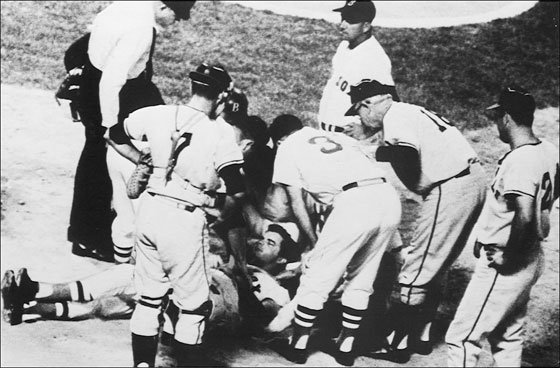
Over 31,000 fans made their way to the Fens to watch the 62-54 Red Sox take on the 62-56 California Angels for Friday's series opener, the first of a four game set with the Halos. Just one week earlier, California had swept a three game series from Boston, sending the Cardiac Kids back to Beantown on a down note in the wake of an ugly 2-7 road trip.   Boston was in the thick of a pennant race, but slipped to fourth place in the standings following a 7-4 loss to the Tigers the day before.  Even so, they were still just three and a half games out of first place when Tony C. stepped up with two outs in the bottom of the fourth inning that fateful night. 

If not for hurling one of the most infamous beanballs of all time, nobody would remember Hamilton and his 32-40 career record, compiled with six different teams across his eight year major league career.  Hamilton had displayed a penchant for wildness since arriving in the Show; as a rookie with the Phillies in 1962 he paced the major leagues in wild pitches (ranked in the top seven three times) and led the NL in walks.  For his career he recorded nearly as many walks (348) as strikeouts (357). The irony was that '67 represented a career year for Hamilton, who went 11-6 with a 3.35 ERA.  He started the season with the Mets, and if he'd remained there he never would have had the opportunity to throw a single pitch to Conigliaro that season (decades before interleague play was introduced).  But, as fate would have it, New York dealt him to California in exhcange for Nick Willhite, an even less effective pitcher who never played another major league game after the season ended.  How such a pointless trade even came to fruition is beyond me.

So while Hamilton was his way to building a forgettable major league career during the '60s, a talented kid named Tony Conigliaro was busy making history.
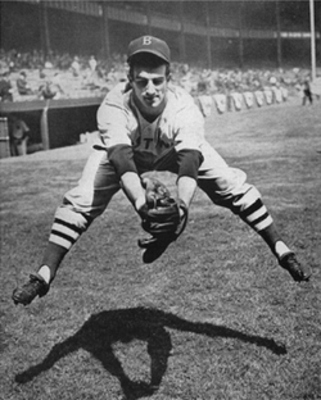
The homegrown boy born in Revere and attended St. Mary's High School in Lynn signed with the hometown team in 1962, the year Hamilton made his major league debut.  He needed all of one year of seasoning down on the farm, where he blasted 70 extra base hits in 83 games, batted .363 and slugged .730.  He was ready.  The Red Sox, coming off their fifth straight season below .500 and struggling to draw fans following the retirement of Ted Williams, wasted no time in promoting the 19 year-old slugger to the big club.  He started on Opening Day, and in his first Fenway Park at-bat he launched a go-ahead home run into the net above the Green Monster off Chicago's Joe Horlen.  The Red Sox won, 4-1, helping lift the spirits of the 20,000+ fans including Ted Kennedy, on hand to represent his slain brother during the somber pregame ceremony.  A star was born.

Broken toes and a broken arm caused him to miss all of August, derailing his stellar rookie campaign.  Had he stayed healthy, he probably would have eclipsed 30, possibly 35 home runs (he finished with 24 in just 111 games, roughly two-thirds of a season) and likely would have given Rookie of the Year Tony Oliva a run for his money.  As it were, he still produced a remarkable .290/.354/.530 triple slash line, good for a 137 OPS+.  The following season, he became the youngest home run champ of all-time when he lead a weak American League in home runs with 32, the lowest total for a league leader in the Junior Circuit since Larry Doby's 32 eleven years before.  He benefitted from a declining Mickey Mantle and injury that limited three-time reigning champ Harmon Killebrew to only 113 games.  Needless to say, he avoided the dreaded "sophomore slump" that plagues so many stars and was one of the few bright spots on a hapless Red Sox squad that lost 100 games.

1966 brought little improvement for the Red Sox, who lost 92 games and barely beat out the Yankees to avoid finishing in last place. At least Conigliaro managed to stay healthy, playing in 150 games and piling up 628 plate appearances, both career highs.  He also posted personal bests in doubles, triples, and walks.  His seven sacrifice flies led the American League.  In '67 he was on his way to another stellar season.  He made his first All-Star team despite missing 21 of 80 first half games.  On July 23rd he slugged the 100th round-tripper of his career with a two-run shot off Cleveland's John O'Donoghue, becoming the youngest player in AL history to reach that benchmark.

He had a reputation for crowding the plate, for standing over the dish and daring opponents to throw inside. But pitchers rarely made him pay for it; he was beaned just five times per season from '64-'67.  When he was slumping, he inched even closer, and on August 18th, 1967 he was in quite a slump; over the previous three weeks he had batted .192/.228/.247 with just one home run. Locked in as the team's cleanup hitter all summer long, he had been dropped him to fifth, and then sixth in the batting order.  He hadn't batted that low in more than two months, but fiery skipper Dick Williams desperately needed one of his top hitters to snap out of the funk, and soon.  After roping a single to center in his first at-bat, perhaps he had finally emerged from the depths. 

But we'll never know.  Just as we will never know how many home runs Conigliaro would have swatted had an errant fastball not curtailed his promising career.  Many believe he would have approached 500.  Through 1967, baseball-reference rated Frank Robinson--a Rookie of the Year, 12 time All-Star, Gold Glove winner, Triple Crown winner, two-time MVP, and first ballot Hall of Famer with nearly 600 career home runs and 3,000 hits--as the most similar player to him. I doubt Conigliaro would have put together that kind of career, especially given his injury woes, but that should give you an idea of the kind of path he was on.

But how many circuit drives would he have amassed?  Let's start in '67.  Had he stayed healthy, I projected Tony to finish the year with 28 home runs--his average from '64 through '66.  Obviously we don't know how he would have performed under the stress of a pennant race, but sabermetrics have proven that such "pressure situations" have little, if any, influence.  Besides, for the sake of the projection you have to remove unforeseen variables such as trades and serioust injuries.  He ends the season with 112 long balls.

He missed all of '68 recovering from his injury, then whacked 20 home runs to take home Comeback Player of the Year honors in 1969.  Accordingly, let's average his projected '67 total with his actual '69 total to give him 24 dingers for 1968.  He now has 156 home runs before his 25th birthday.  In 1970 he enjoyed the most productive season of his abbreviated career, slamming 36 home runs and piling up 116 RBI.  That gives him 192 taters.

A player's prime years span from age 25 through 29, so let's assume he could have sustained that production for another four seasons.  Four multiplied by 36 is 144 additional home runs.  When he celebrates his 30th birthday before the 1975 season, he's sitting on 336 career blasts.  Most players (especially back then) begin to decline during their thirties, so let's have him suffer a 10 percent decline through age 32, followed by a 15 percent decline in his age 33 and 34 seasons, then a 20 percent decline his age 35 seasons gives him 33, 30, 27, 23, 20, and 16 home runs over those six years, an extra 149 four-baggers bringing his career total to 485 through the 1980 season.  All he has to do is hang on for one or two more years and he reaches the magical 500 home run mark at a time when the club was much more exclusive; Hank Aaron, Babe Ruth, Willie Mays, Robinson, Killebrew, Mickey Mantle, Jimmie Foxx, Ted Williams, Willie McCovey, Ernie Banks, Eddie Mathews, and Mel Ott.  A dozen legends, all of whom made it to Cooperstown.

Conigliaro would have followed them there.
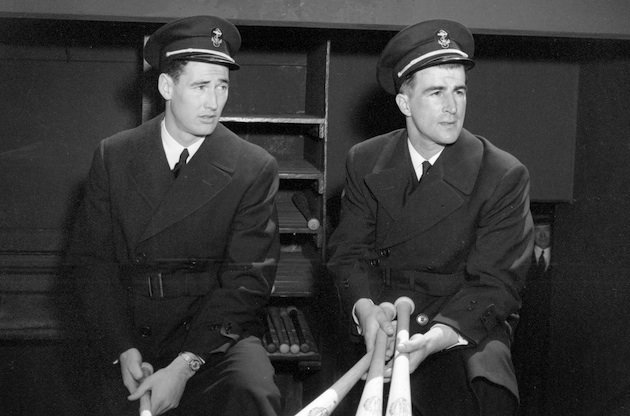
Conigliaro (left) may have passed Ted Williams' total of 521
career home runs and joined him in Cooperstown

Friday, August 17, 2012

Sox-Yanks Preview

The Red Sox wrap up their ten game road trip with a weekend series at The Stadium.  Boston took two out of three last time it was in town three short weeks ago.  Since then the Bosox have gone 7-10, dropping three games below .500 and three additional games behind New York in the standings.  Andrew Bailey and Mark Melancon have returned, but Will Middlebrooks is done for the season and David Ortiz still hasn't returned from his achilles injury.  With the organization embroiled in a toxic blend of controversy, disappointment and widespread dissent off the field on a daily basis, on the field their playoff hopes continue to evaporate with each and every loss.  They are in disarray, and time is running out for them to make a late season playoff push. Yankees, on the other hand, own the best record in the American League at 70-48 and have kept humming along despite losing C.C. Sabathia and Alex Rodriguez in recent weeks. 


Given the two teams' vastly different positions in the standings, these games don't seem to have much significance.  But they do.  With a sweep of the strumbling Sox, New York could bury their rivals' season for good.  Sink the Red Sox ship and send it to the bottom of the ocean.  But if Boston can pull off a stunning sweep, they're back at .500 and maybe, just maybe, will rally and put together that run they've been promising all season long.

Stay tuned.

Friday night: Franklin Morales vs. Phil Hughes
Easily the worst pitching matchup of the series, this one has the makings of a potential slugfest.    Morales (3-3, 3.29 ERA) has been a solid spot-starter in his two August outings, allowing just five hits and four earned runs in eleven and one-third innings of work against the light-hitting Twins and Indians.  Hughes (11-10, 4.44 ERA) has struggled of late and may be hitting a wall after injuries limited him to just 14 starts last season.  He's held Boston to three runs in both of his starts against them this year, but I have a good feeling the offense is going to have a big night against him.  Don't be surprised if this one gets ugly early, forcing Bobby Valentine and Joe Girardi to dip into their bullpens in the middle innings.

My prediction: Red Sox 7, Yankees 5

Saturday afternoon: Jon Lester vs. David Phelps
After putting an abysmal July (9.36 ERA and eight home runs allowed) behind him, Boston's ace has settled down since flipping the calendar to a new month.  In his three August starts the two-time All-Star has a 3.48 ERA--nearly identical to last season's 3.47 mark--with a 23/4 K/BB ratio and no home runs allowed in 20 and two-thirds innings.  After three consecutive starts during mid-July in which he failed to complete the fifth inning, Lester (6-10, 5.20 ERA) has gone at least six in each of his past four turns starting with his last start here. Is coming off his most dominant performance of the season (12 K's against Cleveland), so hopefully he can keep this hot streak going.  Phelps (also 3-3, 2.53 ERA) is filling in for the injured Sabathia.  The rookie has made just four starts in his brief major league career, but it bears mentioning that his last one went well; two earned runs in five innings against the Texas Rangers.  Nobody knows what to expect from him, but I'm fairly confident he won't outpitch Lester, who looks like he's finally turned the corner.

My prediction: Red Sox 6, Yankees 3

Sunday night: Josh Beckett vs. Hiroki Kuroda
Talk about two pitchers going in completely different directions.  Since May 21st, a span of almost three months, Josh Beckett (5-10, 5.19 ERA) has made a dozen starts and gotten the W one time.  One.  His ERA--4.06 at the end of June--has swelled to 5.19.  He made one start against the Yankees this year and it wasn't pretty; eight hits and six earned runs allowed in five innings back on July 6th at Fenway.  Has gotten rocked in each of his two starts this month and just doesn't appear to be the same pitcher he's been in the past.  On the other hand Kuroda (11-8, 3.06 ERA) keeps getting better as the season progresses.  Over his past five starts he boasts a 1.44 ERA and 32/5 K/BB rate while limiting opponents to .213/.247/.290 numbers. Pitched a gem the last time he faced the Red Sox by firing eight innings of two-run ball in a game the Yankees would go on to lose in extra innings.  I actually think Beckett's going to bounce back, but Kuroda will get the best of him in a low-scoring pitcher's duel.

My Prediction:  Yankees 4, Red Sox 2

Thursday, August 16, 2012

Cabrera, Hamilton Power Up

Joey Votto is the better pure hitter.  Adam Dunn, Jose Bautista and Giancarlo Stanton have more raw power.  Robinson Cano has the smoothest swing.  But there's no question that when it comes to hitting homers and driving in tons of runs, the top two power hitters right now are Miguel Cabrera and Josh Hamilton, both of whom are enjoying what could be the finest seasons of their careers.  For the latter, it couldn't come at a better time as he's just a few months away from free agency.  If he stays healthy (a big if, but I'm betting he will) and finishes the year with .300-45-135 numbers, possibly another MVP and his first World Series ring if everything goes according to plan, he should be all set to make a pretty good chunk of change.

Hamilton, who's gone yard five times in the past week after hitting just four in his previous 29 games, holds the advantage in the home run department.  The 2010 AL MVP is tied with Dunn for the major league lead with 34 big flies--already two more than his previous career high--and could be poised for the kind of awesome power binge he displayed in April and May. Miggy is locked in a four-way tie for third place with Josh Willingham, Edwin Encarnacion and Curtis Granderson, all of whom are sitting on 30 dingers.  Iinterestingly, seven of the top eight home run hitters to date play in the Junior Circuit, with Ryan Braun as the exception.  Cabrera has never socked 40 round-trippers in a single campaign--his personal best is 38--but with a strong September the seven time All-Star could clear that benchmark for the first time in his career.  Still, he doesn't figure to catch either Hamilton or Dunn, who still have an outside shot at 50 but will probably settle in the mid-forties.

Cabrera has a slight edge in runs batted in, leading Hamilton 103 to 101.  No one else has more than Willingham's 88.  The Detroit Tiger should have more than Hamilton, given that the former has the benefit of 53 additional plate appearances and has batted with 48 more runners on base this season.  MC Hammer seems to add to his growing RBI total everyday; he has already piled up 18 ribbies this month and has 47 in his past 46 games.  He's well on his way to blowing past his career high of 126 set two seasons ago.  Hamilton will keep getting plenty of chances to catch Cabrera with Ian Kinsler and Elvis Andrus setting the table for him, though.

Wednesday, August 15, 2012

Felix Finds Perfection

Today Felix Hernandez, unquestionably one of the best pitchers in baseball, hurled the 23rd perfect game in major league history.  Unfortunately, it was overshadowed by Melky Cabrera's 50 game suspension for a failed drug test.

 I don't want to talk about one player's mistake; I want to celebrate another's excellence.  This special achievement represented the first of his eight-year career, the first in Mariners history and the third already this season, setting a record for most perfect games in one year.  Interestingly, two of the three perfect games this season--Philip Humber's in April was the other--have shared the exact same setting; a day game at Safeco Field.  22,000+ were on hand for that one, a game that lasted two hours and 17 minutes, while just under 22,000 fans showed up for this gem, which lasted all of five minutes longer.  At least this time around the home team was on the winning side of the perfect game, albeit barely.

And unlike the Humber game, an unsuspecting masterpiece produced by a pedestrian pitcher, this particular perfecto (like Matt Cain's--fourteen strikeouts!) was akin to art in the highest form.  Like watching Vincent van Gogh paint "The Starry Night."  Hernandez, the 2010 AL Cy Young winner and a three time All-Star, submitted a truly dominant performance.  He needed 113 pitches to set down all 27 Rays.  His best stuff was on display as he punched out a dozen Tampa Bay Rays, whiffing every member of the starting nine except for leadoff hitter Sam Fuld. That makes five starts this season with double digit strikeout totals for #34. King Felix struck out the side in the sixth and eighth innings, including five of the final six batters he faced, seemingly gaining strength as he approached the finish line. He fanned Evan Longoria, Elliot Johnson and Sean Rodriguez two times each. By comparison, the entire Seattle lineup struck out twice.

As always, Hernandez had no margain for error.  The light-hitting Mariners managed to score just once off 2011 AL Rookie of the Year Jeremy Hellickson.  Hellboy went toe-to-toe with Seattle's ace, firing seven innings of one-run ball while permitting just five hits and a walk. On most days, the 25 year-old cruises to an easy win with that pitching line.  Instead, he's the tough-luck loser on the wrong end of a remarkable pitching duel.  And for that, he has no one to blame but himself.   His wild pitch in the third inning allowed Brendan Ryan to advance to third base, just in time for Jesus Montero to rip a two-out RBI single into left field.  Because of that one mistake, his record falls to 7-8 and the Rays slip a half game behind Baltimore in the standings. 

But it's not fair to knock Hellickson, who was outstanding in his own right.  He lost because the Rays batted a collective 0-for-27.  They'd like to forget this exercise in futility and move on, but the truth is that they have struggled to score runs on a consistent basis in 2012.  In fact, Tampa Bay fields one of the worst offenses in the American League.  They do rank first in walks and stolen bases, but in every other meaningful category they find themselves at or near the bottom of the totum pole.  Various injuries to key players such as B.J. Upton, Desmond Jennings, Luke Scott, Matthew Joyce and Evan Longoria have depleted the lineup all season long.  To make matters worse, the few who have managed to stay healthy--Carlos Pena, Ben Zobrist and Sean Rodriguez--are underperforming.  So even though the entire lineup has either slumped or gotten hurt, the resilient Rays continue to win because they are one of the best teams when it comes to preventing runs.  The pitching staff features a strong rotation headed by Hellickson, David Price, James Shields, and Matt Moore, all of whom are backed by a bullpen that is nearly untouchable thanks to closer Fernando Rodney.  Pair that depth with a top notch defense and it's not hard to see why Tampa Bay leads the Junior Circuit in ERA.

I'm not trying to take anything away from Hernandez, just trying to provide the proper context.  Tampa had little more than a puncher's chance against the King this afternoon because the odds were stacked against them. What were they supposed to do on the road, in a tough park for hitters, with their pathetic offense pitted against a red-hot pitcher who hasn't dropped a decision in more than two months and posted a 1.73 ERA in the eleven starts preceding this one? As Will Ferrell retorts in The Other Guys, "You lose that battle nine times out of ten!" Complete and utter domination is nothing new to the 26 year-old, though. The historic effort marked Hernandez's fourth shutout of the season, all of which have come in the past six weeks. He now moves ahead of Toronto's Brandon Morrow (DL) for most in the majors. In the process he lowered his ERA to 2.60 and improved his record to 11-5 in the season.  His 174 strikeouts tie Justin Verlander for second most in the AL behind Max Scherzer.  Barring some sort of Tim Lincecum-esque slump, he's a surefire bet to receive serious Cy Young consideration.

His next start isn't exactly a challenge, either.  He'll face the Indians on August 21st and with the way they've been struggling--just seven wins dating back to July 19th including an eleven game losing streak--his summerlong hot streak should continue.  It is worth noting, however, that Cleveland tagged him for eight runs (six earned) and knocked him out of the game in the fourth inning in their last meeting, which came all the way back on May 16th.

No way that happens again.

Pesky Remembered


Pesky is gone, but will never be forgotten
It is a sad day in Red Sox Nation.  Not because the Old Towne Team is underachieving again, two games below .500, 64-79 since last September 1st, and eleven and a half games out of first place.  Not because nearly everyone on the team has been injured at some point, and those who haven't--Jon Lester, Adrian Gonzalez--are underperforming. And no, not because tragedy already befelled them earlier in the year when they lost beloved PA announcer Carl Beane to a heart attack/car accident (this is getting depressing).  So in a season where everything has gone wrong, it was like pouring salt in an open wound when Red Sox legend Johnny Pesky passed away yesterday at the age of 92.  Appropriately, he lived long enough to take the field for Fenway Park's 100th anniversary celebration back in April, when more than 200 former players and coaches attended the ballpark's giant birthday party.  After all, having a Fenway centennial without Johnny Pesky would be comparable to eating Oreos without milk; you can't have one without the other.

Pesky made an immediate impact with one of the
more underrated rookie seasons in baseball history.
John Michael Paveskovich, the son of Croatian immigrants, lived a long and full baseball life that spanned 73 years.  It began when the Boston Red Sox signed him as an amateur free agent in 1940.  After batting .325 in each of his two years of minor league seasoning, Pesky was clearly ready for the Show.  He hit the ground running by putting together one of the more underappreciated great rookie campaigns of all time in 1942.  Penciled in at the two-hole from day one, the 22 year-old shortstop used his remarkable bat control to spray line drives all over the field.  Pesky was worth 5.2 bWAR after scoring 105 runs and pacing the majors with 205 base knocks.  He batted .331/.375/.416, helping spark Joe Cronin's second place Red Sox to 93 wins and earning a third place finish in the AL MVP balloting behind Joe Gordon and Ted Williams for his efforts.  He finished second to Williams (who won the major league Triple Crown that season) in the batting race and laid down a major-league best 22 sacrifice hits.  What a teammate!

But World War II interrupted his career, as it did for stars of the time such as Bob Feller, Hank Greenberg, and Joe DiMaggio.  Pesky served in the navy, losing all of 1943, '44 and '45.  Based on his 1942 and 1946 production, one can assume that he missed out on at least 300 runs scored and 600 hits. Had he remained healthy during those years and maintained his production, he would have ended up with around 1,200 runs scored, 2,100 hits, 300 doubles, 800 walks and 2,600 total bases. Not first-ballot Hall of Fame numbers by any means, but he probably would have gained entry through a Veteran's Committee as contemporary shortstops Phil Rizzuto and Pee Wee Reese did. Even with the three missed seasons, his numbers are still in the same ballpark as Rizzuto's and Lou Boudreau's. I'm not saying he belongs in Cooperstown, but you could certainly make the case. To see a more detailed comparison/argument, read Jay Jaffe's article for SI.com.
Williams (left) and Pesky both sacrificed three prime years to the war effort
Pesky didn't skip a beat upon returning in 1946, the best year of his career.  He finished fourth in the MVP voting and set personal bests with 208 hits (first in the AL), 43 doubles,.335 batting average, .427 SLG, .827 OPS, 125 OPS+, 265 total bases, and 6.4 bWAR  He earned his only All-Star selection that year as the Junior Circuit's starting shortstop in the Midsummer Classic, joining teammates Teddy Ballgame, Dom DiMaggio, double play partner Bobby Doerr, Rudy York, Dave Ferriss, and Mickey Harris. Fenway Park hosted the event that year, the first of three All-Star games that have been played in its friendly confines.  Pesky went hitless in two at-bats, bouncing into a double play before Vern Stephens replaced him in what became a 12-0 rout of the National League.  But Pesky and his comrades had their eyes set on a much bigger prize, for this was the year a juggernaut Boston squad won 104 games and cruised into the World Series, heavily favored to dispose of Stan Musial's St. Louis Cardinals.  Pesky struggled in his lone Fall Classic appearance, batting just .233 with no extra-base hits, zero RBI and only two runs scored.  Worst of all, he became the scapegoat for Boston's Game 7 loss when he reportedly held the ball as Enos Slaughter made his mad dash for home, a play that defined his career and established his role in Boston's fabled "Curse of the Bambino."  Pesky would spend much of his life denying any hesitation in that critical moment, and the film evidence backs him up (though he didn't get much on his relay throw the plate).  The Red Sox would not capture another AL pennant until 1967, long after Pesky and company hung up their spikes for good.

"The Needle" didn't let that one mistake come back to haunt him in '47, as he once again led the league in hits, scored more than 100 runs and batted .324.  But Boston's starting rotation was decimated by arm troubles to Ferriss, Harris and Tex Hughson, causing the defending AL champs to slip to third in the standings. In 1948 he shifted over to third base to accomodate Stephens (something captain Derek Jeter refused to do for Alex Rodriguez more than half a century later), and while his batting average tumbled to .281 he set personal bests in runs scored with 124 and home runs with three.  His strong play wasn't enough to save the Red Sox from their own manager Joe McCarthy, who infamously bypassed Mel Parnell in favor of journeyman Denny Galehouse to start the do-or-die one-game playoff game against the Indians with the pennant on the line.  Galehouse was bombed, and the Sox went home empty-handed. From 1949-'51 Pesky continued to floruish, batting north of .300 and posting OBPs well above .400 each season, but Boston just couldn't get over the hump.

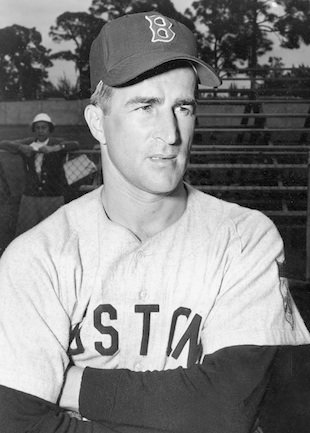
Pesky in 1952, his final season playing
with the Bosox
Then, like so many players of the day, Pesky couldn't sustain his success for long as his career fizzled out in his early thirties. Boston included him in a massive nine player trade with Detroit on May 27th, 1952, a deal that also featured 1950 Rookie of the Year Walt Dropo, former batting champion/future Hall of Famer George Kell, plus All-Stars Hoot Evers and Dizzy Trout. After enduring an abysmal start to the season (.149/.313/.179 through 35 games) in Beantown, Pesky failed to improve much in the Motor City. His days as an everyday player were behind him. The following season he slid over to second base and bounced back to bat .292. But his resurgence was short lived, and his career was winding down.  In 1954 he found himself riding the pine more often than not.  Detroit swapped him with Washington's Mel Hoderlein, a professional benchwarmer, indicating that the end was near. Fittingly, Pesky played his final game at Fenway Park against the Red Sox on September 24th, 1954.  The Senators released the 35 year-old veteran during the offseason, then the Orioles took a flier on Pesky before they, too, released him just before the '55 season got underway.

The playing phase of his career was over, but the second stage of his baseball life had just begun.

Ironically, he got his first coaching gig with the New York Yankees organization in 1955 for their Triple-A organization.  He returned to Detroit as a manager in their farm system from '56 through 1960.  In '61, the year Mickey Mantle and Roger Maris captivated the naiton with their thrilling home run chase, Pesky's career came full circle when he rejoined the Boston Red Sox, first as a Triple-A manager in the Pacific Coast League.  After guiding the Seattle Rainiers to a pair of winning seasons, Tom Yawkey named him as Red Sox manager after promoting Pinky Higgins to general manager.

Unfortunately, Pesky inherited a team with a reputation as a country club because it was neither very good nor very motivated.  The once-proud franchise was mired in a lengthy rut as they paid the price for being the last team to integrate, and were content to finish in the second division while the Yankees ran away with the pennant every year.  To his credit, Pesky tried to change that culture and light a fire under his team, but the stubborn veterans did not co-operate (Four years later, Dick Williams brought the same intentions and succeeded because the "Impossible Dream" team was so young and impressionable).  As always, the 1963 Bosox had a formidable lineup headed by the slugging "Dr. Strangeglove" Dick Stuart, slick-fielding All-Star third baseman Frank Malzone and Carl Yastrzemski, the Splendid Splinter's replacement in left field who would win the first of three batting titles that season.  Surprisingly, the Sox jumped out to an 18-11 start and were in first place as late as May 19th, but couldn't maintain their hot start and quickly faded as the weather heated up.  The pitching faltered and the beleaguered Bostonians finished with 76 wins, the same number of games they won the year before. In '64 they were even worse, dropping 90 games before Pesky was dismissed with two games remaining on the schedule (which the Red Sox would lose under new skipper Billy Herman).  The potent lineup, bolstered by teenage rookie sensation Tony Conigliaro, simply couldn't score enough runs to cancel out the damage done by an atrocious pitching staff.  At a time when baseball was becoming dominated by pitching, Pesky simply didn't have the necessary arms at his disposal to compete.

Pesky remained a familiar face at Fenway well
into his golden years
After a four year hiatus with the Pirates organization, Pesky returned to the Red Sox for good in 1969.  And the rest, as they say, is history.  He served as a color commentator on both radio and TV, then donned the Red So uniform again in 1975 as a first base coach under manager Darrell Johnson, who helmed a colorful bunch--led by Gold Dust Twins Jim Rice and Fred Lynn--to the American League pennant.  Three decades later it must have felt like deja vu for Pesky given the many parallels between the trajectories of the late 1970s Red Sox and their forefathers from the 1940s; the Sox coasting to the Series but just miss out on the title by falling short in Game 7.  Boston's young, talented nucleus poised to launch a dynasty that never was, thwarted by incompetent managers, bad breaks and late season collapses while the hated Yankees continued to add to their impressive October history.  In 1980 he was both a batting coach and a bench coach before filling in as interim manager after Don Zimmer was fired with five games left in the season (the slumping Sox were defeated in all but one).  He resumed his duties as a coach through 1984 before becoming a special instructor, the title that he held until his final breath.

Some more interesting stats from Pesky's playing career;
  • He finished his career with 662 walks versus just 218 strikeouts, an incredible 3:1 ratio.  In 1951 he drew 100 free passes while whiffing just 19 times in 573 plate appearances.  Times sure have changed.
  • One thing Pesky didn't do was hit for power, as his seventeen career homers--only six of which came at Fenway--.386 SLG and .079 ISO (that's Juan Pierre territory) can all attest.  In 1947, he piled up 719 plate appearances and somehow went homerless.  His diminuitive, Dustin Pedroia-like stature (5'9, 168 pounds) probably had something to do with that.  In fairness though, his job was to get on base and set the table for Boston's big bats, a role in which he excelled. His phenomenal career .394 on-base percentage would make Billy Beane smile, ranking higher than greats such as Rod Carew, Joe Morgan, Frank Robinson and Tony Gwynn. As he matured he began trading hits for walks, reaching triple digit walk totals in 1949 and 1950. 
  • Pesky wasn't a good basestealer, either, as he was caught stealing in 49 of his 102 attempts.  Interestingly, 20 of his 53 stolen bases came in the month of August.
  • .321 career batting average at Fenway Park.
  • Had six seasons where he batted north of .300.
  • His career OBP is six percentage points higher than his SLG, a rarity.
  • Was a second half player, batting .319/.403/.397 after the All-Star break compared to .293/.385/.374 before it.
  • Hit just one home run in April, and one in September.
Sadly the man who was born on the day Babe Ruth played his last game for the Boston Red Sox, who accepted less money to sign with them and went on to dedicate 61 years of his life--sticking with them through the good times and the bad--to the organization, who has the right field foul pole named after him and his number six retired on the grandstand roof in America's most beloved ballpark, who became a franchise icon, a Red Sox ambassador and member of the team's Hall of Fame, is gone.

But the memories, his accomplishments, and the impact he had on the game lives on.  We'll miss you, Johnny Pesky.  The Red Sox won't be the same without you.
Pesky tips his cap to the Fenway Faithful