Showing posts with label New York Yankees. Show all posts

Saturday, January 26, 2019

Stottlemyre the Savior

Stottlemyre helped extend the post-war Yankees dynasty one more year (NYT)
Earlier this month, former MLB pitcher and pitching coach Mel Stottlemyre passed away from cancer. He was 77.

In an 11-year playing career spent entirely with the New York Yankees, Stottlemyre distinguished himself as one of the best pitchers in franchise history. A five-time All-Star, Stottlemyre averaged 15 wins per season while compiling a sparkling 2.97 ERA for his career. He was also a workhorse, topping 250 innings every year from 1965-1973 and leading the American League in complete games twice.

That success on the mound served Stottlemyre well over the next three decades, first as a roving instructor and then as a pitching coach. He tutored some of baseball's best hurlers during stints with the Mariners, Mets, Astros, and Yankees, including Dwight Gooden, Roger Clemens, Andy Pettitte, Felix Hernandez, Mike Mussina, and the great Mariano Rivera. While he never won a World Series as a player, his teams won five championships with him on the bench.

Stottlemyre's greatest accomplishment on the field, however, was helping pitch the Yankees to the 1964 pennant as a 22-year-old rookie. After winning 104 games and the pennant in '63, New York got off to a slow start in '64 under new skipper Yogi Berra, who had trouble reining in the same players who'd been his teammates and drinking buddies the year before. When Stottlemyre arrived in August to stabilize the rotation, the Yanks were in third place and 3 1/2 games out of first, putting them in jeopardy of missing the World Series for the first time in five years.

The season seemed to be slipping away when Stottlemyre took the hill for his first Major League start on Aug. 12 against the second-place Chicago White Sox, who had taken the first two games of a four-game set at Yankee Stadium. Having lost seven of their previous nine, the Yankees were in desperate need of a spark from the fresh-faced 22-year-old, who was leading the International League (AAA) with 13 wins, six shutouts and a 1.42 ERA at the time of his call-up.

Stottlemyre answered the bell, tossing a complete-game seven-hitter to halt New York's skid. Even the offense appeared rejuvenated, bashing four homers in support of the rookie, who hadn't even received an invitation to Spring Training just a few months before. It was, in the words of New York sportswriter Til Ferdenzi, "movie script stuff."

Stottlemyre's next pressure-packed start came four days later in Baltimore against the first-place Orioles, led by eventual league MVP Brooks Robinson. That didn't faze Stottlemyre, however, who limited the O's to just one run on five hits over 8 2/3 sterling innings. A rare error by Clete Boyer with two outs in the ninth prevented Stottlemyre from notching his second straight complete game, but once again he had come up big for the Yankees.

Stottlemyre wasn't getting much help from his teammates, however, who promptly dropped six in a row before his next turn on Aug. 22, falling 5 1/2 games back of the Orioles and seemingly out of the race. The sputtering Yankees once again turned to Stottlemyre to stop the bleeding, and once again he responded, delivering a complete-game shutout in the nightcap of a doubleheader at Fenway Park to keep their pennant hopes alive.

The win proved to be a turning point, igniting a furious 30-11 run by the Yankees to close out the season that featured six additional Stottlemyre victories -- three of which were complete games. He won five straight starts during the heart of that stretch, including the game that moved New York into first place for good on Sept. 17. When the dust settled in early October, Stottlemyre had gone 9-3 with a 2.06 ERA across 96 innings, helping New York overtake Chicago and Baltimore in the standings to capture the pennant by a single game.

After putting the Yankees over the top during the regular season, he nearly did the same in the World Series. After New York lost Game 1 in St. Louis, Stottlemyre bested the Cardinals' Bob Gibson in Game 2 to even the series. The duo squared off again in Game 5 at the Stadium, with Stottlemyre twirling seven innings of two-run ball. The Yankees lost in the 10th, however, after Tim McCarver belted a crushing three-run homer to put St. Louis up in the series. The Yanks bounced back to win Game 6, forcing a Game 7 showdown between Stottlemyre and Gibson, both of whom were working on two days' rest.

The pair traded zeroes through three innings before Stottlemyre stumbled in the fourth, giving up three runs after shortstop Phil Linz threw away a potential double play ball. Berra lifted his young star for a pinch-hitter in the top of the fifth, only to watch the bullpen immediately surrender three more runs in the bottom of the frame. A 6-0 deficit against Gibson proved to be insurmountable for even the mighty Yankees, who rallied for three homers but ultimately fell short, losing 7-5.

Still, the future appeared bright for Stottlemyre, who appeared poised to be the next great Yankee ace. He lived up to his end of the bargain in '65, winning 20 games even as the team crumbled around him. Despite toiling for generally mediocre clubs, he established himself as one of the best pitchers in baseball over the next decade, ranking fifth in wins and second in innings from 1965-1973. Had his career not ended when he was just 33 years old, he'd probably be in the Hall of Fame, alongside several pitchers he later went on to coach.

So while the Yankee dynasty died a painful death in the mid-60s, Stottlemyre helped wring one more pennant out of its aging core, proving to be one of the most impactful midseason call-ups in baseball history. It may not have had the ending he or his teammates wanted, but it still made for a pretty good story.

Wednesday, July 12, 2017

Aaron Judge is Also the New Babe Ruth

A couple weeks ago I wrote that Aaron Judge is the new Mike Trout. With Trout coming back on Friday, however, Judge needs a new comparison, and quick. Thankfully his epic Home Run Derby performance revealed his true colors.

Judge is not Mike Trout 2.0: he's a modern-day Babe Ruth. Both are larger than life (literally, in Judge's case) who demolish baseballs, strike out a lot and play right field for the Yankees. I don't believe in re-incarnation, but Judge might actually be Ruth brought back to life.

That might even be under-selling Judge a little. Ruth hit some long ones during his day, but I'm not sure he could do this:

Monday, May 1, 2017

Ellsbury's Slam Saves Yanks

Ellsbury's 100th career homer was also his first grand slam (New York Daily News)
In the seventh inning of Friday night's wild slugfest at Yankee Stadium, which New York won 14-11 in 10 innings despite trailing 9-1 in the sixth and 11-4 in the seventh (way to go, Orioles bullpen), Yankee center fielder Jacoby Ellsbury did something he'd never done before in a Major League game.

New York trailed by seven runs when Ellsbury stepped to the plate with the sacks full and one out in the bottom of the seventh. The Yankees were threatening, but they desperately needed a hit from their cleanup man, who was 0-for-3 to that point (why's he hitting fourth in the first place?!). Their chances of winning were three percent, and it was starting to get late real early in the Bronx.

Hoping to keep the rally going, Ellsbury got himself into a 2-1 count against lefty Vidal Nuno, who was looking shaky after allowing Chase Headley to double and walking Matt Holliday to load the bases. Now Nuno needed to throw a strike, and everyone in the park knew it.

But as he lifted his right leg and aimed a 92 mile-per-hour fastball towards home plate, the possibility of a grand slam seemed remote. For starters, Ellsbury has never been much of a power hitter, reaching double digit homers only twice in 11 seasons. When he does go yard, it tends to be against right-handers and in the second half. The platoon split has become even more pronounced recently, as he managed just one homer in 196 plate appearances against lefties last year.

Career vs. RHP: 1 homer per 39 at-bats
Career vs. LHP: 1 homer per 75 at-bats

Career before July 1st: 1 homer per 71 at-bats
Career after July 1st: 1 homer per 34 at-bats

He also homers less frequently from the seventh inning on (about once every 54 at-bats), but the gap there is less substantial.

There was also the fact that Ellsbury had as many career grand slams as the nearly 37,000 non-Major Leaguers in attendance that night. He had hit 99 home runs, but none with ducks on the pond. He'd plated 73 runs in 106 bases-loaded plate appearances and amassed 478 career RBIs, but never four at once.

So, to recap: Ellsbury hitting a home run at all -- unlikely. Ellsbury hitting a home run off a lefty in April -- even more unlikely. Ellsbury knocking a grand slam out of the park -- unprecedented. The only thing working in Ellsbury's favor was Nuno's propensity for serving up long balls (career 1.5 HR/9 rate), but even that doesn't mean much when you consider that he's only thrown 340 innings in his career.

But that's the beauty of baseball. There are so many games and pitches and at-bats that crazy things happen all the time. Just this weekend, Anthony Rendon went 6-for-6 with three homers and 10 RBIs, the Dodgers drilled three straight homers before walking off in the bottom of the ninth, and Jacoby Ellsbury finally hits a grand slam.

How could he not? That pitch from Nuno was a meatball, straight as an arrow and right down Broadway. A batting practice fastball just begging to be crushed.

And Ellsbury crushed it alright, launching it 417 feet into the right-center bleachers -- his longest homer of the season by 35 feet. The scoreboard read 11-8, the Stadium was rocking, and New York's chances of victory had soared from three percent all the way to...10 percent. The psychological shift, though, was much greater. Teams almost never come back from seven-run deficits, particularly in the late innings. There's just not enough time, and bullpens are too deep nowadays. But get a few men on in an inning, and a three-run lead can disappear with one swing.

Sure enough, Ellsbury's blast proved to be a turning point in the game. The Orioles were so demoralized that after piling up 11 runs in the previous five innings, they managed only one baserunner over the next three frames. The rejuvenated Yankees, meanwhile, rallied to tie the game with three runs in the ninth before completing their epic comeback with three more in the tenth.

It took more than 5,000 plate appearances over 11 years for Jacoby Ellsbury to hit his first grand slam. At that rate, it might also be his last. But if it is, at least he made it count.

Sunday, August 21, 2016

Jeter was no A-Rod

The numbers don't lie: A-Rod was much, much better than Jeter (Complex)
My friend and I got into a contentious Facebook argument the other day debating the merits of the recently retired Derek Jeter and the even more recently (but not officially) retired Alex Rodriguez. My buddy -- a lifelong Jeter disciple -- posed a simple question: Who is a better all-time player, Jeter or A-Rod?

My response: https://www.youtube.com/watch?v=HvkKd572vCw

To which my friend replied, "It's closer than you think..."

Actually, it's not, I thought to myself. But, wanting to end the debate right then and there, I waited until I got home so I could log on to Baseball-Reference and provide the overwhelming statistical evidence proving that while Jeter was a great player, he wasn't even in A-Rod's league. I wanted to hit him with some truth, Kenny Powers-style.

Sure enough, when I clicked over to B-R's handy WAR leaderboard, I found the unassailable proof I was looking for. Nestled in 12th place, between Ted Williams and Lou Gehrig, is Alex Rodriguez. Scroll further down the list, and you'll find Jeter lodged at 58th, between Harry Heilmann and Rafael Palmeiro. That should tell you all you need to know about their respective places in baseball history.

The difference between them is exactly 46 WAR, which is a lot. It's more than several Hall of Famers totalled in their careers, as well as near Hall of Famers such as Gil Hodges, Dave Parker, and Omar Vizquel. Current players with less include Jimmy Rollins, Joey Votto, Matt Holliday, and Ryan Braun -- all of whom have been playing at a high level for at least a decade. Add their careers to Jeter's, and you still don't have A-Rod's career.

Looking at it another way, a five-win season constitutes an All-Star caliber year. That means you could add nine All-Star seasons to Jeter's resume, and he'd still fall short of Rodriguez.

Like I said, not even close.

Even if WAR's not your bag, it still shouldn't be hard to see why A-Rod was the better player. As a hitter, he holds the edge in almost every meaningful category except for batting average, which is negated by his slight edge in OBP. Rodriguez was also a much better power hitter: Jeter had good power for a shortstop, but A-Rod was one of the best sluggers of all time (and the greatest slugging shortstop ever).  He places in the top 10 all time in runs (8th), runs created (8th), total bases (6th), extra-base hits (6th), home runs (4th), and RBI (3rd), Jeter does not have a top-10 ranking in any of those categories. The only one he does is hits (6th), which is largely a function of all the at-bats he received (7th-most all time) and singles he recorded (5th-most).

A-Rod was also the superior baserunner, though not by an overwhelming margin. FanGraphs credits him as being worth 35 baserunning runs during his career, while Jeter checks in at just a shade under 24. That's the difference of roughly a win over the course of their careers, which is pretty negligible. Baseball-Reference has them dead-even with 56 baserunning runs apiece, but I'm inclined to split the difference based on their base-stealing records. Rodriguez swiped 329 bases at an 81.2 percent success rate, whereas Jeter made 358 thefts at a 78.7 percent clip. A-Rod also grounded into 26 fewer double plays despite batting with many more men on base.

And then there's the issue of defense, which is muddled somewhat by Rodriguez's transition to third base midway through his career. Still, anyone claiming Jeter was a better shortstop is delusional. Jeter didn't win any Gold Gloves until after Rodriguez, already a multi-Gold Glove recipient with Texas, changed positions and helped Jeter cover the left side of New York's infield. Had Rodriguez stayed at shortstop, he likely would have added to his trophy case and denied Jeter the chance of ever winning.

That's might be speculation on my part, but the numbers back it up. As with hitting, every defensive metric under the sun rates Rodriguez ahead of Jeter. FanGraphs has A-Rod's final defensive value at plus-64 runs, while Jeter's is negative-29.7. The figures compiled by Baseball-Reference are even more disparate; Rodriguez saved his teams 25 runs in the field whereas Jeter cost his a whopping 246--approximately 25 wins.

Ouch.

Anyone who watched Jeter play on a regular basis knows this to be true, as he was so inept at reaching balls his to his left (up the middle) that fans frequently referred to him as "Pasta," as in "past a diving Jeter." He was great at going into the hole, and his gravity-defying jump-throws will live on as one of baseball's enduring images, but in the aggregate he hurt Yankee pitchers much more than he helped him.

My friend pointed out that Jeter won five Gold Gloves, which are voted on by coaches and managers. Well, just because Jeter won them does not mean he deserved any of them. I don't want to get sidetracked by digressing into why Gold Gloves fail to recognize the best fielders (basically, they're influenced too much by reputation and are susceptible to bias by the voters, who only see opponents play a handful of times every year), but I would just like to point out that Rafael Palmeiro received a Gold Glove in 1999 despite spending 128 games as a designated hitter. So yeah, maybe don't mention Gold Gloves, especially since Jeter wouldn't have any had he changed positions to accommodate Rodriguez in 2004.

But no, it was Rodriguez who moved to third base despite winning the two previous Gold Gloves at shortstop (which he did not deserve either, but at least he was above average defensively, whereas Jeter clearly was not). If Jeter was such a great teammate, how come he didn't do what was best for the team and shift to the hot corner? Granted, the Yankees never asked him to do this (as far as we know), but they shouldn't have had to. History is filled with great players changing positions (Ernie Banks, Cal Ripken Jr., and Robin Yount all moved off shortstop, for instance), but Jeter never did, even when it became apparent in his final seasons that his defense was actively harming his team. There were opportunities to move to second base and center field as well, but Jeter did not step forward and thus stayed put.
A-Rod and Jeter weren't particularly close as friends, or as ballplayers (NY Post)
As our war of words heated up, my friend never tried to make an informed statistical argument on Jeter's behalf. Jeter fans never do, because they know it is a lost cause. As incredible as Jeter's numbers are, they simply don't measure up to A-Rod's. Jeter fans have always known this and always accepted this, because Jeter's contributions extend beyond the box score. "Sure, Rodriguez has better numbers," they say, "but...(insert comment about Jeter being more clutch, a better teammate, and/or a winner)."

Not surprisingly, my friend made that exact argument.  "Jeter made everyone around him better," he informed me. "A-Rod did not."

There it was. No longer was our argument over WAR and postseason performance and Gold Gloves that may or may not have been earned. My blood immediately began to boil.

First of all, there is absolutely no way to quantify this mythical teammate effect, which works both for and against the argument. On the one hand, I can say that being a good teammate is meaningless given the number of jerks throughout sports history who nevertheless made their teams better through their mere presence (Manny Ramirez, Reggie Jackson, Barry Bonds, and Roger Clemens come to mind). On the other hand, my friend can say Jeter added five or ten wins to the Yankees every year through his intangibles, and I can't definitively prove him wrong. There's no stat measuring leadership, unfortunately.

My buddy failed to explain how Jeter made his teammates better or why Rodriguez didn't. He didn't have to, because we both knew what he meant. Jeter was "The Captain," a calming presence in the clubhouse and, above all else, a "winner." Rodriguez was captain of the Rangers for about a day before they shipped him away to New York, where he immediately became a perceived choke-artist and a constant source of distraction and controversy for his team. The Yankees would have followed Jeter off a cliff and wouldn't have hesitated to shove A-Rod off one.

That's the perception, at least, but by all accounts Rodriguez was a great teammate. He led by example with his tireless work ethic, and mentored young players everywhere he went. Michael Young and Mark Teixeira credit A-Rod for showing them the ropes in Texas, while it's no secret that Rodriguez took Melky Cabrera, Robinson Cano and others under his wing in New York. If A-Rod didn't make his teammates better, then surely the Yankees wouldn't be letting him stay on in an advisory role. And how come Jeter doesn't have a similar title? Then again, I don't seem to remember him doing much tutoring on the side during his playing days.

But that's all besides the point, because what does any of that have to do with making your teammates better? You know what makes your teammates better? Getting on base for them so they have guys to drive in. Knowing when to take your walks and pass the baton but also knowing when to expand your strike zone for the sake of getting runners home, and by taking the extra base. Playing sound defense in the field, so that your teammates have less ground to cover and your pitchers aren't afraid of pitching to contact. You know, stuff that actually helps teams win ballgames.

Rodriguez did all of these things better than or just as good as Jeter, making him a much more valuable player. Going by the above WAR differential, we see A-Rod contributed two more wins to his teams than Jeter did every year on average. A-Rod's superior value came across in MVP results as well as earnings, with Rodriguez earning three MVPs to Jeter's none (apparently Jeter's leadership couldn't have been too valuable) and making more money from his age-33 season onward than Jeter made in his entire career.

But I want to get back to the teammate thing for a second, because I have a real axe to grind there. First of all, it has been my humble opinion that Jeter's intangibles have always been grossly overrated. Yes, Jeter's teams always won, but a big reason why was because he happened to be in the right place at the right time. He debuted with the Yankees in 1995, just as the  franchise was emerging from its dark days of the 1980s and early '90s. While their first championship since 1978 coincided with his Rookie of the Year campaign in '96, he didn't transform them into winners overnight. They were leading the AL East when the players' strike cut the season short in 1994, and they reached the postseason with him playing all of 15 games the following year. Andy Pettitte, Jorge Posada, Mariano Rivera and Bernie Williams were already there, supplementing talented veterans such as Paul O'Neill, David Cone, Wade Boggs, Don Mattingly, Darryl Strawberry, Ruben Sierra and John Wetteland. The Yankees would have still be stacked without Jeter; they probably don't win four rings in five years without him, but they still win at least a few.

And what if Jeter hadn't been a Yankee at all? What if one of the five teams that passed on him in the 1992 draft had taken him instead? He could have been an Astro, or an Indian, or even an Expo. Can you imagine how different his career would have been had he spent the first half in Montreal? Jeter was incredibly lucky, which isn't a knock on him because all careers require some amount of luck, but try to picture him in a Reds uniform or an Orioles uniform. You can't. He was born to wear pinstripes.

But also, think about what that means for a second. Five teams had the chance to draft Jeter, but thought they'd be better off taking someone else. That was never the case with A-Rod, who was the consensus number one draft choice a year later. Scouts looked at him as a high schooler and saw a superstar. Five teams looked at Jeter and said, "pass." A-Rod was always better than Jeter, and considerably so.

Anyways, back to the notion that Jeter made his teammates better. While he may have helped his teams overachieve in the first half of this career, there's no doubt that New York underachieved during the second half of his career, when he was surrounded by an absurd amount of talent. If Jeter was able to will his teams to championships, how come the titles suddenly stopped coming once the Yankees started running out the highest payroll in baseball every year? If you want to give him credit for everything that happened pre-A-Rod, fine, but you also must acknowledge everything bad that happened under his watch, too. How come he didn't get A-Rod in line? He failed to rally those super-teams together and clearly lost control of the clubhouse, which should have never happened if he was the great captain that people make him out to be.

And lastly, if Jeter was such a great teammate, he never would have continued playing shortstop and batting second long after it became clear he shouldn't have been doing either. Sabermetrics has identified the two-hole as the most important slot in the lineup, the spot where managers should bat their best hitters. For most of his career, Jeter was not New York's best hitter, but he was still a very good one. Over his last five seasons, however, that was no longer true, as he batted an empty .283 with a .713 OPS and a 94 OPS+. He was especially bad during his final year, when he slashed .256/.304/.313. Jeter should have been batting eighth or ninth during those years, not second. The Yankees had no problem dropping Rodriguez to eighth during a playoff game or benching him outright when he wasn't hitting, but God forbid Jeter take a day off or move down in the order.

My friend's friend made a good point in comparing Jeter to Brett Favre, saying both are overrated for being good guys who played at an above-average level for a long time. I think that's spot-on. Jeter led the  league in hits twice and runs once, but he never won a batting title or an MVP award. He never hit 25 homers in a season or led the league in WAR, and he knocked in 100 runs only once. He was usually very good -- sometimes great -- but never the best.. A-Rod was right to call him a complementary player back in 2001, even if that comment ultimately destroyed their friendship.

Rodriguez, on the other hand, did things no player has ever done before or since. He holds the single-season records for big flies by a shortstop and a third baseman. He was the  youngest player to 300, 400, 500, and 600 home runs. He recorded the most consecutive seasons of at least 30 homers and 100 RBIs, and he also owns the all-time grand slams record. He's the only infielder to go 40/40. And of course, he signed the two biggest free agent contracts in sports history (Giancarlo Stanton's was an extension).

Granted, A-Rod had pharmaceutical help while Jeter, as far as we know, did not. But steroids don't explain how he hit 436 more home runs or drove in 775 more runs. They don't explain the 113-point difference in OPS. And they don't explain how, despite having the world against him and its weight on his shoulders, Rodriguez still managed to blow away Jeter's production year after year after year.

Sunday, August 14, 2016

We Want A-Rod

A-Rod felt the love in the Bronx on Friday night (Yahoo Sports)
In the twilight of Alex Rodriguez's storied career, everyone just wanted him to go away. The Yankees wanted out from under his massive contract, their fans were sick of paying exorbitant ticket prices to watch him play, and the rest of us simply wanted a known cheater out of the game. He was too old, too expensive, and too dirty -- a corrupt politician in need of impeachment.

So when Rodriguez got caught up in the Biogenesis scandal of 2013, Major League Baseball appeased the masses by expelling him for an entire season, slapping him with the largest PED penalty ever handed down by the sport. Rodriguez did not go quietly, kicking and screaming as security dragged him out the door, but in the end he did go away..

Given his age, injury history and declining performance, the ban appeared to be a death sentence. Few saw his controversial career continuing in 2015, the year he turned 40. Nobody minded. A whole season passed without Rodriguez taking a single Major League swing. Nobody missed him. Baseball had washed its hands of Rodriguez and so, it seemed, had everyone else. When the garbage man comes to take the trash away, you don't find yourself wondering what happens to it. You're just happy there isn't a soggy bag of rotting food in your kitchen anymore.

So when Rodriguez returned for the 2015 season, the general response was similar to the one you give the smelly neighborhood dog that keeps showing up at your doorstep. He arrived early to Spring Training, eager to shed the rust that had accumulated over the past year, only to find that the Yankees were pissed. He heard boos everywhere he went. The only way he was going to make anyone happy was by retiring immediately and unceremoniously.

Eighteen months later, that's essentially what's happening except weirdly, no one seems happy about it, except maybe New York's front office. The Yankees are finally done with him (as a player) and are paying him the rest of his contract to go away -- something they said they would not do. They literally couldn't wait to get rid of him, not even letting him finish out a season that has a five percent chance of continuing into October.  But they've always wished he would go away (or at least shut up) more than everyone, if only because they were the ones on the hook for his $275 million contract. His presence was a daily reminder of the most expensive mistake in baseball history.

But while the Yankees' attitude towards Rodriguez never really changed -- they put up with him as long as he produced and were quick to cut him when he stopped -- the fans' stance on him has softened. He's not beloved, but he's no longer reviled. Not embraced, but no longer shunned. For a long time he was merely tolerated, in the way Red Sox fans tolerated Manny Ramirez. But nobody -- not Ramirez, not Barry Bonds, not Roger Clemens -- invited the hatred from his own fans that Rodriguez did. Many, it seemed, came to Yankee Stadium for the sole purpose of booing Rodriguez every time he stepped to the plate (and, if they were lucky, when he booted a ball in the field). Every strikeout in a key situation resulted in a cacophony of derision. You wonder why he didn't play with earplugs.
The Fenway Faithful got one last chance to see--and boo--A-Rod (Miami Herald)
It's ironic, then, that the same fans who never appreciated Rodriguez when he was at his best showered him with love and affection when he was at his absolute worst. Even as he calcified before their eyes, the Yankee faithful never turned on him. You don't get mad at an old pet for pissing on the living room carpet.

Rodriguez was fortunate to have the season that he did in 2015, because if he'd been this bad last year he would have been booed out of the game. But everyone loves a good comeback story, even when the central character is perhaps the most hated man in sports. And last year, Rodriguez authored one of the greatest comebacks of all time. He hit better than he had in years and led New York to the postseason. The same people booing him with gusto in April were championing his All-Star candidacy in July.

It helped that Rodriguez was suddenly likeable for the first time since his Seattle days. After being branded as a liar and a cheat, a phony and a fraud, he used his time away from the game to clean up his image and return a changed man; older, wiser, and infinitely more mature. He didn't just come back a better player -- he came back a better person.

He was also, for the first time in his career, the underdog. No one had ever done what he was trying to do. He should have been too old and washed-up to contribute anything to the Yankees besides adding player days to their disabled list. He came back to find that he'd lost his starting job -- something that hadn't happened to Derek Jeter after missing a year with injuries at the same age -- and that he'd need to earn every at-bat as the team's designated hitter -- a spot for which there'd be no shortage of options on New York's aging roster.

And yet, against all odds, Rodriguez returned to form. He slugged 33 home runs, played 151 games, and tallied 3.1 bWAR. He won games with his bat and fans with his batting gloves. He repaired his relationships with teammates, fans, media, and the Yankees organization, building up a surprising level of goodwill in a short amount of time. That hard work paid off in spades this year, as he had supporters to fall back on when things went south. It's hard to imagine the Yankees offering him a mentor role had he quit last summer.

But what's even harder to imagine is the groundswell of support he received this week. Teammates and peers were sad to see him go. Joe Girardi and Brian Cashman thanked him for everything he'd done. We want A-Rod, beckoned the Fenway Faithful, his most hostile enemies since the day he donned pinstripes.

A sold-out Yankee Stadium echoed the cries of their Boston brethren Friday night, bellowing their singular desire throughout the park that Rodriguez christened with a championship in 2009. We want A-Rod, screamed the 46,459 that turned out for his final game as a Yankee, hoping to experience one last high at the end of their 13-year rollercoaster ride together. We want A-Rod, declared fans who'd finally forgiven a man who'd repeatedly asked for their forgiveness. We. Want. A-Rod. 

Two years ago A-Rod was a cancer to his team, a stain on the game and a monster of a man. Nobody could imagine the career he'd set fire to ending so positively. But as the curtain closed and Rodriguez took his final bow, many of us found ourselves wishing he'd stay just a little bit longer.

Wednesday, August 3, 2016

Rodriguez Resigned to Fate

Rodriguez's days in pinstripes are numbered, and he knows it (Hardball Talk)
Alex Rodriguez was not in the Yankees starting lineup last night, although he did get in the game long enough to slap the fly-out that ended it. He didn't make an appearance at all the previous night, despite the game going 10 innings and Joe Girardi using a dozen position players.  Rodriguez was also absent from the starting nine on Sunday, when he was again limited to a pinch-hit cameo (he struck out).

That's how the summer has gone for Rodriguez, who's watched his playing time evaporate as he sinks deeper and deeper into the worst slump of his career. Since July began Rodriguez has started just nine of his team's past 28 games. And he didn't spend time on the Disabled List, so it's not like he wasn't available.

After two decades as a Major League starter, Rodriguez has finally been reduced to a part-time role. The Yankees are still giving him superstar money, but they're through giving him superstar playing time. Even in a rebuilding year where they've shipped out more talent than they've brought in, they can find better ways to fill their DH slot than with a 41-year-old failing to bat his weight.

Girardi has tried everything to revive Rodriguez's bat. He's given him days off to clear his head and work on his swing. He's continued batting him cleanup, long after it became obvious that Rodriguez is no longer a Major League quality bat, let alone a middle of the order one. He's limited A-Rod's at-bats against righties, even though Rodriguez has never shown much of a platoon split.

None of it's worked, of course, because there's no cure for diminished bat speed and reflexes. Despite Girardi's best efforts, the decline of Rodriguez has only hastened. He's down to .204/.252/.356 after going 4-for-his-last-37, which was lowlighted by a four-strikeout performance in a game at the Trop last weekend. He recently drew comparisons to Willie Mays, and not the good kind.

His collapse extends far beyond last month, though, or even this year. Including last year's Wild Card game, Rodriguez has played 119 games since the beginning of last August, coming to bat 451 times during that span. In what is now a year-long famine, he has almost twice as many strikeouts (126) as hits (79) and has slashed .196/.272/.362. That is unacceptable production for a player at any position, especially one where the sole requirement is hitting.

To his credit, Rodriguez has taken the benching quite well (at least publicly). There has been no sulking or media outbursts. He hasn't demanded a trade. Instead, he's handled everything with grace and professionalism, which can't be easy for a player of his stature.

So when reports leaked today that Rodriguez might be released, of course he was okay with it. Many see it as the Yankees finally ridding themselves of Rodriguez, who long ago stopped being the superstar they were paying him to be. But from Rodriguez's perspective, he will also get a welcome release from what has become a sad existence. The former MVP is now baseball's most expensive bench player. That might at least be palatable if the Yankees were winning, but they're not. Maybe a release will mean more playing time elsewhere (probably not). Perhaps it gives him a shot at a ring.

At this point, releasing Rodriguez is clearly in the best interests of both parties. A-Rod knows it, and the Yankees have been trying to do it for years. He's given them the green light; now it's up to them to pull the plug.


Monday, October 26, 2015

Mantle vs. Mays

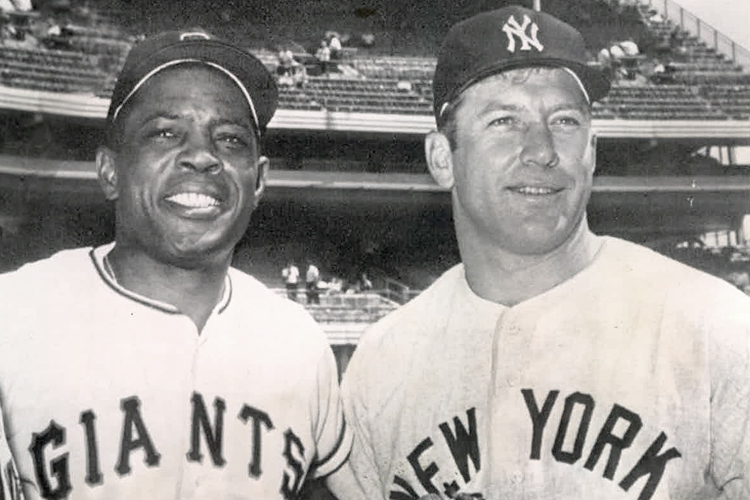
Mays was better, but for a while it was too close to call (Salon.com)
For many years during the 1950s and well into the 1960s, Willie Mays and Mickey Mantle were the best center fielders in their respective leagues, if not the two best players in baseball. Throughout the first halves of their careers, before Mays' Giants moved to San Francisco, they were frequently compared with Duke Snider, the talented center fielder of the Brooklyn Dodgers. Snider and Mays both departed New York after the 1957 season, and while Snider was never again the superstar he'd been in Brooklyn, Mays flourished on the West Coast. He and Mantle were widely regarded as the best all-around players in baseball, and upon retiring found themselves on the short list of not just the best center fielders of all time (along with Tris Speaker and Mantle's one-time teammate Joe DiMaggio), but the best players period.

There's no question as to which one was better. That would clearly be Mays, who many consider the best ballplayer not named Babe Ruth. He was just as good as if not better than Mantle in his prime and lasted longer, which explains his advantage of nearly 50 bWAR.

But for a long time, Mantle hung in there. Despite the injuries, his offensive numbers were on par with Mays's and because Mantle walked more, he was a significantly better hitter. Mays was a much better baserunner and fielder, but as a total package Mantle was very nearly his equal.

Here are their stats from 1951 through 1964:
Mays:    8,002 PA 1,379 R 453 HR 1,290 RBI .313/.388/.589 161 OPS+ 109 bWAR 78.8 WAA
Mantle: 7,979 PA 1,472 R 454 HR 1,298 RBI .309/.429/.582 177 OPS+ 97.8 bWAR 73.5 WAA

After 1964, however, Mantle could no longer keep up. The Mick faded fast, becoming a .250 hitter with 20-homer power over his final four seasons. Mays remained a superstar for several more years, copping his second MVP with 52 dingers in 1965 and putting together a nine-win season in '66. He continued to be a solidly above average player into the early '70s, several years after Mantle retired, before hanging up his spikes after the 1973 campaign.

Many, myself included, maintain that Mantle was actually a hair better than Mays before he broke down. Are they right? Let's take a closer look, going year-by-year to determine which one was better.

1951 Mays
Both had massive expectations place on them from the start and, as 19 year-olds usually do, hit rough patches early on in their rookie campaigns. Mays famously went 1-for-his-first-26 (albeit with a home run off Warren Spahn) and became so discouraged that Leo Durocher promised Mays would remain the starting center fielder for the rest of the season to revive his confidence. Mantle was demoted in mid-July to New York's minor league affiliate in Kansas City, where he remained for six weeks and nearly quit before his father talked some sense into him.

Both rebounded from their early slumps. Mays caught fire in June (1.041 OPS) and July (10 home runs) en route to winning the NL Rookie of the Year award and helping the Giants overtake the Dodgers in a wild pennant race. Mantle rejoined the Yankees in late August in time for the stretch run and hit well enough to reclaim his spot at the top of the order. As fate would have it, the dynamic duo met up in the World Series. The Bombers, in the midst of claiming five straight titles, prevailed despite a gruesome knee injury suffered by Mantle when he caught his spikes in an outfield drainage ditch trying to make a play on a fly ball, a fly ball hit by none other than Willie Mays.

Statistically, Mays outproduced Mantle in almost every offensive category. Granted, part of that was because Mays played 25 more games, but even so he outslashed Mantle in average, OBP, and slugging, producing an OPS 36 points higher than Mickey's .792 mark. Combined with his plus defense in center field (Mantle played the less challenging position of right field with DiMaggio still patrolling center), Willie was worth almost four wins above replacement, more than double Mantle's 1.5.
Mantle and Mays faced each other in two World Series. Mantle's Yankees won both (Bama Media)
1954 Mays
Following a two-year hiatus in the Army, Mays returned to baseball a full-blown superstar. He more than doubled his home run output from his rookie year, improved his OPS by 250 points and scored more than twice as many runs. Mays made his first All-Star team and was voted league MVP after leading the majors in batting (.345), slugging (.667), and bWAR (10.6) while also pacing the NL in triples, OPS, and OPS+. To top it all off, he led the Giants to a World Series victory over the heavily-favored Cleveland Indians, winners of 111 games during the regular season.

Mantle, who'd developed into a great player while Mays was gone, continued to improve in his fourth season. In addition to batting .300 for the second time and exceeding a .400 OBP and 100 RBI for the first, he set career highs in nearly every category and scored an ML-best 129 runs.  The Mick was tremendous, worth almost seven wins, but Mays was playing in a different stratosphere that year.

1955 Mays
Very, very close this time around. Both B-R and FanGraphs give Mantle the slight edge in WAR, rating him closer to 10 while pegging Mays at nine exactly, but frankly I can't see how. Mays was arguably better in his MVP encore, leading the majors with 13 triples, 51 homers, 382 total bases, a .659 slugging, and a 1.059 OPS. Mantle was outstanding in his own right, emerging as a true superstar by leading the AL in triples, big flies, OBP, slugging, and OPS, as well as both leagues in OPS+ and bWAR.

Mays definitely had the bigger offensive season, however, compensating for Mantle's 31 point advantage in OBP with 14 additional home runs, 28 more RBI and a slugging percentage some 48 points higher. Mays also stole three times as many bases as Mantle and was already regarded as the best center fielder in the game after making "The Catch" the previous October. Advantage: Mays.

1956 Mantle
'56 was Mantle's signature season, a gem of a campaign that saw him win the major league triple crown and pile up 11.3 bWAR in addition to leading baseball in runs, runs created, total bases, slugging percentage, OPS, OPS+, WAR, extra base hits, and times on base. When the dust settled, he'd led the Yankees to another World Series championship, won his first MVP award (unanimously), and endeared himself to a new generation of Yankee fans with a season comparable to the best of Babe Ruth, Lou Gehrig, and Joe DiMaggio. Mays, with 36 home runs, a major league leading 40 steals, and 7.6 bWAR, was also terrific, but Mantle was legendary.

1957 Mantle
In his final season in New York (before returning as a Met 15 years later), Mays won his first of 12 straight Gold Gloves. He also treated the fans to some impressive offensive statistics, slugging 35 home runs and a ML-leading 20 triples to go along with his 38 steals (also tops in the bigs) and a 1.033 OPS, good for the best OPS+ (173) in the National League. 

But Mantle, in some respects, had an even better year than his Triple Crown campaign. Not only did he bat a career-best .365 with a .512 OBP (fueled by 146 walks--most in the majors), but he also posted the highest OPS (1.177) and OPS+ (221) of his career. WAR says Mantle's '57 was every bit as valuable as the season that preceded it, and the voters agreed, giving him his second straight MVP trophy despite an otherworldly season by Ted Williams (.388/.526/.731 with 38 homers).
So with a three-bWAR edge over Mays, Mantle wins easily.

1958 Mantle
The Say Hey Kid's first season out west was a good one, as he batted .347/.419/.583 for a league-best 1.002 OPS and 165 OPS+. While his 29 homers were his fewest since his rookie season, he made up for it with personal bests in batting average and hits (208) as well as leading the majors in stolen bases again (with 31). His second season worth at least 10 bWAR was only good enough for second in the NL MVP race, however, as voters elected Ernie Banks (9.4 bWAR) and his prodigious power totals at shortstop.

Mantle fell back to earth a bit after his insane 1956 and 1957 seasons, but still clobbered a league-high 42 home runs, batted over .300, and worked more walks/scored more runs than anybody else in baseball. Despite batting 43 points lower than Mays, he still held significant advantages in OBP (24 points) and slugging (nine points), not to mention the best OPS+ in baseball at 188. That's why I'm giving the edge to him even though bWAR estimates Mays was worth about 1.5 more wins to his team. With Mantle clearly the better hitter and almost Mays' equal on the bases (he was a very efficient 18 for 21 in stolen base attempts), I'm not going to be swayed by unreliable defensive metrics.

1959 Mays
1959 was a major disappointment for Mantle and the Yankees, who finished only four games above .500 and failed to win the pennant for only the second time since Casey Stengel took over. The Mick suffered his worst season since 1953, hitting "only" 31 home runs with "only" 75 RBI. Those numbers would have been more palatable to Yankee fans had he not led the major leagues in whiffs with 126 (a career-high) and batted .285--his worst mark since his rookie season.
While '59 was a down year for Mickey, it was business as usual for Mays, who won another Gold Glove, slugged 34 home runs, drove in 104, and stole a league-high 27 bases in 31 attempts. Add it all up and Mays was worth over a full win more than Mantle, even though their offensive output was almost dead-even (Mays had a 156 OPS+ to Mantle's AL-best 151).
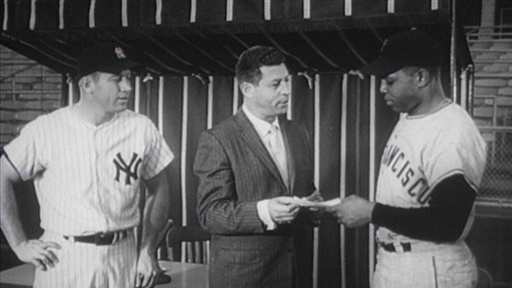
Mantle and Mays squared off in the first ever home run derby. Mantle won
1960 Mays
Offensively, Mays and Mantle were about dead-even in the first year of the '60s, with perhaps the slight edge going to Mantle. By this point, however, Mays was the much better fielder and baserunner, which means on the whole he was more valuable. This is bored out by bWAR, which puts Mays at 9.5--a full three wins better than Mantle's 6.3. Both players endured "down" years by their lofty standards, with Mays failing to reach 30 home runs for the second time in three years and Mantle batting .275 with a league-high 125 strikeouts. I'm nitpicking, of course, but I'm sure both players would tell you that 1960 wasn't their best.

1961 Mantle
Mays boosted his power numbers considerably in his second year at the 'Stick, generating his most home runs (40) and RBI (123) since his monster 1955 campaign and raising his slugging percentage nearly 30 points.

Even with the power spike, he still fell well short of Mantle, who along with teammate Roger Maris challenged Babe Ruth's hallowed single-season home run record. Mantle fell short at 54, but still led the majors in walks (126), slugging (.687) and bWAR (10.5). So feared was the Mick that Maris, despite launching 61 homers himself, did not receive a single intentional walk in 1961, for he spent most of the season batting in front of Mantle.

1962 Mays
Mantle may have won his third MVP but Mays eclipsed him in almost every category. Mantle had the superior rate stats, batting an obscene .321/.486/.605 (195 OPS+), but he also missed roughly a quarter of the season, which limited his value to about six wins. Mays, on the other hand, played 162 of a possible 165 regular season games, racking up personal bests in runs (130), RBI (141), and total bases (382) as well as 49 home runs--most in the majors. Mays was worth an incredible 10.5 bWAR that year, and yet somehow did not win MVP (voters gave it to Maury Wills, who shattered Ty Cobb's single season stolen base record that year).

Mantle got the best of Mays in that year's Fall Classic, which featured the Yankees and Giants in a rematch of the 1951 Series. New York won in seven despite Mantle's mediocre .120/.241/.160 performance. Perhaps the Giants would have won--they lost Game 7 by one run, had Mays done more than bat .250/.276/.321 with zero home runs and one RBI.

1963 Mays
Mantle seriously injured himself, missing almost 100 games after breaking his foot in a nasty collision with a chain-link fence. He was terrific when he did play, replicating his 1962 production, but Mays stayed healthy so there was no discussion.

1964 Mays
'64 was Mantle's last great season, yielding 35 homer runs and 111 RBI as well as the best OBP (.423), OPS (1.015) and adjusted OPS (177) in baseball. But Mays was right there with him, knocking in the same number of runs, socking 12 more home runs, leading the major leagues in slugging percentage at .607 and posting the NL's best raw (.990) and adjusted (172) OPS. Mays was much better in the field and on the bases at this point as well, with 19 steals to Mantle's six and Gold Glove defense in center compared to Mantle's abysmal defense. All said, Mays was worth more than twice as many bWAR (11.1) as Mantle (4.8), making him the obvious choice here.

After 1964, Mays vs. Mantle was no longer a debate. Age, injuries, and alcohol pushed Mantle over the cliff, as he batted just .254 over his final four seasons while averaging just 20 home runs and 53 RBI per season. Mays took much better care of himself, and thus aged more gracefully, winning his second MVP in 1965 and compiling almost 31 bWAR from 1964-1968. Their teams endured similar fates, as the Yankees plummeted to the second division while the Giants remained one of the best teams in baseball.

One can only wonder how Mantle's closing act would have played out had he stayed healthy and avoided the bottle. Based on how close the above comparisons are, I can't imagine it would have been much different from Mays.

Wednesday, October 7, 2015

Astros Bomb Bombers

The upstart Astros finished off the Yankees last night (San Diego Tribune)
It took the Yankees three years to get back to the playoffs--an eternity for baseball's most impatient organization and fan base--but just three hours to get knocked out.

New York losing last night's wild card contest completed their September collapse. Just a half-game out of first on September 8th, they went 10-16 the rest of the way, finishing six games back of the Blue Jays. With a slumping offense, leaky bullpen, and diminished rotation, New York limped to the finish line, losing six of their last seven to inferior Red Sox and Orioles teams. Had they won last night and advanced, they would have been easy prey for the well-rested Royals.

The Astros, on the other hand, were red-hot, having won 9 of their last 14 to close out the season. If LA's last-ditch comeback worried them, they didn't play like it. Houston had the look of a young, energetic team eager to move on, while the tired Yankees looked like they were ready to go home.

And so the surging 'Stros aswaggered into Yankee Stadium and blanked the Bombers, advancing to an ALDS date with Kansas City. Houston grabbed an early lead when Colby Rasmus led off the second inning with a home run and never looked back. The Astros added another in the fourth when Carlos Gomez, who'd done nothing of consequence since coming over in a deadline deal with the Brewers, also went yard, then tacked on an insurance run in the seventh. New York never recovered, making that 3-0 deficit look like a 13-0 hole by the end of the night.

Though both teams were top-five offenses in terms of runs scored and home runs, neither showed much signs of life last night. The oldest lineup and the youngest combined for just three runs and eight hits between them, and if two of those hits had stayed in the yard than it could have been a 1-0 game.

I'm still surprised New York lost, as everything leading up to this game pointed to a Yankees victory. New York was at home with its ace on the mound, facing a pitcher on short rest who'd been far less effective on the road. All the Yankees needed was six solid innings from Masahiro Tanaka and a big fly from one of their boppers, then they could turn the game over to their lights-out bullpen and take it from there.

Instead Tanaka was gone after five, yanked by Joe Girardi after just 83 pitches. Rather than take his chances with a tiring Tanaka, Girardi deployed stud relievers Justin Wilson, Dellin Betances, and Andrew Miller to keep the Astros at bay. Tanaka hadn't done much to warrant staying in the game, throwing just 49 of his 83 pitches for strikes and recording just one punchout after the first inning. Plagued by the long ball all year, he surrendered two more in the first four innings. Facing an Astros lineup that spanked 230 during the regular season in a park that favors the four-bagger, it was only a matter of time before Houston made Tanaka pay for at least one of his mistakes.

They didn't make him pay for loading the bases following the Rasmus homer--a couple hits there drives him from the game and gives Dallas Keuchel an early cushion. Not that the likely Cy Young winner needed it, as he was simply marvelous. Keuchel allowed just three hits--all singles--and one walk across six shutout innings while fanning seven. There were questions about his ability to pitch on the road (his road ERA was over two runs higher than his home mark) and on three days' rest, but he answered them both by silencing New York's bats.
 
The Yankee offense had been quiet lately--averaging just 3.73 runs per game over their final 26--but it had been nearly two months since they'd been shut out at home. To wit, it seemed as though their aging stars simply ran out of gas. It's clear that going forward, New York will need to start phasing out some of its older players and develop (or buy) more young talent in order to compete for a championship. Because as currently constructed, they're just too old to survive a long, grueling baseball season, which still has another month to go.
 
The Astros, meanwhile, remind me of last year's Royals. They're young, hungry, and while not the most talented, certainly have enough to get by. It wouldn't surprise me if they upset the Royals and possibly the Blue Jays on their way to winning the AL pennant. The future is bright for this Houston team, in October and beyond.

Saturday, September 5, 2015

Beltran Bouncing Back

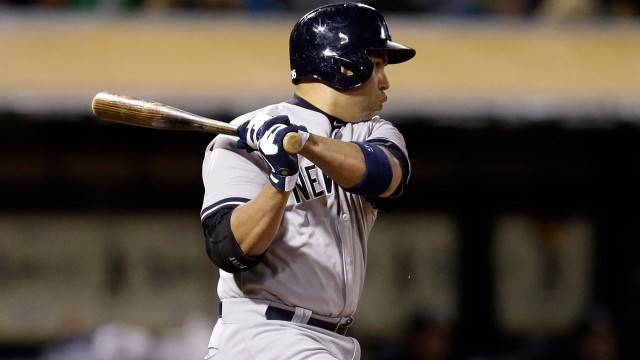
Beltran's back after a poor 2014 and slow start to 2015 (Sports Net)
When the New York Yankees signed Carlos Beltran to a three-year, $45 million deal two winters ago, he was already a player in decline. The formerly fleet center fielder and stolen base threat had lost his explosive speed to age and knee surgery. His bat, while still potent, had also slowed, as his OBP and slugging fell in consecutive seasons. That drop-off had become even more pronounced throughout the previous season (2013), as he experienced a 121 point erosion between his first half OPS and his second half OPS, almost all of which occurred in his slugging percentage.

The Yankees, however, were not scared off by his waning power, worsening platoon splits, or career-low walk rate for a full season. They saw a younger, more dangerous replacement for Ichiro Suzuki in right field. They saw a switch-hitter with life in his bat and a killer postseason resume. They saw a former Met who'd proven he could handle the pressure of playing in New York.

Nearly a decade after losing out on Beltran to the crosstown Mets, Yanks GM Brian Cashman, still liked him enough to buy out the rest of his 30s. It was a classic Yankees move, overpaying a former star for the twilight years of his career.

Beltran was part of the costliest, most aggressive offseason any team has ever had. Having just missed the playoffs for the second time in 20 years, the Yankees went on one of their patented spending sprees, dropping nearly half a billion dollars on free agents. They inked Masahiro Tanaka, Jacoby Ellsbury, Brian McCann, and Beltran, among others, while also a serious run at Robinson Cano.

Dollars doesn't always equal wins, though. After bringing in all that talent, the Yankees won one fewer game than they did the previous year, missing the playoffs again.

One reason why was that Beltran cratered, but it was hardly the only reason. He and McCann were massive disappointments. Tanaka missed most of the summer with elbow inflammation, and Alex Rodriguez sat out the entire year serving his season-long PED suspension. After playing 32 games between them in 2013, Derek Jeter and Mark Teixeira failed to return to their previous performance levels. CC Sabathia got hurt and pitched just 46 innings--by far the fewest of his career.

With all that going on, it was easy to miss Beltran enduring the worst season of his career. Hampered by injuries and a 62 point drop in BABiP (down to .252, easily the worst of his career), Beltran batted a paltry .233/.301/.402 despite playing half his games in the hitter-friendly Yankee Stadium. The short porch in right didn't aid his power stroke, either, as his ISO plunged another 26 points after falling 32 the previous year. A liability in at the plate, in the field, and on the bases, he rated below replacement level for the first time in his career.
Image courtesy of CBS New York
This year brought even harsher struggles for Beltran, who began the year in a horrible slump from which he showed no signs of escaping. Through the first week of May he was batting below .200 and slugging below .300 with his OBP somewhere in between. Some suggested that he abandon hitting from the right side, as he'd shown a 142 point OPS platoon split in 2013 and batted below .200 against lefties in 2014. Given that such a move benefited Shane Victorino, it seemed like a good idea.

Beltran didn't give up on switch-hitting, and since then he's back to being the hitter he was before the Yankees signed him. He's batted .309/.374/.539 dating back to May 8th, and before going 0-for-4 yesterday he'd reached base in all but one of his last 33 games. His batting line has steadily improved throughout the summer, up to a more than respectable .279/.339/.477--right in line with his 2012-2013 figures. In other words, the Yankees are getting the Beltran they paid for.

The explanation for his return to form is simple: he's fixed his swing from the right side. His platoon splits are nearly identical (.803 OPS versus lefties, .826 OPS against righties) this year.

Of course, that's not the only reason Beltran's doing better. A return to health has done wonders for the 38 year-old, who's been on fire since coming off the DL after the All-Star Break. He's also had much better luck on balls in play, with his BABiP returning to normal as he's generated more line drives and fewer grounders/pop ups. After becoming a little too pull-happy last year, Beltran has done a better job of waiting back and using all fields, too.

Beltran isn't the only Yankee making a comeback. Teixeira and Rodriguez have been huge in the middle of the order, and McCann's back to being one of the best-hitting catchers in baseball. Michael Pineda's pitched better than anyone could have possibly expected, and by some miracle Tanaka's stayed healthy. That's why New York, despite being the oldest team in baseball by a mile, leads the AL wild card and is only 2 and 1/2 out of first in the AL East.

Which means in a few short weeks, Yankee fans will see firsthand what Beltran can do in the playoffs, and why his team paid so much to acquire him in the first place. Based on how he's hit this year, he won't let them down.

Friday, September 4, 2015

MLB September Storylines

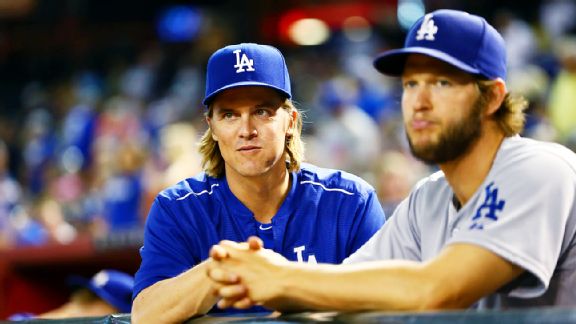
Dodger aces Greinke (L) and Kershaw are players to follow in September (ESPN)
Labor Day weekend is upon us (seriously, how did that happen?), which means there's but one month left of the regular season. Even with most of the divisions and playoff races already decided, several exciting stories have yet to be played out. Will the Blue Jays win their division, thus ending the longest postseason drought in American professional sports? Can Houston hang on in the AL West? And just who is going to put themselves over the top in various award races?

Even if your team is toast and you can't wait for football to start, there's still enough going on to keep fans engaged into October. Here's a sample:

1. David Ortiz's march to 500 home runs
It's been another tough year for the Red Sox but another great one for Ortiz, who's closing in on his 500th career long ball. He has five to go which, given his feverish home run pace (23 taters in his last 70 games), shouldn't take too long.

2. Clayton Kershaw's quest for 300 strikeouts
As Jeff Sullivan noted yesterday, Kershaw's up to 251 K's on the year after fanning 15 Giants in Wednesday night's masterpiece. With five or six starts remaining, he has a chance to become the first pitcher since 2002 to eclipse 300 punchouts. If he does that, a third straight Cy Young award may be in the cards.

3. AL East showdown
As always, the AL East has become a dogfight between its top two teams, one being the Yankees of course. For once, however, the other combatant isn't Boston. It's the Blue Jays, currently clinging to a 1.5 game lead over the Bombers. Toronto will get every opportunity to widen the gap down the stretch with the rest of its games coming against sub-.500 teams and New York.  The Yankees have a similarly easy slate, however, so it wouldn't be surprising to see first place change hands several times over the next month.

4. How will the West be Won?
The fate of the AL West is still up in the air, for it's the only division where the third place team isn't more than 10 games out. It has been turned completely upside down this year, with Houston and Texas (both losers of 90+ games last year) rising to the top while Oakland and Seattle (winners of 88 and 87, respectively) sinking to the bottom. In between are last year's division champs--the Angels--still trying to find their way. LA's coming off a terrible August but could catch up if they play like they did in July. Houston's had control of first place for most of the year, but now find themselves holding on for dear life with a two game edge over the surging Rangers. So hold your breath, Astros fans, and don't exhale until this time next month.

5. Who will snag the second AL wild card?
The Pirates and Cubs have both NL wild card spots wrapped up, and whoever loses the Yankees-Blue Jays duel is guaranteed the first wild card in the AL. The second wild card berth, however, is very much up for grabs. Texas currently leads by one game over Minnesota, with Los Angeles and Tampa Bay looming not far behind. The Twins and Angels are fading fast, while the Rangers have rolled since trading for Cole Hamels. Fingers crossed for a tie, which would mean a play-in game for the play-in game!

6. Will Washington pull it together?
It's now or never for the Nats, who've hovered around .500 all summer and allowed the Mets to break away. They're still close enough (six games) that Washington could steal the division out from under them with a huge September, but time is dwindling. Which team will the Nationals be this month: the one that everyone predicted to win 100 games or the one that might wind up with a losing record? I say they finish strong but still miss the playoffs.

7. St. Louis shoots for 100
Improved parity has made 100-win teams increasingly rare--there were none in each of the past three seasons. Only one team has a legitimate shot to do it this year, and it's not the preseason favorites. The best team in baseball this year has been the St. Louis Cardinals, currently 86-47 and steaming towards their third straight division title. With 29 games remaining on their schedule, the Redbirds need only go .500 to reach the century mark.

8. Does anyone get to 50 homers?
There have been just two instances of a player surpassing 50 home runs during the past seven seasons, but it's possible we'll see two or more players crack that many this year. Nelson Cruz--last year's long ball champion and the current major league leader--needs 11 to get there while Chris Davis--the last to break the 50 barrier--is a dozen away. Look for Carlos Gonzalez, who's cranked 31 over the last three months, to make a run as well.

9. Award races
The AL MVP was seemingly Mike Trout's to lose until about a month ago, at which point he and his Angels went in the toilet while Josh Donaldson and the Blue Jays took off. Now Donaldson appears to have the upper hand, but that could change in an instant if Trout gets back to being himself and leads LA to the playoffs. The NL MVP belongs to Bryce Harper no matter how often Joey Votto reaches base, but Zack Greinke could become the second straight Dodger pitcher to win it if he continues to be lights-out in September.

Speaking of Greinke, he and Kershaw will duke it out for the NL Cy Young award. Wonder which Dodger (and former Cy) voters prefer; Greinke with his sparkling ERA or Kershaw and his gaudy strikeout totals and only slightly less-sparkling ERA? The AL trophy is probably going to Dallas Keuchel (who saw that one coming?), but don't count Chris Sale out just yet.

The AL Rookie of the Year race is a tight one too, with Carlos Correa, Miguel Sano, and Andrew Heaney all having strong cases. The NL field is a two-horse race between Joc Pederson and Kris Bryant, though Noah Syndergaard deserves consideration as well.

10. September call-ups
No matter where your team falls in the standings, it's worth checking in on them throughout September as their future stars get a first taste of the big leagues. For instance, Corey Seager made his major league debut last night.