Tuesday, January 5, 2016

Red Sox New Year's Resolutions

Ramirez (left) and Sandoval were duds in their Red Sox debuts (Yahoo Sports)
No matter how dedicated we are to our new gym memberships, it's going to take awhile for most of us to shed those unwanted pounds we packed on during the holidays. The Boston Red Sox, however, have used the last few months to beef up in a good way, bolstering their starting rotation as well as their bullpen. While they're already looking new and improved, here are some things they need to do to ensure good health in 2016:

Maintain their second half momentum
While the Red Sox sunk themselves with a terrible start last year, they were quietly one of the hottest teams in baseball after the All-Star break. From July 30th on, Boston had the fourth-best record in the American League and outscored everyone except the Toronto Blue Jays thanks to big turnarounds from David Ortiz and Blake Swihart as well as unexpected production from Jackie Bradley, Jr. and Travis Shaw. Their pitching improved too, with Rick Porcello and Joe Kelly rebounding from disastrous first halves while Eduardo Rodriguez and Henry Owens improved down the stretch. Boston played terrific baseball for two months without Dustin Pedroia, Hanley Ramirez, and Clay Buchholz, leaving one to wonder what the Sox are capable of if they can all stay healthy.

Fix Pablo Sandoval and Hanley Ramirez
Boston desperately needs to get something from their two highest-paid position players, because last year they got less than nothing from the $40 million tandem. Both were All-Stars before joining the Red Sox and are young enough to return to that level, but they need to remind Bostonians why their team shelled out $170 million to acquire them in the first place. Ramirez should have an easier time at first base than he did in left field, while Sandoval's offense should bounce back after cratering last year. 

Play Jackie Bradley, Jr. and Rusney Castillo regularly
After years of trying to figure out what the future holds for Bradley (26) and Castillo (27), the time has come for Boston to commit to them as everyday outfielders or start searching for replacements. Bradley's entering his fourth season and has yet to prove he can hit consistently at the major league level, whereas Castillo is much too expensive be a project at over $10 million per year. Neither has logged a full season in the Show yet, but they're both in their primes now and it's not like the Red Sox have better options. Boston needs to know what these guys are capable of, because if they're not everyday players then they'll need to find outfield help fast.

Have a backup plan
Even with the (costly) addition of David Price, Boston's rotation is still loaded with question marks. Buchholz is expected to be the team's second best starter after Price, and he's been one of the most volatile--not to mention injury-prone--pitchers in baseball. Porcello was a major disappointment last year and will be again if he can't keep the ball down. Joe Kelly has potential but seems better suited for the bullpen. Owens and Rodriguez also have potential but just 32 combined major league starts between them, which makes them difficult to count on this year. Roenis Elias and Steven Wright offer depth, but you don't want either one making regular turns. Even Price is a bit risky given the heavy workload he's carried the past six seasons, making him increasingly susceptible to injury as he enters his 30s. It's entirely possible that Boston ends the season with a completely different rotation than the one it starts with, which means the Sox may want to consider shipping out some of their prospects for a proven starter at some point.

Commit to a catcher
Boston is blessed with two young, talented backstops in Christian Vazquez and Blake Swihart. Their skillsets are very different, however, as Vazquez is an excellent pitch-framer and potential Gold Glove winner while Swihart is a switch-hitter with Matt Wieters potential. Swihart looks like the better long-term option due to his bat, which improved by leaps and bounds in the second half along with his defense. Boston was in a similar position in 2013, when they had two phenoms at short (Jose Iglesias and Xander Bogaerts)--one of whom was a defensive wizard while the other excelled at the plate--and wound up trading the better fielder (Iglesias) for starting pitching help at the deadline. The Red Sox would be wise to make a similar decision this year, dealing from a position of strength to address their needs. With Ryan Hanigan also in the mix, they'll want to avoid carrying three catchers on their 25-man roster.

Utilize the bullpen effectively
With Craig Kimbrel, Koji Uehara, and Carson Smith at his disposal, John Farrell has a dominant trio of relievers capable of shortening games by several innings. He should not hesitate, however, to use them to get out of jams in the middle innings, rather than save them for late inning save opportunities that may never come. If Boston's going to roll the dice with this iffy rotation, Farrell needs to forego conventional bullpen usage and be aggressive with his firemen by deploying them in high leverage situations (as Joe Maddon does).

This is going to be a big year for the Red Sox, who seem to be at a crossroads with their manager and numerous players. Everyone on the roster has something to prove and a lot of questions need to be answered as the team tries to chart a new course under Dave Dombrowski. Above all, Boston must get back on track after finishing last three of the past four years, if not by making the playoffs this year then by greasing the skids to do so next year. The Sox certainly have the talent to do so; they just need to find a way to make it all work.

Sunday, January 3, 2016

Top 10 Remaining Free Agents

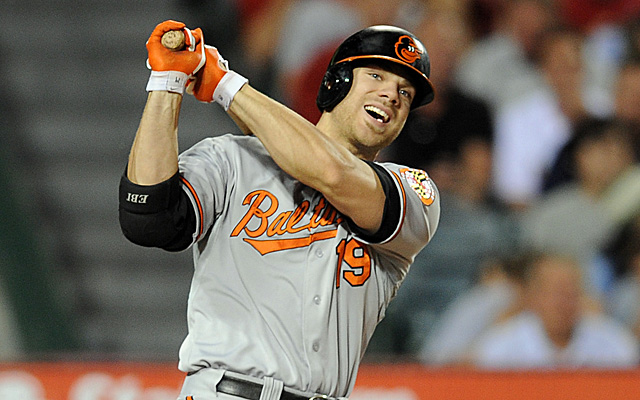
Chris Davis is still the market's top prize (CBS Sports)
With the offseason now two months old, several of this winter's big-ticket free agents are already off the board. Most of the top hurlers--Zack Greinke, David Price, Jordan Zimmermann--in this year's class have been scooped up, but a plethora of impact position players remain. Here are the 10 best players still up for grabs, with next year's age in parentheses:

1. Chris Davis (30)
Crush quietly had a monster season for the Orioles, re-establishing himself as the best slugger in baseball with a major league-leading 47 home runs and 12.2 AB/HR ratio (his .300 ISO was second only to Bryce Harper). Nobody has swatted more homers over the past four years, during which time Davis has averaged 40 big flies per season. Sure, he strikes out a lot, but he actually hits for solid averages and gets on base plenty via walks. His profile is eerily similar to Ryan Howard's, however, which should make teams think twice before handing him the pretty penny he's going to cost.

2. Justin Upton (28)
After an up-and-down tenure with the Diamondbacks, Upton has stayed remarkably consistent over the past three years, settling into a three-win player with close to 30-home run power. He's durable, having exceeded 149 games five years in a row, and a capable left fielder to boot. He'll even steal a base every now and then. One cause for concern, however, is that his OBP has declined every year since 2011.

It's hard to believe that Cespedes is already 30, seeing as how he's only been in the league four years. He's had two amazing years sandwiched around two so-so ones, but he is one of the more reliable sources of righthanded power in the game. He's also a good defensive outfielder, though he was horribly miscast as a center fielder with the Mets last year. Cespedes can hit anywhere, as he's posted strong numbers despite playing in some brutal slugger's parks in Oakland, Detroit, and New York, so if he lands in a hitter's haven watch out.

4. Alex Gordon (32)
No left fielder has provided more defensive value than Gordon over the last five years (Martin Prado only played left in 2011 and 2012), which is reflected in his four straight Gold Gloves. He's also a pretty great hitter, too, typically good for around 20 homers with double digit steals and strong on-base numbers. Add it all up and Gordon's been one of the 10 most valuable position players over the last half decade, ahead of flashier names like Dustin Pedroia, Evan Longoria, and Giancarlo Stanton. He turns 32 next month and missed almost 60 games last year with a groin injury, but he had been exceptionally durable before that and his all-around skill-set should age well,

5. Matt Wieters (30)
Teams in need of a backstop should consider rolling the dice on Wieters, who's been limited to 101 games over the past two seasons due to Tommy John surgery. He was a durable two-way receiver before that, however, and has remained productive at the plate in spite of his injury woes. He's still young enough to rebound, and his price should be reasonable given his spotty track record. He's the perfect candidate for a one-year deal to rebuild his value, as Adrian Beltre did with Boston in 2010.

6. Wei-Yin Chen (30)
The ideal midrotation starter, Chen has remained consistent, healthy, and effective while cutting his teeth in the AL East. The lefty is more of a finesse pitcher, as his strikeout rate is only average, but he hardly walks anybody. You know what you're getting from him, which makes him one of the safer investments this offseason.

7. Dexter Fowler (30)
Last winter, the Cubs traded for Fowler to be their everyday center fielder and leadoff man. The catalyst for Joe Maddon's fearsome lineup, he drew a career-high 84 walks, scored a career-high 102 runs, and swiped 20 bases--his most since 2009. He also tossed in 17 homers, another personal best. The former Rockie has proved he can thrive outside of Coors Field, so teams shouldn't be shy about bringing on the outfielder.

No longer the power pitcher who eclipsed 200 strikeouts in four straight seasons, Gallardo has remade himself into an effective ground ball pitcher. That approach served him well in his transition to the American League last year, which went more smoothly than I or anyone else anticipated (his ERA improved despite pitching half his games in Texas). Solid as a rock, he's made at least 30 starts and exceeded 180 innings in each of the past seven years, only one of which yielded an ERA over four. He's not sexy, but as with Mike Leake reliability is his strong suit.

9. Ian Desmond (30)
Desmond is hitting the market at a terrible time, coming off his worst offensive season to date. It wasn't merely a fluke, either, as his numbers have steadily declined since his All-Star breakout in 2012. His strikeout numbers have gotten out of control--370 times over the past two years--for a guy with 20-homer power. In his defense, no shortstop has launched more homers over the past four years, and Desmond was the only player to go 20/20 every year from 2012-2014 (when he earned three straight Silver Sluggers). Desmond also salvaged his poor 2015 with a strong finish, rallying from a horrid first half to slash .272/.343/.464 with a dozen homers after July 19th. He's a decent defender, but all his offensive value is tied up in his power, so if that dries up he'll become unplayable.

10. Howie Kendrick (32)
Kendrick has been one of the steadiest second-basemen in the game over the past decade, routinely providing above average offense and capable defense at the keystone. Injuries have cut into his playing time lately, causing him to miss at least 40 games in two of the past three seasons, but he's remained as productive as ever with the stick. An annual threat to bat .300, he should have several more solid seasons ahead of him, especially if he winds up in a hitter's park for a change. However, he's getting to an age where even the best second-sackers typically show signs of decline.

Thursday, December 31, 2015

16 to Watch in 2016

All eyes will be on Big Papi next year (Monstah Mash)
With 2016 just around the corner, here are 16 players you should be watching next year:

In his final season and still one of the best hitters in baseball, Big Papi should give us a victory lap to remember.

How will the 34 year-old Cardinals ace hold up after missing most of last season with an Achilles injury? He only pitched out of the bullpen after coming back late last year, but St. Louis is counting on him to be a frontline starter.

Rodriguez returned from a year-long suspension to post one of his best seasons in years, He dropped off sharply in the second half, batting just .191/.300/.377 after August 1st, causing doubt as to whether he can repeat that performance at age 40. Health permitting, however, he should become the fourth player to surpass 700 long balls.

Can't wait to see what the A-Rod clone (Mariners version) does in his first full season. He's only 21.

Will Wrigley Field help him realize his power potential? Probably not, but perhaps a second 20-homer season (and his first since 2012) is in the cards.

One of the game's premier talents with Milwaukee the last few years, Gomez was an absolute disaster after getting traded to Houston last summer. 2016 is a contract year for the 30 year-old, so expect him to right the ship.

We know he can play a mean center field, but we still don't know if he can hit major league pitching. JBJ is entering his fourth season and turns 26 in April, so he's running out of chances to prove himself.

How will going from from one of baseball's pitching-friendliest venues to one of its hitting-friendliest affect the 32 year-old? Let's just say I don't see any more Cy Youngs in his future.

As great as Bryant was last year, he didn't come close to touching his 40-homer ceiling. We'll see what adjustments he makes as a sophomore, or if his strikeout problem (199 K's last year--most in the NL) drags him down some.

Pederson had a terrific first half but fell apart after the All-Star break. Did the league figure him out, or was it merely pitchers adjusting to the talented rookie? The Dodgers are hoping for more consistency from their 24 year-old center fielder in 2016.

Still waiting to see what the former AL Rookie of the Year can do in a full schedule, as he has averaged just 78 games per year over his first three. Now 25, he should be entering his prime.

You're not not going to watch Bryce Harper.

Just a few years ago he looked like the next Mike Trout, but his injury-married 2015 marked a huge step back for him. His Hanley Ramirez-esque attitude problems are a huge issue, but that can be overlooked if he finally puts it all together.

Can he come close to replicating last year's power outburst? As long as he plays half his games in Coors Field, he has a chance.

Boston played considerably better after cancer forced Farrell from the dugout, leaving one to wonder whether he's contributing to the team's consecutive last place finishes. Farrell's under contract through 2017, but should the Sox sputter again he'll likely be out of a job by season's end.

16. The Yankees Bullpen
With Dellin Betances, Andrew Miller, and now Aroldis Chapman waiting for teams at the end of games, will the Yankees lose any games they're leading after the sixth inning? New York is still a flawed team, but its relief corps should be the best in baseball.

The Death of Baseball's Iron Man

Rizzo got hit by more pitches and played more games than any other National Leaguer (SOE)
Anthony Rizzo is good at a lot of things. He's good at hitting for power, as evidenced by his career .206 ISO. He has a knack for hitting in the clutch, for he led all of baseball in Win Probability Added last year. He boasts a great batting eye, which is reflected in his 10.9 percent career walk rate.

Unlike most first basemen, Rizzo's skills extend beyond the batter's box. He's smooth around the bag, ranking in the top three for Total Zone Runs and in the top five for Range Factor among NL first-sackers in each of the past three years. He's even a good baserunner, quick enough to steal 17 bases last year--second only to Paul Goldschmidt at the position.

Rizzo has one other skill, a skill that tends to get underrated when evaluating ballplayers; durability. Over the past three years, Rizzo has played 460 of a possible 486 games. Only 16 men have played more. His only significant injury was a mild back strain that cost him three weeks in 2014, from which he returned to bat .395/.521/.684 the rest of the way (had Chicago not been out of contention, he might have come back sooner).

I bring this up because last year, Rizzo played more games--160--than anyone in the Senior Circuit. He played Chicago's first 79 games before sitting out, then didn't take another day off until the season's final week. With the Cubs fighting for home field advantage in the wild card game, he couldn't exactly afford many rest days, but his attendance is still impressive nevertheless.

What I found interesting was that Rizzo was able to lead the league in games played despite getting plunked 30 times, most in the majors*. On the one hand, getting hit by so many pitches is rather unfortunate (though Rizzo is mostly to blame for standing so close to the plate), but on the other hand he was incredibly fortunate to avoid injury, as one misplaced fastball is enough to end a player's season, or even his life. Cubs fans should thank their lucky stars one of those beanballs didn't shatter Rizzo's wrist or smash his cover-boy face.

*Leading one's league in hit by pitches and games played is not as rare as I originally thought. Recent examples include Prince Fielder in 2012, Carlos Delgado in 2000, and Craig Biggio in 1997. 

What I found even more interesting than Rizzo's strange feat was that he paced his circuit in games played despite missing multiple contests. The last time that happened in the National League, as far as I can tell, was never (in the modern era, at least).

It's amazing how much the games played leaderboards have changed in just the last few years. In 2005, for instance, 10 players played every game. This year, there was only one--22 year-old Manny Machado*--even though there's more young talent proliferating the sport than ever before (young players, theoretically, should be more able to play full slates).

*I would have thought this impossible after the gruesome knee injury he suffered in 2013. Professional ballplayers are just different animals, I guess...
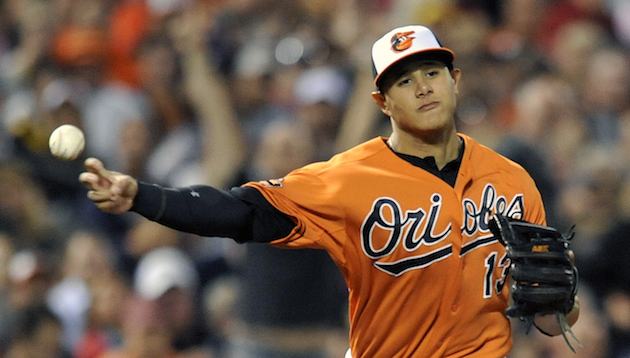
Machado was the only player to appear in every game last year (CBS Sports)
It appears the days of Iron Men like Cal Ripken, Jr., Miguel Tejada, and Steve Garvey are over. I'm sure some of that has to do with the decrease of performance enhancing drugs in the game; players simply can't maintain the stamina needed to survive a 162 game season. They can't train as hard in the offseason, so they wear down faster during the regular season. Training regimens have also shifted, stressing weightlifting more than endurance-boosting cardio, which makes players less flexible and more prone to muscle tears.

I think the real reason for this change, though, is that managers are smarter about how to manage their players. Gone are the days of slave-drive skippers who held little regard for their players' well-being, penciling the same names into their lineup cards everyday as long as they could stand. The new, more understanding breed--the proverbial "player's manager"--is keen on providing "maintenance" days throughout the year to keep his club fresh for the stretch drive. Roster expansion allows them, heck, encourages them to employ scrub-heavy lineups over the season's final month. And those rare times when doubleheaders occur, it's even rarer to see someone play both ends of it.

Some of that, I'm sure, has to do with how much players are paid these days. Teams invest too much in their stars--the guys you'd want playing everyday--to risk them getting hurt overexerting themselves (injuries are more likely to occur when you're over-fatigued, as that's when mechanics break down). They don't want their best players on the field everyday because they have the long-term interests of the players in mind, whereas before they weren't as concerned with protecting their assets. Players aren't disposable when they're signed to nine-figure contracts. You want to take care of that new Lamborghini in the garage, not run it into the ground.

Money has also changed how players view the game. They see it as a career more than just a temporary profession, and they'll do everything in their power to extend their playing careers, and thus their earning potential, as long as possible. They don't want to play 162 games if they don't have to, as every additional game carries the risk of a career-altering injury. And don't forget, they get paid the same for playing 162 as they do for playing 62. There's no incentive for playing every game, so why do it? Taking a few days off here and there versus playing through an injury could mean the difference of millions of dollars, so how can you blame someone for erring on the side of caution?

Lastly, I get the sense that players don't have the same amount of pride their predecessors got from playing every game. Playing all 162 used to be a badge of honor, a sign of strength. It takes a tough SOB to endure 162 ballgames. Perfect attendance was an achievement to be proud of, like batting .300 or driving in 100 runs. Remember, before free agency jacked salaries through the roof, players didn't play major league baseball solely for money; they played because they loved the game. Of course they wanted to play everyday (thinking of you, Ernie Banks).

It's not that players aren't capable of playing full seasons anymore, it's just that there aren't any good reasons to. That, and nobody's forcing them to..

Wednesday, December 30, 2015

Sox Lose Another Legend

Malzone passed away yesterday. He was 85 (Boston Herald)
It's been a rough week for Red Sox legends. On Sunday, Dave Henderson died. Yesterday, Frank Malzone joined him in the great big diamond in the sky.

Whereas Henderson was remembered mostly for one swing, Malzone never had a career-defining moment. He was just a steady third base man for the better part of the decade, one of the best Red Sox during their dark days of the late '50s and early '60s. A slick-fielding, solid-hitting third baseman, Malzone was a Mike Lowell-type destined to be overshadowed by superstar teammates Ted Williams and Carl Yastrzemski.

Despite not doing much to distinguish himself off the field, Malzone did plenty to earn recognition in between the lines. After spending seven seasons in the minors and two years in the military during the Korean War, Malzone debuted with a flourish in 1957, batting .292 with 15 homers and a career high 103 RBI. The first time All-Star and finished second to Tony Kubek in the Rookie of the Year race--an award Malzone deserved to win--but placed seventh in the MVP vote.

Malzone also won his first Gold Glove--the first ever awarded to an American League third baseman. He won the next two as well before Brooks Robinson came along and won 16 straight from 1960-1975 (Who knows how many Malzone might have won had Robinson played in the National League?). Only six men--Robinson, Buddy Bell, Gary Gaetti, Robin Ventura, Eric Chavez, and Adrian Beltre--won more while manning the hot corner for an AL team.

Malzone was more than just a terrific gloveman, however; he was also a pretty decent hitter (thanks to Fenway Park, where he batted .298/.339/.442 for his career). Most years he was good for a .280-ish average, 15 or so homers, and around 80 RBI. You could also count on him to be in the lineup everyday; from 1957-1964, no American Leaguer played more games. It was that kind of solid production and consistency that made him a six-time All-Star during this span, though it helped that the top third basemen at the time (Eddie Mathews, Ken Boyer, Ron Santo) played in the National League.

After dropping off sharply in 1965, the 35 year-old Malzone was released on the last day of November (he didn't remain a free agent for long, however, as the California Angels signed him the same day). After an even worse season with the Angels in 1966, Malzone hung up his spikes for good.

In 1995, 30 years after his last game with the Red Sox, Malzone was one of 14 players inducted into the franchise's inaugural Hall of Fame class, along with former teammates Williams, Yastrzemski, and Tony Conigliaro. Maybe someday the Sox will retire his 11, which he wore from 1956 to 1965. Clay Buchholz is currently wearing it, but should he leave after next season Boston would do well to add it to their line of numbers along Fenway's right field roof.