Showing posts with label American League. Show all posts

Thursday, June 29, 2017

My AL All-Star Picks

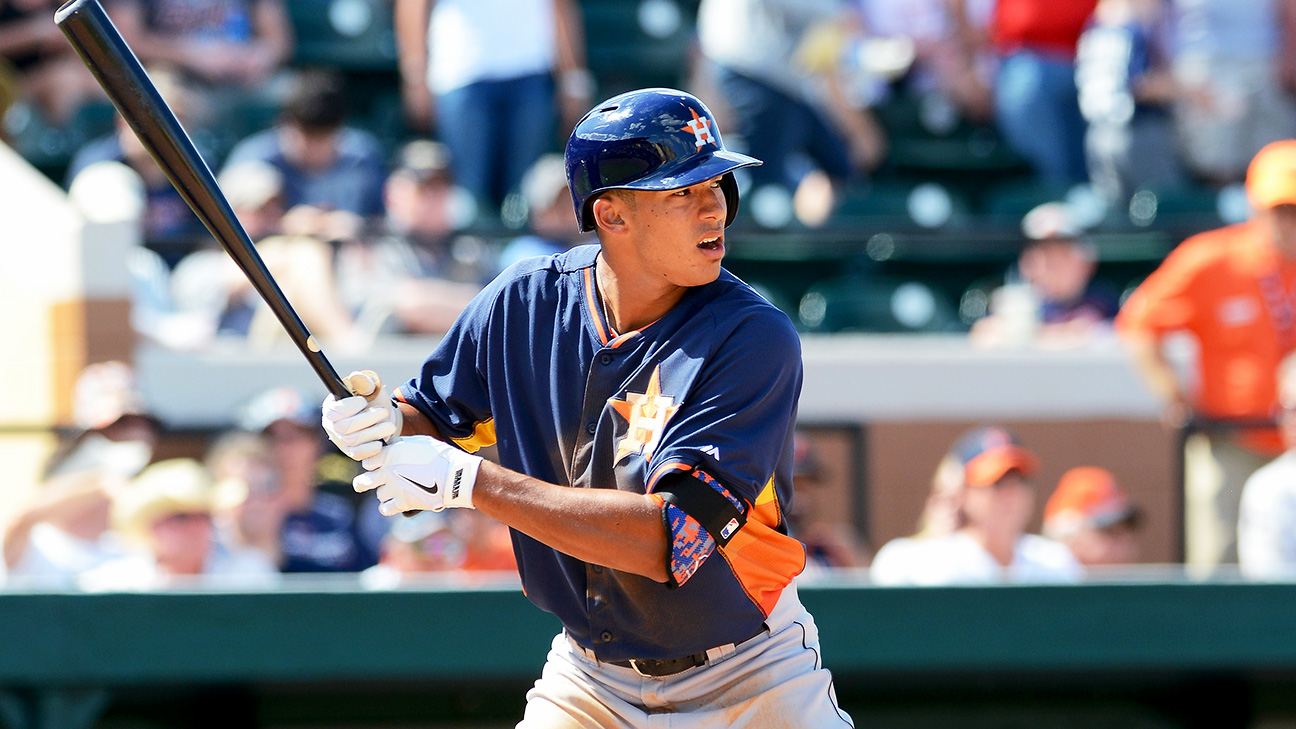
Houston's double-play combo deserves to start the All-Star Game (MLB.com)
All-Star voting ends at midnight tonight, which means it's time to cast those last-minute votes for the Midsummer Classic if you haven't already. Here are mine, with all stats through June 28:

C Alex Avila
Gary Sanchez is a bigger star, Salvador Perez has larger counting stats, and Brian McCann is having a vintage season, but Avila has been the American League's top catcher in the first half with a .321/.435/.597 slash line (174 wRC+) in 191 plate appearances (only 14 fewer than Sanchez). He's been the best-hitting backstop in baseball this year and leads AL receivers in fWAR with 2.4 (nobody else has more than 1.9), making him a fairly easy choice.

The only problem is Avila's not on the ballot, so I have to write him in. This is the problem with starting All-Star voting in April, as James McCann was Detroit's primary catcher at the time with Avila relegated to backup duties. Their roles have flipped, however, due to McCann's slow start and
Avila's monstrous performance.

Avila's resurgence has been one of the biggest surprises of the first half given that he'd batted just .222/.337/.362 from 2012-2016, making his 2011 All-Star nod look like a fluke and distant memory. Now 30, he's looking like a Comeback Player of the Year candidate after playing fewer than 70 games in a backup role each of the past two seasons.

1B Logan Morrison
Tough call here between LoMo, Yonder Alonso and Justin Smoak, since all three have almost identical batting lines. I immediately eliminated Smoak on the basis of his home park being much friendlier, then give Morrison the edge over Alonso for sustaining his performance over an additional 50 plate appearances (roughly 1/6 of the season thus far). It's also a point in Morrison's favor that his 22 dingers are tops for an AL first-sacker.

2B Jose Altuve
Altuve enjoys a comfortable lead in fWAR at the position with 3.5 -- more than a win higher than anyone else. His traditional stats back it up, as he's slashing .328/.402/.527 (150 wRC+ -- the highest for a qualified second baseman) with 11 homers and 14 steals.

3B Jose Ramirez
Miguel Sano should have been the pick here, but a .167/.242/.333 slump since June 9 has caused his OPS to fall more than 100 points, allowing the surging Ramirez to edge ahead:

Ramirez: .322/.377/.557 145 wRC+ .391 wOBA 2.9 fWAR
Sano:      .274/.375/.548 140 wRC+ .384 wOBA 2.3 fWAR

Ramirez is also a superior fielder and has maintained his numbers over 25 more PA's, so Sano would need to have a significant offensive lead to wrestle the spot away. This is a good example of why you should wait until the last possible moment to vote, as a few good or bad weeks can dramatically alter a player's candidacy.

SS Carlos Correa
Francisco Lindor jumped out to an early lead and Xander Bogaerts isn't far behind, but Correa's recovered from a slow start to lead AL shortstops in a host of categories, including counting stats like fWAR (2.8), homers (14, tied with Lindor), runs (52) and RBIs (49), as well as rate stats such as slugging (.514), OPS (.900), wRC+ (141), and wOBA (.380).

OF Aaron Judge
Obviously.

OF Mike Trout
Hasn't played in a month, but he was so good during his first two months that he still deserves a spot. He's been an All-Star every year since 2012, so let's preserve the streak.

OF George Springer
Has as many fWAR as Trout, albeit in 27 more games and 126 additional plate appearances. Still, it's not too often he'll be able to say that. There's a pretty big drop-off from Judge and Trout to Springer, but then there's another big drop-off from Springer, making him an easy choice for the third spot.

DH Corey Dickerson
Dickerson's rate stats are almost identical to Springer's. He's batting a robust .333/.373/.583 (154 wRC+) with a league-leading 103 hits, including 17 homers. He's producing like he did at Coors Field, except now he plays his home games in Tampa Bay's hitter's graveyard. The DH field is wide open this year without David Ortiz, and Edwin Encarnacion is still digging himself out from a miserable start. Dickerson's .381 BABIP suggests he won't necessarily be an All-Star in the second half, but right now he's the obvious choice.

If fans got to pick the starting pitcher, my vote would go to Chris Sale.

Thursday, March 10, 2016

Praise Parity

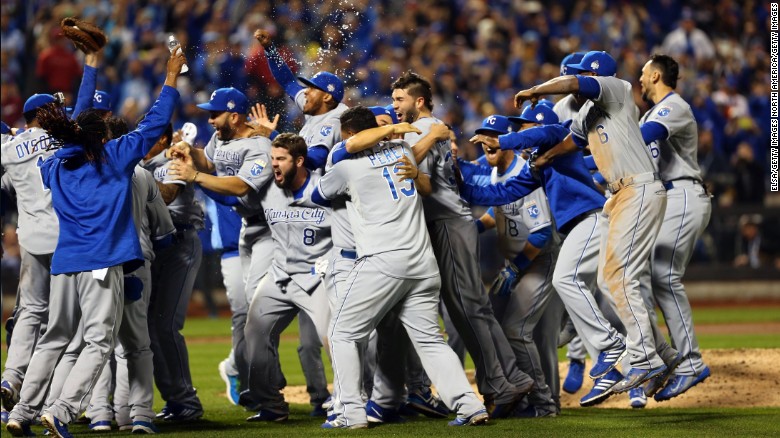
It's going to be tough for KC to repeat with so much competition (CNN)
If you thought there was a lot of parity in the American League last year, just wait. Everybody's going for it this year, which means anyone could win. It's going to be a fun summer.

I've highlighted the strengths of each team below, outlining the reasons they could be this year's American League champions. The teams are ordered by FanGraphs' projected standings, with their projected records and run differentials included in parentheses.

AL East--We've reached a point where every year it seems like every team in the division could have a winning record. Maybe that happens this year.

Boston Red Sox (88-74, +69)
After another busy offseason, Boston now has the division's best pitcher in David Price as well as a shutdown bullpen and a promising lineup. They're blessed with two great young catchers (Blake Swihart and Christian Vazquez) who complement each other perfectly, are extremely talented up the middle and project to have an amazing outfield defense of Mookie Betts, Jackie Bradley, Jr. and Rusney Castillo. This is pretty much the same team that was favored to represent the American League in the World Series last year, only with a better bullpen and the ace that Ben Cherington refused to acquire.

Toronto Blue Jays (84-78, +32)
The best lineup in baseball is back and ready to mash its way to the playoffs, giving pitchers plenty of nightmares along the way. Marcus Stroman, Drew Hutchison, and Aaron Sanchez will have to step up and cover the losses of Price and Mark Buehrle (who finally retired), but if they do it could mean a second straight division crown for Toronto.

New York Yankees (82-80, +11)
New York returns essentially the same crop of position players that outscored every team except Toronto last year, and that was despite having three offensive black holes up the middle in Didi Gregorius, Stephen Drew, and Jacoby Ellsbury (Chase Headley wasn't anything to wrote home about, either). Gregorious is never going to hit, but Drew's gone (replaced by Starlin Castro) and Ellsbury should be better with improved health.  Their rotation has loads of potential if Luis Severino and Michael Pineda break out to supplement Masahiro Tanaka, and their bullpen is so good that they may never lose a game they're leading after the sixth inning.

Tampa Bay Rays (81-81, -1)
PECOTA picked Tampa Bay to win the AL East, and if you look at their starting rotation it's not hard to see why. Headed by Cy Young candidate Chris Archer and filled out by Jake Odorizzi, Drew Smyly, Matt Moore, and Alex Cobb, the Rays rotation could be the AL's best. Its offense should also pack more punch this year--especially in the outfield--with a healthy Desmond Jennings and the plundering of Corey Dickerson from Colorado.

Baltimore Orioles (80-82, -7)
Baltimore boasts a power-laden lineup that ranked third in the majors in home runs last year and could easily lead both leagues this year, which is why FanGraphs expects them to outscore every team except the Blue Jays. Most of their position players are in or near their primes, Manny Machado is still only 23, and Matt Wieters could be in line for a big bounce back as he plays for his next contract. Their bullpen was very good last year, and the rotation could get a boost if young starters Kevin Gausman (25) and Dylan Bundy (23) make the leap.
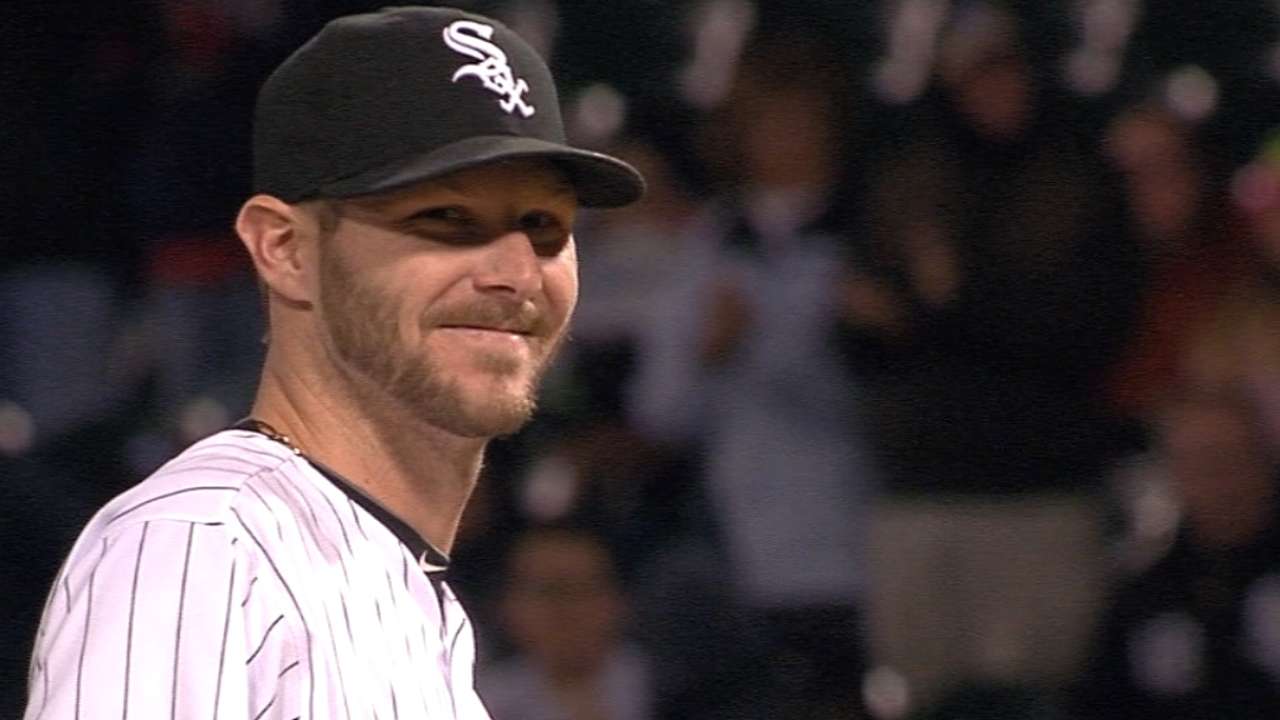
Chris Sale (pictured) and Jose Abreu lead an improved Chicago club (MLB.com)
AL Central--No longer Detroit's to lose, but they're not going down without a fight.

Cleveland Indians (86-76, +45)
The Indians have what FanGraphs believes to be the run prevention in the American League, which could be the case if its flamethrowing rotation holds up. Corey Kluber, Danny Salazar, and Carlos Carrasco make for a formidable big three, and there's plenty of arms beyond them in Trevor Bauer, Josh Tomlin, and Cody Anderson. Cleveland's lineup is balanced, with only one glaring weakness in center field, and their infield looks tremendous on paper. A full season of Francisco Lindor will help, too.

Detroit Tigers (81-81, -1)
After stripping down their team last summer, the Tigers reloaded during the winter and are poised to make another run. Jordan Zimmermann joins what should be a solid rotation, especially if Daniel Norris breaks out and Justin Verlander rebounds a bit. Their dynamite offense, bolstered by Justin Upton, could improve as well if Victor Martinez bounces back, Miguel Cabrera stays healthy, and Nick Castellanos progresses.

Chicago White Sox (81-81, -4)
Two consecutive offseasons of upgrades has the Sox on the brink of contention. Their offseason wasn't as splashy as the cross-town Cubs, but they still improved themselves plenty by signing Mat Latos and Austin Jackson in addition to trading for Todd Frazier and Brett Lawrie. The result is a very well-rounded roster that should make a lot of noise in an up-for-grabs division.

Minnesota Twins (77-85, -34)
Minnesota surprised everyone by remaining in contention deep into lastyear, and their young players are only getting better. Miguel Sano looks primed for an MVP season and Bryon Buxton should make more of an impact. A healthy Ervin Santana will help the rotation.

Kansas City Royals (77-85, -39)
Coming off two straight pennants and a World Series victory, Kansas City is this division's team to beat. They're bringing back pretty much the same team from last year, too (minus Johnny Cueto, who stunk for them anyways).

Already, the best shortstop in baseball, Correa could be AL MVP this year (MLB.com)
AL West--Houston appears to be the top dog in this dogfight.

Houston Astros (87-75, +60)
Houston has plenty of power and speed after ranking first and second in the AL last year in steals and long balls, respectively. Full seasons from George Springer, Carlos Gomez, and Rookie of the Year Carlos Correa will add more of both.  Their rotation is really good too, led by defending Cy Young winner Dallas Keuchel and fortified by Collin McHugh, Lance McCullers, and Doug Fister. The Astros are the most complete team in this division and loaded with young talent, making the AL West theirs for the taking.

Seattle Mariners (82-80, +12)
The M's are like the Rays--loaded with pitching but short on bats. Their rotation projects to be one of the better units in the league, especially if Taijuan Walker steps it up in his third season and Felix Hernandez rebounds from what was a down year for him. They'll have plenty of help from newcomers Wade Miley and Nate Karns as well as the always-underrated Hisashi Iwakuma. Bounce backs by Kyle Seager and Robinson Cano will infuse the offense and relieve some of the pressure on Nelson Cruz.

Los Angeles Angels (81-81, -3)
Mike Trout, a healthy Albert Pujols, and C.J. Cron can do some serious damage, and they now have the game's best defensive shortstop in Andrelton Simmons. The rotation will be better than last year with better health from Matt Shoemaker and C.J. Wilson, improvement from Andrew Heaney and a rebound from Jered Weaver.

Texas Rangers (80-82, -8)
Texas has big bats all over the place with Prince Fielder, Adrian Beltre, Ian Desmond, Josh Hamilton, and Shin-Soo Choo leading the charge. Those are all veterans, but the Rangers have talented youngsters too, as Rougned Odor is trending up and everyone's in love with Jurickson Profar. They also have a pair of bona fide aces in Cole Hamels and Yu Darvish, which will make them tough to beat if their stars ward off age for another year.

Oakland Athletics (79-83, -17)
The A's were one of baseball's unluckiest teams last year, so if their luck flips they'll be contenders again. As always, they're a deep team with talented players manning every position, which makes them better able to withstand injuries. They also have one of the best young pitchers in baseball in Sonny Gray, who heads an intriguing rotation. Full seasons from Kendall Graveman and Jesse Hahn, plus a renaissance from the seemingly rejuvenated Rich Hill, could add up to a successful year for Oakland.
 
My take: As a Red Sox fan I'm tempted to pick Boston, but Houston appears to have the best all-around team on paper. I think their division might be a little easier, too, since LA and Oakland aren't that good and Texas could easily regress if everyone gets old at once. They're a team on the rise, and I like their chances in 2016.

Wednesday, December 30, 2015

Sox Lose Another Legend

Malzone passed away yesterday. He was 85 (Boston Herald)
It's been a rough week for Red Sox legends. On Sunday, Dave Henderson died. Yesterday, Frank Malzone joined him in the great big diamond in the sky.

Whereas Henderson was remembered mostly for one swing, Malzone never had a career-defining moment. He was just a steady third base man for the better part of the decade, one of the best Red Sox during their dark days of the late '50s and early '60s. A slick-fielding, solid-hitting third baseman, Malzone was a Mike Lowell-type destined to be overshadowed by superstar teammates Ted Williams and Carl Yastrzemski.

Despite not doing much to distinguish himself off the field, Malzone did plenty to earn recognition in between the lines. After spending seven seasons in the minors and two years in the military during the Korean War, Malzone debuted with a flourish in 1957, batting .292 with 15 homers and a career high 103 RBI. The first time All-Star and finished second to Tony Kubek in the Rookie of the Year race--an award Malzone deserved to win--but placed seventh in the MVP vote.

Malzone also won his first Gold Glove--the first ever awarded to an American League third baseman. He won the next two as well before Brooks Robinson came along and won 16 straight from 1960-1975 (Who knows how many Malzone might have won had Robinson played in the National League?). Only six men--Robinson, Buddy Bell, Gary Gaetti, Robin Ventura, Eric Chavez, and Adrian Beltre--won more while manning the hot corner for an AL team.

Malzone was more than just a terrific gloveman, however; he was also a pretty decent hitter (thanks to Fenway Park, where he batted .298/.339/.442 for his career). Most years he was good for a .280-ish average, 15 or so homers, and around 80 RBI. You could also count on him to be in the lineup everyday; from 1957-1964, no American Leaguer played more games. It was that kind of solid production and consistency that made him a six-time All-Star during this span, though it helped that the top third basemen at the time (Eddie Mathews, Ken Boyer, Ron Santo) played in the National League.

After dropping off sharply in 1965, the 35 year-old Malzone was released on the last day of November (he didn't remain a free agent for long, however, as the California Angels signed him the same day). After an even worse season with the Angels in 1966, Malzone hung up his spikes for good.

In 1995, 30 years after his last game with the Red Sox, Malzone was one of 14 players inducted into the franchise's inaugural Hall of Fame class, along with former teammates Williams, Yastrzemski, and Tony Conigliaro. Maybe someday the Sox will retire his 11, which he wore from 1956 to 1965. Clay Buchholz is currently wearing it, but should he leave after next season Boston would do well to add it to their line of numbers along Fenway's right field roof.

Saturday, November 14, 2015

2015 AL Silver Sluggers Review

Cabrera copped his sixth career Silver Slugger, but did he deserve it? (PanAmerican World)
November is MLB awards season, and last week saw some hardware handed out in the form of Gold Gloves and Silver Sluggers. Here is my take on the latter, and whether I thought the winners were truly deserving.

McCann bounced back after posting a career-low .692 OPS in his first year with the Yankees, leading all catchers with 26 home runs and 94 RBI and improving his OPS to .756.

In spite of his impressive power totals, I think McCann was probably the third-best hitting catcher in the American League this year. Stephen Vogt and Russell Martin both had a higher OPS, wOBA, and wRC+ than McCann in about equal playing time. They also played in less favorable parks for hitters but were better in all three rate stats.

Vogt and Martin are almost impossible to separate; Vogt got on base a little more while Martin hit for more power. When two players are so close I like to compare their road splits to help eliminate home field advantages, and by that method Vogt comes out way ahead. His numbers, not surprisingly, were severely hampered by playing in Oakland, as he had 13 homers and an .830 OPS on the road compared to five and a ,740 OPS at home. Martin, on the other hand, got a considerable boost from the Rogers Centre, where he launched 13 of his 23 homers and posted an .808 OPS compared to .768 everywhere else. So while Martin's overall numbers are slightly better, Vogt's are undoubtedly more impressive.

Cabrera had another monster year at the plate, continuing his reign as arguably the best hitter in baseball by leading the bigs in batting (.338) and the AL in OBP (.440). He also posted a .413 wOBA and 165 wRC+, tops among American League first basemen. He missed 43 games, though, so his counting numbers were his worst since his rookie year. He failed to reach 25 homers and 100 RBI for the first time since 2003, and just barely qualified for the batting crown.

His only serious competition in the AL came from Chris Davis, who crushed a major league best 47 homers to go along with 117 RBI and 322 total bases. Davis played all but two games, making up most of the ground between him and Cabrera in their rate stats (Davis hit .262/,361/.562, meaning his OPS was 51 points below Cabrera's despite Camden Yards being a much better park for hitters than Comerica). It's close, but Cabrera was so much better when he did play that I think he's the proper call.

Houston's diminutive second baseman had another big season, leading the loop in hits and steals for the second year in a row while batting .313/.353/.459 (120 wRC+). He also improved in the power department by smacking 15 home runs--more than double his previous career high--and driving in 66 runs--also a personal best. While Jason Kipnis was actually a bit better in terms of rate stats, Altuve's edge in playing time (154 games to 141 for Kipnis) and plate appearances (Altuve accumulated 48 more) is enough to make up the difference.

Altuve won his second straight Silver Slugger, topping 200 hits again (Fox Sports)
Manny Machado had a great year, but none of the third-sackers in baseball could hold a candle to the one Donaldson just had. He led the position in pretty much every meaningful statistic, a dominant showing that will likely earn him AL MVP honors over Mike Trout. Donaldson led the majors in runs (122) and the league in RBI (123), total bases (352), and extra base hits, helping Toronto end its 22-year postseason drought.

Wire-to-wire, Bogaerts was the best-hitting shortstop in the American League this year. The 22 year-old rebounded from a horrendous rookie year to bat .320/.355/.421 with 196 hits, including 35 doubles. Lots of things went wrong in Boston this year, but Bogaerts wasn't one of them.

There were two other shortstops, however--both rookies--who were much better on a per-game and per at-bat basis. Houston's Carlos Correa led all shortstops in home runs with 22 despite not making his major league debut until June 8th. And though he batted 41 points lower than Bogaerts, his OBP was nearly as strong and his slugging was over 90 points higher. So while Bogaerts played 156 games to Correa's 99, Correa nearly doubled his offensive value.

Francisco Lindor, like Correa, was also a more valuable offensive player despite appearing in just 99 games. He had almost the same average and OBP as Bogaerts while slugging 61 points higher--all while playing in a much tougher park for hitters.

I would have voted for Correa, who was clearly the best-hitting shortstop in baseball this year, but I can understand why the huge disadvantage in playing time (Bogaerts played all but six games) cost him.

OF Mike Trout
Another year, another Silver Slugger for Trout, who's won in all four of his full seasons. He was the best hitter in the American League this year, pacing the Junior Circuit in slugging, OPS, OPS+, runs created, wRC+, wOBA, total offense, and times on base. He deserves another MVP, too, but it looks like he'll go home empty-handed.

Cruz was a no-brainer after batting .302/.369/.566 (158 wRC+) with 44 homers--amazing numbers for anyone but even more incredible considering he played half his games at Safeco. Among major league outfielders, only Trout and Bryce Harper had a better wOBA, wRC+, and more offensive value.

Here's another place where I disagree. The third-best hitting outfielder in the American League was Jose Bautista, not Mr. Martinez. Their slugging percentages were within one point of each other, but Bautista's OBP was 33 points higher. Even after accounting for their ballparks, Bautista still holds a sizable edge in wRC+ (147 to 137) and wOBA (.389 to .372) in more plate appearances (666 to 657). There is no argument for Martinez over Bautista.

 Martinez received a silver bat that should have gone to Bautista (iSportsWeb)
Morales proved to be a shrewd offseason pickup for Kansas City, enjoying his best season since his 2009 breakout with 41 doubles, 22 homers, 106 RBI, a 131 wRC+ and .364 wOBA. Morales was instrumental in helping the Royals win it all, pacing the team in pretty much every major offensive category and providing much-needed punch in a small-ball lineup. For his efforts, the 32 year-old was rewarded with his first Silver Slugger following his 10th big league season.

But while he may have been the best hitter on the World Series champion Royals, Morales was nowhere near the best-hitting DH this year. David Ortiz posted an OPS some 66 points higher, supplying 37 doubles, the same number of home runs and 108 RBI. His .379 wOBA and 138 wRC+ were both markedly better than Morales's totals, too. The same held true for Edwin Encarnacion, who was actually the most productive DH this year with 39 homers, 111 RBI, a 150 wRC+, and a .392 wOBA.

Then there were a couple of players who were just as deserving as Morales. One was Alex Rodriguez, who slugged 33 homers while posting a nearly identical wRC+ (129) and wOBA (.361). He was also the more valuable offensive player according to FanGraphs, providing roughly five additional runs thanks to his superior baserunning. There was also Prince Fielder, whose numbers (23 homers, 98 RBI, .305/.378/.463) were nearly identical to those of Morales. Even after accounting for the boost Fielder received from Arlington's hitting-friendly environment, his wRC+ (124) and wOBA (.360) suggest he was about dead even with Morales.

It's clear, at least to me, that Morales won largely because of his team's success. Had he still been playing for Seattle or Minnesota, few would have noticed his fine year. After comparing his numbers to other DHs across the league, there's just no way you can conclude he was the best.

Overall, not a great year for Silver Sluggers. The coaches and managers got the easy calls right, but whiffed on a few of the tougher ones. Then again, I'm sure I looked much more extensively into this than the people who actually voted.

Wednesday, October 7, 2015

Astros Bomb Bombers

The upstart Astros finished off the Yankees last night (San Diego Tribune)
It took the Yankees three years to get back to the playoffs--an eternity for baseball's most impatient organization and fan base--but just three hours to get knocked out.

New York losing last night's wild card contest completed their September collapse. Just a half-game out of first on September 8th, they went 10-16 the rest of the way, finishing six games back of the Blue Jays. With a slumping offense, leaky bullpen, and diminished rotation, New York limped to the finish line, losing six of their last seven to inferior Red Sox and Orioles teams. Had they won last night and advanced, they would have been easy prey for the well-rested Royals.

The Astros, on the other hand, were red-hot, having won 9 of their last 14 to close out the season. If LA's last-ditch comeback worried them, they didn't play like it. Houston had the look of a young, energetic team eager to move on, while the tired Yankees looked like they were ready to go home.

And so the surging 'Stros aswaggered into Yankee Stadium and blanked the Bombers, advancing to an ALDS date with Kansas City. Houston grabbed an early lead when Colby Rasmus led off the second inning with a home run and never looked back. The Astros added another in the fourth when Carlos Gomez, who'd done nothing of consequence since coming over in a deadline deal with the Brewers, also went yard, then tacked on an insurance run in the seventh. New York never recovered, making that 3-0 deficit look like a 13-0 hole by the end of the night.

Though both teams were top-five offenses in terms of runs scored and home runs, neither showed much signs of life last night. The oldest lineup and the youngest combined for just three runs and eight hits between them, and if two of those hits had stayed in the yard than it could have been a 1-0 game.

I'm still surprised New York lost, as everything leading up to this game pointed to a Yankees victory. New York was at home with its ace on the mound, facing a pitcher on short rest who'd been far less effective on the road. All the Yankees needed was six solid innings from Masahiro Tanaka and a big fly from one of their boppers, then they could turn the game over to their lights-out bullpen and take it from there.

Instead Tanaka was gone after five, yanked by Joe Girardi after just 83 pitches. Rather than take his chances with a tiring Tanaka, Girardi deployed stud relievers Justin Wilson, Dellin Betances, and Andrew Miller to keep the Astros at bay. Tanaka hadn't done much to warrant staying in the game, throwing just 49 of his 83 pitches for strikes and recording just one punchout after the first inning. Plagued by the long ball all year, he surrendered two more in the first four innings. Facing an Astros lineup that spanked 230 during the regular season in a park that favors the four-bagger, it was only a matter of time before Houston made Tanaka pay for at least one of his mistakes.

They didn't make him pay for loading the bases following the Rasmus homer--a couple hits there drives him from the game and gives Dallas Keuchel an early cushion. Not that the likely Cy Young winner needed it, as he was simply marvelous. Keuchel allowed just three hits--all singles--and one walk across six shutout innings while fanning seven. There were questions about his ability to pitch on the road (his road ERA was over two runs higher than his home mark) and on three days' rest, but he answered them both by silencing New York's bats.
 
The Yankee offense had been quiet lately--averaging just 3.73 runs per game over their final 26--but it had been nearly two months since they'd been shut out at home. To wit, it seemed as though their aging stars simply ran out of gas. It's clear that going forward, New York will need to start phasing out some of its older players and develop (or buy) more young talent in order to compete for a championship. Because as currently constructed, they're just too old to survive a long, grueling baseball season, which still has another month to go.
 
The Astros, meanwhile, remind me of last year's Royals. They're young, hungry, and while not the most talented, certainly have enough to get by. It wouldn't surprise me if they upset the Royals and possibly the Blue Jays on their way to winning the AL pennant. The future is bright for this Houston team, in October and beyond.

Tuesday, October 6, 2015

AL Award Race Preview

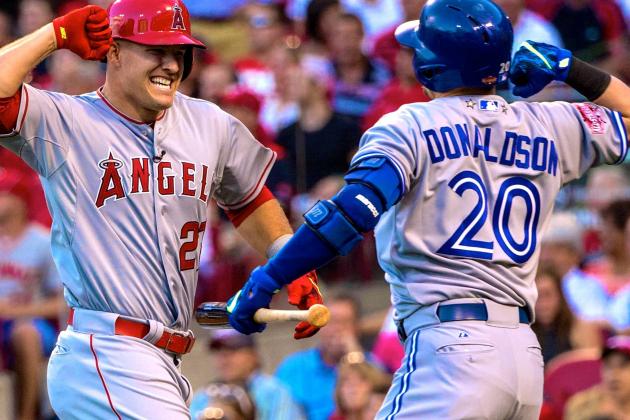
The All-Star teammates are now going head-to-head for AL MVP (Bleacher Report)
On this tense day leading up to tonight's American League wild card game, we might as well lighten the mood by handing out some hardware to this year's top performers. Today I'll tackle the AL races before previewing the NL field tomorrow.

Let me just say that I don't envy the voters this year. This season's award races were some of the closest I can recall, with the AL awards all virtual toss-ups and there being no easy answer to the NL Cy Young conundrum. While I've spilled many words in this space criticizing poor BBWAA choices throughout the years, there will be no such backlash from me this year. I could stare at the numbers until I go blind and I still don't think I could give a definitive answer, so I certainly won't blast a writer for going with his gut on this one.

Anyways, on to the awards:

AL MVP
Last year Trout won in a landslide (unanimously, actually), but if he wins again this year it will be by the skin of his teeth--even though this season was superior to last's by almost every conceivable metric. Although he led all American Leaguers in WAR (both B-R and FanGraphs versions) and posted the league's highest OPS (and OPS+, and slugging percentage), he's once again at a disadvantage because his team failed to make the playoffs. Trout nearly dragged them there, though, keeping the Angels in contention until the season's final day. After a dreadful August slump by him and teammates, he recovered in September to post a 1.078 OPS over the season's final five weeks. It's not Trout's fault LA's bullpen imploded during Game 162, or that nobody besides him and Albert Pujols made a peep against Cole Hamels. One guy can only do so much in baseball (see Joey Votto), and in the end it just wasn't enough.

I won't hold that against Trout, but others might. One of the reasons Trout finished behind Miguel Cabrera in the hotly contested MVP races of 2012 and 2013 was that Cabrera's team made the playoffs while Trout's didn't. When he finally won last year, the Angels winning 98 games and the AL West was definitely a factor. This year they really had no business being in contention after their awful August, but like I said Trout nearly willed them to October.

For those seeking to reward the best player on a playoff team, they'll find few legitimate MVP candidates on the Yankees, Astros, Rangers, and Royals. That leaves the Blue Jays, who are loaded with them. Votes will undoubtedly be cast for big boppers Jose Bautista and Edwin Encarnacion as well as staff ace David Price, but the team's top player this year was clearly Josh Donaldson, a slick-fielding third baseman who also paced the Junior Circuit in runs, RBI, total bases, and extra base hits.

Already an MVP-caliber player his last few years in Oakland, Donaldson exploded his first year in Toronto. Many credit him for helping an underachieving Blue Jays squad snap its 22 year playoff drought--the longest in professional American sports. Not only was he the best hitter in a stacked lineup, but he also played a demanding defensive position and played it well.

So did Trout, which makes this such a close call. Their offensive numbers are eerily similar and they both play tough positions. Up until about three weeks ago I would have said Donaldson, but his late-season slump and Trout's strong finish was enough to sway me back to Team Trout. I think Toronto still makes the playoffs without Donaldson (though probably doesn't win the division), while Los Angeles is a losing team without its star center fielder.

Furthermore, Trout was simply the better player this year. He was a better hitter, especially after accounting for their ballparks (Trout's OPS and OPS+ led the AL). Donaldson played half his games in the Rogers Centre, a launching pad that significantly inflated his statistics. He hit three-fifths of his doubles and home runs there, batted 67 points higher there, and slugged 160 points higher there. It was a given that the move from the Coliseum's suffocating offensive environment to a more generous one in Toronto would boost his numbers, but no one could have foreseen him taking such extreme advantage of his home park.

Trout, however, did not enjoy the same home field boost. Anaheim is a better park for pitchers than hitters, which is evident in Trout's splits. He batted 35 points higher and increased his slugging percentage by almost 70 points on the road. He also had more home runs, more RBI, and nearly twice as many doubles on the road as he did in Anaheim. Had he played in even a neutral park, his numbers would look considerably better. That he still equaled Donaldson's dinger total and led the league in slugging percentage, then, is very impressive.

Bottom line: Donaldson had a great season, but Trout was just a little bit better.
Price positioned himself to win another Cy with his huge second half (Fox Sports)
AL Cy Young award
This one's another tough call. Sonny Gray was the frontrunner for much of the season with a 2.13 ERA and sub-1 WHIP through the end of August, only to falter in September by allowing 20 earned runs over his final five starts. His ERA ballooned more than half a run, costing him the ERA title that may have netted him his first Cy.

Meanwhile, David Price continued mowing down batters in Toronto, putting the finishing touches on what could be his second Cy in four years. His numbers were stellar across the board; first in ERA and fWAR, second in FIP, bWAR, and ERA+; third in innings pitched, fourth in strikeouts,, and fifth in WHIP--all while spending time in two of the tougher parks for pitchers.

He wasn't the American League's best pitcher this year, though; that would be Houston's Dallas Keuchel. The AL's lone 20-game winner finished a close second to Price in raw ERA but led the loop in ERA+. He was also tops in pitcher bWAR, WHIP, and innings pitched. Considering their run-prevention skills were dead-even, the tiebreaker goes to Keuchel for tossing an additional dozen innings--or roughly two extra starts' worth. That was huge for the Astros, who won the second wild card by one game over the Angels.
 
Both were part of compelling narratives after helping pitch their respective teams into the postseason, though obviously Houston misses the playoffs without Keuchel while Toronto probably still makes it in. Price is the bigger name but Keuchel's numbers are a touch better. He deserves to win by the slimmest of margins, so expect a repeat of last year's photo finish between Corey Kluber and Felix Hernandez (neither of whom are serious contenders again this year, by the way).

AL Rookie of the Year Award
What's interesting about the American League race is none of the best candidates played full seasons. Promoted throughout the summer, their campaigns were abbreviated, which makes these comparisons both easier and more difficult. They are easier in the sense that their playing time was roughly even, but more difficult due to their numbers being awfully close.

Carlos Correa's counting numbers--22 home runs, 68 RBI, 14 stolen bases, 4.1 bWAR--would have been phenomenal for a full season, but they're borderline insane considering he played barely three-fifths of one. We can only wonder what he could have accomplished had he debuted before June 8th. His full season numbers project to 36 home runs, 112 RBI, and 23 steals, which for a rookie shortstop is simply ridiculous. Even more ridiculous is that he just became old enough to legally buy a drink two weeks ago.
Correa's already earning comparisons to Alex Rodriguez (News Locker)
But wait, not so fast. What about the other wunderkind shortstop who played 99 games this year? Just 10 months older than Correa, Francisco Lindor was equally spectacular for the Indians, batting .313/.353/.482 (128 wRC+) with a dozen homers and steals. While his bat wasn't quite as potent, it was nearly so, and he was a considerably better defender. They were about even as baserunners, with the slight edge going to Correa. Baseball-Reference has them within half a win of each other in WAR, but FanGraphs gives Lindor a significant edge of more than one win.

I'd be remiss if I didn't mention Minnesota's Miguel Sano, who quietly enjoyed a monster season with the Twins. He was unquestionably the American League's best-hitting rookie, what with his .269/.385/.530 batting line, 151 wRC+, and .392 wOBA--not to mention his 18 home runs and 52 RBI in 80 games. Extrapolate his numbers over a full season and they're nearly identical to Correa's, But whereas Correa plays the most important non-catching position on the diamond, Sano hardly plays the field at all as a DH, making his production far less valuable. Had he played all year and amassed upwards of 30 homers and 100 RBI this would be a different conversation, but there's no reasonable explanation for choosing him over Correa or Lindor.

On the pitching side, Correa's teammate Lance McCullers made a good impression with a 3.22 ERA (80 ERA-), 3.26 FIP (79 FIP-), and over a strikeout per inning. Had he logged a full season, that performance might have merited the trophy, but it covered 22 starts and 125 innings. Two-thirds of a season is only slightly more than the three-fifths that Correa and Lindor played. Both were more dominant relative to their peers, as good-hitting shortstops are once again a rare commodity. In today's offensive environment, I bet most GMs would rather have the shortstop capable of hitting .300 with 20/20 potential rather than a midrotation starter.

So it comes down to Correa and Lindor. Lindor's the better all-around player at this point, but Correa is already showing Troy Tulowitzki-like prowess at the plate. With the margin between them so minute, I'm leaning towards the guy with the better offensive numbers. I think Correa made a little more of an impact in the games he played, and it also helps that he sparked his team to the postseason. Without him, the Astros are watching from home this year, so I think his outstanding performance in the heat of a pennant race deserves to be recognized.

When you get down to it, all of these awards are essentially two-horse races. Trout and Donaldson, Price and Keuchel, and Correa vs. Lindor. They're all so evenly matched you really can't go wrong with any of them. If it was me, I might just skip the analysis-induced headaches and flip three coins.