Showing posts with label Hot Stove. Show all posts

Tuesday, January 8, 2019

Harper and Machado Waiting it Out

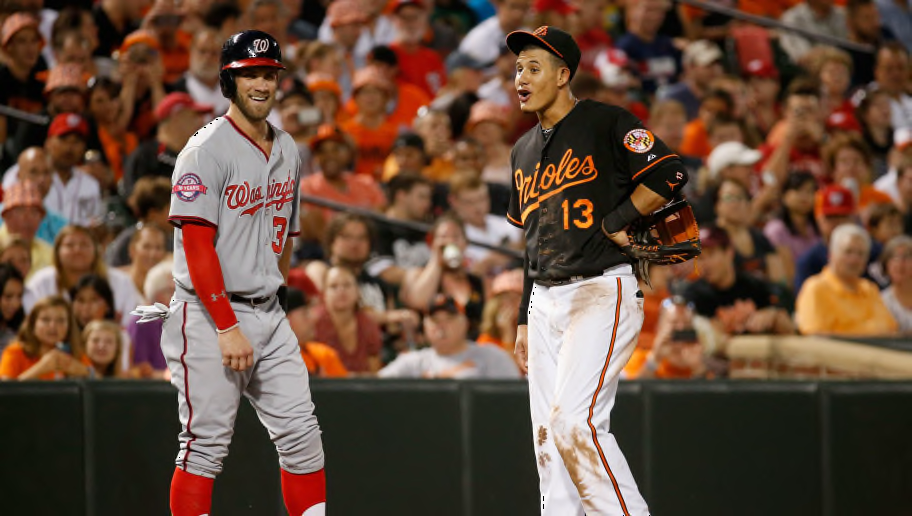
Harper (left) and Machado are holding out for record paydays (12Up)
For nearly two decades, Alex Rodriguez has held the record for the largest free-agent contract in American professional sports. On December 11, 2000, Rodriguez signed a 10-year, $252 million deal with the Texas Rangers, doubling the contract of the highest paid professional athlete at the time --Kevin Garnett of the NBA's Minnesota Timberwolves. Seven years later, Rodriguez opted out of that deal to sign an even bigger one with the New York Yankees worth $275 million over 10 years, with the potential to earn an additional $30 million in incentives for reaching certain home run milestones (which later became controversial following his PED admissions).

Records are made to be broken, but so far neither deal has been surpassed by a free agent* in any sport. The closest anyone's gotten were Albert Pujols and Robinson Cano, who both signed 10-year, $240 million deals in 2011 and 2013, respectively. That's going to change this winter, however; it's only a matter of when.

[*Giancarlo Stanton (13 years/$325 million) and Miguel Cabrera (10 years/$292 million) both later eclipsed Rodriguez via contract extensions, not as free agents. The highest paid athlete is boxer Canelo Alvarez, who's currently on an 11-fight, $365 million deal.] 

Bryce Harper and his agent, Scott Boras (the same agent who negotiated Rodriguez's first megadeal), have had their sights set on the record since Harper was smashing 500-foot homers and making magazine covers as a teenager. He debuted with the Washington Nationals at 19 in 2012, making his first All-Star team en route to winning NL Rookie of the Year honors. He was an All-Star again in 2013 before putting together one of the greatest offensive seasons ever in 2015, when he won the NL MVP unanimously. The Chosen One had arrived.

While Harper hasn't been able to replicate that historic campaign, he showed what his ceiling can be. He showcased it again last summer by winning the Home Run Derby at Nationals Park, wowing the hometown crowd with a display for the ages that included 14 homers in the final 47 seconds and 45 overall. While injuries have often prevented Harper from reaching his full potential, he's still been one of baseball's 12 most valuable position players throughout his career. He's slugged at least 20 homers and been an All-Star in all but one of his seven seasons, and he was headed for a second MVP award in 2017 before hyperextending his knee after slipping on a wet base. Harper's 26 years old, he just led the Major Leagues in walks, and he has MVP potential. He is, in other words, a superstar.

He's not the only one whose services are available this winter, however. Manny Machado, last seen during the World Series with the Los Angeles Dodgers, is arguably just as good as Harper. Machado, who's just four months older than Harper, also debuted in 2012 and immediately emerged as one of the best players in baseball. In 2013 he was an All-Star en route to leading the AL in doubles, and starting in 2015 he's topped 30 homers every year.

While not quite the force that Harper is at the plate, Machado's a comparable baserunner and an elite defender at a more challenging position, earning a pair of Gold Gloves for his outstanding work at the hot corner (he can also play shortstop, but not as well as third). He's one of 15 position players to compile at least 30 fWAR since 2012, tallying virtually the same amount as Harper in one fewer game. That hasn't translated to an MVP yet, but it has helped the four-time All-Star to three top-10 finishes despite playing for mostly mediocre teams in Baltimore. And whereas Harper has struggled with injuries, Machado has been extremely durable, appearing in at least 156 games in five of his last six seasons.
Nearly 20 years later, A-Rod's superdeal is still the standard (SI)
Baseball hasn't had a free agent so good and so young since 2000, when Rodriguez was a 25-year-old shortstop coming off three straight 40-homer seasons with the Seattle Mariners. Now it has two, in the same winter, no less.

In the old days, that would have sparked a feeding frenzy between baseball's richest teams. The Red Sox Yankees, Cubs, and Dodgers would've opened up their vaults for them, spawning a bidding war the likes of which baseball has never seen. But, as last winter's slow-moving market proved, times have changed. Teams are not willing to pursue free agents as aggressively as they used to, not when it means committing large sums of money to ageing players who will cost them compensatory draft picks, luxury tax penalties, and payroll flexibility. Better to drag out negotiations and drive down the price once Spring Training is underway and players start getting desperate.

But if there was ever a player to break the bank for, it's Machado and Harper. Sure, they have red flags and rub a lot of people the wrong way, but they're young and athletic and certifiable stars. There's not too many of those left in baseball these days, so they're sure to attract eyeballs and sell jerseys. Neither has won a championship, which should continue to drive them after the ink dries on their new contracts. They'll instantly transform whichever lineup they join and add multiple wins to a team by themselves. Not everyone can afford them, but everyone could use them.

It's hard to reconcile, then, why both remain unsigned despite playing different positions and negotiating with different teams. The Dodgers have the money and the roster space for Harper after trading away Matt Kemp and Yasiel Puig, while the Phillies, White Sox, and Yankees all need Machado on the left side of their infields. So what's taking so long?

It's not as though teams haven't tried to sign either player. Harper rejected a 10-year, $300 million offer from the Nationals, which would have made him the richest free agent ever (Washington has reportedly since upped its offer). Machado received an offer from the White Sox, albeit a smaller one closer to $200 million. Both are worth more than that, and they know it. But is there a team willing to give it to them?

We'll just have to wait and see.

Friday, February 26, 2016

Baseball's Best Team Just Got Better

Fowler set career-highs in several categories last year (Fox Sports)
Okay, Cubs, we get it. You're clearly the best team in baseball, and you have been for a while now. You don't need to get any better. So just, you know, chill out already.

The Cubs didn't have to do anything this winter, not after spending wads of cash and winning 97 games last year. They already had the NL's reigning Manager of the Year (Joe Maddon), Rookie of the Year (Kris Bryant), Cy Young winner (Jake Arrieta), and a legitimate MVP candidate (Anthony Rizzo). They'd acquired Jon Lester, built a young, power-laden lineup, and assembled a formidable bullpen. They had no weaknesses.

But that didn't stop them from going out and splurging on Jason Heyward, giving him the biggest deal handed to a position player this winter. That didn't stop them from signing Ben Zobrist, one of baseball's best and most versatile assets. That didn't stop them from bringing in Lester's old rotationmate (and fellow World Series champion) John Lackey to bolster their rotation.

After all that, the Cubs had assembled what most pundits agreed was baseball's best team; not by a little, but by a lot. Chicago hadn't replaced players who'd left, as some teams do during free agency; they'd added on to what was already a championship-caliber core.

The only key contributor from last year who wouldn't be returning, it seemed, was Dexter Fowler, the team's center fielder and leadoff man. Fowler had quietly been one of the Cubs' better players, leading the club with 102 runs, 20 stolen bases, and 84 walks while supplying a career-high 17 homers. Chicago had opted to replace him with a younger, better, and wildly more expensive player in Jason Heyward, even though Heyward had spent just 32 of his career 835 games (less than 4 percent) in center. And with youngsters Jorge Soler and Kyle Schwarber flanking him, his job wasn't going to be any easier.

So, rather than move forward with a potentially disastrous outfield alignment, the Cubs traded Chris Coghlan and brought Fowler back on a one-year, $8 million deal with a $9 million option for 2017.

It's a crummy deal for Fowler, who turned down Chicago's $15.8 million qualifying offer and had reportedly secured a three-year deal with the Baltimore Orioles, but a steal for the Cubs. No one was getting a better bargain than what Chicago's other team got on Mat Latos, but this contract still qualifies as highway robbery. Fowler, who turns 30 next month, was worth $25.6 million last year based on FanGraphs's WAR/$ conversion and hasn't been worth less than $10 million since 2010. The Cubs are going to get their money's worth, and then some.

More importantly, signing Fowler allows everyone to return to their natural positions. Heyward goes back to right (where he's a three-time Gold Glove winner) while the kids split time in left. Yes, it's crowded, but I guarantee that every GM would tell you he'd rather have four good outfielders than three. It opens up trade possibilities, plus you never know when injuries are going to crop up. It's also likely that Schwarber and/or Soler will suffer growing pains this year, as they've played fewer than 200 major league games between them.

With Fowler back on board, the Cubs have everything. They have an excellent outfield, a stellar infield (Bryant and Rizzo at the corners, Zobrist and Addison Russell up the middle, and Miguel Montero behind the plate), a deep rotation headed by Arrieta and Lester, a terrific bullpen, and the best manager in baseball, not to mention a huge payroll and a saavy front office. Chicago's cup runneth over, so my only question is; how does this team not win 100 games and the World Series this year?

Orioles Get Good Deal on Gallardo

Gallardo gives the Orioles a frontline starter (MLB.com)
Just when you thought the offseason was winding down and rosters were pretty much set, the Baltimore Orioles made a last-minute splash by inking Yovani Gallardo to a two-year, $22 million deal with a $13 million option and coming oh-so-close to signing Dexter Fowler (more on that to come).

It seemed like the Orioles were content to roll out last year's team minus Wei-Yin Chen, which didn't look promising given that a) Chen was their best pitcher and b) they finished .500. But after shelling out $161 million to keep Chris Davis--more money than they'd ever paid anybody before--there wasn't much wiggle room left in their budget to upgrade elsewhere or re-sign Chen, who landed a five-year, $80 million payday from the Marlins.

In Gallardo, however, they essentially replaced Chen at a fraction of the cost. Both are 30 and have produced almost identical results since Chen made his major league debut in 2012:

Chen 2012-15: 706.2 IP 3.72 ERA 110 ERA+ 4.14 FIP 1.25 WHIP 7.0 K/9
Gall. 2012-15: 761.1 IP 3.69 ERA 108 ERA+ 3.94 FIP 1.34 WHIP 7.3 K/9

Chen's the better option because he has more strikeouts, fewer walks, and pitches from the left side, but not so much better that he deserves a substantially better contract. The Orioles shouldn't feel bad about letting him walk, as they got a great consolation prize in Gallardo.

They also have to be encouraged that Gallardo made a smooth transition to the American League last year, compiling the best raw and adjusted ERA of his career despite making half his starts in the brutal Texas heat. Camden Yards is also tough on pitchers, but that shouldn't be a problem now that Gallardo's thrived in two difficult parks to pitch in (the other being Milwaukee).

What the Orioles should be worried about, however, are Gallardo's poor peripherals. He had the worst WHIP of his career in 2015 and his xFIP was 4.31, nearly a full run higher than his ERA and also a career-worst. In addition to getting lucky on his strand and home run rates, he posted a career-low 5.9 K/9 rate--the third straight year in which his strikeout rate declined. That, combined with his pedestrian walk rate, resulted in a career-low 1.78 K/ BB ratio. Those are the numbers of a bad pitcher, not a good one earning eight figures a year.

That said, Gallardo's track record suggests he'll be a good bargain for the O's as long as he stays healthy, which has never been a problem for him in the past (he's started at least 30 games in each of the past seven years). His durability and consistently above average results (only once has he had a below-average league and park-adjusted ERA) have helped him exceed two fWAR every year dating back to 2009. That may not seem very impressive, but dollars-wise it's worth a lot. Gallardo has provided well over $11 million (his current salary) of value every year of his career but one; 2008, when he made just four starts. As long as he keeps converting half of balls put in play against him on the ground, he'll be fine (Baseball-Reference has him pegged for a 3.68 ERA in 171 innings next year).

Gallardo doesn't have the ceiling of a David Price or even a Chen, but he does have a very high floor, and that's what the Orioles are paying him for.

Wednesday, February 10, 2016

White Sox Get Absurd Deal on Latos

Latos will try to re-establish his value in the Windy City (Bucs Dugout)
Baseball, like life, is all about timing. This is especially true in free agency, where hitting the market after a career year, as Zack Greinke and David Price did, can result in a windfall. Becoming a free agent immediately after an off-year, however, can mean playing for pennies on the dollar, if at all.

Mat Latos falls into the latter camp. From 2010-2014 he was a great pitcher, first with the Padres and then with the Reds. He had a 3.27 ERA (116 ERA+), 1.16 WHIP, and 3.15 K/BB ratio during those five years, averaging 180 innings per year. That brought him to the cusp of free agency; all he needed was one more productive season before hitting the market at 28, presumably as one of baseball's most attractive free agents.

Obviously that didn't happen, hence why Latos just settled for a one-year, incentive-free $3 million deal from the Chicago White Sox. After being traded to Miami last winter, he promptly ripped his previous team (Cincinnati), which left a bad taste's in everyone's mouths. He then proceeded to have the worst season of his career, going 4-10 with a 4.95 ERA for three different teams. Latos also spent time on the Disabled List and suffered several fluke injuries. As far as walk years go, his was the worst-case scenario.

So, rather than leading one of the deepest free agent classes in years, Latos quickly became an afterthought. Teams were quick to scoop up inferior pitchers such as Ian Kennedy and Mike Leake, paying them gobs of money while Latos sat on the shelf, collecting dust. Finally, the White Sox came calling yesterday, just in time for Spring Training.

What a steal for Chicago, who get a great pitcher still in his prime at a bargain rate. As bad as Latos seemed last year, his peripherals suggest otherwise. He still struck out more than three batters for every walk, and his FIP was 3.72--over a full run better than his ERA and just a tick worse than the previous year's 3.65. He was undone, it seems, by some bad luck on balls in play, an elevated HR/FB rate, and the second-worst strand rate of any pitcher with at least 100 innings. Natural regression to the mean says Latos will be better in 2016.

How much better is a different story. Chicago is a tough place to pitch, especially during the summer when the ball really flies. Just ask Jeff Samardzija, who endured an equally miserable contract year with the White Sox last season. Like Latos, Samardzija was also transitioning to the American League after spending most of his career in the Senior Circuit. It wasn't pretty.

Samardzija is just one of many cautionary tales for what can happen when an NL hurler plies his trade in the American League. It helps that Latos is three years younger and has a more established track record of success. It also helps that he's truly pitching for his next contract. Samardzija knew he was going to make bank no matter what, and sure enough San Francisco gave him $90 million even though he bombed last year. But if Latos tanks, he might not get a second chance.

So even though his contract doesn't have any incentives, it doesn't need any. The incentive is already built in. Latos has "only" made $22 million in his playing career (not including his current contract), which he could make in one season on his next deal should he return to form.

The White Sox are certainly hoping he does, as a healthy and effective Latos gives them a formidable trio at the top of their rotation alongside Chris Sale and Jose Quintana. Coming off a disappointing season and with the Cubs looking like the best team in baseball these days, they could definitely use a bounce back.

Almost as much as Latos.

Making Sense of Colorado's Crazy Trade

Dickerson has far more value to a team than McGee (Fox Sports)
It's been two weeks, and I'm still trying to make sense of the Corey Dickerson for Jake McGee exchange. Given how smart front offices have become, it still blows my mind when they make obviously one-sided trades like this one, or last winter's Doug Fister and Jason Heyward trades.

Only on the most basic level does this trade make any sense for Colorado. The Rockies have an abundance of hitting and need pitching. They had a crowded outfield and a terrible bullpen (terrible doesn't even begin to describe how bad it was). So they traded an outfielder for a pretty good reliever. Okay, makes sense.

Except that it doesn't at all. At least for the Rockies.

For the Rays, a team perpetually short on offense, this trade makes all the sense in the world. Tampa Bay ranked second-to-last in the AL in runs scored last year, largely because its outfielders combined for just 56 home runs, 175 RBI, and a .258/.327/.420 batting line. With a collective OPS+ of 100, Rays outfielders provided league average production at best.

Dickerson, however, has been well above average the last two years, posting a 141 OPS+ in 2014 followed by a 118 OPS+ last year. After leaving Coors Field (the best hitter's park in baseball) for Tropicana Field (one of the worst), he's not going to come close to matching his .309/.354/.556 line from 2014-2015, but he's still a solidly above average corner outfielder who's not even 27 yet. Tampa Bay would have been better off going after someone from a less extreme environment, but Dickerson still represents a clear upgrade in an outfield that saw way too much of David DeJesus and Steven Souza last year.

And it's not like the Rays gave up much to get him, either. Relievers are cheap and plentiful, which makes them expendable. Any failed starter can find second life as a reliever. Hard-hitting, in-their-prime outfielders are a rarity, however, especially these days. McGee is good, but he's going to be 30 in August and was hurt last year. His value may never be higher than it is right now.

Which is why the Rays were smart to move him. The timing made sense. For the Rockies, however, this was probably the worst time for them to trade Dickerson. He's not even arbitration-eligible yet and is still under team control for four more years, plus he's coming off an injury-riddled season in which he missed almost 100 games and was worth only 0.5 bWAR. Had they waited for him to rebuild his value a bit, they could have gotten more for him, like a starting pitcher (Colorado could really use one of those).

While dumb, this trade at least would have been more defensible had the Rockies been good, as sometimes it's necessary to sacrifice something valuable to address one of your weaknesses. But Colorado's entire pitching staff is a weakness, and 60 innings from Mr. McGee won't change that. Bad teams don't need ace relievers, because by the time they get in the game the score's already been decided. They need good, young starting pitchers and position players they can build around. The bullpen is often the last piece of the puzzle, and one that can be cobbled together on the cheap (never pay for saves).

McGee's going to be a free agent in two years, and nobody seriously expects Colorado to contend by then. They've endured five straight losing seasons and there's no light at the end of the tunnel, not until they're able to build what passes for a major league-caliber starting rotation. Dickerson could have helped them do that, but now he's gone.

Wednesday, February 3, 2016

January Hot Stove Roundup: Position Players

Davis struck the richest deal for a position player last month (Baltimore Sun)
After being mostly neglected during the first half of the offseason, position players dominated Hot Stove headlines in January. Here are my thoughts on some of last month's biggest (and not so big) signings.


Like everyone else, I did not expect Cespedes to re-up with the Mets, who seemed unlikely to fork over the nine-figure contract that Cespedes seemed assured of. It's still unlikely Cespedes will be a Met beyond next year--his deal includes an opt-out after 2016--especially if his numbers are anything close to last year's. So if we treat this contract as a one-year deal that will pay Cespedes $27.5 million next year, he only needs to be worth between three and four wins in his age-30 season to earn his hefty salary. Given that he's exceeded 3.5 wins (per B-R) in all but one season so far, that's not asking a whole lot.


As predicted, San Diego's infield was a disaster last year. The shortstop situation was especially ugly, with Padres combining to bat a paltry .228/.279/.365 at the position. It's almost impossible to be any worse, but then Mr. Ramirez may not be significantly better. The 34 year-old hit .249/.285/.357 last year, and it's hard to imagine his numbers improving much after switching from one of the best hitter's parks in baseball (U.S. Cellular Field, where he hit 60 percent of his homers and his OPS was nearly 60 points higher than it was everywhere else) to the worst.


After boldly rejecting Baltimore's original seven-year, $154 million offer, Davis ended up signing with the Orioles after all--for seven years and $161 million. Good thing he waited a month to squeeze that extra $1 million per season out of the O's...

Rockies sign Gerardo Parra: 3 yrs/$27.5 M

It will be interesting to see how Coors Field affects Parra's numbers. I can't imagine they'll improve by leaps and bounds, given that he's spent his whole career in hitter's parks and is coming off a career-year, but he should be a threat to bat .300 for the first time. Of course, that might be a mostly-empty .300 since he hardly walks and has league average power at best. If I were the Rockies, I'd be more concerned about how he's going to handle Colorado's spacious outfield, since Parra's posted subpar defensive metrics in each of the past two seasons. Since this  acquisition was the impetus for Colorado's instantly regrettable Corey Dickerson trade, I give this move a big thumbs-down.

Tiger sign Justin Upton: 6 yrs/$132.75 M

Like many recent deals, this one includes an opt-out, allowing Upton to hit the market again after his age-29 season. But while Upton may only be a Tiger for two years, those are the years you want to have a ballplayer. Plus, Detroit's championship window is rapidly closing, and it's very likely that they'll need to blow their team up by the time Upton is a free agent again. Miguel Cabrera and Justin Verlander will be 35. Ian Kinsler will be 36. Anibal Sanchez will be 34, Jordan Zimmermann 32, and Victor Martinez almost 40. The Tigers have all their important players signed through the next two years, so it's now or never.

Giants sign Denard Span: 3 yrs/$31 M
The Giants got a great deal on Span, signing him at a reduced rate after he missed much of last year with injuries. Just how much of a steal is he? Consider that, over the past four years and at the same ages, Span's been as valuable as Jacoby Ellsbury, who's making twice as much on an annual basis:

Ellsbury 2012-2015: 468 G  .276/.331/.396 (101 OPS+)  11.9 bWAR
Span 2012-2015: 498 G  .290/.344/.402 (105 OPS+)  11.8 bWAR

Well played, Brian Sabean.


The Brewers needed a first baseman after trading Adam Lind in December; enter Mr. Carter. While Lind is older and more injury-prone, he's also a much better hitter. Carter is more of a Carlos Pena/Mark Reynolds type, with huge power numbers offset by equally high strikeout rates and terrible batting averages. Before cratering to .199/.307/.420 last year, though, Carter compiled an OPS just shy of .800 from 2012-2014. Since he just turned 29 and is one of the few players capable of popping 30 homers, he should be a good bet to give Milwaukee a cheap offensive boost.


The Royals aren't known for making big splashes during free agency, but they made an exception here for the face of their franchise. While Gordon may not be the best player on the Royals anymore (that would be Lorenzo Cain), he's still incredibly valuable and one of their most important assets. And though he's going to be 32 in a week, Gordon has the kind of all-around skill set that typically ages well, meaning he shouldn't be a burden to Kansas City's payroll.


Washington has desperately needed an upgrade at second base for some time now, as Danny Espinosa just wasn't cutting it. Well, the Nats got one in Murphy, a solidly above average hitter who can run a little and may only now be tapping into his power potential. It's a well-known fact that second basemen don't age well, but this contract should work out for Washington since it doesn't extend into Murphy's mid-30s.

Monday, February 1, 2016

January Hot Stove Roundup: Pitchers

Miami continued to improve this offseason by adding Chen (Yahoo Sports)
When 2016 began, most of this winter's top-shelf free agent pitchers had already been gobbled up, leaving GMs to focus on position players and second-tier hurlers. With the likes of David Price, Zack Greinke, and Johnny Cueto long gone, teams looking for arms were forced to settle for guys who can still upgrade a rotation, but not lead one. As such, we didn't see any more $200 million contracts last month, but several pitchers still made a pretty penny. Since I didn't have a ton to say about any of these signings at the time they were consummated, I figured I'd wait and do a wrap-up on all of them at the end of the month, plus throw in a few reliever signings to boot. Stay tuned for what figures to be a much lengthier post on recently signed position players tomorrow!

Royals sign Ian Kennedy: 5 yrs/$70 M

Since enjoying a Cy Young-caliber campaign five years ago, Kennedy has settled into a mediocre pitcher, going 44-50 with a 89 ERA+ and just two bWAR over the past four years. He's also 31 and transitioning back to the American League after spending the last six years with Arizona and San Diego where, as mentioned, his numbers were unimpressive. Taking a middling hurler on the wrong side of 30 out of the best pitcher's park in baseball and throwing him into the American League just sounds like a recipe for disaster, especially when you're paying him $70 million over the next five years. It's hard to see what the Royals were thinking here, especially since they could have kept James Shields--a much better pitcher--for virtually the same price last year. They're clearly banking on their big ballpark and excellent outfield to contain Kennedy's fly balls, but what happens when they go on the road?


Few players have seen their stock fall more in the past year than Fister, who followed up a career year in 2014 with the worst season of his career last year. Everything that could go wrong did go wrong as he started slow, got hurt, pitched poorly after returning from the DL, and lost his spot in Washington's rotation after his ERA ballooned to 4.60. He initially struggled out of the 'pen but pitched much better in September, offering hope that he may have regained his confidence or at least found second life as a reliever (though maybe not, given his declining velocity). The Astros are hoping he can provide a veteran presence on their young pitching staff, or at least offer them some bullpen depth/rotation insurance. In a similar move, Houston also signed Wandy Rodriguez, another 30-something pitcher who made only 15 starts last year and struggled mightily. Fister's more likely to pan out, given that he's five years younger and has logged two-thirds as many innings, but it's possible Rodriguez recaptures his glory days with his former team.


Chen is the ideal midrotation starter: durable, effective, not terribly old, and left-handed. After a great four-year run with the Orioles in which he helped them reach the postseason twice, Chen appears poised for success in the NL East. One of baseball's best control artists, he's kept his BB/9 rate under two the last two years, which helped him post solid ERAs in the mid-threes. Chen should feel even more confident attacking the zone now that he pitches half his games in Marlins Park, where the fences are near-impossible to clear unless you're Giancarlo Stanton (who Chen will never have to face). This deal should work out well for Miami, who need Chen to provide about 10 WAR over the next half-decade to break even, which is definitely doable considering Chen totaled 10 WAR over his first four seasons.


I'm cheating a bit, since this deal happened at the end of December, but I never wrote about it so I figured I'd include it here. Like John Lackey, Kazmir has enjoyed a nice second act to his career after looking totally done about five years ago. Now 32, Kazmir is coming off his best season since his hard-throwing days with the Devil Rays, albeit a poor second half in which he seemed to wear down. That said, he'll get a nice boost from moving to the National League and Dodger Stadium in particular, which should help him outperform his FIP again (it was nearly a run higher than his ERA last year). Los Angeles is hoping he can help fill the void left by Greinke in their rotation, not to mention give them another southpaw to pair with Clayton Kershaw. The lefty's unconventional career path makes him a bit riskier than most, though he's certainly capable of giving the Dodgers six wins (the value of his contract) over the next three years.


Yes, Feliz was awful last year (6.38 ERA, 1.56 WHIP), but it's important to remember the former Rookie of the Year and All-Star was really good not too long ago. In 2014, for instance, he had an ERA under two and a WHIP below one. He doesn't have the elite strikeout stuff you want in a reliever, but moving to the National League and PNC Park should help him overcome that. Plus he's not even 28 yet, so he should still have something left in the tank.

Mariners sign Ryan Cook: 1 yr/$1.1 M
Why am I writing about a reliever who pitched just 8 and 2/3 innings last year and signed a contract that pays him less than a million dollars after taxes? Because he used to be an All-Star, he's only 28, and he joins an intriguing bullpen situation in Seattle. The M's now have three proved closers in Cook, Joaquin Benoit, and Steve Cishek, though obviously Cook has the most to prove and figures to be a setup man in some capacity. Benoit's old, however, and Cishek's never pitched in the American League, so if Cook can stay healthy he may end up grabbing a share of the closer's role after all.

Sunday, January 3, 2016

Top 10 Remaining Free Agents

Chris Davis is still the market's top prize (CBS Sports)
With the offseason now two months old, several of this winter's big-ticket free agents are already off the board. Most of the top hurlers--Zack Greinke, David Price, Jordan Zimmermann--in this year's class have been scooped up, but a plethora of impact position players remain. Here are the 10 best players still up for grabs, with next year's age in parentheses:

1. Chris Davis (30)
Crush quietly had a monster season for the Orioles, re-establishing himself as the best slugger in baseball with a major league-leading 47 home runs and 12.2 AB/HR ratio (his .300 ISO was second only to Bryce Harper). Nobody has swatted more homers over the past four years, during which time Davis has averaged 40 big flies per season. Sure, he strikes out a lot, but he actually hits for solid averages and gets on base plenty via walks. His profile is eerily similar to Ryan Howard's, however, which should make teams think twice before handing him the pretty penny he's going to cost.

2. Justin Upton (28)
After an up-and-down tenure with the Diamondbacks, Upton has stayed remarkably consistent over the past three years, settling into a three-win player with close to 30-home run power. He's durable, having exceeded 149 games five years in a row, and a capable left fielder to boot. He'll even steal a base every now and then. One cause for concern, however, is that his OBP has declined every year since 2011.

It's hard to believe that Cespedes is already 30, seeing as how he's only been in the league four years. He's had two amazing years sandwiched around two so-so ones, but he is one of the more reliable sources of righthanded power in the game. He's also a good defensive outfielder, though he was horribly miscast as a center fielder with the Mets last year. Cespedes can hit anywhere, as he's posted strong numbers despite playing in some brutal slugger's parks in Oakland, Detroit, and New York, so if he lands in a hitter's haven watch out.

4. Alex Gordon (32)
No left fielder has provided more defensive value than Gordon over the last five years (Martin Prado only played left in 2011 and 2012), which is reflected in his four straight Gold Gloves. He's also a pretty great hitter, too, typically good for around 20 homers with double digit steals and strong on-base numbers. Add it all up and Gordon's been one of the 10 most valuable position players over the last half decade, ahead of flashier names like Dustin Pedroia, Evan Longoria, and Giancarlo Stanton. He turns 32 next month and missed almost 60 games last year with a groin injury, but he had been exceptionally durable before that and his all-around skill-set should age well,

5. Matt Wieters (30)
Teams in need of a backstop should consider rolling the dice on Wieters, who's been limited to 101 games over the past two seasons due to Tommy John surgery. He was a durable two-way receiver before that, however, and has remained productive at the plate in spite of his injury woes. He's still young enough to rebound, and his price should be reasonable given his spotty track record. He's the perfect candidate for a one-year deal to rebuild his value, as Adrian Beltre did with Boston in 2010.

6. Wei-Yin Chen (30)
The ideal midrotation starter, Chen has remained consistent, healthy, and effective while cutting his teeth in the AL East. The lefty is more of a finesse pitcher, as his strikeout rate is only average, but he hardly walks anybody. You know what you're getting from him, which makes him one of the safer investments this offseason.

7. Dexter Fowler (30)
Last winter, the Cubs traded for Fowler to be their everyday center fielder and leadoff man. The catalyst for Joe Maddon's fearsome lineup, he drew a career-high 84 walks, scored a career-high 102 runs, and swiped 20 bases--his most since 2009. He also tossed in 17 homers, another personal best. The former Rockie has proved he can thrive outside of Coors Field, so teams shouldn't be shy about bringing on the outfielder.

No longer the power pitcher who eclipsed 200 strikeouts in four straight seasons, Gallardo has remade himself into an effective ground ball pitcher. That approach served him well in his transition to the American League last year, which went more smoothly than I or anyone else anticipated (his ERA improved despite pitching half his games in Texas). Solid as a rock, he's made at least 30 starts and exceeded 180 innings in each of the past seven years, only one of which yielded an ERA over four. He's not sexy, but as with Mike Leake reliability is his strong suit.

9. Ian Desmond (30)
Desmond is hitting the market at a terrible time, coming off his worst offensive season to date. It wasn't merely a fluke, either, as his numbers have steadily declined since his All-Star breakout in 2012. His strikeout numbers have gotten out of control--370 times over the past two years--for a guy with 20-homer power. In his defense, no shortstop has launched more homers over the past four years, and Desmond was the only player to go 20/20 every year from 2012-2014 (when he earned three straight Silver Sluggers). Desmond also salvaged his poor 2015 with a strong finish, rallying from a horrid first half to slash .272/.343/.464 with a dozen homers after July 19th. He's a decent defender, but all his offensive value is tied up in his power, so if that dries up he'll become unplayable.

10. Howie Kendrick (32)
Kendrick has been one of the steadiest second-basemen in the game over the past decade, routinely providing above average offense and capable defense at the keystone. Injuries have cut into his playing time lately, causing him to miss at least 40 games in two of the past three seasons, but he's remained as productive as ever with the stick. An annual threat to bat .300, he should have several more solid seasons ahead of him, especially if he winds up in a hitter's park for a change. However, he's getting to an age where even the best second-sackers typically show signs of decline.

Saturday, December 26, 2015

Cardinals Plug Leake

Leake fills a hole in the Cardinals rotation (SI)
Mike Leake got a nice Christmas present this year--a five-year, $80 million contract from the St. Louis Cardinals.

When I saw those figures for the first time, my immediate reaction was shock; in what world is Mike Leake worth $80 million?

After all, Leake has been the very definition of average since debuting in 2010. He's never been an All-Star and his career ERA+ is 101. He's never won 15 games in a season, and only once has he exceeded 200 innings. He's a contact pitcher with one of the worst strikeout rates in the game, which makes him susceptible to the long ball. Baseball-Reference and FanGraphs agree he's been worth roughly 1.8 wins above replacement per year over the past five seasons, when an average major league regular is typically worth close to two.

But since teams are currently paying about $8 million for one WAR on the open market, average major leaguers like Leake are worth $16 million a year. A five-year contract for a durable 28 year-old makes sense as well, since Leake figures to maintain his current level of production for the next half-decade. Even if he slips a bit in his early 30s, the cost of a win will be higher with inflation, meaning he should still be worth his salary.

Leake's one of baseball's most consistently effective starters, and that has value. Over the past three years, he's been worth 7.4 bWAR by averaging 200 innings with a 3.59 ERA and 3/1 K/uIBB (unintentional walk) ratio. Despite not missing many bats, he excels by keeping the ball on the ground with a 50.2 GB% for his career. While he's outproduced his FIP by 33 points, pitching in a friendlier home park with a better defense behind him should help him continue to do so, as should throwing to one of the game's best signal-callers in Yadier Molina.

Jeff Sullivan also pointed out that Leake is more than just a solid midrotation starter; his athleticism makes him one of the better hitting and fielding pitchers in the game. His glove and bat are capable of adding up to an extra win of value, elevating him a cut above your typical hurler.

In past years, Leake getting a John Lackey-type deal would have seemed ridiculous, but with so much money going to starting pitchers this offseason Leake's contract doesn't look crazy at all. Consider that Jeff Samardzija got the same number of years and $10 million more despite being three years older and having a more volatile track record than Leake. St. Louis preferred the latter, and based on Leake's superior career numbers and younger age they were right to do so.

After losing Lackey to the Cubs and Lance Lynn to injury, the Cardinals needed a starter. In Leake, they got one of the youngest and most reliable arms on the market at a reasonable cost, without sacrificing their top draft pick. If Leake stays healthy, this won't be an overpay at all. It might even be a bargain.

Wednesday, December 23, 2015

How Greinke Got (Over-) Paid

Greinke's LA numbers were better even though he stayed the same (Yahoo Sports)
When Zack Greinke signed his six-year, $147 million contract with the Los Angeles Dodgers after the 2012 season, he became the highest-paid pitcher in baseball history in terms of annual salary. Now, after opting out of that deal and inking an even bigger one with the Arizona Diamondbacks, he’s the highest-paid player in baseball history in terms of annual salary.
How did Greinke get the same contract length and $60 million more at 32 than he he did at 29? By stringing together three straight dominant seasons in Los Angeles, the last of which was easily the best of his career and, in a normal year, would have earned him his second Cy Young. Greinke’s timing was impeccable, as he hit the open market after posting the lowest ERA (1.66) in 20 years and leading the majors in WHIP (0.84), winning percentage (.864), pitcher WAR (as calculated by Baseball-Reference), and ERA+ (225). His two years before that weren’t too shabby, either, as he posted sub-three ERAs and drew Cy Young votes both years.
But were his last three campaigns really that much better than the three that preceded his Dodgers contract? It depends which stats you use:
2010-2012: 41-25 W-L 3.83 ERA (106 ERA+) 1.22 WHIP .248 BA 8.4 bWAR
2013-2015: 51-15 W-L 2.30 ERA (156 ERA+) 1.03 WHIP .219 BA 17.5 bWAR
By traditional metrics, Greinke was a much better pitcher from ages 29-31 than he was from 26-28, which are supposed to be a player’s prime years. His ERA was a run and a half lower in the same number of innings, which explains why his bWAR more than doubled (B-R bases pitcher WAR off ERA and innings pitched). He won more games, lost fewer, and improved his WHIP and opponent batting average considerably.
Advanced metrics tell another story. Let’s start by looking at the two things pitchers can control, strikeouts and walks. I don’t include home runs because those are heavily influenced by park factors, temperature, air density, wind currents, and a bunch of other things beyond a pitcher’s sphere of influence:
2010-2012: 23.3 K% 6.2 BB%
2013-2015: 23.3 K% 5.4 BB%
Greinke’s strikeout rate remained identical, which one would expect given that nobody gains velocity as they get older. His walk rate improved a bit, which works out to be one fewer walk every two or three starts — hardly a big difference in the grand scheme of things.
People also believe pitchers have control over the type of hits they allow. Has Greinke’s distribution of batted balls become more favorable?
2010-2012: 20.3% LD 47.4% GB 32.3% FB 7.9 % IFFB
2013-2015: 21.8% LD 47.5% GB 30.8% FB 11.1% IFFB
Not really. Greinke’s groundball rate stayed the same, and he offset an increase in line drives with an increase in pop-ups. It’s weird that his line-drive rate went up, seeing as how he induced more soft contact and less hard contact over the past three years:
2010-2012: Soft 17.0% Med 54.7 % Hard 28.3%
2013-2015: Soft 19.3% Med 53.3% Hard 27.6%
Again, not much change, though there is some indication that he’s gotten better at generating weaker contact. Not enough to radically improve his results, mind you, or significantly alter his BABiP (keep that in mind for a minute).
While his ERA doesn’t reflect his stable peripherals, his FIP, xFIP, and SIERA do.
2010-2012: 3.16 FIP 3.17 xFIP 3.26 SIERA
2013-2015: 2.97 FIP 3.12 xFIP 3.23 SIERA
As you can see, fielding-independent metrics support the information above, suggesting Greinke was essentially the same pitcher over the past six years.
So why, then, are his Dodgers numbers so much shinier? Moving to Dodger Stadium (where he has a 2.00 career ERA) and a weaker division gave him a boost. Leaving behind a god-awful defense in Milwaukee helped. Having a better bullpen behind him didn’t hurt.
But also, a lot of it was just pure luck. Greinke was fairly unlucky in the three years before coming to Los Angeles, only to become one of the most fortunate pitchers in baseball during his time with the Dodgers. Greinke had the highest strand rate in baseball over the last three years, but from 2010-2012 he had one of the worst. Dodger Stadium and superior defense also helped him on balls in play. From 2010-2012, only Justin Masterson had a higher BABiP among pitchers who threw at least 600 innings. Over the last three years, however, Greinke had the third-lowest BABiP at .271 — roughly 30 points below the league average.
Greinke also had better luck on balls not in play, as in home runs. His HR/FB% dropped almost a full percentage point, which is substantial considering the league average is around 10% (Greinke’s mark from 2010-2012). Accordingly, his HR/9 rate improved by 16 percent. That works out to be only a handful of homers per season, but those long balls can make a serious dent in a pitcher’s ERA if they come with multiple guys on base.
Taking all this into consideration, Greinke is not a better pitcher now than he was three years ago. His park, fielders, and bullpen have made him look like a better pitcher, as has better luck, but at his core he’s the same guy. Here’s one more figure to prove it:
2010-2012: 13.6 fWAR (8th in pitcher fWAR)
2013-2015: 13.6 fWAR (8th in pitcher fWAR)
Greinke is getting paid to be the best pitcher in baseball, even though he’s not. After a few starts in the Arizona heat, that should become abundantly clear.