Showing posts with label Astros. Show all posts

Wednesday, October 7, 2015

Astros Bomb Bombers

The upstart Astros finished off the Yankees last night (San Diego Tribune)
It took the Yankees three years to get back to the playoffs--an eternity for baseball's most impatient organization and fan base--but just three hours to get knocked out.

New York losing last night's wild card contest completed their September collapse. Just a half-game out of first on September 8th, they went 10-16 the rest of the way, finishing six games back of the Blue Jays. With a slumping offense, leaky bullpen, and diminished rotation, New York limped to the finish line, losing six of their last seven to inferior Red Sox and Orioles teams. Had they won last night and advanced, they would have been easy prey for the well-rested Royals.

The Astros, on the other hand, were red-hot, having won 9 of their last 14 to close out the season. If LA's last-ditch comeback worried them, they didn't play like it. Houston had the look of a young, energetic team eager to move on, while the tired Yankees looked like they were ready to go home.

And so the surging 'Stros aswaggered into Yankee Stadium and blanked the Bombers, advancing to an ALDS date with Kansas City. Houston grabbed an early lead when Colby Rasmus led off the second inning with a home run and never looked back. The Astros added another in the fourth when Carlos Gomez, who'd done nothing of consequence since coming over in a deadline deal with the Brewers, also went yard, then tacked on an insurance run in the seventh. New York never recovered, making that 3-0 deficit look like a 13-0 hole by the end of the night.

Though both teams were top-five offenses in terms of runs scored and home runs, neither showed much signs of life last night. The oldest lineup and the youngest combined for just three runs and eight hits between them, and if two of those hits had stayed in the yard than it could have been a 1-0 game.

I'm still surprised New York lost, as everything leading up to this game pointed to a Yankees victory. New York was at home with its ace on the mound, facing a pitcher on short rest who'd been far less effective on the road. All the Yankees needed was six solid innings from Masahiro Tanaka and a big fly from one of their boppers, then they could turn the game over to their lights-out bullpen and take it from there.

Instead Tanaka was gone after five, yanked by Joe Girardi after just 83 pitches. Rather than take his chances with a tiring Tanaka, Girardi deployed stud relievers Justin Wilson, Dellin Betances, and Andrew Miller to keep the Astros at bay. Tanaka hadn't done much to warrant staying in the game, throwing just 49 of his 83 pitches for strikes and recording just one punchout after the first inning. Plagued by the long ball all year, he surrendered two more in the first four innings. Facing an Astros lineup that spanked 230 during the regular season in a park that favors the four-bagger, it was only a matter of time before Houston made Tanaka pay for at least one of his mistakes.

They didn't make him pay for loading the bases following the Rasmus homer--a couple hits there drives him from the game and gives Dallas Keuchel an early cushion. Not that the likely Cy Young winner needed it, as he was simply marvelous. Keuchel allowed just three hits--all singles--and one walk across six shutout innings while fanning seven. There were questions about his ability to pitch on the road (his road ERA was over two runs higher than his home mark) and on three days' rest, but he answered them both by silencing New York's bats.
 
The Yankee offense had been quiet lately--averaging just 3.73 runs per game over their final 26--but it had been nearly two months since they'd been shut out at home. To wit, it seemed as though their aging stars simply ran out of gas. It's clear that going forward, New York will need to start phasing out some of its older players and develop (or buy) more young talent in order to compete for a championship. Because as currently constructed, they're just too old to survive a long, grueling baseball season, which still has another month to go.
 
The Astros, meanwhile, remind me of last year's Royals. They're young, hungry, and while not the most talented, certainly have enough to get by. It wouldn't surprise me if they upset the Royals and possibly the Blue Jays on their way to winning the AL pennant. The future is bright for this Houston team, in October and beyond.

Friday, September 4, 2015

MLB September Storylines

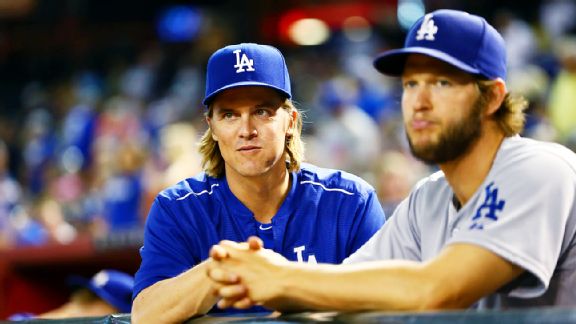
Dodger aces Greinke (L) and Kershaw are players to follow in September (ESPN)
Labor Day weekend is upon us (seriously, how did that happen?), which means there's but one month left of the regular season. Even with most of the divisions and playoff races already decided, several exciting stories have yet to be played out. Will the Blue Jays win their division, thus ending the longest postseason drought in American professional sports? Can Houston hang on in the AL West? And just who is going to put themselves over the top in various award races?

Even if your team is toast and you can't wait for football to start, there's still enough going on to keep fans engaged into October. Here's a sample:

1. David Ortiz's march to 500 home runs
It's been another tough year for the Red Sox but another great one for Ortiz, who's closing in on his 500th career long ball. He has five to go which, given his feverish home run pace (23 taters in his last 70 games), shouldn't take too long.

2. Clayton Kershaw's quest for 300 strikeouts
As Jeff Sullivan noted yesterday, Kershaw's up to 251 K's on the year after fanning 15 Giants in Wednesday night's masterpiece. With five or six starts remaining, he has a chance to become the first pitcher since 2002 to eclipse 300 punchouts. If he does that, a third straight Cy Young award may be in the cards.

3. AL East showdown
As always, the AL East has become a dogfight between its top two teams, one being the Yankees of course. For once, however, the other combatant isn't Boston. It's the Blue Jays, currently clinging to a 1.5 game lead over the Bombers. Toronto will get every opportunity to widen the gap down the stretch with the rest of its games coming against sub-.500 teams and New York.  The Yankees have a similarly easy slate, however, so it wouldn't be surprising to see first place change hands several times over the next month.

4. How will the West be Won?
The fate of the AL West is still up in the air, for it's the only division where the third place team isn't more than 10 games out. It has been turned completely upside down this year, with Houston and Texas (both losers of 90+ games last year) rising to the top while Oakland and Seattle (winners of 88 and 87, respectively) sinking to the bottom. In between are last year's division champs--the Angels--still trying to find their way. LA's coming off a terrible August but could catch up if they play like they did in July. Houston's had control of first place for most of the year, but now find themselves holding on for dear life with a two game edge over the surging Rangers. So hold your breath, Astros fans, and don't exhale until this time next month.

5. Who will snag the second AL wild card?
The Pirates and Cubs have both NL wild card spots wrapped up, and whoever loses the Yankees-Blue Jays duel is guaranteed the first wild card in the AL. The second wild card berth, however, is very much up for grabs. Texas currently leads by one game over Minnesota, with Los Angeles and Tampa Bay looming not far behind. The Twins and Angels are fading fast, while the Rangers have rolled since trading for Cole Hamels. Fingers crossed for a tie, which would mean a play-in game for the play-in game!

6. Will Washington pull it together?
It's now or never for the Nats, who've hovered around .500 all summer and allowed the Mets to break away. They're still close enough (six games) that Washington could steal the division out from under them with a huge September, but time is dwindling. Which team will the Nationals be this month: the one that everyone predicted to win 100 games or the one that might wind up with a losing record? I say they finish strong but still miss the playoffs.

7. St. Louis shoots for 100
Improved parity has made 100-win teams increasingly rare--there were none in each of the past three seasons. Only one team has a legitimate shot to do it this year, and it's not the preseason favorites. The best team in baseball this year has been the St. Louis Cardinals, currently 86-47 and steaming towards their third straight division title. With 29 games remaining on their schedule, the Redbirds need only go .500 to reach the century mark.

8. Does anyone get to 50 homers?
There have been just two instances of a player surpassing 50 home runs during the past seven seasons, but it's possible we'll see two or more players crack that many this year. Nelson Cruz--last year's long ball champion and the current major league leader--needs 11 to get there while Chris Davis--the last to break the 50 barrier--is a dozen away. Look for Carlos Gonzalez, who's cranked 31 over the last three months, to make a run as well.

9. Award races
The AL MVP was seemingly Mike Trout's to lose until about a month ago, at which point he and his Angels went in the toilet while Josh Donaldson and the Blue Jays took off. Now Donaldson appears to have the upper hand, but that could change in an instant if Trout gets back to being himself and leads LA to the playoffs. The NL MVP belongs to Bryce Harper no matter how often Joey Votto reaches base, but Zack Greinke could become the second straight Dodger pitcher to win it if he continues to be lights-out in September.

Speaking of Greinke, he and Kershaw will duke it out for the NL Cy Young award. Wonder which Dodger (and former Cy) voters prefer; Greinke with his sparkling ERA or Kershaw and his gaudy strikeout totals and only slightly less-sparkling ERA? The AL trophy is probably going to Dallas Keuchel (who saw that one coming?), but don't count Chris Sale out just yet.

The AL Rookie of the Year race is a tight one too, with Carlos Correa, Miguel Sano, and Andrew Heaney all having strong cases. The NL field is a two-horse race between Joc Pederson and Kris Bryant, though Noah Syndergaard deserves consideration as well.

10. September call-ups
No matter where your team falls in the standings, it's worth checking in on them throughout September as their future stars get a first taste of the big leagues. For instance, Corey Seager made his major league debut last night.

Tuesday, August 4, 2015

Beltre Breaks Out, Cycles Again

Beltre's bat seems to be coming around (SI)
Adrian Beltre turned back the clock last night, notching the third cycle of his illustrious career to help the Texas Rangers outslug the Houston Astros 12-9. Interestingly enough, all three of Beltre's cycles have come at Globe Life Park in Arlington--home of the Texas Rangers. His first cycle was as a visitor with the Seattle Mariners in 2008, while the second occurred in 2012--his second season with the Rangers.

Now 36 and in his 18th season, Beltre has shown signs of slipping this year. While he's continued to provide his usual stellar defense at the hot corner, he entered last night's game batting just .262/.305/.394--his lowest figures since his injury-plagued 2009. From 2010 to 2014 Beltre was among the best hitters in the game, but this year he's finally started to show his age. His power is down for the fourth straight year, though that might have something to do with the sprained left thumb that cost him three weeks in June. With his body breaking down and skills eroding, Beltre, like most athletes in their 30s, simply isn't the player he once was.

But for one night, at least, he was. The life returned to his bat, enabling him to Beltre wasted no time getting going, keying the Rangers' six-run first with a go-ahead, two-run triple into the left-centerfield gap. He doubled his next time up the very next inning, then followed that up with a single in the third. Facing Mike Fiers in the fifth, he proceeded to rip a laser over the left field wall, completing the cycle before the game was even half over.

Beltre's is the second cycle by a Ranger in less than two weeks, as teammate Shin-Soo Choo turned the trick at Coors Field back on July 21st. Beltre's cycle was special, however, for being the third of his career, which ties a major league record shared by John Reilly, Bob Meusel, and Babe Herman. All of them retired before Jackie Robinson broke the color line, making Beltre the first player with three cycles since baseball was integrated--a fitting accomplishment considering his Dominican heritage.

The Rangers, who are just two games behind the Twins for the second wild card, are hoping there's more where that came from. Beltre had already shown signs of breaking out prior to last night's display, going 3-for-4 with a home run on Friday and notching two more hits on Saturday. With a dozen hits--five for extra bases--in his past half dozen games, Beltre's bat appears to be coming around. A strong second half from him would go a long way towards keeping the Rangers' playoff hopes alive, not to mention prove he still has something left in the tank.

The Rangers and their fans can only hope that last night's game was a sign of things to come rather than a reminder of the beast Beltre used to be.

Tuesday, January 20, 2015

Fowler Fits Cubs Plan

Trading for Fowler is a win-now move by the Cubs (USA Today)
The Chicago Cubs continued to improve this offseason, swapping a utility man (Luis Valbuena) and a busted starting pitcher (Dan Straily) to the Houston Astros for Dexter Fowler yesterday.

The Cubs sold high on Valbuena, their third baseman who enjoyed a career year last year at 28. With uberprospect Kris Bryant expected to take over at the hot corner shortly, Valbuena had become expendable, so Chicago turned him and Straily into a center fielder, something the Cubs never really had last year.

Former skipper Rick Renteria relied primarily on Emilio Bonifacio (fine utility guy, but not an everyday player) and, after Bonifacio was dealt to the Braves, a raw 22 year-old rookie by the name of Arismendy Alcantara, who did his best Jackie Bradley, Jr. impression by posting a paltry .621 OPS. Junior Lake, Ryan Sweeney, and Justin Ruggiano, none of whom are any good, also spent significant time in center. Not surprisingly, Chicago got next-to-nothing from its center fielders, who batted a measly .222/.264/.346 last year, making that the team's weakest position OPS-wise. No team got less offense from its center fielders than the Cubs, who had the third-worst crew of center fielders overall based on fWAR.

Fowler, a solidly above average hitter with an established track record, represents a clear upgrade offensively that figures to add several wins to Chicago's ledger this year. The Cubs are getting a 29 year-old center fielder who's typically good for 10-15 home runs, 10-15 steals, and a very high on-base percentage every year. Last year, the former Rockie proved he could hit away from Coors Field by enjoying his best offensive season on a league and park adjusted basis with a 124 wRC+, batting .276/.375/.399 despite missing seven weeks in the middle of the season with back tightness.

That high OBP wasn't a fluke, either. Fowler has always been great at getting on base and owns a .366 career OBP to prove it. The switch-hitting leadoff man also brings some speed to the table, having swiped 94 bases and legged out 57 triples over the past six seasons. Despite his mediocre theft success rate (67.6 percent), he ranks 25th in baserunning value since the start of the 2009 season. He's no Juan Pierre either, offering slightly above average power (career .149 ISO) that stands to benefit from Wrigley Field's friendly confines.

While Fowler is a good hitter, he is not without flaws. He strikes out a lot for someone who's never hit 15 homers or slugged .475 in a season, and the metrics have never loved his defense. Like many Rockies past and present, Fowler's also had trouble staying healthy, as he's never played 145 games or recorded 500 official at-bats in any season. As such, B-R and FanGraphs agree that he has never once been worth three WAR.

Fowler is also not a long-term fix. Now in his final year of arbitration, he expects to earn around $10 million this year before becoming a free agent next winter, meaning he's a not inexpensive short-term solution.

But he is a solution, and a good one at that. With Chicago leaning on so many youngsters to carry the offensive load this season, Fowler is a proven performer with a steady history of success. In addition to setting the table for the likes of Bryant, Anthony Rizzo, and Jorge Soler, he'll add some much-needed veteran presence and leadership to a team short on both. Best of all, he's a good center fielder, which is something the Cubs desperately needed (but could trade if they stumble through another terrible season).

Based on their splashy Jon Lester signing and serious pursuit of Russell Martin earlier this winter, the Cubbies are making a strong push to contend in 2015. Fowler fits into the plan.

Thursday, September 18, 2014

The Other Martinez

Martinez has been a force since the calendar flipped to June (CBS)
A lot of praise has been showered on Victor Martinez for his MVP-caliber season, and rightly so. He's been one of the best hitters in baseball this year, putting up monster numbers in the face of sagging offensive production across the sport.

Just don't forget about the "other" Martinez on the Tigers, an unheralded Spring Training pickup who's having an outstanding season in his own right. I'm talking about J.D. Martinez (no relation), this year's Jose Bautista or Adam Lind.

Martinez was virtually unheard of before this year, but so it goes when you're a bad player on an awful team. You see, Martinez was a corner outfielder who didn't hit much or play much in his first three big league seasons, averaging just 84 games per campaign after arriving as a late-July call-up in 2011. Martinez actually hit decently that year with a .274/.319/.423 batting line (104 OPS+) and numbers that, when projected out over 160 games, worked out to be around 40 doubles, 18 home runs and 105 RBI. Martinez, just 23 years-old at the time, was a mild success on an abysmal Astros club that lost 106 games.

2012 wasn't any better for Houston, which lost 107 games, or Martinez, who struggled in his first taste as an everyday player. Despite a strong start his batting line shrunk to .240/.311/.375 (86 OPS+), leaving him below replacement level at -0.6 bWAR. On the plus side he showed a bit more patience and his power held steady, but didn't build off his solid debut so much as he took a step back from it.

2013 marked continued decline for Martinez, who batted an anemic .250/.272/.378 and was worth a full win below replacement despite barely playing half a season (86 games). Whatever strides he'd made in plate discipline the year before had disappeared, as he posted an abominable 82/10 K/BB ratio. The 25 year-old was supposed to be coming into his prime, but instead was merely treading water as a below average player. With minimal contributions in power, speed, and fielding, Martinez was a liability even the horrid Houston Astros couldn't afford to keep around.

So, in March of this year, with Spring Training drawing to a close, the Astros cut him. Based on what they'd seen from him--a .251 batting average, .300 on-base percentage, and sub-.400 slugging percentage in nearly 1,000 plate appearances--they were totally justified in doing so. Most teams would have given up on Martinez as well, I suspect.

The Tigers didn't. They scooped him up two days later, signing him to a minor league contract. Given his age (26) it wasn't entirely unreasonable for them to bank on a breakout, or at least hope he could be a productive fourth outfielder. But I'm guessing not even in their wildest dreams would they ever have expected Martinez to become a full-blown star.

An improved swing has led to better results at the plate (Boston Herald)
That's what happened in June, when Martinez mashed to the tune of .345/.367/.702 with nine doubles, seven home runs and 21 RBI. Given his spotty track record, one would have expected him to cool off sooner or later, but it hasn't happened. He's continued to rake since then and has been especially hot lately with 22 hits, six home runs and 17 RBI already in September. With the Tigers trying to fend off Kansas City, that barrage couldn't have come at a better time.

In Detroit Martinez has not only resurrected his career, but he's also emerged as one of the best hitters in baseball with his .398 wOBA, 157 wRC+, and .928 OPS. With his remade swing he's hitting well over .300, which makes up for his iffy on-base skills (only 25 unintentional walks) but is also completely tied to his .382 BABiP--a ridiculous number given his average footspeed that becomes even harder to explain after seeing only a slight uptick in line drive rate and considerable drop-off in ground ball rate.

But what's been most surprising has been his power. After managing just 24 home runs in his first three seasons (averaging one every 37.5 at-bats) he's already slugged 23 this year, going yard once every 17.6 ABs. He has as many home runs as Miguel Cabrera and his ISo is twice what it was last year. Power progression is to be expected as a player reaches his mid-20s, but seemed unlikely given his shift from a great home run park for righties in Houston to a much tougher one in Detroit. He's hit a few more fly balls than last year, but not enough to explain how he more than doubled his home run frequency.

Rather, that can be explained by his HR/FB ratio, which has more than doubled from last year's 9.5 percent to over 21 percent this year. There's probably some luck in there, as according to the ESPN home run tracker eight of his bombs just barely got out, but even if you take all those shots away he'd still have 15 on the year--a career high.

Martinez has noticeably improved against almost every type of pitch, but none more so than fastballs. After posting negative values against the heater in each of his first three seasons, he's been worth more than 21 runs above average against them this year. That, combined with better success against curveballs, sliders, and changeups, have made him a much more effective hitter.

And that's been huge for the Tigers this year, who've need every one of the four wins above replacement he's provided for them. If Detroit does hold on and win the division, Martinez's breakout season will be a big reason why.


Monday, June 9, 2014

Chris Carter AKA Carlos Pena

Carter hits bombs but doesn't do anything else (RantSports)
Remember the home run, whiffing, and walking machine known as Carlos Pena? The prized rookie traded off the Moneyball Oakland A's to supposedly make room for Scott Hatteberg? The same one who later emerged as an All-Star, Gold Glover, Silver Slugger, and home run champ with the Rays?

The 36 year-old free agent hasn't played since last year and is likely finished given his age and recent poor performance. But if you're a fan of Pena's and TTO players like him (Adam Dunn, Mark Reynolds), fear not. One of his former teammates from Houston (what? he played for the Astros?) has taken up Pena's propensity for fanning, dingers, and low batting averages. Like Pena, he was shipped out of Oakland by Billy Beane early on in his career. Now he play's Pena's old position--first base--and wears Pena's old number--23.

His name is Chris Carter, and he is the righthanded version of Pena. Carter's numbers have been virtually identical to Pena's circa 2010-2012. In fact, Carter's 2013 is almost a dead-ringer for Pena's 2011, Pena's lone season with the beleaguered Chicago Cubs.

Pena 2011:   600 PA 497 AB 111 H 27 2B 3 3B 28 HR 80 RBI 2 SB .225/.357/.462 228 TB
Carter 2013: 585 PA 506 AB 113 H 24 2B 3 3B 29 HR 82 RBI 2 SB .223/.320/.451 228 TB

And since Opening Day 2011, their numbers are eerily similar as well:

Pena:   55 HR  166 RBI  435 K  .210/.339/.394 .733 OPS  103 OPS+  3.1 oWAR
Carter: 55 HR  148 RBI  382 K  .217/.315/.445 .761 OPS  109 OPS+  2.7 oWAR

Still toiling in mediocrity, Carter's on pace for similar numbers again this year, much like how Pena's 2011 was nearly a repeat of his 2010. Carter is what he is--a one-dimensional slugger--and has shown no willingness to cut down on his swing in hopes of sacrificing power for contact. He's currently batting below .200, but could very well wind up with 30 dingers. He's the top power source in Houston's lineup not named George Springer, and as long as he continues to bring the goods he'll remain their everyday DH.

But Pena showed how fast players of that ilk (see Jack Cust, Russell Branyan, Richie Sexson, Troy Glaus) can lose it. Once those fly balls stop leaving the yard, Carter won't have a shred of value and will be out of a job before long. Seeing as how he's in the heart of his prime at 27, that shouldn't happen for a few more years. When it does, it won't be pretty.

Until that day comes, let's appreciate Carter for what he is while we can. The rebuilding Astros might not have any better options at the moment, but it's only a matter of time before one comes along. And then Carter will be gone, long gone, like one of his many homers.

Friday, February 28, 2014

MLB Offseason Winners

New York put the pieces in place to make a championship run in Derek Jeter's (MSN)
Minus a few exceptions (Stephen Drew, Ervin Santana), most of the key free agents have signed and the offseason is pretty much over. So who "won" the offseason? Here are the five teams I think are most improved:

1. New York Yankees
Losing Robinson Cano didn't devastate the Yankees, who spent over half a billion dollars this winter. Not only did they land prized Japanese hurler Masahiro Tanaka to anchor the rotation, but they also added All-Stars Brian McCann, Jacoby Ellsbury and Carlos Beltran to beef up their lineup. I doubt Kelly Johnson and Brian Roberts will pan out, but they're guaranteed to get more from Mark Teixeira and Derek Jeter. After winning just 85 games last year--their fewest in a non-strike season since 1992--and missing the postseason for only the second time in the past two decades, New York should win at least 90 and reclaim their status as one of the American League's elite.

2. Washington Nationals
Washington added Doug Fister to a rotation that already featured Stephen Strasburg, Jordan Zimmermann, and Gio Gonzalez. Better yet, they didn't give up anyone of value to get him. Nate McLouth brings depth to an outfield that gave way too many at-bats to the likes of Tyler Moore, Roger Bernadina, Steve Lombardozzi and Scott Hairston last year. Expect the Nats to win closer to 98 games (their 2012 win total) than 86 (last year's total).

3. Texas Rangers
Signing Shin-Soo Choo and trading for Prince Fielder should give their lineup some much-needed oomph, especially given the free agent departure of Nelson Cruz. They also got nine years younger at catcher by replacing A.J. Pierzynski with J.P. Arencibia, who ranks fifth among catchers in home runs over the past three years.

4. Tampa Bay Rays
The Rays needed to re-sign David Price and they did, keeping one of baseball's best rotations intact. They also improved their bullpen by signing Grant Balfour and trading for Heath Bell. David DeJesus solidifies the outfield, and first baseman James Loney will return to prove if last year's renaissance was legit.

5. Houston Astros
Houston's still going to be bad, but not as bad as they were last year. They fleeced Colorado for Dexter Fowler, improved their bullpen via Jesse Crain and Chad Qualls, plus landed a decent starting pitcher in Scott Feldman. Things can only get better for a team that lost 111 games last year.

Thursday, February 13, 2014

Roy Oswalt Retires

Oswalt was one of the National League's top pitchers for a decade (LATimes)
The 2019 Hall of Fame ballot is going to be crowded with Texas icons. In just the last two weeks Lance Berkman, Michael Young, Roy Oswalt hung up their spikes. All three played for the Rangers at some point, but Oswalt and Berkman spent the bulk of their careers with the Astros.

In fact, their careers followed almost identical trajectories and overlapped very well. They were both exceptional during their time together in Houston, which ended two days apart in 2010. Oswalt was traded to Philadelphia on July 29th, and two days later Berkman was sent packing to the Yankees as the Astros began their teardown (the following summer, Hunter Pence would join Oswalt in Philly and Michael Bourn was dealt to the Braves). Oswalt and Berkman were both great for about a decade, then crapped out in their early 30s and finished their careers with around 50 bWAR.

Oswalt's career was relatively short, lasting just 13 seasons. But during those 13 seasons, he was the third most valuable pitcher in baseball behind only Roy Halladay (a one-time teammate of Oswalt's who also happened to be his most similar pitcher at ages 31, 32, and 33) and CC Sabathia, both of whom are likely Hall of Famers.

Oswalt probably won't be, because his career was too short to make up for never winning a Cy Young award or having a killer peak like Sandy Koufax or Pedro Martinez. But Oswalt was very good, better than most people realize. He was good enough to finish in the top six of the Cy Young voting six times from 2001-2010, when he was also durable enough to exceed 200 innings seven times and average 202 per season.

He didn't dominate hitters with overpowering velocity the way Justin Verlander and Clayton Kershaw do today, but instead had great command of his four pitches, consistently finishing among the league's top ten in BB/9 rate and K/BB ratio. That control helped him win an ERA title in 2006 and have a career ERA that was 27 percent better than average.

The three-time All-Star drew MVP votes on four separate occasions. He also won 20 games twice and more than 61 percent of his decisions (for people who care about such things). Oswalt was good enough long enough to be worth 50 wins above replacement level in his career. He was one of the 100 best starting pitchers of all time according to JAWs and bWAR (the latter of which rated him as the league's most valuable pitcher in 2007).

He was also, according to Bill James, the best Big Game pitcher of all-time. Better than Bob Gibson, Whitey Ford, and yes, Jack Morris. That sounds like a ridiculous claim to make of a man who get shelled in his only World Series start, but it's true. His teams went 46-12 in the most important games he ever pitched, which is truly astounding.

His shining moment was the 2005 postseason, when he was instrumental in helping Houston reach their first (and only) World Series. In the Divisional Series against Atlanta, with the series tied at one game apiece, Oswalt pitched into the eighth inning of Game 3 and got the win, which helped the 'Stros advance to the NLCS where they were pitted against the defending NL champs.

 In Game 2 versus St. Louis, with Houston needing a win after dropping Game 1, Oswalt shut down the Cardinals with seven innings of one-run ball. Back in St. Louis for Game 6 with the Astros looking to clinch their first pennant in franchise history, Oswalt was once again sublime, holding the Cards to one run on three hits through seven spectacular innings. Houston cruised to victory, and Oswalt was named NLCS MVP.

Unfortunately for him and the Astros, disaster struck in the World Series. The Chicago White Sox won their first World Series since 1917 by sweeping the Astros, just as the Red Sox had done to the Cardinals while ending their own World Series drought the previous fall. You could say the turning point of that series was Game 3 in Houston. With Oswalt on the bump, Houston took a 4-0 lead into the fifth inning and looked like they might just climb back into the series if they could finish off the win. There was still hope.

But in the top of the fifth, Oswalt unraveled. He imploded, allowing Chicago to send 11 men to the plate and score five runs. Houston eventually lost the game in 14 innings, a game they could and should have won. After that their title hopes vanished, and they were shutout in Game 4 as the White Sox popped champagne on their turf.

The Astros haven't been back to the playoffs since. Oswalt would make just four postseason starts after that and never pitch in the Fall Classic again.

                                                                   *****

Oswalt was one of those rare players who's great from the start and avoids the growing pains/adjustment periods that plague most young stars. He went 14-3 as a 23 year-old rookie in 2001, which gave him the league's best winning percentage. He also posted a 2.73 ERA that was 70 percent better than average when adjusted for league and park, and struck out six batters for every one he walked. Despite making only 20 starts, Oswalt should and would have been a slam dunk for Rookie of the Year most years. But 2001 was an exceptional freshman class, with Ichiro Suzuki taking home the AL award and MVP honors, something only Fred Lynn had ever done, while in the National League Albert Pujols had numbers that were Joe DiMaggio-esque. Pujols won the award unanimously, Oswalt finished a distant second.

But that perfectly embodies how poor Oswalt's timing was. His phenomenal early seasons were overshadowed by Randy Johnson and Roger Clemens. Then it was Johan Santana and Tim Lincecum. At times he was even obscured by his own teammates: Rocket and Andy Pettitte, Berkman and Jeff Bagwell and Craig Biggio. He got stuck in the "very good" class of pitchers that Dan Haren and Jon Lester have been living in for awhile. It's too bad he didn't get traded to the Phillies sooner--he joined the defending NL champs just as their core was beginning to show its age.

He did to get to be a part of one of the best rotations ever assembled, even if only for a season. He, Halladay, Cliff Lee, and Cole Hamels led the Phillies to 102 wins in 2011, a year which also marked the beginning of Oswalt's decline. Before the season, Oswalt looked like he might make the Hall of Fame one day. He had finished 2010 strong with the Phillies, leading the league in WHIP and coming in sixth in the Cy Young voting. Going into his age 33 season, it still seemed like he had plenty of gas left in the tank.. He needed a few more good seasons to pump up his counting numbers, probably needed to pitch into his late 30s at least, and if he got a World Series ring or two with the Phillies that would be icing on the cake.

None of that happened. Oswalt regressed to merely average in 2011, was terrible with Texas in 2012 and even worse with Colorado last year. The last two seasons were especially bad, as he got lit up for a 6.80 ERA in 26 appearances (15 starts). Like Berkman, Young, Halladay, Todd Helton, Oswalt did not go out on top. Few (Mariano Rivera, Ted Williams, Mike Mussina come to mind) do.

But those last few starts, ugly as they were, don't diminish what Oswalt was: a great pitcher for a full decade and one of his generation's finest. He may not be a Hall of Famer, but he's an easy choice for the Astros Hall of Fame and the (fictional) Hall of Very Good.

Wednesday, January 29, 2014

Bye-Bye Berkman

Berkman was an outstanding hitter before his body gave out (SportingNews)
Lance Berkman announced his retirement from baseball today. The soon-to-be 38 year-old is leaving the game after a pair of injury plagued seasons in which he played just 105 games and batted .246.

But Berkman accomplished a lot during his 15 big league seasons, the first 11 and a half of which were spent with the Houston Astros. During that time he made his mark as one of the greatest switch hitters ever (more on that to come).

I already wrote a good deal about Berkman's career when he signed with the Texas Rangers last winter, but even then I don't think I realized just how impressive some of his numbers were. His 293/.406/.537 triple slash stats are tremendous, nearly identical to those of one-time teammate Jeff Bagwell (.297/.408/.540). His career .943 OPS has been bettered by only 25 men and is the 14th best mark for players who debuted after World War II. His 144 OPS+ is tied for the 48th best mark of all-time.

Perhaps most surprising was how well he rates by Baseball-Reference's advanced statistics. He has the 29th best Win Probability Added of all-time, which suggests he was good at coming through in tight spots. He also rates inside the top-35 in Base-Out Runs Added (31st), Situational Wins Added (33rd) and Base-Out Wins Added (34th). The traditional numbers bear this out too: he batted .311/.432/.550 with men on base and posted a .963 OPS in high leverage situations.

Because Berkman's prime years overlapped with Albert Pujols's (and Barry Bonds' ridiculous run) he  never won an MVP, but did finish third twice and in the top-10 four other times. He never won received a Silver Slugger despite enjoying an eight year-stretch from 2001 to 2008 where he was worth 40.6 bWAR, averaging 33 home runs and 110 RBI per season in addition to his .303/.417/.564 batting line. FanGraphs rates him as the sixth most valuable position player during the 2000s, behind Alex Rodriguez, Pujols, Bonds, and a couple of other phenomenal switch-hitters--Chipper Jones and Carlos Beltran.

But that decade is pretty much the entirety of Berkman's career. He played just 34 games before it and struggled with age and injuries after it. Because of the relatively short length of his career (fewer than 8,000 plate appearances and not even 6,500 official at-bats), his counting numbers are a bit lacking. He failed to reach 2,000 hits and 400 homers, for instance.

Actually, some of Berkman's numbers are almost indistinguishable from those of another great hitter who recently retired: Todd Helton. Both were pure hitters who walked a lot, drove in tons of runs, hit for power and posted high batting averages.

Berkman 1999-2013: 366 HR  .293/.406/.537  .943 OPS  six All-Star appearances
Helton 1997-2013: 369 HR  .316/.414/.539  .953 OPS  five All-Star appearances

But while Helton is a deserving Hall of Famer (though not by much), Berkman is not (but also not by much). By all established Hall of Fame standards (JAWS, Bill James, Hall of Stats), Berkman falls a tad short. His numbers aren't strong enough for a corner outfielder/first baseman who was a liability in the field and on the basepaths. Berkman's peak was Cooperstown quality for sure, but he didn't do enough after leaving Houston and so his 52 career WAR don't cut it. He needed at least two or three more quality seasons, but unfortunately injuries essentially finished him after his age 35 season.

Big Puma, like most sluggers of his ilk, simply wasn't built to last. Players like him rarely age well, especially when they play more games in the outfield than they do at first base. Had Bagwell not blocked first until 2005, perhaps Berkman would still be playing. Maybe he would have fallen apart anyways, since he didn't become serious about his conditioning until it was almost too late. The point is that both were great players, and the Astros were lucky to have them.

Monday, April 1, 2013

Notes From Opening Night

The 2013 baseball season began with last night's interleague game between the Texas Rangers and Houston Astros at Minute Maid Park. I don't think anybody gave Houston's glorified Triple-A team much of a chance to win, so it was shocking to see the 'Stros pound their new division rivals by a score of 8-2. Bud Norris got the win, Matt Harrison took the loss and Erik Bedard earned the save.

Here are some more box score notes from the game:
  • Ian Kinsler flew out in the first at-bat of 2013
  • Jose Altuve recorded the first hit of the year and added an RBI single in the bottom of the fifth
  • Rick Ankiel smacked the first home run of the year with a three-run bomb off Derek Lowe Ankiel was inserted into the game as a pinch-hitter for Brandon Barnes in the bottom of the sixth
  • Nelson Cruz committed the first error the season (which led to an unearned run), but at least he made up for his mistake by going 2-for-3 at the dish with an RBI single and a walk
  • Erik Bedard notched his first career save. Unlike a Mariano Rivera or Jonathan Papelbon, he actually had to work for his save, recording ten outs to finish what Norris started
  • Lance Berkman performed well in his Rangers debut, going 2-for-4 with a run scored. A.J. Pierzynski didn't do quite as well; 1-for-4 with a strikeout
  • Justin Maxwell ripped two triples, more three-baggers in one game than many hitters will over the course of an entire season. Additionally, he and Altuve were the only Astros not to strike out last night
  • Both teams combined for 15 hits--12 singles, Maxwell's triples, and Ankiel's home run
  • The game ran three hours long
Happy Opening Day! 

Saturday, March 30, 2013

A-Rod Out-earns Astros

Alex Rodriguez will make more money than all the Houston Astros combined.

That's crazy. One player is going to earn more than an entire team, and considering that baseball teams field 25-man rosters, that is quite impressive.

A-Rod is no longer a superstar, but he still gets paid like one. He's set to collect $29 million in 2013, making him the sport's highest paid player for the 13th straight season. The lowly Astros, by comparison, have trimmed their payroll to $25 million, equal to Cliff Lee's salary and easily the lowest in baseball. They've lost more than 100 games in each of the past two seasons and aren't expected to do much better after moving to the American League West.

Rodriguez's outlook isn't much brighter. He's expected to miss the entire first half as he works his way back from offseason hip surgery, and Brian Cashman acknowledged it's possible that the three-time MVP won't play at all this year.

 A-Rod isn't the only pricey player opening the season on the Disabled List, though. Teammate Mark Teixeira (price tag: $23.1 million) is on the mend until May with a strained wrist. Johan Santana ($24.6 million) might never pitch ago after going under the knife for a second shoulder surgery. Rodriguez's injury is serious, but the Yankees and their fans should be thankful (or not) that at least it isn't career-threatening.

But even if he comes roaring back with a monster second half, he still won't do enough to earn his paycheck. The market rate for a win above replacement is about $5 million these days, meaning Rodriguez would have to be worth six wins to justify his earnings. He hasn't had a season that good since 2008 and has averaged 3.6 bWAR per year since. Given his age (37), eroding skills and inability to stay healthy, it's safe to say he will be grossly overpaid until the day he retires.

Tuesday, March 26, 2013

AL West Preview

1st Place--Los Angeles Angels
2012 Record: 89-73
2012 Pythagorean: 88-74
2013 Projected: 92-70
After starting last year 7-15 with Mike Trout toiling in the minors and Albert Pujols mired in the worst slump of his career, the Halos dug themselves out of an early hole and produced the best record in baseball from that point forward. Though their wretched April cost them a playoff berth in 2012, the Angels are poised to make the postseason after inking Josh Hamilton--the most coveted position player on the free agent market--to a five-year, $125 million deal. Though the former MVP is on the wrong side of 30 and will likely regress and/or get hurt following a career year in 2012, he'll provide a heavy dose of lefthanded power LA so desperately craves. That said, don't be surprised if Hamilton goes bust and Torii Hunter, now with the Tigers, produces more value in 2013. Mike Scoscia will have the pleasure of filling out a lineup card that features baseball's best all-around player (Trout), baseball's most exciting player (Hamilton) and one of the best hitters of all-time in Pujols. Trout figures to slide a bit following his historic season, but at least his talent won't be wasted in the minor leagues. Pujols shrugged off a slow start to bat .312/.374/.589 from May 15th onward, proving talk about his decline to be premature. Expect similar numbers in year two of his gargantuan contract. Slugger Mark Trumbo has been a mess since the end of July, but I think he reverts to his mashing ways in his age-27 season. I could also see Peter Bourjos breaking out. Jered Weaver, the only American League pitcher to finish in the top five of the Cy Young voting in each of the past three years, is a bona fide ace even though his strikeout rate has plunged from 9.3 K/9 in 2010 to 6.8 K/9 last year. C.J Wilson will improve upon his first season with the Angels when he takes advantage of the run support boost and friendly home ballpark. Jason Vargas and Tommy Hanson are intriguing additions to the starting rotation, though I'm guessing most Angels fans would rather have seen their team keep Dan Haren and Zack Greinke. However, I don't think they'll miss Ervin Santana and Vernon Wells too much. The bullpen should get a nice boost from Ryan Madson, but it remains to be seen how effective he'll be after sitting out all of last year recovering from Tommy John surgery. Given how much worse the Rangers got over the winter, the AL West is theirs for the taking.

2nd Place--Texas Rangers
2012 Record: 93-69
2012 Pythagorean: 91-71
2013 Projected: 88-74
As if blowing their division lead on the regular season’s final day wasn’t miserable enough, the Texas Rangers followed up their late-season collapse with a lean winter. They waved goodbye when sluggers Josh Hamilton and Mike Napoli signed with new teams. They parted ways with veteran leader and fan favorite Michael Young. They winced when Nelson Cruz‘s name surfaced in the latest PED scandal. They whiffed on Justin Upton. Talk about a rough offseason. Faced with limited options and suddenly short on offense, the Rangers turned to Lance Berkman out of desperation. Five years ago that would have been a great get for them, but Big Puma is 37 and doesn't appear to have much left in the tank after needing four separate DL stints last year. He's just one of many Rangers at risk for disappointing seasons. Texas paced the American League in runs and hits last year, and while their lineup is still formidable there's no way that happens again this year. Adrian Beltre is their best hitter, and he'll be 34 two weeks from now. Ian Kinsler is on the wrong side of 30, too, and second basemen age horribly. Cruz will turn 33 and his best days are probably behind him. At 36, A.J. Pierzynski can't possibly repeat his career year and will probably wear down over the course of a long Texas summer. The offense will probably be fine, but there's a lot of downside risk here and not much upside. Yu Darvish made adjustments toward the end of last year and is going to have a big sophomore season (like Daisuke Matsuzaka did). He needs to cut down on his walks, but could win 20 games and the Cy Young award even though the Ballpark in Arlington will likely suppress his numbers. He anchors a strong rotation that also features Matt Harrison, Derek Holland, and Alexi Ogando. Joe Nathan proved he's still an elite closer in his Texas debut last year, making the All-Star team and saving 37 games. Joakim Soria, a former All-Star closer with the Kansas City Royals, will set him up. The Rangers certainly have enough talent to win 90+ games again and challenge the top spot in the division, but I see them taking a small step back in 2013.


3rd Place--Oakland A's
2012 Record: 94-68
2012 Pythagorean: 92-70
2013 Projected: 83-79
I still can't believe these guys won the AL West last year, especially since they ended May seven games below .500. Maybe that's why I can't shake the feeling that they just got red-hot for four months and will probably fall back to earth in 2013 (not quite like the Orioles, but similar). The A's are woefully short on offense without Chris Carter, Stephen Drew, and Jonny Gomes, though the middle of the order has some potential. Yoenis Cespedes is a Vladimir Guerrero-type who can hit the ball out of a canyon and is an MVP-candidate-in-the-making, but I'm not totally sold on Josh Reddick as an All-Star caliber player just yet. Chris Young brings a nice power/speed combo, but it's worth noting that he's a .224/.311/.409 hitter away from Chase Field. Jemile Weeks is almost guaranteed to bounce back from a miserable year in which his BABiP cratered at .256. The bottom half of their lineup is a disaster, so runs will be in short supply. That means Oakland will have to rely on its elite pitching staff, which ranked second in ERA last year. With Jarrod Parker, Tommy Milone, A.J. Griffin, and Dan Straily all poised to build off successful 2012s, the young rotation is brimming with upside. Brandon McCarthy will be missed, but Oakland is hoping Brett Anderson can finally stay healthy after averaging just 13 starts per year over the past three. He's demonstrated the ability to pitch like an ace, so a full season from him would go a long way towards boosting his team's playoff chances (but I wouldn't count on it). The bullpen looks stellar on paper, and the defense is solid, too. The A's could be a great team again if the starting pitching improves and Cespedes makes the leap to superstardom, but I see them settling into the 80-85 win range and missing the postseason.

4th Place--Seattle Mariners
2012 Record: 75-87
2012 Pythagorean: 77-85
2013 Projected: 73-89
The Mariners have lacked adequate firepower for quite some time now--you'd have to go back to the end of the Bush administration to find the last time Seattle didn't finish last among AL teams in runs scored. That's going to change this year after taking on veteran hitters Michael Morse, Kendrys Morales, Raul Ibanez, and Jason Bay. Ibanez and Bay are bench players at this stage in their careers, but Morales and Morse add much-needed pop to the middle of the order. As the cornerstone of Seattle's lineup, Jesus Montero must (and will) improve upon his disappointing 2012 (.685 OPS, -0.2 bWAR). He's just 23 and still has room to grow, as do Kyle Seager, Dustin Ackley and Justin Smoak. Moving in Safeco's fences will help these young hitters, but not enough to make much of a difference. The Mariners have one of the best pitchers around in Felix Hernandez, but he seems to be at risk for a down year after receiving a mammoth contract extension and throwing more innings than any other hurler since 2009. Seattle's rotation is a mess with him and would be downright unwatchable without him. M's are stocked with young pitching talent that could arrive in the Show later this year, but by the time they're ready to contribute it will too late to improve Seattle's non-existent playoff chances. They're still rebuilding and at least another year or two away from making a serious run at one of the wild card spots.

5th Place--Houston Astros
2012 Record: 55-107
2012 Pythagorean: 59-103
2013 Record: 58-104
Welcome to the American League, boys. It's going to eat you alive.