Showing posts with label Outfield. Show all posts

Wednesday, June 28, 2017

A History of Great Red Sox Outfields

The Red Sox have a long lineage of talented outfields (Boston Baseball Prospectus)
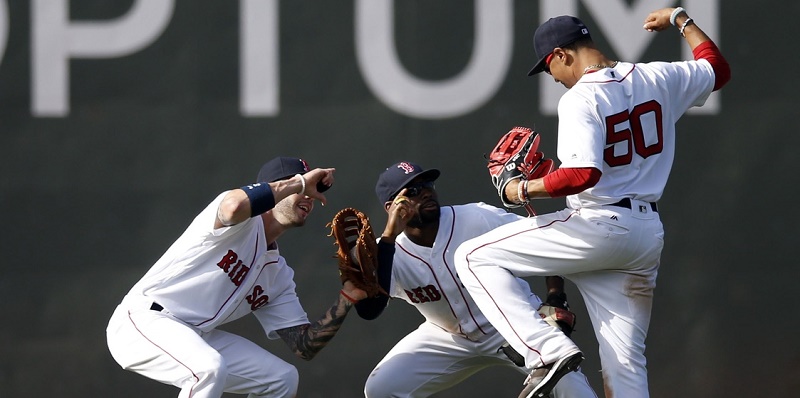
Before the season began there was an ungodly amount of hype surrounding Boston's young outfield of Andrew Benintendi, Jackie Bradley Jr., and Mookie Betts -- who, you might remember, made the cover of Sports Illustrated (thankfully, the jinx has spared them). Some went so far as to crown them the best outfield in team history, on par with the club's vaunted trio of Jim Rice, Fred Lynn, and Dwight Evans during the mid and late 1970s.

While the current crop certainly has that level of talent (Betts and Benintendi both have Hall of Fame ceilings, while Bradley could wind up being a modern day Reggie Smith), such talk is wildly premature. They haven't even played 100 games together yet! Benintendi's just 22, and it's far too early to project how his career will pan out. Betts -- a superstar on the rise -- has yet to celebrate his 25th birthday and stonewalled Boston's attempts to lock him up last winter, meaning his future in a Red Sox uniform is far from guaranteed. Bradley is the outfield's elder statesman at 27, and yet he's actually the most volatile in terms of performance due to his streakiness. His glove is amazing, but his ebbs and flows at the plate have led some to wonder whether he'll be Clay Buchholz with a bat in his hands.

In any event, this is shaping up to be an outstanding outfield for the next few years at least, and hopefully more. But the Red Sox have been often blessed with many great outfields, going back to their first dynasty a century ago.

Indeed, Boston's original golden outfield consisted of Duffy Lewis in left and Hall of Famers Tris Speaker in center and Harry Hooper in right. The trio led the Olde Towne Team to championships in 1912 and 1915 before Speaker was traded at the start of the '16 season. But so rich with pitching were the Sox that they still won it all without Speaker that year, then won again two years later with Babe Ruth caddying in right when he wasn't pitching.

Following the sale of Ruth in 1920, the Red Sox were largely bereft of talent at all positions throughout the next two decades, but by the late '30s they had once again assembled a stellar outfield. The 1938 trio of Joe Vosmik, Doc Cramer, and Ben Chapman all bettered .300, leaving no room for a brash 19-year-old rookie by the name of Ted Williams, who would have to wait until '39 to get his chance.

The Kid's arrival signaled a changing of the guard, as Dom DiMaggio joined him a year later. By the time Williams was chasing .400 in 1941, Boston had a completely new outfield from the one he'd been shut out of three years prior. Williams and DiMaggio were mainstays into the early '50s, when DiMaggio retired and Williams briefly departed for Korea, but in all that time the Red Sox never found a long-term right fielder to round out their trios. Sam Mele, Stan Spence, and Al Zarilla proved capable, but none stuck.

When Williams returned from Korea, he joined Jim Piersall in center and Jackie Jensen in right. By this point Williams was well into his 30s and increasingly banged up, missing an average of 36 games per season from 1954-1960. While still a fearsome hitter, he was unable to suit up enough to approximate his sublime production during the '40s, when he averaged just under 10 bWAR per season from 1941-1949. Piersall was a defensive wizard in the mold of his precessor, DiMaggio, but didn't stand out offensively. Jensen hit a lot of homers and drove in lots of runs, even stealing the MVP from a vastly more deserving Mickey Mantle in 1958.

The retirements of Williams and Jensen in the early 1960s paved the way for the next great Red Sox outfield, which came together during the franchise's dark days in the middle of the decade. Williams' replacement, Carl Yastrzemski, took over left field in 1961 and quickly emerged as one of the league's best at the position. He was joined in right three years later by teenaged phenom Tony Conigliaro, who immediately made his mark as one of the most prolific young sluggers in baseball history. Reggie Smith completed the outfield during the Impossible Dream summer of '67, finishing as AL Rookie of the Year runner-up. Unfortunately, Red Sox fans never got to see that outfield live up to its potential, as Tony C caught a fastball in the eye and was never the same.

It would be nearly a decade before Jim Ed and Freddie Lynn joined Dwight Evans in Boston, with both receiving cups of coffee in 1974 before bursting onto the scene as Rookie of the Year and MVP frontrunners in '75, leading the Red Sox to their first pennant since '67. The Gold Dust Twins, as they were called, were at their best from 1975-1979, but Evans didn't truly blossom as a hitter until the '80s, by which point Lynn was out west and Rice was past his prime. They never wonted for a third musketeer, however, as the likes of Tony Armas, Mike Greenwell, and Ellis Burks ensured that Boston always had one of the league's top outfields during the '80s.

Once Rice retired in 1989 and Evans left the following year, however, the Red Sox struggled to find an identity for their outfield. After decades of having Cooperstown-bound fixtures patrolling left, right, and center, the Red Sox filled their ranks with a motley crew of solid, if unexceptional veterans. Jack Clark, Otis Nixon, Troy O'LearyReggie Jefferson, Jose Canseco, and the legendary Tom Brunansky all rotated through. It was definitely a weird time for Red Sox outfields, with no real continuity to speak of.

That came to an end, briefly, in the early 2000s, when the Red Sox inked Manny Ramirez to an eight-year, $160 million deal before the 2001 season. He was joined the following season by Johnny Damon, giving the Red Sox an excellent outfield for the first half of the decade with Trot Nixon in right. Together they helped their beleaguered franchise end its 86-year curse in 2004, etching their names in Boston lore.

Until the Killer B's coalesced, however, the mid-2000s to mid-2010s resembled the '90s in that the outfield was constantly in flux. Left field became a revolving door after Manny forced his way out of town, with cameos from Jason Bay, Carl Crawford, Cody Ross, Jonny Gomes, Daniel Nava, and Brock Holt. Coco Crisp didn't materialize into Damon 2.0 while Crisp's successor, Jacoby Ellsbury, was unbearably injury prone. J.D. Drew manned right field for five utterly forgettable seasons before fading away, while Shane Victorino had that one magical year during the 2013 World Series run before breaking down.

That brings us to today, with what is likely the most athletic outfield in Red Sox history. Boston essentially has three center fielders, as all three have played the position. Bradley and Betts are arguably the best defenders at their positions, and Benintendi isn't your typical first baseman/DH masquerading as a left fielder (looking at you, Hanley Ramirez). They're all fast and graceful and have great arms -- they all belong in the outfield. So they're probably the best defensive outfield the team has ever had, plus they can hit, too. And dance. Boy, can they dance.

Tuesday, December 1, 2015

Sox Sign Young

Young will be a nice complementary piece for Boston (Newsday)
Red Sox GM Dave Dombrowski made his second major move of the offseason yesterday, inking Chris Young to a two-year, $13 million deal.

The pact is a reasonable one for Young, 32 and a fourth outfielder at this stage in his career. More importantly, it adds depth to Boston's young outfield, which is relying on the inexperienced trio of Mookie Betts, Rusney Castillo, and Jackie Bradley, Jr. (less than 2,000 major league plate appearances between them).

A lefty-mashing righthanded power-hitter, Young fits the Jonny Gomes/Cody Ross type that tends to do well in Boston. Now on his fifth team in five seasons, he has proven he can handle big market pressure after two years in New York. Young was a fixture in the Yankees outfield last year, playing 140 games and posting a 112 OPS+. That stability was huge for the depleted Bombers, who still made the playoffs despite losing two-thirds of their outfield (Jacoby Ellsbury and Carlos Beltran) for extended periods of time.

Young earned consistent playing time with his strong start, slugging six home runs and putting up a 1.084 OPS through his first 22 games. The streaky slugger fell off the rest of the way, but that didn't discourage Joe Girardi from getting him into the lineup almost everyday.

Young isn't going to be a difference maker, but he's shown he can play a key role on a contender. It's very likely that the Red Sox will need him, as it's easy to envision a scenario where Bradley slumps his way back to the minors, Castillo is still too raw to play everyday, and/or Betts struggles in his second full season. At the very least he'll spell one of those guys' names when they need a breather and pop a few homers over the Monster. He'll earn his keep even if he's only one win above replacement level, which is how many he's averaged over the past four years.

Nice move, Dave. Now go get David Price.

Tuesday, August 5, 2014

What's Behind Brantley's Breakout?

An All-Star for the first time this year, Brantley's having an MVP caliber season
Is Michael Brantley baseball’s best kept secret? If he played on a better team in a bigger market, wouldn't we be talking about him the way we talk about Mike Trout, Andrew McCutchen, Adam Jones, and Yasiel Puig?

I think so. Don't believe me? Go ahead. Check the numbers. They're closer than you think. Seriously, see for yourself. I'll wait. 

Over the first five years of his career, Brantley was pretty much the definition of an average everyday outfielder. With an OPS+ of 100, his bat was perfectly pedestrian. He hit for a little bit of power and flashed a little bit of speed, got on base at a solid rate and played decent defense, too. He didn’t really have any holes in his game, but at the same time failed to stand out. He was productive, capable, solid, but boring. Nothing special.

Not this year. Brantley, a beast all season long and first-time All-Star, is playing like an MVP. That's been even more true lately, as he's recorded five straight multi-hit games and seven in his past nine. With his batting line now up to .324/.383/.515 on the season, Brantley can say there's nobody in the American league who beats him in all three triple slash categories. In fact, there's only one player in baseball who can beg to differ, and it's Troy Tulowitzki. Only three players have provided more offensive value than Brantley, and their names are Trout, McCutchen, and Puig, all serious MVP candidates. Brantley deserves to be, too.

Because in his age-27 season, Brantley's taken a quantum leap from average hitter to one of the best in baseball, enjoying an unexpected breakout in the same vein as Melky Cabrera and Daniel Nava. His 154 wRC+ ties him with Jose Bautista for tenth-highest in baseball, better than Miguel Cabrera, Robinson Cano, and Ryan Braun. With roughly one-third of the season still to go, B-R has already valued Brantley's performance at almost five wins above replacement. Per FanGraphs, Brantley has been baseball's ninth-most valuable position player this year, including the third-best outfielder in the American League to only Trout and Alex Gordon (and most of Gordon’s value comes from his defense, at which Brantley is merely okay).

So what’s fueling Brantley’s big, out-of-nowhere season? Surprisingly not BABiP, which at .325 is almost dead even with his actual average of .324. Considering Brantley’s career BABiP is .308, one can't merely chalk his success up to good luck. What's driving his robust batting average is the highest line drive rate of his career at nearly 27 percent. When more than one in four of your batted balls are frozen ropes, chances are you're doing something right.

As for the power surge, well, that's easy to explain. Brantley's boasting the highest HR/FB rate of his career by far. At 14.7 percent, it’s more than double last year’s 6.8 percent and his 6.7 percent career rate. That explains why he already has 16 home runs--on pace for 24--after never hitting more than 10 in a season before. In turn his ISO, which hovered in the .110-.120 range the past three years, has jumped up close to .200. 

He’s also being pitched to a little differently. Whether that's because of his newfound success or vice-versa is up for debate, but this isn't: after struggling mightily against fastballs last year, Brantley's been well above average against the heater this year (two and four-seamers). On a similar note he’s also enjoyed much more success against the cutter, a pitch that tends to give lefty hitters such as Brantley trouble by exploding in on their hands when thrown from a righthander. Pitchers appear to be taking notice, as they’ve given him fewer fastballs this year and more changeups, perhaps trying to catch Brantley off guard or get him out in front. But Brantley’s always been a good hitter against changeups, and that has remained true this year. 

On top of all that, Brantley's been much better on the basepaths as well. With 13 stolen bases in 14 attempts, he's been almost impossible to throw out. That represents a big step up over just two years ago, when he was nabbed nearly as many times (9) as he was successful (12). FanGraphs estimates he's provided more baserunning value than all but 14 major leaguers this year. Among players who have been less valuable than Brantley on the bases; Carlos Gomez, Jacoby Ellsbury, Brett Gardner, and Trout.

Offensively, Brantley's playing at his absolute best right now. His walks are up from last year and his strikeouts are down, so much so that the rates are almost dead even. He's hitting for power and getting on base a ton, and when he does get on base he makes a positive difference with his legs.  The only area in which he hasn't improved is defense, where he's average at best and subpar at worst. At this point in his career Brantley's probably never going to be a great defensive outfielder, as he already plays a corner spot and can be expected to cover less ground with each passing year. 

But as long as he keeps hitting the way he is,  then that's something the Indians can live with. 

Saturday, August 2, 2014

Can Craig Bounce Back?

Once an elite hitter, Craig has struggled at the plate this year (CNN)
Mere hours after trading Jon Lester and Jonny Gomes to Oakland for Yoenis Cespedes on deadline day, the Red Sox dealt their next-best starting pitcher--John Lackey--to St. Louis for another outfield bat (Allen Craig) and starting pitcher Joe Kelly, both of whom competed against Boston in last fall's World Series.

A ground ball pitcher who doesn't strike anyone out, Kelly is a back of the rotation starter at best. Boston will need him to fill in now that 80 percent of its Opening Day rotation is gone, but once the young guns are ready he'll likely be ousted to the bullpen. Though not a difference maker by any means, Kelly is only 26 and won't reach free agency until 2019. That makes him an attractive trade chip, if not someone worth keeping around.

Craig, an All-Star last year and hard-hitting outfielder until recently, would seem to be the bigger get. He was a terrific hitter in the three years before this one, batting over .300 every year, reaching base more than 36 percent of the time and slugging .500. His 139 wRC+ during that span was the eighth-highest among outfielders, sixth after excluding American Leaguers Mike Trout and Jose Bautista. He twice received MVP consideration while averaging 40 doubles, 23 home runs, and 114 RBI per 162 games from 2011 through 2013.

But Craig can't stay healthy. He's never played 135 games in a season, let alone all 162. He's endured several lower body injuries over the years, including a fractured knee in 2011 and foot last injury year that combined with age have limited his mobility and apparently his power. His fly ball rate and home run per fly ball rate are both at career lows, and he's pounding the ball into the ground more than half the time he puts the ball into play--a horrible strategy for someone with no foot speed.

So unfortunately for Boston, Craig appears to be a player in decline. His slugging, OPS and ISO have fallen every year since 2011, a trend that has coincided with increased playing time as well as age, thus suggesting that he's unable to . His walk rate has declined the last two years including this one, and his strikeout rate has gone the other way. This year's been a disaster for Craig, who didn't get his average over .200 until the last day of April, went homerless in June and recorded just six hits in 16 July games.

Craig's been healthy this year and had a full offseason to recover from his ankle sprain, so there's really no excuse for his poor performance. His BABiP has plunged more than 80 points from last year and 50 points below his career mark, which suggests some bad luck, but that's also due to his line drive rate falling from almost 27 percent last year to below 20 percent this year. Craig''s just not hitting the ball with the same authority, and the results have been Billy Butler and Derek Jeter-esque.

Craig, who signed an extension with the Cardinals before last season, will be under team control through 2017 and has an option for 2018. But if his best days truly are behind him and he's going to stay the same or get worse, then he'll be horribly overpaid as his salary escalates over the next few years, especially in 2016-2017 when he's set to make $20 million. And he can forget about his 2018 player option that would net him an additional $13 million.

Could Craig rebound in Boston? It's not out of the question. Barely 30 years old, he's not far removed from his prime and could easily bounce back, especially now that he's playing half his games at Fenway Park. ZiPS and Steamer both project him to finish the season strong, with ZiPS predicting him to bat .278/.330/.440 the rest of the way and Steamer even more optimistic at .295/.348/.470. The offenseively challenged Red Sox are hoping he can turn it around and get back to his old ways, which would give them another run-producer and lengthen the lineup.

But even if Craig does there's really no place for him. He can man left field for now with Yoenis Cespedes covering for Shane Victorino in right, but that's about the only place he can play. His range is too limited to patrol Fenway's expansive right field and the Red Sox already have expensive and productive regulars at DH and first base in David Ortiz and Mike Napoli. Once Victorino comes back Cespedes would likely move to left to accomodate him, though it's possible the Flyin' Hawaiian goes back to center given Jackie Bradley, Jr.'s offensive woes.

Craig could be the odd man out soon, and needs to hit to carve out out playing time for himself. These next two months are essentially an audition for him. If he can get his swing right, John Farrell will find a place in his lineup card for a bat with .300-20-100 potential. But the Red Sox have made it clear that they want to give more playing time to their young stars, which means they won't have much patience for a washed up corner outfielder/first baseman on the wrong side of 30. Should Craig continue to struggle, expect him to be somewhere else come Opening Day.

Friday, June 27, 2014

Cruz Crushing

Cruz has been one of 2014's biggest first half surprises (MLB.com)
When the Baltimore Orioles signed Nelson Cruz to a one-year, $8 million deal during spring training, nobody expected him to emerge as the team's best player. Not on a roster loaded with younger, in-their-prime standouts such as Chris Davis, Adam Jones, Matt Wieters, and Manny Machado. Cruz appeared to be a player in decline, and there were serious doubts about what he'd be able to give the Orioles. He was, after all, about to turn 34, coming off a 50-game ban for PED use, and leaving a hitter's paradise in Arlington behind. Why do you think so many teams passed on him?

Well, Cruz quickly erased those doubts by homering in the first two games of the season and hasn't stopped hitting since. He slumped briefly at the beginning of June, but seems to have turned it around with three home runs and nine RBI in his past ten games, including a game-tying grand slam on Wednesday night that sparked the Orioles to an extra-inning victory.

Cruz now leads the major leagues in home runs (with 24) and RBI (64), on pace for 49 and 131, respectively. Even if he falls well short of those totals, he'll still blow his career highs (33 and 90) out of the water. He might as well go ahead and take the rest of the year off, because he's already earned his pay and then some. He's already been hailed as the best bargain of the offseason, and rightly so.

It's tempting to say Cruz can't and won't keep this up, that he'll cool off in the second half like so many sluggers with big first halves tend to do. But it's important to remember that he was hitting well last year before baseball suspended him for the rest of the season. Dating back to the start of last year, a span of 185 game for Cruz (essentially seven months of baseball), he's swatted 51 home runs, driven in 140 and slugged .541. That's a fairly large sample size, and Cruz was successful before that, too.

Could Cruz be juicing again? Given his history, it's not out of the question. It's rare to see players have career years at 33/34, but Cruz was a late-bloomer to begin with. He didn't play his first full season until he was 28, so experience-wise he's where most players are at in their late twenties. That, and the fact that he doesn't have nearly as much mileage as most outfielders in their mid-thirties, could explain why it's clicking for Cruz (and a few more fly balls flying over the fence never hurts, either).

Even if he does tail off in the second half, his pre-All-Star Break performance has been strong enough to merit a considerable pay raise when he becomes a free agent again this winter. He's a good bet to break 40 homers and 100 RBI for the first time, numbers that few in the game today are capable of reaching. That kind of big-time power deserves a big-time contract, and this time around I'm sure someone will give it to him.

Tuesday, June 11, 2013

Sox Score Bargain with Carp

Carp has been more than just a feel-good story 
In their quest for outfield depth after injuries forced Bobby Valentine to use about a bajillion outfielders last year, the Boston Red Sox got Mike Carp for next to nothing on February 20th, when they acquired the 26 year-old from the Seattle Mariners for a player to be named later or cash considerations (a bag of balls, essentially). Carp was coming off a down year in which he batted just .213/.312/.341, and the M's didn't have much use for him after signing Raul Ibanez, Jason Bay and Mike Morse during the offseason.

The Red Sox didn't appear to have much need for him either, not with Jackie Bradley Jr. poised to make a big splash in the big leagues. But Bradley bombed during his first two weeks in the Show and was quickly demoted to Pawtucket for additional seasoning. That opened up playing time for Carp, who smashed three extra base hits in his first start with the Sox--a 6-3 win over the Cleveland Indians on April 17th--and hasn't stopped hitting since. After going 2-for-5 with a pair of RBI in last night's extra inning marathon victory over the Tampa Bay Rays, Carp hiked his batting line is up to an impressive .322/.367/.667 over 98 plate appearances.

Like Cody Ross last year, Carp's performed way better than anyone could have possibly predicted. He's taken his game to another level as one of the unsung heroes driving Boston's excellent first half. Carp has smacked more home runs than Dustin Pedroia, driven in more runs than Jacoby Ellsbury and compiled more total bases than Shane Victorino. Not bad for someone barely making more than $500,000 this year.

Carp came into the season expecting to spend lots of time on Boston's bench as the club's fifth outfielder (behind Ellsbury, Victorino, Daniel Nava and Jonny Gomes), but his heavy hitting has forced John Farrell to overlook his lackluster glove and pencil him into the starting lineup more frequently. After making just eight starts in the season's first six weeks, Carp's appeared in 15 of Boston's previous 18 games, starting 13 of them. Consistent playing time has helped him get in a groove at the plate; since the calendar flipped to June, he's belted three home runs, knocked in nine, and batted a scintillating .444/.484/.852.

When a player's that hot, you don't take him out of the lineup, regardless of where he stands on the depth chart.

Wednesday, January 30, 2013

Projecting the Braves Outfield

With Justin Upton  on board, Atlanta has assembled a dynamic outfield
Nearly two months after signing B.J. Upton to the largest free agent contract in Atlanta Braves history, the organization consummated a seven-player trade with the Arizona Diamondbacks in which Justin Upton, B.J.'s little brother, was the centerpiece. The Braves also received Chris Johnson in exchange for Martin Prado and four prospects: Randall Delgado, Nick Ahmed, Zeke Spruill and Brandon Dury.

With the multi-talented Upton brothers joining Jason Heyward, who's been compared to Ken Griffey Jr., the Braves boast one of the best outfields in baseball. All three are toolsy ballplayers that blend power with speed. They're also former first round draft picks (both Uptons were selected first overall) that still have room to grow.

It will be interesting to see how the Uptons adjust to their new surroundings, but both could be in line for career years. They wore out their welcomes with their previous employers and desperately needed changes of scenery.  Freed from the burdens of unfulfilled expectations that destroy so many highly touted prospects, they should benefit from fresh starts. It's possible the elder Upton struggles to live up to his new five-year, $75 million contract (especially if Michael Bourn outplays him), but his kid brother should be extra motivated to make the D-Backs rue the day they gave up on him.

So how will they fare in 2013? I'm optimistic that Atlanta's trio of stars will post strong numbers this year, and readily admit they have the potential to exceed my predictions. Bossman Junior owns the longest track record and has been the most consistent, so he was the easiest to project. His little brother's been an every-other-year player so far, which means he's due for a big year after slumping through 2012. The J-Hey Kid has less than 500 big league games under his belt and isn't much older than the typical college graduate, but he's already one of the better all-around players in baseball.

LF Justin Upton
At 25, Upton is just coming into his prime and could emerge as the superstar/MVP candidate he's supposed to be. His 2012 (1.8 bWAR) was equal parts frustrating and disappointing even though he scored more runs than any National Leaguer not named Ryan Braun. A thumb injury sapped his power, holding his slugging percentage below .400 through late-August and causing his ISO to plunge 90 points. It's worth noting that he looked better at the plate as the season wore on and finished the year on a tear that could be a harbinger of good things to come. Much has been made about his massive home/road splits--.937 OPS at Chase Field, .731 OPS everywhere else--but he's posted solid numbers (.871 OPS against formidable pitching, I might add) at Turner Field throughout his career. And ohbytheway, he's just one season removed from a fourth place MVP finish/31-homer campaign. Expect numbers much closer to, or possibly better than, that year rather than his underwhelming follow-up.

My Projections: 103 runs, 30 home runs, 94 RBI, 22 steals, .291/.370/.516, 4.4 bWAR

CF B.J. Upton
At this point in Upton's career, after nearly 1,000 games and more than 4,000 plate appearances, we know what he is; a low average, high strikeout player with good pop, great speed and decent defense. His improved power stroke suggests he's still evolving as a hitter and could crack 30 home runs for the first time in 2013. On the surface, moving out of pitching-friendly Tropicana Field to Turner Field, a more neutral park for hitters, should boost his numbers, but during his time in Tampa his home/road splits were indistinguishable: .758 OPS at home and .757 away.

My Projections: 84 runs, 26 home runs, 83 RBI, 37 steals, .252/.314/.448, 2.7 bWAR

RF Jason Heyward
Shrugged off a down 2011 (sophomore slump?) and bounced back strong last year. Compiled his first 20/20 season (there's more where that came from), won his first Gold Glove and helped lead the Braves to 94 wins. The sky's the limit for Heyward, but at 23 he's still a few years away from his peak. I don't see him taking the same kind of leap that Matt Kemp and Andrew McCutchen made in recent seasons, so I don't feel comfortable projecting monster numbers from him just yet. Like Griffey, Mickey Mantle and Duke Snider, he probably won't reach his superstar MVP-level ceiling until his mid-twenties, but he's on the right track.

My Projections: 98 runs, 25 home runs, 90 RBI, 22 steals, .274/.356/.473, 5.8 bWAR