Showing posts with label Winter. Show all posts

Tuesday, December 15, 2015

Cueto Quite the Bargain

Cueto could fetch an even bigger payday two years from now (NBC Sports)
After missing the playoffs for the fourth odd-year in a row, the San Francisco Giants are gearing up for what hopes to be their fourth straight even-year championship.

Since losing out on Zack Greinke, the Giants have already spent more than what it would have taken to acquire him, but for two pitchers rather than one. Normally I'd say that's a smart move--you're not putting all your eggs in one basket--but not when one of those guys is Jeff Samardzija. I still can't wrap my head around why anyone would want to give $90 million to a 31 year-old who just posted an ERA dangerously close to five, but that's another topic for another post.

Because while I think the Samardzija deal was a mistake as soon as the ink dried, I actually like the Johnny Cueto contract a lot. Forget about his up-and-down second half with Kansas City last year and look at the larger sample size--all in the National League, where he'll be returning next year. Over the past five years only Clayton Kershaw has started at least 100 games and compiled a lower ERA than Cueto, which speaks to just how sneaky-dominant he's been. He hasn't been the most durable pitcher ever, exceeding 200 innings in just three of his eight years, but he's not Clay Buchholz, either. There's only been two years where he's failed to start 30 games, meaning you can pretty much count on him to take the ball every fifth day.

So given his age (30), health, and recent dominance, I'm shocked Cueto settled for six years and $130 million. Granted, he's a virtual lock to opt out after two years and seek another similarly-sized contract, but with the crazy money pitchers have gotten this winter I'm surprised he didn't fetch at least $150 million. I mean, Jon Lester got six years/$155 million last year, and he was a year older with another full season of innings on his arm. David Price is six months older, yet Cueto received one fewer year and only 60 percent the money. Greinke is two years older, but got the same number of years and $76 million more.

What gives? Cueto's never won a Cy Young, like Greinke and Price have, and he's not a lefty, like Lester and Price are. They're also all better strikeout guys than Cueto--whose whiff rate has been roughly league average throughout his career--and strikeouts have proven to be the pitching equivalent of home runs when it's time to get paid (which is why Chris Davis just turned down Baltimore's $150 million offer).

But while punchouts are sexy, they aren't the only way to get outs, and Cueto has done a better job at doing that than everyone besides Kershaw. Five years is a big enough sample size--almost 900 innings--to prove that Cueto's success is not a fluke. He's an elite pitcher, even if his peripherals don't exactly back that up.

Cueto probably could have gotten more had he pushed harder or waited longer to sign, but like Jason Heyward chose to leave a good chunk of guaranteed money on the table for the chance to hit the market again in a few years. He'll be the same age Greinke is now, and that didn't stop Greinke from getting the richest contract in baseball history on an annual basis. With a couple big seasons in San Francisco and perhaps another championship under his belt, Cueto will be an even more attractive free agent at 32 than he was at 30.

 And if he's not, well, four more years at $84 million is nothing to cry about.

Cubs Team to Beat

The revamped Cubs could win 100 games next year (CBS Chicago)
The Chicago Cubs didn't have to make any major splashes this offseason. They could have consolidated after winning 97 games last year, banking on improvement from youngsters like Kris Bryant and Kyle Schwarber to cover decline from aging veterans and departing talent. The Cubs would have been completely justified in making a few minor tweaks and leaving their roster as is, letting their young core blossom into perennial contenders..

Instead, Chicago has been the most active team in free agency thus far. They dipped their toe into this year's deep talent pool by poaching John Lackey away from the Cardinals. Then they stole Ben Zobrist from a market that underrates his skills.

But those deals were mere appetizers for the main course, which was served last Friday. Chicago capped a whirlwind week by picking St. Louis's pocket yet again, wooing Jason Heyward from their division rivals.

In just one week, the balance of power shifted not only in the NL Central, but all of baseball. The Cubs have established themselves as the team to beat next year, a team with 100-win potential. That's why Heyward turned down more money to play elsewhere. He wants to be on the World Series favorites.

I already wrote about how much I like the Lackey deal--a short-term bet on one of the game's better starting pitchers--so now please indulge me as I examine the Zobrist and Heyward deals.

At four years and $56 million, Zobrist is a veritable bargain in spite of his age (he'll be 35 in the spring). Consider that last year, Victor Martinez got more money over the same number of years despite being a) one year older when he signed his contract and b) a full-time designated hitter. Nelson Cruz, another DH-type, got virtually the same contract, and while his has worked out so far it will get ugly fast if his home run power disappears, which can happen overnight for a player his age.

Zobrist has been much better than either of those guys and is younger, He's quietly been the fifth-most valuable position player in baseball over the past seven seasons, out-WAR'ing all but the game's truest superstars (Mike Trout, Miguel Cabrera, Joey Votto, and Andrew McCutchen). While his defense went south last year and he didn't make the same impact on the bases that he usually does, at least part of that can be blamed on his midseason knee surgery. His balky knee didn't slow his bat, however, which remained as robust as ever despite injuries and a midseason trade to Kansas City.

Even if his defense and baserunning never recover, Zobrist will earn his paycheck as long as he keeps hitting like last year, when he was worth $16.4 million basically on his bat alone. If his hitting starts to slow too, however, then he'll be a bust. But seeing as how he's showed no signs of slowing down at the plate, the Cubs have no reason to worry just yet.

It was fitting that the deal for a long under-appreciated player was soon overshadowed by a monster contract attached to a much bigger name. Jason Heyward has been a breakoit candidate ever since scouts compared his likeness to Ken Griffey, Jr. during his rookie season. Heyward has failed to live up to those lofty expectations, instead settling into something just shy of a superstar. Skill-wise, he falls into the same category as Zobrist and Alex Gordon, but with the added benefit of being much, much younger.

Heyward is the rare free agent whose prime years are just about to begin rather than come to an end. So if Zobrist--the former type of player--is a bargain, Heyward's an absolute steal. Heyward has been one of the dozen-best position players in baseball since beginning his career in 2010 (notice the player right above him on that list). He's an excellent baserunner, a three-time Gold Glove winner, and a solid hitter. It's not worth discussing whether he'll be worth the eight years and $184 million (spoiler alert: he will be) because he'll opt out by the end of the decade, but when he does you can bet it will be for as much as or more than what he just accepted.

What's funny is that Zobrist and Heyward are essentially the same player. They both walk a lot, hit for medium power, have a bit of speed, and are plus defenders. While not great at any one thing, they are good at everything, and that's what makes them so valuable. Zobrist has played every position save pitcher and catcher, while Heyward can play anywhere in the outfield.

The Cubs seem likely to install the latter in center field, where he's only played sporadically. Still, Heyward can't be much worse than the man he's replacing out there--Dexter Fowler, who's provided positive defensive value just twice in his eight year-career according to Baseball-Reference. Thanks to his youth and athleticism, Heyward's one of the few corner outfielders capable of making the transition to center, as usually players go the other way.

So forget the Royals; the Cubs are baseball's model franchise. Their whip-smart front office has assembled a juggernaut around solid drafting, saavy free agent signings, and great trades. As for their latest spending spree, the rest of baseball should take note. If you're going to spend close to $300 million on free agents, this is the way to do it. Not, you know, how the Red Sox do it.

Monday, December 7, 2015

Samardzija Slipping

Samardzija isn't the pitcher the Giants are paying him to be (ESPN)
One would think that a smart, competitive baseball team wouldn't want to spend almost $100 million on a 31 year-old pitcher who just led the major leagues in earned runs and hits allowed. And yet, that is what the San Francisco Giants just did by inking Jeff Samardzija to a five-year, $90 million deal.

The question isn't how much stock you put in Samardzija's fluky 2015, a bad year exacerbated by terrible luck. The question is how much faith do you put in a guy on the wrong side of 30 who had one All-Star season sandwiched between two horrendous ones?

Because $90 million is a huge investment in a pitcher who's yet to demonstrate any sort of consistency beyond his ability to top 200 innings repeatedly -- something he's done three straight years now. Despite his advanced age, Samardzija's been a full-time starter only four years, during which time his results have varied wildly. He was good in 2012, bad in 2013, great in 2014, and terrible last year. His career has been a rollercoaster ride in the same vein as Clay Buchholz's, minus the injuries.

Who is the real Jeff Samardzija, then? Probably somewhere in between, but definitely in decline. His strikeout rate has dropped every year since 2012, from a stellar 9.27 K/9 to last year's mediocre 6.9 K/9. He's lost nearly a mile off his average fastball during this time, which explains why batter pull rates have increased against him the last two years along with those sinking whiff rates. Hitters aren't just making more contact against him--they're having an easier time turning on his stuff.

Samardzija seemed to be compensating for this drop in velocity by becoming more of a sinkerballer, as his ground ball rates improved steadily from 2010 through 2014. Last year was a reversal of this trend, however, as he posted his lowest grounder rate since 2010--a direct result of leaving too many pitches up in the zone (hence all the homers). A return to form requires that he gets back to keeping the ball down, lest he continue surrendering big flies at a prodigious rate.

Moving back to the National League and trading Chicago's launching pad for San Francisco's pitcher's heaven will help, as will regression to the mean. But Samardzija's never going to be the pitcher he was two years ago unless his strikeout rate returns -- a longshot given his plummeting velocity. At best, he projects to be a mid-rotation arm, while at worst he's a back-of-the-rotation filler making boatloads of money.

The Giants know better than anyone what it's like to be stuck with a bad, expensive, healthy starting pitcher--i.e. Barry Zito, Tim Lincecum, and now Matt Cain--which makes this deal all the more confusing. Obviously they expect him to bounce back, which I think he will to some degree, but they were probably just as motivated by their disappointing 2015 campaign and subsequent failure to land Zack Greinke.

I just don't see this deal working out for San Francisco. I think it's going to end up like the Lincecum extension, which everyone knew was a mistake at the time and, sure enough, proved to be a huge waste of money. Except this deal is even worse, because the Giants are on the hook for more years and dollars with an older, less established pitcher who's on his fourth team in three years (never mind the fact that Samardzija was never as good for as long as Lincecum--a two-time Cy Young winner).

As with Lincecum, Brian Sabean is overestimating Samardzija's ability to rebound from a bad season and not seeing the forest for the trees. He's paying Shark to be the pitcher he used to be, not the pitcher he is or will be.

Tuesday, December 1, 2015

Sox Sign Young

Young will be a nice complementary piece for Boston (Newsday)
Red Sox GM Dave Dombrowski made his second major move of the offseason yesterday, inking Chris Young to a two-year, $13 million deal.

The pact is a reasonable one for Young, 32 and a fourth outfielder at this stage in his career. More importantly, it adds depth to Boston's young outfield, which is relying on the inexperienced trio of Mookie Betts, Rusney Castillo, and Jackie Bradley, Jr. (less than 2,000 major league plate appearances between them).

A lefty-mashing righthanded power-hitter, Young fits the Jonny Gomes/Cody Ross type that tends to do well in Boston. Now on his fifth team in five seasons, he has proven he can handle big market pressure after two years in New York. Young was a fixture in the Yankees outfield last year, playing 140 games and posting a 112 OPS+. That stability was huge for the depleted Bombers, who still made the playoffs despite losing two-thirds of their outfield (Jacoby Ellsbury and Carlos Beltran) for extended periods of time.

Young earned consistent playing time with his strong start, slugging six home runs and putting up a 1.084 OPS through his first 22 games. The streaky slugger fell off the rest of the way, but that didn't discourage Joe Girardi from getting him into the lineup almost everyday.

Young isn't going to be a difference maker, but he's shown he can play a key role on a contender. It's very likely that the Red Sox will need him, as it's easy to envision a scenario where Bradley slumps his way back to the minors, Castillo is still too raw to play everyday, and/or Betts struggles in his second full season. At the very least he'll spell one of those guys' names when they need a breather and pop a few homers over the Monster. He'll earn his keep even if he's only one win above replacement level, which is how many he's averaged over the past four years.

Nice move, Dave. Now go get David Price.

Monday, February 16, 2015

MLB Offseason Losers

The Giants will not be repeating in 2015 (Live4SportNetwork)
Earlier today I weighed in on the teams that I felt improved the most this winter. Now it's time to look at the ones that really dropped the ball.

Atlanta Braves
The Braves slumped from 96 wins in 2013 to 79 wins last year, then promptly blew up their team. Gone are three of their top position players--Jason Heyward, Justin Upton, and Evan Gattis--as well as Ervin Santana. Good thing they shelled out $44 million for Nick Markakis, though.

Kansas City Royals
The Royals celebrated their first postseason trip since 1985 by blowing three years and $33 million on Alex Rios and Edinson Volquez--a fourth outfielder and poor starting pitcher. A small market team like Kansas City can't afford to burn money like that, especially considering they weren't even really that good last year (pythag W-L was 84-78). They also lost James Shields, easily their best starting pitcher. Expect the Royals to finish closer to 80 wins than 90 this year.

New York Mets
The Mets were almost a .500 team last year without Matt Harvey, and with a few key upgrades could have established themselves as the clear no. 2 team in the NL East behind the Nationals (who are absolutely stacked, by the way). Instead, all they did was sign Michael Cuddyer, which is probably going to work out about as well as those Jason Bay and Curtis Granderson signings did. The Mets may play in a big market, but they certainly don't act like it.

Philadelphia Phillies
The Phils traded Jimmy Rollins, which was a start, but have failed to trade either Ryan Howard or Cole Hamels. Howard's a tough sell, but Hamels would net Philadelphia a bevy of prospects. So would Cliff Lee. The Phillies still have too much veteran talent for a team in desperate need of a rebuild/youth movement/whatever you want to call it when a team needs to make itself worse in order to get better.

San Francisco Giants
The Giants didn't do much besides re-signing Jake Peavy and Sergio Romo. Being inactive would typically be forgivable considering they just won it all (again), but there's a big difference between a 98-win powerhouse and an 88-win wild card team, which is what the Giants were last year. With Los Angeles and San Diego both getting better, San Francisco really couldn't afford to stand pat, especially after overtaxing their best pitcher (the one and only Madison Bumgarner) during their championship run and losing one of their best hitters in Pablo Sandoval afterwards. They also missed out on James Shields, Jon Lester, and everyone else they were in on this winter. I'd bet a lot of money that they miss the playoffs next year.

Dishonorable Mentions: Colorado Rockies, Arizona Diamondbacks, Pittsburgh Pirates, Milwaukee Brewers

MLB Offseason Winners

The Padres added a ton of talent this winter (UT San Diego)
With spring training just days away, it's time to take stock of what teams did over the past few months and crown this winter's winners and losers. Here are the five most-improved teams in my opinion.

Boston Red Sox
The Red Sox added a lot of punch to what was a woefully thin offense last year, inking two of the market's top hitters in Pablo Sandoval and Hanley Ramirez. They also overhauled their rotation, trading for Rick Porcello and Wade Miley in addition to signing Justin Masterson. After losing 91 games and finishing last in the AL East in 2014, Boston's back to being one of the best teams in baseball.

Chicago Cubs
An 89-loss team last year, the youthful Cubbies enter 2015 on the brink of contention. Their abundant young talent is about to bloom, and they brought in a good deal of veteran talent by landing Jon Lester, bringing back Jason Hammel, and trading for Dexter Fowler as well as Miguel Montero. Look for Chicago to make a big leap forward this year and challenge St. Louis for the NL Central crown.

Chicago White Sox
The White Sox made several good moves this winter that should at least get them over .500 after dropping 89 games a year ago. The Jeff Samardzija trade gives them a formidable top of the rotation alongside Chris Sale and Jose Quintana, and the offense should be better with Melky Cabrera and Adam LaRoche on board. I don't like the White Sox as much as their crosstown rivals, but both teams project to be relevant for the first time in a while.

San Diego Padres
No team upgraded more this offseason than the Padres, who signed James Shields last week to cap their busiest winter in recent memory. Shields should thrive in Petco Park and the offense looks dynamite after trades for Matt Kemp, Justin Upton, Wil Myers, Derek Norris, and Will Middlebrooks. Yes, their outfield defense looks terrible and their infield might be atrocious, but San Diego should be able to take advantage of a relatively weak NL West outside of the Dodgers.

Toronto Blue Jays
The Blue Jays committed to their win-now approach by signing Russell Martin--a top-five catcher--and trading for Josh Donaldson--one of baseball's best players period. Both should benefit from the homer-friendly conditions in Toronto and will join with Jose Bautista, Edwin Encarnacion, and Jose Reyes to form an incredibly lethal lineup. The Jays have underachieved the past two years, but I think this is the year they finally break through and make some noise in the AL East.

Honorable Mentions: Houston Astros, Los Angeles Dodgers, Miami Marlins

Saturday, January 10, 2015

Howard Has to Go

The Phillies have made it clear that Howard has to go, but where? (ESPN)
After reading up on the latest Ryan Howard rumors, I've concluded that he's the least desirable player in baseball. His team doesn't want him, and apparently neither does anyone else. Probably because he's the new (and more expensive) Adam Dunn, by which I mean the washed-up version of Dunn who struggled to hit .200 with 20 home runs and still struck out a ton last year.

Howard has always been a three true-outcome hitter, but that was perfectly fine when he was cranking 45 home runs and driving in 140 runs. Those days are long gone, however, and they're never coming back. Howard's two beneficial outcomes--walks and homers--are happening less frequently while his worst outcome (the dreaded strikeout) is occurring more often:

Year
HR%
BB%
K%
2011
5.1
11.7
26.7
2012
4.8
8.6
33.9
2013
3.5
7.3
30.3
2014
3.6
10.3
29.3

These troubling trends have diminished Howard from a great hitter in 2011 (126 OPS+) to a below average one by 2014 (93 OPS+). Already a liability in the field and on the bases, Howard is now deficient in all areas of the game. Sure enough, he was below replacement level last year (and in 2012, for that matter).

Like the recently-retired Dunn, Howard is unplayable on defense, so incompetent in the field that even first base is out of the question. The 35 year-old is a DH-only at this point. Problem is, he plays for a National League team (the Phillies). Philadelphia would love to trade him, but good luck finding someone to take him off their hands.

Because in addition to being a big-bodied 35 year-old in steep decline, Howard still has two years remaining on his ill-advised five-year, $125 million contract extension he signed with Philadelphia prior to the 2012 season, plus a team option for 2017 that, barring a Barry Bonds or David Ortiz-esque renaissance, seems guaranteed to be bought out (at a cost of $10 million). In order to move Howard, the Phillies are going to have to eat a considerable chunk of that, but it's better than cutting him outright for nothing in return.

Even Ruben Amaro, Jr., Philly's clueless GM, has realized it's time to move on. He's finally kickstarting the rebuild process in Philadelphia, albeit two or three years too late. He already traded Jimmy Rollins, who was actually still useful. Jonathan Papelbon is likely headed out the door, and Cliff Lee will probably be gone next summer, too. Pretty soon it's going to be Chase Utley and a bunch of guys.

So it's clear Howard has to play elsewhere next year, but where will he land? Surely someone could find a spot for him, as he's not completely useless at this point. He still has above average power and gets on base at a league average rate. He's not an everyday player anymore, especially against lefties, but he'd be a great fit for an AL team seeking power, especially if said team plays in a hitter-friendly park.

He'd probably do really well with the Yankees, but they've got plenty of DH options between Alex Rodriguez and Carlos Beltran. The Orioles could use him after losing Nelson Cruz, and like New York have a ballpark that's well-suited to Howard's strengths. The Indians, perhaps? The Tigers? (if they want to see firsthand how Prince Fielder would have aged?).

Wherever he goes, the Phillies have made one thing abundantly clear. It's closing time, Ryan Howard, and you can't stay here.

Monday, December 15, 2014

Headley Headed Back to New York

Headley has replaced Alex Rodriguez as New York's everyday third baseman (NYPost)
Chase Headley, who was traded to the New York Yankees midway through last season, has re-signed with the Bombers on a four-year, $52 million deal.

Headley had a down year by his standards in 2014, batting just .243/.328/.372 with 13 home runs and 49 RBI in 135 games. Those dismal figures can be attributed to a slow start, which saw Headley spend time on the DL with a strained calf and struggle to bat just .202/.287/.318 through July 3rd. He hit considerably better after that, batting .279/.364/.421 from that point forward, right in line with his career .265/.347/.409 marks.

Part of that turnaround was a result of finally escaping PetCo Park. The switch-hitter has put up good numbers in his new digs, compiling a .823 OPS in 35 games at the new Yankee Stadium. Staying with New York should help mitigate any natural decline he's likely to experience over the course of his contract, which covers his age 31-34 seasons.

Headley strikes me as a player cut from the same cloth as former teammate Stephen Drew: an above average defender on the left side of the infield who can hit a bit. Drew's a year older than Headley and debuted one year before him, but their careers are pretty comparable. Check it out:

S. Drew: 4,218 PA  .256/.322/.425 .747 OPS (93 wRC+)  8.9 BB%  19 K%  .168 ISO  .324 wOBA
Headley: 3,944 PA  .265/.347/.409 .756 OPS (114 wRC+) 10.3 BB% 22.6 K% .144 ISO .334 wOBA

As you can see, very similar hitters. Drew has a bit more power, while Headley gets on base a little more (but also strikes out more). Headley's considerably better after adjusting for league and ballpark, but their raw numbers (read: results) are virtually even. It's funny to think that Headley got a fat four-year deal while Drew will likely have to scrounge around for another one-year deal, hoping somebody takes a flier on him so he can re-establish his value.

Overall I think this is a very fair deal for Headley, who's been worth an average of 4.38 fWAR per year over the past five seasons. During that time, he's been more valuable than Ryan Braun, Jason Heyward, Yadier Molina, David Wright, Adrian Gonzalez, and Pablo Sandoval, among others. At $13 million a year, the Yanks are paying him to be a two-win player when he's typically worth twice that. Even last year, he still graded out as a four-win player according to FanGraphs (B-R had him at just over two, so let's split the difference and call it three). Assuming he doesn't get old overnight defensively and last year wasn't the beginning of a drastic decline at the plate, Headley figures to be a productive player over the life of his new contract.

And that's good for the Yankees, because they can't say that about too many players on their current payroll.


Thursday, December 11, 2014

Boston Bolsters Rotation Via Trades

Miley makes Boston's rotation marginally better (ESPN)
The Red Sox moved quickly after missing out on Jon Lester, pulling off a pair of trades that will bring starting pitchers Wade Miley and Rick Porcello to Boston. While neither are anywhere near Lester's caliber, both are younger and just as durable. They're quality major league arms that make Boston's rotation more formidable.

The Miley trade was consummated first, sending Allen Webster and Rubby De La Rosa, the pitching prospects acquired in Boston's 2012 blockbuster trade with the Dodgers, to Arizona. Webster, 24, has failed to impress at the major league level with a 6.25 ERA, 5.08 FIP, and 1.58 WHIP in 19 big league appearances (18 starts). Clearly the Red Sox did not like what they saw from last summer's audition and felt it was time to move on.

De La Rosa, 25, showed flashes of dominance but has been wildly inconsistent in his major league career, yielding a 4.34 ERA and 1.46 WHIP across 174 and 1/3 innings. Like Felix Doubront, he hasn't been able to translate his great stuff into steady success. Boston was wise to move both while they were still young and raw enough to command some value on the trade market. Each still has the potential to develop into a quality major league starter some day, albeit probably at the back end of someone's rotation. Perhaps they're destined to be bullpen guys. Either way, it seems highly unlikely that Boston just traded away a couple of aces in the making.

Miley's by no means an ace, either, but has been solid since debuting in 2011. He holds a 3.79 career ERA (103 ERA+) equal to his FIP, meaning his results are in line with his skills. He's gone downhill since making the All-Star team and finishing second in the 2012 NL Rookie of the Year voting to Bryce Harper, however, but still made 33 starts and topped 200 innings in each of the past two years with a 3.98 FIP each year. He's also lefthanded, which is a plus for a team that was counting on Lester's return but could spell trouble whenever he toes the rubber in Fenway Park. Good thing he's generated ground balls on more than half the balls he's allowed in play over the past two years.

As if moving to the Fenway and the American League isn't scary enough, the trends in his peripherals are positively frightening. His home run, walk, and hit rates have gone up since 2012, causing his WHIP to jump from 1.18 to 1.32 to 1.40. His ERA has risen more than a full run as he's gone from a solidly above average pitcher to a solidly below average one. At 28, he's an innings eater with little upside, as whatever bounce back potential he has will likely be offset by his transition to the AL East. At least he's under team control for three more years, which gives him a bit of re-sale value should he flop in his Red Sox debut.

Porcello will pitch for Boston in 2015 (HardballTalk)
Porcello, another ground ball pitcher, appears to be the better get here. Boston dealt Yoenis Cespedes to Detroit for him, fulfilling the Tigers' need for a right fielder in the wake of Torii Hunter's departure (three minor leaguers were also involved, two leaving Boston and one from Detroit). Like Cespedes, Porcello will be a free agent next winter, which means the Red Sox probably won't be committed to him beyond 2015.

Unlike Miley, the soon-to-be 26 year-old has become a better pitcher in recent years. His ERA has improved every year since 2010 and so has his ERA+. Last year was the best of Porcello's six-year career, resulting in a career-high 15 wins, 204 and 2/3 innings, 3.43 ERA, 116 ERA+, and 1.23 WHIP, not to mention his major league leading three shutouts (tied with Henderson Alvarez and Adam Wainwright). He probably won't replicate those numbers pitching half his games at Fenway Park next year, but should be good for around 180 league average innings.

His ability to do that over the course of his career has been surprisingly valuable. Despite a career 4.30 ERA (98 ERA+), he's been worth at least 1.7 fWAR every year and at least 2.6 in each of his last four, meaning his floor is pretty high. Seeing as how 2015 is his final arbitration year, he won't come cheap, but at least he'll stabilize Boston's rotation and be a reliable starter every fifth day. Like Miley, he's predominately a ground-ball pitcher who shouldn't suffer too much at Fenway's friendly confines and will benefit away from Detriot's abysmal infield defense (though I'm not sure Pablo Sandoval and Hanley Ramirez/Xander Bogaerts on the left side is much better). He also has postseason experience, having pitched for Detroit's division-winning ballclubs in the past.

While these moves fill out the back of Boston's rotation beyond Clay Buchholz and Joe Kelly, they still leave the Red Sox in need of an ace. Max Scherzer and James Shields are still available if Boston's open to reinvesting the money they planned to give Lester, or package some of their many prospects for Mat Latos or Cole Hamels. Either way the price is going to be steep, but the Red Sox must land one of those guys in order to contend next year.

Boston's rotation looks considerably better than it did yesterday, but there is still work to be done.

Wednesday, December 3, 2014

Atlanta Acquires Markakis

Nick Markakis is solid, but he's no Jason Heyward (Huffington Post)
Three weeks after trading Jason Heyward and Jordan Walden to the St. Louis Cardinals in exchange for Shelby Miller and Tyrell Jenkins, the Atlanta Braves have found a replacement right fielder in Nick Markakis.

Now, at $44 million over the next four years Markakis is going to cost Atlanta a lot less than Jason Heyward would have (Heyward's going to be a free agent next winter), but he's also not nearly the player Heyward is. Over the past four seasons, Markakis was worth 5.8 fWAR, while Heyward was worth 5.1 fWAR last year alone. Since 2010, Heyward's rookie season, he's compiled 21.4 fWAR to Markakis's 8.2. The gulf between them is only going to grow wider, as the 31 year-old Markakis is exiting his prime while Heyward (25) is just entering his. So while Markakis may not be as expensive as Heyward, he's hardly a bargain.

And based on how Markakis has aged, Baltimore was wise to let him walk. He peaked early, had his best season at 24, and was merely solid throughout the rest of his 20s. Now 31, his best case scenario is that he holds steady and remains a 2-2.5 win player. If he follows a normal aging curve, we'd expect him to lose about a half win per season and regress to replacement level by the end of the contract.

His decline will likely accelerate in Atlanta, as Markakis's already middling power numbers (.097 ISO in 2013-2014 combined) will suffer away from Camden Yards. Markakis made the most of his mediocre pop there, taking advantage of its close right field wall by slugging 23 of his 37 home runs at Camden over the past three years. Make him play half his games at the more neutral Turner Field, though, and he goes from being a 15-homer guy to a 10-homer guy, probably less than that as he gets older. Such pedestrian power wouldn't play at second base (looking at you, Dustin Pedroia), much less right field.

That said, Markakis does bring some positive qualities to the table. He's very durable, having played at least 147 games in all but one of his nine big league seasons. A career .290 hitter, he has great contact skills and walks a good amount too (.358 career OBP). He's a decent baserunner for his age and a capable right fielder, though not as good as his two Gold Gloves might suggest. He's never had a bad season and is a lock for solid numbers if healthy. Barring serious injury, he's a good bet to produce six or seven wins over the life of his contract for Atlanta to get its money's worth.

Then again, you could say all those things about Nori Aoki, and nobody's giving him four years and $44 million.


Hunter Headed Back to Minnesota

Hunter's not the player he used to be, but that's okay (HuffingtonPost)
Torii Hunter, a Minnesota Twin from 1997 through 2007, is returning to the team that made him a first round draft pick in 1993.

Hunter has slowed considerably during the intervening time with the Angels and Tigers, going from a Gold Glove center fielder in 2008 to an everyday right fielder and seeing more time at DH. Now 39, he's lost most of the speed that once made him a perennial Gold Glover and 20 stolen base threat.

His hitting skills have remained largely intact, however, though he doesn't walk as much as he used to and the home runs come less frequently. Like most players at this stage in their careers, Hunter's a hitter in decline, as all three of his slash stats dropped in each of the last two seasons. He projects to be a league average hitter at best next year (playing half his games at Target Field won't help), and for $10.5 million that's not so bad, especially given the dearth of available impact bats. Seeing as though he was barely above replacement level last year, however, he seems unlikely to produce the 1.5 WAR needed to earn his paycheck.

That said, the Twins aren't going to be contenders in 2015, so who really cares if they overpay Hunter by a few million bucks? Their main motive in signing a 39 year-old right fielder/DH wasn't to make their team better--if he does that's merely a bonus.

No, Minneosta made Hunter a Twin again because 2015 will be his 19th season, and very possibly his last. He was very popular in Minnesota and has a lot of sentimental value to the team. Even though he's no longer a star, he still provides some name value and a familiar face for a rebuilding franchise that doesn't have many besides Joe Mauer.

And if he retires after next year, at least he will retire as a Minnesota Twin,

Monday, December 1, 2014

Nelson Cruz Massive Mistake for Seattle

Cruz rode a career year with the Orioles to a massive payday (NBCDFW)
The Seattle Mariners added some much-needed righthanded thump to their lefty-heavy lineup, signing Nelson Cruz to a four-year deal worth $57 million. Cruz, 34, led the major leagues with 40 home runs last year, 13 of which qualified as "just enough" according to ESPN's home run tracker. He also knocked in 108 runs and was worth 4.7 bWAR en route to a seventh-place MVP finish, the first time in his career he drew MVP votes.

That's way too much for an aging, injury-prone slugger who hardly walks, can't run, and plays abysmal defense. Last year, coming off a PED suspension, Cruz settled for a one-year, $8 million contract with the Orioles. No question he was undervalued at the time. But now, another year older, and he gets four years and almost $60 million? In the same neighborhood as Victor Martinez, a far superior hitter in every sense (but also two years older)? Sounds like an overpay to me.

Cruz re-established his value with a tremendous 2014, but Seattle would be foolish to expect another season like that from the three-time All-Star. He is, after all, past his prime and only once played more than 130 games before suiting up for 159 last year, though that number will be more attainable if he abandons playing the outfield altogether and settles in as Seattle's everyday DH (a likely scenario given Safeco's spacious outfield). His 2014 bWAR total exceeded his total from 2011-2013 combined (4.3 bWAR), reflecting just how much of a fluke last year was for him.

It's going to look even flukier after moving into the hitter's nightmare that is Safeco Field. Cruz has benefitted enormously from friendly home parks in Texas and Baltimore throughout his career, posting an .890 OPS at home compared to .769 on the road. Playing half his games in Seattle, plus more in LA and Oakland, is probably going to push his OPS down to that road figure or possibly below, making him a league average bat with decent power (20-25 homer upside).

Basically, I hate this deal for Seattle because Cruz can only provide value with his bat at this stage in his career, and he's going to a place that suffocates offense. He'll improve Seattle's lineup some, but won't provide an impact worthy of his lavish contract, especially given his durability issues. I think the Mariners will be luck to get 20 bombs and one WAR out of Cruz next year, which would be very valuable given their current position on the win curve. But a few years from now, Cruz won't even be able to give them that, and they're going to regret committing so many years and dollars to an injury-prone, one-dimensional corner outfielder/DH in his mid-thirties.


Saturday, November 29, 2014

Toronto Trades for Donaldson

Oakland unloaded its best player at the worst possible time (SFGate)
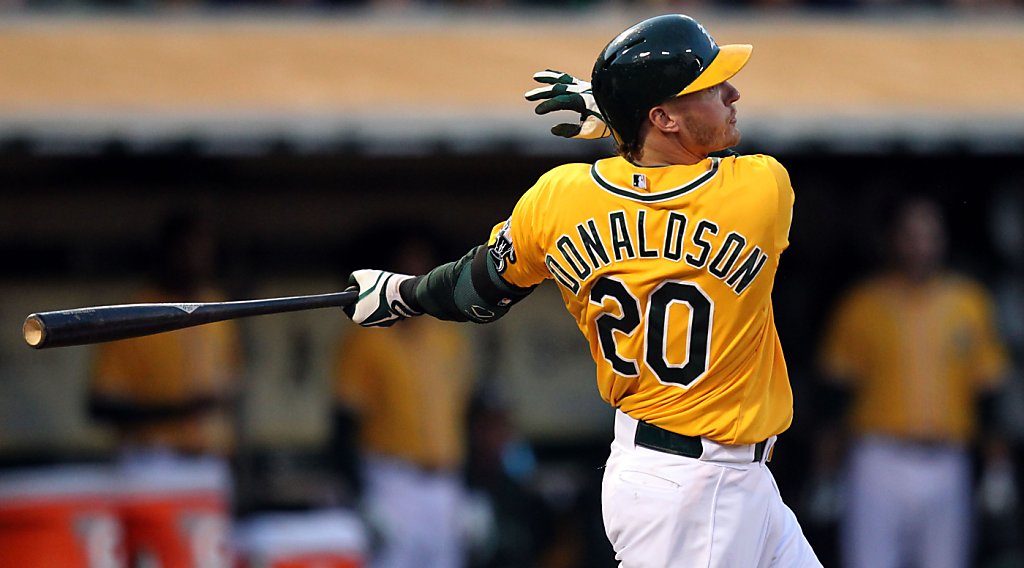
When you have not just the best third-baseman in baseball, but the sport's second most valuable position player over the past two years behind the one and only Mike Trout, and you have him under team control for four more years, and he's still only 29 years old, you'd be crazy to trade him, right? Especially when you're at a point on the win curve where one win could mean the difference between making the playoffs and playing golf in October. Unless you get so much in return that the trade is a can't miss opportunity, you thank your lucky stars that your late-blooming third-sacker unexpectedly evolved into one of the best all-around players in the game and wave him good bye when he hits the open market at 33.

For the Oakland A's to justify trading Josh Donaldson, their All-Star third baseman who finished fourth in the 2013 AL MVP race and eighth last year, they clearly needed to win such a trade. And while they're getting a four-for-one in their latest deal with the Toronto Blue Jays, I think they're probably looking at a loss, at least in the near future. The best they can hope for is a push.

The main piece Oakland gets in return for their All-Star third baseman is Brett Lawrie, who looks like a lost cause at this stage in his career. Since bursting onto the scene in 2011 with a .293/.373/.580 slash line, Lawrie's turned in three straight subpar, injury-plagued seasons. He's batted just .261/.316/.406 over the past three years with 34 home runs and 5.4 fWAR in 302 games, failing to deliver on the enormous promise he displayed as a rookie that drew comparisons to Ryan Braun. The soon-to-be 25 year-old is still young enough that an Alex Gordon or Donaldson-esque breakout might be looming, but right now there's not much to suggest such a transformation is coming. Moving from the Rogers Center to Oakland's Colisieum, a hitter's nightmare, won't help speed that process along.

The best-case scenario is that Lawrie puts it all together and becomes as good as Donaldson (it's pretty much impossible to be better), but even if he does the A's will only control him for three years rather than the four they had left with Donaldson. Granted, one player's age 25-27 seasons are more appealing than another's age 29-32 years, but Donaldson's already a finished product. Lawrie's still a project. Think of it this way; would you rather have the next three years of Jackie Bradley, Jr. (25 next year) or four more years of Andrew McCutchen (28)? Or how about Lawrie versus Evan Longoria (29)?

Lawrie's not Donaldson, and he's probably never going to be Donaldson because Gold Glove-caliber defenders with 30-homer pop are exceptionally rare these days. But the A's got more than Lawrie; they got three other players as well, all prospects. The most promising of those is Franklin Barreto, an 18 year-old shortstop who hit well in low-A ball last year (.399 wOBA, 141 wRC+ with 29 steals in 73 games). Barreto, Toronto's No. 5 prospect per Baseball America, could be something special, but he also won't be major league ready for at least a few more years. I'd feel a lot better about this deal for the A's if he becomes their franchise shortstop, but right now that's far from guaranteed.

The other two prospects are arms, neither of whom were considered among Toronto's 10 best prospects. One is lefty Sean Nolin, who's about to turn 25 but has only pitched one game in each of his two major league seasons. Even so, his solid minor league track record (3.06 ERA) suggests he's major league ready and could crack Oakland's rotation next year. Ditto Kendall Graveman, a righty and the other pitching prospect in this deal. Graveman's going to be 24 next year but shot up through Toronto's farm system, making his major league debut little more than a year after being drafted. He dominated at every minor league level last year with a 0.34 ERA at A ball, 2.23 in high-A, 1.50 at Double-A, and 1.88 in Triple-A. Just as playing in Oakland will hurt Lawrie, pitching there should only help Nolin and Graveman's development.
Lawrie leaves a lot to be desired (CBC Canada)
Looking at the swap from Oakland's perspective, my concern has more to do with the timing of it than what the A's got in return. Lawrie's an everyday third baseman: not a great one, but a major league regular at the very least. Barreto's the shortstop of the future, and on top of that Oakland nets a pair of major league ready arms to bolster its staff. If the A's were in rebuilding mode, this would be a fantastic move for them.

Only the A's are in no position to rebuild coming off last season's soul-crushing wild card game defeat. They were the best team in baseball in last year's first half, for crying out loud, and still mortgaged their future to acquire Jason Hammel and Jeff Samardzija from the Cubs (and then traded Yoenis Cespedes for Jon Lester and Jonny Gomes). You can't blame Billy Beane for wanting to restock the farm system a bit, but with that roster he should be focused on winning now, not five years from now. When you're on the cusp of your first World Series title since 1989, you don't trade your best player unless you're getting someone of similar value in return. Lawrie, Nolin, and Graveman combined probably won't provide as many wins as Donaldson will for the Blue Jays next year (Steamer says they'll produce 3.9 fWAR to Donaldson's 5.6 in 2015), and they take up three roster spots to Donaldson's one. Seven win players are incredibly rare and worth their weight in gold. Beane was lucky enough to have one, then crazy to trade him.

If you're the Blue Jays, though, you have to be excited with how your team's looking these days. Adding Donaldson to a lineup that already featured Jose Bautista, Edwin Encarnacion, Jose Reyes, and the recently acquired Russell Martin gives Toronto one of the best offenses in baseball (after they ranked fourth in runs and second in OPS among American League teams last year). The rotation isn't as formidable, but projects to be solid nonetheless. When you have a lineup like that, you can win plenty of games without top-shelf starting pitching.

Toronto's trying to be the top dog in an unstable AL East, and you have to commend the Jays for going for it. They know the time to win is now, with Boston, New York, and Tampa Bay all reeling from disappointing seasons, and they're doing all they can to end what is now the longest playoff drought in the four major American sports. Toronto's last two seasons have yielded disappointing results, but that hasn't stopped them from trusting their talent and doubling down on a championship-caliber core.

The A's could learn a thing or two.