Showing posts with label Atlanta. Show all posts

Wednesday, December 3, 2014

Atlanta Acquires Markakis

Nick Markakis is solid, but he's no Jason Heyward (Huffington Post)
Three weeks after trading Jason Heyward and Jordan Walden to the St. Louis Cardinals in exchange for Shelby Miller and Tyrell Jenkins, the Atlanta Braves have found a replacement right fielder in Nick Markakis.

Now, at $44 million over the next four years Markakis is going to cost Atlanta a lot less than Jason Heyward would have (Heyward's going to be a free agent next winter), but he's also not nearly the player Heyward is. Over the past four seasons, Markakis was worth 5.8 fWAR, while Heyward was worth 5.1 fWAR last year alone. Since 2010, Heyward's rookie season, he's compiled 21.4 fWAR to Markakis's 8.2. The gulf between them is only going to grow wider, as the 31 year-old Markakis is exiting his prime while Heyward (25) is just entering his. So while Markakis may not be as expensive as Heyward, he's hardly a bargain.

And based on how Markakis has aged, Baltimore was wise to let him walk. He peaked early, had his best season at 24, and was merely solid throughout the rest of his 20s. Now 31, his best case scenario is that he holds steady and remains a 2-2.5 win player. If he follows a normal aging curve, we'd expect him to lose about a half win per season and regress to replacement level by the end of the contract.

His decline will likely accelerate in Atlanta, as Markakis's already middling power numbers (.097 ISO in 2013-2014 combined) will suffer away from Camden Yards. Markakis made the most of his mediocre pop there, taking advantage of its close right field wall by slugging 23 of his 37 home runs at Camden over the past three years. Make him play half his games at the more neutral Turner Field, though, and he goes from being a 15-homer guy to a 10-homer guy, probably less than that as he gets older. Such pedestrian power wouldn't play at second base (looking at you, Dustin Pedroia), much less right field.

That said, Markakis does bring some positive qualities to the table. He's very durable, having played at least 147 games in all but one of his nine big league seasons. A career .290 hitter, he has great contact skills and walks a good amount too (.358 career OBP). He's a decent baserunner for his age and a capable right fielder, though not as good as his two Gold Gloves might suggest. He's never had a bad season and is a lock for solid numbers if healthy. Barring serious injury, he's a good bet to produce six or seven wins over the life of his contract for Atlanta to get its money's worth.

Then again, you could say all those things about Nori Aoki, and nobody's giving him four years and $44 million.


Monday, November 17, 2014

St. Louis Steals Heyward, Walden

Heyward helps the Cardinals considerably (USAToday)
Needing a short-term, last-minute fix in right field following the tragic and untimely death of Oscar Taveras, the St. Louis Cardinals sacrificed a pair of former first-round draft picks to acquire Jason Heyward, probably the best right fielder in the game not named Giancarlo Stanton. The Cardinals also received a plus reliever in Jordan Walden, who was an All-Star closer for the Los Angeles Angels in 2011. Walden should bolster the Redbirds' bullpen based on his career 3.10 ERA and 10.8 K/9 rate over five big league seasons.

But Walden's just icing on the cake, really, because St. Louis clearly got the best player in this deal. Heyward hasn't developed into the Ken Griffey Jr. clone people thought he'd be during his first season, when he was an NL All-Star and Rookie of the Year runner-up to Buster Posey, but he's still a phenomenal player. A true all-around talent, the two-time Gold Glove recipient has twice stolen 20 bases or more in a season and once hit as many as 27 home runs (in 2012). He also owns a rock-solid .351 OBP for his career, during which time he's been worth 24.5 bWAR and rated as the third-best rightfielder in baseball behind Jose Bautista and Ben Zobrist. Plus, he's only 25, though he will be free agent-eligible after next year.

In return the Braves landed Shelby Miller, who's only one year younger than Heyward but won't be eligible for free agency until after the 2018 season. Miller, a starting pitcher, finished third in the 2013 NL Rookie of the Year award to Jose Fernandez and Yasiel Puig after going 15-9 with a 3.06 ERA and 169 strikeouts in 173 and 2/3 innings. His 3.67 FIP and 1.21 WHIP suggested regression was coming, however, and sure enough Miller was merely a league average starting pitcher last year. His record fell to 10-9, his ERA swelled to 3.74, and his strikeout rate plummeted from 8.8 K/9 in 2013 to a paltry 6.2 K/9 last year. His walk rate increased as well, resulting in a 4.54 FIP that says he was very lucky in 2014. Miller may not completely unravel next year, but he seems doomed for more regression and won't have a very long career if he doesn't improve his command. There's just too much uncertainty about his effectiveness going forward, and right now the signs point to bad.

Atlanta's also getting Tyrell Jenkins, a 22 year-old pitching prospect who has yet to pitch above High-A. It's much too early to tell what kind of impact he'll have if and when he reaches the majors, as he'll likely need a few more years of seasoning before he's ready.

So yeah, clear win for the Cardinals here. They get at least one year of Heyward and two years of Walden for four years of Miller and a complete unknown in Jenkins. A six-win player last year, Heyward could very well end up creating as much or more value in 2015 than Miller does over the next four years, especially if the former finally puts it all together to produce that superstar caliber season we've been waiting for. Walden's already an established big league reliever, while there's a good possibility that Jenkins never throws a pitch in the Show.

This trade makes the Braves considerably worse for 2015, which is not the direction they want to go in after losing 83 games last year. St. Louis, on the other hand, remains a safe bet to win 90-plus games again en route to a third consecutive division title. If you're Atlanta, you have to do better than a league-average starting pitcher/likely project and a raw prospect for an elite outfielder such as Heyward. If you're St. Louis, you deserve a giant pat on the back.


Monday, August 11, 2014

Upton and Down


On Friday night the Upton brothers homered in the same game for the fifth time, setting a new major league record in the process. Each touched Stephen Strasburg for a two-run dinger, with Justin's breaking a scoreless tie in the first and B.J.'s doubling the lead to 4-0 the following inning. The Braves survived a late rally from the Nationals and held on to win 7-6.

After another bomb by Justin yesterday, the Upton siblings now have 28 long balls between them this year; 20 from Justin and 8 off the bat of B.J.

That Justin Upton leads his older brother by such a big margin is hardly groundbreaking news, as the former has been a much better player since they came together to form two-thirds of the Braves outfield. But as recently as 2012, B.J. Upton could claim outright superiority in that department. At that point the elder Upton had outhomered his kid brother 118 to 108 with three 20-homer campaigns to Justin's two. B.J. had just popped a career-high 28 with the Tampa Bay Rays, while Justin had only managed a disappointing 17 with the Arizona Diamondbacks in a much friendlier park for hitters.

It's fascinating how much their careers have diverged since. In the three seasons before they joined forces in Atlanta, both players compiled 10.7 fWAR apiece. But seeing as how most of Justin's came during his stellar 2011 campaign and B.J. was between three and four wins every year, the latter could certainly claim to be more consistent.

At the time B.J. was coming off the better season, having just established personal bests in home runs and total bases (260). Justin was trying to forget a down year in which he hit 17 home runs with a .785 OPS and 2.1 fWAR, a far cry from his MVP-caliber 2011 that produced 31 homers, an .898 OPS and 6.1 WAR. For the second time in three seasons, WAR rated B.J. ahead of Justin.

The last two years, however, it's like they're playing in completely different leagues. B.J.'s fallen off a cliff since the ink dried on his instantly regrettable five-year, $75 million pact with Atlanta. In his 235 games with the Braves he's batted a paltry .197/.273/.310 (62 OPS+) with 17 home runs, 55 RBI and 297 strikeouts, making him a sub-replacement level player this year and last. Justin, on the other hand, has been comfortably above replacement level thanks to his still-dangerous bat, which since he was traded to Atlanta rates almost 30 percent better than average after adjustments for league and park.

With B.J. already an albatross and Justin a borderline All-Star, the disparity between the two has never been greater. It's just funny to think that not too long ago, B.J. was actually the better player.


Wednesday, July 30, 2014

Maddux Musings


Ten thoughts on the recently inducted and much-deserving Hall of Famer Greg Maddux:

1. Maddux pitched for many great teams in Atlanta and won a ton of games--355 of them--so it's rather surprising that a) he never won more than 20 games in a season and b) he enjoyed only two 20 win seasons. Maddux managed five with 19 and two others with 18.

2. I think the most impressive part of Maddux's track record is his durability. From his second season in 1987 through his final season in 2008, he started at least 25 games every year. He topped 200 innings every year from 1988 through 2001, including the strike years of 1994-95, and missed extending that streak by two outs in 2002. He went on to compile four more 200 inning seasons consecutively and 18 in all, the last of which came at age 40. Even at 41 (198 innings) and 42 (194 in his final season) he remained indestructible. That longevity is a testament to his control and efficiency as much as it is his ability to stay healthy. He threw more than 5,000 innings in his career which, if you think about it, requires 25 seasons with 200 innings or 20 of 250. Seeing as how Maddux pitched 23 seasons, the first of which yielded only five starts and two of which were shortened by strikes, he essentially did the latter.

3. I'm really surprised that Maddux "only" won four ERA titles. You look at some of his ERA numbers and think about the context, and it's hard to see how he didn't win with a 2.18 in 1992, or a 2.72 in 1997, or a 2.20 the year after, or a 2.62 in 2002.

4. It blows my mind that Maddux maintained a 3.16 career ERA considering that he started out with a 5.59 ERA through his first two seasons and finished up with 4.13 ERA. He pitched more than 1,400 innings, almost 30 percent of his career total, that weren't very good, but still managed a 3.16 ERA. In the 15 years in between (1988-2002) it was 2.68. His worst ERA during that span was his 3.57 in 1999, a year that saw two players eclipse 60 homers.

5. Maddux often helped his own cause with his terrific defense, which won him 18 Gold Gloves--the most at any position ever.

6. Even as he got older, Maddux never got hurt and never deteriorated into a poor pitcher. While his ERA was over 3.95 in each of his last six seasons, it was still four percent better than average and helped him add 13.5 bWAR to his career total. He still had the league's lowest walk rate in four of those seasons as well, which helped him remain effective even as his velocity declined and he became more hittable

7. What really blows me away about Maddux is that he only had one season where he struck out 200 batters, and even then he just barely did so (204 in 1998).

8. At his peak Maddux was unreal. From 1992 through 1998, when Maddux compiled 54.6 of his 104.6 career bWAR, he had an ERA below 2.40 in six out of seven (and in the year he missed it was 2.72) while averaging 239 innings per year. In four of those years his WHIP was under 1.00, and it stood at 0.97 for the full seven. His K/BB ratio was 4.78. It was like Pedro Martinez's run a few years later, and if Maddux had retired at the end of it he'd be the modern-day Sandy Koufax, only better.

9. Maddux was phenomenal at limiting the long ball. In the seven years I just mentioned, he allowed 66 home runs. Total. That works out to be less than 10 per year, obviously, and while the steroid era was fully underway. In 1994 he was taken deep four times. Four! And the next year, only eight. Two years later--nine. The best collection of power hitters baseball's ever seen, jacked up on Lord knows what, couldn't do much damage against Maddux at his best.

10. Maddux hold the major league record for most seasons leading the league in games started (7) and most inside the top 10 in wins (18).

Glavine's Greatness


Here are ten testaments to Tom Glavine's greatness

1. Glavine did not go on the Disabled List until his age 42 (and final) season in 2008.

2. Like his rotationmate and fellow inductee Greg Maddux, Glavine was incredibly durable, making at least 25 starts in every season from 1988 through 2007. That's 20 years, in the last of which he threw 200 and a third innings at age 41.

3. Speaking of Maddux, I find it funny that Glavine made more All-Star teams (10) than Maddux (8). Glavine also had five 20 win seasons to Maddux's two.

4. Many pitchers are doomed to consistently finish with 17-19 wins per year while rarely reaching 20. Maddux was one such pitcher, Mike Mussina another. Glavine wasn't. He won precisely 20 three times, 21 once and 22 once, but never 19 and 18 only once. He had zero 17-win seasons. This probably explains why whenever Glavine received Cy Young consideration, (six times--including all five 20-win seasons--and winning twice) he never finished outside the top-three.

5.Glavine was a pretty decent hitting-pitcher, winning four Silver Slugger awards (second only to Mike Hampton all-time) and batting as high as .289 in 1996. Far from an automatic out, Glavine got on base in nearly one-quarter of his plate appearances. Interestingly enough, his best run as a hitter (1995 through 1998, when he won three of his four Silver Sluggers) also coincided with his best run as a pitcher. His 2.87 ERA over that stretch was 48 percent better than average on a league and park adjusted basis. As a batter he contributed 7.5 bWAR over the course of his career.

6. Great as Glavine was, the 1995 World Series MVP was even better in the playoffs, with a 3.30 postseason ERA compared to his 3.54 regular season mark. He pitched the equivalent of a full season in October, making 35 starts (24 of them quality) and throwing 218 and a third innings. And while he had a losing record in the playoffs (14-16), his teams had a winning record (18-17). Opponents batted .237/.316/.366 against him in the postseason compared to .257/.319/.378 in the regular season.

7. I believe he is still the only pitcher to throw two shutouts at Coors Field.

8. Glavine's 682 starts are a record for someone who never made a relief appearance. Throw in his 35 postseason starts--also without a relief appearance--and that makes 717.

9. One of only six southpaws with at least 300 career wins. The others are Steve Carlton, Lefty Grove, Warren Spahn, Randy Johnson, and Eddie Plank.

10. Glavine was rarely great, with only two seasons over the six-win mark and just two more above five, but he was always good (typically in the three-to-four win range). His adjusted ERA was better than average every year but one from 1991 through 2006 and he had four other seasons (1989, 90, 2003, and 07) where it was very close to average.

Monday, May 26, 2014

Sox Stop Skid, Beat Braves

The Red Sox halted their 10-game losing streak today with an 8-6 win over the Atlanta Braves. Boston had not won since Wednesday, May 14th in Minnesota, when they routed the Twins 9-4. What followed was a loss in the series finale and three consecutive sweeps to the Tigers and Blue Jays at home, then to the Rays on the road. The skid, Boston's longest since 1994, included three walk-off defeats and dropped them from second place in the AL East to fifth, aka last.

John Farrell's team won today with their biggest scoring output since their most recent win, rallying from a 6-1 deficit to stun the Braves. Trailing 6-1 in the top of the fifth thanks to another horrible start from Clay Buchholz, Boston hung five runs on the scoreboard to tie the game with a two-run single from Dustin Pedroia followed by a three-run bomb off the bat of David Ortiz.

Papi struck again in the top of the seventh, giving Boston the lead with his fourth RBI of the day; a go-ahead sacrifice fly that plated Brock Holt. The next batter, A.J. Pierzynski, knocked in Xander Bogaerts with a ground ball single to Andrelton Simmons.

Boston's airtight bullpen took it from there, as Junichi Tazawa set down the Braves in the bottom half of the frame and Andrew Miller did the same in the eighth. After getting Justin Upton to fly out to lead off the bottom of the ninth, Koji Uehara was touched for a single by Chris Johnson, which brought the potential tying run to the plate in the form of Simmons. But the slumping Simmons grounded into a game-ending 6-4-3 double play, giving Uehara his tenth save and Boston a much-needed win.

The Sox will look to turn this victory into a winning streak tomorrow with Jon Lester on the mound. Atlanta answers with Aaron Harang. Both have been very good this season, so expect a good old-fashioned pitcher's duel at Turner Field tomorrow night.

Sunday, April 27, 2014

Upton Starting Strong Again

Just like last year, Upton's been tremendous in April (RantSports)
On this date last year, Justin Upton smoked his 12th home run of the young season off Detroit's Joaquin Benoit. Atlanta's newly acquired outfielder finished the day batting a ridiculous .302/.384/.779, well on his way to winning NL Player of the Month honors for April and asserting himself as the early season MVP favorite. It looked like he had finally put it all together and was about to deliver the superstar-caliber season that had long been expected of him.

Didn't happen. It would be another two weeks before Upton homered again, the beginning of a lengthy power outage that lasted most of the summer. From April 28th through the end of July, a span of 77 games that comprised nearly half the season, Upton homered four times. Four. He struck out 85 times and batted .243/.339/.342, looking almost as lost as his big brother B.J. Upton. Monster April aside, Upton was essentially the same player he was during his disappointing 2012 campaign, the one that caused Arizona to give up on him when he was just 25 and still under team control for three more years.

This year, Upton is off to another phenomenal start. After his 2-for-4 performance today, he's currently hitting .330/.406/.625 with seven home runs and 16 RBI. The strikeouts have been an issue again: he's already fanned 32 times in 24 games, which puts him ahead of last year's pace when he whiffed 161 times--a career high. That makes me think the two-time All-Star can't sustain his hot streak for much longer, that he'll cool off soon and go through a dry spell similar to the one he endured last year.

Will it last three months? Probably not, but until Upton--currently on pace for 216 K's--cuts down on his whiffs and becomes more consistent, he's never going to be a superstar.

Tuesday, April 8, 2014

Aaron's Anniversary

40 years ago today, a new home run king was crowned. Hank Aaron, 40 years old at the time took Al Downing deep for the 715th home run of his career, breaking Babe Ruth's record. In the four decades since only one other player--Barry Bonds--has hit as many in his career. Bonds, of course, would up with 762, seven more than Aaron.

Both needed late career surges to get there. Bonds averaged 52 home runs per year from age 35 through 39, belting 258 in all. Aaron averaged 41 per season over the same age span, adding 203 to his career total. Ruth was not far off, hitting 192 from age 35 to 39, though his run followed a more natural age pattern as his home run totals dropped every year, falling from 49 at 35 to 22 at 39.

(Ruth was very nearly matched by the ageless Rafael Palmeiro, who cranked 190 big flies from ages 35 to 39 and has the fourth most home runs in that age bracket. I never would have guessed who was fifth: none other than Andres Galarraga)

It's not surprising that the three greatest home run hitters of all-time were also the three best home run hitters from age 35 to 39. Most sluggers begin to experience a power drop-off in their early 30s, so anyone who can average 40-50 home runs in his late 30s is truly remarkable.

I guess my point is that in order to have what can be considered one of the best careers of all-time, you have to remain elite into your late 30s. It's not enough to be great when you're young because almost all great players are great when they're young. What separates the best from the rest is the ability to stay healthy and retain your skills as you approach 40. Most players fall apart and retire. The best keep plugging along without skipping a beat.

Aaron always said the home run chase was incredibly draining and took a lot out of him. Based on his numbers in the years leading up to his achievement, you wouldn't have thought so. But I do find it interesting that after Aaron broke the record, he got old very quickly. He hit 20 home runs in 1974--half as many as the season before--and posted the second-lowest batting average, OBP, slugging, OPS, and OPS+ of his career. The Braves, perhaps sensing he was slipping, traded him to the Brewers so he could finish his career in Milwaukee. In his time with the Brewers he was merely a shell of his former self--not even DHing could revive his bat--and he called it quits at 42. Starting the day after he broke Ruth' record, Aaron hit .244 and slugged .397 over the remainder of his career. I guess even the best old players get too old at some point.

Wednesday, March 12, 2014

Braves Snag Santana

The Braves scooped up Santana well below the market rate 
When pitchers and catchers reported to spring training four weeks ago, I'm sure the last thing the Atlanta Braves thought they'd need would be more starting pitching. But a sudden rash of injuries to Kris Medlen, Mike Minor and Brandon Beachy left them short on arms, prompting yesterday's signing of Ervin Santana to a one-year deal worth $14.1 million.

Despite forfeiting a draft pick the Braves still got a great deal by essentially acquiring Santana, who originally wanted $100 million and was still seeking a four-year deal recently, for the cost of his qualifying offer. Plus they were able to avoid giving him a multi-year deal, which would have been risky given his spotty track record (Santana's posted full season ERAs over five in 2007, 2009 and 2012) and likely unnecessary, assuming something doesn't happen to Julio Teheran and that at least one of the aforementioned injured hurlers returns to health this year or next.

Given his level of success last year and throughout his career (six years with at least 30 starts, five with over 200 innings) I'm surprised Santana was still available. Durable, effective and still relatively young at 31, Santana would have been an asset for any team and is a more than capable last-minute fix. FanGraphs and Baseball-Reference both agree he was worth around three wins above replacement last year when he bounced back from a miserable 2012 to give the Royals 211 innings of 3.24 ERA ball (the best league and park adjusted ERA of his career). He also posted the second-best WHIP, walk rate and K/BB ratio of his career, teaming up with James Shields to form a dynamic duo at the top of Kansas City's rotation

Santana couldn't get the Royals over the postseason hump last year but should make an impact as a mid-rotation starter for the reigning NL East champions. Though he's another year older and thus more prone to age and injury regression, moving to the National League and a pitching friendly park should help Santana duplicate, if not improve, his 2013 production and thus his earning potential for next winter. Turner Field will help neutralize his home run tendencies, too, which makes his 2014 outlook even rosier.

So long as Santana stays healthy and doesn't have one of his patented disaster years, Atlanta's going to get their money's worth.

Tuesday, February 25, 2014

Simmons Latest Brave to be Rewarded


Simmons was worth almost seven bWAR last year largely because of his defense

At the rate they're going, the Atlanta Braves will have their entire team signed through the end of the decade by Opening Day.

Andrelton Simmons is the latest Braves to be rewarded with a payday, following in the footsteps of Freddie Freeman, Jason Heyward, Craig Kimbrel, and Julio Teheran. Simmons received a seven-year, $58 million extension that covers all his arbitration seasons and first two free agent seasons. The deal runs through his age 30 season, which means the Braves won't have to pay for much, if any, of his decline phase.

Assuming Simmons stays healthy, Atlanta's going to get tons of value out of this deal. His masterful glovework at shortstop makes him the most valuable defender in the game, so much so that he had one of the best defensive seasons in recorded history last year. And he's no slouch with the bat either, having hit 17 home runs last year and posting an .807 OPS from July 14th onward. Just 24, he figures to get better with age as he enters his prime years.

I like this deal much better than the one Texas gave to Elvis Andrus last year at the same age. Andrus was more established with four full seasons and two All-Star appearances under his belt, but the difference between the two skills-wise isn't enough to justify Andrus getting an extra year and twice as much money.

In fact, I don't think it's much of a stretch to say that Simmons will have the better career. Just last year alone, Simmons hit almost as many home runs as Andrus has hit in his entire career. Simmons also did so while striking out nearly half as often as Andrus does and while working a similar number of walks. Andrus is a better baserunner and plays good defense, but Simmons is so good defensively that he makes up whatever advantages Andrus has and then some.

So while it's hard to imagine Simmons getting such a deal in less enlightened times (he did hit only .248/.296/.396 last year, after all), it stands to reason that Simmons could and should get better. He's going to earn every cent of that money.

Friday, February 14, 2014

Braves Extend Teheran

The Braves signed up for Teheran's bright future (CBSSports)
More than a week after extending their two best position players--Freddie Freeman and Jason Heyward--the Atlanta Braves locked up Julio Teheran for the rest of the decade at a bargain bin price of $32.4 million. The six-year deal buys out the rest of his pre-arbitration and arbitration years as well as his first year of free agency. It also includes a $12 million option for 2020, Teheran's age 29 season, which Atlanta will likely pick up assuming he stays healthy and productive.

Teheran was terrific in 2013, his first full season, posting a 3.20 ERA (121 ERA+) with 170 strikeouts in 185-plus innings. He displayed great control for a 22 year-old rookie too, walking just 2.2 batters per nine innings and 45 in all. His 3.78 K/BB rate was one of the ten best in the National League. Most years that probably would have been good enough for Rookie of the Year honors, but not in 2013, which produced one of the most stacked rookie classes in baseball history. Teheran finished fifth in the NL voting, far behind frontrunners Jose Fernandez and Yasiel Puig.

So based on what we saw last year, it looks like Atlanta is getting a fantastic deal. Teheran's future looks bright, and the upside of signing a player like him after his rookie year is that he still has room to grow and potentially get better. The Braves just got him to sign away his prime for little more than $30 million, which could be a huge steal if Teheran improves into a Cy Young contender or even stays the same as a steady number two. His most similar player by age so far is Kevin Appier, and if Teheran is the next Appier (an All-Star with more than 100 wins and a 3.30 ERA before his 30th birthday) then the Braves are golden.

All long term commitments carry risk, though, and in this case Teheran's track record is so short. Who's to say Teheran isn't just a fluky one-year wonder? Plus, a lot can happen between now and 2020. Teheran could get hurt next year and never be the same. He could flame out after a few seasons. Pitchers are much harder to project than position players because they're so fragile and their performances tend to be more volatile.

But even if Teheran doesn't pan out, $32 million spread out over six years isn't going to cripple the Braves by limiting their payroll flexibility in any way. It won't be a burden the way contracts for Vernon Wells, Albert Pujols, Alex Rodriguez, and others have been. Thus, Teheran is a risk worth taking.

Wednesday, February 5, 2014

Braves Extend Heyward, Freeman

The Braves are smart to bet on their young talent 
The Atlanta Braves had a mostly quiet winter until yesterday, when they committed almost $150 million to two of their franchise centerpieces--Jason Heyward and Freddie Freeman.

The lion's share of that money is going to Freeman, who received an eight-year, $135 million contract extension that is the longest commitment the Braves have ever made to a player, topping the six-year, $90 million deal signed by Chipper Jones in 2000. It is also the most expensive on an annual basis, beating B.J. Upton's five-year, $75 million agreement. Freeman's extension will keep him with the Braves through 2021--his age 31 season.

The two-year pact with Heyward will cover his 2014 and 2015 (age 24 and 25) seasons at a cost of at least $13.3 million, with additional performance and award bonuses that could push his 2015 salary higher.

It's interesting how drastically different those contracts were since both debuted in 2010, are essentially the same age (Heyward is a month older), and have very similar career numbers so far:

Heyward: 2,170 PA  489 H  99 2B  73 HR .259/.352/.443  115 OPS+  18.4 bWAR
Freeman: 1,908 PA  481 H  93 2B  68 HR .285/.358/.466  123 OPS+   9.3 bWAR

(They have also each made an All-Star team and were NL Rookie of the Year runner-ups: Heyward in 2010 and Freeman the year after).

Though Freeman is the better hitter (but not by much), Heyward's been almost twice as valuable because he runs well and plays a great right field. All of Freeman's value is tied up in his bat, which is better than Heyward's but not enough so that he can compensate for Heyward's advantages in defense and baserunning. As an all-around player Heyward is clearly superior to Freeman.

So if Heyward has been twice the player that Freeman has, then why did Freeman get a contract that run six years longer and pays ten times as much as Heyward's?

The answer is timing. Heyward is coming off a disappointing and injury-plagued campaign. An emergency appendectomy and fractured jaw (courtesy of this pitch from Jonathon Niese) combined to limit him to just 104 games--a career low--with the former necessitating an early season DL stint that undoubtedly contributed to his slow start (.142/.283/.246 with two homers and eight RBI through June 1st).

Heyward rallied to bat .297/.376/.500 the rest of the way, and his final batting line of .254/.349/.427 was right in line with his career figures. Even with those disastrous first two months, Heyward was still worth around three and a half wins and showed signs of improvement, such as trimming his strikeout rate from 23.3 percent in 2012 to 16.6 percent--the best mark of his career--in 2013. He also bumped his walk rate up from 8.9 percent to 10.9 percent, which helped produce the second best OBP of his career.

So based on his strong finish to the season, Heyward looks like a good bet to rebound in 2014 (assuming good health) and could perhaps be ready to take the leap to superstardom that's been expected of him since he burst onto the scene in 2010. Steamer projects better things to come in 2014, expecting Heyward to be worth close to five wins and hit 21 home runs with a .367 wOBA and 135 wRC+. I'd say that sounds reasonable, maybe even a bit conservative.He's about to enter his prime years and should prove to be a massive bargain over the next couple seasons, especially if his career continues on its current trajectory (the top two similar batters through his current age are Jack Clark and Barry Bonds).

So whereas Heyward did not live up to expectations in 2013, Freeman exceeded his by a fairly substantial margin. Freeman finished fifth in the NL MVP voting after what was easily the finest season of his career to date, one in which he smashed 23 home runs, drove in 109 and batted a robust .319/.396/.501--all career highs. He also set personal bests in hits (176), walks (66), and total bases (276) in addition to posting the best walk and strikeout rates of his career, a performance that was worth approximately five wins.

Steamer predicts more of the same from Freeman this year: 23 home runs and similar rate stats. It's probably wise to expect some decline seeing as how his BABiP was .371 last year, which was the fifth highest mark in the majors and isn't likely to be repeated given Freeman's lack of speed.

But outside of some batting average regression, there's no reason to expect that Freeman will fall off in other areas. Whereas Heyward has alternated good years with bad years, Freeman has been remarkably consistent in his first three full seasons. Working backwards, he's played 147, 147 and 157 games and smacked 23, 23 and 21 home runs. His 2011 and 2012 seasons are virtually indistinguishable from each other, and while his raw OPS shot up by about 100 points in 2013 his counting numbers pretty much remained the same.

It's fitting, then, that Freeman's best comp at his present age is Eddie Murray, who of course was known as Steady Eddie. He's also earned flattering comparisons to Orlando Cepeda and John Olerud. If Freeman's career plays out like theirs did--landing him in Cooperstown or not far from it--then the Braves are going to get plenty of bang for their buck.

Thursday, June 13, 2013

Braves Outfield Disappoints

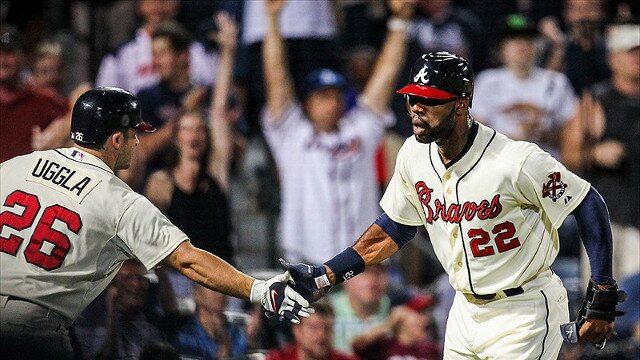
Dan Uggla greets Heyward after a long home run
Hopes were high for Jason Heyward and the Atlanta Braves coming into the 2013 season. After winning 94 games last year while ushering Chipper Jones into retirement, the Braves went out and signed B.J. Upton to the largest free agent contract in franchise history. Two months later, they fleeced the Arizona Diamondbacks for Justin Upton, scoring a 25 year-old superstar-in-the-making who won't become a free agent until after the 2015 season.

Adding the Upton brothers to its incumbent right fielder gave Atlanta one of baseball's best outfields. All three are young, athletic ballplayers projected for greatness long before they ever set foot on a big league diamond. Blessed with power and speed, the trio of former first round draft picks are three of the game's brightest talents.

So why aren't they playing like it?

More than two months into the season, the outfield that was supposed to lead Atlanta back to the postseason has gone bust. elder Upton's been a train wreck at the plate, striking out in one-third of his plate appearances and showing no semblance of the power stroke that helped him blast 28 home runs last year. Justin carried the Braves with his monster April  but hasn't done much lately, batting just .222/.343/.326 since April 28th.

And then there's Heyward, who's slow start to the season was exacerbated by an emergency appendectomy that forced him onto the Disabled List in late April and caused him to miss 23 games (the same operation derailed Adam Dunn early in 2011, and we all know how that turned out). Since returning to action on May 17th, it's taken Heyward a couple weeks to get his timing back and regain his footing at the plate.

But with both Uptons still dragging their feet in June, Heyward has shown signs of life at the plate. After going 2-for-5 with a double last night, Heyward now has hits in each of his last 10 games--including seven multi-hit efforts--to push his batting line up to .215/.324/.362.  He's been squaring up the ball better and making hard contact more consistently. These improvements are reflected in his improved strikeout rate, which he's trimmed from 18.8 percent before June 2nd to 12.8 percent since.

Credit Fredi Gonzalez for sticking with his slumping 23 year-old, batting him second even as his batting average languished below the Mendoza line into early June. Many managers would have dropped Heyward down in the lineup or benched him in an effort to help get him going, but such moves can end up doing more harm then good. They reflect a lack of faith on the manager's part and can end up damaging the ballplayer's already diminished confidence. Gonzalez's long leash has served him (and Heyward) well.

Even after getting swept by the San Diego Padres, Atlanta still leads the NL East by six games. The Braves are a first place team in spite of their vaunted outfield, not because of them. The rotation's remained healthy and everybody's pitching well. Evan Gattis and Chris Johnson are picking up the slack on offense. The defense is as good as expected.

Still, one can only imagine how strong the Braves will be once Heyward and the Uptons start doing what they're capable of.

Wednesday, June 5, 2013

B.J. Upton Breaking Out

Upton is putting his slow start behind him
After an abysmal start to the season for B.J. Upton, he finally seems to be getting his act together at the plate. After batting just .145/.230/.245 with 63 strikeouts through the end of May, Atlanta's new center fielder is showing signs of life in the batter's box . Since the calendar flipped to June, Upton has four hits, including a pair of home runs, and four RBI in four games to briefly silence those clamoring for him to be benched. Not coincidentally, Atlanta won all four tilts.

Obviously four games (2.5 percent of the season) is a small sample size and doesn't mean much in the grand scheme of things. But for the ever-streaky Upton, this mini-hot streak could be a sign that he's about to go on a tear. Braves skipper Fredi Gonzalez gave him a few days off last week to clear his head, and so far the mental breather has proved beneficial for the slumping star.

I couldn't help but think of Dan Uggla, who joined the Braves as a free agent prior to the 2011 season and struggled mightily in the first half., batting .173/.241/.327 through the Fourth of July. But Gonzalez stuck with his struggling second baseman, and was ultimately rewarded when Uggla went off in the second half and finished with his typically strong power numbers.

Upton's in a similar boat; and I figured it was only a matter of time before the former first overall draft pick came around at the dish. Don't be surprised if he doubles his season home run total (he has six) by the end of the month and looks more like the player Atlanta thought they were getting when they signed him to the largest free agent contract in the organization's history.

And if he doesn't? Well, good thing the Braves have his more talented little brother Justin Upton.

Wednesday, April 24, 2013

Justin Upton: Man on a Mission

Justin Upton is insanely, impossibly, ridiculously hot right now. He's so hot, in fact, that you can almost see the flames radiating from his bat every time he swings. His plate appearances have materialized into must-see TV.

After homering in both games of yesterday's doubleheader in Colorado, he now has 11 big flies on the young season. Nobody else has more than seven. He also has the highest slugging percentage (.813) and most total bases (61) of anyone in baseball. But since all but one of his dingers came with nobody on base, his power surge has produced just 16 RBI. For that he can blame Atlanta's table-setters--Andrelton Simmons and his big brother B.J. Upton--who have a combined OBP somewhere in the .250 range. Because of them, most times when the younger Upton digs in, the table is empty.

But a dearth of RBI opportunities hasn't stopped Upton from enjoying one of the best starts in baseball history. The Braves have gone along for the ride, jumping out to a 15-5 record and building a quick five game lead over the NL East, making their 25 year-old left fielder an early MVP favorite as well as a shoo-in to make his third All-Star team.

Out west, Upton's former employers have to be kicking themselves for trading him away when he was still under team control through 2015. Everyone could see the former first overall draft pick had this kind of superstar talent in him; he just needed time to mature. Now, he's growing up right before our eyes and is poised to become a major force for years to come. Three weeks into the season, it seems inevitable that future generations of baseball fans will look back on this trade the same way we disparage Boston's sale of Babe Ruth or the Reds' trading Frank Robinson.

More importantly, Upton's home run barrage merely reinforces what we knew three months ago; the Diamondbacks were dumb to trade Justin Upton.

Saturday, March 30, 2013

NL East Preview

1st Place--Washington Nationals
2012 Record: 98-64
2012 Pythagorean: 96-66
2013 Projected: 102-60
Tom Verducci showed how 100-win teams are dying out in the modern game, but if any team has the potential to crack the century mark in the win column, its the Nationals. Washington posted the best record in baseball last year and returns fully intact (minus Mike Morse), another year older and wiser. This is a team that has to be considered World Series favorites because it has no holes. The Nats have quality bats top-to-bottom, speed, power and on-base ability. The only weak spot is catcher (Kurt Suzuki), but hopefully he hits so poorly that Wilson Ramos earns a chance to win the job back. Their rotation (Stephen Strasburg, Gio Gonzalez, Dan Haren, Jordan Zimmermann, and Ross Detwiler) is the best in baseball, and their bullpen is just as filthy with Tyler Clippard and Drew Storen setting up Rafael Soriano. Full seasons from Strasburg and Bryce Harper (and hopefully Ryan Zimmerman and Jayson Werth) will push this team over the top.

2nd Place--Atlanta Braves
2012 Record: 94-68
2012 Pythagorean: 92-70
2013 Projected: 91-71
The Braves boast a young, exciting lineup loaded with tons of speed and power. Justin Upton and B.J. Upton are the key additions that will balance out Atlant's southpaw mashers with their righthanded pop. Jason Heyward took a big step forward last year to get back on the Ken Griffey Jr. track scouts predicted him to follow. Dan Uggla must improve after submitting the worst season of his career last year. Freddie Freeman should get better after putting his eye issues behind him. Gerald Laird will be forced to catch on a regular basis until Brian McCann returns, and even then there's a chance that McCann won't be the perennial All-Star we're used to seeing. Shortstop Andrelton Simmons plays stellar defense but will be tested in his first full big league season. However it's important to remember that Michael Bourn, Chipper Jones and Martin Prado and their combined 14 bWAR will not return in 2013. The rotation looks good on paperwith the timeless Tim Hudson leading the way, flanked by Mike Minor, Paul Maholm, and budding ace Kris Medlen. Medlen pitched like Sandy Koufax in a dozen starts last year, but it remains to be seen how he'll hold up over the course of a full season. The staff will get a nice boost if/when Brandon Beachy returns from Tommy John, probably near the end of the summer. Atlanta has what is arguably the best bullpen in baseball with Jordan Walden joining Jonny Venters, Craig Kimbrel and Eric O'Flaherty. The Braves are going to be tough to beat in the late innings of close ballgames and shouldn't have much of a problem making it back to the postseason.

3rd Place--Philadelphia Phillies
2012 Record: 81-81
2012 Pythagorean: 81-81
2013 Projected: 87-75
The Phillies were massive disappointments last year, when injuries ruined their roster and resulted in a .500 season. It's easy to write them off as too old and injury-prone (like the Yankees), but don't forget that they're just one year removed from a 102 win season. Philadelphia is still a dangerous, if not top-heavy, ballclub loaded with veteran talent. The offense is an interesting mix of aging stars and unproven youngsters. The infield triumvirate of Chase Utley, Ryan Howard, and Jimmy Rollins are all past their primes, but if they all stay healthy then they're going to be productive. Carlos Ruiz will return from his suspension at the end of the month to provide an offensive lift behind the plate, even if there's no chance he replicates his sensational 2012. Everybody's saying this is the year Domonic Brown breaks out, and one look at his spring training numbers confirms the hype. The outfield (Brown, Ben Revere, and Laynce Nix) is going to miss Hunter Pence and Shane Victorino, though Revere provides a heavy dose of speed and defense as a homeless' man's Michael Bourn. Don't expect much out of newcomers Michael Young and Delmon Young. Philly's rotation is still a three-headed monster with Roy Halladay, Cole Hamels and Cliff Lee all capable of winning a Cy Young award, though Halladay is coming off a poor season and hasn't looked the same in spring training. His age and heavy workloads may have finally caught up to him. Lee pitched much better last year than his 6-9 record indicates and should see his win total bounce back in 2013. Jonathan Papelbon was terrific in his NL debut, but Charlie Manuel needs to deploy him properly. I don't think Philadelphia will make the playoffs, but one has to acknowledge that the talent is there for a 90 win season and a postseason berth.

4th Place--New York Mets
2012 Record: 74-88
2012 Pythagorean: 75-87
2013 Projected: 75-87
As bad as the depleted Yankees look right now, they'll still be better than their crosstown rivals. The last half-decade has not been kind to the team in Flushing, and this season doesn't figure to be any different. The Mets have a nice infield and several premier prospects, but that's not going to cut it in a loaded NL East. 23 year-old Ruben Tejada held his own as the everyday shortstop last year, but his lack of power makes him Elvis Andrus without the wheels. David Wright returned to form last year after a down 2011, but his health woes in spring training lead me to believe he might struggle again in 2013. Slugging first baseman Ike Davis is one of baseball's best kept secrets and should have better luck after posting a .246 BABiP last year. Now if he can just figure out how to hit lefties... He and Lucas Duda are coming into their primes and will be counted on to support Wright in the meat of New York's order. Without Johan Santana and R.A. Dickey, the rotation lacks a true number one. Jonathan Niese was great last year, but he's no ace. Neither is the ever-underrated Shaun Marcum, who missed time with an elbow strain last year and will open the season on the Disabled List. Young power-pitcher Matt Harvey needs to step up and fill the void, though he'll likely face an adjustment period at some point this season. He could be the best pitcher on the Mets this year, or he could just as easily go bust when big league hitters start figuring him out. I can't say I like New York's bullpen, not that it's going to make much of a difference either way. the Mets have the talent to be a .500 team at best, but I see them enduring a fifth consecutive losing season. At least they don't have to worry about finishing in last place.

5th Place--Florida Marlins
2012 Record: 69-93
2012 Pythagorean: 68-94
2013 Projected: 57-105
There's no way this team doesn't lose at least 100 games. Less than a year after spending money like a drunken playboy in a Vegas casino, the Marlins dismantled their roster piece by piece, trading away all their talent Harry Frazee-style. Now, all that's left is the wildly inconsistent Ricky Nolasco, a disgruntled Giancarlo Stanton (who may not see a decent pitch to hit again for the rest of the decade), and Twittaholic Logan Morrison. I envision many solo home runs in Stanton's future, for the basepaths will be just as empty as the seats in Miami's shiny new baseball stadium. The mass exodus began during the summer when the losses began to mount and it became clear the Marlins weren't going to contend for a playoff spot. Hanley Ramirez took his fading star to Hollywood. Anibal Sanchez and Omar Infante packed their bags for Motown. A struggling Gaby Sanchez got dumped on the Pittsburgh Pirates. After the season ended Heath Bell was banished to the Arizona desert. Ozzie Guillen got canned. Then, to top it all off, the Fish pulled off a fire sale that rivaled Boston's late summer housecleaning. Miami jettisoned its remaining stars--Jose Reyes, Josh Johnson, and Mark Buehrle--north of the border in a blockbuster 12-player trade that rocked the baseball world and ignited a media firestorm. It's no wonder Stanton wants to be traded, too.
Monday, February 18, 2013

MLB Hot Stove winners

After examing the offseason's five biggest losers yesterday, today I take a look at five teams that won the winter.

Atlanta Braves
The Braves brought in some much-needed righthanded pop in the form of the Upton brothers, who will team with Jason Heyward to form the National League's most exciting outfield. Though they failed to acquire a strong replacement for Chipper Jones (Chris Johnson is replacement level at best) and lack catching depth behind Brian McCann (Gerald Laird? pass), the Braves are primed for another playoff run in 2013.

Boston Red Sox
Boston began the offseason by firing Bobby Valentine, the man responsible for so much of the controversy and dysfunction that plagued the Red Sox last season. Ben Cherington found a good replacement in John Farrell, a former Red Sox pitching coach whom many members of the team (Jon Lester, Clay Buchholz, Dustin Pedroia) respect. He satisfied David Ortiz with a contract extension, then went about reshaping the roster with cheap, productive character guys. Cherington signed Mike Napoli to replace Adrian Gonzalez, Shane Victorino to man right field (then slide over to center when/if Jacoby Ellsbury leaves) and Ryan Dempster to fill Josh Beckett's void in the rotation. He also added David Ross to complement Jarrod Saltalamacchia behind the plate, imported lefty-masher Jonny Gomes and traded for All-Star closer Joel Hanrahan, thus relegating Andrew Bailey to eighth inning duties. The Sox needed a new shortstop after trading Mike Aviles and found a decent one in Stephen Drew, younger brother of J.D. Drew, who played the last five years of his career in Boston and collected $70 million for his services.  All winter long Cherington preached patience and discipline, and the mantra seems to have paid off. There's no question the Red Sox will be a better team in 2013--the only question is will they be good enough to reach the postseason for the first time in four years?

Cleveland Indians
The Tribe lost 94 games last year but got significantly better this winter. They upgraded their outfield outfield by signing Nick Swisher and Michael Bourn, signed slugging corner infielder Mark Reynolds to a cheap one-year deal and traded for Trevor Bauer, who projects to be a future ace. With veteran skipper Terry Francona at the helm, Cleveland now has one of the best managers of the past decade at the reins. The Indians aren't talented enough to surpass the Detroit Tigers in the AL Central but have the pieces to move above .500 for the first time since 2007.

Seattle Mariners
Besides locking up their staff ace/face of the franchise for the rest of the decade, the M's brought in plenty of offensive firepower in the way of Michael Morse, Jason Bay, Kendrys Morales, Raul Ibanez, and Kelly Shoppach, all of whom will be the first Mariners to benefit from Safeco Field's closer fences. The starting rotation could use more depth, but King Felix is an ideal hurler to build around. The Mariners will have their hands full with the Rangers, Angels, and A's this year, but they could be sneaky-good and post a winning record in baseball's toughest division.

Toronto Blue Jays
The Jaybirds look like World Series favorites (on paper, at least) after completing two blockbuster trades to bring in Mark Buehrle, Jose Reyes, Josh Johnson, and reigning NL Cy Young winner R.A. Dickey. Not to mention, Melky Cabrera could turn out to be a massive steal for a two-year, $16 million commitment.