Showing posts with label Evan Longoria. Show all posts

Thursday, November 26, 2015

Longoria Losing Power and Patience

Longoria's suffered two down years in a row when he should be in his prime (TBO)
For the first six years of his career, Evan Longoria was the best position player in baseball. Despite losing over a year's worth of games to injury, his combination of elite glovework at third base and a top-shelf bat made him a superstar when healthy.

Then 2014 happened. Injuries weren't the issue, as Longoria played all 162 games for the first time, but his production cratered. He'd been so good up to that point, though, and he was only 28, so it looked like nothing more than an off-year. Surely Tampa Bay's $100 million third baseman would bounce back.

He didn't. His numbers improved slightly, but his 2015 was essentially the same as his 2014. Once again he was healthy, appearing in all but two games, so injury-woes were not to blame. That made two down years in a row for Longoria, in what were supposed to be his prime years.

I don't have to tell you that unless there's a career-altering injury involved, great athletes typically don't get dramatically worse during their late 20s. Oftentimes, many get better. They're still young enough to be in their physical primes, but experienced enough to have acclimated to major league competition. These are supposed to be an athlete's greatest seasons.

For Evan Longoria, they have been his worst.

Longoria has had a weird career. When he debuted at 22 in 2008, he was mostly a finished product, winning Rookie of the Year unanimously and blasting 27 homers. He only improved from there, looking like a surefire MVP for years to come as he entered his mid-20s. All he had to do was take his game a little bit higher.

He never did. Injuries caused him to miss 117 games between 2011 and 2012, his age-25 and -26 seasons. He came back strong in 2013, playing 160 games and finishing sixth in the AL MVP vote, but his production had plateaued. Longoria was still a great player, just not quite the dominant force he seemed poised to become.

Over the last couple years, however, Longoria has slipped from a great player to a merely good one, declining in all facets of the game. The two-time Gold Glove winner hasn't won since 2010, with metrics now suggesting he's much closer to an average fielder than the vacuum cleaner he was previously. His baserunning has also fallen off considerably. While never a burner, he was an asset on the basepaths through the first three years of his career, stealing 31 bases in 36 attempts and providing a full win's worth of value over an average runner. In the five years since, he's managed just 14 steals and been four runs worse than average on the bases, providing positive value with his legs in just one year.

Defense and speed peak early, however, so it's not surprising that Longoria's lost some of both as he's advanced into his late 20s. What's concerning is how he's become a league average hitter after previously producing like David Ortiz.

How did Longoria fall so far, so fast? A major red flag is his plummeting walk rate, which has declined every year since 2011. Once a very patient hitter, he's now drawing free passes at a roughly league average rate. Longoria's chasing, and hitting, more pitches outside the zone than ever before, which explains both his eroding walk rates and hard-hit frequencies. He's swinging more in general, too, which wouldn't be a bad thing if he hadn't started hacking at so many non-strikes.

It could be that Longoria's new aggression is in response to seeing more first pitch strikes than ever before. Part of that's due to the larger strike zone, but it's also likely that pitchers have recognized Longoria's willingness to let the first offering go by. In 2015 the league hit just .225/.265/.344 after falling behind 0-1. Longoria isn't much better, batting .234/.277/.388 for his career after first pitch strikes. Since he's seeing more of those, it follows that his numbers have nosedived. And since he's on the defensive more often, he has to chase more often, thus explaining the loss of patience.

What's really troubling, though, is Longoria's loss of power. After averaging 33 home runs per 162 games with a .237 ISO through his first six seasons, he's averaged just 22 with a .158 ISO over the past two. His doubles were down too, from 41 per 162 games to 31, so it's not like he was just getting unlucky with his HR/FB rates (though those are down too).

The reason for Longoria's diminished power is simple (and one I alluded to earlier); he's not hitting the ball as hard as he used to. The only time he had a worse hard-hit % than he did the last two years was in his injury-hampered 2011. Meanwhile, his soft contact rate nearly doubled from 2013 to 2015, and his medium contact rate is up as well (the only time it was higher; 2009). This data, along with his rising pop-up rates, suggest he's not squaring up the ball as well as he used to. That's a side effect of hacking, to be sure, but he also might be losing strength and bat speed as he ages.

Longoria's career seems to be following the same path as David Wright's. Both peaked early and were at their best in their mid-20s, looking like future Hall of Famers. Then their performance started dropping off in their late 20s, because of injuries with Wright and the reasons outlined above with Longoria. Wright has yet to recapture the consistent greatness he exhibited through his first five seasons, and it seems unlikely that Longoria--who just turned 30 last month--will either.

Friday, September 19, 2014

Longoria: Above the Nettles

Longoria is following in Nettles's footsteps (ESPN)
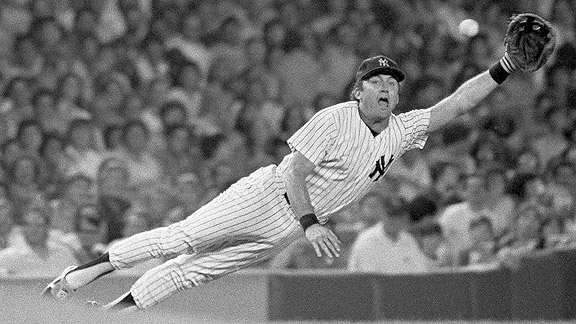
The more I think about it, the more Evan Longoria seems like a modern-day Graig Nettles to me, or at least a superior version of Nettles.

Think about it: they're basically the same player. Neither one hit for great average or had much speed, but both have above average on base skills because they walk a good amount. Both have good power, typically settling for around 20 homers and 90 RBI per season. Both have seen their numbers stifled by the pitching-dominated environments in which they play: Nettles spent most of his 22-year career in a wasteland for hitters (1967-1988) while Longoria has been victimized by the new Deadball Era, not to mention played half his games in the offense-suffocating Trop. For the most part they've been pretty durable, too.

Defensively, both are terrific. Nettles won two Gold Gloves and probably deserved a lot more, seeing as how B-R says his glove was worth nearly 21 wins over the course of his career (FanGraphs more or less agrees and has him at 18), though he was overshadowed by Brooks Robinson early in his career. Longoria also has a pair of Gold Gloves and has accrued the most defensive value of any third baseman since 2008, the year he broke in. His slick fielding combined with his elite bat has made him the best all-around third sacker during that span. He's been better than Adrian Beltre even, something I feel that most people don't appreciate.

Nettles had two top-six finishes in the MVP voting. Longoria also has two top-six finishes, though with admittedly more time to add more. Both came up with big hits in the postseason though their overall playoff numbers aren't great.

Nettles, of course, was a great player for a very long time; a borderline Hall of Famer. Longoria, with almost 40 bWAR through his age 28 season, is well on his way.  Though this year's been a bit of a struggle for him, he's remained healthy enough to play everyday and so his numbers will turn out alright. He was so good so young anyways that he really only needs a couple more big seasons to cement his Hall of Fame case, and seeing how he's signed through 2022 that shouldn't be too hard to do.

Nettles was very nearly a Hall of Famer, and Longoria's better than him. Few players play past 44, as Nettles did. But health and luck permitting, Longoria won't turn out to be the next Scott Rolen.

Tuesday, October 1, 2013

Rays Win Game 163

After their 5-2 win last night the Rays live to play another day (Yahoo Sports)
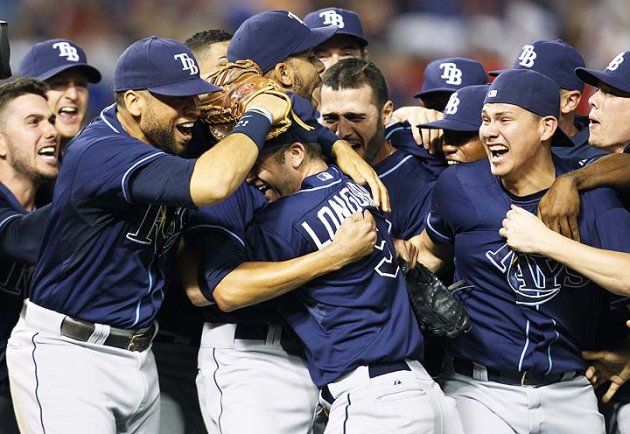
Last night the Tampa Bay Rays and Texas Rangers, both of whom finished the regular season with identical 91-71 records, squared off in Arlington last night to determine the American League's second Wild Card team.

This game--Game 163--wouldn't have happened two years ago. Instead, both teams would be lamenting how they finished one game behind the Cleveland Indians--the true Wild Card winners. But the times, and rules, have changed, so both teams were given a second shot at October baseball.

The Rangers were red-hot, having won seven straight games to close out the year. That sprint to the finish left Ron Washington unable to start Yu Darvish or Derek Holland. He went with 22 year-old rookie Martin Perez, who acquitted himself well this year but wouldn't have been anyone's first choice to start a game of this magnitude.

That's what made the Rays clear favorites to win. In this do-or-die, win-or-go-home cage-match,Tampa Bay turned to its ace and reigning AL Cy Young winner David Price. Putting his postseason struggles against Texas aside, the three-time All-Star is widely considered to be one of baseball's best pitchers and his availability seemed likely to swing the game in Tampa Bay's favor.

Sure enough, it did. Price pitched the Rays into the playoffs by going the distance, scattering seven hits and allowing just two runs. Tampa Bay staked him to an early lead, drawing first blood on Delmon Young's sac fly in the top of the first. The Rays led from that point forward, and with Price pitching their lead was never seriously threatened.

Perez didn't pitch poorly, but simply wasn't good enough to outduel Price. He departed in the sixth after striking out Ben Zobrist to open the frame, giving way to Alexi Ogando. Texas was losing 3-1 at the time, but doubles from Evan Longoria and David DeJesus made that deficit 4-1 before Ogando could close out the inning.

The Rangers responded with a run in their half of the inning on an RBI double from Alex Rios, but Price shut them out for the rest of the night. Tampa added an insurance run in the top of the ninth to make the score 5-2. Rather than tap into his bullpen, Joe Maddon let Price, who had thrown 108 pitches through eight, come back out to finish what he started. He finished strong, setting down Adrian Beltre, A.J. Pierzynski and Nelson Cruz in order.

(Speaking of Cruz, all the hoopla surrounding his return from a 50 game suspension turned out to be much ado about nothing. Cruz was a non-factor, going 0-for-4 with a strikeout).

Price put the team on his back, but so did Evan Longoria, who continued his run of monster games on the final day of the season. Longo went 3-for-4 with a single, double, and two-run homer. The long ball was his seventh career blast on the final day of the season, breaking a tie with Stan Musial. Longoria clearly understands the importance of saving his best for last.

So for the second year in a row, the Rangers are headed home after narrowly missing the postseason and Washington will likely be fired as a result. The Rays travel to Cleveland, where they will take on Terry Francona's Indians tomorrow night in another sudden-death affair--the Wild Card (aka coin toss) playoff game. Tampa Bay will pin its playoff hopes on Alex Cobb, while Cleveland will ride rookie Danny Salazar, who has just ten big league starts under his belt.

Obviously this game could go either way, but my gut tells me the Rays will come out on top. I say Tampa Bay 4, Cleveland 3.

Sunday, December 2, 2012

Longoria Locked Up, Price is Wright

Earlier this week the Tampa Bay Rays locked up Evan Longoria with a six year, $100 million contract extension that will keep him with the Rays through the next decade.

It's rare to see Tampa's thrifty front office spend so much money at once, but Longoria is worthy investment. Since winning the 2008 AL Rookie of the Year award, he has been arguably the game's top third baseman. In his five years he's batted .276/.361/.516, good for a 137 OPS+, while averaging 26 home runs and 91 RBI per season. He's been worth 29.3 fWAR over that timeframe, making him more valuable than any position player in the sport not named Albert Pujols or Ryan Braun.

Injuries have hampered Longo over the past two seasons. He missed a month in 2011 with an oblique injury and spent half the season on the shelf in 2012. His torn hammy cost his Rays a playoff spot; they were a sub-.500 team with him on the DL but won nearly two-thirds of their games when he wasn't. However, Longoria is entering his age-27 season and poised for a monster season that could net him his first MVP award. Unless the Rays score a big bat this offseason, he will have to pick up the slack for B.J. Upton as well.

On Friday the New York Mets inked David Wright, their franchise cornerstone, to an eight-year deal worth $138 million. The deal represents the largest contract in team history, nudging out their six-year $137.5 million commitment to Johan Santana.

Wright has spent his entire career with the Mets, who drafted him in the first round 11 years ago and watched him develop into the NL's top third baseman. Since debuting in 2004 he's made six All-Star teams, batted .301/.381/.506 and averaged 23 home runs/91 RBI per season. He's been worth 47 fWAR in his career, a total surpassed only by Pujols, Chase Utley, Alex Rodriguez and Miguel Cabrera during that time.

Give Credit to Wright for sticking with the Mets. He's endured some lean years and devastating collapses with them, and given their bleak outlook I don't think anyone would have blamed him for abandoning ship. The fan favorite will continue to provide veteran leadership and be a good example for up-and-comers Ike Davis, Lucas Duda, and Ruben Tejada. Hopefully the front office rewards him by bringing back NL Cy Young winner R.A. Dickey and building around the dynamic duo in the future.
Wright turns 30 later this month, which makes this extension somewhat risky. It's quite possible that we've seen the best of Wright and that he'll only decline from this point forward. He hasn't been a model of consistency lately:

2008: 33 HR 124 RBI .924 OPS
2009: 10 HR  72 RBI  .837 OPS
2010: 29 HR 103 RBI .856 OPS
2011: 14 HR  61 RBI  .771 OPS
2012: 21 HR  93 RBI  .883 OPS

On the bright side, Wright improved his approach at the dish this past year by trimming five percent off his K rate and upping his walk rate to 12.1 %, the highest it's been since his monster 2008 campaign. David Ortiz made similar improvements the past two seasons and has remained an elite hitter well into his thirties, so if Wright sustains his plate discipline he should have several more productive years in front of him.

And ohbytheway, he'll still be making only half as much as the other third baseman in New York, a former superstar by the name of A-Rod.