Showing posts with label Ballot. Show all posts

Thursday, December 24, 2015

My 2016 Hall of Fame Ballot

Bonds and Clemens are the most deserving candidates on this year's ballot (CBS Sports)
Hall of Fame ballots were due Monday, and while I don't have a vote here is how I would have voted if I did. As has been the case the last few years, there are more qualified candidates than one is allowed to vote for, due to the Hall's arbitrary 10-player maximum. As such, my ballot reflects the 10 players I believe are most worthy of enshrinement, though several more (listed below) also deserve to have their name called in Cooperstown one day.

3. Ken Griffey, Jr.


Two ballots barely fits all the Hall-worthy candidates on this year's ballot. No wonder there's such a logjam to get into Cooperstown.

Friday, November 20, 2015

My 2015 MLB Award Ballot

Just realizing I never released my unofficial ballot, as MLB awards week really snuck up on me this year. So now that the votes are in, here is how I would have filled out my ballot, if I had one.

AL MVP

1. Dallas Keuchel
2. David Price

AL Rookie of the Year

AL Manager of the Year
2. Jeff Bannister

NL MVP

NL Cy Young
1. Clayton Kershaw
2. Jake Arrieta
3. Zack Greinke

NL Rookie of the Year

NL Manager of the Year

Thursday, November 12, 2015

2016 Hall of Fame Ballot Newcomers

Griffey's going into the Hall of Fame next summer (Yahoo Sports)
This year's Hall of Fame ballot was released on Monday, adding 15 newcomers to the list of 17 holdovers. While the incoming class isn't as strong as previous years, which saw three first-timers inducted in both 2014 (Greg Maddux, Tom Glavine, Frank Thomas) and 2015 (Randy Johnson, Pedro Martinez, John Smoltz), by my count there's still a pair of surefire Hall of Famers as well as a couple more with very strong cases for induction. Let's take a look:

Hall of Famers
How could you note vote Ken Griffey, Jr. into the Hall of Fame? For the first half of his career he was Willie Mays, and while he was more like Mickey Mantle in the second half (the late-career version of Mantle), he still did enough to wind up with tremendous counting stats. His 630 long balls and 1,836 RBI are second only to Mays among center fielders, and his 83.6 bWAR (77.7 by FanGraphs) place him comfortably above the Hall's standards.
Few players were ever as good as peak Griffey, a dazzling center fielder and .300 hitter with 50-homer power and 20-steal speed.  Looking at his numbers, especially the late '90s ones, it's hard to believe he won only one MVP (at least it was unanimous). Even so, he was one of the decade's most decorated players. An All-Star and Gold Glove winner every year during the '90s, he also won seven Silver Sluggers and that MVP in '97, which he won unanimously despite a 1.067 OPS from Frank Thomas and a 12-win season by Roger Clemens (wins above replacement, that is).
Griffey dominated the '90s, a decade in which he hit more home runs than anyone not named Mark McGwire, drove in more runs than anyone besides Albert Belle, and compiled more fWAR than every position player who wasn't Barry Bonds. Despite beginning the decade as a 20 year-old, losing time to the strike in '94 and getting hurt in '95, he still averaged 38 homers, 109 RBI, and 6.7 bWAR per season during the '90s. Junior was already a Hall of Famer before he left Seattle in 2000; the only question was whether he would be able to challenge Hank Aaron's home run record. Injuries and normal age-related decline prevented him from doing so, though he did end up with more dingers than all but five men in baseball history.
 
No, he wasn't Mariano Rivera, but there's no shame in being the second-greatest closer of the wild card era. A seven-time All-Star, Hoffman compiled a 2.87 ERA (141 ERA+) despite pitching his entire career during an inflated era for offense. That wasn't a fluke, either, as he punched out more than a batter per inning and maintained a 1.06 career WHIP.
 
While Hoffman had many great seasons, his best was undoubtedly 1998, when he finished runner-up to Tom Glavine in the NL Cy Young race (Hoff would also finish second in 2006, behind Brandon Webb). In the year that Mark McGwire smashed 70 homers, Sammy Sosa slugged 66, and balls were flying out of ballparks at dizzying rates, Hoffman had a microscopic 1.48 ERA (265 ERA+) and 0.85 WHIP to go along with his major-league leading 53 saves. Perhaps more impressively, he allowed just two home runs that year in 73 innings of work.
 
That was the middle year in a five-year stretch where Hoffman was the best reliever in baseball. He sustained his success nearly a decade beyond that, keeping his ERA under three in all but two seasons during the 2000s. He had his last great year in 2009, posting a 1.83 ERA (226 ERA+) and 0.91 WHIP at age 41. He hung on in 2010 to get his 600th save and retired as the all-time saves leader with 601, a record that lasted just one year before Rivera broke it. Still, there's no question Hoffman was one of the best relievers of all-time, and for that he deserves first-ballot induction.
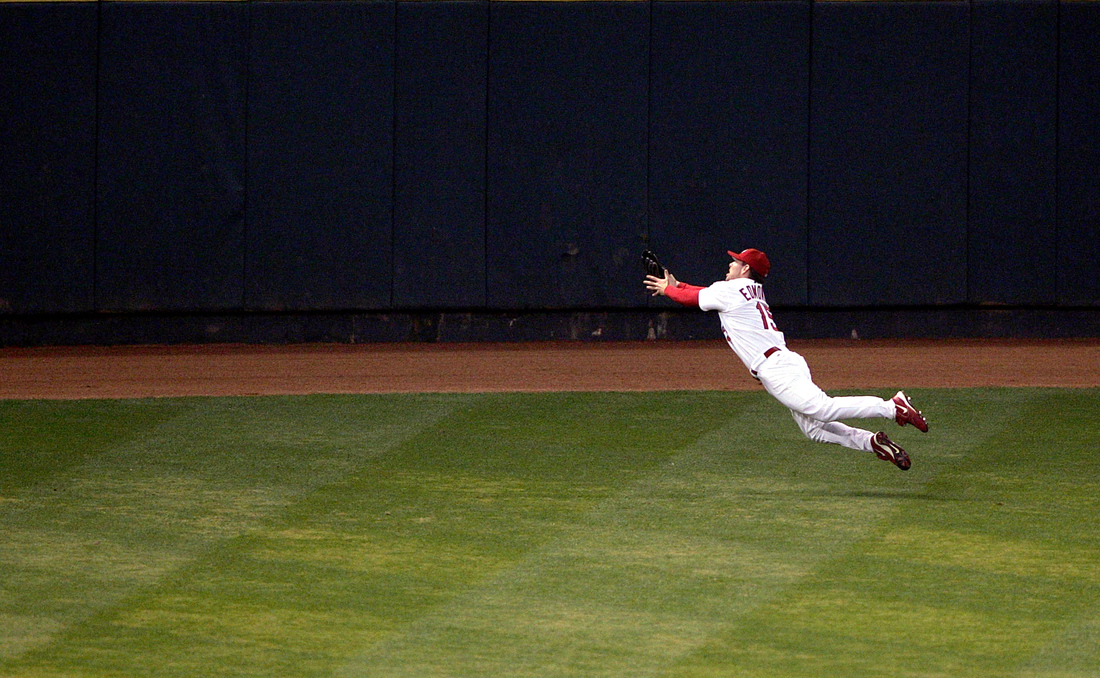
Edmonds made too many highlight-reel catches to count (SB Nation)
On the Fence
 
Edmonds has an interesting Hall case. With 60.3 bWAR and 64.5 fWAR, he's right on the bubble (60 WAR is the low end for a Hall of Famer). In fact, he has a very similar Hall case to another player on the ballot, a former teammate of his.

Jim Edmonds: 17 yrs 2,011 G 393 HR 1,199 RBI 132 OPS+ 64.5 fWAR
Larry Walker: 17 yrs 1,988 G 383 HR 1,301 RBI 141 OPS+ 68.7 fWAR

Edmonds earned eight Gold Gloves, Walker won seven. Walker made five All-Star teams, Edmonds four. Not surprisingly, Walker rates as Edmonds' seventh-most similar batter while Edmonds is Walker's fifth-closest comp.

Both had several phenomenal years and fantastic rate stats, but they rarely played full seasons and thus ended up with good-not-great counting stats. Both were excellent fielders, Edmonds more so since he played center, though Walker was a better baserunner. It would also seem that Walker was the better hitter since his raw OPS is 62 points higher, but I honestly believe that if Larry Walker had never played in Coors Field, he would have had the same career as Jim Edmonds.

Sure enough, if you neutralize Walker's numbers...

Walker 1,159 R 1,994 H 444 2B 348 HR 1,129 RBI .289/.373/.522 (.895 OPS) 1,325 RC

Then compare those to Edmonds' actual numbers:

Edmonds 1,251 R 1,949 H 437 2B 393 HR 1,199 RBI .284/.376/.527 (.903 OPS) 1,199 RC

There you have it. Edmonds is Walker, and Walker is Edmonds. I feel Walker's Hall-worthy, so therefore I feel that Edmonds is as well. Unfortunately, Walker's barely polled 10 percent the last two years, so that doesn't bode well for Edmonds. I think he'll get a little more credit since he was such a great center fielder, but I'd be shocked if he gets more than 15-20 percent.
 
When I first saw Wagner's name on the ballot, I immediately dismissed him as a serious candidate for Cooperstown. Then I took a closer look, and, well, I think he deserves a close examination
 
For starters, Wagner was way more dominant than Hoffman, with an ERA (2.31) that was more than a half run lower as well as a superior WHIP (1.00), strikeout rate (11.9), and K/BB ratio (3.99). Hoffman had more longevity, which helped him rack up 179 additional saves, but saves are a silly stat to begin with. Hoffman pitched about 180 more innings than Wagner, which amounts to roughly three extra seasons worth, but I'm guessing Wagner was so much better when he did pitch that his peak offsets Hoffman's longevity.
 
Lo and behold, Wagner's bWAR was 27.7, while Hoffman's was 28 on the nose. A vote for Hoffman is also a vote for Wagner, so I'd say yes to both.
 
We're Not Worthy:
 
Everyone Else. Jason Kendall had a Joe Mauer-ish start to his career but fell off a cliff after 30. Troy Glaus and Mike Sweeney had some huge seasons but not enough of them, kind of like Nomar Garciaparra. Mike Lowell was a very good player, but nobody's idea of a Hall of Famer. Garrett Anderson had a good run there in the early 2000s and a Tino Martinez-esque career, but that's not getting him into Cooperstown anytime soon. Luis Castillo and Randy Winn had better careers than you might remember, but they were nothing more than good complementary players. As for the rest, well, I guess you could say the same about them.

Tuesday, December 23, 2014

My 2015 HOF Ballot

Pedro should be assured of first ballot entry to Cooperstown (FoxSports)
With BBWAA Hall of Fame ballots due on Saturday, here's mine (which, sadly, won't be counted). Because voters may not vote for more than 10 candidates, I was forced to leave off many players whom I believe are Hall of Famers. Accordingly, these are the 10 most deserving candidates in my opinion (ranked from best to worst)

1. Barry Bonds
The best hitter since Ted Williams is also probably the best position player ever, or comes a close second to Babe Ruth.

2. Roger Clemens
If not the best pitcher ever, than the best pitcher of the live ball era for sure.

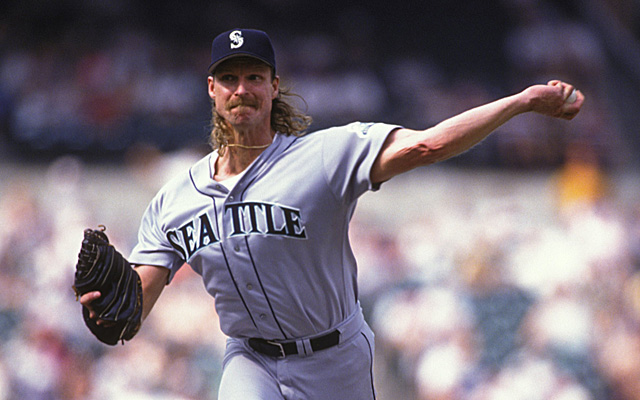
3. Randy Johnson
Best lefthanded pitcher ever.

4. Pedro Martinez
As dominant as Sandy Koufax and surrounded his peak with better seasons.

5. Craig Biggio
Should have been inducted each of the past two years. I say the third time's a charm for Biggio, one of the 28 members of baseball's exclusive 3,000 hit club.

6. Jeff Bagwell
The best all-around first baseman in the second half of the 20th century, he was the 1990s version of Albert Pujols.

7. Mike Piazza
The best-hitting catcher of all time.

8. Curt Schilling
Arguably the best postseason pitcher ever and has the best K/BB ratio of all-time (ignoring pre-1900 players).

9. Mike Mussina
Basically had the same career as Tom Glavine, who sailed into the hall on his first try last year.

10. John Smoltz
Won a Cy Young and made six All-Star teams as a starter, sandwiched around three dominant seasons as a closer. Like Schilling, was money in the postseason.

I feel the following are also Hall of Fame-worthy, just not as much as the 10 players on my hypothetical ballot. In fact, I could fill another whole ballot with the "rejects" (again ranked from best to worst).

1. Tim Raines
Best percentage basestealer of all-time, only player with more than 800 steals not in the Hall, best leadoff man not nam

2. Mark McGwire
Best HR/AB ratio in history, four 50-homer seasons including two with at least 65, and 583 career home runs.

3. Sammy Sosa
609 big flies, four 50-homer seasons including three with over 60 (a record).

4. Larry Walker
Three-time batting champion hit .313/.400/.565 with 383 home runs, 230 steals, and seven Gold Gloves. And he wasn't just a product of Coors Field, either.

5. Gary Sheffield
Poor man's Manny Ramirez slugged 509 home runs, stole 253 bases, and batted .292/.393/.514 (140 OPS+).

6. Edgar Martinez
DH or not, you can't deny that .312/.418/.515 (147 OPS+) batting line.

7. Alan Trammell
Basically Barry Larkin.

8. Jeff Kent
Best hitting second baseman since Rogers Hornsby and Charlie Gehringer.

9. Fred McGriff
As many home runs as Lou Gehrig and one of only 10 players with a career .886 OPS or better in at least 10,000 plate appearances.

10. Carlos Delgado
One of only six players with 10 consecutive 30-homer seasons. Had 457 home runs and 1,454 RBI in a 13-year period (1996-2008), averaging 35 and 112 per season while batting .282/.386/.552 (140 OPS+). Feels like a modern day Dick Allen or Gil Hodges to me, both of whom are Hall-worthy in my eyes.

Once again, it looks like the voters have their work cut out for them.

Friday, November 28, 2014

2015 Hall of Fame Ballot Newcomers

Johnson's at the top of his Hall of Fame class (CBSSports)
The 2015 Hall of Fame ballot was released last week, adding 17 new names to what is already an overcrowded BBWAA ballot. In addition to the three pitchers everyone thinks are Hall-worthy, I also view a hitter as Cooperstown-caliber. Here are my thoughts on the star-studded first-timers.

Hall of Famers

Randy Johnson
Like Greg Maddux last year, Johnson is a slam-dunk, no-doubt Hall of Famer. Let's start with the five Cy Young awards--more than anyone not named Roger Clemens--including four consecutively from 1999-2002 (he also finished runner-up three times and third once). There's also the 4,875 strikeouts, second only to Nolan Ryan (but most by a lefty), and nine strikeout titles.  The ten-time All-Star is the record-holder for starting pitchers in career and single season K/9 marks, with 10.6 and 13.4 (in 2001), respectively. One of the most dominant pitchers ever, Johnson hurled two no-hitters (including a perfect game), struck out 20 batters in a game, pitched an immaculate inning (three strikeouts on nine pitches), and was co-World Series MVP in 2001 with Curt Schilling. Incredibly durable, Johnson pitched until he was 46, sustaining a 3.29 ERA (135 ERA+) and compiling 111.7 fWAR over more than 4,000 innings. Lastly, the Big Unit won 303 games in his 22-year career, which should placate the old-school voters who still think 300 wins is a requisite for any starting pitcher to make the Hall.

Pedro Martinez
The only knock against Martinez is that he wasn't very durable (only two seasons with more than 217 innings), but that didn't stop him from accumulating 87.1 fWAR over his 18-year career. The best pitcher in baseball from 1997 through 2003, Pedro sustained the prime dominance of Sandy Koufax (five major league ERA titles, each time with an ERA+ above 200) but surrounded it with more good seasons, earning All-Star nods in eight of them. Peak Pedro (1999-2000) pitched better than anyone else in baseball history given what he did while pitching half his games at Fenway during the height of the steroid era. He deserved the 1999 AL MVP award over Ivan Rodriguez and won three Cy Youngs, finishing in the top-four four other times.  Had a career 2.93 ERA (154 ERA+, best in history for s starter), 1.05 WHIP (the lowest of any live-ball era starting pitchers, 4.15 K/BB ratio (third-highest in MLB history), and the second-best winning percentage (.687 at 219-100) ever. He also helped the Boston Red Sox end their 86-year World Series drought. If that's not a Hall of Famer, I don't know what is.

John Smoltz
With 78.7 fWAR and over 3,000 strikeouts, Smoltz is clearly a Hall of Famer: the only question is whether he's a first-ballot Hall of Famer like rotation-mates Maddux and Tom Glavine. My guess is that the writers will say no because his candidacy is awfully similar to Curt Schilling's, and Schilling didn't come close to getting elected in either of his first two years on the ballot. Voters are also likely to ding him because of the four seasons he spent as a closer (although he was a phenomenal closer) and the one year he missed entirely due to injury in the heart of his 30s. Even so, the eight-time All-Star and 1996 NL Cy Young winner deserves to go in this year, if only to help clear the logjam of viable candidates. Voters might frown on his 213 career wins and one 20-win season, even though he had 10 with at least 14 victories. More importantly, he maintained a 3.33 ERA (125 ERA+), 3.24 FIP, 1.18 WHIP, and 3.05 K/BB ratio over nearly 3,500 innings, the bulk of which came during the steroid era. The 1992 NLCS MVP also deserves a bump for his exceptional postseason record, which includes 15 wins and a 2.67 ERA in 209 October innings.

Gary Sheffield
Putting aside his PED associations and relatively modest WAR total (60.2 according to B-R, right on the borderline of Hall-worthy), Sheffield seems like a pretty clear Hall of Famer to me. Over the meat of his career from 1992 to 2005, when he made nine All-Star teams, won five Silver Sluggers, and earned six top-10 MVP finishes, he produced more offensive value than all but two guys; Barry Bonds and Jeff Bagwell, both of whom should have been inducted already.  He topped 30 homers and 100 RBI eight times each during that span, exceeding a 1.000 OPS five times while batting .304/.411/.551 (153 wRC+). For his career he smacked 509 homers, scored and knocked in more than 1,600 runs, stole 253 bases, walked 304 times more than he whiffed, piled up nearly 2,700 hits, and posted a .907 OPS. He's in the top-40 all-time in oWAR, runs, homers, RBI, total bases, walks, runs created, times on base, and extra base hits. What's more, he's comfortably worthy based on the Hall of Fame monitor,  Hall of Fame standards, and Hall of Stats. I hated Sheffield during his playing days, but the guy could flat-out mash. He was like a poor man's Manny Ramirez.

On the Fence:

Carlos Delgado
From 1996 though 2008, only five men hit more home runs than Delgado, who slugged 457 of his 473 career dingers. Just two--Alex Rodriguez and Manny Ramirez--drove in more runs. A feared hitter for many years, Delgado managed at least 138 games played, 24 home runs, and 87 RBI every year during that span, consistency reminiscent of Eddie Murray. He is one of only six men in baseball history to hit at least 30 home runs in ten consecutive seasons, something he accomplished from 1997 through 2006 (he also went yard 38 times in 2008, giving him 11 30-homer seasons overall). Delgado's career included a tremendous six-year stretch from 1998 through 2003 in which he exceeded 30 doubles, 30 homers, 100 RBI, and a .948 OPS every year. He won all three of his Silver Sluggers during that span, each one coinciding with a 40-homer season. Delgado remained productive to the very end, and were it not for a trio of hip surgeries cutting short his career he likely would have reached 500 home runs and doubles for his career. Delgado's definitely a borderline case at best (his candidacy is very similar to Jim Rice's) and he shouldn't go in on the first ballot, or possibly even the writer's ballot, but I think he should be inducted eventually for sustaining such a high level of production for such a long time. His 138 OPS+ is very strong and he's in the top-50 all-time in home runs, at-bats per homer, slugging, OPS, extra base hits, and falls just outside in RBI. He's also the all-time leader in home runs and RBI for Puerto Rican born players, something I give a lot of consideration to in that he was an exemplary ambassador of the game.

Troy Percival
Percival was a very good closer in his decade with the Angels, but wasn't dominant enough and didn't do it long enough to get my vote. His 3.87 FIP indicates he wasn't nearly as sharp as his 3.17 career ERA (146 ERA+) and 1.11 WHIP suggest, and he just wasn't the same guy after leaving the Angels (2.99 ERA with Anaheim, 4.06 ERA in the four seasons afterwards). Only had five seasons with an ERA below 3.45, which isn't that impressive for a closer pitching half his games in a friendly home park. His 358 saves are impressive (ninth-most all-time), and he was in his league's top-10 nine straight seasons from 1996 through 2004 (when only Trevor Hoffman and Mariano Rivera had more saves) and again in 2008, but saves aren't a good measure of a pitcher's skill. I think it's more telling that he wasn't able to thrive away from Anaheim's strong defenses and pitcher-friendly park. That said, closers are underrepresented in the Hall and Percival was definitely a good one, so I could see him going in someday.

We're Not Worthy:

Rich Aurilia
Aurilia was a solid shortstop in the first half of the 2000s, but didn't do nearly enough in his 15-year career to merit induction. Like Erstad, had one really great season (2001) surrounded by a couple decent ones.

Aaron Boone
Made an All-Star team and hit one of the most memorable home runs in baseball history, but overall his career was pretty mediocre. He was never the same after shredding his knee while playing pick-up basketball during the 2003-2004 offseason, an injury that led the New York Yankees to acquire then-shortstop Alex Rodriguez to replace him at the hot corner.

Tony Clark
Clark enjoyed a great start to his career with 127 home runs, 402 RBI, and an .855 OPS through his first five seasons, but injuries suppressed his counting numbers throughout the remainder of his playing days. He never exceeded 130 games played in a season after his age-27 season and averaged only 104 per year in his 15-year career. Was a great slugger when healthy with four 30-homer seasons and another with 27, even posting a 1.003 OPS at age 33 in 2005, but his career numbers are about half of what a first baseman from the last quarter century needs to make the Hall.

Jermaine Dye
A steady source of power, Dye was one of the more consistent players in baseball throughout the 2000s. Excusing his injury-shortened 2003 in which he played just 65 games, Dye blasted at least 23 home runs every year from 1999 through 2009--his final big league season--with at least 78 RBI and a 102 OPS+ each year. The two-time All-Star finished fifth in the 2006 AL MVP vote with a career-high 44 home runs, 120 RBI, and 1.006 OPS, the only time he ever finished in the top-10 (he finished 15th two years later), and won his only Silver Slugger that year as well. Never a great baserunner or defender (his lone Gold Glove aside), Dye finished his career with only 20.3 bWAR despite slamming 325 home runs and driving in 1,072 runs with an .826 OPS. Dye involuntary retired following a 2009 campaign in which he still showed plenty of thump in his bat, as he was unable to find a contract to his liking after smacking 27 home runs and posting a .340 OBP the year before.

Darin Erstad
Like Garciaparra, Erstad was a fine player who played from 1996 to 2009, peaked in the late 1990s and early 2000s, but really didn't do much in his last handful of seasons. Nothing special offensively outside of his Mike Trout-esque 2000 (93 career wRC+), Erstad supplemented his mediocre bat with decent speed (179 steals against 58 caught stealing) and terrific defense in center field, where he won a trio of Gold Gloves. The two-time All-Star might have had a chance at the Hall had he remained productive throughout his 30s, but had his last good year at 31 and played his last game at 35.

Cliff Floyd
Floyd was a solidly above average hitter for the majority of his 17-year career (118 wRC+), but his attendance was astoundingly poor: in only five of those years did he even play 120 games. Accordingly, his counting numbers are pretty weak (fewer than 1,500 hits and 900 runs/RBI). That said, we shouldn't overlook the fact that a healthy Floyd was a very good ballplayer--a 20/20 threat (something he did twice) capable of batting .300 with good on-base percentages. He just didn't show up often enough.

Nomar Garciaparra
Like Don Mattingly and Tony Oliva, Garciaparra had a Hall of Fame peak (just look at his 162 game averages) but not a Hall of Fame career. The two-time batting champion had seven seasons with at least 20 home runs, 90 RBI, and a .300 batting average, racking up 43 bWAR in those years (an average of 6.1 per season). In his other seven seasons, however, he was worth only 1.2 bWAR combined. The 1998 AL MVP runner-up was practically irrelevant after turning 30, but before that he was ahead of Derek Jeter and not far behind A-Rod.

Brian Giles
One of the more underrated players of the past two decades, Giles was a tremendous on-base threat (career .400 OBP) with good power (.211 ISO). I was shocked to see he was worth 50.9 bWAR in his 15-year career, an average of 3.9 per 600 plate appearances. The two-time All-Star had a sensational four-year run from 1999 through 2002, swatting at least 35 home runs every year while batting .309/.426/.604 (158 wRC+), ranking as the sixth-most valuable position player in baseball during that span but never finishing higher than 13th in the MVP voting (so it goes when you play for losing Pirates teams while Barry Bonds, Sammy Sosa, and Mark McGwire are doubling your home run totals). Giles had several more good years after that, remaining productive through his age 37 season, but still ended up with less than stellar career totals because he didn't reach 400 plate appearances in a season until he was 28 (similar to David Ortiz in that he got a late start but was a great hitter deep into his 30s). While his .902 career OPS (136 wRC+) is impressive, he falls considerably short in counting numbers and overall career value. Reminds me of Ryan Klesko's case from a few years ago.

Tom Gordon
I couldn't believe Flash lasted 21 years in the big leagues and made three All-Star teams. While he was effective as both a starter and reliever, he wasn't dominant enough in either role to merit induction. He was like a homeless man's Smoltz or Dennis Eckersley in this regard. Little more than 2,100 innings with a 3.96 ERA (113 ERA+), 1.36 WHIP, and 1.97 K/BB ratio doesn't cut it.

Eddie Guardado
Had a nice run in the early-to-mid-2000s with the Twins and Mariners, but the rest of his 17-year career was largely mediocre (46-61 with 4.31 ERA and 1.32 WHIP).

Jason Schmidt
Schmidt had a few dominant seasons with back-to-back top-five NL Cy Young finishes in 2003 and 2004 but was only intermittently effective in his 14-year career. In short, his 130 wins, 3.96 ERA (110 ERA+), 1.32 WHIP and 31.7 bWAR in fewer than 2,000 innings aren't good enough.

Monday, November 3, 2014

Breaking Down Golden Era Ballot

Dick Allen's paid his dues--it's time to let him in (CSNChicago)
Dick Allen: YES
I've written several times before on this blog that I feel very strongly about Allen's status as a worthy Hall of Famer. He was the best hitter in baseball for more than a decade, for crying out loud.

Ken Boyer: YES
Said yes to him when I looked at his candidacy over the summer. He was basically Ron Santo before Ron Santo, and the Hall could really use more third basemen.

Gil Hodges: YES
Falls a bit short as a player, but his status as a Brooklyn Dodger legend and famed manager of the Miracle Mets should be enough to put him over the edge. This is a sentimental pick; he was a great ballplayer and a better man.

Jim Kaat: YES
Kaat's a tricky one, as he compiled some impressive counting numbers in his 25 big league seasons but rarely dominated. A lot like Tommy John in this regard. A three-time All-Star, only once did he receive Cy Young votes or finish higher than 20th in the MVP balloting. Kaat was a true compiler, pitching until he was 44, winning 283 games, and completing over 4,500 innings. His 16 Gold Gloves are the second-most at any position to Greg Maddux's 18. According to FanGraphs he's a deserving candidate with 69.4 fWAR, but Baseball-Reference values his career at a clearly un-Hall-worthy 45.3 bWAR. Split the dfference and you wind up with 57.4 WAR; good but not very impressive for somebody with a quarter-century long career.This disparity is explained by the two sites' different methods in calculating pitching WAR, with FanGraphs relying on FIP and B-R preferring runs allowed. While Kaat was better than average when it came to keeping opponents from scoring, his 108 ERA+ and 93 ERA- are nothing special. His 3.41 FIP is solid, right in line with his 3.45 ERA, and reflects how he was a good control pitcher who was difficult to take deep.

So why am I saying yes to Kaat? A few reasons. One is that eight of his 10 most comparable pitchers are in the Hall, and the other two (John and Frank Tanana) have compelling cases. Another is that he did have a Hall of Fame peak, even if it wasn't very long and sort of spread out (2.95 ERA from 1964''68, plus Cy Young caliber years in 1974 and 1975). But the third and most important one is that if he had won just one more decision for every year that he pitched, he'd have 308 career wins and of course he would be in the Hall of Fame. I'm not going to keep him out of Cooperstown because he didn't pitch for very good teams early and later on in his career.

Minnie Minoso: YES
A classic borderline case, Minoso's career has been re-examined lately by statheads who appreciate his career .298/.389/.459 batting line. During his heyday in the 1950s he was one of the best all-around players in baseball, ranking as the sixth-most valuable position player in baseball from 1951 through 1961. During that time Minoso was worth over 50 fWAR, earned seven All-Star nods, won three Gold Gloves, and stole almost 200 bases. He was also a great run producer, averaging nearly 100 runs and 90 RBI per year despite never hitting 25 home runs in any season. Had Minoso not been held back by the racial attitudes of the times (he didn't play his first full season until he was 25) or not completely fallen apart after turning 36 (-1.4 fWAR in his final five seasons) he would have a much stronger case, but as it is he merits induction for his decade-long dominance of the American League.

Tony Oliva: NO
Oliva's a lot like Don Mattingly in that he was absolutely a Hall of Fame hitter at his peak, but knee injuries ruined the second half of his career and ultimately prevented him from compiling Hall-worthy numbers. His career was just too short, as he only had 11 seasons with more than 70 games played and thus fell short of 2,000 hits and 1,000 runs/RBI. It's too bad because he was a beast in his prime from 1964--the year he won AL Rookie of the Year award--to 1971, when he won his third and final batting title. In between he piled up 42.2 bWAR, made eight straight All-Star teams, led the league in hits five times, and drew MVP votes every year. His batting record is awfully similar to Kirby Puckett's, another popular Minnesota Twin whose career was tragically cut short by physical circumstances.

Billy Pierce: NO
Pierce has been largely forgotten by baseball fans, which shouldn't have happened considering he was the third-most valuable pitcher in baseball from 1950 through 1962. During those 13 years only Robin Roberts and Warren Spahn, two clear-cut Hall of Famers, were better. He made seven All-Star squads, won 211 games, and was worth around 55 wins above replacement depending on which site you prefer. It's tough to say no to someone who was the third-best pitcher in baseball for 13 years, but that's what I'm doing with Pierce. He's right on the cusp for me, but I say nay because his peak wasn't quite dominant enough for someone who pitched 14 full seasons, six of which produced five or more fWAR but with only two others topping three. He falls short in all the Hall of Fame statistics except for Gray Ink, which he barely passes. It's too bad his career wrapped up just as the second Deadball era was getting underway, as he likely would have had several more effective seasons and retired Hall-worthy.

Luis Tiant:YES
Wrote at length about Loo-eee's worthy candidacy here. As somebody who exceeds the BBWAA standard and Hall of Fame standard, he's somebody who should have gone in a long time ago.

Maury Wills: NO
If Wills is worthy, then so is Roger Maris, though neither of them are because they did not sustain their greatness long enough. Wills was very overrated because of his blinding speed, which wasn't particularly valuable because he actually led the league in caught stealing more times (7) than he did in stolen bases (6). With no power to speak of (20 career big flies) and an unimpressive .330 OBP, he would only be Hall-worthy if he played Ozzie Smith-quality defense. While Wills did win two Gold Gloves, he was nothing special in the field. Add it all up and you have a solid, but hardly Hall-worthy shortstop who didn't even crack 40 career WAR.

Bob Howsam: SURE
GM and club president of the Big Red Machine, one of the great baseball dynasties of all time. He also tried to bring big league baseball to Colorado three decades before the Rockies became a thing. So why not?

Wednesday, July 9, 2014

Ranking the NL Final Vote Candidates

Rendon's performance is worthy of his first All-Star appearance (CSN Washington)
While the American League Final Vote race is comprised of five hurlers, the National League field features five position players, three of whom have never been named All-Stars before. That makes comparing them easy, as does the fact that all five play corner positions (four in the infield and one, Justin Upton, in the outfield). Still, for the purposes of the game I'm trying to pick the best player. I was torn between the top two choices, but ultimately feel that I made the correct call.

5. Casey McGehee (1.4 bWAR)
McGehee's a great comeback story playing as well as he is after spending 2013 in Japan and struggling badly in the two years before that. He's leading the loop in hits and batting a robust .318, but without any power (one home run) or speed (one stolen base). So while he's hitting for a great average and getting on base at a tremendous clip, he hasn't been nearly as valuable as those numbers would suggest due to his inability to clear the fences, swipe a bag, or play even capable defense at the hot corner. He has the lowest OPS, raw and adjusted, of the five and doesn't bring anything to the table elsewhere, so he's an easy first cut.

4. Justin Morneau (1.9 bWAR)
Looking to make his first All-Star team since 2010 and fifth overall (but first as a National League representative), Morneau's enjoying a big bounce back year at 33. He's hitting nearly as well as McGehee--.313 to the Marlin's .318--but with much more pop. Morneau has the same number of doubles (20) and 12 more home runs, which explains his 119 point advantage in slugging percentage. And while Coors Field has certainly boosted his numbers a bit, he's still batting over .300 on the road with a slugging percentage close to .500. Morneau's hit everywhere this year, but for a Rockies first baseman his numbers are merely good, not great. Thus, he's next to go.

3. Justin Upton (1.7 bWR)
B.J. Upton's kid brother is having another fine all-around season, albeit still not at the superstar level everyone thought he'd have reached by now. His 17 home runs rank fifth in the National League, four behind league leader Giancarlo Stanton. His 50 RBI are just outside the Circuit's top 10, as are his .503 slugging percentage and .854 OPS. He's also getting on base at a good clip (.350 OBP) despite striking out a ton, and has seven steals in eight attempts as well. Because of his power and speed I like his game more than Morneau's; Upton's skills are better suited for the Midsummer Classic, which he's appeared in twice before (in 2009 and 2011).

2. Anthony Rizzo (2.7 bWAR)
Rizzo disappointed last year, but this year he's been the hitter everyone thought he'd be. A better hitter than Upton, to be sure, which is why I have Rizzo ranked higher. With his name plastered all over the leaderboards, the Cubs first baseman has been one of the Senior Circuit's ten best hitters this year. That alone gives him a very strong case. His 19 home runs are second only to Stanton in the NL, and he's showed tremendous patience by walking 51 times, an approach that's fueling his .383 OBP. Rizzo, along with teammate Starlin Castro, is having a great year for a terrible team and deserves to be recognized for it, but unfortunately for him he's not the best player on this list.

1. Anthony Rendon (3.0 bWAR)
The 24 year-old Rendon is making a name for himself in his second big league season. After holding his own as a rookie last year, he's made great strides by improving his game in several areas. He's hitting for more power, playing better defense and being smarter on the basepaths, all while being forced to play out of position due to Ryan Zimmerman's injury. His numbers don't jump off the page, but he does everything well. As it stands, he's on pace to score 120 runs with 190 hits, 40 doubles, 10 triples, 25 home runs, 100 RBI, 15 steals, 60 walks and 325 or so total bases. There aren't many players in the game today, regardless of position, capable of that kind of all-around production. He's been huge for the Nationals this year, stepping up to man the hot corner in Zimmerman's absence, and because of his bat and versatility deserves to make his first All-Star squad.

Rizzo's easily the best hitter on this list, but WAR confirms that Rendon's been the better player. Almost as good with the bat, better on the bases and more valuable in the field as well. So as much as I hate to leave Rizzo out, that's why I'm voting Rendon by a nose.

Tuesday, July 8, 2014

AL Final Vote: Choose Chris Sale

Chicago's sale is having a Cy Young caliber season (TheSportsPost)
Not surprisingly, in a year where offense continues to take a back seat to pitching and defense, all five of the American League's candidates for the final roster spots are men who make their living on the mound. And with the exception of Chris Sale, none of them have been All-Star before. They're not quite household names just yet, but one of them could become one depending on how the voting turns out.

Well, at least having a quintet of pitchers to choose from makes the comparisons easy. Here are my rankings in descending order, from least deserving to most deserving.

5. Rick Porcello
Porcello hasn't been this good since 2009, when he was a 20 year-old rookie making a name for himself in a rotation featuring Justin Verlander, Edwin Jackson (when he was good), and Armando Galarraga (pre-near-perfecto). But don't let his shiny record (11-5) fool you; he's the least deserving candidate. Not only is his 3.53 ERA the highest of the five, but he also has the fewest strikeouts and lowest bWAR score. He's having a good season, don't get me wrong, on track to post the best numbers of his career and possibly win 20 games. But he's a middle of the rotation guy, not an ace, as his 3.94 FIP and 3.85 xFIP suggest. Porcello's closer to an average pitcher than his luck-suppressed ERA would suggest. Put him on a lesser team, without the bats of Miguel Cabrera, Victor Martinez and Ian Kinsler to back him, and his record is closer to .500 and we're not even having this conversation. Pass on Porcello, please.

4. Dallas Keuchel
Keuchel's transformation into an All-Star caliber starter has been one of this year's most pleasant surprises for the Houston Astros. After putting up a 5.20 ERA through his first two seasons, which included 38 starts, Keuchel did not appear to have a bright future as even an average starting pitcher. This year, however, he's been a revelation, sporting a 3.06 ERA through his first 16 starts, a mark supported by his 3.14 FIP. He's lowered  his WHIP--over 1.5 in 2012 and 2013--by trimming his walk rate to 2.2 BB/9--almost a full batter better than last year's mark--and limiting his hits allowed to fewer than one per inning (which, based on his .304 BABiP against, does not appear to be linked to good fortune or helpful defense).

Keuchel's been a bit lucky with his strand rate, but has been doing a much better job of inducing ground ball outs and keeping the ball in the park (only six home runs allowed on the season). Keuchel doesn't dominate batters and is an average strikeout pitcher at best, which might explain his recent troubles. The lefty's ERA, which stood at 2.38 in the middle of June, has ballooned to 3.06 since after he allowed 13 earned runs and 39 baserunners (walks plus hits plus hit batters) in his three most recent starts. Keuchel was a much stronger candidate before then, and as it stands now he's not quite good enough to merit that final roster spot.

3. Garrett Richards
In Richards' case, his phenomenal W-L record (10-2) accurately reflects how well he's pitched this year. Save for a brief hiccup at the end of May, he's been phenomenal since day one. In addition to having the league's lowest H/9 rate, he also ranks among the AL's top five in wins, winning percentage, WHIP, home rate rate, and FIP. On top of that, he's also in the top ten for strikeouts, K rate, pitching WAR, ERA, and adjusted ERA.  Enjoying his finest season to date, the 26 year-old has a great case. Since the calendar flipped to June he's been unbeatable, compiling a 1.45 ERA over his most recent seven starts--all quality--with 55 strikeouts against 14 walks in just under 50 innings. The Angels have won every won of those starts as Richards has emerged as their ace, outshining LA's more established (and expensive) starters Jered Weaver and C.J. Wilson. Richards wouldn't be a bad choice: he's just not the best choice.

2. Corey Kluber
Like Richards, Kluber's quietly made the leap to great pitcher this year--his third as a starting pitcher--following last season's breakout. He's already surpassed his strikeout total from last year in 22 fewer innings, and with 137 (fourth-most in the AL) is on pace to sail past 200. After a slow start he's come on strong lately, lowering his ERA almost half a run from 3.35 on midway through June to 2.86 after his most recent start--a masterful turn against the Royals on Sunday. His numbers are excellent across the board, from his 2.65 FIP (second best in the American League!) to his 9.81 K/9 rate (fifth-best) and his 4.57 K/BB ratio (sixth). He's been reliable too, leading the majors in starts with 19 and racking up more innings than any American League pitcher not named David Price or Felix Hernandez. His record (8-6) just isn't that great because he plays for a mediocre Indians club. Is Kluber having an All-Star season? Absolutely. But there's someone better on this list.

1. Chris Sale
Sale, who authored one of the season's best starts on the Fourth of July versus Seattle, is clearly the best pitcher of this bunch and deserving of his third straight All-Star nod. Ignore the fact that he missed over a month with an elbow strain and marvel at his otherworldly statistics. Such as his 2.16 ERA, which would rank second to only Felix Hernandez if he had enough innings to qualify. Or his six strikeouts for every walk. Or his 0.87 WHIP, which would be the best in the American League. He's barely thrown 87 innings, 21 fewer than any other candidate listed here, but those 87 and one-third frames have been more valuable according to BR's pitching version of WAR. In fact, only Masahiro Tanaka, Mark Buehrle, and King Felix have been more valuable among American League pitchers in terms of WAR, and they've all completed approximately 50 percent more innings than him. On a per-inning basis, Sale's been arguably the best pitcher in the Junior Circuit this year. That's why I'm overlooking his missed time and taking him for the final roster spot.