- Chris Davis won't get to 60 home runs, but he'll clear 50 easily
- The Reds and Cardinals will both pass the Pirates in the NL Central standings
- Every member of the Red Sox starting lineup winds up with at least 10 home runs, and 11 Red Sox reach double digits overall
- R.A. Dickey will be the only Blue Jays starter with a winning record
- Matt Holliday gets his batting average up over .300
- So will Robinson Cano...
- ....And Dustin Pedroia
- Both AL Wild Card teams will come out of the AL East
- Somebody besides Giancarlo Stanton leads the Miami Marlins in home runs
- Jon Lester finishes with a better ERA than Felix Doubront
- The Nationals improve and win more games than they lose
- Prince Fielder fails to bat his weight
- Adam Wainwright ends up with the same amount of walks as starts
- Paul Goldschmidt isn't the top RBI man in the NL when the dust settles
- The Orioles will once again win over 90 games despite only having one starter win more than a dozen decisions
- The Colorado Rockies, currently third place in the NL West, will finish dead last
- Domonic Brown finishes with more home runs than Chase Utley and Ryan Howard combined
- Michael Bourn ends the year with more RBI than Nick Swisher. Both have 35.
- CC Sabathia will lead the Yankees in losses
- Ian Kennedy's ERA will be at least two runs lower with San Diego than it was with Arizona
- Carlos Gonzalez will go 30/30 for the first time
- David Wright won't catch teammate Marlon Byrd either both home runs or RBI
- Max Scherzer will throw a no-hitter
- The White Sox lose more games than the Marlins from this point forward
- Raul Ibanez sets a career high in home runs at the ripe old age of 41
Sunday, August 11, 2013
25 Bold(ish) Predictions for the Rest of the Season


Middlebrooks Comes Back

The Red Sox recalled Will Middlebrooks from Pawtucket yesterday, a move that reaped immediate rewards when he keyed Boston's 5-3 victory over the red-hot Royals.
Middlebrooks, who had not faced major league pitching in seven weeks, didn't skip a beat in his return. Starting at third base and batting ninth, he went 2-for-4 with two runs soored and two more driven in. After flying out in his first at-bat, he was at the center of the Red Sox's four-run fourth inning. With two men in scoring position and Boston looking to build upon its 1-0 advantage, Middlebrooks slashed a single to right that plated Jarrod Saltalamacchia and Stephen Drew. He didn't spend much time on first though, coming around to score when Jacoby Ellsbury doubled into the right-centerfield gap.
By the time he came up again in the top of the sixth, Boston's lead had been trimmed to 4-3. Royals starter Jeremy Guthrie was still in the game, needing only to retire Middlebrooks to get through the frame. He would have no such luck. Though Middlebrooks didn't hit the ball hard this time, it was well-placed, and so he reached base via an infield single. He then motored home on another RBI double from Ellsbury, who was thrown out trying to take third on the play.
The bullpen took it from there and held on for the win, Boston's 71st of the season (most in the American League). Other notes from last night's game:
- Ellsbury had a big night, cracking four hits and swiping his ML-leading 42nd stolen base. (with an outstanding 91.3 % success rate) of the sesason. He started slow out of the gate but has been hitting like an MVP all summer. Since May 26th he's batted .353/.405/.527 with 28 steals.
- Speaking of hot hitters, Drew extended his hitting streak to 11 games with an RBI double. Drew's been terrible for much of the season but has come on strong as of late, batting .415/.510/.610 with nine RBI over the course of his streak. Perhaps he's turned the corner and can help his team win the division, as he did for Oakland last year.
- Another rough night for Mike Napoli, who went 0-for-4 with three strikeouts. With just eight hits (and 24 strikeouts) in his past 15 games, the streaky slugger is mired in a horrendous slump.
- Great work by Boston's bullpen, which came up big with five shutouts innings after Felix Doubront departed without recording an out in the fifth. Credit rookie Brandon Workman for stopping the bleeding to earn the win in his first high-leverage relief appearance. Still, it'd be nice if John Lackey could pitch deep into today's game and give the relievers some rest.
- Koji Uehara pitched a scoreless ninth to earn the save. He has not allowed an earned run since June 30th.
- Two more doubles for Billy Butler, who's amassed 196 two-baggers since the start of the 2009 season. Only Robinson Cano (with 204) has more.
- With two hits last night, Eric Hosmer now has seven multi-hit performances in his last eight games. He's batting .299 on the year and is poised to push his average north of .300 for the first time in four months.
Tuesday, August 6, 2013
Dumb Diamondbacks
 |
| Kennedy is the latest Diamondback to be traded for pennies on the dollar |
Since I already analyzed the Peavy trade in this space last week, I wanted to breakdown the Kennedy trade while it was still fresh. My first impression is that it's a curious move for the Diamondbacks, who led the NL West for most of the summer before slipping behind the hard-charging Los Angeles Dodgers (cue Yasiel Puig highlights). Arizona's fighting to stay above .500 at the moment, but they're still within striking distance of first and could feasibly make a run down the stretch. So why trade Kennedy, a sturdy starter who takes the ball every fifth day, when it's common knowledge that one can never have too much pitching?
The explanation is quite simple, really. Arizona's GM Kevin Towers has a history of trading away young, struggling talent. In fact, this trade makes four times in the past year that Towers has sold low. Let's take a look.
Stephen Drew: traded to Oakland on 8/20/12
J.D. Drew's kid brother was one of the National League's top shortstops before a fractured ankle took him out of commission for 11 months. When he returned midway through the 2012 season--his walk year--he clearly wasn't the same player. He was still shaking off the rust off when the Diamondbacks traded him to Oakland on August 20th. Though he was batting below .200 at the time, Drew bounced back in September, helping the A's stun Texas and win the division on the season's final day. Billy Beane gave Arizona Sean Jamieson, a 24 year-old who's yet to play a single game above Single-A. Rather than deal a slumping, rehabbing Drew, Towers should have held on to Drew and let him recoup some of his lost value. The Diamondbacks weren't in contention last year anyways, so what was the harm in letting Drew play out the string and seeing if he could rediscover his stroke? Had he continued to flail, then nobody would have thought twice about letting him go as a free agent.
Trevor Bauer: traded to Cleveland on 12/11/12
Arizona's first round selection (third overall) in the 2011 draft pitched all of 16 innings in his lone season with the D-Backs before he was sent packing to Cleveland in a three-way trade that acquired Drew's replacement, Didi Gregorius. Gregorius has been solid, but his ceiling is nowhere near as high as Bauer's. The future ace has yet to take off, but he's just 22 and still has plenty of time to figure it out. Even if he never pans out, I would much rather roll the dice with the next Tim Lincecum rather than settling for a competent but unspectacular shortstop.
Justin Upton: traded to Atlanta on 1/24/13
The Diamondbacks were downright foolish to move B.J. Upton's younger brother, whom they still controlled through 2015. Frustrated by his inconsistency, attitude problems and inability to realize his massive potential, they gave up on him after a down 2012. Towers could have and should have been able to get more for a budding superstar than two complementary players (Martin Prado and Randall Delgado) packaged together with three so-so prospects. The result has been a punchless Diamondbacks outfield that's slugged just .383 with 25 home runs. Upton has 20 by himself. He should be hitting in front of Paul Goldschmidt instead of playing in the same outfield with his older brother and Jason Heyward.
Ian Kennedy: traded to San Diego on 7/31/13
Once a treasure of the Yankees farm system, Kennedy was dealt to Arizona after the 2009 season as part of the three-way trade that put Curtis Granderson in pinstripes and sent Max Scherzer to Detroit. Two years later, he emerged as one of baseball's best starting pitchers when he won 21 games and finished fourth in the NL Cy Young race. While that superlative season now appears to be a fluke, he's still a durable starting pitcher who should approach or exceed 200 innings pitched for the fourth consecutive year. And yet, all Towers could fetch for him was a prospect and a lefty reliever (Joe Thatcher). Granted, teams aren't lining up for someone with an ERA over five, but Kennedy's 4.29 xFIP and strand rate suggest that luck was not on his side. He's not as bad as his year-to-date numbers suggest. With regression to the mean and some assistance from PetCo Park, he should be able to turn his year around. Expect a second-half resurgence similar to the one Josh Beckett enjoyed with the Dodgers last summer.
In an alternate reality where Towers didn't make these trades, it's quite possible that Arizona would still be sitting atop the NL West, or at least giving LA a run for their money. Instead, the D-Backs are fading fast. When October comes around they'll be on the outside looking in, giving their fans plenty of time to ponder what might have been.
Monday, August 5, 2013
Too Little, Too Late
The MLB took a big step in combating PED use within the sport by handing out suspensions to 13 players today, forcing those associated with the latest BioGenesis scandal to pay the piper.
Not surprisingly, Alex Rodriguez was the only player not to accept his suspension. He's appealing, and will thus get a chance to spark the fourth-place Yankees into the postseason. Hope he owns a good pair of earplug, because he's going to be the target of some vicious booing over the next two months. His "nightmare" is only going to get worse.
But as good as it feels to see Rodriguez, Ryan Braun, and others go down in flames/get what they deserve, it's too late. Where were these suspensions ten years ago, when Roger Clemens and Barry Bonds were re-writing the record books? Testing has, for the most part, cleaned up the game in recent years. Selig can pat himself on the back all he wants, but no amount of suspensions will ever erase the damage that was done during the late 90's and early 00's.
It's good that baseball is taking such an aggressive stance against PED use. If only they'd been 20 years sooner....
Not surprisingly, Alex Rodriguez was the only player not to accept his suspension. He's appealing, and will thus get a chance to spark the fourth-place Yankees into the postseason. Hope he owns a good pair of earplug, because he's going to be the target of some vicious booing over the next two months. His "nightmare" is only going to get worse.
But as good as it feels to see Rodriguez, Ryan Braun, and others go down in flames/get what they deserve, it's too late. Where were these suspensions ten years ago, when Roger Clemens and Barry Bonds were re-writing the record books? Testing has, for the most part, cleaned up the game in recent years. Selig can pat himself on the back all he wants, but no amount of suspensions will ever erase the damage that was done during the late 90's and early 00's.
It's good that baseball is taking such an aggressive stance against PED use. If only they'd been 20 years sooner....
Thursday, August 1, 2013
Remembering George Scott
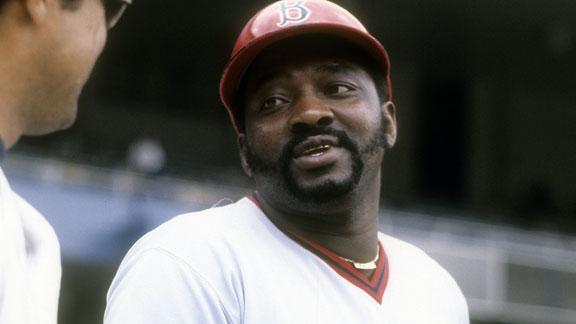
Boomer, a big man with a big swing, will be remembered for many things, namely his referring to home runs as "taters." He named his glove "Black Beauty." He wore a batting helmet while playing the field, a measure of protection against road fans who would throw hard objects his way. A latter-day Babe Ruth, he enjoyed consuming prodigious amounts of food more than he enjoyed hammering home runs. In the end it caught up with him.
Scott's legacy extends far beyond his quirky mannerisms and big-time power. It's important to remember that Scott was one of the saviors of baseball in Boston. Along with Tony Conigliaro, Rico Petrocelli, Reggie Smith, and Joe Foy, Boomer was one of the many talented young Red Sox to blossom at the tail end of the team's dark age in the mid-1960s. He also overcame the burden of being one of the team's first African American stars, coming along just seven years after Pumpsie Green broke the franchise's color barrier in 1959.
Scott hit the ground running in his 1966--his rookie campaign--by swatting 11 home runs in his first 26 big league games. He went on to play in all 162 games that year, was chosen as the AL's starting first baseman in the All-Star Game and finished third in the Rookie of the Year vote behind Tommy Agee and Jim Nash. As sensational as the 22 year-old was, his all-or-nothing approach at the plate produced 27 home runs, 90 RBI, and 152 strikeouts--most in the majors. Scott, like most of his young teammates, had plenty of potential but lacked the polish needed to realize it.
Looking back, Scott probably didn't get the credit that his impressive power figures deserved because of his .245 batting average, even though he actually bettered the league average by five points. And while we wouldn't give too much thought to his 152 strikeouts today, it's important to remember that hitters back then fanned 29% less often than they do in 2013. Adjusted to current league averages, Boomer would've whiffed 196 times. Imagine the outcry that would have ensued had he done that in 1966!
There was no sophomore slump for Scott, who was instrumental in helping Boston capture its first pennant since 1946. Though his power numbers suffered a bit, he showed signs of maturity under new manager Dick Williams. His walk rate improved and he cut down on his strikeouts, helping him boost his batting average to .303. He also won his first of eight career Gold Glove awards: among first basemen, only Don Mattingly and Keith Hernandez have more.
While Baby Boomers remember Carl Yastrzemski single-handedly willing the Red Sox into the World Series with his clutch hitting down the stretch, Scott did his part by batting .357 with two home runs in the last seven games of the season. Unfortunately, he couldn't carry that momentum into the Fall Classic, where he batted .231 with nary an RBI. Boston lost to Bob Gibson and the St. Louis Cardinals in seven games, and Scott would never again experience the thrill of a postseason at-bat.
The defending AL champs slumped to fourth place in 1968, but nobody regressed more than Scott. He cratered in "The Year of the Pitcher," enduring what was probably the worst offensive season of all time. For someone who played 124 games, his numbers are staggeringly bad: 23 runs, three long balls, 25 RBI, and a .171/.236/.237 batting line. Even considering the offense-starved context, those triple slash stats translated to a putrid 40 OPS+. Though he won the Gold Glove award again, B-R calculates that his embarrassing incompetence at the plate cost the Red Sox three wins that year.
Scott bounced back in 1969 (it's not like he could've been any worse) but still had a subpar year with the stick. We'll never know if he would've won a third straight Gold Glove award, for he moved across the diamond to third base (where he played in the minors) so Dalton Jones could man first. This wasn't Miguel Cabrera going back to the hot corner to make room for Prince Fielder, though, and Scott would return to first full-time two years later. He picked up where he left off, winning his third Gold Glove award in addition to clubbing 24 home runs. Boomer was back.
But as good as Scott was, there was the sense he wasn't playing up to his potential. He'd yet to replicate the home run and RBI totals from his rookie year, failing to develop into the .300-30-100 monster he seemed destined to become. That October, Scott was one of six Red Sox packaged together with Jim Lonborg, Ken Brett, Billy Conigliaro in a blockbuster trade with the Milwaukee Brewers that netted four players, including All-Star Tommy Harper, in return. If Boston's front office thought Scott had already reached his ceiling, they were sorely mistaken. In reality, he was just coming into his prime.
Away from the Boston's intense media scrutiny and polarizing racial divisions, Scott enjoyed his peak seasons with Milwaukee. He emerged as one of the league's best sluggers and continued playing top notch defense. In his five seasons with the Brewers, he was a Gold Glove recipient every year while averaging 23 dingers, 93 ribbies and a 131 OPS+ per season. His best year came in 1975, when he won two legs of the triple crown by topping the Junior Circuit in home runs with 36, tying Reggie Jackson, and runs batted in with 109. He also paced the AL with 318 total bases and was an All-Star selection for the first time since his rookie year.
After a comparatively down year in 1976, Scott was traded back to Boston for Cecil Cooper, an up-and-coming first baseman who, like Scott, would make Red Sox management look foolish by starring in Milwaukee long after Boomer hung up his spikes. To be fair, Scott's first year back in Beantown was a good one, but by '78 he was 34 and a shell of his former self, a liability for a team that missed out on a postseason berth by one win. He struggled even worse in 1979, causing the Red Sox to trade him away to Kansas City. The Royals needed just two months to realize he was over the hill, then flipped him to New York, where he enjoyed one final blaze of glory by batting .318 in his 16 game stint with the Yankees.
Scott finished his 14 year-career with 271 home runs, 1,051 RBI, and 1.992 base hits. Not Hall of Fame numbers, but still pretty good nevertheless. Had he stayed in better shape, he probably could've played into the 1980s and might have landed a DH gig somewhere. Even so, he's still one of the 50 best first basemen ever. Surprisingly, the Red Sox haven't had very many good first basemen, so Scott has a legitimate case as the best in team history (depending on how much you value his defense). Since I believe a first baseman's bat is much more important that his glove, I rank Scott third behind Jimmie Foxx and Mo Vaughn among Red Sox first sackers.
Subscribe to:
Posts (Atom)