Showing posts with label Trades. Show all posts

Wednesday, February 10, 2016

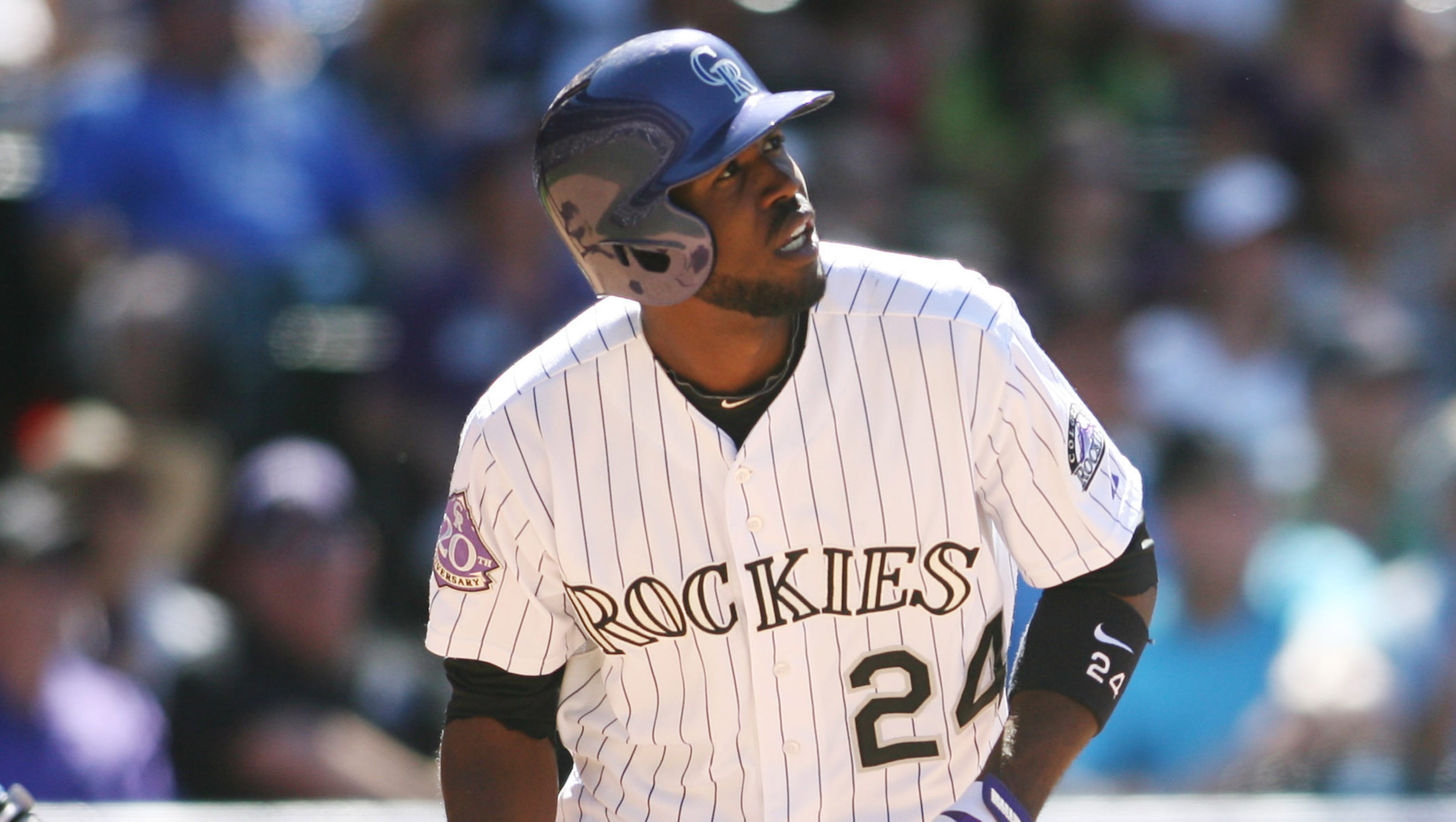
Making Sense of Colorado's Crazy Trade

Dickerson has far more value to a team than McGee (Fox Sports)
It's been two weeks, and I'm still trying to make sense of the Corey Dickerson for Jake McGee exchange. Given how smart front offices have become, it still blows my mind when they make obviously one-sided trades like this one, or last winter's Doug Fister and Jason Heyward trades.

Only on the most basic level does this trade make any sense for Colorado. The Rockies have an abundance of hitting and need pitching. They had a crowded outfield and a terrible bullpen (terrible doesn't even begin to describe how bad it was). So they traded an outfielder for a pretty good reliever. Okay, makes sense.

Except that it doesn't at all. At least for the Rockies.

For the Rays, a team perpetually short on offense, this trade makes all the sense in the world. Tampa Bay ranked second-to-last in the AL in runs scored last year, largely because its outfielders combined for just 56 home runs, 175 RBI, and a .258/.327/.420 batting line. With a collective OPS+ of 100, Rays outfielders provided league average production at best.

Dickerson, however, has been well above average the last two years, posting a 141 OPS+ in 2014 followed by a 118 OPS+ last year. After leaving Coors Field (the best hitter's park in baseball) for Tropicana Field (one of the worst), he's not going to come close to matching his .309/.354/.556 line from 2014-2015, but he's still a solidly above average corner outfielder who's not even 27 yet. Tampa Bay would have been better off going after someone from a less extreme environment, but Dickerson still represents a clear upgrade in an outfield that saw way too much of David DeJesus and Steven Souza last year.

And it's not like the Rays gave up much to get him, either. Relievers are cheap and plentiful, which makes them expendable. Any failed starter can find second life as a reliever. Hard-hitting, in-their-prime outfielders are a rarity, however, especially these days. McGee is good, but he's going to be 30 in August and was hurt last year. His value may never be higher than it is right now.

Which is why the Rays were smart to move him. The timing made sense. For the Rockies, however, this was probably the worst time for them to trade Dickerson. He's not even arbitration-eligible yet and is still under team control for four more years, plus he's coming off an injury-riddled season in which he missed almost 100 games and was worth only 0.5 bWAR. Had they waited for him to rebuild his value a bit, they could have gotten more for him, like a starting pitcher (Colorado could really use one of those).

While dumb, this trade at least would have been more defensible had the Rockies been good, as sometimes it's necessary to sacrifice something valuable to address one of your weaknesses. But Colorado's entire pitching staff is a weakness, and 60 innings from Mr. McGee won't change that. Bad teams don't need ace relievers, because by the time they get in the game the score's already been decided. They need good, young starting pitchers and position players they can build around. The bullpen is often the last piece of the puzzle, and one that can be cobbled together on the cheap (never pay for saves).

McGee's going to be a free agent in two years, and nobody seriously expects Colorado to contend by then. They've endured five straight losing seasons and there's no light at the end of the tunnel, not until they're able to build what passes for a major league-caliber starting rotation. Dickerson could have helped them do that, but now he's gone.

Tuesday, December 8, 2015

Sox Move Miley

Miley was 11-11 with a 4.46 ERA in his lone year with Boston (Boston Herald)
Less than a year after trading for Wade Miley, the Boston Red Sox are trading him away.

Miley was sent to Seattle yesterday, the latest casualty (along with reliever Jonathan Aro) of Dave Dombrowski's new quest to build a super-bullpen. He'd been acquired by the Sox last winter in a three-for-one swap with Arizona, replenishing a Boston rotation that had been depleted by trades the previous summer. They promptly locked up his arbitration years, making Miley an apparent fixture in Boston for seasons to come.

Ten months later, he's already gone. Not because he pitched poorly--his numbers last year were comparable to his final one in Arizona--but because Boston's new GM is hell-bent on assembling a shutdown relief unit (though I do wonder how much Miley's meltdown last summer contributed to the decision to trade him, as John Farrell is coming back and the Red Sox don't have much patience for internal feuds).

The David Price signing also made Boston's rotation too lefty-heavy, as he joins fellow southpaws Eduardo Rodriguez and Henry Owens. It's generally not a good idea to have 80 percent of your starters throw from the left side when the left field wall in your home park is a mere 315 feet away. Fenway has chewed up and spit out many a lefty, and may well do the same to the aforementioned trio (as well as newcomer Roenis Elias--more on him in a minute).

But as I wrote in my analysis of last month's Craig Kimbrel trade, Boston's bullpen needed help. Red Sox relievers were among the worst in baseball last year, and adding 60 innings of Kimbrel was only a start. Getting another 70 from Carson Smith, Seattle's setup man last year, should help. Like Kimbrel, he's exactly the sort of young power arm Boston needs. Having him, Kimbrel, and a healthy Koji Uehara gives the Sox one of the best late-game relief corps in the majors.

Dombrowski appears to be trying to emulate Kansas City, who have ridden their stellar bullpen to consecutive AL pennants and a championship. Or he could be trying to avoid ending up like the Mets, who were undone in this year's Fall Classic by shaky relief work.

If this had been a one-for-one trade--Miley for Smith straight-up (which is how the press is spinning it)--then I'd be calling for Dombrowski's head. Miley's nothing special, but he's a durable league-average starter who soaks up innings, and that's more valuable than a setup man. But the Red Sox are basically getting Miley back in Elias, a lefthander who posted similar numbers last year. And seeing as how Elias is two years younger and won't be arbitration-eligible until 2018, he's the superior commodity. It's possible the third-year starting pitcher, whose next start will be his 50th, still elevates his game to another level. After four full seasons, the 29 year-old Miley is what he is at this point. Elias could wind up being better.

So Elias is more preferable to Miley, and Smith is probably better than Aro, who has yet to prove himself at the major league level. I'd say that makes this trade a win for Boston.

Monday, November 16, 2015

Breaking Down Boston's Big Trade

Kimbrel helps the Red Sox, but did they give up too much to get him? (Sports on Earth)
Dave Dombrowski got the ball rolling on what figures to be a busy offseason for the Boston Red Sox, trading four prospects to the San Diego Padres for All-Star closer Craig Kimbrel.

As a Red Sox fan, I feel very conflicted about this deal. When the trade was first announced Friday I was vehemently against it (four prospects for a closer? What were they thinking??), but after giving it some thought this weekend I don't hate it. I definitely don't love it, though, which is why I want to examine both sides of the coin.

Why it's a good trade for Boston:

So much of the blame for Boston's last place finish fell on their starting rotation that it was easy to overlook how terrible their bullpen was last year. It wasn't just bad; it was one of the worst. Red Sox relievers ranked last in FIP and fifth from the bottom in ERA last year.  One might think they struggled because they were overworked, that they had to pitch more frequently because Sox starters got shelled so often, but that wasn't the case. In fact, Boston's bullpen pitched fewer innings than average.

The reason Red Sox relievers stunk was because they couldn't miss bats. Boston had the majors' fifth-lowest K/9 rate, which reflected the dearth of power arms on their roster. The strikeout is an essential weapon for any reliever, as it's the best way of getting out of jams and avoiding late-inning meltdowns. This is especially true in Fenway Park, where any ball hit in play can spell trouble.

In Kimbrel, the Sox are getting one of the nastiest flamethrowers in the game. He's been the best reliever in baseball since debuting in 2010, leading all firemen in saves, FIP, and xFIP during that time. He also has the second-best strikeout rate in baseball over that span, trailing only Aroldis Chapman (who was linked to the Red Sox last week).

Kimbrel will also solidify the back of Boston's bullpen. Current closer Koji Uehara, while still dominant, will be 41 in April. Compounding his age is his Clay Buchholz-like tendency to get injured, as he did last year when he suffered a season-ending wrist fracture in early August.

What's more, Uehara will be a free agent at season's end, whereas Kimbrel is under team control for three more years. Given his age, it's unlikely that Uehara will still be pitching by the time Kimbrel hits the market, making the latter more of a long-term solution. More importantly, Kimbrel is 13 years younger than Uehara and has never spent a day on the Disabled List. If they both stay healthy, Boston's going to have one of the best bullpen duos in baseball next year.

And for those worried about how Kimbrel will adjust to the American League, fear not. Kimbrel has had great success against the Junior Circuit throughout his career, posting a 1.44 ERA against AL teams, which is actually better than his 1.65 mark versus NL competition.

Lastly, none of the four prospects Boston gave up appeared to have much of a future with the team. The best players sent to San Diego in the deal--center fielder Manuel Margot and shortstop Javier Guerra--were both blocked by Mookie Betts and Xander Bogaerts, who figure to be franchise cornerstones for years to come (unless Dombrowski decides to trade them, too). Carlos Asuaje struggled at Double-A last year, batting just .251/.334/.378, and is also blocked at second base by Dustin Pedroia, who's signed through 2021. Last but not least is Logan Allen, who just graduated high school. Scouts like him and he pitched well across his eight minor league starts this year, but it's much too soon to predict his future. In any case, all were unlikely to crack the major league roster next year.

Boston needs to be aggressive after back-to-back last place finishes, and this move signals they're serious about contending again in 2016. Fans would have rather seen them address their starting pitching first, but it doesn't matter when you fix your issues so long as they all get fixed. This move is only the first of many, and it's one the Red Sox wouldn't have made if they weren't going to add more pieces later.

As for the prospects, well, I'm not crying over any of them. Boston boasts the best farm system in baseball, so they certainly have trade chips to spare. Dombrowski's predecessors seemed over-protective of their minor leaguers at times (can you imagine Ben Cherington making this deal?), but I'll never argue against exchanging kids for proven talent. Boston could afford to pony up the prospects and can afford to pay Kimbrel, so what's the problem? He's as good as it gets, and he makes the Sox better in the short run without harming their long-term plans.
Kimbrel might never be as good as he was with the Braves (Fox Sports)
Why it's a bad trade for Boston:

For whatever reason, managers and front offices are seduced by star closers and their ability to rack up saves. Like saves, the men who compile them are overrated. They pitch roughly 60 innings per year--usually one inning a few times a week--and the majority of those innings come when their team's already leading in the ninth inning. Teams convert 95 percent of ninth-inning leads anyways, meaning they pitch only when victory is all but assured. As such, the advantage of having a quote-unquote shutdown closer is marginal at best, meaning closers are not worth the lavish contracts they command

The Red Sox are paying a steep price for Kimbrel, both in terms of dollars and who they sacrificed to get him. He'll earn $11.25 million next year and $13.25 million the year after that, more than Wade Miley and nearly as much as  Pedroia. Kimbrel won't be nearly as valuable as either of those guys, meaning he'll be responsible for a disproportionate percent of the team's payroll. You could get a decent starting pitcher or a solid regular for that price.

And if that weren't bad enough, Boston also surrendered four prospects to San Diego in the trade. While the Red Sox farm system is deep, four prospects is a lot no matter how you slice it. Definitely too many for a guy who throws 60 innings a year. Dombrowski should have used those prospects to land a starter, something the Red Sox desperately need. Dombrowski says they'll attempt to do so via free agency, but that almost guarantees they'll be stuck with a massive contract they'll regret someday. Better to trade for a starter and pay for relievers, who can often be had on the cheap.

Another reason for concern is that Kimbrel's coming off the worst year of his career. Granted, it was still a terrific season by any standard, but it's still discouraging that he pitched significantly worse despite moving to the best pitcher's park in baseball. Pitchers peak early, meaning we may have already seen Kimbrel's best. Though he'll only be 28 next year, his decline phase could be well underway. His ERA and FIP have both increased in three consecutive seasons, while his strikeout totals have fallen every year since 2011.

And while Kimbrel's proven he can handle American League opponents, who knows how he'll fare in Fenway Park--a much better place for hitters than his previous homes in Atlanta and San Diego. Just because he's pitched well in the National League doesn't mean he'll replicate his success in the American League, either. The Red Sox have whiffed badly on the last few big-name NL relievers they've acquired, from Mark Melancon to Joel Hanrahan to Edward Mujica. You can add Andrew Bailey, Bobby Jenks, and Dan Wheeler to the list as well, even though they came from American League teams.

On the opposite end of the spectrum, this looks like a great trade for the Padres, who traded five players and took on B.J. (excuse me, Melvin) Upton's albatross contract to acquire Kimbrel last April (now that was a terrible trade). Pricey closers are expensive luxuries rebuilding teams don't need (just ask the Phillies), making Kimbrel expendable. More importantly, the swap helps replenish San Diego's farm system, which A.J. Preller gutted to acquire all those big names last winter. Netting two top-100 prospects and a couple of lottery tickets is a fantastic haul, not to mention a big first step towards recovery.

So who won? San Diego doesn't lose anything by giving up Kimbrel, so you can't really say they lost even if none of their new prospects pan out (at least they saved themselves some money). But for this trade to work in Boston, the Red Sox have to be good. Kimbrel's only useful if they have late-inning leads for him to protect. If they don't, well, it won't be long before Kimbrel finds himself on the trading block again.

Friday, November 13, 2015

Aybar for Andrelton

In Simmons, the Angels acquired one of the best shortstops in the game (Sports On Earth)
Who would you rather have; A 31 year-old shortstop (32 next year) who batted .270/.301/.338 and is an okay defender? Or a 26 year-old shortstop who hit .265/.321/.338 and plays superlative defense? Furthermore, the former is entering his walk year, whereas the younger is under contract for a reasonable $10.6 million per year over the next five years.

Um, I'll take the world-class defender who's half a decade younger. Apparently the Atlanta Braves would rather have the other guy.

In a bizarre trade that makes absolutely no sense to me, the rebuilding Atlanta Braves traded Andrelton Simmons to the Los Angeles Angels for Erick Aybar. In this swap of shortstops, the Angels are clearly getting the better one. They get an in-his-prime, two-time Gold Glove winner who'll be around for the rest of the decade. The Braves get a placeholder for a year and a pair of pitching prospects. The two starters are highly regarded, but when it comes to prospects--pitchers in particular--you just never know.

Especially wild ones like Sean Newcomb and Chris Ellis, who placed eighth and 47th last year in walk rate among the 578 pitchers who threw at least 100 innings (thanks to Jeff Sullivan at FanGraphs for the info). Obviously wildness can be tamed--see Sandy Koufax and Randy Johnson-- and the Braves are known for developing great pitchers, but there's a real chance neither of them ever pan out. They're risks.

In Simmons, they had a sure thing; an elite gloveman who wasn't a total liability with the bat, a guy who's been worth roughly 17 wins through his first 500 games. Since debuting in 2012, Simmons has been baseball's fifth-most valuable shortstop despite playing just 49 games in his abbreviated rookie season.

Number six, interestingly enough, is Aybar. But Aybar, as mentioned, is going to be 32 next year. His defense has slipped noticeably the last couple years, and he just posted his lowest OPS since 2010. He still has a little bit of speed, but not enough to compensate for his eroding skills at the plate and in the field. He'll be an average major league shortstop at best in 2016, with the very real possibility that he drops below replacement level.

That's not going to happen to Simmons for some time, simply because he's such an outstanding defender. He could be a black hole on offense and still save enough runs with his glove to be an everyday shortstop. He'd be much more valuable, of course, if he could combine last year's decent OBP (.321) with the 17 homers he hit in 2013, but there's nothing wrong with being a slicker-fielding Elvis Andrus type who doesn't run.

I'm just baffled as to why Atlanta would give up on Simmons so soon after locking him in to a team-friendly contract. He has not progressed with the stick as hoped, so maybe they feel his value will never be higher than it is right now, before his defense declines and drags down his worth. 2,000 plate appearances into his major league career, Simmons has failed to show he can be even an average major league hitter, so the Braves might be on to something there.

Still, quality shortstops don't just grow on trees, and it's hard to be much better than Simmons has over the past few years. That's why the Red Sox didn't move Xander Bogaerts when he was struggling last year; because young, controllable shortstops are worth their weight in gold. The Halos were wise to swap out Aybar for Simmons, especially with no viable replacement on the horizon. Rather than overpay to keep Aybar or go through a revolving door of shortstops a la Boston circa 2004-2013, they ensured stability at the position for the foreseeable future. (They also get a catching prospect to boot, though it doesn't look like he'll amount to much after posting a sub-.500 OPS last year).

I'm sure finances played a role in this exchange as well. Aybar's only under contract for one more year and will cost Atlanta a modest $6 million, as LA is picking up $2.5 million of the price tag to split the difference between his and Simmons' salaries. Simmons, on the other hand, is owed $53 million over the next five years. Maybe the Braves felt that was a contract they needed to get out from under, even though they had no problem ponying up $44 million for Nick Markakis last winter. In reality, though, Simmons is an absolute steal at that price. He only needs to be worth seven or eight wins over the next five years to earn his keep, which should be a breeze as long as he stays healthy (he was worth seven wins in 2013 alone).

As with all trades, we won't be able to judge this one for a while. The Angels addressed their short-term needs and got the best player in the deal (as of now), whereas the Braves saved some money and stocked their farm system. For now both teams are winners, though my gut's telling me history will favor Los Angeles on this one.

Sunday, August 2, 2015

Dead Sox Miss Deadline

The Red Sox had a quiet deadline this year (Boston CBS Local)
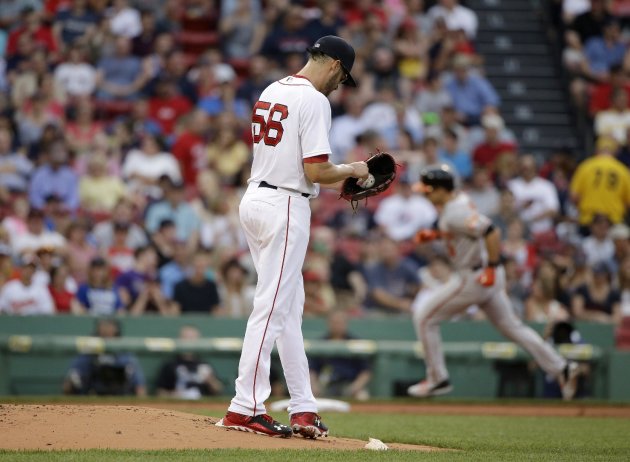
Despite their enviable position as one of the few sellers in a market flooded with buyers, the Boston Red Sox were unable to accomplish much at this year's trade deadline. All they managed to do was ship Shane Victorino to the Angels for Triple-A utilityman Josh Rutledge and acquire Ryan Cook, a reliever (pictured), from the Oakland A's for a player to be named later or cash.

Boston sold Victorino at his absolute low, at the age of 34 and in his second straight injury-plagued season. After picking up all but $1.1 million of money remaining on his contract, they'll have paid him about $38 million for roughly a full season (185 games). Rutledge is eight years younger but won't have much of an impact, seeing as how he hit just .259/.308/.403 in three years with Colorado and didn't get so much as a plate appearance since being traded to the Angels last December. Cook, 28, also spent much of the year in Triple-A after being demoted in early May. Once an All-Star (in 2012), his peripherals have been in decline ever since.

All in all, it was a very weak take for a last place team that needs all the help it can get. Cook could prove useful if he returns to his 2012-2014 form, but the Red Sox need a lot more than a middle reliever. It's going to take much bigger moves and millions more dollars to fix this bloated mess of a team.

It was especially disappointing that Boston was unable to upgrade its horrendous rotation with so many starting pitchers on the move last week. Granted, pretty much all of them save Cole Hamels are going to be free agents this winter, but then the Red Sox aren't the Royals when it comes to budget constraints. It's high time Boston paid real money to a pitcher that isn't Rick Porcello, and they better be ready to shell out this winter for a Mat Latos or Jeff Samardzija, if not a Price or a Cueto.

Boston's relatively inactive trade deadline was a far cry from last year's roster purge, when Ben Cherington traded eight players leading up to the deadline, including four-fifths of his Opening Day rotation. In breaking up the team that won it all nine months earlier, he was taking the first steps towards rebuilding for a competitive 2015. It hasn't worked out, mainly because all the players Cherington got in return (except Eduardo Rodriguez, who's been a gem) are either no longer with the club (Yoenis Cespedes, Kelly Johnson) or have played like garbage (Joe Kelly, Allen Craig).

To be fair, the Red Sox did not have many desirable trade chips this year. Teams weren't exactly lining up for the services of Mike Napoli, Alejandro De Aza, and Junichi Tazawa. Hanley Ramirez and Pablo Sandoval are untradeable given their poor performance and massive contracts. And for whatever reason, the Red Sox once again failed to unload Koji Uehara, a ticking time bomb at age 40 who should have been traded last summer.

Boston's best chance to add appreciable talent was via a three-way trade with the Cubs and Padres, but that deal was declared dead this morning. Deader than their moribund season.

Friday, July 31, 2015

Royals Reel in Big Fish

Cueto can help Kansas City win it all (Kansas City Star)
It was surprising--nay, shocking--that the Royals were the first team to make a major splash leading up to the deadline, landing Johnny Cueto on an otherwise sleepy Sunday. Not just because they already had the best record in the American League and were favored to win the World Series, but because it was totally out of character for an organization known for its restraint whenever superstars become available.

They Royals, because they are a small-market team with an average payroll, rarely generate shockwaves of this magnitude. Their last was the intensely-ridiculed Wil Myers for James Shield swap, which happened nearly three years ago. That the trade actually ended up working out better for Kansas City than it did for Tampa Bay, who promptly dumped Myers on San Diego two years after the fact, is besides the point. The point is that the Royals rarely come up whenever big name players are discussed, largely because they can't afford them. Giving somebody a lengthy nine-figure contract is simply out of the question.

But while that's the case for many teams, most can afford a superstar's final months before he reaches free agency, even the Royals. The issue is no longer salary, then, but the prospects one must give up to net such a big fish. When you're in the playoff hunt and every win counts, it can be worth it to sacrifice tomorrow for today. But for Kansas City, an organization that builds and develops from within, mortgaging the future for a few months of an elite rental was never in their best interest, especially because they were never in contention. Two months of a star player doesn't make a difference when you're in last place.

Well, the Royals are no longer also-rans: they are legitimate contenders, and when you're a contender you have to try to separate yourself from the other contenders. You have to plug your leaks as best you can, whether that means shoring up the bullpen, adding a frontline starter, or bringing in another bat. Stand still, and you run the risk of getting passed.

It's been awhile since the Royals were buyers at the trade deadline--usually they're at the other end of the table--and it felt like a ravenous tiger being let of its cage. They pounced, coming away with Johnny Cueto and Ben Zobrist to kick off a busy week across baseball. They might not be done--they could still use another arm--but they have to be satisfied with impressive haul.

The cost for Cueto was steep--three young lefthanded pitchers--but should also pay big dividends in the short-term. In Cueto, the Royals finally have a legitimate ace to replace James Shields, who departed over the winter via free agency. He's somebody you want to hand the ball when a championship's on the line, because he's someone who's capable of doing what Madison Bumgarner did last October. We're talking about a guy who's had an ERA in the twos each of the past five seasons, who led his league in strikeouts and innings pitched last year, and who won 20 games last year while finishing second to Clay Kershaw in the NL Cy Young vote last year.

That's a stud.
Zobrist was brought in to help replace Alex Gordon's production (Grantland)
Most teams would have been happy to add Cueto and called it a day, but Kansas City didn't stop there. Two days later, in what was only the third-biggest deal of a wild day that saw Troy Tulowitzki (more on him later) and Jonathan Papelbon change hands, the Royals reeled in Ben Zobrist from the flatlining A's.

Even at 34, Zobrist is still one of the most impactful players in the game today. Like Cueto, he's been criminally underrated despite ranking third among position players in fWAR since 2009, behind a couple of guys named Miguel Cabrera and Andrew McCutchen. Also like Cueto, he's going to be a free agent at year's end, meaning he'll likely be playing elsewhere next year.

Even so, two months (hopefully three) of Zobrist and Cueto beats no months of them. Because of Oakland's poor play and a knee injury that limited him to just 14 games through May 25th, Zobrist has flown under the radar even more than usual this year. When healthy, however, he's been his usual self, flashing strong on-base numbers, medium power, and the ability to man multiple positions. A jack of all trades who can hit--think Brock Holt--has real value, not just in the depth charts but on the field everyday. He can fill the void left by Alex Gordon in left field until Gordon returns--possibly by early September--then play wherever Ned Yost needs him.

Royals GM Dayton Moore has made numerous miscalculations during his underwhelming tenure, several of which occurred just this past winter, but it's safe to say trading for Cueto and Zorbist won't join them. On the contrary, this week has to be considered his finest hour. Although his team has the best record in the American League and a cushy lead over a mediocre AL Central, he wasn't content with cruising into the postseason. He knew that his team, as well as they've played, was not going to win the World Series without help, so he went out and got it.

Moore could have just as easily done nothing because hey, if it ain't broke, why fix it? But he looked at his team, saw an aceless rotation and a gaping hole in the lineup, and made the necessary moves to quickly address them. That's his job, sure, but for him to score two huge victories during the busiest week of the baseball year--when everyone and their mother is trying to do something--well, that deserves applause.

I wonder how much of his aggression, if any, can be traced back to Kansas City's Game 7 loss in last year's World Series. To come so close to winning it all and lose, with the tying run on third base, isn't just heartbreaking--it's soul-crushing. How much did that that inspire them to double down, like the Red Sox did after losing Game 7 of the 2003 ALCS, in order to get over the hump? The Royals hadn't made the playoffs since 1985 before last year, so they know how rare these opportunities are. They've waited long enough. Their time is now, and they know there's a weak American League out there for the taking. They already had a clear path to the postseason, but now they're better positioned to get back to the World Series, where they'll have another crack at winning their first championship in 30 years.

As seen by this year's All-Star "voting," interest in the Royals has never been higher. Kudos to Moore for trying to capitalize on that by dramatically strengthening his team for the stretch run. Last year won the fans back, and this year's going to keep them there. Sometimes even when you're at the top, you have to reach just a little bit higher.

Thursday, June 25, 2015

Boston's Former Cardinals Crash and Burn

Joe Kelly will try to figure it out in the minors (Yahoo Sports)
With Joe Kelly's demotion to Triple-A Pawtucket today, the Red Sox have officially lost last summer's trade with the St. Louis Cardinals--the one that sent John Lackey packing to St. Louis in return for Joe Kelly and Allen Craig, neither of whom are currently on the big league roster..

In fact, I think it might be the worst trade Ben Cherington has ever made. Kelly and Craig have both been massive busts in Boston, while Lackey has continued to be an effective starter for the Cards. Kelly has not developed into a viable starting pitcher, much less the Cy Young winner he predicted he'd be. With a 5.67 ERA and 1.50 WHIP, he's been one of the worst starting pitchers in baseball this year. At this point, his best bet is to take his heater to the bullpen, where he may enjoy a renaissance a la Andrew Miller.

As for Craig, he has yet to rediscover the stroke that made him a .300 hitter and one of the league's best RBI men. Not even Fenway Park could help restore the former All-Star's bat, as he's hit a meager .130/.235/.192 since joining the Red Sox. His age, injury history, non-existent production, and costly price tag (he'll earn $11 million next year) makes him all but untradeable.

Meanwhile, Lackey has continued to thrive in St. Louis. He faded down the stretch last year but has bounced back strong this year, posting a 3.41 ERA, 1.22 WHIP, and 3.14 K/BB ratio. He's been one of the most reliable starters for the first-place Cardinals, leading the staff in innings pitched and helping pick up the slack in Adam Wainwright's absence. Even at 36, he shows no signs of slowing down.

At the time, trading a veteran starter in his mid-30s for a hard-throwing hurler in his mid-20s made plenty of sense, but taking on Craig's costly contract and expecting him to bounce back proved to be too much of a gamble. Boston really could have used Lackey in its rotation this year, and had absolutely no need for Craig given its already-crowded outfield situation when he arrived. Now it looks like the Sox are stuck with him, unless they can convince somebody that regular playing time will rejuvenate the soon-to-be 31 year-old's bat.

I still think Kelly has a future as a shut-down reliever, but that's not as valuable as a reliable starting pitcher, especially given the struggles of Boston's rotation this year. This trade is just one of many reasons why the Red Sox have underperformed this year, but it's now clear that they'd be better off had Cherington never done this deal.

Tuesday, April 7, 2015

Revisiting Boston's Miley Extension

Photo credit: The Sports Quotient
(In light of yesterday's Rick Porcello extension, I just wanted to say my piece about Wade Miley, who received his own contract extension nearly two months ago).

The Boston Red Sox must really like Wade Miley. Not only did they trade three players (Rubby De La Rosa, Allen Webster, and Raymel Flores) to the Arizona Diamondbacks for him last December 12, but they also signed him to a three-year, $19.25 million contract extension before he threw a single pitch for them.


"I think, obviously, with Wade going into his first arbitration year, he's a guy we traded for for a reason—because we like him and we believe that he's going to help us win games," Red Sox general manager Ben Cherington toldMLB.com’s Ian Browne. "When we traded for him, our full expectation was that he could be here for a while.”

Though Miley is coming off a down year in which he went 8-12 with a 4.34 ERA and 1.40 WHIP, Boston determined that he would be a good fit and proposed an extension. Miley expressed interest as well, allowing the two sides to strike a deal on February 5, over two weeks in advance of spring training.

"While we've gotten to know him a little better since the trade, we felt very comfortable with who we were acquiring even before the trade,” Cherington told Browne. “So it made these talks relatively easy, because aside from his performance and durability, he's got a reputation as a good person, a good clubhouse guy, a good teammate. So it made it easier to get into this kind of conversation.

"And so we were either going to try to figure out a one-year number either through a settlement or a hearing or look at some different model or different contract,” Cherington continued. “And I think there was interest from Wade, and he expressed through his agent Tom O'Connell about looking at that."

Miley, 28, is also elated to be part of Boston’s long-term plans and looks forward to beginning his Red Sox career.

"I'm just excited to get the commitment and everything, and hopefully everything works out and we're going to win some ballgames," Miley said via telephone to MLB.com. "I'm just thrilled to be a part of this Red Sox Nation and be a part of the organization and excited to get it going."

The former National League All-Star will feature prominently in Boston’s remade rotation, which has only one holdover—Clay Buchholz—from last year’s Opening Day staff. The southpaw joins newcomers Rick Porcello and Justin Masterson in trying to help the Red Sox rebound from a last place finish. Unlike his new rotation-mates, Miley faces the additional challenges of adjusting to the American League and a ballpark that is notoriously tough on left-handed pitchers. As of yet, however, he does not intend to modify his approach.

“I just try to get guys out at all costs, really. I don’t care what pitch I’m throwing,” Miley said in his teleconference. “My goal is to just try to get hitters out and give [Boston] a chance to win.”
Cherington cited Miley’s health and makeup as reasons for the extension.

"The best predictor of future durability and performance is past durability and performance," Cherington explained to Browne. "He's taken the ball consistently. He's been a guy that was relied upon by Arizona. Aside from his durability, we had done a lot of work on Wade prior to the trade, just in terms of what kind of guy he was. We had a lot of confidence in what type of person Wade is before we traded for him.”

The contract includes a $500,000 signing bonus and covers Miley’s three arbitration years, paying him $3.5 million this year, $6 million next year and $8.75 million in 2017. The deal also includes a $12 million club option for 2018, which would allow Boston to prevent him from reaching free agency that year. The option has a $500,000 buyout should the Red Sox decline it.

Miley will get his first taste of the Red Sox-Yankees rivalry when he makes his Boston debut at Yankee Stadium on Friday.

Tuesday, January 20, 2015

Rangers Get Gallardo

Gallardo's not good enough to survive the Texas run environment (Bases Loaded)
The Texas Rangers made their first major offseason move yesterday (seriously, it's about time), sending three players to the Milwaukee Brewers in exchange for Yovani Gallardo. The Brewers also agreed to cover $4 million of the $14 million owed to Gallardo in 2015, the final year of a five-year extension he signed back in 2010.

Gallardo, a former All-Star, has been one of the steadiest starting pitchers in baseball over the past six years. Though walks have often limited his ability to pitch deep into games, he's made at least 30 starts and completed more than 180 innings every year dating back to 2009. Gallardo's compiled a 3.73 ERA (equivalent to his FIP) during that span, putting him in the same neighborhood as Max Scherzer (3.61), James Shields (3.62), and Dan Haren (3.80).

A very promising pitcher at the start of the decade, the hard-throwing righthander never quite became the ace he was supposed to be. He settled down as a good, if occasionally frustrating pitcher; a fine number two or three but not a number one. With 16 fWAR over the last six years, he's been the 31st most valuable starting pitcher in baseball, near the likes of Matt Cain, Ricky Nolasco, and Jake Peavy.

Gallardo, who's going to be 29 this year, will have to adjust to the American League as well as an incredibly tough park for pitchers in Texas. Such a transition would be difficult for any hurler, especially one whose strikeout rate has gone into free-fall. Since peaking at 9.9 K/9 in 2009, Gallardo's whiff rate has fallen every year since then save 2012, when it remained the same as the year before. Once an elite strikeout artist who fanned at least a batter per inning every year from 2009 through 2012, Gallardo is now below average in that department after making a more concerted effort to pitch to contact, which has resulted in his averaging just seven whiffs per nine in 2013 and 2014 combined.

In spite of his waning whiff rate, Gallardo has remained effective by become more of a ground ball pitcher in recent years, as his ground ball rate has steadily risen every year since 2010 (he added a sinker to his repertoire in 2011). Last year, for the first time in his career, more than half of the batted balls he generated were on the ground. That bodes well for him moving to Texas and a new home park that turns long fly balls into homers. He'll benefit from a superior infield defense with the Rangers, who boast Adrian Beltre and Elvis Andrus on the left side of their infield as opposed to Aramis Ramirez and Jean Segura in Milwaukee, but will lose out on Jonathan Lucroy's magnificent pitch-framing capability.

So how will Gallardo fare in his American League debut? Not great, says Steamer. The projection system predicts continued regression in his strikeout rate and an uptick in his walk rate, which was a career-best 2.5 BB/9 last year. These developments, combined with a spike in home run rate, would likely drive his ERA and FIP over four. Steamer expects his ERA to rise to 4.61, more than a full run worse than his 3.51 mark a year ago. That seems a bit excessive to me, but I agree that his ERA is going to exceed his previous career-worst of 4.18 set two years ago.

Gallardo's just not a great pitcher any more, which makes him vulnerable to the hitter's park in Arlington and more formidable American League lineups. He's an average pitcher at best in this stage of his career, which qualifies as an improvement only because of how horrendous the Rangers' rotation was last year. Of the nine pitchers who started eight or more games, only one--Yu Darvish--had an ERA under 4.35. Texas desperately needed pitching help, and Gallardo will provide some, but his ERA probably won't be much better than that and is far more likely to be worse.

As such, Gallardo is a minor upgrade that won't make much difference for a team that lost 95 games last year. Obviously the Rangers need all the help they can get, and every little bit helps, but Gallardo's not going to move the needle much. The Rangers really need another ace to complement Darvish, and could have used a Jon Lester or a James Shields. Instead, they settled for mediocrity and got Gallardo.

Fowler Fits Cubs Plan

Trading for Fowler is a win-now move by the Cubs (USA Today)
The Chicago Cubs continued to improve this offseason, swapping a utility man (Luis Valbuena) and a busted starting pitcher (Dan Straily) to the Houston Astros for Dexter Fowler yesterday.

The Cubs sold high on Valbuena, their third baseman who enjoyed a career year last year at 28. With uberprospect Kris Bryant expected to take over at the hot corner shortly, Valbuena had become expendable, so Chicago turned him and Straily into a center fielder, something the Cubs never really had last year.

Former skipper Rick Renteria relied primarily on Emilio Bonifacio (fine utility guy, but not an everyday player) and, after Bonifacio was dealt to the Braves, a raw 22 year-old rookie by the name of Arismendy Alcantara, who did his best Jackie Bradley, Jr. impression by posting a paltry .621 OPS. Junior Lake, Ryan Sweeney, and Justin Ruggiano, none of whom are any good, also spent significant time in center. Not surprisingly, Chicago got next-to-nothing from its center fielders, who batted a measly .222/.264/.346 last year, making that the team's weakest position OPS-wise. No team got less offense from its center fielders than the Cubs, who had the third-worst crew of center fielders overall based on fWAR.

Fowler, a solidly above average hitter with an established track record, represents a clear upgrade offensively that figures to add several wins to Chicago's ledger this year. The Cubs are getting a 29 year-old center fielder who's typically good for 10-15 home runs, 10-15 steals, and a very high on-base percentage every year. Last year, the former Rockie proved he could hit away from Coors Field by enjoying his best offensive season on a league and park adjusted basis with a 124 wRC+, batting .276/.375/.399 despite missing seven weeks in the middle of the season with back tightness.

That high OBP wasn't a fluke, either. Fowler has always been great at getting on base and owns a .366 career OBP to prove it. The switch-hitting leadoff man also brings some speed to the table, having swiped 94 bases and legged out 57 triples over the past six seasons. Despite his mediocre theft success rate (67.6 percent), he ranks 25th in baserunning value since the start of the 2009 season. He's no Juan Pierre either, offering slightly above average power (career .149 ISO) that stands to benefit from Wrigley Field's friendly confines.

While Fowler is a good hitter, he is not without flaws. He strikes out a lot for someone who's never hit 15 homers or slugged .475 in a season, and the metrics have never loved his defense. Like many Rockies past and present, Fowler's also had trouble staying healthy, as he's never played 145 games or recorded 500 official at-bats in any season. As such, B-R and FanGraphs agree that he has never once been worth three WAR.

Fowler is also not a long-term fix. Now in his final year of arbitration, he expects to earn around $10 million this year before becoming a free agent next winter, meaning he's a not inexpensive short-term solution.

But he is a solution, and a good one at that. With Chicago leaning on so many youngsters to carry the offensive load this season, Fowler is a proven performer with a steady history of success. In addition to setting the table for the likes of Bryant, Anthony Rizzo, and Jorge Soler, he'll add some much-needed veteran presence and leadership to a team short on both. Best of all, he's a good center fielder, which is something the Cubs desperately needed (but could trade if they stumble through another terrible season).

Based on their splashy Jon Lester signing and serious pursuit of Russell Martin earlier this winter, the Cubbies are making a strong push to contend in 2015. Fowler fits into the plan.

Saturday, January 10, 2015

Howard Has to Go

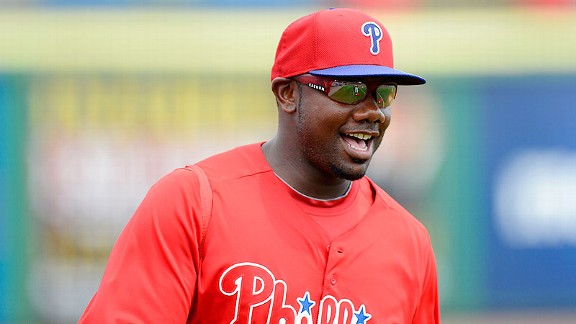
The Phillies have made it clear that Howard has to go, but where? (ESPN)
After reading up on the latest Ryan Howard rumors, I've concluded that he's the least desirable player in baseball. His team doesn't want him, and apparently neither does anyone else. Probably because he's the new (and more expensive) Adam Dunn, by which I mean the washed-up version of Dunn who struggled to hit .200 with 20 home runs and still struck out a ton last year.

Howard has always been a three true-outcome hitter, but that was perfectly fine when he was cranking 45 home runs and driving in 140 runs. Those days are long gone, however, and they're never coming back. Howard's two beneficial outcomes--walks and homers--are happening less frequently while his worst outcome (the dreaded strikeout) is occurring more often:

Year
HR%
BB%
K%
2011
5.1
11.7
26.7
2012
4.8
8.6
33.9
2013
3.5
7.3
30.3
2014
3.6
10.3
29.3

These troubling trends have diminished Howard from a great hitter in 2011 (126 OPS+) to a below average one by 2014 (93 OPS+). Already a liability in the field and on the bases, Howard is now deficient in all areas of the game. Sure enough, he was below replacement level last year (and in 2012, for that matter).

Like the recently-retired Dunn, Howard is unplayable on defense, so incompetent in the field that even first base is out of the question. The 35 year-old is a DH-only at this point. Problem is, he plays for a National League team (the Phillies). Philadelphia would love to trade him, but good luck finding someone to take him off their hands.

Because in addition to being a big-bodied 35 year-old in steep decline, Howard still has two years remaining on his ill-advised five-year, $125 million contract extension he signed with Philadelphia prior to the 2012 season, plus a team option for 2017 that, barring a Barry Bonds or David Ortiz-esque renaissance, seems guaranteed to be bought out (at a cost of $10 million). In order to move Howard, the Phillies are going to have to eat a considerable chunk of that, but it's better than cutting him outright for nothing in return.

Even Ruben Amaro, Jr., Philly's clueless GM, has realized it's time to move on. He's finally kickstarting the rebuild process in Philadelphia, albeit two or three years too late. He already traded Jimmy Rollins, who was actually still useful. Jonathan Papelbon is likely headed out the door, and Cliff Lee will probably be gone next summer, too. Pretty soon it's going to be Chase Utley and a bunch of guys.

So it's clear Howard has to play elsewhere next year, but where will he land? Surely someone could find a spot for him, as he's not completely useless at this point. He still has above average power and gets on base at a league average rate. He's not an everyday player anymore, especially against lefties, but he'd be a great fit for an AL team seeking power, especially if said team plays in a hitter-friendly park.

He'd probably do really well with the Yankees, but they've got plenty of DH options between Alex Rodriguez and Carlos Beltran. The Orioles could use him after losing Nelson Cruz, and like New York have a ballpark that's well-suited to Howard's strengths. The Indians, perhaps? The Tigers? (if they want to see firsthand how Prince Fielder would have aged?).

Wherever he goes, the Phillies have made one thing abundantly clear. It's closing time, Ryan Howard, and you can't stay here.