Showing posts with label Justin Upton. Show all posts

Friday, December 19, 2014

Yes, the Padres Will be Good

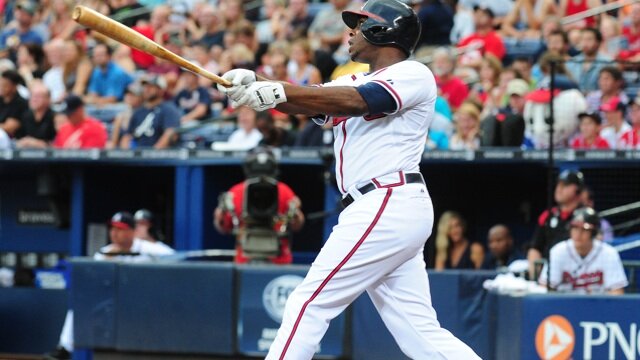
Upton rounds out a formidable San Diego outfield (SI)
In the three years I've been writing this blog, I could probably count the number of posts dedicated to the San Diego Padres on one hand. Welcome back to baseball relevance, San Diego.

Piggybacking off yesterday's post and my suggestion that San Diego still needed another big bat before I could call them contenders, the Padres got one in Justin Upton. San Diego swapped out four players for B.J. Upton's little brother and another player from the rapidly dismantling Braves, who appear to be punting on 2015 after trading Jason Heyward (replacing him with the perfectly average Nick Markakis) and Jordan Walden for Shelby Miller and Tyrell Jenkins.

The Padres, who recently traded for All-Star catcher Derek Norris as well, now have one of the best-hitting outfields in baseball in Upton, Matt Kemp, and Wil Myers (though they all bat from the right side and project to be terrible defensively). That leaves them with an entire outfield's worth of reserves--Seth Smith, Will Venable, and Carlos Quentin--from which to trade, though it might be worth keeping one or two around given Kemp's age and injury history as well as Myers's inexperience.

More importantly, the Padres revamped their lineup without sacrificing much of their dynamite rotation of Andrew Cashner, Ian Kennedy, and Odrisamer Despaigne. That they were able to acquire four big bats via trade while giving up just one of their major league-ready arms (Jesse Hahn) is remarkable, but perhaps also speaks to the stupidity of the teams they were dealing with. Given what the Dodgers, Rays, and Braves just gave up, they were well within their right to demand at least one of the aforementioned hurlers, and yet not a single one was moved. Billy Beane, who offered the worst player of San Diego's new quartet, got Hahn in return. Incredible.

I think that says something about how teams treat prospects, that simply stockpiling them is the way to go because the law of averages, right? Well the minor league washout rate is something like 83 percent, which means five out of every six prospects don't pan out. Hording prospects doesn't improve those odds. Rather than collecting players who are still in the midst of their development (guys with "upside," which is really just the "downside" of likely washing out), teams should be targeting players who have already reached the majors or are about to. They should be aiming for nearly-finished products instead of projects, quality over quantity.

Anyways, kudos to the Padres for not just keeping their rotation mostly intact, but coming out of nowhere to gear up for a playoff run in 2015. Just four wins below .500 last year in spite of a historically anemic offense, they were wise to go for it when it makes sense for most teams with a fighting chance at October to do so (thanks to improved parity and the second wild card). I think they're probably even with the Giants now, maybe even a little bit better, which means I'm putting them down for their first winning season since 2010. The division still belongs to the star-studded Dodgers, but the Padres are well-positioned to win upwards of 85 games and contend for one of the two wild card spots.

Because for the first time in a long time, the Padres are going to hit.


Monday, August 11, 2014

Upton and Down


On Friday night the Upton brothers homered in the same game for the fifth time, setting a new major league record in the process. Each touched Stephen Strasburg for a two-run dinger, with Justin's breaking a scoreless tie in the first and B.J.'s doubling the lead to 4-0 the following inning. The Braves survived a late rally from the Nationals and held on to win 7-6.

After another bomb by Justin yesterday, the Upton siblings now have 28 long balls between them this year; 20 from Justin and 8 off the bat of B.J.

That Justin Upton leads his older brother by such a big margin is hardly groundbreaking news, as the former has been a much better player since they came together to form two-thirds of the Braves outfield. But as recently as 2012, B.J. Upton could claim outright superiority in that department. At that point the elder Upton had outhomered his kid brother 118 to 108 with three 20-homer campaigns to Justin's two. B.J. had just popped a career-high 28 with the Tampa Bay Rays, while Justin had only managed a disappointing 17 with the Arizona Diamondbacks in a much friendlier park for hitters.

It's fascinating how much their careers have diverged since. In the three seasons before they joined forces in Atlanta, both players compiled 10.7 fWAR apiece. But seeing as how most of Justin's came during his stellar 2011 campaign and B.J. was between three and four wins every year, the latter could certainly claim to be more consistent.

At the time B.J. was coming off the better season, having just established personal bests in home runs and total bases (260). Justin was trying to forget a down year in which he hit 17 home runs with a .785 OPS and 2.1 fWAR, a far cry from his MVP-caliber 2011 that produced 31 homers, an .898 OPS and 6.1 WAR. For the second time in three seasons, WAR rated B.J. ahead of Justin.

The last two years, however, it's like they're playing in completely different leagues. B.J.'s fallen off a cliff since the ink dried on his instantly regrettable five-year, $75 million pact with Atlanta. In his 235 games with the Braves he's batted a paltry .197/.273/.310 (62 OPS+) with 17 home runs, 55 RBI and 297 strikeouts, making him a sub-replacement level player this year and last. Justin, on the other hand, has been comfortably above replacement level thanks to his still-dangerous bat, which since he was traded to Atlanta rates almost 30 percent better than average after adjustments for league and park.

With B.J. already an albatross and Justin a borderline All-Star, the disparity between the two has never been greater. It's just funny to think that not too long ago, B.J. was actually the better player.


Sunday, April 27, 2014

Upton Starting Strong Again

Just like last year, Upton's been tremendous in April (RantSports)
On this date last year, Justin Upton smoked his 12th home run of the young season off Detroit's Joaquin Benoit. Atlanta's newly acquired outfielder finished the day batting a ridiculous .302/.384/.779, well on his way to winning NL Player of the Month honors for April and asserting himself as the early season MVP favorite. It looked like he had finally put it all together and was about to deliver the superstar-caliber season that had long been expected of him.

Didn't happen. It would be another two weeks before Upton homered again, the beginning of a lengthy power outage that lasted most of the summer. From April 28th through the end of July, a span of 77 games that comprised nearly half the season, Upton homered four times. Four. He struck out 85 times and batted .243/.339/.342, looking almost as lost as his big brother B.J. Upton. Monster April aside, Upton was essentially the same player he was during his disappointing 2012 campaign, the one that caused Arizona to give up on him when he was just 25 and still under team control for three more years.

This year, Upton is off to another phenomenal start. After his 2-for-4 performance today, he's currently hitting .330/.406/.625 with seven home runs and 16 RBI. The strikeouts have been an issue again: he's already fanned 32 times in 24 games, which puts him ahead of last year's pace when he whiffed 161 times--a career high. That makes me think the two-time All-Star can't sustain his hot streak for much longer, that he'll cool off soon and go through a dry spell similar to the one he endured last year.

Will it last three months? Probably not, but until Upton--currently on pace for 216 K's--cuts down on his whiffs and becomes more consistent, he's never going to be a superstar.

Tuesday, August 6, 2013

Dumb Diamondbacks

Kennedy is the latest Diamondback to be traded for pennies on the dollar
The two most notable trades leading up to an otherwise quiet trading deadline involved starting pitchers not named Cliff Lee. The first had Jake Peavy changing Sox (from white to red). The second was consummated between divisional rivals--the Arizona Diamondbacks and the San Diego Padres--sending Ian Kennedy from the former to the latter.

Since I already analyzed the Peavy trade in this space last week, I wanted to breakdown the Kennedy trade while it was still fresh. My first impression is that it's a curious move for the Diamondbacks, who led the NL West for most of the summer before slipping behind the hard-charging Los Angeles Dodgers (cue Yasiel Puig highlights). Arizona's fighting to stay above .500 at the moment, but they're still within striking distance of first and could feasibly make a run down the stretch. So why trade Kennedy, a sturdy starter who takes the ball every fifth day, when it's common knowledge that one can never have too much pitching?

The explanation is quite simple, really. Arizona's GM Kevin Towers has a history of trading away young, struggling talent. In fact, this trade makes four times in the past year that Towers has sold low. Let's take a look.

Stephen Drew: traded to Oakland on 8/20/12
J.D. Drew's kid  brother was one of the National League's top shortstops before a fractured ankle took him out of commission for 11 months. When he returned midway through the 2012 season--his walk year--he clearly wasn't the same player. He was still shaking off the rust off when the Diamondbacks traded him to Oakland on August 20th.  Though he was batting below .200 at the time, Drew bounced back in September, helping the A's stun Texas and win the division on the season's final day. Billy Beane gave Arizona Sean Jamieson, a 24 year-old who's yet to play a single game above Single-A. Rather than deal a slumping, rehabbing Drew, Towers should have held on to Drew and let him recoup some of his lost value. The Diamondbacks weren't in contention last year anyways, so what was the harm in letting Drew play out the string and seeing if he could rediscover his stroke? Had he continued to flail, then nobody would have thought twice about letting him go as a free agent.

Trevor Bauer: traded to Cleveland on 12/11/12
Arizona's first round selection (third overall) in the 2011 draft pitched all of 16 innings in his lone season with the D-Backs before he was sent packing to Cleveland in a three-way trade that acquired Drew's replacement, Didi Gregorius. Gregorius has been solid, but his ceiling is nowhere near as high as Bauer's. The future ace has yet to take off, but he's just 22 and still has plenty of time to figure it out. Even if he never pans out, I would much rather roll the dice with the next Tim Lincecum rather than settling for a competent but unspectacular shortstop.

Justin Upton: traded to Atlanta on 1/24/13
The Diamondbacks were downright foolish to move B.J. Upton's younger brother, whom they still controlled through 2015. Frustrated by his inconsistency, attitude problems and inability to realize his massive potential, they gave up on him after a down 2012. Towers could have and should have been able to get more for a budding superstar than two complementary players (Martin Prado and Randall Delgado) packaged together with three so-so prospects. The result has been a punchless Diamondbacks outfield that's slugged just .383 with 25 home runs. Upton has 20 by himself. He should be hitting in front of Paul Goldschmidt instead of playing in the same outfield with his older brother and Jason Heyward.

Ian Kennedy: traded to San Diego on 7/31/13
Once a treasure of the Yankees farm system, Kennedy was dealt to Arizona after the 2009 season as part of the three-way trade that put Curtis Granderson in pinstripes and sent Max Scherzer to Detroit. Two years later, he emerged as one of baseball's best starting pitchers when he won 21 games and finished fourth in the NL Cy Young race. While that superlative season now appears to be a fluke, he's still a durable starting pitcher who should approach or exceed 200 innings pitched for the fourth consecutive year. And yet, all Towers could fetch for him was a prospect and a lefty reliever (Joe Thatcher). Granted, teams aren't lining up for someone with an ERA over five, but Kennedy's 4.29 xFIP and strand rate suggest that luck was not on his side. He's not as bad as his year-to-date numbers suggest. With regression to the mean and some assistance from PetCo Park, he should be able to turn his year around. Expect a second-half resurgence similar to the one Josh Beckett enjoyed with the Dodgers last summer.

In an alternate reality where Towers didn't make these trades, it's quite possible that Arizona would still be sitting atop the NL West, or at least giving LA a run for their money. Instead, the D-Backs are fading fast. When October comes around they'll be on the outside looking in, giving their fans plenty of time to ponder what might have been.

Thursday, June 13, 2013

Braves Outfield Disappoints

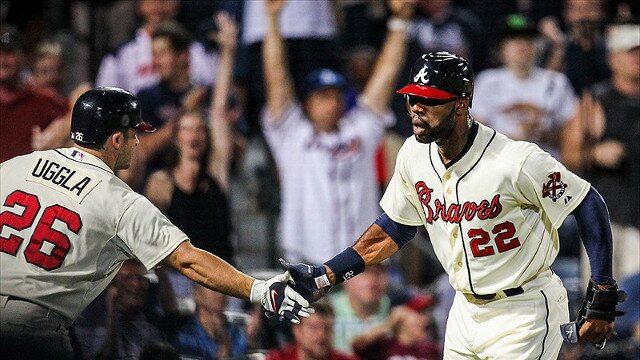
Dan Uggla greets Heyward after a long home run
Hopes were high for Jason Heyward and the Atlanta Braves coming into the 2013 season. After winning 94 games last year while ushering Chipper Jones into retirement, the Braves went out and signed B.J. Upton to the largest free agent contract in franchise history. Two months later, they fleeced the Arizona Diamondbacks for Justin Upton, scoring a 25 year-old superstar-in-the-making who won't become a free agent until after the 2015 season.

Adding the Upton brothers to its incumbent right fielder gave Atlanta one of baseball's best outfields. All three are young, athletic ballplayers projected for greatness long before they ever set foot on a big league diamond. Blessed with power and speed, the trio of former first round draft picks are three of the game's brightest talents.

So why aren't they playing like it?

More than two months into the season, the outfield that was supposed to lead Atlanta back to the postseason has gone bust. elder Upton's been a train wreck at the plate, striking out in one-third of his plate appearances and showing no semblance of the power stroke that helped him blast 28 home runs last year. Justin carried the Braves with his monster April  but hasn't done much lately, batting just .222/.343/.326 since April 28th.

And then there's Heyward, who's slow start to the season was exacerbated by an emergency appendectomy that forced him onto the Disabled List in late April and caused him to miss 23 games (the same operation derailed Adam Dunn early in 2011, and we all know how that turned out). Since returning to action on May 17th, it's taken Heyward a couple weeks to get his timing back and regain his footing at the plate.

But with both Uptons still dragging their feet in June, Heyward has shown signs of life at the plate. After going 2-for-5 with a double last night, Heyward now has hits in each of his last 10 games--including seven multi-hit efforts--to push his batting line up to .215/.324/.362.  He's been squaring up the ball better and making hard contact more consistently. These improvements are reflected in his improved strikeout rate, which he's trimmed from 18.8 percent before June 2nd to 12.8 percent since.

Credit Fredi Gonzalez for sticking with his slumping 23 year-old, batting him second even as his batting average languished below the Mendoza line into early June. Many managers would have dropped Heyward down in the lineup or benched him in an effort to help get him going, but such moves can end up doing more harm then good. They reflect a lack of faith on the manager's part and can end up damaging the ballplayer's already diminished confidence. Gonzalez's long leash has served him (and Heyward) well.

Even after getting swept by the San Diego Padres, Atlanta still leads the NL East by six games. The Braves are a first place team in spite of their vaunted outfield, not because of them. The rotation's remained healthy and everybody's pitching well. Evan Gattis and Chris Johnson are picking up the slack on offense. The defense is as good as expected.

Still, one can only imagine how strong the Braves will be once Heyward and the Uptons start doing what they're capable of.

Wednesday, April 24, 2013

Justin Upton: Man on a Mission

Justin Upton is insanely, impossibly, ridiculously hot right now. He's so hot, in fact, that you can almost see the flames radiating from his bat every time he swings. His plate appearances have materialized into must-see TV.

After homering in both games of yesterday's doubleheader in Colorado, he now has 11 big flies on the young season. Nobody else has more than seven. He also has the highest slugging percentage (.813) and most total bases (61) of anyone in baseball. But since all but one of his dingers came with nobody on base, his power surge has produced just 16 RBI. For that he can blame Atlanta's table-setters--Andrelton Simmons and his big brother B.J. Upton--who have a combined OBP somewhere in the .250 range. Because of them, most times when the younger Upton digs in, the table is empty.

But a dearth of RBI opportunities hasn't stopped Upton from enjoying one of the best starts in baseball history. The Braves have gone along for the ride, jumping out to a 15-5 record and building a quick five game lead over the NL East, making their 25 year-old left fielder an early MVP favorite as well as a shoo-in to make his third All-Star team.

Out west, Upton's former employers have to be kicking themselves for trading him away when he was still under team control through 2015. Everyone could see the former first overall draft pick had this kind of superstar talent in him; he just needed time to mature. Now, he's growing up right before our eyes and is poised to become a major force for years to come. Three weeks into the season, it seems inevitable that future generations of baseball fans will look back on this trade the same way we disparage Boston's sale of Babe Ruth or the Reds' trading Frank Robinson.

More importantly, Upton's home run barrage merely reinforces what we knew three months ago; the Diamondbacks were dumb to trade Justin Upton.

Monday, April 8, 2013

9 Lessons From Baseball's First Week

Baseball has been back for little more than a week, so what have we learned so far? It's still early, so not much, but here are a few key takeaways from the first week of ballgames:
  1. Chris Davis's breakout was for real
  2. Roy Halladay might actually be done...
  3. ...But Chase Utley isn't
  4. The Red Sox are better than we thought
  5. The Yankees are just as bad (and maybe worse) than we feared
  6. Bryce Harper, not Mike Trout, is poised to become the best player in baseball
  7. Texas does not like Josh Hamilton
  8. A healthy Mike Morse is a force to be reckoned with
  9. Justin Upton is a legit MVP candidate, his disappointing 2012 notwithstanding

Sunday, February 17, 2013

MLB Hot Stove Losers

With spring training here at last, it's time to reflect on another busy baseball offseason. Here's a look at the five biggest losers of the winter (in no particular order).

Miami Marlins
Traded away most of their established talent (Jose Reyes, Mark Buehrle, Josh Johnson) and pissed off their franchise player, Giancarlo Stanton, in the process. Considering the Fish lost 93 games with that crew last year (plus Hanley Ramirez, Heath Bell, Omar Infante, and Anibal Sanchez), the Marlins are a lock to lose at least 100 games in 2013.

Kansas City Royals
The Royals haven't won in so long that they clearly have a misconception about what it means to "win now." It definitely doesn't mean signing innings-eaters Ervin Santana (5.16 ERA in 2012) and Jeremy Guthrie. It also doesn't mean trading away Wil Myers, the best hitter in the minor leagues last year, for a number two pitcher disguised as an ace (James Shields). Even with continued growth from young stars Salvador Perez, Eric Hosmer and Mike Moustakas, KC is a .500 team at best with almost no chance at contending for the second wild card. Don't be surprised if GM Dayton Moore is out of a job by this time next year.

New York Yankees
After getting wiped out by the Detroit Tigers in last fall's ALCS, the Yanks failed to do much this offseason besides get older. Squeezed by their commitment to getting their payroll below the luxury tax threshold of $189 million by next season, the typically free-spending Yankees restrained from handing out multi-year deals to any notable free agents. Brian Cashman was forced to pinch every penny, and what resulted was perhaps the quietest Yankee winter in recent memory. They picked up Kevin Youkilis to fill in for Alex Rodriguez at third, but Youk brings an injury-checkered past and eroding skills to the Big Apple. Instead of ponying up for Nick Swisher, they brought back a 39 year-old Ichiro Suzuki to man right field. Gone too is Rafael Soriano, an elite closer who stepped up when Mariano Rivera went down (though the 43 year-old Mo will be back, as will 40 year-old Andy Pettitte and 38 year-old Hiroki Kuroda). Russell Martin departed via free agency, leaving New York without an everyday backstop. Key role players Eric Chavez, Andruw Jones and Raul Ibanez--who combined for 49 home runs last year--are gone as well. Travis Hafner is an intriguing addition with that ballpark, but I'm not as enthusiastic about Dan Johnson, Matt Diaz and Juan Rivera. The Bronx Bombers enter 2013 loaded with question marks and will probably miss the playoffs for just the second time in the past 20 seasons.

Baltimore Orioles
If the O's think they can repeat last year's fluky success (93 wins with a +7 run differential), then they are sorely mistaken. After sitting on their hands this winter, they're doomed to crash and burn in 2013 when their good fortune runs out.

Arizona Diamondbacks
Made the biggest blunder of the offseason by trading Justin Upton, a potential MVP-in-the-making whom they still controlled for another three years, and Chris Johnson for Randall Delgado and Martin Prado. They gave up on B.J. Upton's little brother too early and should have been able to get a whole lot more in return than a pair of complementary players and three so-so prospects.