Sunday, August 10, 2014
Martinez Mashing
For more than a year now, playing in the shadow of Miguel Cabrera, Victor Martinez has quietly been one of the best hitters in baseball.
It all started midway through last year, with Martinez scuffling at the plate after missing the entire 2012 season because of a torn ACL. Towards the end of June the then-34-year-old was hitting just .225/.283/.332, still shaking off the rust despite playing everyday for almost three full months.
Then, finally, the hits started falling for the slumping switch-hitter. He ripped off a 14-game hitting streak just before the All-Star Break, part of an incredible July in which he batted .390/.429/.581 with 41 base knocks. V-Mart remained red-hot through the dog days of August, roping 44 hits and batting .386/.449/.491 as a follow-up. In September he finally cooled off, but still strung together a 12-game hitting streak and batted .315/.367/.483 for the month to notch his fourth straight .300 season and seventh overall. All told, Martinez hit .370/.422/.519 over his final 82 games of the season, helping the Tigers go 49-33 in those games in narrowly beat out the Indians for the AL Central crown.
This year's been even better for Detroit's designated hitter, who's hitting for more power now than he has at any other point in his career. His .238 ISO and .560 slugging percentage are easily career bests, with the latter mark good for fifth in baseball among qualified hitters. His 23 home runs have him tied for ninth with Oakland bash brothers Brandon Moss and Josh Donaldson and are only two short of his personal high.
Even at Martinez's advanced age (35), it's not unusual to see him hitting .321 or getting on base more than 38 percent of the time. The five-time All-Star is a .304 career hitter who's career walk to strikeout ratio is nearly even. He still retains the tremendous bat speed, sharp reflexes and remarkable strike zone recognition needed to keep up with today's flamethrowing hurlers.
No, what's curious about this year is his unexpected power resurgence. While Martinez has always been a great hitter, his power appeared to be declining. His slugging and isolated power decreased in the two seasons since he left the Red Sox, and he swatted only 26 home runs in those years after exceeding 20 five times between 2004 and 2010. Given his advancing age, diminishing HR/FB rates, and the cavernous outfield dimensions of his home field, Martinez losing power was only natural. It seemed unlikely to ever return.
He's reversed that trend this year, however, by trading a good number of ground balls for fly balls. With more elevation in his swing, he's kept his GB/FB rate under one for just the second time in ten years. More fly balls typically translates to more big flies, but Martinez is also benefiting from the best HR/FB rate of his career. At 16.2 percent, it's more than double his rates from the last two seasons (both in the low sevens) and much higher than his career rate of 10.5 percent.
Could it be a small sample fluke? Maybe. Martinez crushed 20 home runs through June 25th but has only three since, which could be an indication that regression under way. According to ESPN's nifty home run tracker, seven of V-Mart's bombs have qualified as "just enough." Take those wall-scrapers away and he's sitting on 16, still a good number but nowhere near the pace that has him on track for his first 30-homer season. But with an average true distance of 389 feet and average speed off the bat of almost 104 miles per hour, many of Martinez's dingers have been legit. Five qualify as no-doubters and eleven left the yard by plenty. Even without the aforementioned "lucky" shots he'd have already exceeded his home run totals from his two most recent seasons. His HR/FB rate would be 11.3 percent, still above his career average and the highest it's been since 2009. Put simply, his power surge is not an aberration.
By improving his pop at 35, Martinez has found a new way to defy baseball's aging curve. Ballplayers typically don't have their best power seasons in their mid-thirties unless they're using certain performance enhancing substances (see Mark McGwire and Barry Bonds) or move to a hitting-friendly venue (Adrian Beltre, Hank Aaron). Comerica suppresses home runs, so that means the second explanation is out. I don't mean to suggest that Martinez is on something, but in this day and age a semi-suspicious power spike from a 35 year-old former catcher does make one wonder.
But Victor Martinez has always been a great hitter and displayed the ability to hit for power before, so I'm willing to give him the benefit of the doubt. Great hitters like him stay great longer, especially when they don't have to play the field. All I'm really trying to say with this post is that V-Mart is a phenomenal hitter, and has been one for a long time. This year, he's been a great power hitter, which hasn't always been the case, especially recently, and that merits a closer look.
Coghlan's Comeback
![]() |
| Coghlan's been on base a lot lately (CSN Chicago) |
Until about a week ago, I'd completely forgotten the 2009 NL Rookie of the Year. After looking at his recent track record, it's not hard to see why.
In the four years between his rookie season and this one, he batted .242/.307/.352 with 12 home runs and 70 RBI in just over 1,000 plate appearances. Across 265 games he put up a 79 OPS+ and was worth -1.4 fWAR. Injuries played a big part in that, robbing him of almost the entire second half of his sophomore season (knee surgery), nearly 60 percent of his 2011 (inflammation in the same knee), and almost three months last year (lower back strain). In this regard he was like the National League equivalent of Grady Sizemore; an outfielder who'd shown tons of promise early in his career only to see his prime years ruined by injuries.
Still, the fact remains that when Coghlan was healthy enough to play during those years, he wasn't very good. So it came as no surprise that the Marlins, the only team Coghlan had ever known, non-tendered him last winter. It was time. Even bad teams like the Marlins can't afford to waste a roster space on a corner outfielder in his late 20s who can't hit, run, or field. With young Christian Yelich showing promise and ready to replace him, Miami had to cut Coghlan loose. No regrets and no hard feelings.
Closing in on 30, beaten down by injuries and five years removed his last (and only) good season, Coghlan looked like he was going to be remembered as one of those Rookies of the Year who fell off the map, a one-hit wonder whose best season just happened to come at the beginning of a career that, for whatever reason (injuries, failure to make adjustments, bad luck) never panned out. Added to the list of vaguely familiar names like Angel Berroa, Bobby Crosby, and Jason Jennings, recent Rookie of the Year recipients nobody remembers.
The rebuilding Cubs took a flier on him, giving him a minor league deal with an invitation to Spring Training. He wasn't on the big league roster when camp broke and was optioned to Triple-A Iowa, where he got on base a good amount (.379 OBP) but failed to hit a home run in 24 games there. He was basically Daniel Nava.
So it was somewhat surprising when the Cubs called him up in early May. Initially Coghlan played sparingly, limited to pinch-hitting duty and the occasional start. He began receiving regular at-bats in June and became more comfortable at the plate as a result. His batting line rose steadily throughout the month, from .139/.184/.139 on the first to .204/.281/.330 by the end of June.
In July, with the Cubbies no longer in contention, Coghlan began to shine. He hit safely in 13 of 14 games before the All-Star Break, catching fire and becoming a mainstay in Chicago's lineup. His power, dormant for so long, emerged as well with eight doubles and three homers.
Coghlan continued raking after the break, notching hits in 14 of 17 games to open the second half and raising his batting line all the way up to .302/.382/.498 after a 3-for-3 effort on August 6th.
It's been far and away Coghlan's best prolonged stretch of hitting since he batted .321/.390/.460 as a 24 year-old rookie in 2009. Rick Renteria, the Cubs manager, has responded by batting him leadoff, using Coghlan's on-base skills to jumpstart a lineup that doesn't have much offense outside of Starlin Castro and Anthony Rizzo (much like how John Farrell's been batting Brock Holt leadoff to try to spark an otherwise lifeless Red Sox lineup). With Coghlan notching 13 multi-hit games and reaching base more than 46 percent of the time since the calendar flipped to July, scoring 23 times as a result, the move has paid off. He's setting the table and giving the guys behind him lots of opportunities to drive in runs, which is all anyone can really ask of a leadoff man.
Coghlan's unexpected comeback has been of the better stories in baseball lately, seeing as how he appeared to be out of a job not too long ago. A career-best walk rate and improved strikeout rate have fueled his success along with the highest HR/FB rate of his career and a more balanced batted ball distribution. His .337 BABiP is significantly better than average but not out of whack with his .320 career rate, though his .413 rate since the start of July screams small sample fluke. Accordingly, neither Steamer nor ZiPS expect the 29 year-old to keep hitting this way much longer. Both predict that his OPS to fall about 50 points between now and the end of the season, but neither one projects him to totally fall apart, either.
That's because for the first time in half a decade, Chris Coghlan's a legitimately good baseball player again.
Saturday, August 9, 2014
We Want a Homer, Just a Little Homer
![]() |
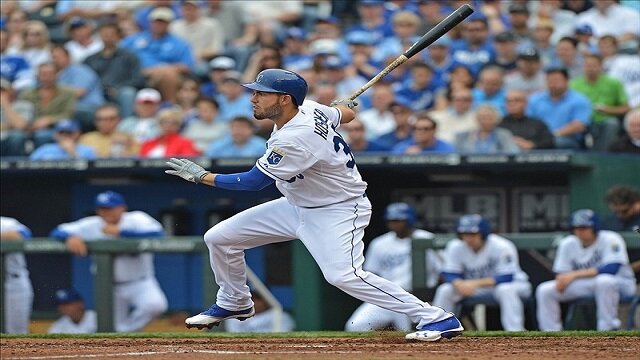
| Hosmer hasn't developed into a slugger, and neither have the other Royals |
The problem with that approach is that those averages are largely empty. KC ranks dead last in homers and walks and second-to-last in OPS. Seeing as how they rank 11th among the 15 AL teams in runs scored, it's clearly not working. All those singles and doubles aren't putting points on the board, even with the Royals hitting a more-than respectable .267/.331/.402 with runners in scoring position.
They’ve made up for their light-hitting ways by stealing a bunch of bases, most in the American league, but aggressive baserunning can only help so much. At some point you have to drive guys in, and that’s always easier when the ball goes over the fence. It's much more efficient to get a single, walk, and three-run jack than it is to string together multiple hits with a steal or two mixed in.
Kansas City doesn't have guys who can do that. Their top home run hitter is Moustakas with 14, and he shouldn't even be on the field with his .263 OBP. Eric Hosmer hasn't built on the promising power he displayed as a rookie in 2011. Billy Butler's always been more of a doubles guy, and so has Alex Gordon. Salvador Perez has good power for a catcher, but you never want your backstop to be the best power hitter on your team (unless he's Johnny Bench). The Royals, more than anything else, desperately need somebody capable of going deep every now and then. It’s something they haven’t had in a long time and probably won’t have for a while, given inability to acquire big name sluggers and stupid deal for James Shields that sacrificed Wil Myers, the minor leagues' second-best home run hitter in his last full year on the farm.
The Royals play in a park that encourages singles and doubles, rewards speed, and suppresses home runs. Their offense reflects this. But they play half their games in other parks, and still the results have not been pretty (.388 road SLG). If the Royals could just be an average home run hitting team and draw some walks every once in a while, they’d be a playoff team. But they don’t, and so they’re not.
It’s bad enough that they can’t afford to even be in the conversation when a top power bat hits the free agent market. It’s even worse that they haven’t been able to develop hitters with game-changing power. The Red Sox just traded Jon Lester, a free agent in two months, for Yoenis Cespedes, one of baseball’s best raw power hitters. With James Shields set to join him and command much, much more than Kansas City can possibly afford, there’s no reason the Royals couldn’t do that trade, except that they’re the Royals, and they never make trades like that, and the one time they did, it was a colossal mistake.
When you’re a team like the Royals, a team that rarely walks and can go weeks without hitting a home run, then it isn’t enough to have the league’s third-highest batting average. You need to have the best, and by a considerable margin. You need to have multiple .300 hitters, guys who can be counted on to get hits with runners in scoring position and produce runs that way. But in an age where better defensive positioning and tougher pitching are stealing countless base hits every day, that’s a tough strategy to follow. The Royals are living in the past, playing an AstroTurf style of baseball on grass, trying to make the 1980s brand of baseball work in the 2010s. Maybe that's why they haven't made the playoffs since 1985.
Friday, August 8, 2014
Holliday Heating Up
| After three tough months at the plate, Holliday finally looks locked in |
You wouldn't know it by looking at the final numbers, but Matt Holliday got off to a painfully slow start last year. When play began on June 3rd he was hitting .244/.329/.415 with eight home runs through his first 51 games of the season. The early season slump, combined with his age (33) and coming on the heels of back-to-back seasons of declining OPS, led many to speculate that Holliday's best days were behind him.
Only the six-time All-Star wasn't done. Far from it, in fact. Holliday proceeded to snap out of his , of course, and was fine from that point forward. He hit .333/.423/.535 the rest of the way, ending up with a .300/.389/.490 batting line in addition to his 22 home runs and 94 RBI. Another typically excellent offensive campaign for the St. Louis Cardinal, who was one of just nine players last year to top 20 home runs, 90 RBI and a .300 batting average. Only three National Leaguers did it; Paul Goldschmidt, Freddie Freeman, and Holliday. Note that Goldy and Freeman play first base, a less challenging defensive position than left field per Bill James's defensive spectrum.
This season appears to be following a similar script; sluggish start, strong finish. Only this time around, the funk was a little deeper, lasting about a month longer. Through July 7th Holliday was hitting a disappointing .260/.367/.373 with only five home runs, showing none of the power that helped him swat at least 19 every year for the past nine. Once again, it seemed as though Holliday had seen better days.
And once again, he's done everything he can to dispel that notion. In the four weeks before last night's 0-for-3 against Boston, he batted .307/.381/.653 with seven home runs, going yard more times in those 21 games than he did in the previous 87. The power surge has coincided with an increased strikeout rate for Holliday, who whiffed 21 times over that stretch (one per game) as opposed to 54 times prior to that (.62 per game). Holliday may be consciously trying to sacrifice contact for power, but if that's the case it hasn't negatively affected his average. Or it could merely be that July has traditionally been his best home run month.
Whatever the reason, Holliday's swinging the bat well and it's had a positive impact on St. Louis, which went 12-9 during his hot streak. Currently one game behind the first-place Brewers in the NL Central, the Cards could certainly use a big finishing kick from Holliday like the one he provided last year. Though he leads the team in doubles and RBI and ranks tied for second with Matt Adams in home runs, his .792 OPS could stand to jump another 50 or 60 points between now and the end of the season, if not more.
At least Mike Matheny needn't worry about his number three hitter. Holliday, who's done nothing but hit for the past decade-plus, is hitting now, so there's really no reason to doubt him. He's dug himself out of a big hole before, and here in 2014 he appears to be doing it again.
Thursday, August 7, 2014
Explaining Chris Davis's Sudden Drop-off
So how has Davis turned from Babe Ruth into Mark Reynolds overnight? As is usually the case in these scenarios, the BABiP of the slumping player in question has taken a major nosedive. It's at .250 right now, 74 points below his career average and 86 points less than what it was last year. Given that his line drive rate is over 26 percent--a career-best--Davis appears to be suffering from horrible luck this year. It doesn't help that like most lefthanded pull hitters, he faces defensive shifts on a regular basis. Based on his .145 average on ground balls (.199 last year), it would seem Davis has lost more than a few base knocks to these strategic alignments.
The sharp downturn in BABiP fully explains why his batting average is down almost 90 points from last year. That's not the only thing that jumps out from his batted ball data, though. He's also showing slight dips in his fly ball rate, from 45.7 percent last year to 40.3 percent this year, and home run/fly ball rate, from almost 30 percent to just a shade under 23 percent. The latter is likely a result of normal regression to the mean, as it's very difficult to hit three fly balls out of the yard for every ten put in play.
So bad luck combined with aggressive defenses and normal regression--all factors outside of one's control--have combined to put a hurt on Davis, but the simple truth is that he hasn't the same hitter he was in 2013. Less complete, less dangerous. Where he's really struggled is against offspeed pitches and breaking stuff, as Jeff Sullivan of FanGraphs points out here. Davis has more or less been the same hitter he was against fastballs as he was last year, but this year he's been a mess against non-heaters. Pitchers have exploited this weakness, throwing him fewer fastballs in favor of more curves and changeups, against which Davis has been helpless.
All that flailing has led to the second-worst worst contact rate and strikeout rate of his career. It also doesn't help that he's seeing more first pitch strikes than he did last year, causing him to fall behind early in the count (never good for a big-swinger such as Davis). He's been more selective, which should be a good thing, but based on the previous fact it seems that his discipline may be working against him, especially when he lets those first pitch fastballs go by. It's good to see him laying off more balls, but it would probably serve him well to be more aggressive against pitches in the zone, particularly early in the count when he's more likely to see a fastball. After that, he's going to see more breaking and offspead stuff used to put him away.
(I also might as well bring up the fact that Davis spent time on the Disabled List earlier in the season with an abdominal strain. Before going on the DL his OPS was .754; since returning, it's .688.)
Is there any hope for Davis, whose numbers have declined every month since May? Well for all his struggles, he continues to do what he's always done best: hit for power. With six home runs over the last month and 19 on the season, he's still on pace for around 30 homers and 80-85 RBI--essentially a repeat of his 33-85 production two years ago. With a playable on-base percentage over .300 (which should only improve as his luck turns), there's a regular spot for him in Baltimore's lineup. Just not in the middle of it.
Subscribe to:
Posts (Atom)