Showing posts with label Cubs. Show all posts

Sunday, December 14, 2014

Here Comes Chicago

With Lester aboard, the Cubs have the pitching to complement their hitting (NESN)
Despite finishing last year with identical 73-89 records, the remade Chicago Cubs and White Sox are teams to be feared in 2015.

The long-suffering Cubs are coming off their fifth consecutive fifth-place finish and 106th straight season without a World Series championship (but who's counting). Even so, 2014 was an encouraging year for the beleaguered Cubbies. Franchise centerpieces Anthony Rizzo and Starlin Castro enjoyed bounce back years, Jorge Soler and Kyle Hendricks made promising debuts, and Jake Arrieta was one of the National League's best pitchers on a per-inning basis. Chicago ranked second in the Senior Circuit in long balls, and Kris Bryant hasn't even arrived yet. Imagine how many bombs they'll hit when he does and with Soler and Javier Baez playing every day.

Entering the fourth year of Theo Epstein and Jed Hoyer's rebuilding project, Chicago appears on the brink of contention. The major league roster finally has the talent ready to compete. Aided by Soler and Hendriks, the Cubs were actually a much better team in the second half last year despite trading away their two best pitchers (Jeff Samardzija and Jason Hammel) in early July. Chicago went 31-28 after July 27th, winning one more game than the eventual World Series champion San Francisco Giants during that span.

It's no secret that Chicago has an abundance of young hitting talent, so the next logical step was to add quality arms this winter. The Cubs did so by re-signing Jason Hammel, who had a 2.98 ERA in 17 starts with them last year before being traded to Oakland, and swaying Jon Lester away from the Red Sox with a jaw-dropping six-year, $155 million offer that sent shockwaves throughout baseball. Chicago's new ace immediately improves a rotation that had the seventh-highest ERA in baseball last year. A vaunted big game pitcher and two-time World Series champion with Boston, Lester brings a furnished postseason track record to the Windy City as well.

Chicago also acquired arguably the game's best manager in Joe Maddon. Maddon, a two-time AL Manager of the year (2008 and 2011), helmed the Rays to five 90-win seasons between 2008 and 2013 (and 84 wins in 2009, the lone non-90 win season in that timeframe). More importantly, he has postseason experience, having managed four playoff teams in Tampa Bay including the 2008 American League champions. Unlike most of the Cubs, he's been to the World Series.

And while the Cubs didn't get the market's top catcher (Russell Martin, who went to the Blue Jays instead), they still got a good one by trading for Miguel Montero. A two-time All-Star, Montero was a four-win player in 2011 and 2012 and should remain productive at age 31. In addition to swinging a pretty solid stick, he also provides veteran leadership and experience behind the plate.

A busy offseason has prepared the Cubs for a competitive 2015 that could very well result in a playoff berth. Chicago will have its hands full with the St. Louis Cardinals, favorites to win the division for the third year in a row,  but the rest of the division looks less than formidable. The Reds are rebuilding, the Pirates keep losing talent (i.e. Martin), and the Brewers haven't improved. The Cubs could easily finish second and ride a wild card berth all the way to World Series glory.
Jose Abreu (pictured) and Chris Sale have help (GalleryHip)
The White Sox, who last made the playoffs in 2008, were essentially a .500 team last year into August (54-56 on the morning of August 2nd) before fading down the stretch. They were second in their division through the first week in June, but ultimately their thin rotation and aging lineup caught up to them.

Don't expect the same issues to derail Chicago this year. The White Sox won't have the MLB's sixth-worst rotation ERA again after trading for Jeff Samardzija, one of the game's premier power pitchers. Paired with Chris Sale, Samardizja gives the Sox an outstanding left-right punch atop their rotation. Chicago also signed David Robertson, a shutdown closer and one of baseball's best relievers over the past four years. He solidifies the back end of a leaky bullpen that finished 2014 with the third-worst ERA in the majors.

The White Sox upgraded their offense as well, inking Melky Cabrera and Adam LaRoche to bolster a lineup that was heavily dependent on Jose Abreu in 2014. LaRoche, a lock for 20 to 25 home runs when healthy, offsets the loss of Adam Dunn as the team's primary lefthanded power source. A former Gold Glove winner, LaRoche will also allow Abreu to DH a few times per week.

Cabrera figures to slide in behind leadoff man Adam Eaton, giving the team two quality table-setters for Abreu and LaRoche. With an OPS above .800 in three of the past four seasons, he's the kind of impact bat Chicago needs, and like LaRoche his power should play well at U.S. Cellular Field. Cabrera's also a switch-hitter, which helps keep Chicago's lineup balanced.

Like the Cubs, the White Sox seem to have an insurmountable foe in their division vis a vis the Detroit Tigers, winners of four straight AL Central crowns. They also must contend with the reigning AL pennant winners (though Kansas City will surely suffer from losing James Shields), and a solid Indians team. Even the Twins have improved. Accordingly, Chicago will be hard-pressed to make the playoffs coming out of such a competitive division, but I'd expect them to at least go .500. They're still a bit top-heavy (they're doomed if Abreu and/or Sale are lost for extended periods of time), but if their stars are healthy and perform then they'll have enough talent to make some noise.

Regardless of which side they stand on, Chicago baseball fans have plenty to be excited about. Both teams are much-improved and will be right in the thick of things, which hasn't been the case very often. Neither club has made the playoffs since 2008, but it wouldn't surprise me to see both playing next October.

An all-Chicago World Series might be a longshot, but at least there's a chance.

Thursday, December 11, 2014

Sox Lose Lester Sweepstakes

Lester made a disappointing decision by rejecting Boston's offer (FoxSports)
For the second year in a row, the Boston Red Sox failed to retain their marquee free agent. Just as Jacoby Ellsbury jumped ship to the Yankees for a $153 million contract, Jon Lester chose the Chicago Cubs and their $155 million offer.

But Ellsbury's departure was a foregone conclusion, allowing Red Sox Nation to brace themselves for his inevitable exit. There were no illusions about him coming back to Boston. So when he left to go play for the Yankees, of all teams, there were no hard-feelings, no sense of shocked betrayal.

Lester leaving, on the other hand, was like a blow to New England's collective gut. The moment he was traded to the Oakland A's last July 31st, fans began dreaming of his return. Sure, the Red Sox had royally screwed up their contract extension talks with him, but Lester loved Boston. He didn't want to play anywhere else, he said, and when he reached free agency he promised not to sign with the highest bidder. Like Arnold Schwarzenegger, he'd be back.

Even after emptying their pockets for big-ticket free agents Pablo Sandoval and Hanley Ramirez, the Red Sox remained committed to Lester. They promised him more years (6) and dollars ($135 million) than either Ramirez or Sandoval, trying to make amends by buying back his love. Their aggressive pursuit of him culminated in a competitive offer that seemed sizable enough to reel him in, especially given his stated preference for Boston.

Perhaps sensing that Lester was lukewarm about returning, the Sox put the full-court press on Lester, even sending principal owner John Henry to try to sway him back. Henry, who'd awkwardly embraced Lester as the star pitcher exited Fenway Park, did everything he could to coax Lester into coming back. But at the end of the day, Boston's offer just wasn't high enough.

Had they offered him that six months ago, Lester would still be a Red Sox. Instead, his new home address is Wrigley Field.

As much as it hurts to not end up with what felt like a sure thing, Boston made the right call. Lester's a helluva pitcher, but he's not worth a $155 million contract at this stage in his career. The contract covers his age 31-36 seasons, paying him almost $26 million per year (only Clayton Kershaw makes more among pitchers) for the decline phase of somebody who's not quite really an ace (last year notwithstanding). Justin Verlander, Cliff Lee, and CC Sabathia were way better than Lester when they signed their megadeals, and look how they've done since. Roy Halladay retired after his age-36 season, meaning there's a good chance that Lester's a broken down shell of a pitcher by the time his new deal expires.

Chicago got a bit carried away, but if Lester leads them to their first World Series championship since 1908 he'll have been worth every cent. The Cubs were clearly on a mission to redeem themselves after falling short in the Russell Martin sweepstakes. Martin seemed like a lock to land with the Cubs--who are in the market for a high-caliber backstop--only to sign with Toronto when the Blue Jays swooped in with their five-year, $82 million offer. Desperately in need of quality starting pitching, they turned to Lester, and this time didn't let their target slip away. They overpaid for him, yes, but now have a front of the rotation workhorse to replace Jeff Samardzija, whom Oakland recently traded to Chicago's other baseball team. Lester brings the Cubs that much closer to contending in 2015 and beyond.

As for Boston, it's back to the drawing board. Their next move is to go after James Shields and/or Max Scherzer. Scherzer will cost even more than Lester, which is why I'm partial to Shields, who also has plenty of experience pitching in the AL East. The Sox will also have to put together a package for Cole Hamels, which would likely include Yoenis Cespedes and perhaps Xander Bogaerts. With an abundance of outfielders and shortstops, Boston shouldn't have too much trouble unloading some of that excess talent.

So while the Red Sox didn't get their man, there's no reason to panic. There are still several aces available and plenty of time left to get them.

Wednesday, December 10, 2014

Lester Decision Looming


Sorry, San Francisco Giants fans, but it looks like Jon Lester won't be joining Madison Bumgarner in your team's rotation next year.

Apparently Lester, already a two-time World Series champion with Boston, wasn't swayed by the Giants' recent title--their third in five years. He also couldn't be bothered to move out to San Francisco, where he'd benefit from one of the MLB's friendlier parks for pitchers.

So with two days of winter meetings in the books, the three-time All-Star appears to be deciding between two teams; his former Boston Red Sox and the Chicago Cubs.

Both sides offer compelling reasons for him to accept their offer. The Red Sox have history with Lester. They were his first big league team and, until last summer, his only big league team. He's said all along that Boston was his first choice and that he'd willingly take a hometown discount to stay there. Unfortunately, the Red Sox took that to mean that he'd accept roughly half of what he was worth, a misstep that may come back to bite them if he rejects their final offer.

The Cubs' front office features many former members of Boston's organization that were there during Lester's development, including former Sox GM and current Cubs president Theo Epstein. There's also the allure of ending the franchise's century-long title drought, which extends back to 1908. Remember that a big reason why Curt Schilling chose Boston was the opportunity to help the Sox reverse the curse. Chicago also has the larger (confirmed) offer, albeit slightly.

Lester looks like he'll make a decision soon, and I'm all but certain he's going back to Boston. The Red Sox may have stumbled at first, but they've made it abundantly clear how much they want him in their rotation for the foreseeable future (John Henry's been campaigning like a politician over the past few days). Their offer is competitive, and they offer the security and familiarity Lester values. Even if the Cubs outbid the Sox, I can't imagine Lester leaving over a few million dollars. If the dollar values are similar, which they appear to be, then he's not getting shortchanged by Boston in the slightest. Chicago can't woo him away with an offer that barely tops Boston's.

If Lester really loves the Red Sox as much as he claims to, then he'll put his money where his mouth is and come home.


Wednesday, November 5, 2014

Soriano Says Good-bye

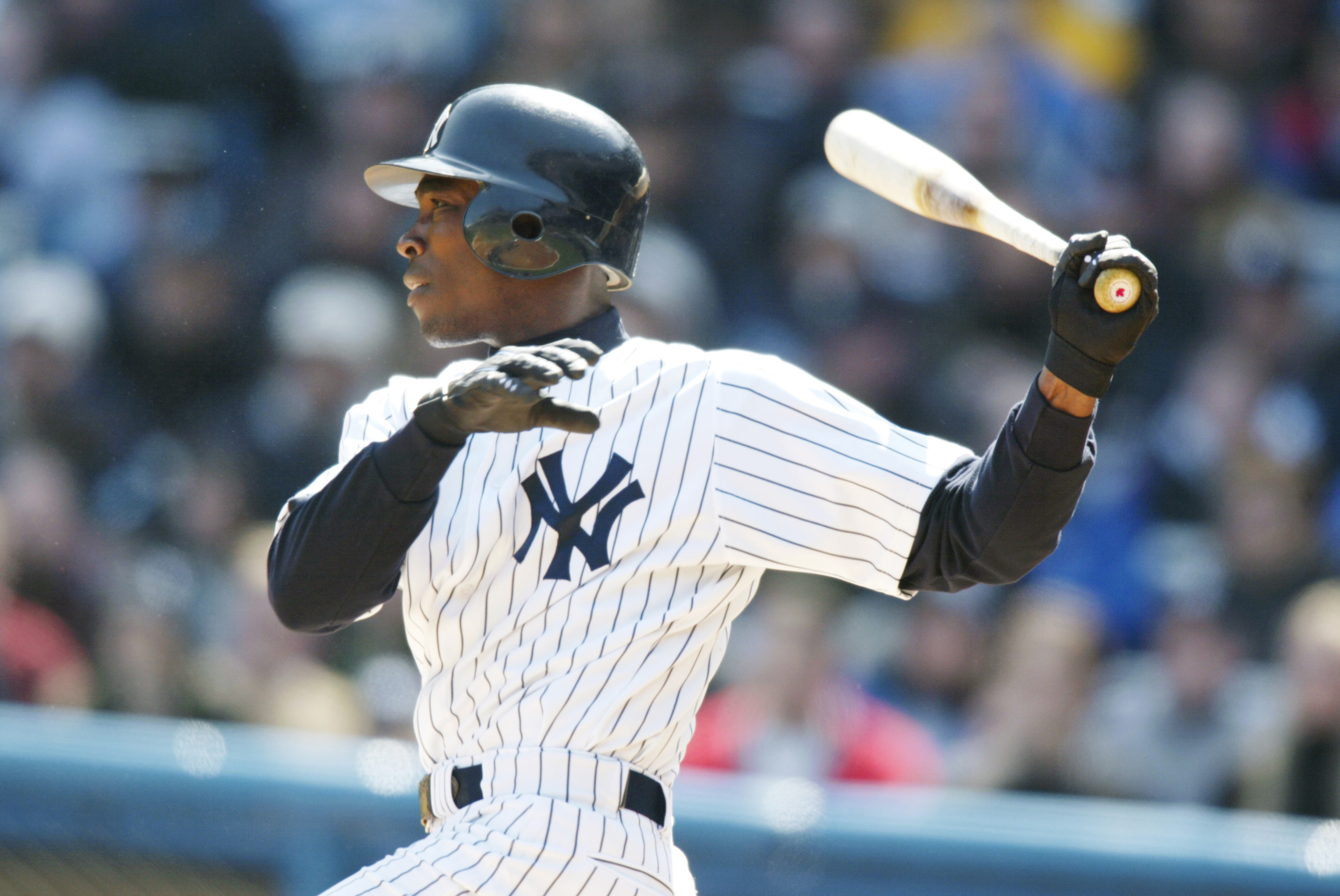
Soriano had a stellar 16-year career (Rumors and Rants)
As of yesterday, Alfonso Soriano is officially all done with baseball.

The end came quickly for Soriano, as it often does for whiffing machines in their late 30s. After exceeding 30 home runs and 100 RBI in both 2012 and 2013, Soriano fell apart at age 38 in 2014. Soriano batted a meager .221/.244/.367 with six home runs and 23 RBI in 67 games, snapping his streak of 13 consecutive seasons with at least 18 home run and earning a DFA from the Yankees in early July, followed by an outright release. New York cut him loose little more than a year after trading for him to ail their sinking offense, which he did with 17 homers and 50 RBI in just 58 games.

It was a grand return for Soriano, who began his professional career with the Yankees when they purchased him from Japan in 1998. One year later he made his debut, though his role was limited to a cameo on the championship teams of 1999 and 2000. In 2001 he inherited the everyday second baseman's job from the error-prone Chuck Knoblauch, only to become an error-prone second baseman himself. But like Knoblauch, Soriano could hit, and that more than compensated for his adventures in the field.

Following a third place-finish in the AL Rookie of the Year race in 2001, Soriano emerged as a star in 2002, earning his first All-Star nod, Silver Slugger award, and finishing third in the MVP race behind a pair of slugging shortstops: Miguel Tejada and Alex Rodriguez. Batting leadoff in Joe Torre's lineup ahead of Derek Jeter, Bernie Williams, Jorge Posada, and Hideki Matsui, Soriano led the major leagues with 128 runs, 209 hits, and stole a league-high 41 bases. With 39 home runs he narrowly missed a 40/40 campaign, especially since he hit his 39th with two weeks left in the season. He also batted an even .300 with 51 doubles and 381 total bases, making his 2002 one of the finest offensive seasons ever by a second baseman.

His 2003 was nearly as good (more valuable according to bWAR, actually), as he was again an All-Star, scored well over 100 runs (114), and went 30/30 with 38 bombs and 35 thefts (caught just eight times). He also piled up 358 total bases and knocked in 91 runs while cutting down on his strikeouts and improving his walk rate. Soriano seemed destined to wind up as one of the all-time great Yankee second basemen, in the same league as Joe Gordon and Willie Randolph.

Only fate intervened. Aaron Boone shredded his knee playing pickup basketball, leaving New York in need of a third baseman. Brian Cashman asked if Alex Rodriguez, who was nearly traded earlier in the 2003-2004 offseason to Boston, was still for sale. He was, and became a Yankee after New York sent Soriano and a player to be named later (Joaquin Arias) to Texas for A-Rod and cash.

Soriano played for four teams but started and ended his career in pinstripes (SBNation)
Soriano continued to produce big numbers for two years in the Texas heat before he was traded to the Washington Nationals, where he enjoyed the finest season of his career in 2006. Moved to left field, he responded with just the fourth 40/40 season in baseball history, joining Jose Canseco, Barry Bonds, and Alex Rodriguez. He also posted a career high .911 OPS en route to 6.1 bWAR and a sixth place finish in the NL MVP race.

That monster season, which included 362 total bases, couldn't have come at a better time for Soriano, who was in his walk year. He capitalized by signing an outlandish eight-year, $136 million contract with the Chicago Cubs which was doomed from the start, as he was about to begin his age 31 season when the ink dried.

Sure enough, Soriano's numbers slid as he aged and struggled with injuries, as he missed significant time in 2007, 2008, and 2009. The speed that helped him steal 30 or more bags five times from 2001 through 2006 dried up overnight, limiting him to single digit stolen base totals (outside of his aberrant 18 steal campaign in 2013) after 2008. His outfield defense, solid at first, grew to be truly abhorrent as his range diminished.

The Cubs' fortunes followed Soriano's, as they fell from playoff contender to one of the worst teams in baseball. It was fitting that they were stuck with a .250 hitter who rarely walked, struck out a ton, and couldn't run or field--a daily reminder of their massive misfire. Soriano would accrue 7.9 bWAR across his eight-year contract, worth not even one win per year despite being one of his league's 10 most expensive players from 2009 through 2013. His contract and underwhelming performance was a significant reason, but hardly the only one (see Edwin Jackson signing), for Chicago's rapid descent into irrelevance.

Soriano's age, declining skills and hefty salaries made his contract appear unmovable. Enter the Yankees, who are always willing to play past-their-prime players big bucks to fill out their roster. In desperate need of a power bat to complement Robinson Cano, the great heir to Soriano's second base job, New York sought out Soriano. That's he ended up back in pinstripes for the final act of his career, which included its last hot streak (second half of 2013) and last gasp (2014).

With 27.2 career bWAR, Soriano's not a Hall of Famer, but he's certainly a Hall of Gooder. His 412 home runs are 50th-most all-time, fueled by seven 30-homer seasons. The seven-time All-Star stole nearly 300 bases (289), notched over 2,000 hits (2,095), and eclipsed both 1,000 runs (1,152) and 1,000 RBI (1,159). His combination of power, speed, and low on-base percentages make him something of a modern Andre Dawson.

During the meat of his career from 2001 and 2013, he ranked second in doubles (to Albert Pujols), fifth in long balls, eighth in hits, 10th in runs and stolen bases, and 12th in RBI. It's easy to forget now just how exceptional he was during his prime 10 years ago, and how even in his later years he remained surprisingly durable and a steady source of power. He only had a handful of truly great seasons, but had more than a few good to okay ones. He didn't live up to his contract, but few players would have. It's not like it was a total disaster, either, as he did hit 204 home runs with 599 RBI, 1,004 hits, and an .802 OPS over the life of it.

Don't remember Soriano only for his failures with the Cubs and the massive paychecks he collected from them. Remember him as a good (but flawed), sometimes great ballplayer who combined power and speed like few others, hit wherever he went, then quickly faded away.

Monday, August 25, 2014

Castro and Rizzo Rebounding

Castro and Rizzo are enjoying big bounce back years after disappointing 2013s
Baseball fans have been spoiled by the recent, immediate success of the sport's numerous young stars. With so many guys showing up and setting the world on fire right away--Buster Posey, Jose Abreu, Jose Fernandez, Matt Harvey, Bryce Harper, Manny Machado, Yasiel Puig, etc.--the bar has been raised for how top prospects are expected to perform once they reach the big leagues.

What's more common is for young players to experience ups and downs, deal with the growing pains that are a natural part of the development process. The league adjusts to players, exploiting their holes and weaknesses, forcing the players to make their own adjustments that ultimately help them become better ballplayers. They're supposed to make mistakes, learn on the job through trial and error. They're supposed to fail. Just look what's happened to Xander Bogaerts, Gregory Polanco, and Kelton Wong this year. Does anybody doubt that their futures are still incredibly bright?

The Chicago Cubs recently experienced these issues with two of their most promising young position players. In 2012 both Starlin Castro and Anthony Rizzo were 22 years old, hailed as an up-and-coming tandem of stars that was supposed to help turn their struggling franchise around. Castro made his second straight All-Star team that year, batting .283/.323/.430 with a career-high 14 home runs and 25 steals while playing solidly above average shortstop. Worth somewhere between 3 and 3.5 WAR that year, he was easily a top-10 shortstop overall and one of the five best in the National League.

Rizzo, in his first season with Chicago after being traded by San Diego that January, started the year in Triple-A but was in the majors by the end of June and made an immediate impact, slugging four home runs in his first ten games and winning NL Rookie of the Month honors for July. Entrenched as the Cubs' everyday first baseman, he played well the rest of the way, finishing the year with a .285/.342/.463 slash line. He displayed good power as well, clubbing 15 doubles and 15 homers to go along with 48 RBI in roughly half a season (87 games).

Both appeared to be cornerstones of a rebuilding Cubs team that dropped 101 games in 2012 but had its eyes set on the future. Chicago improved marginally the following year, losing 96 games, but did so without much help from Castro and Rizzo. Castro bottomed out, flailing at the plate (hitting just .245/.284/.347 with a measly 72 OPS+) and regressing in the field, resulting in a sub-replacement level season.

Rizzo, despite once again showing good power (40 doubles, 23 dingers) and patience (76 walks), was also a disappointment. He batted only .233/.323/.419--roughly league average production when adjusted for league and park--and struck out 127 times in his first full season. He and Castro had been expected to improve, but instead appeared to take significant steps back.

This year both were selected to the NL All-Star team and appear to have gotten themselves back on track. Rizzo's emerged as one of the sport's top sluggers, with his 29 long balls just three shy of Giancarlo Stanton for the league lead. He's more than just a power hitter though, as his robust .278/.376/.510 batting line has made him one of the Senior Circuit's ten best hitters this summer, which is also evident in his high standing on many of the league's leaderboards.

Castro has also returned to form at the dish, with his .284/.333/.429 slash line nearly a dead ringer for his 2012 stats. He's one home run away from his personal best and needs only two more walks to tie his previous high. His defense has held steady compared to last year and he's all but abandoned his running game (four steals in seven attempts), but at least he's back to being one of the better-hitting shortstops in baseball.

The Cubs, who have improved again this year and can count on more hitting talent arriving shortly, have to be encouraged by these recent signs of progress. Castro and Rizzo are All-Star caliber players expected to be cornerstones of the organization's next postseason contender, which could be ready as soon as next year. For the Cubs to reach their full potential, Castro and Rizzo have to reach theirs, and based on their performance this year they appear to be doing just that.

Sunday, August 10, 2014

Coghlan's Comeback

Coghlan's been on base a lot lately (CSN Chicago)
Remember Chris Coghlan?

Until about a week ago, I'd completely forgotten the 2009 NL Rookie of the Year. After looking at his recent track record, it's not hard to see why.

In the four years between his rookie season and this one, he batted .242/.307/.352 with 12 home runs and 70 RBI in just over 1,000 plate appearances. Across 265 games he put up a 79 OPS+ and was worth -1.4 fWAR. Injuries played a big part in that, robbing him of almost the entire second half of his sophomore season (knee surgery), nearly 60 percent of his 2011  (inflammation in the same knee), and almost three months last year (lower back strain). In this regard he was like the National League equivalent of Grady Sizemore; an outfielder who'd shown tons of promise early in his career only to see his prime years ruined by injuries.

Still, the fact remains that when Coghlan was healthy enough to play during those years, he wasn't very good. So it came as no surprise that the Marlins, the only team Coghlan had ever known, non-tendered him last winter. It was time. Even bad teams like the Marlins can't afford to waste a roster space on a corner outfielder in his late 20s who can't hit, run, or field. With young Christian Yelich showing promise and ready to replace him, Miami had to cut Coghlan loose. No regrets and no hard feelings.

Closing in on 30, beaten down by injuries and five years removed his last (and only) good season, Coghlan looked like he was going to be remembered as one of those Rookies of the Year who fell off the map, a one-hit wonder whose best season just happened to come at the beginning of a career that, for whatever reason (injuries, failure to make adjustments, bad luck) never panned out. Added to the list of vaguely familiar names like Angel Berroa, Bobby Crosby, and Jason Jennings, recent Rookie of the Year recipients nobody remembers.

The rebuilding Cubs took a flier on him, giving him a minor league deal with an invitation to Spring Training. He wasn't on the big league roster when camp broke and was optioned to Triple-A Iowa, where he got on base a good amount (.379 OBP) but failed to hit a home run in 24 games there. He was basically Daniel Nava.

So it was somewhat surprising when the Cubs called him up in early May. Initially Coghlan played sparingly, limited to pinch-hitting duty and the occasional start. He began receiving regular at-bats in June and became more comfortable at the plate as a result. His batting line rose steadily throughout the month, from .139/.184/.139 on the first to .204/.281/.330 by the end of June.

In July, with the Cubbies no longer in contention, Coghlan began to shine. He hit safely in 13 of 14 games before the All-Star Break, catching fire and becoming a mainstay in Chicago's lineup. His power, dormant for so long, emerged as well with eight doubles and three homers.
Coghlan continued raking after the break, notching hits in 14 of 17 games to open the second half and raising his batting line all the way up to .302/.382/.498 after a 3-for-3 effort on August 6th.

It's been far and away Coghlan's best prolonged stretch of hitting since he batted .321/.390/.460 as a 24 year-old rookie in 2009. Rick Renteria, the Cubs manager, has responded by batting him leadoff, using Coghlan's on-base skills to jumpstart a lineup that doesn't have much offense outside of Starlin Castro and Anthony Rizzo (much like how John Farrell's been batting Brock Holt leadoff to try to spark an otherwise lifeless Red Sox lineup). With Coghlan notching 13 multi-hit games and reaching base more than 46 percent of the time since the calendar flipped to July, scoring 23 times as a result, the move has paid off. He's setting the table and giving the guys behind him lots of opportunities to drive in runs, which is all anyone can really ask of a leadoff man.

Coghlan's unexpected comeback has been of the better stories in baseball lately, seeing as how he appeared to be out of a job not too long ago. A career-best walk rate and improved strikeout rate have fueled his success along with the highest HR/FB rate of his career and a more balanced batted ball distribution. His .337 BABiP is significantly better than average but not out of whack with his .320 career rate, though his .413 rate since the start of July screams small sample fluke. Accordingly, neither Steamer nor ZiPS expect the 29 year-old to keep hitting this way much longer. Both predict that his OPS to fall about 50 points between now and the end of the season, but neither one projects him to totally fall apart, either.

That's because for the first time in half a decade, Chris Coghlan's a legitimately good baseball player again.

Saturday, July 12, 2014

A's Add Arms, Cubs Collect Chips

Jeff Samardzija makes Oakland's great rotation even better (ESPN)
"Going for it" has never really been part of Billy Beane's philosophy. He constructs his teams with the goal of regular season success in mind. They're built with depth and balance, designed to withstand the rigors of a long, grueling season. And they usually do, better than most. But without elite aces, top-shelf closers and dynamic power hitters, they are not built for the inherent randomness of postseason small sample sizes.

The playoffs are a different beast than the regular season. The margin for error is razor thin, and luck plays more of a role than we'd like to think. The goal is not to win 95 games in six months; it's to win 11 (or 12 if you're one of the wild card teams) in four weeks against the best competition baseball has to offer. Anyone can win a one-game playoff or five-to-seven game series. It truly is a crapshoot.

Beane knows this, and knows there's nothing anyone can do about it. He can't afford to chase the big-name power arms or sluggers that would likely put him over the top in the postseason. All he can do is build his team to make the playoffs and hope things fall into place. Hope they get the breaks and and the calls and the timely hits and big defensive plays.

Unfortunately for the Oakland A's, the stars haven't aligned for them in quite some time. It's been 25 years since Tony LaRussa guided Mark McGwire, Jose Canseco, Rickey Henderson, Dave Stewart, Dennis Eckersley and co. to Oakland's most recent World Series. For all the regular season success that Beane's teams have enjoyed in his 17 seasons as general manager of the A's--the six division titles, the seven playoff appearances, the two seasons with more than 100 wins and the six others with over 90--he's never won the big one. Incredibly, all of Oakland's wins have not produced a World Series championship in the most recent quarter-century. Beane's teams have never won a pennant, much less a World Series game.

This year, with Oakland cruising along to a third straight division title and likely the best record in baseball, Beane did something he rarely does. He traded young talent for established veteran starting pitching. Usually it's the other way around.

But with most teams still in the playoff hunt, Beane got a jump on the rest of baseball by making a big splash last weekend--nearly four weeks ahead of the trading deadline. He did business with another analytically-minded front office--that of Theo Epstein's and Jed Hoyer's Chicago Cubs--and was able to hammer out a deal more than a week before the All-Star Break. Dealing from a position of strength as one of the few seller's in a buyers' market, the rebuilding Cubs were able to pry away two top prospects and failed starter Dan Straily from the A's for a pair of talented starters; Jeff Samardzija and Jason Hammel, both of whom were enjoying excellent starts with the Cubs.

In Samardzija Oakland gets a very good pitcher, a 29 year-old flamethrower who struck out more than a batter per inning in 2012 and 2013. His 2.78 ERA would easily be the best mark of his career since becoming a regular starter in 2012, over a full run better than his previous best. None of his peripherals suggest he's been particularly lucky, so he's a good bet to sustain his performance going forward. Sure enough, he's been phenomenal in his first two starts with Oakland, allowing just four earned runs in 15 innings with a 10/1 K/BB ratio.

Hammel, with a 4.62 ERA (96 ERA+) in more than 1,000 big league innings, will never be mistaken for an ace, though he's pitched like one this year with a 2.98 ERA, 1.02 WHIP, and 4.52 K/BB ratio through his first 17 starts. Seeing as how Hammel is all of the sudden pitching the best baseball of his life at age 31 after many mediocre seasons, the Cubs were wise to sell high on him, though if he maintains his current K rate and walk rate--both career bests--he'll be very useful to the A's in the second half. His 3.32 FIP and xFIP indicate that he hasn't been especially lucky, though his .273 BABiP--34 points below his career rate--and 78.5 percent strand rate certainly suggest some good fortune. He's also on pace to set a career high in innings, which could lead to a fade down the stretch.

The trade gave the A's an abundance of arms. The stingiest team in the American League has so much pitching that they were forced to demote Tommy Milone, a crafty southpaw who hadn't lost a start since the beginning of May and carried a 3.55 ERA through the first week of July. On most teams he'd be a solid mid-rotation starter, but on the A's he isn't even good enough to crack the starting five.

As for the Cubs, they got quite a haul in outfielder Billy McKinney, Oakland's first-round draft pick last year, and shortstop Addison Russell--Oakland's first round selection the year before. Russell ranked as one of the sport's 15 best prospects coming into the season and has hit well in the minors, compiling an .897 OPS on the farm to date. McKinney has struggled in High-A Ball this year after raking Low-A last year but he's still only 19 and has plenty of time to figure things out. Even Straily, a decent starting pitcher before this year, could have some value if the Cubs get him right.

Both teams have to like this trade. The A's bolster their rotation and become the clear favorites to win not just the AL West, but the pennant as well. The early returns on the deal have been great, as Samardzija was terrific in his first two starts and Hammel pitched decently in his one. Meanwhile the future-minded Cubs unloaded Hammel, a free agent at year's end, and Samardzija, their most valuable trade chip. Arbitration-eligible this winter, he was due for a raise if the Cubs held on to him. In return they get two great pieces that figure to play a prominent role on the offensive juggernaut being assembled on the farm. They make the Cubs' already bright future even brighter and will likely be key contributors going forward for Chicago, who appear well-positioned to win a championship before the decade's out.

But if the Cubs win a title before Billy Beane does, then it will probably be because this trade went horribly wrong for him--like if Samardzija blows out his arm or Hammel regresses into the mediocre pitcher he was before this year. The AL West is a much more challenging division than the NL Central, which could also limit their effectiveness. Some have criticized this move as a redux of the ridiculed James Shields-Wil Myers trade from two offseasons ago, and it's possible that Beane just made a similar blunder. He hasn't had the best luck, you know.

Tuesday, August 27, 2013

Starlin Castro's Catastrophic Season

Coming into the 2013 season, Starlin Castro seemed to be a player on the rise. Just 23 years old, he'd already made two All-Star appearances and amassed over 500 hits. His power was developing and he'd improved upon his subpar defense. All signs pointed to a player who was trending upward, who was only going to get better until he reached his superstar ceiling in a few short years.

Well, so much for that.

Rather than continuing to progress, Castro's cratered. His latest slump (just seven hits--all singles--in the past two weeks) has dropped his batting line to .238/.276/.333. His strikeouts are up, way up, and his walks are down. His season-long slump has sapped his confidence, causing Castro to look worse with each passing day.

Those offensive struggles seem to have followed him out onto the field, where he's regressed into the below average shortstop he was prior to last season. He's shown poor decision making on the basepaths as well, getting thrown out in six of his 14 steal attempts.

In short: everything that could go wrong has gone wrong. And on top of that, his Chicago Cubs are wallowing in last place, playing out the string in what will become their fourth straight losing season and, more importantly, 105th consecutive year without a World Series championship.

But Castro was supposed to be one of the few bright spots for the Cubbies in 2013, a building block for a rebuilding franchise. Instead, he's unraveled. His numbers have flatlined to the point where he been the team's least valuable position players per bWAR.

As is usually the case with such dramatic drop-offs, he's been victimized by bad luck. His .287 BABiP isn't crazy low compared to the league average, but it is nearly 40 points below his career norms. His batted ball distribution hasn't changed much, so declining contact rates, especially on pitches within the strike zone, appear to be the culprit for his struggles at the plate. As for his issues on the bases and in the field, those have more to do with his Hanley Ramirez-esque mental lapses than anything else.

Castro's better than this, and I have to believe he'll bounce back next year. He showed far too much promise in his early 20s to be written off. Players who succeed at such an early age (i.e. Mickey Mantle, Alex Rodriguez, Albert Pujols) tend to thrive, if not get better. Even the best young baseball players struggle, as we've seen with Jason Heyward, Justin Upton, and Eric Hosmer.

Growing pains are part of the game, and it's clear that Castro still has some growing up to do.

Tuesday, March 20, 2012

Best Offensive Baseball Season of the 1930s

I had a hard time making a selection here because offense spiked so much during this decade.  Juicing the ball in 1930 with Australian wool probably produced at least five or six legitimate candidates that year alone. In the end, I copped out a little bit and just went with the overwhelming numbers of Lewis Wilson.

1930 Hack Wilson (7.4 bWAR)

The barrel-chested slugger;s career had been trending up since he became a full time player in 1926.  His home run, walks, SLG, and OPS increased each year since, very similar to how David Ortiz steadily improved from 2003 through 2006.  After leading the league in long balls three straight years, he seemed to peak in 1929 when he teamed up with Rogers Hornsby to lead the Cubbies to the World Series.  He set career highs in virtually every category and led the majors in RBI.  But just when it looked like Wilson couldn't get much better, he took his game to historic heights in 1930, his age 30 season.  It turned out that '29 was just a dress rehearsal for one of the best seasons of all time.

It was a perfect storm for Wilson to break Lou Gehrig's RBI record of 175, a number Larrupin' Lou reached three years prior while hitting in the heart of New York's Murderer's Row.  Wilson batted cleanup in a lineup that finished first in the NL in home runs, walks, OBP, SLG, OPS, and total bases.  The offense triple slashed .309/.378/.481, and the two team's number two and three hitters--Woody English and Kiki Cuyler--were perfect table setters.  They OB'ed .430 and .428, respectively, and racked up tons of extra-base hits (but not home runs, so they were always in scoring position and didn't clear the bases).  Not surprisingly, English scored 152 runs and Cuyler crossed home 155 times.  Wilson started slow out of the gate, but a 22 game hit streak in late April/early May kickstarted his monster season.  By midseason he was on pace for 164 RBI, only five more than his total the previous year, but he picked up the pace during the second half.  He drove in 118 runs over the season's last three months and  finished the year on a tear, knocking in 18 runs over his final ten games with a September hot streak that would make Troy Tulowitzki jealous.

His 56 dingers and 191 RBI gave him two-thirds of the major league Triple Crown.  He also paced the Senior Circuit with his 105 walks, .723 SLG, 1.177 OPS and 177 OPS+.  He also scored 146 runs, piled up 208 hits, and accumulated 423 total bases.  Although no MVP was awarded that season, Wilson probably would have won it.  As it were, the BBWAA recognized him as the National League's most "useful" player.  His 191 RBI is one of baseball's most unbreakable records.  Lou Gehrig (184--the American League record) and Hank Greenberg (183) challanged it during the decade, but in the 70 years since nobody has seriously threatened the mark.  Manny Ramirez drove in 165 runs in 1999 while missing 15 games, but extrapolating his numbers to a 162 game season still only takes him to 181.  Unless he went on a grand slam binge, I don't think ManRam would have eclipsed Wilson's record anyways.

Unfortunately Wilson lived, drank, and fought harder than he played.  He reported to spring training 20 pounds overweight the following year, and predictably his production fell off a cliff Adam Dunn-style.  He made matters worse by blaming Hornsby, the new skipper, for not letting him be as aggressive at the plate as former manager Joe McCarthy had.  He found himself riding the pine in May, and by late summer Cubs owner William Wrigley Jr. expressed his desire to trade him.  In September Wilson was suspended without pay for sparring with reporters while boarding a train in Cincy.  He finished with his worst numbers since his days with the Giants, and his off-field issues left a sour taste in the organization's mouth. Chicago dealt him to the Dodgers after his OPS plunged nearly 400 points, and although Wilson did bounce back in 1932 he was never the same player.  His swift decline forced him out of baseball before his 35th birthday.  Although he only put together half a dozen good years, he did enough during that abbreviated stretch to earn a spot in Cooperstown from the Veteran's Committee in 1979, more than three decades after his death.


Some more big stats from Wilson's big year

-Laid down an astonishing 18 sacrifice hits that year, though that isn't too surprising when you see that he averaged 19 per year from 1927 through 1930
-His 56 home runs stood as a National League record until 1998, when Mark McGwire and Sammy Sosa obliterated it with their epic home run chase
-In 1999 the Commissioner of Baseball officially increased Wilson's 1930 RBI total to 191 after a box score analysis by baseball historian Jerome Holtzman revealed that Charlie Grimm had been mistakenly credited with an RBI actually driven home by Wilson. 
-Drove in 109 runs during the season's second half.  In 2010 Robinson Cano needed the whole season to plate 109 runners.  In August alone, Wilson knocked in 53 runs.
-Loved hitting at Wrigley, where his OPS was 240 points higher than it was everywhere else that year.  His 33 home runs and 116 RBI there match Ryan Howard's full season production from last year.
-Wilson led the league in strikeouts for the fourth straight year with 84 whiffs.  Nowadays, that would be a fantastic number for a 50 home run hitter.
-The only team that gave him some trouble was the St. Louis Cardinals, who beat out the Cubbies for the pennant by a mere two games

Thursday, October 13, 2011

Cubs Hire Epstein

Epstein will attempt to break an even longer curse in Chicago
Terry Francona was the first casualty of the historic Boston Red Sox collapse, and now it looks like DM wunderkind Theo Epstein has put Beantown in his rearview mirror as well.

After building the unforgettable team that ended the city's 86 year World Series drought, Epstein is reportedly on his way to Chicago, where he will attempt to help the Cubbies win their first title since 1908 (or at least get them to their first Fall Classic since 1945).  The Cubs had already wooed Theo throughout most of September, and it's certainly possible he would have taken the position even if his Red Sox managed to hold their Wild Card lead and limp into the postseason. 

Although it is sad to see the architect of Boston's mini-dynasty skip town, there really wasn't much left for him to do there.  He joined the Sox as a 28 year-old Yalie, the youngest GM in baseball history who had dreamed of working for the Old Towne Team as a high schooler in local Brookline.  He inherited a talented team from interim GM Mike Port that hadn't made the playoffs since 1999 but included superstars Manny Ramirez, Nomar Garciaparra and Pedro Martinez.  After a roster overhaul brought undervalued players such as Kevin Millar, Bill Mueller, Todd Walker and David Ortiz to Beantown during his offseason debut, he had assembled one of the most potent lineups in baseball history that carried the team to within five outs of the World Series.  After replacing Grady Little with Terry Francona, Epstein addressed the squad's most glaring weakness--pitching--by bringing an ace and shutdown closer in Curt Schilling and Keith Foulke.  But he still wasn't content, and nearly pulled off a blockbuster three-way trade of Nomar and Manny for Alex Rodriguez and Magglio Ordonez.  This guy had guts.

And the rest, as they say, is history.  Epstein saved the 2004 season with a blockbuster deadline trade of Garciaparra to the Cubs to acquire Gold Glovers Orlando Cabrera and Doug Mientkiewicz, two players who sparked Boston's second half surge and eventual World Series triumph.  Boston bowed out of the ALDS in 2005, and Epstein unexpectedly resigned shortly after.  Fortunately, he was rehired as the GM and Executive VP three months later and helped bring Boston another championship in 2007.  Meanwhile, the organization thrived; Fenway Park is riding an impressive sellout streak, the franchise became much more saavy with its new emphasis on statistical analysis, the farm system flourished (see Dustin Pedroia, Kevin Youkilis, Jacoby Ellsbury, Jon Lester, Clay Buchholz, and Jonathan Papelbon) and the team is a threat to win the World Series every year. At this point, his job was more about maintaining and tweaking the team than rebuilding it . 

Even so, Epstein has received plenty of criticism for his inability to find a stable, productive replacement at shortstop for Garciaparra, whose successors include Edgar Renteria, Alex Gonzalez, Julio Lugo, Jed Lowrie, and Marco Scutaro.  He's also been bashed for questionable and expensive free-agent signings such as Renteria, J.D. Drew, Julio Lugo, Daisuke Matsuzaka, John Lackey, and Carl Crawford.  I don't blame Epstein for any of them because they were all good players when he signed them and it's impossible to gauge how a player will handle Boston's intense media and fans.  The Red Sox have the second largest payroll in baseball at $163 million, so they can afford to make these kinds of "mistakes," just as the Yankees can afford to lose money on Kevin Brown, Carl Pavano, Kei Igawa, A.J. Burnett, and Rafael Soriano.  Perhaps they weren't the wisest decisions, but they were certainly defensible at the time.

So now he takes over the Cubs with a new five year, $20 million contract.  Fifth place Chicago just completed a 71-91 season and is looking to rebuild around a solid young nucleus that includes Starlin Castro, Geovany Soto, Tyler Colvin and Matt Garza.  Their attendance is strong (over 3 million fans) and they have a lot of money coming off the books soon, but the frustrated franchise still has a long way to go if it wants to overtake the more talented Cardinals, Brewers and Reds. 

First he vanquished the Curse of the Bambino, so naturally the next step is to take down the even longer and more ludicrous Curse of the Billy Goat.  Fortunately for long-suffering Cubs fans, Epstein is the right man for that job.