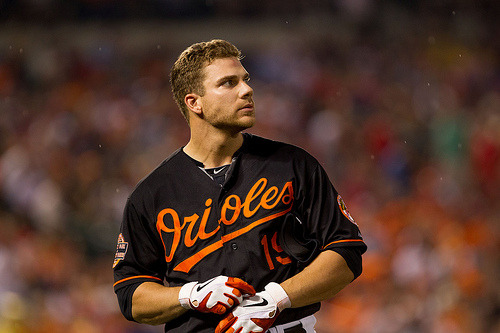
Showing posts with label Baltimore Orioles. Show all posts

Monday, May 1, 2017

Ellsbury's Slam Saves Yanks

Ellsbury's 100th career homer was also his first grand slam (New York Daily News)
In the seventh inning of Friday night's wild slugfest at Yankee Stadium, which New York won 14-11 in 10 innings despite trailing 9-1 in the sixth and 11-4 in the seventh (way to go, Orioles bullpen), Yankee center fielder Jacoby Ellsbury did something he'd never done before in a Major League game.

New York trailed by seven runs when Ellsbury stepped to the plate with the sacks full and one out in the bottom of the seventh. The Yankees were threatening, but they desperately needed a hit from their cleanup man, who was 0-for-3 to that point (why's he hitting fourth in the first place?!). Their chances of winning were three percent, and it was starting to get late real early in the Bronx.

Hoping to keep the rally going, Ellsbury got himself into a 2-1 count against lefty Vidal Nuno, who was looking shaky after allowing Chase Headley to double and walking Matt Holliday to load the bases. Now Nuno needed to throw a strike, and everyone in the park knew it.

But as he lifted his right leg and aimed a 92 mile-per-hour fastball towards home plate, the possibility of a grand slam seemed remote. For starters, Ellsbury has never been much of a power hitter, reaching double digit homers only twice in 11 seasons. When he does go yard, it tends to be against right-handers and in the second half. The platoon split has become even more pronounced recently, as he managed just one homer in 196 plate appearances against lefties last year.

Career vs. RHP: 1 homer per 39 at-bats
Career vs. LHP: 1 homer per 75 at-bats

Career before July 1st: 1 homer per 71 at-bats
Career after July 1st: 1 homer per 34 at-bats

He also homers less frequently from the seventh inning on (about once every 54 at-bats), but the gap there is less substantial.

There was also the fact that Ellsbury had as many career grand slams as the nearly 37,000 non-Major Leaguers in attendance that night. He had hit 99 home runs, but none with ducks on the pond. He'd plated 73 runs in 106 bases-loaded plate appearances and amassed 478 career RBIs, but never four at once.

So, to recap: Ellsbury hitting a home run at all -- unlikely. Ellsbury hitting a home run off a lefty in April -- even more unlikely. Ellsbury knocking a grand slam out of the park -- unprecedented. The only thing working in Ellsbury's favor was Nuno's propensity for serving up long balls (career 1.5 HR/9 rate), but even that doesn't mean much when you consider that he's only thrown 340 innings in his career.

But that's the beauty of baseball. There are so many games and pitches and at-bats that crazy things happen all the time. Just this weekend, Anthony Rendon went 6-for-6 with three homers and 10 RBIs, the Dodgers drilled three straight homers before walking off in the bottom of the ninth, and Jacoby Ellsbury finally hits a grand slam.

How could he not? That pitch from Nuno was a meatball, straight as an arrow and right down Broadway. A batting practice fastball just begging to be crushed.

And Ellsbury crushed it alright, launching it 417 feet into the right-center bleachers -- his longest homer of the season by 35 feet. The scoreboard read 11-8, the Stadium was rocking, and New York's chances of victory had soared from three percent all the way to...10 percent. The psychological shift, though, was much greater. Teams almost never come back from seven-run deficits, particularly in the late innings. There's just not enough time, and bullpens are too deep nowadays. But get a few men on in an inning, and a three-run lead can disappear with one swing.

Sure enough, Ellsbury's blast proved to be a turning point in the game. The Orioles were so demoralized that after piling up 11 runs in the previous five innings, they managed only one baserunner over the next three frames. The rejuvenated Yankees, meanwhile, rallied to tie the game with three runs in the ninth before completing their epic comeback with three more in the tenth.

It took more than 5,000 plate appearances over 11 years for Jacoby Ellsbury to hit his first grand slam. At that rate, it might also be his last. But if it is, at least he made it count.

Friday, February 26, 2016

Orioles Get Good Deal on Gallardo

Gallardo gives the Orioles a frontline starter (MLB.com)
Just when you thought the offseason was winding down and rosters were pretty much set, the Baltimore Orioles made a last-minute splash by inking Yovani Gallardo to a two-year, $22 million deal with a $13 million option and coming oh-so-close to signing Dexter Fowler (more on that to come).

It seemed like the Orioles were content to roll out last year's team minus Wei-Yin Chen, which didn't look promising given that a) Chen was their best pitcher and b) they finished .500. But after shelling out $161 million to keep Chris Davis--more money than they'd ever paid anybody before--there wasn't much wiggle room left in their budget to upgrade elsewhere or re-sign Chen, who landed a five-year, $80 million payday from the Marlins.

In Gallardo, however, they essentially replaced Chen at a fraction of the cost. Both are 30 and have produced almost identical results since Chen made his major league debut in 2012:

Chen 2012-15: 706.2 IP 3.72 ERA 110 ERA+ 4.14 FIP 1.25 WHIP 7.0 K/9
Gall. 2012-15: 761.1 IP 3.69 ERA 108 ERA+ 3.94 FIP 1.34 WHIP 7.3 K/9

Chen's the better option because he has more strikeouts, fewer walks, and pitches from the left side, but not so much better that he deserves a substantially better contract. The Orioles shouldn't feel bad about letting him walk, as they got a great consolation prize in Gallardo.

They also have to be encouraged that Gallardo made a smooth transition to the American League last year, compiling the best raw and adjusted ERA of his career despite making half his starts in the brutal Texas heat. Camden Yards is also tough on pitchers, but that shouldn't be a problem now that Gallardo's thrived in two difficult parks to pitch in (the other being Milwaukee).

What the Orioles should be worried about, however, are Gallardo's poor peripherals. He had the worst WHIP of his career in 2015 and his xFIP was 4.31, nearly a full run higher than his ERA and also a career-worst. In addition to getting lucky on his strand and home run rates, he posted a career-low 5.9 K/9 rate--the third straight year in which his strikeout rate declined. That, combined with his pedestrian walk rate, resulted in a career-low 1.78 K/ BB ratio. Those are the numbers of a bad pitcher, not a good one earning eight figures a year.

That said, Gallardo's track record suggests he'll be a good bargain for the O's as long as he stays healthy, which has never been a problem for him in the past (he's started at least 30 games in each of the past seven years). His durability and consistently above average results (only once has he had a below-average league and park-adjusted ERA) have helped him exceed two fWAR every year dating back to 2009. That may not seem very impressive, but dollars-wise it's worth a lot. Gallardo has provided well over $11 million (his current salary) of value every year of his career but one; 2008, when he made just four starts. As long as he keeps converting half of balls put in play against him on the ground, he'll be fine (Baseball-Reference has him pegged for a 3.68 ERA in 171 innings next year).

Gallardo doesn't have the ceiling of a David Price or even a Chen, but he does have a very high floor, and that's what the Orioles are paying him for.

Monday, September 28, 2015

Sox Sweep Fenway Finale

Holt celebrates after scoring the first run of Sunday's game (Washington Post)
The Red Sox put their fans through a lot of pain and suffering this summer. But on a beautiful fall weekend in New England, they treated the Fenway Faithful to their best baseball of the season.
 
With Baltimore in town for the season's final series at the Fens, Boston did not allow a single run in the three-game set. In just their third sweep of the season (all at home), they had more shutouts in one weekend than they did in the previous three months.
 
Friday night featured another dominant start by Rich Hill, who has struck out 10 batters in each of his three starts since joining the Red Sox two weeks ago. The area-native was near-perfect, allowing just two hits and one walk as he breezed through a tough Orioles lineup. Boston backed him up with plenty of run support, breaking through for three runs in the sixth to send Kevin Gausman to the showers and give Hill a 5-0 advantage.
 
It was 7-0 when he came back out for the ninth, seeking his first complete game shutout since 2006 and just the second of his career. He nearly lost it with one out to go when Chris Davis launched his 116th pitch of the evening towards the right field bullpen, only to be saved by a spectacular leaping catch at the wall by Mookie Betts--the kind of catch Torii Hunter just missed making two Octobers ago.
 
If Hill's shutout was unexpected, surely nobody thought the Sox would get another one on Saturday--Boston's bullpen day. Interim manager Torey Luvollo gave Craig Breslow his first career start. Breslow--terrible this year and last out--baffled the O's through four in the longest outing of his career. A half-dozen relievers followed him out of the bullpen as Heath Embree worked out of a two-on, two-out jam in the fifth, Matt Barnes kept Baltimore at Bay in the sixth and seventh, and a different pitcher recorded each of the three outs in the eighth. 24 year-old rookie Jonathan Aro closed out the ninth,.
 
Once again Boston's bats were quiet in the first half of the game but erupted in the second. Held scoreless by Wei-Yin Chen through four, the Red Sox got on the board thanks to a RBI double from Josh Rutledge. Though they left the bases loaded, their bats had come alive and would add another run in the sixth, two more in the seventh, and four in a lead-padding bottom of the eighth. Only two of Boston's eight runs were earned, however, as Baltimore committed three errors in the field.
 
That sloppy defense persisted on Sunday, as Orioles outfielders lost a pair of fly balls in the early-autumn sun. Neither time did the Red Sox capitalize, though they did break the ice on a wild pitch by the notoriously erratic Ubaldo Jimenez, who has led his league in that dubious statistic twice in the past five years. His errant offering to Big Papi bounced up off the glove of Caleb Joseph, rolling far away enough for Brock Holt to score easily off his terrific jump. Boston doubled its lead on a Blake Swihart home run--his third of the season, and that proved plenty on a sleepy afternoon for both offenses.
 
Because while Jimenez was actually quite good, Henry Owens was even better. For the second time in 12 days, he pitched 7 and 2/3 scoreless against the Orioles. It was, according to GameScore, the best outing of his young career, which consists of the 10 starts he's made since his early August call-up. He's now gone at least seven in each of his last three starts after doing so just once in his first seven.
 
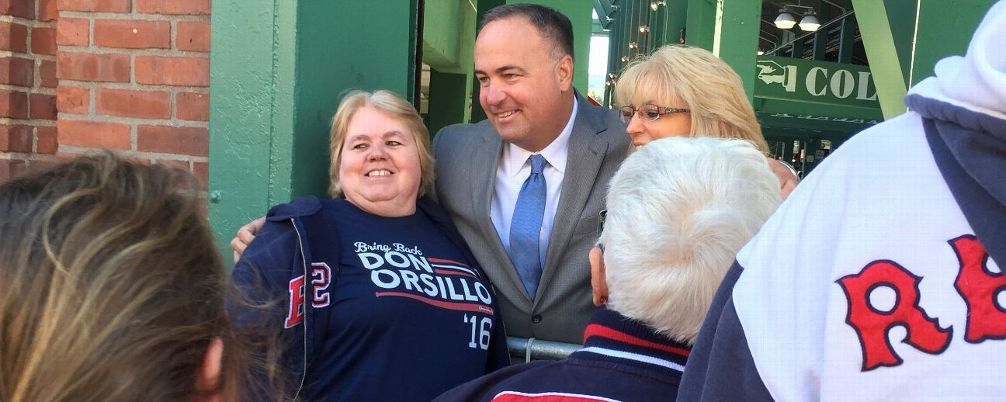
Owens walked off the mound to a thunderous cheer from the Fenway crowd (paid attendance: 33,306), but that was nothing compared to the receptions given to Larry Lucchino and Don Orsillo. Both received outstanding video tributes as well as a big hand from the fans. But while Lucchino was named honorary President/CEO and threw out the first pitch, it was Orsillo who felt the warm, loving embrace of the fans. Sad to see their popular play-by-play announcer go, the Fenway Faithful followed a stirring highlight reel of Orsillo's most memorable calls and hijinks (which NESN, true to form, did not show) with a full-throated standing ovation. Many of whom hoisted cutout images of  of the recently-fired TV commentator's face, while even more chanted his name. Orsillo returned the salute with one of his own, grateful for the groundswell of support he's received throughout this entire episode, then sat in silence, momentarily unable to describe what was happening on the field.
 
It hasn't been a pretty year for the Red Sox, a season most would like to soon forget. But yesterday, which ended with thousands of fans circling the bases as the sun set over their beloved ballpark, was one that many, myself included, will always remember.
We'll miss you, Don (ESPN)
 

Friday, June 12, 2015

Sox Swept, Sinking Fast

Farrell (L) and Miley pictured moments before their shouting match (Boston Herald) 
It's starting to turn into that kind of season for the Red Sox, the kind of season where they take one step forward, then two steps back. The kind of frustrating year where they're hot one week, cold the next, and ultimately end up underperforming expectations. By a lot.

Over the weekend Boston swept the Oakland A's at home. In and of itself, this was not impressive. The A's were, and still are, the only team in the American League with a worse record than the Sox. Furthermore, the Red Sox were at home, where they've actually had a winning record this year (hard to believe, I know). All three games were close, too, with Boston winning each by three runs or less.

So even though it took the Red Sox two months to earn their first sweep of the season, and they won three in a row for just the second time all year, and at the end of it they were still last in the AL East, there was hope. They were starting to hit. Their pitching had been better. Things were looking up for the Olde Towne Team, especially with a three-game set against Baltimore, with whom the Sox shared last place. With an off day for travel, Boston would be fully rested and ready to continue their recent tear.

Didn't happen. The Red Sox stumbled into Camden Yards and dropped three in a row, falling a season-worst seven games below .500. They were blanked 1-0 in the opener despite Miguel Gonzalez, the Orioles starter, leaving the game in the fifth with a strained groin, for which he was just placed on the DL. They left nine men on base and went 0-for-8 with runners in scoring position, wasting another magnificent start by rookie Eduardo Rodriguez, who gave them six shutout innings while striking out seven.

The lineup, which has struggled all season long despite the high-priced additions of Pablo Sandoval and Hanley Ramirez, dropped the ball again in the middle game as Boston fell 5-2. That one was more on Rick Porcello, who allowed the Orioles to jump out to a 2-0 lead and was scored upon both times Boston scratched out a run. Porcello's pitched poorly all season with a 5.26 ERA to show for it, making the $82.5 million contract extension he received two months ago look like a mistake with each time he takes the ball.

The finale featured a similarly ugly outing from Wade Miley, who was bombed for three home runs and had more runs allowed than innings pitched in his final line for the fourth time this year (out of 12 starts). After being rightfully removed from the game, Miley proceeded to lose it on John Farrell in the dugout, as if it's somehow the manager's fault that Miley owns a 5.07 ERA on the season. Down four runs by the end of the third, the Sox rallied but ultimately came up just short, losing by one run for the second time in three days.

And with that, Boston has now lost three in a row five times this year. They've been swept three times, though this was the most inexcusable given that a) Baltimore was a last place team going into the series.and b) the Red Sox used their two best starting pitchers. They're back home tonight, where they've played decently this year, but against the red-hot Toronto Blue Jays, winners of eight in a row. The Jays have the kind of lineup that can feast off Boston's weak rotation, especially with righty mashers Jose Bautista, Edwin Encarnacion, and Josh Donaldson capable of launching balls over the Monster.

Tonight's game in particular has all the makings of a slugfest, what with two mediocre starting pitchers (Drew Hutchison and Joe Kelly) facing opponents that have given them serious trouble this season. Tomorrow afternoon's tilt could bring more of the same, with probable starters R.A. Dickey and Clay Buchholz a combined 5-12 on the season. The Red Sox should have the upper hand in Sunday's series finale with Rodriguez back on the bump versus Marco Estrada, and they'll likely need a strong start after the heavy workload Boston's bullpen will have to carry today and tomorrow.

Rodriguez, a 22 year-old rookie, is the only Boston starter who can be trusted right now. That says all you need to know about how this season is going for the Sox.

Wednesday, December 3, 2014

Atlanta Acquires Markakis

Nick Markakis is solid, but he's no Jason Heyward (Huffington Post)
Three weeks after trading Jason Heyward and Jordan Walden to the St. Louis Cardinals in exchange for Shelby Miller and Tyrell Jenkins, the Atlanta Braves have found a replacement right fielder in Nick Markakis.

Now, at $44 million over the next four years Markakis is going to cost Atlanta a lot less than Jason Heyward would have (Heyward's going to be a free agent next winter), but he's also not nearly the player Heyward is. Over the past four seasons, Markakis was worth 5.8 fWAR, while Heyward was worth 5.1 fWAR last year alone. Since 2010, Heyward's rookie season, he's compiled 21.4 fWAR to Markakis's 8.2. The gulf between them is only going to grow wider, as the 31 year-old Markakis is exiting his prime while Heyward (25) is just entering his. So while Markakis may not be as expensive as Heyward, he's hardly a bargain.

And based on how Markakis has aged, Baltimore was wise to let him walk. He peaked early, had his best season at 24, and was merely solid throughout the rest of his 20s. Now 31, his best case scenario is that he holds steady and remains a 2-2.5 win player. If he follows a normal aging curve, we'd expect him to lose about a half win per season and regress to replacement level by the end of the contract.

His decline will likely accelerate in Atlanta, as Markakis's already middling power numbers (.097 ISO in 2013-2014 combined) will suffer away from Camden Yards. Markakis made the most of his mediocre pop there, taking advantage of its close right field wall by slugging 23 of his 37 home runs at Camden over the past three years. Make him play half his games at the more neutral Turner Field, though, and he goes from being a 15-homer guy to a 10-homer guy, probably less than that as he gets older. Such pedestrian power wouldn't play at second base (looking at you, Dustin Pedroia), much less right field.

That said, Markakis does bring some positive qualities to the table. He's very durable, having played at least 147 games in all but one of his nine big league seasons. A career .290 hitter, he has great contact skills and walks a good amount too (.358 career OBP). He's a decent baserunner for his age and a capable right fielder, though not as good as his two Gold Gloves might suggest. He's never had a bad season and is a lock for solid numbers if healthy. Barring serious injury, he's a good bet to produce six or seven wins over the life of his contract for Atlanta to get its money's worth.

Then again, you could say all those things about Nori Aoki, and nobody's giving him four years and $44 million.


Monday, December 1, 2014

Nelson Cruz Massive Mistake for Seattle

Cruz rode a career year with the Orioles to a massive payday (NBCDFW)
The Seattle Mariners added some much-needed righthanded thump to their lefty-heavy lineup, signing Nelson Cruz to a four-year deal worth $57 million. Cruz, 34, led the major leagues with 40 home runs last year, 13 of which qualified as "just enough" according to ESPN's home run tracker. He also knocked in 108 runs and was worth 4.7 bWAR en route to a seventh-place MVP finish, the first time in his career he drew MVP votes.

That's way too much for an aging, injury-prone slugger who hardly walks, can't run, and plays abysmal defense. Last year, coming off a PED suspension, Cruz settled for a one-year, $8 million contract with the Orioles. No question he was undervalued at the time. But now, another year older, and he gets four years and almost $60 million? In the same neighborhood as Victor Martinez, a far superior hitter in every sense (but also two years older)? Sounds like an overpay to me.

Cruz re-established his value with a tremendous 2014, but Seattle would be foolish to expect another season like that from the three-time All-Star. He is, after all, past his prime and only once played more than 130 games before suiting up for 159 last year, though that number will be more attainable if he abandons playing the outfield altogether and settles in as Seattle's everyday DH (a likely scenario given Safeco's spacious outfield). His 2014 bWAR total exceeded his total from 2011-2013 combined (4.3 bWAR), reflecting just how much of a fluke last year was for him.

It's going to look even flukier after moving into the hitter's nightmare that is Safeco Field. Cruz has benefitted enormously from friendly home parks in Texas and Baltimore throughout his career, posting an .890 OPS at home compared to .769 on the road. Playing half his games in Seattle, plus more in LA and Oakland, is probably going to push his OPS down to that road figure or possibly below, making him a league average bat with decent power (20-25 homer upside).

Basically, I hate this deal for Seattle because Cruz can only provide value with his bat at this stage in his career, and he's going to a place that suffocates offense. He'll improve Seattle's lineup some, but won't provide an impact worthy of his lavish contract, especially given his durability issues. I think the Mariners will be luck to get 20 bombs and one WAR out of Cruz next year, which would be very valuable given their current position on the win curve. But a few years from now, Cruz won't even be able to give them that, and they're going to regret committing so many years and dollars to an injury-prone, one-dimensional corner outfielder/DH in his mid-thirties.


Saturday, October 11, 2014

Hate Hardy's Extension

Hardy's still great in the field, but his bat has slipped (BaltimoreSports)
I was surprised to hear the other day that the Baltimore Orioles inked shortstop J.J. Hardy to a three-year, $40 million extension. Teams usually wait to take care of this stuff until after the postseason, but with Baltimore still basking in the afterglow of its first AL East title since 1997 perhaps Dan Duquette was feeling a little bold.

Not saying this move is bold, per se, but it could easily backfire. This move has been largely well-received, and frankly I'm not sure why. Hardy's a 32 year-old shortstop, after all, and is coming off a poor season with the bat. He managed just nine home runs last year after swatting 77 over the previous three seasons, with a career-low .104 ISO to go with it. He also posted the worst walk rate of his career at 5.1 percent, as well as the highest K rate (18.3 percent). None of that bodes well for a hitter who previously derived most of his offensive value from power due to his subpar on-base skills and non-existent speed.

So even though Hardy had just as much value this year as he did in 2013 (3.4 fWAR), when he was a Gold Glove and Silver Slugger-winning All-Star, I see a player in decline. Most of that value stems from his stellar defense, which by itself was worth at least two wins this year according to both B-R and FanGraphs. Hardy won't win another Silver Slugger, but he deserves a third straight Gold Glove award.

The problem is that sooner or later, Hardy's defense is going to start slipping. He's getting to that age where reflexes begin to slow down and range starts diminishing. Maybe not next year or maybe not the year after, but it will happen eventually because it happens to everyone, including shortstops much more gifted than Hardy.

And given his spotty track record at the dish (his wRC+ has been above 100 just once in the past six seasons), Hardy's hardly a guarantee to bounce back offensively. An average hitter at best, Hardy will be a real liability at the plate if he can't recoup some of the power that made him an annual 20-25 home run threat prior to this year. He doesn't walk enough, run enough, and strikes out way too much for a guy with single-digit home run pop.

If I'm Dan Duquette, I'm not giving three years and $40 million to a 32 year-old who's batted .255/.298/.399 over the past three years, and I'm definitely not banking on him to rebound.

Wednesday, September 17, 2014

Birds, Nats Clinch

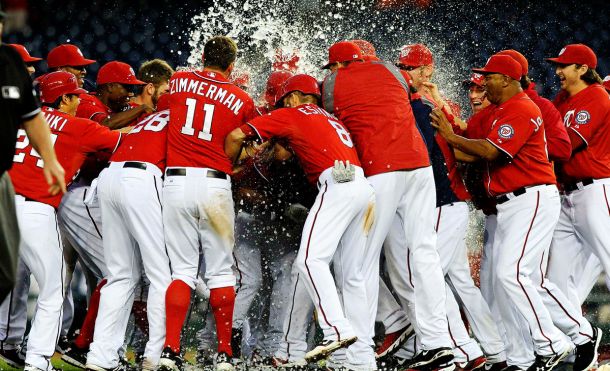
Washington won its second division title in three years (Vavel)
Last night was a great night to be a baseball fan from the D.C. metro area. In Atlanta the Nationals blanked the Braves 3-0 to clinch the NL East for the second time in three years. In Baltimore the Orioles won their first division title since 1997, bludgeoning the Blue Jays 8-2 in front of a celebratory home crowd of 35,000-plus.

But while both of the nation's capital's baseball teams ended up in the same place--at the top of their division and postseason-bound--how they got there turns out to be two very different yet similar stories

It's impossible to talk about this season without first mentioning 2012, when both teams shed their also-ran status by making the playoffs. Washington was the best team in baseball that year, winners of 98 games and clear favorites to win the National League. The former Montreal Expos had been more or less irrelevant since moving to Washington after the 2004 season, never winning more than 81 games and finishing last in their division five times, but thanks to an influx of young talent and a killer pitching staff that had changed practically overnight. For the first time since 1933, there was playoff baseball in our nation's capitol.

That same year, the Baltimore Orioles also came out of nowhere to make the playoffs, winning 93 games and the AL Wild Card. The once-proud franchise had endured 15 straight losing seasons prior to its magical turnaround, going from a 69-93 last-place finish in 2011 to two games out of first the following year.

The Nationals were a veritable juggernaut. The Orioles were a Cinderella story, a good team that overachieved due to extraordinary luck in one-run games. And yet they both met the same fate: eliminated from the Division Series in five games, with Baltimore falling to their mighty division rivals from New York and Washington losing to the defending World Series champion St. Louis Cardinals.

Still, 2012 was a banner year for the Nats, who were poised to be the crown jewel of the Senior Circuit for the foreseeable future. That season marked not just the beginning of a new era in Washington baseball, but also appeared to signal a changing of the guard in the NL East, a transition away from the Braves dynasty and Phillies mini-dynasty. With their tantalizing core of young position players (Bryce Harper, Ian Desmond, Wilson Ramos) and plentiful pitching (Stephen Strasburg, Jordan Zimmermann, Gio Gonzalez), Washington was armed and ready be kings of NL East for years to come.

For the first time since Clinton's presidency, the O's are AL East champs (Baltimore Sun)
The Orioles, on the other hand, were treated as a fluke. There was no such talk of a repeat performance in 2013, much less the next Orioles dynasty. They had an outstanding core of in-their-prime position players (Adam Jones, Matt Wieters, Nick Markakis, J.J. Hardy), but not nearly enough arms to match their competitors in the AL East. Everyone knew that with natural regression they'd likely be a .500-ish team in 2013, and that's basically what happened. They won 85 games and fell back to the pack, finishing tied-for-third with the Yankees behind pitching-rich Boston and Tampa Bay. Nobody saw Baltimore as underachievers that year, but rather a club that played to its true talent level.

Not so with the Nationals, the preseason favorites to win the World Series. Washington was shockingly irrelevant last summer, 16 games out of first and four below .500 on the morning of August 20th. A late surge pushed them 10 games over .500 but still left them 10 back of the Braves and out of the playoffs. Almost the exact same results as the Orioles, one might notice, but drastically different expectations led to the Nationals' season being viewed as a massive disappointment, if not an outright failure.

Both responded with significant roster upgrades over the winter--Baltimore inked Nelson Cruz and Ubaldo Jimenez while Washington stole Doug Fister from Detroit--and have come back strong. The Nationals reclaimed their status as the top dog in their division and, as of this writing, the National League. Not that they had much competition--Atlanta was the only other rival with legitimate postseason hopes and now sits below .500--but first place wasn't guaranteed until mid-August, when Washington won 10 in a row and 12 out of 13 to wrap up the division. They've continued to roll since, breaking away from the pack and building their lead up to its high-water mark of 12.5 games.

Baltimore, on the other hand, wasn't given a snowball's chance in hell to win the AL East before the season began. The Orioles were widely viewed as one of the two weakest teams in the division, with the other being the Blue Jays. Boston, New York, and Tampa Bay were expected to duke it out for the top spot. Nobody gave Baltimore a second thought.

So when the Orioles were in first place for a good while in May, nobody thought it would last. And while they were only a few games over .500 for most of June, that was enough to stay near the top of the division. In early July they made their move, winning 10 of 13 leading up to the All-Star break to finish the first half 10 games above .500 and with a four game lead in the AL East. They've been in first place every day since, putting away the division with a torrid second half. Since the last day of June they've gone 49-21. That's a .700 winning percentage, folks, spanning almost half a season.

It's fitting that both teams ran away with their divisions around the same time, and that they'll likely finish the season with similar records. Because for the second time in three years, both teams will be playing in October, vying for the chance to compete in the first-ever all-DC area Fall Classic (a Beltway Series, I guess?). While I'd rather see a Freeway Series between the more exciting Dodgers and Angels (Yasiel Puig, Clayton Kershaw, and Mike Trout on the game's grandest stage? Yes please), that would be a pretty good series in its own right.


Thursday, August 7, 2014

Explaining Chris Davis's Sudden Drop-off


2014 hasn't been kind to last year's home run and RBI champion, or anyone who drafted him onto their fantasy team.  Crash back to earth is what Chris Davis has done, reverting into a replacement level player after finishing third behind Miguel Cabrera and Mike Trout in the 2013 AL MVP race. His current OPS is 300 points lower it was a year ago.  He's hitting not just below his weight (230) but also the Mendoza line, and he leads the league in strikeouts. Crush has regressed into the whiff machine he was prior to 2012, leaving a gaping hole in the heart of an Orioles' lineup that was counting on 30-40 home runs and at least 100 RBI from him.

So how has Davis turned from Babe Ruth into Mark Reynolds overnight? As is usually the case in these scenarios, the BABiP of the slumping player in question has taken a major nosedive. It's at .250 right now, 74 points below his career average and 86 points less than what it was last year. Given that his line drive rate is over 26 percent--a career-best--Davis appears to be suffering from horrible luck this year. It doesn't help that like most lefthanded pull hitters, he faces defensive shifts on a regular basis. Based on his .145 average on ground balls (.199 last year), it would seem Davis has lost more than a few base knocks to these strategic alignments.

The sharp downturn in BABiP fully explains why his batting average is down almost 90 points from last year.  That's not the only thing that jumps out from his batted ball data, though. He's also showing slight dips in his fly ball rate, from 45.7 percent last year to 40.3 percent this year, and home run/fly ball rate, from almost 30 percent to just a shade under 23 percent. The latter is likely a result of normal regression to the mean, as it's very difficult to hit three fly balls out of the yard for every ten put in play.

So bad luck combined with aggressive defenses and normal regression--all factors outside of one's control--have combined to put a hurt on Davis, but the simple truth is that he hasn't the same hitter he was in 2013. Less complete, less dangerous. Where he's really struggled is against offspeed pitches and breaking stuff, as Jeff Sullivan of FanGraphs points out here. Davis has more or less been the same hitter he was against fastballs as he was last year, but this year he's been a mess against non-heaters. Pitchers have exploited this weakness, throwing him fewer fastballs in favor of more curves and changeups, against which Davis has been helpless.

All that flailing has led to the second-worst worst contact rate and strikeout rate of his career. It also doesn't help that he's seeing more first pitch strikes than he did last year, causing him to fall behind early in the count (never good for a big-swinger such as Davis). He's been more selective, which should be a good thing, but based on the previous fact it seems that his discipline may be working against him, especially when he lets those first pitch fastballs go by. It's good to see him laying off more balls, but it would probably serve him well to be more aggressive against pitches in the zone, particularly early in the count when he's more likely to see a fastball. After that, he's going to see more breaking and offspead stuff used to put him away.

(I also might as well bring up the fact that Davis spent time on the Disabled List earlier in the season with an abdominal strain. Before going on the DL his OPS was .754; since returning, it's .688.)

Is there any hope for Davis, whose numbers have declined every month since May? Well for all his struggles, he continues to do what he's always done best: hit for power. With six home runs over the last month and 19 on the season, he's still on pace for around 30 homers and 80-85 RBI--essentially a repeat of his 33-85 production two years ago. With a playable on-base percentage over .300 (which should only improve as his luck turns), there's a regular spot for him in Baltimore's lineup. Just not in the middle of it. 

Wednesday, July 2, 2014

50 Homer Dreams

Balls are flying off the bats of Abreu (pictured), Cruz, and Encarnacion.
But can they keep it up? (Chicago CBS Local)
At the halfway point of the season and three players, all American Leaguers, are on pace to finish the season with approximately 50 home runs.

Considering that the past six seasons have produced only two 50-homer campaigns--Jose Bautista's out-of-nowhere 54 in 2010 and Chris Davis's equally surprising 53 last year--it's doubtful that even one of them will reach the 50 homer plateau. But as it stands, all three are on track to do so or at least come close, and that alone is reason enough to stop and take notice.

Atop the leaderboards are Nelson Cruz and Jose Abreu, both with 26 bombs under their belts after going deep yesterday to break a three-way tie with Edwin Encarnacion, who's still stuck on 25. All are on pace to establish career highs, if not reach the 50 home run benchmark that defines a truly historic offensive campaign (well, unless you're Brady Anderson).

Baseball has not had multiple hitters with 50 or more home runs in the same season since 2007, when Alex Rodriguez (54) and Prince Fielder (50) both cleared the half-century mark. To find the last time two American Leaguers did so, you'd have to go back more than a decade to 2002, when A-Rod ripped 57 and Jim Thome tagged 52.

Three hitters exceeding 50 home runs in the same season is exceptionally rare, so much so that it's only happened twice in baseball history (which, if I'm not mistaken, dates back to the stone age). Both times performance enhancing drugs were involved, of course. The most recent occurrence was in 2001, when an "enhanced" Barry Bonds belted 73 to break Mark McGwire's single season record and eclipse fellow National Leaguers Sammy Sosa (64) and Luis Gonzalez (57). The only other time a trio topped 50 was in another monumental season for long balls; 1998, when McGwire mashed 70, Sosa socked 66, and Ken Griffey Jr hammered 56 in the most exciting home run race since Mickey Mantle and Roger Maris duked it out for Babe Ruth's record back in the summer of 1961.

Abreu, Cruz, and Encarnacion are all great power hitters, but certainly not on the Hall of Fame levels of those aforementioned stars. Which begs the question: can any of these guys reach 50 home runs, let alone all three?

Cruz, the oldest of the bunch at 34, appears to be the long shot due to his age and the fact that he's never even hit 35 home runs in any season. He also must contend with the tough pitching staffs of the AL East, which boasts dominant hurlers such as Masahiro Tanaka, Jon Lester, and David Price, among others. Lastly, he's historically struggled in August, in which he has the fewest home runs and second-lowest OPS of any month, meaning he's a good bet to tail off in the second half.

That said, Cruz does a great job of getting the ball in the air with more fly balls than ground balls to date, an approach well-suited to a homer-friendly park like Camden Yards, where Cruz plays half his games. Additionally his 24.3 percent HR/FB rate, a career high, is pretty reasonable considering that he's been over 21 percent three times before, including last year. So while I wouldn't bet on Cruz, I wouldn't count him out just yet, either.

For Encarnacion, this year could be shaping up to be a repeat of last year, when he also went yard 25 times in the first half, only to fade down the stretch and end the season at 36. Still, he does have more home runs than anyone since the start of the 2012 season, and he's also two and a half years younger than Cruz, who also hails from the Dominican Republic. The notoriously streaky first baseman will need to avoid another month like his April (two taters, .413 SLG) or replicate something approximating his monster month of May (18 dingers, .763 SLG). Like Cruz, Encarnacion also does a great job of lifting fly balls, with nearly half of his batted balls qualifying as such. His HR/FB, just south of 20 percent, is a career high but still has room to grow, especially during the summer months when the ball tends to fly out of ballparks.

As for Abreu, no one really knows what he's capable of. It is his first season, after all, which means it's probably only a matter of time before he endures a prolonged slump, as his 73/18 K/BB ratio seems to suggest. There's also no way he'll be able to sustain his current HR/FB rate, which is currently pushing up against 36 percent. He'll need to start hitting more fly balls to balance out his inevitable regression in that department, for his fly ball rate is currently lower than his HR/FB rate, which just screams fluke.

Then again, the Cuban rookie needed just 71 games to bash his 26 home runs, so with a full slate of games in the second half it's not unreasonable to think he'll at least match that number, if not exceed it. His future is the hardest to predict, but he's done nothing except set the world on fire since his debut back in April. it doesn't hurt that he calls the homer-friendly U.S. Cellular Field home. He's also just 27, in the heart of his prime and at the peak of his powers, so who's to say he can't hit 50? For now, at least, McGwire's rookie record of 49 four-baggers appears to be in jeopardy, as does Albert Belle's franchise record of the same number.

If I had to bet on one to cross the 50-homer threshold, I'd pick Abreu simply because his raw power is so ridiculous. Cruz and Encarnacion are playing at their full potential, but there's a possibility, however slight, that Abreu hasn't reached his yet and could get even better with experience, a frightening proposition for any person who throws a baseball for a living. The sky's the limit for him, assuming he can avoid another trip to the Disabled List this year. Hopefully he's one and done.

Speaking of the DL, Cruz is always a health-risk, and frankly I wouldn't be surprised if he fell short of 40 even without getting hurt. Encarnacion's not a model of durability either: like Cruz, he has only one with season with more than 150 games played. I'm also not convinced he has 25 more homers in him this year, especially given his propensity for withering cold spells, but fully ackowledge that a great month of July could put him close to 40 with a third of the season left to play.

But regardless of where they end up, all three have put together marvelous first halves worthy of All-Star recognition. They're definitely worth keeping an eye on as the summer progresses, because if all three maintain their current paces they'll become the first trio of American Leaguers to hit 50 home runs in the same season. That would be pretty cool.

Friday, June 27, 2014

Cruz Crushing

Cruz has been one of 2014's biggest first half surprises (MLB.com)
When the Baltimore Orioles signed Nelson Cruz to a one-year, $8 million deal during spring training, nobody expected him to emerge as the team's best player. Not on a roster loaded with younger, in-their-prime standouts such as Chris Davis, Adam Jones, Matt Wieters, and Manny Machado. Cruz appeared to be a player in decline, and there were serious doubts about what he'd be able to give the Orioles. He was, after all, about to turn 34, coming off a 50-game ban for PED use, and leaving a hitter's paradise in Arlington behind. Why do you think so many teams passed on him?

Well, Cruz quickly erased those doubts by homering in the first two games of the season and hasn't stopped hitting since. He slumped briefly at the beginning of June, but seems to have turned it around with three home runs and nine RBI in his past ten games, including a game-tying grand slam on Wednesday night that sparked the Orioles to an extra-inning victory.

Cruz now leads the major leagues in home runs (with 24) and RBI (64), on pace for 49 and 131, respectively. Even if he falls well short of those totals, he'll still blow his career highs (33 and 90) out of the water. He might as well go ahead and take the rest of the year off, because he's already earned his pay and then some. He's already been hailed as the best bargain of the offseason, and rightly so.

It's tempting to say Cruz can't and won't keep this up, that he'll cool off in the second half like so many sluggers with big first halves tend to do. But it's important to remember that he was hitting well last year before baseball suspended him for the rest of the season. Dating back to the start of last year, a span of 185 game for Cruz (essentially seven months of baseball), he's swatted 51 home runs, driven in 140 and slugged .541. That's a fairly large sample size, and Cruz was successful before that, too.

Could Cruz be juicing again? Given his history, it's not out of the question. It's rare to see players have career years at 33/34, but Cruz was a late-bloomer to begin with. He didn't play his first full season until he was 28, so experience-wise he's where most players are at in their late twenties. That, and the fact that he doesn't have nearly as much mileage as most outfielders in their mid-thirties, could explain why it's clicking for Cruz (and a few more fly balls flying over the fence never hurts, either).

Even if he does tail off in the second half, his pre-All-Star Break performance has been strong enough to merit a considerable pay raise when he becomes a free agent again this winter. He's a good bet to break 40 homers and 100 RBI for the first time, numbers that few in the game today are capable of reaching. That kind of big-time power deserves a big-time contract, and this time around I'm sure someone will give it to him.

Sunday, June 22, 2014

Hardy Homers

Hardy hit his first home run of the year yesterday as Baltimore defeated New York
The Baltimore Orioles were already ahead 5-1 when J.J. Hardy dug in for his fourth and final plate appearance of yesterday's game at Yankee Stadium, Baltimore's 73rd of the season. Hardy had appeared in 65 of those, come to bat 263 times, and was still homerless. None of his 83 fly balls had left the park. His uncharacteristic power outage had long since passed the point of reaching epic proportions.

I say uncharacteristic because Hardy has always shown good power, particularly for a shortstop. With 158 home runs in his first nine seasons, he'd exceeded 20 in five of those years and hit as many as 30 in 2011. Going back to the start of the 2007 season, only Hanley Ramirez and Troy Tulowitzki have more home runs among shortstops. After narrowing that window down to the past three years, Hardy's gone yard more often than any shortstop in baseball, the only person at the position to slug 20 homers or more in all three of those seasons.

Hardy had showed no signs of slipping last year, when he banged 25 homers and was an All-Star, Gold Glover and Silver Slugger recipient. 31 this year, he was too young to have his power disappear overnight like that. It's not normal for players to hit 25 homers one year and none the next year, especially when said player is healthy and still relatively young (which Hardy is) and when there's virtually no change in his batted ball data (Hardy's has remained the same, minus his HR/FB ratio, of course).

Even weirder than Hardy's sudden inability to leave the building was his good fortune on balls in play. Thanks to his .335 BABiP--nearly 60 points above his career average--he was hitting .300 as recently as two weeks ago and is on pace to not only post the highest batting average of his career, but the most doubles a well. With the batting average boost he's getting on base more frequently than at any point in the past three years, and his 92 OPS+ is not far off last year's mark of 100.

Still, Hardy had not been been hitting for power or driving in runs. With no speed to speak of and an aversion to drawing walks, he's been very limited offensively. Not bad, just less effective than in years past, when he could be counted on to put 25 or so balls into the seats.

This year, it took him nearly three months to belt his first. There was one out and nobody on base when he stepped in to face Jose Ramirez, a rookie reliever from the Dominican Republic who'd just whiffed Chris Davis. Hardy got himself into a hitter's count by taking the first two pitches for balls, then turned on a 95 mile per hour heater from Ramirez and launched it into the left field bleachers. The tater was Baltimore's fourth of the afternoon, as Adam Jones, Nelson Cruz and Steve Pearce had already gone deep, and gave them an insurance run over the Bombers. More importantly, the blast was Hardy's first since September 5th of last year, ending a span of 87 games and 360 plate appearances without a big fly.

With the weather warming and regression to the mean a near certainty, it won't take Hardy nearly as long to hit another.

Friday, April 4, 2014

Sox Take Rubber Game

Bogaerts slides in to score as Matt Wieters awaits the throw (Yahoo)
The Boston Red Sox took the final game of their season-opening three game series in Baltimore, beating the Orioles 4-3 to win the rubber game and move into first place in the AL East.

Boston swung the bats well against Orioles starter Wei-Yin Chen, pounding him for 12 hits in five and two-thirds innings. Every Red Sox batter collected at least one hit except for Mike Napoli, who went 0-for-5 with two strikeouts and a double play. David Ortiz and Xander Bogaerts both had three hits apiece, while Will Middlebrooks and Jackie Bradley, Jr. each went 2-for-4.

The Red Sox certainly could have and should have scored more, but they bounced into three double plays and struggled with runners in scoring position, collecting just two hits in ten such opportunities and leaving nine men on base in all. Nevertheless, four runs was just enough to squeak by the Orioles, who scored three off Felix Doubront but were held scoreless by the Red Sox bullpen as Brandon Workman, Chris Capuano, Junichi Tazawa and Koji Uehara preserved the lead.

Hopefully Boston's bats can remain hot against Milwaukee's Marco Estrada in today's home opener at Fenway Park. Based on how he pitched last fall, Jake Peavy's going to need all the help he can get.

Wednesday, April 2, 2014

Napoli, Ortiz Support Lackey in First Sox Win

Napoli paced the Red Sox attack with a home run and four RBI
The Boston Red Sox won their first game of the season today, beating the Baltimore Orioles 6-2 behind a strong start from John Lackey and a four-RBI night by Mike Napoli.

Lackey looked terrific in his first start of the season, giving Boston six strong innings before turning a 6-2 lead over to the bullpen. Lackey threw 68 of his 90 pitches for strikes and allowed just three hits and one walk while striking out six. He made one mistake to Nelson Cruz, who launched a game-tying two-run bomb in the fourth (this after beating the Sox with his go-ahead home run on Opening Day), but otherwise kept Baltimore's bats in check. The bullpen trio of Edward Mujica, Junichi Tazawa and Koji Uehara delivered scoreless innings to seal the win.

The Red Sox lineup broke out after scoring just once on Opening Day. Tonight they scored six runs on ten hits, putting two on the board in the third, fifth, and seventh innings. David Ortiz (fresh off a new contract extension) kicked off the scoring by ripping a two run shot over the right field fence to bring home Dustin Pedroia, who had four hits on the day. The long ball was the 432nd of Ortiz's career, breaking a tie with Orioles legend Cal Ripken Jr. for 45th place on the all-time home run list, as well as his first career hit off Orioles' starter Ubaldo Jimenez (making his Orioles debut after signing a four-year, $50 million deal).

Jimenez surrendered another two-run job in the fifth--to Mike Napoli--and like Lackey was gone after six (but, unlike Lackey, was not particularly sharp). Napoli knocked in two more with a base loaded single off reliever Ryan Webb in the seventh to plate Pedroia and Daniel Nava, doubling Boston's lead with some much-needed insurance runs. The Orioles made things mildly interesting in the bottom of the ninth, getting runners to second and third with two outs before Uehara slammed the door in a non-save situation.

The Bosox will try to take the rubber game tomorrow with Felix Doubront (11-6, 4.32 ERA last year) on the bump. Baltimore will counter with Wei-Yin Chen (7- 7, 4.07).

Tuesday, April 1, 2014

Guerrero Calls it a Career

Vlad was a flashy player and lethal hitter throughout his 16 year career
More than two years after his last game, Vladimir Guerrero officially retired yesterday at the age of 39.

Guerrero, who last played for the Baltimore Orioles in 2011 (not counting his 2012 minor league tryout with Toronto), signed a one-day contract so he could retire as a member of the Angels. Fittingly, he threw out their ceremonial first pitch yesterday to new Angels hitting coach Don Baylor, who broke his right leg while receiving the toss and had to be carried off the field (that can't be a good sign if you're an Angels fan).

That moment, bizarre and unfortunate as it was, doesn't look so out of place with the rest of Guerrero's career, which was generally beyond explanation and on many occasions seemed to defy belief.

A notorious bad-ball hitter, Guerrero never saw a pitch he didn't like. For mere mortals, that kind of swing-at-everything approach would lead to a lot of weak contact and ugly strikeouts. Not Guerrero who had an uncanny ability to make consistent, quality contact and hit the ball with authority. His off-the-charts hand-eye coordination allowed him to reach pitches most men could never dream of hitting, and his natural strength allowed him drive those pitches into the gaps and over the fence. His swing was vicious, but it was also a thing of beauty. It was controlled aggression.

Guerrero was like Roberto Clemente with power. He batted .318/.379/.553 in his 16 year career, blending power (449 home runs) with speed (181 stolen bases). He hit above .300 every year from 1997 through 2008 and never hit below .290, save for his nine game cameo at the end of the 1996 season. It shocks me that Guerrero never won a batting title despite batting over .320 seven times and hitting as high as .345 one year).

He always seemed to get the bat on the ball. Guerrero never struck out 100 times in any season and topped 90 only once--in 1998, his first full season. After 2001, he never even struck out 80 times in a single season. Vlad came to the plate more than 9,000 times and fanned fewer than 1,000, an exceptional ratio for a slugger.

Vlad the Impaler won eight Silver Slugger awards and was one of the most feared hitters of his era, a modern day Jim Rice. He led the league in intentional walks five times and his career total of 250 ranks fifth all-time, behind only Barry Bonds, Hank Aaron, Albert Pujols, Willie McCovey. Pitchers couldn't pitch around him because he could expand the strike zone and still do damage. They didn't know what to do with him.

As a baserunner and outfielder Guerrero can best be described as erratic. He had good speed in his early years, twice going 30/30 and falling one home run shy of a 40/40 season in 2002, but he was successful in less than 66 percent of his stolen base attempts. He was caught 20 times in 2002--most in the majors--and didn't steal much after that as age and wisdom forced him to be less aggressive on the basepaths.

He was a poor, error prone outfielder despite his Clemente-esque cannon for an arm. Though he led the league in right field assists three times and racked up 126 in his career, he gave up just as many outs with his mistakes. He led the league in errors by a right fielder nine times and his career total of 125 is fifth-most. He made daring throws and often overthrew his intended targets.

In spite of his flaws, Guerrero is still Hall of Fame worthy. He maintained a .980 OPS (151 OPS+) and averaged 35 home runs and 114 RBI per season from 1998 through 2007 when he was one of the ten best position players in baseball. He drew MVP votes in 12 different seasons, winning the award in 2004 and finishing third twice. His 2,590 hits are the most of any Dominican player, and he was one of the game's most popular players throughout his career. To my knowledge he has never been linked to PEDs.

JAWs estimates Guerrero's career value was about the same as Ichiro Suzuki's (a slam dunk, probable first ballot Hall of Famer) and just a hair below Dave Winfield's (a first ballot inductee). His most similar batter is Jeff Bagwell, who should have been elected already but is being kept out because of unfounded steroid suspicions. Like Bagwell, Guerrero won't get in on the first try, but both deserve to get in and will be inducted eventually.