Showing posts with label 2014. Show all posts

Wednesday, December 24, 2014

14 Best Baseball Players of 2014

Clayton Kershaw reigned supreme in 2014 (BlackSportsOnline)
Here is my list for the 14 best ballplayers of 2014. Their 2013 rankings are in parentheses.

1. Clayton Kershaw (8)
The National League MVP and Cy Young winner claims the top spot after his historic season, which saw him lead both leagues in bWAR, wins, winning percentage, ERA, ERA+, complete games, WHIP, FIP, and strikeout rate.

2. Mike Trout (1)
There's no shame in finishing second to this generation's Sandy Koufax. Trout topped the American League in bWAR and RBI while pacing the majors in oWAR, runs scored, runs created, total bases, and extra base hits. Throw in his 16 steals and center field defense for the team with the best record in baseball, and it's easy to see why he was the AL's first unanimous MVP since Ken Griffey Jr.

3. Andrew McCutchen (4)
The NL's best hitter led the Senior Circuit in OPS, OPS+, oWAR, runs created, and extra base hits in addition to an ML-best .410 OBP, all while manning center field for the Pittsburgh Pirates.

4. Giancarlo Stanton (UR)
Rivaled McCutchen in terms of offensive production, leading the National League with 37 home runs, 299 total bases, a .555 slugging percentage, 14.6 AB/HR ratio, and 69 extra base hits. Had his season not been cut three weeks short by a beanball, he may well have finished first on this list. The recent recipient of a 13-year, $325 million contract, he'll be worth every penny.

5. Michael Brantley (UR)
The AL version of McCutchen was worth 7.0 bWAR after batting .327/.385/.506 with 20 home runs, 23 steals in 24 attempts, and almost as many walks (52) as strikeouts (56). He and Brian Dozier were the only American Leaguers to go 20/20, while he Jose Altuve were the only two men in baseball to exceed 200 hits.

6. Jonathan Lucroy (UR)
The National League's most valuable position player per bWAR. Lucroy led both leagues with 53 doubles and batted .301/.373/.465 in addition to catching more games than anyone named Salvador Perez. Toss in his excellent pitch-framing skills, and Lucroy had a legitimate MVP case.

7. Jose Abreu (UR)
The AL's answer to Stanton slugged 36 home runs, knocked in 107, and batted .317/.383/.581, becoming the first rookie in baseball history to finish in his league's top five for batting average, dingers, and RBI. The unanimous AL Rookie of the Year selection led the majors in slugging percentage and OPS+ (169). Like Stanton, had he not missed time he would have finished significantly higher on this list.

8. Felix Hernandez (UR))
The deserving AL Cy Young winner finished a close second to the next guy on this list. King Felix was the AL ERA and WHIP champion after a season in which he set the record for most consecutive starts of seven innings pitched and two earned runs allowed or fewer (16).

9. Corey Kluber (UR)
Kluber upset Hernandez, the 2010 AL Cy Young recipient, but earned the award on the srength of his league-leading 2.35 FIP, 7.4 pitching bWAR, and 18 wins, not to mention a lights-out second half that saw him post a 1.81 ERA and 161 strikeouts over his final 19 starts (139 innings).

10. Jose Bautista (UR)
Joey Bats didn't get nearly enough credit for a monster offensive campaign in which he batted .286/.403/.524 (159 OPS+) with 35 home runs and over 100 runs, RBI, and walks. All told, he finished second in the AL in walks and OBP, third in oWAR and runs, fourth in OPS and runs created, and fifth in long balls.

11. Buster Posey (HM)
Posey continued his Joe Mauer-ish run, capping his season with a huge second half  that helped him hit .311/.364/.490 (143 OPS+) with 22 home runs and 89 RBI. His big bat (fourth in the NL in oWAR, fifth in OPS+) combined with everyday presence behind the plate (only Lucroy and Miguel Montero caught more games among NL receivers) made him one of baseball's best in 2014.

12.Jose Altuve (UR)
The 5'6 Altuve surpassed Dustin Pedroia as the best short player in baseball by leading the majors with 225 hits and a .341 batting average. The Astros second baseman also stole 56 bases--most in the AL--and socked 47 doubles in what turned out to be a six-win season.

13. Victor Martinez (UR)
Martinez might have been the best hitter in baseball. V-Mart's .974 OPS was tops in baseball and his .409 OBP was .001 behind McCutchen's MLB-leading .410 mark. The Tigers DH also finished second in hitting (to Altuve), slugging (to Abreu) and OPS+ (also to Abreu), resulting a second-place MVP finish and a fat new contract.

14. Miguel Cabrera (2)
Cabrera added another excellent season to his Hall of Fame resume by batting .313/.371/.524 (146 OPS+) with 25 home runs, 109 RBI, 320 total bases, and a league-leading 52 doubles. Not quite the monster numbers we've come to expect from Cabrera, but still pretty darn incredible.

Honorable Mentions: Anthony Rendon, Adrian Beltre, Josh Donaldson, Robinson Cano, Adam Wainwright, Johnny Cueto, Carlos Gomez, Jon Lester, Hunter Pence, Yasiel Puig, Chris Sale

Off the list: Chris Davis (3), Paul Goldschmidt (6), Matt Carpenter (7), Joey Votto (9), Yadier Molina (12), Evan Longoria (13)

Monday, November 17, 2014

Bold Predictions Busts

Where did we go wrong, Prince? (RangersBlog)
With the 2014 baseball season in the rearview mirror, I can finally take a look back at how my 14 bold predictions for the year panned out (I'll give you a hint: they didn't).

1. Prince Fielder hits 40 home runs: WRONG
I thought the move to Texas would help restore some of Fielder's lost power. Instead, he got hurt for the first time in his career and was shut down in late May after going deep just three times. Yep, three.

2. The Yankees finish last: WRONG
No way this was happening given the ungodly amount of money New York spent last winter. They disappointed with 84 wins, but that was still enough to place second in the AL East.

3. Miguel Cabrera spends time on the Disabled List: WRONG
Miggy did slip a bit from his monster 2012-2013 stretch, but not because of injury woes. He played all but three games. At 31 he was still as durable as ever.

4. The Nationals will win 100 games: WRONG
The Nats had a great season, winning 96 games and their second division title in three years, but 96 wins isn't 100. Close, but no cigar.

5. Alfonso Soriano hits less than 20 homers: CORRECT
Finally! Sori finally broke down at age 38 after slamming 66 dingers in 2012-2013 combined, managing just six homers in his final major league season.

6. The Pirates revert to their losing ways: WRONG
I'm always down on the Bucs, and lately they've been proving me wrong a lot. They slipped a bit from their 94-win 2013 but still won 88 games and made the playoffs as one of the Senior Circuit's two wild card entrants.

7. Ryan Braun returns to form: WRONG
Braun wasn't bad, but he also wasn't anything close to the guy who won the 2011 NL MVP award and finished runner-up the following year. 31 today, Braun has declined precipitously over the past two years and is in danger of becoming only an average player.

8/ The Phillies finish over .500: WRONG
The Phils were terrible in 2013, going 73-89, and they were just as terrible in 2014, going 73-89 again.

9. Curtis Granderson becomes the next Jason Bay: WRONG
Granderson was surprisingly okay in his first season with the Mets, clubbing 20 home runs and working 79 walks in 155 games. He might turn into a pumpkin next year, but at least the Mets got one solid season out of him, which is more than they can say about Bay.

10. Yasiel Puig will win the National League MVP: WRONG
Right team, wrong guy. Wasn't expecting Clayton Kershaw to become the first National League starting pitcher to be named MVP since Bob Gibson.

11. Nobody on the Tigers receives Cy Young votes: WRONG
Justin Verlander fell apart and Anibal Sanchez, the 2013 AL ERA champion, came back to earth. But Max Scherzer, the 2013 AL Cy Young recipient, enjoyed another dominant season and finished fifth in the voting.

12. The Astros have a better record than the Marlins: WRONG
Houston improved a ton from its horrid 2013, climbing from a mere 51 wins to a more respectable (but still bad) 70. The 'Stros won seven fewer games than the Miami Marlins, however, who remained on the fringes of contention late into the season thanks to some surprise pitching performances and an MVP-caliber year from Giancarlo Stanton.

13. Jackie Bradley, Jr. has a better season than Xander Bogaerts: PUSH
Bogaerts was worth a measly 0.2 bWAR due to his atrocious hitting and poor fielding. Bradley was even worse at the plate (his .531 OPS fell a good 129 points shy of Bogaerts), but grated out 0.6 bWAR because of his slick glovework in center field. So Bogaerts was the better hitter, but technically Bradley was more valuable, so I'll call this one a wash.

14. The Blue Jays win the American League East: WRONG
Toronto did improve from its dismal last place finish in 2013, going from 74 wins to 83 wins and a third place finish. But they were not able to go from worst to first, as the Red Sox did in 2012-2013.

Thursday, November 13, 2014

LA: City of MVPs

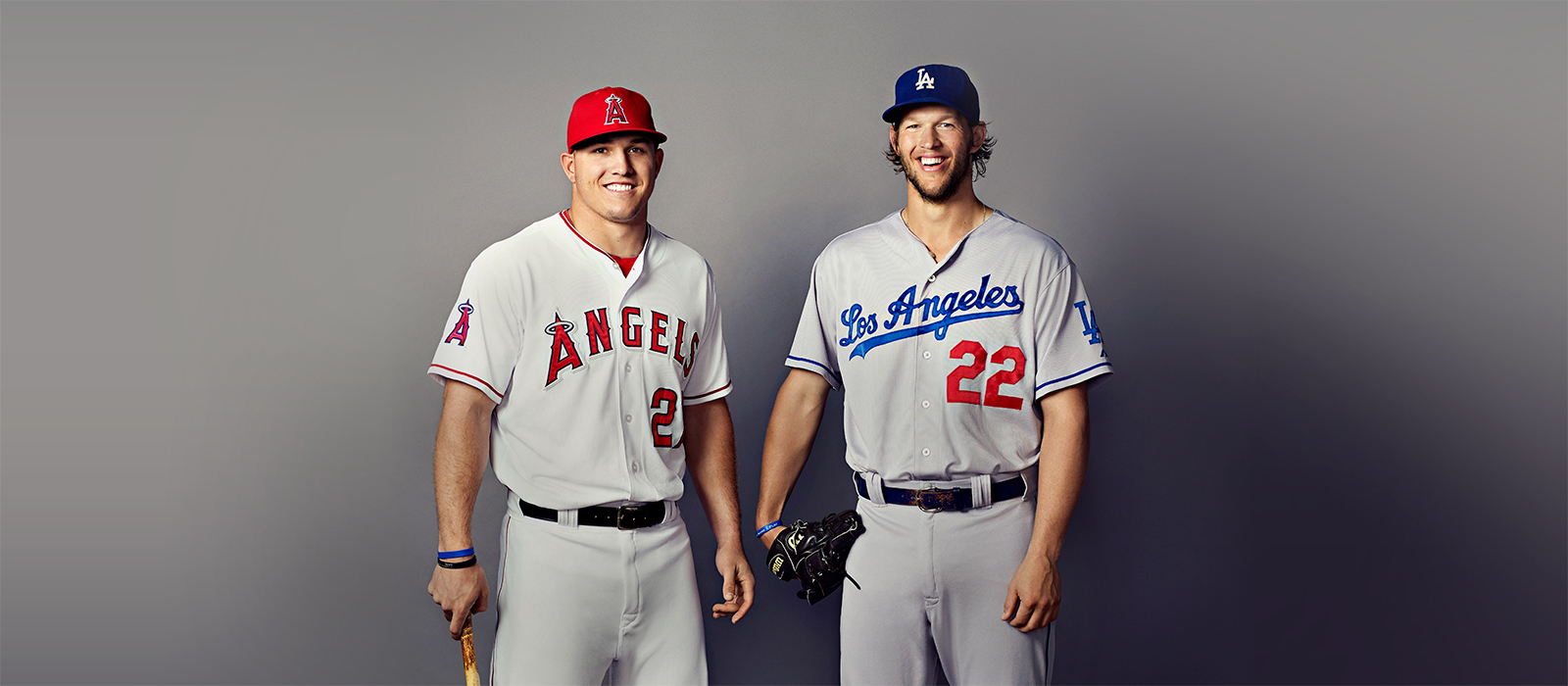
As expected, Trout (left) and Kershaw walked away with league MVP honors (ESPN)
All hail Clayton Kershaw, king of the mound, the City of Angels, and the National League.

Already the best pitcher on the planet, Kershaw raised his game to new heights in 2014. Already earning comparisons to Sandy Koufax, another great Dodger lefty, Kershaw delivered a historic campaign that looks like it was lifted straight out of Koufax's prime. Already a three-time Cy Young recipient, Kershaw added a new piece of hardware to his trophy collection: the National League MVP, something no starting pitcher had won since Bob Gibson in 1968.

Despite missing more than a month early in the season, Kershaw was so dominant in his 27 starts that he still managed to lead all players in the Baseball-Reference version of WAR with 8.0. Though he fell just shy of 200 innings, he still topped the majors in wins (21) and complete games (6) while ranking seventh with 239 strikeouts.

And while Kershaw's counting stats were excellent, his rate stats were off the charts. His 1.77 ERA secured his record fourth straight ML-ERA crown and was the lowest by a pitcher since Pedro Martinez's 1.74 in 2000. His 1.81 FIP and 0.86 WHIP, both best in the bigs, were the fourth and seventh-best marks of the live ball era. His 10.8 K/9 ratio, 197 adjusted ERA+, and .875 winning percentage were all tops in baseball. His 7.71 K/BB ratio was the highest in the Senior Circuit, too.

That's why voters were willing to overlook the fact that he only started 27 games--the fewest ever by an MVP starting pitcher--and spent 41 consecutive days on the Disabled List (between his first start and his second)--also a record for an MVP.

While Kershaw was leading the Dodgers to the NL West division title, Mike Trout was doing the same for the city's American League team. Though he had a down season by his standards, Trout was the unanimous choice in the American League after helping the Angels to 98 wins and the best record in baseball. All Trout did was lead the majors in runs (115), total bases (338), and extra base hits (84), plus runs created (137) and oWAR (8.7) while patrolling center field for the Halos. He also paced the AL with 111 RBI, smashed 36 home runs, and stole 16 bases in 18 attempts. Altogether he was worth 7.9 bWAR this year, most in the American League.

This should be Trout's third straight award, but he had to settle for second the previous two years because of the voting bloc's affinity for Miguel Cabrera's shiny Triple Crown stats. But with Cabrera having an off year by his standards as well, the door was wide open for Trout to run away with the trophy, and that's exactly what he did. He was the clear favorite for most of the season, and was so good in the first half (1.012 OPS through July 20th) that he still won easily despite a poor second half (.249/.333/.485 and 84 strikeouts thereafter, not including his miserable postseason).

Just 23 years old, Trout became the youngest unanimous winner in baseball history and fifth-youngest overall. He is the first American League player to win unanimously since Ken Griffey Jr. in 1997. Trout joins Don Baylor (1979) and Vladimir Guerrero (2004) as the only Angels to win the award in team history, which dates back to 1961.

And if Trout keeps playing the way he has, he'll win at least a few more before he's through.

Wednesday, November 12, 2014

Kluber Robs King Felix

Hernandez deserved to win his second Cy Young, but didn't (RotoScout)
The races for the American League and National League Cy Young couldn't have been any different.

In the National League, Clayton Kershaw was the heavy favorite and won easily, securing his third Cy Young in four years (and, let's be honest, he deserved the 2012 award over R.A. Dickey too). It was Kershaw and everyone else, meaning a vote for Johnny Cueto or Adam Wainwright, while defensible, was clearly misguided.

The American League's top two candidates were virtually inseparable. They both had dominant seasons and compelling reasons, but in the end it came down to splitting hairs. In what was destined to be a photo finish, Corey Kluber beat out Felix Hernandez. Kluber nabbed 17 of the 30 first place votes and 169 points, edging out the 13 and 159 compiled by King Felix. Chris Sale finished a distant third with 78 points.

Looking at Hernandez's stats, it's hard to see how he didn't win. He had the league's lowest ERA, WHIP, and hit rate while placing second in pitcher bWAR (to Kluber), innings pitched (to David Price), ERA+ (to Sale), and FIP (to Kluber). He also led in most of the advanced stats like adjusted pitching runs and wins, base-out runs and wins saved, and situational wins saved. Opponents batted just .200/.243/.303 (.244 wOBA) against him, and his average GameScore was 65. For most of the summer, he was the clear favorite as he strung together an MLB-record 16 straight starts with at least seven innings pitched and two earned runs allowed or fewer.

But he slipped just a bit over the final six weeks (2.75 ERA), opening the door for Kluber, who came on like a freight train down the stretch. His first half was hardly Cy-worthy (3.01 ERA), but after the All-Star Break he had a 1.73 ERA over his final 104 innings to lower his final ERA to 2.44. He also struck out 39 batters over his final three starts to give him a whopping 269 K's on the season, second only to Price and 21 more than Hernandez. He also finished in a three-way tie for the league lead in wins with 18 (same as Max Scherzer and Jered Weaver) while pacing the circuit in pitching bWAR (7.4), and FIP (2.35).

While Kluber had an outstanding season, I believe the hardware belongs to King Felix. For one, Kluber wasn't even Cy Young-caliber for most of the first half, while Hernandez was Cy Young worthy from start to finish. Kluber had that great finishing kick, but I think Hernandez deserves credit for being more consistent. Additionally Kluber's average GameScore (63) was a hair lower than Hernandez's, revealing that he was slightly less dominant on a per-start basis. Batters also had more success against him, hitting .233/.279/.345 (.277 wOBA) when he was on the bump--a 78 point difference between him and Hernandez. That's pretty sizable, especially considering Kluber faced slightly weaker hitting talent.

It's true that Hernandez did pitch in a more favorable environment with a better defense behind him, but the park is accounted for in Adjusted ERA+, which has him considerably ahead of Kluber 170 to 152. Furthermore, Safeco doesn't help Hernandez as much as other pitchers because of his ability to induce ground balls. As for the defense, well, it's not like Hernandez was pitching to contact. He still struck out 248 batter's, for heaven's sake! Tony Blengino over at FanGraphs took all these factors into account and calculated Hernandez's true ERA to be 2.29, a touch better than Kluber's 2.45.

All in all, I like Hernandez's case a little better than Kluber's. I'm not sure what swayed the voters over to the latter's side: I hope it was the FIP and gaudy strikeout rates but I suspect the monster second half and shinier win total played a role as well. The voters had to make a really tough choice, so I'm not surprised they got it wrong (look no further than their inability to elect Mike Trout MVP before this year). Kluber was great, but Hernandez was a tad better and deserved to win by the slimmest of margins.

Tuesday, November 11, 2014

Recounting Abreu's Rookie Season

Abreu had one of the best rookie years of all-time (FoxSports)
In an announcement that surprised no one, Jose Abreu was a unanimous selection for the American League Rookie of the Year. Abreu is just the ninth player ever to win the award unanimously, beating out Matt Shoemaker (second) and Dellin Betances (third). He was voted AL Rookie of the Year by Sporting News as well, winning the award in a landslide with 149 of 160 possible votes. Nobody else received more than four.

By batting .317 with 36 home runs and 107 RBI, the 27 year-old Cuban sensation became the first rookie in MLB history to rank top-five in his league for the Triple Crown stats (he was fifth in average, third in big flies and fourth in ribbies). His 36 home runs, a White Sox rookie record, were the sixth-most by a rookie all-time, exceeded only by Mark McGwire (49), Frank Robinson and Wally Berger (both with 38), and Al Rosen and Albert Pujols (both with 37). Interestingly, all those players are/were righthanded, as is Abreu. Had he not spent time on the Disabled List in May with ankle tendinitis, he likely would have joined Nelson Cruz in reaching the 40 home run benchmarks and/or passed all those aforementioned names save McGwire.

29 of those big flies came prior to the All-Star Break--only McGwire with 33 had more. Abreu was named AL Rookie of the Month in April, June, and July and took home AL Player of the Month honors in April and July. He set the record for most home runs and RBI by a rookie in the month of April, with 10 and 32, respectively (31 if you discount the one he recorded on March 31st). He also became the fourth player ever with 30 doubles, 30 homers, and 100 RBI in his rookie season, joining Hal Trosky, Ted Williams, and Albert Pujols.

What's more, Abreu was played a pretty solid first base. He had the highest Range Factor/9 innings and most double plays turned among American League first basemen. He ranked second in Range Factor/game and fourth in fielding percentage and putouts. All in all, not a bad first impression for somebody in the first year of a six-year, $68 million contract given to him before he'd ever stepped up to the plate in the big leagues.

Almost as unsurprising was the National League award going to Jacob deGrom, who secured 26 of the 30 possible first place votes to win handily. Billy Hamilton came in second and Kolten Wong finished third. DeGrom went 9-6 with a 2.69 ERA and 144 strikeouts in 140 and 1/3 innings pitched, making him just the fifth rookie in NL history to post an ERA below 2.75 and a K/9 ratio above 9 (the others being Jose Fernandez, Roy Oswalt, Hideo Nomo, and Dwight Gooden).

Originally called up in mid-May to work out of the Mets bullpen, he flourished as a starter with Dillon Gee out and made 22 starts in all. He had a few hiccups at first but pitched better as the season wore in, establishing himself as the team's top pitcher. New York hopes deGrom can be a mainstay in a rotation that gets Matt Harvey back next year and has an ace on the rise in Zack Wheeler. Together they'd form a formidable big three and are essential to the Mets having their first winning season since 2008.


Thursday, November 6, 2014

2014 Silver Sluggers Review

The major league batting champ was rewarded with his first Silver Slugger
Silver Sluggers were announced today, and while I was fine with most of them there were a few I disagreed with.

American League
C Yan Gomes
Gomes was a clear choice here given that he had the highest wOBA, wRC+, and second-most home runs among AL catchers (to Brian McCann). Nobody else had a good year behind the plate in the Junior Circuit, opening the door for Gomes in his first full season. He batted .278/.313/.472 with 21 big flies and 74 RBI despite striking out five times as often as he walked.

1B Jose Abreu
Hate to snub Miguel Cabrera and Edwin Encarnacion, but Abreu was better than both. All he did was hit .317/.383/.581 with 36 home runs, 107 RBI, and the highest slugging and OPS+ in baseball.

2B Jose Altuve
Choosing between him and Robinson Cano came down to splitting hairs, but I'm fine with Altuve because he led the majors in hits and batting average with 225 and at .341, respectively. While he managed just seven home runs he did club 47 doubles and rack up 299 total bases.

3B Adrian Beltre
Another well-deserved honor for Beltre, who continued to pad his Hall of Fame totals with a seven-win season. Yup, that's what happens when you play elite defense at third and bat .324/.388/.492 in a parched scoring environment.

SS Alexei Ramirez
In a weak year for American League shortstops, Ramirez wins by default. His 15 homers and 74 RBI were most among AL shortstops, and he also smashed 35 doubles. en if his .273/.305/.408 line was roughly league average after adjustments for league and park. Jose Reyes was the only other one worth considering, and nobody in this day and age is going to give a Silver Slugger to a guy with nine home runs, 51 RBI and a .398 slugging percentage.

OF Mike Trout
Obviously

OF Michael Brantley
Duh

OF Jose Bautista
Of course

DH Victor Martinez
No-brainer

Stanton was born to win Silver Sluggers (RantSports)
National League
C Buster Posey
Posey just barely beats out Jonathan Lucroy for the award on the strength of his slightly superior rate stats and power figures, which look even better with park adjustments. Posey rode a torrid second half to the finish line to end up at .311/.364/.490 with 22 homers and 89 RBI. Also feel obliged to mention Devin Mesoraco.

1B Adrian Gonzalez
Gonzalez had a good year by traditional standards with his 41 doubles, 27 homers and ML-leading 116 RBI, but Anthony Rizzo was clearly the better hitter. Not only did Rizzo exceed Gonzalez in all three rate stats, but he also outhomered Gonzo 32 to 27 and dwarfed him in wOBA (46 point edge for Rizzo) and wRC+ (25 point advantage). Rizzo missed 22 games to Gonzalez's three, but still provided twice as much offensive value according to FanGraphs.

2B Neil Walker
Pretty easy, as few NL second basemen had years worth remembering in 2014 besides Chase Utley and (I guess) Daniel Murphy. Walker was terrific though, smashing a career high 23 home runs to go along with his robust .271/.342/.467 batting line.

3B Anthony Rendon
Todd Frazier had a great year, but Rendon's was better. On top of leading the league in runs with 111, he also popped 21 homers and 39 doubles, batted .287/.351/.473, and knocked in 83 runs despite primarily batting second. And with the 17 steals in 20 tries, it was truly a fantastic all-around campaign.

SS Ian Desmond
Desmond won his third straight Silver Slugger with another solid all-around season, his third straight with at least 20 home runs and 20 steals. His 24 bombs and 91 RBI led the position, but his .255/.313/.430 slash line is not exactly eye-popping. Jhonny Peralta bettered Desmond in all three rate stats, hitting .263/.336/.443, and also posted a higher wOBA and wRC+. With 21 home runs and 75 RBI, his power numbers were nearly as good as Desmond's too. It's a close call either way, but I would have given it to Peralta who was worth 15 runs better than average as a hitter compared to Desmond's three.

OF Andrew McCutchen
Obviously.

OF Giancarlo Stanton
Duh.

OF Justin Upton
Hold on there. While Upton had strong power numbers (29 taters, 102 RBI) to go along with his .270/.342/.491 batting line, those rate stats were nowhere near as good as Yasiel Puig's .296/.382/.480. Puig didn't hit for much power with 16 home runs and 61 RBI, but nevertheless crossed home 92 times, posted a .379 wOBA, and notched a gaudy 147 wRC+. FanGraphs estimates he provided roughly 33 percent more offensive value than B.J. Upton's little brother.

P Madison Bumgarner
We''ll always remember Bumgarner's 2014 for what he did on the mound in October, but let us not forget that he held his own at the plate that year as well. MadBum mashed four home runs and drove in 15 runs to support himself, batting .258/.286/.470 in 78 plate appearances. It was a surprising outburst given that he had managed a meager .138/.185/.192 line with two home runs and 16 RBI in his career prior to 2014.

2014 MLB Award Finalists

With no Miguel Cabrera to beat him, Trout will win AL MVP (ESPN)
The three finalists for each of the BBWAA's awards were announced the other day, with the winners to be announced next week. Here are my thoughts on and rankings of the finalists for each award.

AL MVP
1. Mike Trout
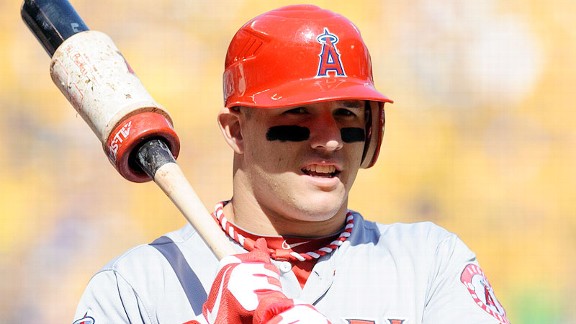
Duh. There's no way he doesn't win this year. Not only was he the major league leader in runs (115), total bases (338), extra base hits (84), and runs created (137) but he also paced the American League in bWAR (7.9), and RBI (111), smashed 36 home runs and stole 16 bases in 18 attempts, all while playing center field for the team with the best record in baseball. He's a lock despite having a "down" year.

2. Michael Brantley
Brantley was positively Trout-ish this year, posting tremendous numbers across the board en route to a seven win season. While he failed to lead the league in any one category, his name was all over the leaderboards. The first-time All-Star batted .327/.385/.506 (154 OPS+) with almost as many walks (52) as strikeouts (56), not to mention 45 doubles, 20 home runs, 97 RBI, and 309 total bases. He also piled up 200 hits, scored 94 runs, and swiped 23 bases against just one caught stealing. Not a great outfielder, but that can be overlooked when you produce that much offense.

3. Victor Martinez
Not sure V-Mart was one of the three most valuable players in the American League given that he was primarily a DH and is a liability on the basepaths, but he did have a fantastic year at the plate. The best pure hitter in baseball last year, Martinez led the majors in OPS at .974, had the American League's highest OBP at .409, and was the most difficult to strike out with a 13.4 AB/K ratio. The 35 year-old former catcher hit like a man ten years younger, batting a robust .335/.409/.565 (168 OPS+) with 32 home runs, 103 RBI, 317 total bases, and 67 percent more walks (70) than strikeouts (42). The batting title runner-up to Jose Altuve also finished second in slugging (to Jose Abreu), runs created (to Trout), and adjusted OPS+ (to Abreu).

NL MVP
1. Clayton Kershaw
Missed a month, but Pedro Martinez-esque production when he pitched makes up for lost time. Led the major leagues in almost every major pitching category and helped pitch his team to a division title with 7.5 bWAR--most in the NL.

2. Andrew McCutchen
McCutchen was a monster this year, and if he'd played the whole season I'd probably give him the nod over Kershaw. But the defending MVP missed time too (16 games), and so his counting numbers are a bit weak for an MVP with 25 homers and fewer than 90 RBI/runs. His rate stats were certainly MVP-caliber though: .314/.410/.542, giving him the best OBP in baseball as well as the league's highest OPS and OPS+. If he was an elite defensive centerfielder or made more of an impact on the bases I'd be tempted to choose him over Kershaw, but as a complete package (6.4 bWAR) he just wasn't as good.

3. Giancarlo Stanton
Pretty much everything I said about McCutchen applies to Stanton. Through no fault of his own, Stanton was drilled in the face and missed the final 17 games of the season. That didn't stop him from pacing the Senior Circuit in home runs (37), slugging percentage (.555) and total bases (299), but it was enough to effectively finish his MVP chances. At least he got the Hank Aaron award.

AL Cy Young
1. Felix Hernandez
By the slimmest of margins, King Felix deserves his second career Cy. The AL leader in ERA (2.14) and WHIP (0.92) was phenomenal in pretty much every way you can measure a pitcher, with 248 strikeouts in 236 innings and a 5.39 K/BB ratio and the lowest hit rate in the league. I've heard arguments made for Kluber because he pitches in a more neutral ballpark with a less talented defense behind him, but I'm swayed by Hernandez because his ERA, ERA+, and WHIP were all considerably better. To me, WHIP and ERA are the two-most important stats for a pitcher, and in those Felix comes out on top.

2. Corey Kluber
When you get down to it, Kluber's case is just as strong as Hernandez's. Kluber led the league in wins (18), FIP (2.35), and pitching bWAR (7.4). Usually that's good enough to win it, but Felix just barely edges him out.

3. Chris Sale
On a per-inning basis, Sale was probably the best pitcher in the American League this year. His 178 ERA+ and 10.8 K/9 rate were tops in the AL, while his 2.17 ERA and 0.97 WHIP were second. He placed third in the league in pitching bWAR with 6.6 despite completing only 174 innings because of a strained flexor muscle in his elbow forcing him to the Disabled List. That he missed more than a month and still ranked so highly among AL hurlers just goes to show how special his season was, but because of his reduced workload he must take a back seat to Hernandez and Kluber.

Kershaw has the NL Cy Young and MVP sewn up (NextImpulseSports)
NL Cy Young
1. Clayton Kershaw
If he's good enough to be MVP, he's definitely good enough to cop the Cy Young.

2. Johnny Cueto
Cueto had the most innings (243 and 2/3) and strikeouts (242) in the National League, not to mention 20 wins, a 2.25 ERA, a 0.96 WHIP, and 6.4 bWAR. Any other year he wins, but not in the year of the Kershaw.

3. Adam Wainwright
Nobody's better at coming close to, but not winning, the Cy Young than Wainwright, who is set to finish second or third for the fourth time in six years. Always amazing, he was a 20 game winner with a 2.38 ERA in 227 innings, good for 6.1 bWAR. Better luck next year, Adam.

AL Rookie
1. Jose Abreu
Should win unanimously.

2. Matt Shoemaker
Most years, Shoemaker walks home with this award no problem. The 27 year-old emerged as the Angels' second-best starter to Garrett Richards and picked up the slack when he went down with a knee injury in late August. Had Shoemaker not been shut down for the last two weeks of the season, his case would likely look even better as he was on an incredible roll at the time with seven straight wins and just seven earned runs allowed in his previous 48 and 2/3 innings. As it were, he still finished with a 16-4 record (good for the best winning percentage in the American League), 3.04 ERA in 136 innings, and a sterling 5.17 K/BB ratio.

3. Dellin Betances
Betances was about as dominant as a reliever can be, striking out 135 men in 90 innings and maintaining a 1.40 ERA across his 70 appearances. Worth 3.7 bWAR, the All-Star setup man also had a 0.78 WHIP, 5.63 K/BB ratio, 277 ERA+ and a 1.64 FIP. Not surprisingly, his record was a perfect 5-0.

NL Rookie
1. Jacob deGrom
In baseball, as in life, timing is everything. If deGrom debuted last year with the likes of Yasiel Puig, Jose Fernandez, and Julio Teheran, nobody would have noticed him. But because the rookie class was so weak this year, and because they have to give the award to someone, deGrom's the guy. He pitched well in his 22 starts, averaging more than a strikeout per inning and keeping his walk and homer rates down. So while his 2.69 ERA (130 ERA+) looks great, it looks even better backed up by a 2.67 FIP.

2. Billy Hamilton
Were it not for the late-season emergence of deGrom, Hamilton would have won the trophy by default. Cincinnati's speedy leadoff man and center fielder played exceptional defense but struggled at the plate, batting just .255/.292/.355 with 117 strikeouts against just 34 walks (more than three K's per free pass). A terror on the basepaths, he did steal 56 bases, second only to Dee Gordon, but was thrown out 23 times--more than anyone else in baseball. All in all he was a servicable regular worth in the neighborhood of three WAR due to his baserunning and plus defense at a premium position. The 24 year-old is not a leadoff hitter, though, and is likely too flawed at the plate to avoid becoming anything other than a rich man's Jackie Bradley, Jr or a homeless man's Jose Reyes.

3. Kolten Wong
That Wong was one of the three best rookies in the National League this year says a lot about how weak that rookie class was. He hit marginally better than Hamilton (.249/.292/.388), but that's not saying much, and was only okay at second base. He ran the bases well, going 20 for 24 in stolen base attempts, and showed a dash of power with 12 home runs in 402 official at-bats. Still just 24, Wong (like Hamilton) has room to improve and will look to build upon a promising but underwhelming rookie year.

AL Manager
1. Buck Showalter
Nobody, and I mean nobody, gave the Orioles a chance to win the AL East. Showalter squeezed the most out of a team that lost Matt Wieters and Manny Machado for much of the season, got next to nothing out of Chris Davis, and received minimal offensive production from its double play combo. That team won 96 games; at full strength they easily win over 100.

2. Mike Scoscia
The Angels had the best record in baseball, but then they also had Trout, Josh Hamilton, Albert Pujols, Jered Weaver, and C.J. Wilson. LA overachieved everyone's expectations this year, but they wildly underachieved last year (and the year before that, too). Not quite sure where Scoscia fits into all of this.

3. Ned Yost
(Trying not to laugh...)

NL Manager
1. Bruce Bochy
Led an 86-loss team in 2013 back to the playoffs despite continued ineffectiveness from Tim Lincecum and injuries to Matt Cain and a host of regulars, including Angel Pagan, Brandon Belt, and Mike Morse. That he guided them all the way to the World Series title, while unknown at the time ballots were cast, makes this feat even more impressive.

2. Clint Hurdle
Hurdle led a Pirates team ripe for regression back to the playoffs, which I have to admit I did not see coming. But seeing as how he won last year and his team dropped six games in the standings, there's zero chance he repeats this year.

3. Matt Williams
Inherited a ridiculously talented team that under-performed in 2013. To run away with a weak division all they had to do was play up to their true talent level, and that's exactly what happened. Don't see why a push-button manager like Williams should get much credit for that.

Wednesday, November 5, 2014

2014 Gold Glove Review

Injuries have not affected Pedroia's stellar play in the field (BostonCBS)
Baseball's Gold Glove award winners were named yesterday, and while there are always some questionable selections I have to say most of these are pretty spot on. The selections have become markedly more accurate in recent years, which is absolutely a good thing. They're doing a much better job of what they were intended for, which is to honor the best defender at each position in both leagues. As always, though, there were a few miscalls that I felt obliged to point out.

Here's my position-by-position breakdown.

American League

C Salvador Perez
Second consecutive Gold Glove for Perez, who seems to be developing into the AL equivalent of Yadier Molina. FanGraphs had him as the best defensive catcher in baseball last year.

1B Eric Hosmer
Second straight for Hos.

2B Dustin Pedroia
Pedroia's bat's been slowed by injuries in recent years but his defense has remained elite, as he was the best defensive second baseman this year according to FanGraphs. Baseball-Reference rated his fielding contributions as worth 2.5 dWAR, the highest total of his career even though he missed 27 games.

3B Kyle Seager
While his offensive figures have held steady over the last three years, Seager made significant strides in the field this year. A mediocre third baseman in the past, he elevated his fielding and was an asset at the hot corner this year. But he was not as good as Josh Donaldson, who was tremendous last year and even better this year--worth 2.7 dWAR according to Baseball-Reference. B-R and FanGraphs both rate Seager inferior.

SS JJ Hardy
Hardy's signature power disappeared, but he was still as slick-fielding as ever and nabbed his third straight Gold Glove as a result.

LF Alex Gordon
Easy call here, as Gordon is universally regarded as one of the finest defensive outfielders in the game today.

CF Adam Jones
The metrics disagree with this one, but many who watch Jones play everyday say he's absolutely deserving. I'm inclined to think his true value falls somewhere in the middle. That said, he was actually pretty good this year, but I'm just not sure he was better than Jackie Bradley Jr. (what can't that kid catch?) and Leonys Martin. What I am sure about is that he should not have four Gold Gloves lined up in his trophy case.

RF Nick Markakis
No way. Markakis has been a bad defender since 2008, and yet somehow has managed to snag a pair of Gold Gloves during that time.

P Dallas Keuchel
Sure.

Lagares patrols the Mets' outfield with authority (Hardball Times)
National League

C Yadier Molina
Yadi took home the hardware for the seventh straight year, which is understandable given that his elite defense behind the plate held steady. That said, he didn't deserve this one because he wasn't as valuable as Jonathan Lucroy, a more worthy candidate because of his elite pitch-framing capabilities. Lucroy wasn't much better, but both B-R and FanGraphs agree he was superior. Molina wasn't a bad choice, it's just that Lucroy was the right choice.

1B Adrian Gonzalez
Gonzo had a good year at the plate and in the field, earning his fourth career Gold Glove and first since 2011.

2B DJ LaMahieu
Like teammate Nolan Arenado last year, didn't do much with the bat but had a heck of a year defensively. Well-deserved.

3B Nolan Arenado
Won his second straight, as he was worthy nearly two dWAR despite missing a third of the season. This wasn't a mistake--he's really that good.

SS Andrelton Simmons
Jhonny Peralta had an excellent year with the glove, but Simmons was even more fantastic. Not quite as great as he was last year, when he won his first Gold Glove with 5.4 dWAR, but his 3.9 dWAR this year were exceptional, making him the best defensive shortstop in either league.

LF Christian Yelich
Yep. Good call.

CF Juan Lagares
If you watched Lagares play at all this year, then you know how much he deserves this award.

RF Jason Heyward
Another easy call, as Heyward was far and away the best defensive right fielder in baseball this year. His bat hasn't progressed the way we'd hoped, but the 25 year-old probably has a few more Gold Gloves in his future.

P Zack Greinke
Okay.

Friday, October 31, 2014

Poor Royals


While the San Francisco Giants are basking in the glory of their third championship in five years (which I guess makes them a dynasty), the Kansas City Royals are surely reeling from such a heartbreaking defeat. Losing Game 7 by one run is tough, especially when you're on your home field and especially when you last made the playoffs in 1985. It's tougher still when the game ends with the tying run standing on third base.

With Alex Gordon 90 feet away after Gregor Blanco misplayed his two out single, Salvador Perez needed only a single, just a little single, to tie the game and possibly chase Madison Bumgarner from it. All he needed was for a blooper to fall in, for a ground ball to find a hole, and it would have been a brand new ballgame.

Bumgarner, well aware of Perez's aggressive tendencies, fed the catcher a steady diet of high fastballs. Perez couldn't resist. On the sixth one, he popped up.

Pop ups, at least in my opinion, are the most disappointing type of out a player can make. The ball goes up, and right away you know nothing good can happen. The best case scenario is that it lands in the seats--foul--or that the fielders can't get to it in time or they miscommunicate and it falls harmlessly to the ground. By the time it's reached its apex you can usually tell whether it's going to be caught or not. And then you wait, wait for it to drop into the fielder's mitt below.

A pop out is perhaps the easiest out to predict before it happens, because so much time passes between the ball leaving the bat and settling into the fielder's glove. It allows time to think, and more importantly to recognize what is about to transpire. When Perez popped up and Pablo Sandoval chugged under it, we knew the game was over. The series was over, and with it the season. The Royals had lost. The Giants had won. Game, set, match..

Other teams have come closer--the 1986 Red Sox and 2011 Texas Rangers come to mind, one strike away from victory. But man, the Royals were right there. If only they'd held on to win Game 4. If only Eric Hosmer hadn't dived into first base. If only Gordon sprinted out of the box on that soft single to center. If only.

The 1967 Red Sox couldn't overcome Bob Gibson. The Yankees were helpless against Curt Schilling and Randy Johnson, then Josh Beckett two years later. And the 2014 Royals couldn't figure out Madison Bumgarner. Better luck next year.

Thursday, October 30, 2014

The Magnificent Madison Bumgarner

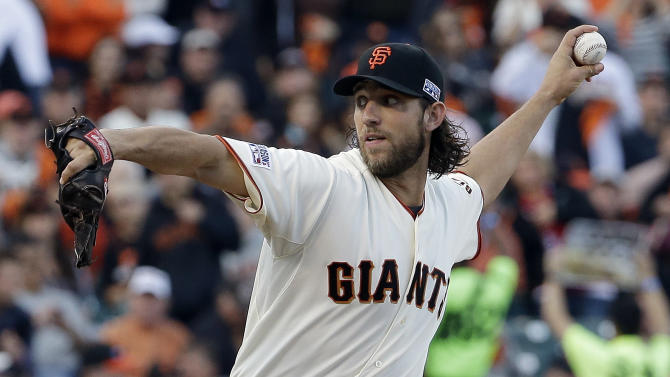
Bumgarner capped a stellar postseason with a marvelous World Series (Yahoo)
Even before last night, we knew Madison Bumgarner's 2014 postseason run was spectacular, one of the best ever, in fact. We knew it represented a pitcher at his absolute best. We knew we were witnessing a level greatness rarely sustained for long during playoff time.

What we did not know, however, was how that run would end. We knew Bumgarner was going to make a relief appearance in Game 7 three days after spinning the first Series shutout in over a decade. Nobody could have known how long he'd stay in or how effective he would be.The general consensus was that he'd pitch one to three innings.

He went five, closing out the game and the series with the most memorable postseason relief appearance this side of Pedro Martinez.

Bumgarner, as he was all month, was absolutely nasty. Once again he proved to be the Royals' kryptonite, muting their bats over five scoreless innings. Kansas City managed just two hits against him, both singles. For the third time in the series, they were completely and utterly helpless against him.

They were hardly the only ones looking overmatched against him this fall (his ERA this postseason: 1.03). First he blanked the Pirates on the road in the wild card play-in game, and that was just the appetizer. He turned in seven strong innings in his lone NLCS start versus the Nationals, then seven and 2/3 scoreless frames in St. Louis in Game 1 of the NLCS. Back at home for Game 5, he went eight innings and allowed three runs in the pennant clinching game.

By the time the World Series rolled around, the 25 year-old southpaw was all warmed up. He pitched the Giants to an easy victory in Game 1 with seven innings of one-run ball. He hurled a four-hit shutout in Game 5 to bring San Francisco within one game of the title. And, after Jake Peavy and Tim Hudson faltered in Kansas City, Bumgarner took his team all the way with five scoreless frames.

MadBum was as deserving as a World Series MVP possibly can be. He put the team on his back, carried them on his shoulders, and delivered them to their third World Series title in five years. While he was credited with the save in Game 7 (Jeremy Affeldt got the win), for all intents and purposes he won three games in this series.

Bumgarner's stat lines from this series are just ridiculous. There's the one earned run in 21 innings, of course, which works out to a 0.43 ERA. He walked only one batter over that span (Lorenzo Cain in Game 1) and allowed just nine hits (only three of which went for extra bases), resulting in a 0.48 WHIP. Of the 74 batters he faced, he retired 63 of them (85 percent), 17 by way of the K. Opponents batted just .127/.151/.197 against him, and he threw 70 percent of his 291 pitches for strikes.

What we saw was a great pitcher at the peak of his powers, and the result was probably the best postseason any pitcher has ever had. Even more incredible is that Bumgarner was able to do what he did after tossing a career high 217 and 1/3 innings during the regular season. Including his five inning relief appearance, he basically made 40 starts this year and remained sharp to the last out.

Bumgarner's been a great pitcher for several years now (did you know he was a two-time All-Star?), but this World Series felt like his coming out party the way 2003 was for Josh Beckett. Madison Bumgarner is now a household name the way Clayton Kershaw and Justin Verlander are. The best part is; he's barely 25.