Wednesday, June 28, 2017

A History of Great Red Sox Outfields

The Red Sox have a long lineage of talented outfields (Boston Baseball Prospectus)
Before the season began there was an ungodly amount of hype surrounding Boston's young outfield of Andrew Benintendi, Jackie Bradley Jr., and Mookie Betts -- who, you might remember, made the cover of Sports Illustrated (thankfully, the jinx has spared them). Some went so far as to crown them the best outfield in team history, on par with the club's vaunted trio of Jim Rice, Fred Lynn, and Dwight Evans during the mid and late 1970s.

While the current crop certainly has that level of talent (Betts and Benintendi both have Hall of Fame ceilings, while Bradley could wind up being a modern day Reggie Smith), such talk is wildly premature. They haven't even played 100 games together yet! Benintendi's just 22, and it's far too early to project how his career will pan out. Betts -- a superstar on the rise -- has yet to celebrate his 25th birthday and stonewalled Boston's attempts to lock him up last winter, meaning his future in a Red Sox uniform is far from guaranteed. Bradley is the outfield's elder statesman at 27, and yet he's actually the most volatile in terms of performance due to his streakiness. His glove is amazing, but his ebbs and flows at the plate have led some to wonder whether he'll be Clay Buchholz with a bat in his hands.

In any event, this is shaping up to be an outstanding outfield for the next few years at least, and hopefully more. But the Red Sox have been often blessed with many great outfields, going back to their first dynasty a century ago.

Indeed, Boston's original golden outfield consisted of Duffy Lewis in left and Hall of Famers Tris Speaker in center and Harry Hooper in right. The trio led the Olde Towne Team to championships in 1912 and 1915 before Speaker was traded at the start of the '16 season. But so rich with pitching were the Sox that they still won it all without Speaker that year, then won again two years later with Babe Ruth caddying in right when he wasn't pitching.

Following the sale of Ruth in 1920, the Red Sox were largely bereft of talent at all positions throughout the next two decades, but by the late '30s they had once again assembled a stellar outfield. The 1938 trio of Joe Vosmik, Doc Cramer, and Ben Chapman all bettered .300, leaving no room for a brash 19-year-old rookie by the name of Ted Williams, who would have to wait until '39 to get his chance.

The Kid's arrival signaled a changing of the guard, as Dom DiMaggio joined him a year later. By the time Williams was chasing .400 in 1941, Boston had a completely new outfield from the one he'd been shut out of three years prior. Williams and DiMaggio were mainstays into the early '50s, when DiMaggio retired and Williams briefly departed for Korea, but in all that time the Red Sox never found a long-term right fielder to round out their trios. Sam Mele, Stan Spence, and Al Zarilla proved capable, but none stuck.

When Williams returned from Korea, he joined Jim Piersall in center and Jackie Jensen in right. By this point Williams was well into his 30s and increasingly banged up, missing an average of 36 games per season from 1954-1960. While still a fearsome hitter, he was unable to suit up enough to approximate his sublime production during the '40s, when he averaged just under 10 bWAR per season from 1941-1949. Piersall was a defensive wizard in the mold of his precessor, DiMaggio, but didn't stand out offensively. Jensen hit a lot of homers and drove in lots of runs, even stealing the MVP from a vastly more deserving Mickey Mantle in 1958.

The retirements of Williams and Jensen in the early 1960s paved the way for the next great Red Sox outfield, which came together during the franchise's dark days in the middle of the decade. Williams' replacement, Carl Yastrzemski, took over left field in 1961 and quickly emerged as one of the league's best at the position. He was joined in right three years later by teenaged phenom Tony Conigliaro, who immediately made his mark as one of the most prolific young sluggers in baseball history. Reggie Smith completed the outfield during the Impossible Dream summer of '67, finishing as AL Rookie of the Year runner-up. Unfortunately, Red Sox fans never got to see that outfield live up to its potential, as Tony C caught a fastball in the eye and was never the same.

It would be nearly a decade before Jim Ed and Freddie Lynn joined Dwight Evans in Boston, with both receiving cups of coffee in 1974 before bursting onto the scene as Rookie of the Year and MVP frontrunners in '75, leading the Red Sox to their first pennant since '67. The Gold Dust Twins, as they were called, were at their best from 1975-1979, but Evans didn't truly blossom as a hitter until the '80s, by which point Lynn was out west and Rice was past his prime. They never wonted for a third musketeer, however, as the likes of Tony Armas, Mike Greenwell, and Ellis Burks ensured that Boston always had one of the league's top outfields during the '80s.

Once Rice retired in 1989 and Evans left the following year, however, the Red Sox struggled to find an identity for their outfield. After decades of having Cooperstown-bound fixtures patrolling left, right, and center, the Red Sox filled their ranks with a motley crew of solid, if unexceptional veterans. Jack Clark, Otis Nixon, Troy O'Leary, Reggie Jefferson, Jose Canseco, and the legendary Tom Brunansky all rotated through. It was definitely a weird time for Red Sox outfields, with no real continuity to speak of.

That came to an end, briefly, in the early 2000s, when the Red Sox inked Manny Ramirez to an eight-year, $160 million deal before the 2001 season. He was joined the following season by Johnny Damon, giving the Red Sox an excellent outfield for the first half of the decade with Trot Nixon in right. Together they helped their beleaguered franchise end its 86-year curse in 2004, etching their names in Boston lore.

Until the Killer B's coalesced, however, the mid-2000s to mid-2010s resembled the '90s in that the outfield was constantly in flux. Left field became a revolving door after Manny forced his way out of town, with cameos from Jason Bay, Carl Crawford, Cody Ross, Jonny Gomes, Daniel Nava, and Brock Holt. Coco Crisp didn't materialize into Damon 2.0 while Crisp's successor, Jacoby Ellsbury, was unbearably injury prone. J.D. Drew manned right field for five utterly forgettable seasons before fading away, while Shane Victorino had that one magical year during the 2013 World Series run before breaking down.

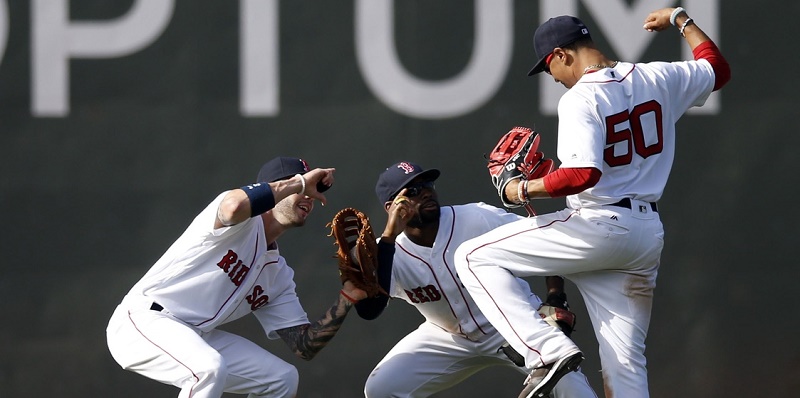
That brings us to today, with what is likely the most athletic outfield in Red Sox history. Boston essentially has three center fielders, as all three have played the position. Bradley and Betts are arguably the best defenders at their positions, and Benintendi isn't your typical first baseman/DH masquerading as a left fielder (looking at you, Hanley Ramirez). They're all fast and graceful and have great arms -- they all belong in the outfield. So they're probably the best defensive outfield the team has ever had, plus they can hit, too. And dance. Boy, can they dance.

Tuesday, June 27, 2017

Sox Pick Up Peralta, Fister

Fister joined the Bosox Friday and made his season debut two days later (CSNNE)
The Red Sox made a kiddie pool-sized splash on Friday by signing Jhonny Peralta to a Minor League deal and claiming Doug Fister off waivers. Peralta had been linked to Boston since St. Louis designated him for assignment earlier in the month, but the Fister move seemed to come more out of left field. While both were star players a few years ago, they have slipped considerably with age and are unlikely to contribute much to a Boston team that's clearly scrounging for reinforcements.

An All-Star as recently as 2015, Peralta's offense became below average (90 OPS+) as he battled injuries last year before bottoming out to .204/.259/.204 in 58 plate appearances with the Cardinals this year. Now 35, his OPS has fallen every year since 2013 and he's clearly in the twilight of his career. The three-time All-Star had a good run over the last decade, but it's hard to imagine him sparking the offense after failing to record an RBI or extra-base hit in 21 games this season.

Granted, third base has been a black hole for Boston this year, with Pablo Sandoval and co. combining to hit just .198/.250/.308 through Monday. Even a washed-up Peralta would do better than that, but how much better remains to be seen. The Sox are hoping he can find his swing in Pawtucket before calling him up, where Fenway would ostensibly help revitalize his sagging production, although it's worth remembering that the same plan failed with Allen Craig. Their best option remains cutting ties with Sandoval and promoting Rafael Devers, but good luck convincing the front office to swallow the remaining half of Panda's $95 million contract.

The Peralta pickup is reminiscent of last summer when the Red Sox traded not one, but two prospects to land a 34-year-old Aaron Hill from the Brewers. Hill was batting a solid .283/.359/.421 (106 OPS+) at the time but immediately fell apart after arriving in Boston, posting a lowly 53 OPS+ from there on out (Hill has been even worse for the Giants this year, so kudos to Milwaukee for selling high on Hill before he collapsed). At least Dealin' Dave didn't burn any prospects this time around, although he probably dangled a few before being reminded that no, sorry, you can't trade players when signing unrestricted free agents.

While Peralta has yet to take his first cuts in a Red Sox uniform, Fister was immediately thrown into the rotation and started Sunday's series finale against the Angels. While his quality start was encouraging, he's another player who's been trending in the wrong direction the past several seasons, as his walk rate his increased along with his WHIP every year since 2014. His ERA nearly doubled in that time, ballooning from 2.41 in '14 to 4.64 last year as his lack of strikeouts (career 6.0 K/9 rate) caught up with him. The 33-year-old doesn't throw hard and pitches to contact, which is a recipe for disaster at Fenway and in this new era of juiced baseballs. He'll merely be a back-of-the-rotation filler until Eduardo Rodriguez returns from the DL, but until then the Sox are merely hoping he can outpitch the likes of Hector Velazquez, Kyle Kendrick, and others who have filled this role for Boston lately.

With neither player likely to move the needle for the first-place Sox, the best explanation for these acquisitions might be that Dombrowski was familiar with them from their time on the Tigers earlier this decade, when both were markedly better players. Dombrowski originally traded for both, bringing Peralta over from the Indians in 2010 (and immediately re-signing him that winter) before dealing for Fister the following summer. Both excelled under Dombrowski's watch, with Peralta making two All-Star teams in his three full seasons with Detroit while Fister emerged as a solid mid-rotation starter behind Justin Verlander and Max Scherzer. Both were sent packing following Detroit's disastrous collapse to Boston in the 2013 ALCS as Peralta left via free agency and Fister was dealt to Washington (in one of the more widely criticized trades of recent times).

Dombrowski watched both players help his Tigers contend for several seasons and knows them well. While he clearly doesn't value prospects, he appears to have a soft spot for over-the-hill veterans.

Tuesday, June 20, 2017

The Elusive 20 Wins

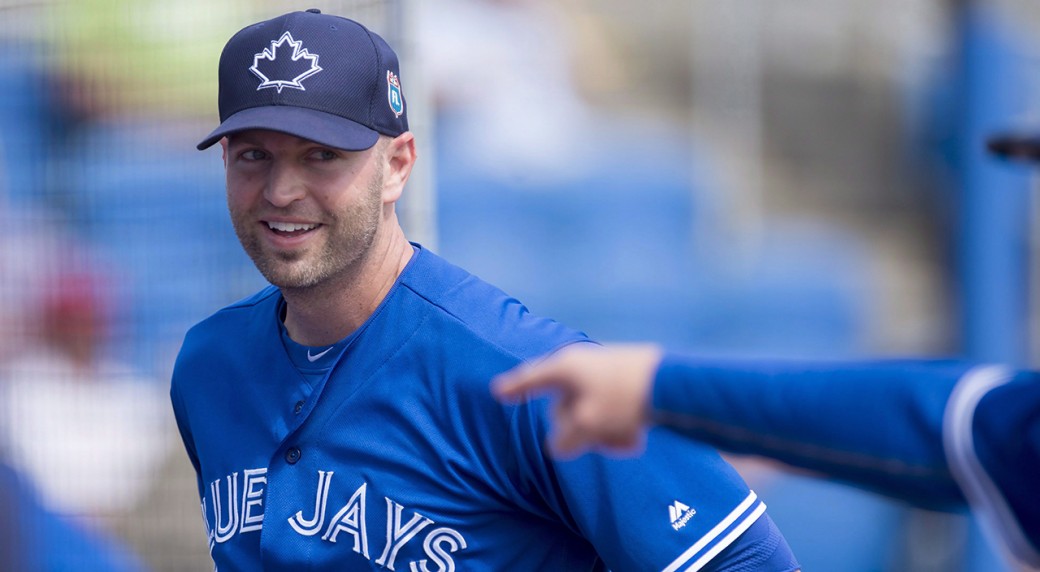
J.A. Happ was, improbably, a 20-game winner last year (Canada Sports Net)
With all the bullpen specialization and attention to pitch counts that has gone on recently, one would think that only the game's elite pitchers would be capable of winning 20 games in a season anymore. In reality, though, the list of hurlers who've done it recently is kind of a mixed bag. None of them are bad, obviously, but there's a good number of mid-rotation arms mixed in there with the cream of the crop.

Over the last several years, there's been about one pitcher per year who comes out of nowhere to win 20 games. In 2011 it was Ian Kennedy, and the following year it was R.A. Dickey and Gio Gonzalez. In 2015 Dallas Keuchel and Jake Arrieta did it, while last year both J.A. Happ and Rick Porcello reached the milestone. They've rivaled, and in some cases surpassed, the victory totals studs such as Clayton Kershaw and Justin Verlander and David Price, not to mention this list of pitchers (Cy Young winners starred)who have yet to win 20 games:
This year, Jason Vargas is atop the wins leaderboard, tied with Kershaw at 10 apiece. Rockies rookie Antonio Senzatela is just one behind them. I'm betting only Kershaw makes it, but then I would have said the same thing about Happ and Porcello last year.

Monday, June 19, 2017

Nashville-Born Ballplayers

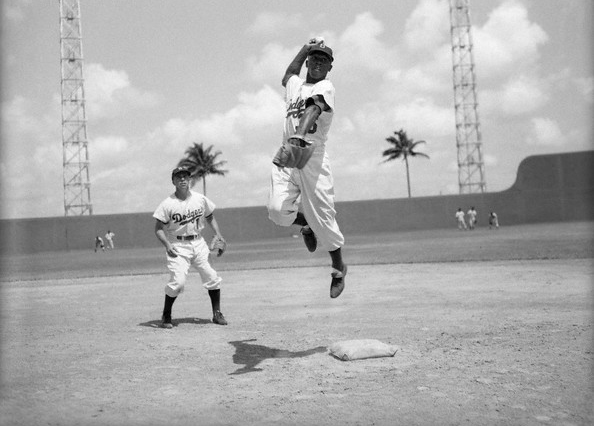
Junior Gilliam has a street named after him in Nashville (90 Feet of Perfection)
While walking around Nashville last weekend during CMA Fest, I noticed there was a street running through the heart of the city named "Junior Gilliam Way," not far from Rosa Parks Boulevard. That made me wonder what other players hail/hailed from Smashville, and if Gilliam was truly the best (and thus worthy of the distinction as the city's only ballplayer with a street named in his honor). Turns out there were quite a few players born in Nashville -- 39 and counting according to Baseball-Reference. While none are Hall of Famers (yet), there were a few who came close, as well as one who will likely go into Cooperstown one day wearing the cap of my beloved Boston Red Sox.

Best Players:

Ben Chapman (41.3 bWAR)
Chapman barely edges out Gilliam in terms of career value, but he was never going to have a street named after him following his shameful treatment of Jackie Robinson while managing the Phillies in 1947. While he was clearly a despicable human being, Chapman was also a pretty good ballplayer, leading the Major Leagues in steals four times (but also caught-stealing four times) and batting .302/.383/.440 (114 OPS+) for his career. His most memorable highlight as a player, however, was being told by Ted Williams, "I'll be back, and I'll make more money in this bleeping game than all three of you (Boston's outfield) combined!" after being sent down from Spring Training in 1938. With Chapman playing for Cleveland the following year, Williams arrived for good and set about delivering on that promise.

Jim Gilliam (40.7 bWAR)
Gilliam, more popularly known as "Junior," spent his entire 14-year career with the Dodgers. Despite spending most of those seasons on the trading block, he was only Boy of Summer from the '50s who was still a meaningful contributor during the Sandy Koufax-Don Drysdale era. The speedy switch-hitter proved to be a lesser version of Robinson -- his predecessor at second base -- with his baserunning, defensive versatility, and table-setting skills. A two-time All-Star, Gilliam won NL Rookie of the Year honors in 1953 and drew MVP votes four times, finishing in the top-six twice. He also played in seven World Series, winning four. Had he not begun his career in the Negro Leagues, he might have made it to the Hall of Fame.

Roy Cullenbine (31.4 bWAR)
Cullenbine was similar to Gilliam, as both were patient switch-hitters who made two All-Star teams, received MVP consideration four times, and led their league in walks once while playing the outfield a lot. A journeyman outfielder from 1938 to 1947, Cullenbine possessed one of the sharpest batting eyes in baseball history. He posted a career 17.8 percent walk rate and set a record by drawing a walk in 22 consecutive games, finishing with a career .408 OBP. He also developed power later in his career, slugging 73 of his 110 home runs over his final four seasons. Cullenbine played for a pair of pennant winners despite switching teams seven times in his career, helping Detroit win it all in 1945. With his solid pop, strong throwing arm and elite ability to get on base, he would have had a much longer and more stable career had he been born half a century later.

Best Names:

So many good ones. Here's a smattering: Tiny Graham, Noodles Hahn (think he had a weak arm, or just really liked spaghetti?), Ray Hamrick, Foster Castleman, Mickey Kreitner, Bubber Jonnard (brother of Claude Jonnard), Ike Fisher (brother of Bob Fisher), Clyde McCullough (say that one ten times fast). There were also a pair of "Lefty"s -- Lefty Davis and Lefty Sullivan. Now I'm wondering if a team has ever had two "Lefty"s at the same time...

Greatest What-if?

Johnny Beazley (4.6 bWAR)
Beazley burned bright and fast like a comet, going 21-6 with a 2.13 ERA and a 1.18 WHIP at age 24 to help his St. Louis Cardinals upset Joe DiMaggio's New York Yankees in the 1942 Fall Classic (the only World Series that DiMaggio would ever lose). Then he went into the service, and when he returned three years later he wasn't the same. Who knows how his career would've played out had he come up after the war instead of before.

Current Stars:

Mookie Betts (21.1 bWAR)
Just four seasons into his career, Betts has already accumulated more than half the WAR of any other Nashville-born player. A tremendous defensive outfielder with elite power, speed, and contact skills, he's arguably the American League's best all-around player not named Mike Trout. And the best part is -- he's only 24.

R.A. Dickey (20.8 bWAR)
Okay, maybe not a current star given how awful he's been this year, but he enjoyed a brief run as one of the game's top pitchers. In 2012, he prevented Clayton Kershaw from joining Greg Maddux and Randy Johnson as the only hurlers to win four straight Cy Young awards (Kershaw won in 2011, then again in 2014 and '15). The Mets, knowing how fickle knuckle-ballers can be, wisely traded the then-38-year-old for a package of prospects that included Noah Syndergaard. Dickey's reverted into a Tim Wakefield-esque innings-eater since then, but 15 years and nearly 2,000 innings in the Majors are nothing to sneeze at.

Sonny Gray (10.1 bWAR)
Gray's career got off to a promising start with Oakland, as he went 33-20 with a 2.88 ERA over his first three seasons and finished third in the 2015 AL Cy Young vote. He struggled during an injury-plagued 2016 and is still trying to get back on track this year. He's only 27, though, so hope remains that he will once again be a quality starter.

While not stars, this is where I give shout-outs to Andrew Triggs and Caleb Joseph.

Not bad, Nashville. While not as prolific as pumping out ballplayers as you are at country music stars, you can still lay claim to a National League Rookie of the Year and Cy Young winner, a likely future Hall of Famer, and a Hollywood villan.

Friday, June 2, 2017

The Red Sox Mashed in May

After scuffling in April, Boston's offense turned things around in May (CBS Boston)
After leading the majors in a host of hitting categories last year, including runs, hits, doubles, AVG/OBP/SLG/OPS, and total bases, the Red Sox were expected to have one of baseball's best offenses in 2017. Despite losing David Ortiz to retirement, they still boasted a fearsome lineup headed by Hanley Ramirez, Mookie Betts, Xander Bogaerts, Dustin Pedroia, and Jackie Bradley--all of whom exceeded an .800 OPS last year. With a healthy Pablo Sandoval, an ascendant Andrew Benintendi and the solid-if-unspectacular Mitch Moreland in the mix, Boston's batting order looked potent on paper.

It was surprising, then, when runs were suddenly hard to come by during season's first month. After averaging 5.4 runs per game in 2016, Boston managed just 3.9 in April. Their power vanished, yielding only 15 home runs and a .111 ISO in 24 games--well below last year's .183 ISO. They were hitting the ball hard and often, but not into the gaps or over the wall with any regularity. A whopping 74 percent of their hits were singles, which obviously isn't ideal, especially for a team that plays its home games in front of a 37-foot high doubles magnet in left field.

The team's best hitters simply weren't driving the ball like they used to. Pedroia managed just one extra-base hit--a double--in 86 plate appearances, failing to live up to his Laser Show nickname. Bogaerts wasn't much better, tallying a mere two extra-base hits (no homers) in 80 plate appearances. Bradley, who's notoriously streaky, began the season in a slump and also totalled just two extra-base hits in April. Ramirez didn't provide his usual thump, taking 15 games to go yard, and Betts cleared the fence only twice in April.

These offensive woes led Bogaerts to voice the team's frustrations by saying how much they missed Ortiz's presence in the middle of the lineup, even though his replacement (Moreland) was their only steady source of power with 12 doubles (but just two homers).

Their paralysis at the plate followed them into the basepaths, where they looked like the station-to-station Red Sox of yesteryear rather than the athletic bunch that ranked sixth in the American League in steals last year. Despite having several players who can impact games with their legs, they didn't take advantage of all the extra stolen base opportunities that resulted from runners being on first base, rather than already in scoring position or back in the dugout after riding one out. But the Sox stole just 10 bases, too often waiting around for home runs that never came.

As the weather warmed, however, so did Boston's bats, producing 5.7 runs per game in May which was good for second in the AL. After never exceeding eight runs in any game during April (which they only did twice), the Red Sox eclipsed double digits five times in May. And after being held to one run or less in six of 24 April games, they only had one such game in 28 May contests.

Boston's average held steady at .269, but its hits went for extra bases much more frequently. They nearly doubled their home run output from 0.63 HR/G to 1.18 HR/G and saw a similar spike in doubles, which rose from 1.63 2B/G to 2.14 2B/G. Their ISO jumped 60 points month-over-month, and suddenly no one was talking about Big Papi anymore. The power surge corresponded to a slight uptick in strikeouts (19.3 K% in April vs. 20.2 K% in May) but an even larger rise in walk rate, which jumped from 8.3 percent to 10.5 percent. As such, the Sox improved their OBP from .334 in April to .351 in May, which also contributed to the bump in runs.

Not surprisingly it was two of Boston's Killer Bees--Betts and Bogaerts--who led the charge, combining for 32 of the team's 96 extra-base hits. Betts slugged seven homers and 10 doubles, giving him the second-most extra-base hits in the Majors last month. Bogaerts was back to his old self, batting .351 with 15 extra-base hits (tied for 10th in the MLB). Pedroia chipped in 10 extra-base hits and 16 RBI while slashing .295/.376/.442 (right in line with his career .301/.366/.443 marks) before landing on the DL. Bradley only had 17 hits in 77 at-bats (.221), but nine of them went for extra bases, including five that left the yard.

It also helped that they were more aggressive on the bases despite starting out in scoring position more frequently. After stealing just 10 bases in 16 attempts during April, the Sox swiped 22 in 28 attempts in May.

With the offense firing on all cylinders and David Price finally healthy, the Red Sox are rounding into form. After going 21-21 to open the season, they won eight of ten to finish May. They still have holes to address at third base (can we get a re-do on that Tyler Thornburg for Travis Shaw trade?) and could use more depth, but overall they appear to be in good shape heading into summer.

One final note is that the Red Sox haven't hit for power at home, with just 16 round-trippers and a ,113 ISO in 27 games at home compared to 33 dingers and a .172 ISO on the road. Fenway isn't a great home run park, but don't expect that trend to continue, especially if the offense is built more around singles and doubles rather than the long ball. Fenway's conditions are ideal for those kinds of hits, so you can bet the Sox will start hanging more crooked numbers on the manual scoreboard in left.