Showing posts with label Rangers. Show all posts

Friday, February 28, 2014

MLB Offseason Winners

New York put the pieces in place to make a championship run in Derek Jeter's (MSN)
Minus a few exceptions (Stephen Drew, Ervin Santana), most of the key free agents have signed and the offseason is pretty much over. So who "won" the offseason? Here are the five teams I think are most improved:

1. New York Yankees
Losing Robinson Cano didn't devastate the Yankees, who spent over half a billion dollars this winter. Not only did they land prized Japanese hurler Masahiro Tanaka to anchor the rotation, but they also added All-Stars Brian McCann, Jacoby Ellsbury and Carlos Beltran to beef up their lineup. I doubt Kelly Johnson and Brian Roberts will pan out, but they're guaranteed to get more from Mark Teixeira and Derek Jeter. After winning just 85 games last year--their fewest in a non-strike season since 1992--and missing the postseason for only the second time in the past two decades, New York should win at least 90 and reclaim their status as one of the American League's elite.

2. Washington Nationals
Washington added Doug Fister to a rotation that already featured Stephen Strasburg, Jordan Zimmermann, and Gio Gonzalez. Better yet, they didn't give up anyone of value to get him. Nate McLouth brings depth to an outfield that gave way too many at-bats to the likes of Tyler Moore, Roger Bernadina, Steve Lombardozzi and Scott Hairston last year. Expect the Nats to win closer to 98 games (their 2012 win total) than 86 (last year's total).

3. Texas Rangers
Signing Shin-Soo Choo and trading for Prince Fielder should give their lineup some much-needed oomph, especially given the free agent departure of Nelson Cruz. They also got nine years younger at catcher by replacing A.J. Pierzynski with J.P. Arencibia, who ranks fifth among catchers in home runs over the past three years.

4. Tampa Bay Rays
The Rays needed to re-sign David Price and they did, keeping one of baseball's best rotations intact. They also improved their bullpen by signing Grant Balfour and trading for Heath Bell. David DeJesus solidifies the outfield, and first baseman James Loney will return to prove if last year's renaissance was legit.

5. Houston Astros
Houston's still going to be bad, but not as bad as they were last year. They fleeced Colorado for Dexter Fowler, improved their bullpen via Jesse Crain and Chad Qualls, plus landed a decent starting pitcher in Scott Feldman. Things can only get better for a team that lost 111 games last year.

Thursday, February 13, 2014

Roy Oswalt Retires

Oswalt was one of the National League's top pitchers for a decade (LATimes)
The 2019 Hall of Fame ballot is going to be crowded with Texas icons. In just the last two weeks Lance Berkman, Michael Young, Roy Oswalt hung up their spikes. All three played for the Rangers at some point, but Oswalt and Berkman spent the bulk of their careers with the Astros.

In fact, their careers followed almost identical trajectories and overlapped very well. They were both exceptional during their time together in Houston, which ended two days apart in 2010. Oswalt was traded to Philadelphia on July 29th, and two days later Berkman was sent packing to the Yankees as the Astros began their teardown (the following summer, Hunter Pence would join Oswalt in Philly and Michael Bourn was dealt to the Braves). Oswalt and Berkman were both great for about a decade, then crapped out in their early 30s and finished their careers with around 50 bWAR.

Oswalt's career was relatively short, lasting just 13 seasons. But during those 13 seasons, he was the third most valuable pitcher in baseball behind only Roy Halladay (a one-time teammate of Oswalt's who also happened to be his most similar pitcher at ages 31, 32, and 33) and CC Sabathia, both of whom are likely Hall of Famers.

Oswalt probably won't be, because his career was too short to make up for never winning a Cy Young award or having a killer peak like Sandy Koufax or Pedro Martinez. But Oswalt was very good, better than most people realize. He was good enough to finish in the top six of the Cy Young voting six times from 2001-2010, when he was also durable enough to exceed 200 innings seven times and average 202 per season.

He didn't dominate hitters with overpowering velocity the way Justin Verlander and Clayton Kershaw do today, but instead had great command of his four pitches, consistently finishing among the league's top ten in BB/9 rate and K/BB ratio. That control helped him win an ERA title in 2006 and have a career ERA that was 27 percent better than average.

The three-time All-Star drew MVP votes on four separate occasions. He also won 20 games twice and more than 61 percent of his decisions (for people who care about such things). Oswalt was good enough long enough to be worth 50 wins above replacement level in his career. He was one of the 100 best starting pitchers of all time according to JAWs and bWAR (the latter of which rated him as the league's most valuable pitcher in 2007).

He was also, according to Bill James, the best Big Game pitcher of all-time. Better than Bob Gibson, Whitey Ford, and yes, Jack Morris. That sounds like a ridiculous claim to make of a man who get shelled in his only World Series start, but it's true. His teams went 46-12 in the most important games he ever pitched, which is truly astounding.

His shining moment was the 2005 postseason, when he was instrumental in helping Houston reach their first (and only) World Series. In the Divisional Series against Atlanta, with the series tied at one game apiece, Oswalt pitched into the eighth inning of Game 3 and got the win, which helped the 'Stros advance to the NLCS where they were pitted against the defending NL champs.

 In Game 2 versus St. Louis, with Houston needing a win after dropping Game 1, Oswalt shut down the Cardinals with seven innings of one-run ball. Back in St. Louis for Game 6 with the Astros looking to clinch their first pennant in franchise history, Oswalt was once again sublime, holding the Cards to one run on three hits through seven spectacular innings. Houston cruised to victory, and Oswalt was named NLCS MVP.

Unfortunately for him and the Astros, disaster struck in the World Series. The Chicago White Sox won their first World Series since 1917 by sweeping the Astros, just as the Red Sox had done to the Cardinals while ending their own World Series drought the previous fall. You could say the turning point of that series was Game 3 in Houston. With Oswalt on the bump, Houston took a 4-0 lead into the fifth inning and looked like they might just climb back into the series if they could finish off the win. There was still hope.

But in the top of the fifth, Oswalt unraveled. He imploded, allowing Chicago to send 11 men to the plate and score five runs. Houston eventually lost the game in 14 innings, a game they could and should have won. After that their title hopes vanished, and they were shutout in Game 4 as the White Sox popped champagne on their turf.

The Astros haven't been back to the playoffs since. Oswalt would make just four postseason starts after that and never pitch in the Fall Classic again.

                                                                   *****

Oswalt was one of those rare players who's great from the start and avoids the growing pains/adjustment periods that plague most young stars. He went 14-3 as a 23 year-old rookie in 2001, which gave him the league's best winning percentage. He also posted a 2.73 ERA that was 70 percent better than average when adjusted for league and park, and struck out six batters for every one he walked. Despite making only 20 starts, Oswalt should and would have been a slam dunk for Rookie of the Year most years. But 2001 was an exceptional freshman class, with Ichiro Suzuki taking home the AL award and MVP honors, something only Fred Lynn had ever done, while in the National League Albert Pujols had numbers that were Joe DiMaggio-esque. Pujols won the award unanimously, Oswalt finished a distant second.

But that perfectly embodies how poor Oswalt's timing was. His phenomenal early seasons were overshadowed by Randy Johnson and Roger Clemens. Then it was Johan Santana and Tim Lincecum. At times he was even obscured by his own teammates: Rocket and Andy Pettitte, Berkman and Jeff Bagwell and Craig Biggio. He got stuck in the "very good" class of pitchers that Dan Haren and Jon Lester have been living in for awhile. It's too bad he didn't get traded to the Phillies sooner--he joined the defending NL champs just as their core was beginning to show its age.

He did to get to be a part of one of the best rotations ever assembled, even if only for a season. He, Halladay, Cliff Lee, and Cole Hamels led the Phillies to 102 wins in 2011, a year which also marked the beginning of Oswalt's decline. Before the season, Oswalt looked like he might make the Hall of Fame one day. He had finished 2010 strong with the Phillies, leading the league in WHIP and coming in sixth in the Cy Young voting. Going into his age 33 season, it still seemed like he had plenty of gas left in the tank.. He needed a few more good seasons to pump up his counting numbers, probably needed to pitch into his late 30s at least, and if he got a World Series ring or two with the Phillies that would be icing on the cake.

None of that happened. Oswalt regressed to merely average in 2011, was terrible with Texas in 2012 and even worse with Colorado last year. The last two seasons were especially bad, as he got lit up for a 6.80 ERA in 26 appearances (15 starts). Like Berkman, Young, Halladay, Todd Helton, Oswalt did not go out on top. Few (Mariano Rivera, Ted Williams, Mike Mussina come to mind) do.

But those last few starts, ugly as they were, don't diminish what Oswalt was: a great pitcher for a full decade and one of his generation's finest. He may not be a Hall of Famer, but he's an easy choice for the Astros Hall of Fame and the (fictional) Hall of Very Good.

Tuesday, February 4, 2014

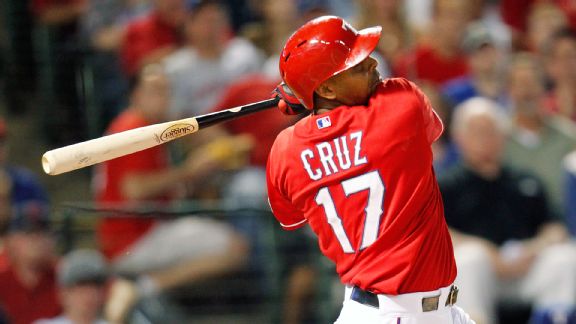
6 Reasons You Don't Want Nelson Cruz

Cruz is not as good as his power numbers suggest (ESPN)
Nine days until pitchers and catchers report to spring training, and Nelson Cruz is still a free agent (but probably not for long). That probably wouldn't be the case if he hadn't served a 50-game PED suspension last year, but then again so did Jhonny Peralta and he signed a fat deal with the St. Louis Cardinals over two months ago. Cruz is one of the few remaining impact free agents, but while his power may be alluring you should hope your team doesn't commit multiple years and millions of dollars to him. Here's why:

1. He's old
Cruz is going to turn 34 on July 1st, well past a player's prime age. His best years are likely behind him, so whoever signs Cruz is likely paying for the decline phase of his career.

2. He's injury-prone
Cruz has played more than 130 games in a season once in his nine-year career.

3. He doesn't hit well outside of Texas
The Ballpark in Arlington (now Ameriquest Field?) is a hitter's haven. Everyone knows that. It's so advantageous that it makes Cruz hit like Frank Robinson, as he's batted .294/.356/.555 with 58.6 percent of his career home runs there. But away from home he's hit a much less formidable .242/.299/.435. Teams like the Mariners who play in pitching friendly environments need to take that into account and adjust their expectations accordingly.

4. His offense is one-dimensional
Cruz is going to get paid because of his power. He's gone yard 135 times during the past five seasons, a total that exceeds those of Ryan Howard, Josh Hamilton and Joey Votto and works out to be an average of 27 dingers per year. Only 16 players have hit more home runs during that span and just four players have posted a better ISo while playing in more games. Still, power is pretty much the extent of Cruz's offensive contributions these days. He's never topped 90 RBI despite batting in some loaded Rangers lineups. He strikes out a lot, doesn't hit for high averages and is a subpar baserunner. Lastly, his patience leaves something to be desired, for Cruz has never walked 50 times in any season and holds a .319 OBP over the last three years. He's basically an older Mark Trumbo.

5. He's a defensive liability
Never a Gold Glover to begin with, Cruz can no longer hold his own in right field and gives back a good chunk of the value his bat provides, which at about two wins per seasons really isn't that valuable to begin with. At this stage of his career he'd be better-suited as a DH, which limits roster flexibility and should make National League teams wary of signing him.

6. He just got busted for PEDs
Cruz was involved in the Biogenesis scandal that brought down Peralta, Alex Rodriguez and Ryan Braun, among others. Who knows how that's going to affect his performance? Melky Cabrera suffered a notable drop-off in performance in his first season following a PED suspension, and he's four years younger than Cruz.

Cruz is a two-win player at best these days, and probably not even that once you factor in age, ballpark, and PED-related decline. The two-time All-Star is probably going to be a bust wherever he signs, especially if he goes to Seattle and has to play half his games in notorious power-killer Safeco Field.

Steer clear, Mariners!

Friday, January 31, 2014

Young Bows Out

Young is leaving the game before his performance starts to suffer (ESPN)
It's fitting that two days after Lance Berkman called it quits, Michael Young is following him out the door. Fitting because they were both gifted hitters who made their names playing 257 miles from each other in Texas: Berkman in Houston and Young in Arlington.

Born eight months apart in 1976, they retired just two days apart in 2014, each at the age of 37 after enduring back-to-back disappointing seasons. But whereas Berkman was more or less forced out by injuries, Young is choosing to leave the game on his own terms after playing 147 games for the Phillies and Dodgers last year and batting a respectable .279 with a 102 OPS+.

Even still, their careers overlapped pretty well, which is funny considering how different they were as ballplayers. Berkman was a native Texan and a lumbering, switch-hitting slugger who played first base and left field, while Young hailed from California and was more of a slap-hitting shortstop. It's surprising, then, just how well some of their career totals match up:

Berkman: 1,879 G, 1,146 R, 422 2B, 86 SB, .293 Avg, 3,485 TB, six All-Stars
Young: 1,970 G, 1,137 R, 441 2B, 90 SB, .300 Avg, 3,491 TB, seven All-Stars

And here are some other similarities:

-Berkman debuted in 1999, one year before Young played his first big league game
-Both played at least 100 games at four different positions (not counting DH) and were very poor fielders
-After having somewhat down years in 2010, both bounced back for one last big season in 2011, when each made the All-Star team. Berkman finished seventh in the NL MVP voting while Young placed eighth in the AL race
-Both were traded away from their Texas teams and finished their careers elsewhere (though Berkman eventually made his way back to Texas to play for the Rangers)
-Neither won an MVP or Silver Slugger
-Both played in two World Series, including the 2011 Fall Classic when Berkman's Cardinals beat Young's Rangers in seven games

But that's enough about Berkman. I haven't written extensively about Young since he got his 2,000th career hit back in the summer of 2011--his last great season. He batted .338 with 106 RBI--both career highs--while sharing the major league lead for hits (213) with Boston's Adrian Gonzalez. At the time, he seemed to have an outside chance at 3,000 hits.

Then the following year, at age 35, his numbers dropped dramatically. His batting average plummeted more than 60 points, his OBP nearly 70, and his slugging by more than 100. Sensing the end was near, Texas traded him to the Phillies with cash for a pitching prospect (Lisalverto Bonilla) and a nothing reliever (Josh Lindblom).

There was hope that Young might be able to revive his career in Philadelphia, but all he did there was round out an aging infield of washed-up stars that already included Jimmy Rollins, Chase Utley and Ryan Howard. Young's numbers were almost identical to his 2012 production, and at the end of August the Phillies dealt him to the Dodgers for a pitching prospect (Rob Rasmussen) with a 6.46 ERA in Triple-A. Young was lucky to jump off the sinking Phillies ship and climb aboard the contending Dodgers just in time for the playoffs, but his last shot at that ever-elusive World Series ring was derailed by an old nemesis (St. Louis) in the NLCS. Young didn't do much to help matters there, coming up empty in all seven of his plate appearances.

So rather than hang around to pad his hit totals and chase a ring, Young called it a day. He can protect his .300 career batting average and leave long before he hits rock bottom. It's better this way.

A couple months from now Derek Jeter may have wished he'd done the same thing. I bring up Jeter in part because he is another shortstop in his late 30s (soon to be 40, actually), but also because I want to call attention to just how similar they were for a full decade. Check out how close they were from 2002--Young's first full season--through 2012--Jeter's most recent (and probably last) full season.

Jeter: 7,644 PA  1,153 R  2,105 H  336 2B  156 HR  .309/.376/.435  .811 OPS 114 OPS+
Young: 7,616 PA  1,028 R  2,134 H  396 2B 166 HR .304/.350/.447 .796 OPS 106 OPS+

I'm really surprised Jeter doesn't show up as one of Young's comps on his B-R page. They were very durable. They also struck out a good amount and bounced into a lot of double plays. Defensively they were about the same, with Young costing his team 8.6 wins and 126 runs with his glove while Jeter cost the Yankees 7.8 wins and 160 runs. Jeter, of course, was a much better baserunner with almost three times as many steals, and compensated for Young's power edge by getting on base more often. The point is that Young was very nearly Jeter's equal as a hitter for a long time. Take away 2002 (when Young had a .690 OPS) and 2012 (.682), and he comes out ahead.

That said, it can not be ignored the degree to which Young's numbers were enhanced by playing half his games in Texas. Like many hitters, Young got a big boost from his home ballpark. He batted a George Brett-esque .320/.368/.479 in Arlington, and if he had hit that well everywhere else we'd probably be discussing him as a serious Hall of Fame contender. As it were, his road OPS is more than 100 points lower.

For that reason (and others), Young was simply not as good as his numbers suggest. FanGraphs and Baseball-Reference agree he was worth around 25 WAR for his career, which leaves him well short of the Hall of Fame. JAWs has him as the 92nd best shortstop of all time, which seems baffling considering a lot of his counting numbers rank within the position's top 20. On the surface, a .300 career hitter who played the vast majority of his games at shortstop, second base and third base (all premium positions) would appear to be a very valuable player. Where was the disagreement between perception and reality coming from?

For starters, Young's offense really wasn't worth that much--about 60 runs for his career according to FanGraphs. Taking everything into account, that makes sense. Yes, Young got a lot of hits (six seasons with more than 200) and hit for some power (almost 700 extra base hits), but he didn't walk that much (typically around 50 times per season) so his on-base percentage of .346 is merely good, not great. Most of his power was in the form of doubles which obviously are not as valuable as home runs, so his career .141 ISo and .342 wOBA aren't very impressive either.

When he did get on he was a slightly above average baserunner, but any value he provided there was canceled out by his propensity for grounding into double plays. He also struck out quite a bit for somebody who never hit 25 home runs in a season. Throw in his friendly home park and the high-scoring era in which he played, and his numbers aren't anything special, as his .265 True Average and 104 wRC+/OPS+ indicate. He was only 61 runs better than the average hitter over the course of his career, which works out to be about 4.36 runs above average per year.

Then add to the mix his subpar glovework (2008 Gold Glove notwithstanding) which subtracts about a win per season from his value (two in his later years), and we're left with a slightly better than average hitter who has some nice counting numbers.

I don't mean to take anything away from Young. He was a good player for many years, a batting champion who set Rangers franchise records in numerous categories. But he's not a Hall of Famer (even though five of his ten best statistical comps are, and he probably would have been had he played in the 1920s or 30s), and not as good as some of his numbers suggest. Young is a perfect example of how advanced metrics and analysis can paint a more complete picture than those old-school statistics (like hits, RBI and batting average) ever can.

Saturday, December 21, 2013

Choo Deserved Ellsbury Money

Boras and Choo weren't wrong to ask for Ellsbury money
Shin-Soo Choo could have been a Yankee, had they been willing to shell out $13 million more to secure his services. New York made him a seven-year, $140 million offer, which Choo rejected because he wanted a contract to match Jacoby Ellsbury's. Rather than up the ante, the Yankees didn't budge, just like they didn't budge for Robinson Cano.  As a consolation prize they went out and got Carlos Beltran for about $100 million less. Choo over played his hand, settling for $130 million from the Texas Rangers instead.

But should Choo have settled for anything less than what Ellsbury got? I don't think so, but can see why he did. Ellsbury is more than a year younger than Choo, who turns 32 next summer. Ellsbury also plays center field and plays it well. Choo has never had a year like the one Ellsbury had in 2011, and while he too was a center fielder in 2013 he was absolutely abysmal there. It goes without saying that he will hold down a corner in 2014, wherever he lands, and the only corner outfielder to outearn Ellsbury was Manny Ramirez. Choo is a great ballplayer, but he is not Manny Ramirez.

You could certainly make the argument that he's better than Ellsbury, though. Look how their numbers compare since 2007, the year Ellsbury debuted:

Choo (2,947 AB): .290/.392/.468 (137 OPS+), 101 HR, 100 SB, 24.5 bWAR
Ellsbury (2,912 AB): .297/.350/.439 (108 OPS+), 65 HR, 241 SB, 21 bWAR

Even taking into account Ellsbury's superiority on the basepaths and in the fields, Choo does more than enough with the stick to compensate. Choo's an on-base machine and has much more power than Ellsbury, who has never topped double digit home runs in any season outside of his monster 2011. Choo strikes out more, a lot more, but his batting average is still comparable to Ellsbury's, which is more than a little inflated by Fenway Park (he's a .288 hitter everywhere else).

Another way in which Choo comes out on top is durability. Choo's played at least 144 games in four of the past five years. Ellsbury has done so just twice, and played 92 games in 2010 and 2012 combined. As Joe Posnanski likes to say. one of the most underrated talents in life is simply showing up.

So rather than bat at the top of New York's lineup, Choo will be setting the table for Prince Fielder and Adrian Beltre. Given how old and decrepit the Yankees are looking these days, he'll probably have a much better chance to win his first World Series ring with Texas, even if he did have to settle for $10 million less.

Tuesday, October 1, 2013

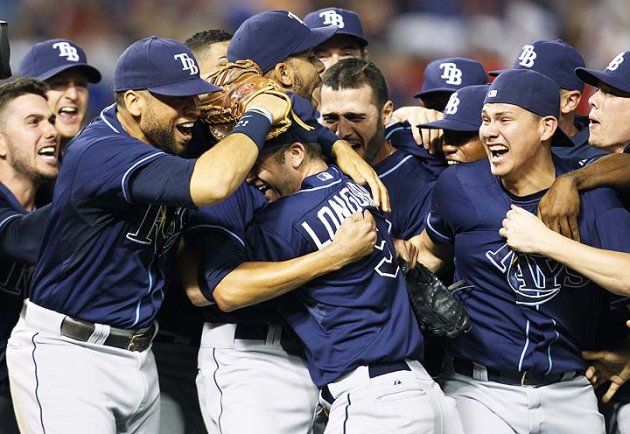
Rays Win Game 163

After their 5-2 win last night the Rays live to play another day (Yahoo Sports)
Last night the Tampa Bay Rays and Texas Rangers, both of whom finished the regular season with identical 91-71 records, squared off in Arlington last night to determine the American League's second Wild Card team.

This game--Game 163--wouldn't have happened two years ago. Instead, both teams would be lamenting how they finished one game behind the Cleveland Indians--the true Wild Card winners. But the times, and rules, have changed, so both teams were given a second shot at October baseball.

The Rangers were red-hot, having won seven straight games to close out the year. That sprint to the finish left Ron Washington unable to start Yu Darvish or Derek Holland. He went with 22 year-old rookie Martin Perez, who acquitted himself well this year but wouldn't have been anyone's first choice to start a game of this magnitude.

That's what made the Rays clear favorites to win. In this do-or-die, win-or-go-home cage-match,Tampa Bay turned to its ace and reigning AL Cy Young winner David Price. Putting his postseason struggles against Texas aside, the three-time All-Star is widely considered to be one of baseball's best pitchers and his availability seemed likely to swing the game in Tampa Bay's favor.

Sure enough, it did. Price pitched the Rays into the playoffs by going the distance, scattering seven hits and allowing just two runs. Tampa Bay staked him to an early lead, drawing first blood on Delmon Young's sac fly in the top of the first. The Rays led from that point forward, and with Price pitching their lead was never seriously threatened.

Perez didn't pitch poorly, but simply wasn't good enough to outduel Price. He departed in the sixth after striking out Ben Zobrist to open the frame, giving way to Alexi Ogando. Texas was losing 3-1 at the time, but doubles from Evan Longoria and David DeJesus made that deficit 4-1 before Ogando could close out the inning.

The Rangers responded with a run in their half of the inning on an RBI double from Alex Rios, but Price shut them out for the rest of the night. Tampa added an insurance run in the top of the ninth to make the score 5-2. Rather than tap into his bullpen, Joe Maddon let Price, who had thrown 108 pitches through eight, come back out to finish what he started. He finished strong, setting down Adrian Beltre, A.J. Pierzynski and Nelson Cruz in order.

(Speaking of Cruz, all the hoopla surrounding his return from a 50 game suspension turned out to be much ado about nothing. Cruz was a non-factor, going 0-for-4 with a strikeout).

Price put the team on his back, but so did Evan Longoria, who continued his run of monster games on the final day of the season. Longo went 3-for-4 with a single, double, and two-run homer. The long ball was his seventh career blast on the final day of the season, breaking a tie with Stan Musial. Longoria clearly understands the importance of saving his best for last.

So for the second year in a row, the Rangers are headed home after narrowly missing the postseason and Washington will likely be fired as a result. The Rays travel to Cleveland, where they will take on Terry Francona's Indians tomorrow night in another sudden-death affair--the Wild Card (aka coin toss) playoff game. Tampa Bay will pin its playoff hopes on Alex Cobb, while Cleveland will ride rookie Danny Salazar, who has just ten big league starts under his belt.

Obviously this game could go either way, but my gut tells me the Rays will come out on top. I say Tampa Bay 4, Cleveland 3.

Thursday, May 23, 2013

Darvish Dominating

After a strong but somewhat uneven debut last year, Yu Darvish has emerged as the bona fide ace Nolan Ryan thought he was getting when he invested $112 million in the Japanese pitching phenom. Hailed as a preseason Cy Young favorite, Darvish has begun building the foundation for his case with a stellar start to his sophomore campaign.

Since coming within one out of a perfect game in his first start of the season, Darvish has been on a roll. The 26 year-old currently leads the majors in strikeouts (91), K/9 rate (12.3) and starts (10). He also sports a 7-2 record, 2.84 ERA, 0.96 WHIP and 4.14 K/BB ratio while limiting opponents to a .179 batting average. At the rate he's going, he could punch out 300 batters by season's end, which hasn't happened since Randy Johnson passed the benchmark in 2002. What's more, 300 Ks would put him in the same club as immortal hurlers such as Bob Feller, Sandy Koufax, and Pedro Martinez.

He's improved his already-elite strikeout rate by making a key adjustment in his approach. Rather than trying to blow everyone away with his blazing fastball, as he seemed to do last year, he's relying less on his heater. Instead, he's going to his slider more than twice as often as he did last year, a wise decision given that his slider is the best in the business. As a result, Darvish is getting more swinging strikes and weaker contact than he did last year. He's keeping batters off-balance and on their toes instead of letting them sit on his fastball.

However, the main driving force behind Darvish's breakout is improved command. He's getting more first strikes, which allows him to get in the driver's seat and dictate how each at-bat plays out. Whereas he issued 89 free passes last season-fourth most in the American League--and posted a 4.2 BB/9 rate, he's trimmed his walk rate to 3.0 batters per nine innings in 2013. This improvement has helped him become more efficient with his pitches and last deeper into ballgames, as he's completed at least six innings in all but one of his starts this season.

Look for Darvish to shine in his first interleague start of the year on Monday against the Arizona Diamondbacks.

Sunday, April 7, 2013

Rangers Reward Andrus

Shortly after former MVPs Buster Posey and Justin Verlander joined baseball's ever-growing $100 million club, Elvis Andrus' received a brand-spanking-new eight-year, $120 million contract expension that puts him in the same rarefied air as the aforementioned duo along with Evan Longoria, Josh Hamilton, and David Wright.  Here are five reasons why Andrus does not deserve that kind of cash.
  1. With just 14 career home runs, a .354 slugging percentage and .079 ISO, Andrus has no power to speak of. In 2010 he failed to go deep and compiled only 18 extra base hits in 674 plate appearances. Not surprisingly, he has yet to earn an intentional walk in over 2,600 career trips to the dish
  2. He's regressed as a basestealer. As a rookie he stole 33 bases in 39 attempts (84.6 percent), but last year swiped just 21 bases in 31 attempts (67.7 percent--barely above the break-even point). Considering that speed and defense--his two greatest skills--deteriorate with age, Andrus is likely to suffer a dramatic drop-off in value once he reaches his early 30s
  3. He strikes out a good amount for somebody with zero pop, whiffing 96 times in 2010 and again in 2012. That's way too many whiffs for a Juan Pierre-type and explains why he's failed to bat above .286 despite his blazing speed
  4. He's basically Erick Aybar. Aybar is signed to a five-year, $40 million deal with the Los Angeles Angels
  5. Andrus is a two-time All-Star, but his trophy case is pretty empty. He's never received an MVP vote, won a Gold Glove, or led the league in any significant batting category
Andrus is a nice complementary piece on a winning team, but the Rangers were crazy to outbid themselves and hand him a Jose Reyes/Carl Crawford sum of money. At 24, Andrus is still young enough that he has room to keep developing, but I just can't see him emerging as a Reyes or Derek Jeter type who commands $15 million a year. Maybe Texas thinks otherwise, that his strong Spring Training (.404/.456/.596) indicates a breakout is on the horizon?

I believe the real reason Texas locked him up is because the Rangers are a team in transition. With Ian Kinsler declining, Nelson Cruz embroiled in PED controversy, Adrian Beltre getting old, and Hamilton, Michael Young, and Mike Napoli all gone, the Rangers crave the kind of young talent and optimism that Andrus provides. They see him as a bridge to the future, a source of consistency and stability for a roster that is about to undergo major turnover in the next few years. They're hoping Andrus embraces his role not just as a team leader, but as a winner. 

Still, that shouldn't boost Andrus's price tag north of nine figures. I get that Texas has money to burn, but the whole point of extending young players before they reach free agency is to secure their services at a discount, to pay less than what you expect they'll demand when they hit the open market in return for the security that a long-term contract provides. Andrus was slated to become a free agent at the age of 27, in the heart of a player's prime earning years, but even then I'm not so sure he could have fetched as much money.

But we'll never know.

Monday, April 1, 2013

Notes From Opening Night

The 2013 baseball season began with last night's interleague game between the Texas Rangers and Houston Astros at Minute Maid Park. I don't think anybody gave Houston's glorified Triple-A team much of a chance to win, so it was shocking to see the 'Stros pound their new division rivals by a score of 8-2. Bud Norris got the win, Matt Harrison took the loss and Erik Bedard earned the save.

Here are some more box score notes from the game:
  • Ian Kinsler flew out in the first at-bat of 2013
  • Jose Altuve recorded the first hit of the year and added an RBI single in the bottom of the fifth
  • Rick Ankiel smacked the first home run of the year with a three-run bomb off Derek Lowe Ankiel was inserted into the game as a pinch-hitter for Brandon Barnes in the bottom of the sixth
  • Nelson Cruz committed the first error the season (which led to an unearned run), but at least he made up for his mistake by going 2-for-3 at the dish with an RBI single and a walk
  • Erik Bedard notched his first career save. Unlike a Mariano Rivera or Jonathan Papelbon, he actually had to work for his save, recording ten outs to finish what Norris started
  • Lance Berkman performed well in his Rangers debut, going 2-for-4 with a run scored. A.J. Pierzynski didn't do quite as well; 1-for-4 with a strikeout
  • Justin Maxwell ripped two triples, more three-baggers in one game than many hitters will over the course of an entire season. Additionally, he and Altuve were the only Astros not to strike out last night
  • Both teams combined for 15 hits--12 singles, Maxwell's triples, and Ankiel's home run
  • The game ran three hours long
Happy Opening Day! 

Tuesday, March 26, 2013

AL West Preview

1st Place--Los Angeles Angels
2012 Record: 89-73
2012 Pythagorean: 88-74
2013 Projected: 92-70
After starting last year 7-15 with Mike Trout toiling in the minors and Albert Pujols mired in the worst slump of his career, the Halos dug themselves out of an early hole and produced the best record in baseball from that point forward. Though their wretched April cost them a playoff berth in 2012, the Angels are poised to make the postseason after inking Josh Hamilton--the most coveted position player on the free agent market--to a five-year, $125 million deal. Though the former MVP is on the wrong side of 30 and will likely regress and/or get hurt following a career year in 2012, he'll provide a heavy dose of lefthanded power LA so desperately craves. That said, don't be surprised if Hamilton goes bust and Torii Hunter, now with the Tigers, produces more value in 2013. Mike Scoscia will have the pleasure of filling out a lineup card that features baseball's best all-around player (Trout), baseball's most exciting player (Hamilton) and one of the best hitters of all-time in Pujols. Trout figures to slide a bit following his historic season, but at least his talent won't be wasted in the minor leagues. Pujols shrugged off a slow start to bat .312/.374/.589 from May 15th onward, proving talk about his decline to be premature. Expect similar numbers in year two of his gargantuan contract. Slugger Mark Trumbo has been a mess since the end of July, but I think he reverts to his mashing ways in his age-27 season. I could also see Peter Bourjos breaking out. Jered Weaver, the only American League pitcher to finish in the top five of the Cy Young voting in each of the past three years, is a bona fide ace even though his strikeout rate has plunged from 9.3 K/9 in 2010 to 6.8 K/9 last year. C.J Wilson will improve upon his first season with the Angels when he takes advantage of the run support boost and friendly home ballpark. Jason Vargas and Tommy Hanson are intriguing additions to the starting rotation, though I'm guessing most Angels fans would rather have seen their team keep Dan Haren and Zack Greinke. However, I don't think they'll miss Ervin Santana and Vernon Wells too much. The bullpen should get a nice boost from Ryan Madson, but it remains to be seen how effective he'll be after sitting out all of last year recovering from Tommy John surgery. Given how much worse the Rangers got over the winter, the AL West is theirs for the taking.

2nd Place--Texas Rangers
2012 Record: 93-69
2012 Pythagorean: 91-71
2013 Projected: 88-74
As if blowing their division lead on the regular season’s final day wasn’t miserable enough, the Texas Rangers followed up their late-season collapse with a lean winter. They waved goodbye when sluggers Josh Hamilton and Mike Napoli signed with new teams. They parted ways with veteran leader and fan favorite Michael Young. They winced when Nelson Cruz‘s name surfaced in the latest PED scandal. They whiffed on Justin Upton. Talk about a rough offseason. Faced with limited options and suddenly short on offense, the Rangers turned to Lance Berkman out of desperation. Five years ago that would have been a great get for them, but Big Puma is 37 and doesn't appear to have much left in the tank after needing four separate DL stints last year. He's just one of many Rangers at risk for disappointing seasons. Texas paced the American League in runs and hits last year, and while their lineup is still formidable there's no way that happens again this year. Adrian Beltre is their best hitter, and he'll be 34 two weeks from now. Ian Kinsler is on the wrong side of 30, too, and second basemen age horribly. Cruz will turn 33 and his best days are probably behind him. At 36, A.J. Pierzynski can't possibly repeat his career year and will probably wear down over the course of a long Texas summer. The offense will probably be fine, but there's a lot of downside risk here and not much upside. Yu Darvish made adjustments toward the end of last year and is going to have a big sophomore season (like Daisuke Matsuzaka did). He needs to cut down on his walks, but could win 20 games and the Cy Young award even though the Ballpark in Arlington will likely suppress his numbers. He anchors a strong rotation that also features Matt Harrison, Derek Holland, and Alexi Ogando. Joe Nathan proved he's still an elite closer in his Texas debut last year, making the All-Star team and saving 37 games. Joakim Soria, a former All-Star closer with the Kansas City Royals, will set him up. The Rangers certainly have enough talent to win 90+ games again and challenge the top spot in the division, but I see them taking a small step back in 2013.


3rd Place--Oakland A's
2012 Record: 94-68
2012 Pythagorean: 92-70
2013 Projected: 83-79
I still can't believe these guys won the AL West last year, especially since they ended May seven games below .500. Maybe that's why I can't shake the feeling that they just got red-hot for four months and will probably fall back to earth in 2013 (not quite like the Orioles, but similar). The A's are woefully short on offense without Chris Carter, Stephen Drew, and Jonny Gomes, though the middle of the order has some potential. Yoenis Cespedes is a Vladimir Guerrero-type who can hit the ball out of a canyon and is an MVP-candidate-in-the-making, but I'm not totally sold on Josh Reddick as an All-Star caliber player just yet. Chris Young brings a nice power/speed combo, but it's worth noting that he's a .224/.311/.409 hitter away from Chase Field. Jemile Weeks is almost guaranteed to bounce back from a miserable year in which his BABiP cratered at .256. The bottom half of their lineup is a disaster, so runs will be in short supply. That means Oakland will have to rely on its elite pitching staff, which ranked second in ERA last year. With Jarrod Parker, Tommy Milone, A.J. Griffin, and Dan Straily all poised to build off successful 2012s, the young rotation is brimming with upside. Brandon McCarthy will be missed, but Oakland is hoping Brett Anderson can finally stay healthy after averaging just 13 starts per year over the past three. He's demonstrated the ability to pitch like an ace, so a full season from him would go a long way towards boosting his team's playoff chances (but I wouldn't count on it). The bullpen looks stellar on paper, and the defense is solid, too. The A's could be a great team again if the starting pitching improves and Cespedes makes the leap to superstardom, but I see them settling into the 80-85 win range and missing the postseason.

4th Place--Seattle Mariners
2012 Record: 75-87
2012 Pythagorean: 77-85
2013 Projected: 73-89
The Mariners have lacked adequate firepower for quite some time now--you'd have to go back to the end of the Bush administration to find the last time Seattle didn't finish last among AL teams in runs scored. That's going to change this year after taking on veteran hitters Michael Morse, Kendrys Morales, Raul Ibanez, and Jason Bay. Ibanez and Bay are bench players at this stage in their careers, but Morales and Morse add much-needed pop to the middle of the order. As the cornerstone of Seattle's lineup, Jesus Montero must (and will) improve upon his disappointing 2012 (.685 OPS, -0.2 bWAR). He's just 23 and still has room to grow, as do Kyle Seager, Dustin Ackley and Justin Smoak. Moving in Safeco's fences will help these young hitters, but not enough to make much of a difference. The Mariners have one of the best pitchers around in Felix Hernandez, but he seems to be at risk for a down year after receiving a mammoth contract extension and throwing more innings than any other hurler since 2009. Seattle's rotation is a mess with him and would be downright unwatchable without him. M's are stocked with young pitching talent that could arrive in the Show later this year, but by the time they're ready to contribute it will too late to improve Seattle's non-existent playoff chances. They're still rebuilding and at least another year or two away from making a serious run at one of the wild card spots.

5th Place--Houston Astros
2012 Record: 55-107
2012 Pythagorean: 59-103
2013 Record: 58-104
Welcome to the American League, boys. It's going to eat you alive.

Saturday, January 12, 2013

Can Berkman Bounce Back?

Berkman's getting older, but he can still hit (KeyeTV)
The Texas Rangers, suddenly short on offense after the free agent departures of Josh Hamilton and Mike Napoli, replaced some of their lost firepower by signing Lance Berkman to a one-year contract worth $10 million plus a vesting option for 2014. The six-time All-Star will serve as his new team's Designated Hitter in the wake of Michael Young's being traded to the Philadelphia Phillies last month.

Berkman may never get another major league contract, so if this is the end of the line for him then his career has come full circle. This deal brings the Texas native back to the Lone Star State, where he was born, raised, and educated before the hometown Houston Astros drafted him out of Rice University in 1997. Berkman debuted with the big club two years later and spent the first dozen seasons of his big league career as an Astro. One of Houston's Killer B's along with Craig Biggio, Jeff Bagwell, Carlos Beltran and Derek Bell, Berkman helped lead the team to four playoff appearances during his time there, including the franchise's only World Series appearance in its 50-year history. The starstruck 'Stros were no match for the Chicago White Sox, who took a cue from the Red Sox and ended their own interminable championship drought with a Series sweep. Berkman was one of the few Astros who offered any resistance, batting .385 and knocking in six of the 14 runs his team scored in the series.

The nucleus of that team aged out and Houston hasn't been to the playoffs since. Bagwell never played again. Biggio deteriorated into a replacement level player and hung on just long enough to get his 3,000th career hit. Roger Clemens and Andy Pettitte stuck around for another year before returning to the Yankees. Morgan Ensberg fell apart in his thirties, as so many ballplayers do.  But has his team crumbled around him, Berkman soldiered on.  He inherited the first base job from Bagwell, one of the finest to ever man the position, and continued to be a force in Houston's lineup until 2010.

That summer, with Berkman scuffling and the team trying to go in a different direction, Astros GM Ed Wade dealt him to the New York Yankees the day of the trading deadline even though NY had its own switch-hitting first baseman in Mark Teixeira. Berkman followed Roy Oswalt, who'd also been sent packing to the northeast (Philadelphia) two days earlier, out the door. The trade was bittersweet for Berkman, who desperately wanted to win but had spent his entire career with Houston up to that point. But the Astros were going nowhere, headed for another losing season, and the Yankees were just nine months removed from winning the World Series.  Berkman never seemed comfortable in the Big Apple and his offensive woes persisted.

Trading Berkman and Oswalt marked the onset of a rebuilding process in Houston. In the time since, the club's front office bulldozed the roster by unloading the rest of their established veterans (Michael Bourn, Carlos Lee, Wandy Rodriguez, Hunter Pence, and Brett Myers). In their two full seasons without Berkman, the Astros are the worst team in baseball and have lost twice as many games as they've won.

Many wrote him off after 2010, when he looked finished at the age of 34 and endured the worst full season as a professional. He struggled mightily at the plate, hitting just .248 with 14 home runs and 58 RBI between the Astros and Yankees. Some doubted he'd be able to find a job for 2011.

But after accepting a one-year, eight million dollar contract from the Cardinals (nearly a 50 percent pay cut), and moving to right field out of respect for Albert Pujols, Big Puma committed himself to improving his fitness routine over the offseason.  Noticeably trimmer and in the best shape of his life, Berkman returned to form in 2011. He got off to a great start with his new team and never looked back, finishing the season with a .301/.412/.547 triple slash line that produced the third highest OPS+ in the league (behind league MVP Ryan Braun and runner-up Matt Kemp). The NL Comeback Player of the Year also belted 31 homers, plated 94 runs, scored 90 times and drew 92 free passes while protecting Pujols and Matt Holliday in the Cardinals lineup. He finished seventh in the MVP race and went on to play an integral role in the team's World Series championship that fall. Berkman delivered several key hits and was especially lethal in the Fall Classic, batting .423/.516/.577 as St. Louis prevailed over Texas in seven games.

Not surprisingly, the Redbirds picked up his $12 million option for 2012, but Berkman went bust when he took four separate trips to the Disabled List and appeared in just 32 games. Once again, his future looked uncertain. When he grounded out in his final at-bat on the last day of the regular season, it seemed very possible that we had seen the last of Lance Berkman in a major league uniform. He was left off the Cardinals postseason roster. He watched from the sidelines as St. Louis came within one win of returning to the Series, only to squander their 3-1 lead over the eventual World Series champions and go home empty handed. He considered retiring.

Now, in a twist of irony, Berkman will suit up for a team still chasing its first World Series championship in part because of the damage he inflicted on them two Octobers ago. Funny how that happens in sports.

Berkman will be 37 in February, the same age Bagwell was in his injury-wracked final season, an age when most players are deep into the twilight of their careers. It goes without saying that he may not have much left in the tank. He's playing on a bum right knee that required two surgeries last year, adding to the host of leg issues that have prevented him from reaching 500 at-bats in a season since 2008. Given his age and injury history, at this stage in his career he's all but guaranteed to miss a good chunk of time.  Even if he manages to avoid the Disabled List, the Texas heat figures to wear him down over the course of a long season.

Signing Berkman is a calculated risk, but could prove to be a massive bargain if he has another renaissance season. Moving to the most hitting-friendly venue outside of Colorado will boost his numbers, or at least offset some of his age and injury-related decline. DH'ing full time should limit his injury risk and keep his body fresh. Plus it's always nice batting in the heart of a loaded lineup. Ron Washington has already said he's going to bat his new DH third to replace Hamilton's spot in the order. That means he'll have plenty of RBI opportunities with Ian Kinsler and Elvis Andrus setting the table for him. He'll also have Adrian Beltre, Nelson Cruz, and possibly Justin Upton (?) batting behind him. Berkman's primed for a comeback.

So what can the Rangers (and fantasy owners) expect from Berkman in 2013? His age definitely worries me, but not enough to label him "washed up." 37 is old in baseball years, but not too old to be a productive Designated Hitter, as Paul Molitor, Jim Thome and Edgar Martinez have proven. Father Time catches up to everyone at some point, but Berkman was a beast at 35 and hit well enough in limited action last year to suggest that his skills are still intact.  Even taking his age and medical issues into account, I feel confident saying he will rebound this year if his body holds up.

Still, it's tricky trying to forecast what Berkman will do in 2013. Bill James projects him to play 134 games, club 21 home runs and bat .273/.389/.485 (.369 wOBA).  FanGraphs is equally optimistic, predicting him to sock 19 dingers and bat .279/.384/.470 (.366 wOBA) in 123 games. Texas has to be thrilled if it can squeeze that kind of production out of Berkman. Last year, the team's DHs (mainly Napoli and Michael Young) batted a disappointing .265/.323/.432 with 18 homers and 78 RBI. If healthy, Berkman is a good bet to reach or exceed those numbers. I'll split the difference and peg him for 20 bombs, 80 RBI, and a .275 batting average. His ceiling is 2011 and his floor is 2012; I'm guessing he winds up somewhere in the middle.

He's definitely worth a spot in AL-only leagues and I'd take a flier on him in mixed leagues. Offense is hard to come by these days, and you need to get it where you can. Even if it's in the form of a 37 year-old playing on one leg.