Wednesday, August 3, 2016

Rodriguez Resigned to Fate

Rodriguez's days in pinstripes are numbered, and he knows it (Hardball Talk)
Alex Rodriguez was not in the Yankees starting lineup last night, although he did get in the game long enough to slap the fly-out that ended it. He didn't make an appearance at all the previous night, despite the game going 10 innings and Joe Girardi using a dozen position players.  Rodriguez was also absent from the starting nine on Sunday, when he was again limited to a pinch-hit cameo (he struck out).

That's how the summer has gone for Rodriguez, who's watched his playing time evaporate as he sinks deeper and deeper into the worst slump of his career. Since July began Rodriguez has started just nine of his team's past 28 games. And he didn't spend time on the Disabled List, so it's not like he wasn't available.

After two decades as a Major League starter, Rodriguez has finally been reduced to a part-time role. The Yankees are still giving him superstar money, but they're through giving him superstar playing time. Even in a rebuilding year where they've shipped out more talent than they've brought in, they can find better ways to fill their DH slot than with a 41-year-old failing to bat his weight.

Girardi has tried everything to revive Rodriguez's bat. He's given him days off to clear his head and work on his swing. He's continued batting him cleanup, long after it became obvious that Rodriguez is no longer a Major League quality bat, let alone a middle of the order one. He's limited A-Rod's at-bats against righties, even though Rodriguez has never shown much of a platoon split.

None of it's worked, of course, because there's no cure for diminished bat speed and reflexes. Despite Girardi's best efforts, the decline of Rodriguez has only hastened. He's down to .204/.252/.356 after going 4-for-his-last-37, which was lowlighted by a four-strikeout performance in a game at the Trop last weekend. He recently drew comparisons to Willie Mays, and not the good kind.

His collapse extends far beyond last month, though, or even this year. Including last year's Wild Card game, Rodriguez has played 119 games since the beginning of last August, coming to bat 451 times during that span. In what is now a year-long famine, he has almost twice as many strikeouts (126) as hits (79) and has slashed .196/.272/.362. That is unacceptable production for a player at any position, especially one where the sole requirement is hitting.

To his credit, Rodriguez has taken the benching quite well (at least publicly). There has been no sulking or media outbursts. He hasn't demanded a trade. Instead, he's handled everything with grace and professionalism, which can't be easy for a player of his stature.

So when reports leaked today that Rodriguez might be released, of course he was okay with it. Many see it as the Yankees finally ridding themselves of Rodriguez, who long ago stopped being the superstar they were paying him to be. But from Rodriguez's perspective, he will also get a welcome release from what has become a sad existence. The former MVP is now baseball's most expensive bench player. That might at least be palatable if the Yankees were winning, but they're not. Maybe a release will mean more playing time elsewhere (probably not). Perhaps it gives him a shot at a ring.

At this point, releasing Rodriguez is clearly in the best interests of both parties. A-Rod knows it, and the Yankees have been trying to do it for years. He's given them the green light; now it's up to them to pull the plug.


Monday, August 1, 2016

Why Didn't Griffey Get More MVPs?

Griffey won a lot of his awards in his career. But only one MVP? (CBS Sports)
I don't envy the person who had to write Ken Griffey, Jr.'s Hall of Fame plaque. There's a lot to say and not nearly enough space to say it. How do you sum up a 22 year career into a single paragraph? You have to mention the 10 straight Gold Gloves--the most by a center fielder not named Willie Mays. You can't overlook the 13 All-Star appearances, including 11 in a row at one point. And there absolutely needs to be a line about his home run total--he hit 630 of them, after all, sixth-most in baseball history.

The inscription also had to say that Griffey was AL MVP in 1997 (but failed to mention he won unanimously). What it doesn't say is how many others Griffey could, or should, have won.

It's simply mind-boggling to me that a player as beloved and talented as Griffey won but a single MVP award. He was the face of baseball for an entire decade, the same way Mantle was the face of baseball for the '50s and Babe Ruth was during the '20s. Griffey wasn't just a star or even a superstar; he was a super-duper-star. He was everywhere, on everything from cereal boxes and videogames to commercials and movies. The only athlete more popular than Griffey during the '90s was Michael Jordan.

He was so good and so popular that you would have thought he was winning the MVP every year, or at least coming close. As it turns out, Griffey had two seasons in his 22 year career where he finished in the top three of his league's MVP voting. Two.

It's incomprehensible that among players who won MVPs during the '90s, Griffey has the same number as Terry Pendleton, Ken Caminiti, Dennis Eckersley, and Mo Vaughn. None of those players were anywhere close to the player Griffey was during his prime.

I can't get over it. How how did Griffey, the face of baseball and the best player in his league for a decade, a .300 hitter who slugged more home runs and drove in more runs than all but one player during the '90s, a dazzling defender who won the Gold Glove every year, who made the Mariners relevant for the first time, win just one MVP award when Juan Gonzalez--Juan Gonzalez--won two. It doesn't make any sense.

By my count, there were a half-dozen seasons during the '90s when Griffey had a legitimate MVP case. Only once--in 1997 when he led the league in WAR (for a position player), runs, homers, RBI, slugging, and total bases--did he actually win the darn thing. Even though everyone knew he had been the best player in the American League for several years by that point, it all had to come together (Seattle making the playoffs, him leading the league in almost everything) for the MVP to go his way.

In this regard, Griffey is like another tremendous all-around center fielder who preceded him by a few generations: Willie Mays. Starting when he won his first MVP at age 23, Mays was clearly the best player in the National League for more than a decade. And yet, voters kept finding reasons to give the MVP to someone else (it didn't help that Mays's teams only made the playoffs once from his age 24-39 seasons). As such, Mays didn't win again until 34, by which point he only had one more MVP-caliber season left in him. He retired with two MVPs when he easily could have had seven or eight.

Griffey, who ceased to be healthy after turning 30, wouldn't have won that many. But he should have more than one, right? I mean, there was a four-year stretch in the late '90s where he averaged 52 homers, 142 RBI, and a .996 OPS (152 OPS+) while winning the Gold Glove every year. Surely he deserved at least one, maybe two more?

Let's go back and find out...
Griffey was more than just a great hitter, he was a freak athlete (ESPN)
1993: Griffey finishes fifth, should have won
Griffey was a great player for the first few years of his career--an instant star--but it wasn't until his fifth year/age 23 season that he became a superstar. That was the year he cranked 45 homers--blowing away his previous career high of 27, and set a bunch of other personal bests. He batted .309/.408/.617 (171 OPS+), led the league in total bases and, for the only time in his career, walked more than he struck out. His 8.7 bWAR were the most by an American League position player, plus he helped the Mariners to a winning season--which was a big deal considering they'd lost 98 games the year before.

Still, being a star on an also-ran isn't going to get you much love from the BBWAA. Seattle finished fourth in the AL West, 12 games behind Chicago, who produced the league's unanimous MVP in Frank Thomas. In retrospect, it's puzzling to see how Thomas was a unanimous selection. His offensive stats (.317/.426/.607, 41 HR, 128 RBI) were almost identical to Griffey's, but he was a first baseman. Griffey was a Gold Glove-winning center fielder, not to mention a better baserunner (Thomas had four steals to Griffey's 17). All told, Griffey was much more valuable, holding a 2.5-win edge in WAR.

The same goes for the other three players who finished ahead of him; Paul Molitor, John Olerud, and Juan Gonzalez. Molitor was a DH with half as many homers and an OPS that was over 100 points lower than Griffey's. Olerud had better hitting stats but, like Thomas, played first and was a non-factor on the bases (0 steals). Gonzalez, a left fielder, basically had the same stats as Griffey except in OBP, where he trailed by 40 points. Griffey should have won his first MVP at 23, just like Mays, or at least deserved to be a close second.

1994: Griffey finishes second, right call
Few players got shortchanged more by the player's strike than Griffey, who already had 40 homers--most in the AL--when his year was cut short with 50 games remaining. He was wielding a red-hot bat at the time, with four home runs and 13 RBI in just 10 August games. Who knows what Griffey might have done with the rest of August and September--he might have been the first man to break Roger Maris's home run record.

As good as Griffey's numbers were, they weren't as good at the time as those of Frank Thomas (MVP again) and Albert Belle, who finished third. Thomas had 30 points of batting average, 85 in OBP and 55 in slugging on Griffey, with just two fewer homers but 11 more RBI. Belle also probably had a better case, as his slash stats were all about 35-40 points better than Griffey's. Of course, it's hard to hit .350 for a full season so maybe those numbers would have come down, but we'll never know.

1996: Griffey finishes fourth, deserves second
After an injury-plagued down year, Griffey came back with a vengeance in 1996, slamming 49 home runs and knocking in 140 in just 140 games. He also batted .303/.392/.628, stole 16 bases in 17 tries, and played the best center field of his career. Not surprisingly, Griffey led the league in bWAR with 9.7--which easily would have been a 10-win year had he not missed three weeks leading up to the All-Star Break.

This was the best year of Griffey's career to that point, but voters bypassed him and teammate Alex Rodriguez (who was actually more deserving) in favor of Juan Gonzalez, who helped Texas to a division title with slightly more impressive power numbers (47 homers, 144 RBI and a .643 slugging). Griffey and A-Rod were both much better all-around players and posted superior offensive numbers at more demanding positions, which is why B-R credits both with over nine wins while Gonzalez gets less than four.

Part of the problem was that Griffey and Rodriguez stole votes from each other, as A-Rod received 10 first-place votes and Griffey got four. Had all those first place votes gone to one Mariner, he would have exceeded Gonzalez's 11 and won the award. If only the baseball writers had co-ordinated which Seattle superstar they were voting for.
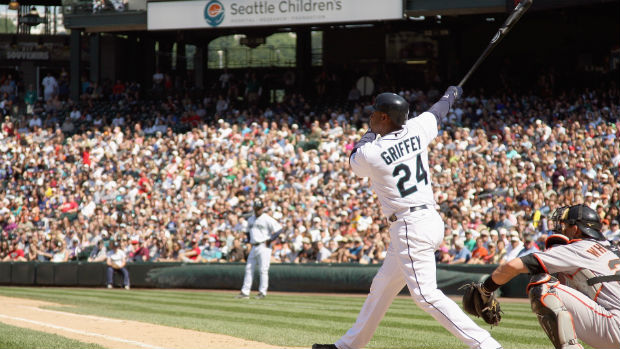
It took a home run barrage to win Griffey his first (and only) MVP (NY Daily News)
1997: Griffey wins! (finally)
Griffey had his best season and Seattle won the division, making him an easy choice for MVP (he won unanimously). Upon closer inspection, however, one finds that there was a player considerably more valuable than the Kid that year, and his name was Roger Clemens. The Rocket totaled an otherworldly 12.1 bWAR in his Blue Jays debut yet finished a distant tenth in the MVP race, failing to receive even a first place vote despite leading the majors in wins, innings, FIP, ERA+, and WAR. Clemens was undoubtedly hurt by the fact that Toronto finished last in the AL East, while Griffey clearly received much of the credit for leading the Mariners to a division title. When tasked with choosing between the game's best pitcher and the best position player for MVP honors the BBWAA, as they usually do, opted for the position player. I usually prefer the position player as well, so I won't argue here.

1998: Griffey finishes fourth, deserves top-three
Griffey was at it again in '98, blasting 56 homers for the second consecutive year as he give Roger Maris another run for his money. While the rest of his numbers dipped slightly, they were still almost identical to the ones he posted the previous season. And yet, he went from winning the MVP unanimously to finishing fourth, with nary a first place vote. Ahead of him finished Juan Gonzalez (again) and two superlative shortstops, Derek Jeter and Nomar Garciaparra. While both were phenomenal in helping their teams reach the playoffs, their power numbers were dwarfed by Griffey's. He ripped 21 more home runs than Garciaparra, for instance, and nearly three times as many as Jeter. He also knocked in more runs than either of them and, despite hitting 40 points lower, more than made up for this discrepancy with his power, which allowed him to out-OPS both of them.

While the most valuable player in the American League suited up for Seattle that year, his name wasn't Griffey. It was Alex Rodriguez, the league-leader in hits and bWAR who became the third player in baseball history (and still the only infielder) to go 40/40. However, his power numbers paled in comparison to Junior's and so he finished ninth. Both were also hurt by their team's lackluster record, which saw them go from division champs the year before to nine games below .500.

1999: Griffey finishes tenth, deserves higher
Griffey's final dominant season saw him finish 10th in the MVP voting despite winning his third straight home run title (and fourth overall) with 48, complemented by his typical gaudy runs/RBI totals as well as 24 steals--a career high. While his defense was slipping by this point, he still won another Gold Glove--his tenth in a row.

I'm not going to argue that Griffey deserved to win the last MVP of the '90s, because he didn't. Pedro Martinez, Ivan Rodriguez, Derek Jeter, Manny Ramirez, Roberto Alomar, and Nomar Garciaparra were all more deserving. Still, he definitely should have finished higher than Jason Giambi, Rafael Palmeiro, and Shawn Green.

So after all that, it appears Griffey deserved at least two MVP awards, maybe three if you give him '96 over A-Rod (had Griffey stayed healthy that year, it might have happened). Two is a good number of MVPs to win--that's as many as Frank Robinson, Ernie Banks, and Lou Gehrig, among others. When you win multiple MVPs, you're in pretty good company.

Like Mike Trout, Griffey had the misfortune of peaking when one of the greatest righthanded hitters in history was at his zenith (Miguel Cabrera's batting record is remarkably similar to Thomas's). Later on, his ridiculous run in the late '90s overlapped with the emergence of baseball's Holy Trinity at shortstop, not to mention some very short-sighted MVP votes. I mean, how crazy is it that a center fielder who averaged 52 homers, 142 RBI, and a .996 OPS (152 OPS+) for four years had one top-3 MVP finish? Probably about as crazy as a different center fielder leading his league in WAR every year for four years and winning just one MVP award.

Monday, June 6, 2016

Cavs' Poor Defense Puts Them Down 0-2

Cleveland's defense had no answer for the Warriors in Games 1 & 2 (TopBET.eu)
This submission comes from friend of the think tank Glen Krebs, who was probably wearing his Steph Curry Davidson jersey while writing this:

For the second straight game, the Cleveland Cavaliers' defensive issues from the regular season (but were masked by their dominance of the Eastern Conference) were exposed by the Golden State Warriors, as the Warriors trounced them by 33 points at the Oracle Arena on Sunday night.  

It's hard to believe this is the same Cleveland team that coasted to its second straight Finals, rolling over the rest of the East with its superior talent level.  Going against one of the best teams in history, however, its deep-seeded flaws have come to the forefront.  Heading back home for Game 3, the Cavaliers find themselves in a position they haven’t been in since 2008: down 0-2 in a playoff series. 

What has to be most concerning for the Cavs is that they seem to be running out of adjustments to make on defense.  Their personnel have put Tyronn Lue between a rock and a hard place in terms of defensive game planning.  Cleveland played defense at the beginning of Game 2 the same way they did in Game 1, with their guards fighting over off-ball screens and switching on off-ball screens.  Their defensive communication was still sloppy, however, leading to a series of easy lay-ups and open shots for Golden State during the first quarter.  

Lue adjusted by having the Cavs switch on everything, which incurred disastrous results as Kevin Love and Tristan Thompson were repeatedly switched onto Stephen Curry and Klay Thompson.  The two bigs have shown no indication that they can adequately guard either of those two on the ball, forcing Lue back to his original game plan early in the second quarter. After that, it was all Warriors.

Although Lue seems to be running out of options, there is one key change he can make to try and (literally) slow Golden State down.  After Kyrie Irving went down with a fractured kneecap in Game 1 of last year's Finals, David Blatt reconfigured the offense to feature LeBron James catching the ball in the high post and running iso-heavy sets through him.  Although the strategy had mixed results as James had a historically inefficient Finals on offense, it did slow the Warriors down enough to keep the series competitive for the next five games. Now would seem to be the best time for Lue to return to that, as his players have repeatedly blown assignments in transition that have either led to wide-open threes or defensive mismatches that the Warriors capitalized on immediately.

LeBron must be more assertive in Game 3 (CheatSheet.com)
It will be interesting to see what LeBron’s mindset is at the beginning of Game 3.  Although he finished Game 2 with 19 points and a near triple-double, it never felt like James was in attack mode.  He seemed focused on getting his teammates involved early, finishing the first quarter with no points and five assists.   If LeBron really is the “offensive coordinator” of the Cavs as claims to be, then it was clear he wanted to spoon feed Irving and Love to get them in an early rhythm.  

While the reasoning behind this makes sense--if Irving and Kevin Love get going early they will have more confidence at the end of games--the best thing for Cleveland might be for James to attack early and often.  The consummate team player throughout his career (often to a fault), LeBron might have to let the other All-Stars worry about getting their shots while he’s on the bench.  The most important thing for him looking ahead will be getting Andre Iguodala in foul trouble at the beginning of Game 3 by using the home atmosphere to get some calls that went against him in Game 2. 

Finally, the Cavs were also out-rebounded on both ends of the floor.  Coming into the series, that was supposed to be one of their biggest advantages over the Warriors.  That was not the case in Game 2, however, as Golden State annihilated Cleveland on the boards, 46-34.  If the Cavaliers are to have any shot at making this series competitive, they need to reverse this trend immediately.  

That seems unlikely to happen, however. As much of a toll as the OKC series took on the Warriors, it forced them to focus on both individual and team rebounding in a way they hadn't all season.  Their newfound dedication to improving that weakness has completely snuffed out any advantage that the Cavs had on the glass.  Andrew Bogut and Draymond Green were active in the early going, with Bogut doing a commendable job boxing out Tristan Thompson and keeping offensive chances alive by tapping them off the glass.  After having to deal with Steven Adams and Serge Ibaka for the last two weeks, Bogut and Green must feel like a baseball player swinging a bat without the weights on it.  Barring a major injury or divine intervention, it feels like the Warriors are going to cap off the best season of all-time with a ring.

Random Musings from Game Two

1.     LeBron’s Post Problems
a.      If it’s possible for the best player in the world to improve upon anything this offseason, it’s his postgame.  The King has done a masterful job of transitioning his game to being almost completely interior-based to accommodate the strengths of Love and Irving.  Although James is a mismatch against any small forward and most traditional fours, he still has a tendency to end his post-ups by finding himself underneath the basket with a crowd of people around him.  If he can start his post moves with more of a plan and sprinkle in some counters when he gets stopped initially, he should be the best back-to-the-basket player in the league.  That’s a scary thought for the rest of the Association, considering he’s already a supersized Blake Griffin in his current iteration. 

2.     The Curious Case of Harrison Barnes
a.      For as much as Harrison Barnes has struggled this year, he has found new life against Cleveland.  Lue has tried to hide J.R. Smith and Kyrie Irving on Barnes sporadically throughout the first two games without any success.  Barnes has done a great job exploiting Irving and Smith’s ball-watching tendencies by cutting for open looks close to the basket and driving to a spot that puts the defense at a disadvantage and opens up playmaking for his teammates.  Although Barnes struggles at creating his own shot and often seems to get in his own head, his smart play on both ends of the court show he is still a valuable asset for Golden State.

3.      Richard Jefferson’s Last Stand

a.      One Finals story that never gets old is that of the veteran role player, long past his glory days who knows this is his last real chance at a ring.  Jefferson is that guy this year.  He was ignominiously traded from Golden State in 2013 to clear up cap space fir Iguodala, his four year $39 million contract suddenly an albatross.  Although Jefferson is nowhere close to the player he was as an All-Star with the New Jersey Nets of the early 2000’s, he has aged gracefully as a backup small forward for these Cavaliers.  He was one of their few bright spots in Game 2, tallying 12 points and five rebounds in a throwback performance  Here’s to hoping to he’ll be able to continue that success as the series progresses.  

Monday, April 25, 2016

The Way-Too-Early All-Stars

It's that time of year again, baseball fans--time to vote for the MLB All-Star Game!

Don't worry, you didn't bump your head back in April and miss all of spring with a concussion. May is still a week away.

But wait, isn't the All-Star Game in July? And wasn't Opening Day, like, yesterday?

Not quite, but it sure feels that way. The season is only three weeks old, and everyone still seems to be getting their legs under them. We've only just begun.

And yet, MLB wants us to start picking who should start the All-Star Game in San Diego, even though the stats are pretty much useless at this point. There's not much to glean from a handful of starts or three weeks of at-bats, as the sample size is just too small. We haven't seen close to enough baseball to know who's legit and who's not. We've only had a taste.

Besides, what's the rush? The game is 11 weeks from Tuesday, which means many teams have about 70 games to go until the Midsummer Classic. A lot can change between now and then, including perceptions of possible All-Stars.

But say the voting closed tomorrow and we had to choose today. Who would you pick?

If you were filling out your ballot based on who's played the best so far, it might look something like this:
Get used to that friendly face, baseball fans (Chron.com)
American League

An All-Star each of the past three years, so this makes sense.

Chris Davis is a bigger name, but White has been a hair better.

Could win MVP this year.

Tough to say no to Josh Donaldson, but Machado's hit for just as much power while batting close to .400.

In a relatively weak crop of shortstops, Correa's shadow looms large. He missed out last year, but this should be his first nod of many.

I wasn't sure off the top of my head if Trumbo had been an All-Star before, as it's been awhile since he was actually good. Turns out he was--once--in 2012, when he had that ferocious first half before face-planting in the second.

Rasmus has never made an All-Star team, which is certainly disappointing considering he received Rookie of the Year consideration in 2009 and hit 23 home runs with a 132 OPS+ the following year at age 23. Five years ago, Rasmus looked like a future star. Perhaps that future is finally here?

A boring pick, but the right one. Joey Bats has been an All-Star every year this decade, which I don't think anyone else can say (at least for position players).

It's Big Papi's final season. Even if he wasn't crushing the ball, you're not going to not vote for him, unless you're a Yankees fan, in which case you have no soul and are voting for Alex Rodriguez instead.
I have no idea who that is (kdding--Denver Post)
National League

C Wellington Castillo
I'm pretty sure he has more homers than all the other NL catchers combined (not really, but it's close).

He can keep flirting with the Mendoza line all year as long as he keeps putting up those big-time power numbers.

He's picking up right where Daniel Murphy left off. Apparently playing second base for the Mets in the past six months causes players' power production to go through the roof.

Nolan Arenado's better, but the laws of baseball dictate that any and all Rockies hitters be harshly penalized for playing half their games in Coors Field. That's why Larry Walker's not in the Hall of Fame, and it's also why no Colorado player has won an MVP in almost 20 years..

Never heard of him.

They used to say the All-Star Game was made for Willie Mays. It was also made for Bryce Harper.

He's back, baby (but hopefully not back on the 'roids).

Two months ago he was unsigned despite having the best year of his career in 2015. Did everyone just sort of forget about him? I think everyone forgot about him. Who were we just talking about?

Some of these guys will be deserving All-Star starters, but some will be best suited as reserves or left off the team altogether. I don't think anyone would rather see Castillo start in place of Buster Posey or White taking Chris Davis's place at first. So please walk, don't run, to the ballot boxes. Trust me, you have plenty of time.

Sunday, April 10, 2016

The Cardiac Kids: A Dream Deferred

This year's Red Sox conjure memories of the Impossible Dream (Boston Globe)
With the 2016 season now underway, Red Sox fans have plenty to be excited about. This year's team features one of the best starters in the game (David Price), one of the best relievers in the game (Craig Kimbrel) and, for the final time, the great David Ortiz.

That's all well and good, but what Sox fans should really be psyched about is Boston's youth. Whereas the teams that won World Series in 2004, '07 and '13 were veteran-laden clubs, this year's outfit oozes youth. With Mookie Betts, Xander Bogaerts, Blake Swihart, Henry Owens, Eduardo Rodriguez, Christian Vazquez, Travis Shaw, and Jackie Bradley Jr. 25 or younger on Opening Day, the Sox boast their best young core in years. In fact, one might argue it's been nearly half a century since Boston had such an abundance of twenty-something talent.

If you want to make a Baby Boomer feel old, tell him or her it's been almost 50 years since the Impossible Dream (they'll remember it like it was yesterday). For Red Sox fans, the story of the fabled 1967 Red Sox is as familiar as Paul Revere's midnight ride and the Pilgrims' landing at Plymouth Rock. Tabbed 100-to-1 World Series longshots after after finishing ninth in a ten-team league the year before, the Cardiac Kids shocked the world by by winning the pennant on the season's final day. Then, just as improbably, Boston failed to win another one until 1975, by which point only two Impossible Dreamers remained (three if you count Tony Conigliaro, who played just 21 games and retired that summer) and the Sox had been re-built around a new generation of emerging stars.

The dream was ephemeral, a dream in the truest sense. While the Cardiac Kids are credited with saving baseball in Boston, revitalizing a franchise that had suffered eight losing seasons in a row and gone over two decades without a pennant, their failure to win another flag was somewhat disappointing. The '67 Red Sox were impossibly young, sporting baseball's second-youngest lineup and zero starting pitchers over 30. Considering that young players typically get better or at least stay the same, and that many Boston regulars weren't even in their primes yet, the team should should have improved throughout the late '60s and into the '70s.

Instead, the Red Sox went backwards, following up their pennant with a fourth-place finish and then three straight third-place finishes in their new six-team division. After winning 92 games in '67, the Sox didn't win that many again until 1975.

So why didn't Boston emerge as the powerhouse it seemed poised to become? The main reason is that their resurgence coincided with Baltimore's run as one of the most dominant teams in baseball history. The 1966 AL champs had a down year in '67, hired Earl Weaver midway through '68, and then ripped off three straight 100-win seasons and pennants from 1969-71. Their injury-marred '67 and subsequent re-shuffling opened a brief window for Boston and other teams to contend, but that window quickly slammed shut as Baltimore reloaded under Weaver.

By 1972, Boston's roster looked dramatically different from that which had fallen one game short of winning it all five years earlier. The entire infield had turned over with the exception of Rico Petrocelli, who had moved to third base to accommodate aging future Hall of Fame shortstop Luis Aparicio. Conigliaro, Jim Lonborg, and Dick Williams were all gone, too. Carl Yastrzemski still remained, but at 32 his best days were behind him. It was unusual for teams to dismantle so quickly in the days before free agency, but within half a decade the soul of the Impossible Dream team was gone.
Aside from Yaz, the '67 Red Sox didn't have much staying power (ESPN)
So that's one reason, Boston swapping out most of its pennant winning pieces within a few years. They gave up too soon on Joe Foy and Sparky Lyle, couldn't make it work with Ken Harrelson, failed to realize Reggie Smith's value, dealt their 27-year-old second baseman (Mike Andrews) for a 37-year-old Luis Aparicio, and traded George Scott before the best years of his career (then traded back for him after they'd already happened). Some of those trades worked out and some didn't, but the point is that the Red Sox didn't make themselves any better.

One could also argue that Cardiac Kids simply weren't that good to begin with. They were heavily reliant on Yastrzemski and Lonborg, that year's MVP and Cy Young winners, and were just a handful of wins away from finishing fifth. The problem with that argument is while Boston won the pennant by a combined five games over the three closest teams, they were still the American League's best team that year in several respects, leading the league in scoring, run differential, and road record. Anytime you win a pennant on the season's final day, you're going to need some breaks, but Boston didn't luck into its flag by any means, as they had a losing record in one-run games and extra innings.

It's not like all the Red Sox happened to have career years in 1967, either. Sure, Yaz won the Triple Crown, but he was arguably just as good the following year and again in 1970. The best of George Scott and Reggie Smith was still to come, while the best seasons of Boston's double play combo (Petrocelli and Mike Andrews) remained in the future.

Maybe the real reason the dream ended so soon was that it quickly became a nightmare for two of the team's best players. Tony Conigliaro was just 22 in 1967, but he was already a home run champion as well as the club's second-best hitter after Yastrzemski. The future seemed bright for the Red Sox slugger until a Jack Hamilton fastball crashed into his face on August 18th, costing him the rest of '67 and all of '68, as well as much of the vision in his left eye. Tony C would return to produce effective campaigns in 1969-70, but he was traded to California and played just 95 games after that.  Had Hamilton's heater sailed one foot higher, Conigliaro likely would have remained a star throughout the 1970s and gone on to enjoy a Hall of Fame career. Instead, he was basically finished by 26.

Four months after Conigliaro was carried off the field on a stretcher, another Boston star suffered a career-altering injury. Fresh off signing a $50,000 contract for 1968, Lonborg shredded his knee while skiing at Lake Tahoe just before Christmas. The reigning Cy Young winner made just 44 starts over the next three seasons, effectively wasting his prime years. Losing Lonborg, who had carried much of the load in '67 by ranking second in innings pitched during the regular season before making three World Series starts, was a devastating blow to Boston's rotation. It would be several years before the team found another reliable ace and big-game pitcher in Luis Tiant, whose first season in Boston coincided with Lonborg's last. Had Lonborg stayed healthy, Boston likely would not have traded him following the 1971 season, pairing him with Tiant for years to come.

The dual-loss of Conigliaro and Lonborg likely cost the Sox around eight wins in 1968, as both were four win-players the year before by bWAR (any regression suffered by Lonborg likely would have been negated by a full season and continued improvement from Conigliaro). While manager Dick Williams was able to adequately replace Tony C by shifting first baseman Ken Harrelson to right, a healthy Conigliaro would have let Williams play Hawk at first and bench George Scott instead. The portly first baseman batted a dreadful .171/.236/.237 and was worth 2.8 wins below replacement that year, so Williams could have saved Boston several wins by replacing Scott early on. Throw in a typical Conigliaro season and a less dominant but still effective year from Lonborg, and Boston probably wins more games than they did in '67 and challenges Detroit for the American League pennant. Instead, they slipped from 92 wins to 86 and finished fourth, 17 games off the pace.

After that there was no beating Baltimore, but it seems likely that, had Conigliaro and Lonborg been healthy, the Red Sox would have been consistent 90-95 game winners with them, seeing as how they usually won 85-87 without them. Perhaps that would have convinced Boston's front office to keep the Cardiac Kids together, rather than slowly ship them out one by one until most of them were gone. They had built a team capable of competing with the Orioles; they just never knew it because fate intervened.