Showing posts with label Alex Rodriguez. Show all posts

Tuesday, January 8, 2019

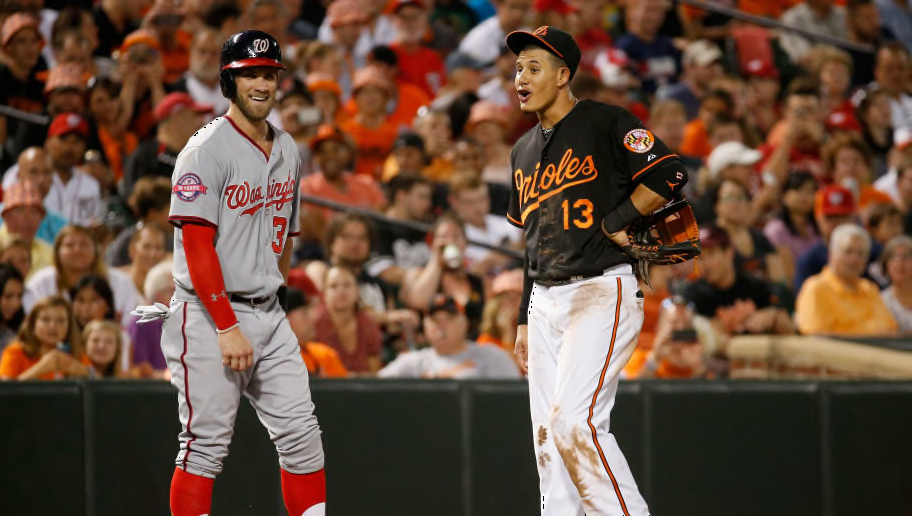
Harper and Machado Waiting it Out

Harper (left) and Machado are holding out for record paydays (12Up)
For nearly two decades, Alex Rodriguez has held the record for the largest free-agent contract in American professional sports. On December 11, 2000, Rodriguez signed a 10-year, $252 million deal with the Texas Rangers, doubling the contract of the highest paid professional athlete at the time --Kevin Garnett of the NBA's Minnesota Timberwolves. Seven years later, Rodriguez opted out of that deal to sign an even bigger one with the New York Yankees worth $275 million over 10 years, with the potential to earn an additional $30 million in incentives for reaching certain home run milestones (which later became controversial following his PED admissions).

Records are made to be broken, but so far neither deal has been surpassed by a free agent* in any sport. The closest anyone's gotten were Albert Pujols and Robinson Cano, who both signed 10-year, $240 million deals in 2011 and 2013, respectively. That's going to change this winter, however; it's only a matter of when.

[*Giancarlo Stanton (13 years/$325 million) and Miguel Cabrera (10 years/$292 million) both later eclipsed Rodriguez via contract extensions, not as free agents. The highest paid athlete is boxer Canelo Alvarez, who's currently on an 11-fight, $365 million deal.] 

Bryce Harper and his agent, Scott Boras (the same agent who negotiated Rodriguez's first megadeal), have had their sights set on the record since Harper was smashing 500-foot homers and making magazine covers as a teenager. He debuted with the Washington Nationals at 19 in 2012, making his first All-Star team en route to winning NL Rookie of the Year honors. He was an All-Star again in 2013 before putting together one of the greatest offensive seasons ever in 2015, when he won the NL MVP unanimously. The Chosen One had arrived.

While Harper hasn't been able to replicate that historic campaign, he showed what his ceiling can be. He showcased it again last summer by winning the Home Run Derby at Nationals Park, wowing the hometown crowd with a display for the ages that included 14 homers in the final 47 seconds and 45 overall. While injuries have often prevented Harper from reaching his full potential, he's still been one of baseball's 12 most valuable position players throughout his career. He's slugged at least 20 homers and been an All-Star in all but one of his seven seasons, and he was headed for a second MVP award in 2017 before hyperextending his knee after slipping on a wet base. Harper's 26 years old, he just led the Major Leagues in walks, and he has MVP potential. He is, in other words, a superstar.

He's not the only one whose services are available this winter, however. Manny Machado, last seen during the World Series with the Los Angeles Dodgers, is arguably just as good as Harper. Machado, who's just four months older than Harper, also debuted in 2012 and immediately emerged as one of the best players in baseball. In 2013 he was an All-Star en route to leading the AL in doubles, and starting in 2015 he's topped 30 homers every year.

While not quite the force that Harper is at the plate, Machado's a comparable baserunner and an elite defender at a more challenging position, earning a pair of Gold Gloves for his outstanding work at the hot corner (he can also play shortstop, but not as well as third). He's one of 15 position players to compile at least 30 fWAR since 2012, tallying virtually the same amount as Harper in one fewer game. That hasn't translated to an MVP yet, but it has helped the four-time All-Star to three top-10 finishes despite playing for mostly mediocre teams in Baltimore. And whereas Harper has struggled with injuries, Machado has been extremely durable, appearing in at least 156 games in five of his last six seasons.
Nearly 20 years later, A-Rod's superdeal is still the standard (SI)
Baseball hasn't had a free agent so good and so young since 2000, when Rodriguez was a 25-year-old shortstop coming off three straight 40-homer seasons with the Seattle Mariners. Now it has two, in the same winter, no less.

In the old days, that would have sparked a feeding frenzy between baseball's richest teams. The Red Sox Yankees, Cubs, and Dodgers would've opened up their vaults for them, spawning a bidding war the likes of which baseball has never seen. But, as last winter's slow-moving market proved, times have changed. Teams are not willing to pursue free agents as aggressively as they used to, not when it means committing large sums of money to ageing players who will cost them compensatory draft picks, luxury tax penalties, and payroll flexibility. Better to drag out negotiations and drive down the price once Spring Training is underway and players start getting desperate.

But if there was ever a player to break the bank for, it's Machado and Harper. Sure, they have red flags and rub a lot of people the wrong way, but they're young and athletic and certifiable stars. There's not too many of those left in baseball these days, so they're sure to attract eyeballs and sell jerseys. Neither has won a championship, which should continue to drive them after the ink dries on their new contracts. They'll instantly transform whichever lineup they join and add multiple wins to a team by themselves. Not everyone can afford them, but everyone could use them.

It's hard to reconcile, then, why both remain unsigned despite playing different positions and negotiating with different teams. The Dodgers have the money and the roster space for Harper after trading away Matt Kemp and Yasiel Puig, while the Phillies, White Sox, and Yankees all need Machado on the left side of their infields. So what's taking so long?

It's not as though teams haven't tried to sign either player. Harper rejected a 10-year, $300 million offer from the Nationals, which would have made him the richest free agent ever (Washington has reportedly since upped its offer). Machado received an offer from the White Sox, albeit a smaller one closer to $200 million. Both are worth more than that, and they know it. But is there a team willing to give it to them?

We'll just have to wait and see.

Sunday, August 21, 2016

Jeter was no A-Rod

The numbers don't lie: A-Rod was much, much better than Jeter (Complex)
My friend and I got into a contentious Facebook argument the other day debating the merits of the recently retired Derek Jeter and the even more recently (but not officially) retired Alex Rodriguez. My buddy -- a lifelong Jeter disciple -- posed a simple question: Who is a better all-time player, Jeter or A-Rod?

My response: https://www.youtube.com/watch?v=HvkKd572vCw

To which my friend replied, "It's closer than you think..."

Actually, it's not, I thought to myself. But, wanting to end the debate right then and there, I waited until I got home so I could log on to Baseball-Reference and provide the overwhelming statistical evidence proving that while Jeter was a great player, he wasn't even in A-Rod's league. I wanted to hit him with some truth, Kenny Powers-style.

Sure enough, when I clicked over to B-R's handy WAR leaderboard, I found the unassailable proof I was looking for. Nestled in 12th place, between Ted Williams and Lou Gehrig, is Alex Rodriguez. Scroll further down the list, and you'll find Jeter lodged at 58th, between Harry Heilmann and Rafael Palmeiro. That should tell you all you need to know about their respective places in baseball history.

The difference between them is exactly 46 WAR, which is a lot. It's more than several Hall of Famers totalled in their careers, as well as near Hall of Famers such as Gil Hodges, Dave Parker, and Omar Vizquel. Current players with less include Jimmy Rollins, Joey Votto, Matt Holliday, and Ryan Braun -- all of whom have been playing at a high level for at least a decade. Add their careers to Jeter's, and you still don't have A-Rod's career.

Looking at it another way, a five-win season constitutes an All-Star caliber year. That means you could add nine All-Star seasons to Jeter's resume, and he'd still fall short of Rodriguez.

Like I said, not even close.

Even if WAR's not your bag, it still shouldn't be hard to see why A-Rod was the better player. As a hitter, he holds the edge in almost every meaningful category except for batting average, which is negated by his slight edge in OBP. Rodriguez was also a much better power hitter: Jeter had good power for a shortstop, but A-Rod was one of the best sluggers of all time (and the greatest slugging shortstop ever).  He places in the top 10 all time in runs (8th), runs created (8th), total bases (6th), extra-base hits (6th), home runs (4th), and RBI (3rd), Jeter does not have a top-10 ranking in any of those categories. The only one he does is hits (6th), which is largely a function of all the at-bats he received (7th-most all time) and singles he recorded (5th-most).

A-Rod was also the superior baserunner, though not by an overwhelming margin. FanGraphs credits him as being worth 35 baserunning runs during his career, while Jeter checks in at just a shade under 24. That's the difference of roughly a win over the course of their careers, which is pretty negligible. Baseball-Reference has them dead-even with 56 baserunning runs apiece, but I'm inclined to split the difference based on their base-stealing records. Rodriguez swiped 329 bases at an 81.2 percent success rate, whereas Jeter made 358 thefts at a 78.7 percent clip. A-Rod also grounded into 26 fewer double plays despite batting with many more men on base.

And then there's the issue of defense, which is muddled somewhat by Rodriguez's transition to third base midway through his career. Still, anyone claiming Jeter was a better shortstop is delusional. Jeter didn't win any Gold Gloves until after Rodriguez, already a multi-Gold Glove recipient with Texas, changed positions and helped Jeter cover the left side of New York's infield. Had Rodriguez stayed at shortstop, he likely would have added to his trophy case and denied Jeter the chance of ever winning.

That's might be speculation on my part, but the numbers back it up. As with hitting, every defensive metric under the sun rates Rodriguez ahead of Jeter. FanGraphs has A-Rod's final defensive value at plus-64 runs, while Jeter's is negative-29.7. The figures compiled by Baseball-Reference are even more disparate; Rodriguez saved his teams 25 runs in the field whereas Jeter cost his a whopping 246--approximately 25 wins.

Ouch.

Anyone who watched Jeter play on a regular basis knows this to be true, as he was so inept at reaching balls his to his left (up the middle) that fans frequently referred to him as "Pasta," as in "past a diving Jeter." He was great at going into the hole, and his gravity-defying jump-throws will live on as one of baseball's enduring images, but in the aggregate he hurt Yankee pitchers much more than he helped him.

My friend pointed out that Jeter won five Gold Gloves, which are voted on by coaches and managers. Well, just because Jeter won them does not mean he deserved any of them. I don't want to get sidetracked by digressing into why Gold Gloves fail to recognize the best fielders (basically, they're influenced too much by reputation and are susceptible to bias by the voters, who only see opponents play a handful of times every year), but I would just like to point out that Rafael Palmeiro received a Gold Glove in 1999 despite spending 128 games as a designated hitter. So yeah, maybe don't mention Gold Gloves, especially since Jeter wouldn't have any had he changed positions to accommodate Rodriguez in 2004.

But no, it was Rodriguez who moved to third base despite winning the two previous Gold Gloves at shortstop (which he did not deserve either, but at least he was above average defensively, whereas Jeter clearly was not). If Jeter was such a great teammate, how come he didn't do what was best for the team and shift to the hot corner? Granted, the Yankees never asked him to do this (as far as we know), but they shouldn't have had to. History is filled with great players changing positions (Ernie Banks, Cal Ripken Jr., and Robin Yount all moved off shortstop, for instance), but Jeter never did, even when it became apparent in his final seasons that his defense was actively harming his team. There were opportunities to move to second base and center field as well, but Jeter did not step forward and thus stayed put.
A-Rod and Jeter weren't particularly close as friends, or as ballplayers (NY Post)
As our war of words heated up, my friend never tried to make an informed statistical argument on Jeter's behalf. Jeter fans never do, because they know it is a lost cause. As incredible as Jeter's numbers are, they simply don't measure up to A-Rod's. Jeter fans have always known this and always accepted this, because Jeter's contributions extend beyond the box score. "Sure, Rodriguez has better numbers," they say, "but...(insert comment about Jeter being more clutch, a better teammate, and/or a winner)."

Not surprisingly, my friend made that exact argument.  "Jeter made everyone around him better," he informed me. "A-Rod did not."

There it was. No longer was our argument over WAR and postseason performance and Gold Gloves that may or may not have been earned. My blood immediately began to boil.

First of all, there is absolutely no way to quantify this mythical teammate effect, which works both for and against the argument. On the one hand, I can say that being a good teammate is meaningless given the number of jerks throughout sports history who nevertheless made their teams better through their mere presence (Manny Ramirez, Reggie Jackson, Barry Bonds, and Roger Clemens come to mind). On the other hand, my friend can say Jeter added five or ten wins to the Yankees every year through his intangibles, and I can't definitively prove him wrong. There's no stat measuring leadership, unfortunately.

My buddy failed to explain how Jeter made his teammates better or why Rodriguez didn't. He didn't have to, because we both knew what he meant. Jeter was "The Captain," a calming presence in the clubhouse and, above all else, a "winner." Rodriguez was captain of the Rangers for about a day before they shipped him away to New York, where he immediately became a perceived choke-artist and a constant source of distraction and controversy for his team. The Yankees would have followed Jeter off a cliff and wouldn't have hesitated to shove A-Rod off one.

That's the perception, at least, but by all accounts Rodriguez was a great teammate. He led by example with his tireless work ethic, and mentored young players everywhere he went. Michael Young and Mark Teixeira credit A-Rod for showing them the ropes in Texas, while it's no secret that Rodriguez took Melky Cabrera, Robinson Cano and others under his wing in New York. If A-Rod didn't make his teammates better, then surely the Yankees wouldn't be letting him stay on in an advisory role. And how come Jeter doesn't have a similar title? Then again, I don't seem to remember him doing much tutoring on the side during his playing days.

But that's all besides the point, because what does any of that have to do with making your teammates better? You know what makes your teammates better? Getting on base for them so they have guys to drive in. Knowing when to take your walks and pass the baton but also knowing when to expand your strike zone for the sake of getting runners home, and by taking the extra base. Playing sound defense in the field, so that your teammates have less ground to cover and your pitchers aren't afraid of pitching to contact. You know, stuff that actually helps teams win ballgames.

Rodriguez did all of these things better than or just as good as Jeter, making him a much more valuable player. Going by the above WAR differential, we see A-Rod contributed two more wins to his teams than Jeter did every year on average. A-Rod's superior value came across in MVP results as well as earnings, with Rodriguez earning three MVPs to Jeter's none (apparently Jeter's leadership couldn't have been too valuable) and making more money from his age-33 season onward than Jeter made in his entire career.

But I want to get back to the teammate thing for a second, because I have a real axe to grind there. First of all, it has been my humble opinion that Jeter's intangibles have always been grossly overrated. Yes, Jeter's teams always won, but a big reason why was because he happened to be in the right place at the right time. He debuted with the Yankees in 1995, just as the  franchise was emerging from its dark days of the 1980s and early '90s. While their first championship since 1978 coincided with his Rookie of the Year campaign in '96, he didn't transform them into winners overnight. They were leading the AL East when the players' strike cut the season short in 1994, and they reached the postseason with him playing all of 15 games the following year. Andy Pettitte, Jorge Posada, Mariano Rivera and Bernie Williams were already there, supplementing talented veterans such as Paul O'Neill, David Cone, Wade Boggs, Don Mattingly, Darryl Strawberry, Ruben Sierra and John Wetteland. The Yankees would have still be stacked without Jeter; they probably don't win four rings in five years without him, but they still win at least a few.

And what if Jeter hadn't been a Yankee at all? What if one of the five teams that passed on him in the 1992 draft had taken him instead? He could have been an Astro, or an Indian, or even an Expo. Can you imagine how different his career would have been had he spent the first half in Montreal? Jeter was incredibly lucky, which isn't a knock on him because all careers require some amount of luck, but try to picture him in a Reds uniform or an Orioles uniform. You can't. He was born to wear pinstripes.

But also, think about what that means for a second. Five teams had the chance to draft Jeter, but thought they'd be better off taking someone else. That was never the case with A-Rod, who was the consensus number one draft choice a year later. Scouts looked at him as a high schooler and saw a superstar. Five teams looked at Jeter and said, "pass." A-Rod was always better than Jeter, and considerably so.

Anyways, back to the notion that Jeter made his teammates better. While he may have helped his teams overachieve in the first half of this career, there's no doubt that New York underachieved during the second half of his career, when he was surrounded by an absurd amount of talent. If Jeter was able to will his teams to championships, how come the titles suddenly stopped coming once the Yankees started running out the highest payroll in baseball every year? If you want to give him credit for everything that happened pre-A-Rod, fine, but you also must acknowledge everything bad that happened under his watch, too. How come he didn't get A-Rod in line? He failed to rally those super-teams together and clearly lost control of the clubhouse, which should have never happened if he was the great captain that people make him out to be.

And lastly, if Jeter was such a great teammate, he never would have continued playing shortstop and batting second long after it became clear he shouldn't have been doing either. Sabermetrics has identified the two-hole as the most important slot in the lineup, the spot where managers should bat their best hitters. For most of his career, Jeter was not New York's best hitter, but he was still a very good one. Over his last five seasons, however, that was no longer true, as he batted an empty .283 with a .713 OPS and a 94 OPS+. He was especially bad during his final year, when he slashed .256/.304/.313. Jeter should have been batting eighth or ninth during those years, not second. The Yankees had no problem dropping Rodriguez to eighth during a playoff game or benching him outright when he wasn't hitting, but God forbid Jeter take a day off or move down in the order.

My friend's friend made a good point in comparing Jeter to Brett Favre, saying both are overrated for being good guys who played at an above-average level for a long time. I think that's spot-on. Jeter led the  league in hits twice and runs once, but he never won a batting title or an MVP award. He never hit 25 homers in a season or led the league in WAR, and he knocked in 100 runs only once. He was usually very good -- sometimes great -- but never the best.. A-Rod was right to call him a complementary player back in 2001, even if that comment ultimately destroyed their friendship.

Rodriguez, on the other hand, did things no player has ever done before or since. He holds the single-season records for big flies by a shortstop and a third baseman. He was the  youngest player to 300, 400, 500, and 600 home runs. He recorded the most consecutive seasons of at least 30 homers and 100 RBIs, and he also owns the all-time grand slams record. He's the only infielder to go 40/40. And of course, he signed the two biggest free agent contracts in sports history (Giancarlo Stanton's was an extension).

Granted, A-Rod had pharmaceutical help while Jeter, as far as we know, did not. But steroids don't explain how he hit 436 more home runs or drove in 775 more runs. They don't explain the 113-point difference in OPS. And they don't explain how, despite having the world against him and its weight on his shoulders, Rodriguez still managed to blow away Jeter's production year after year after year.
Sunday, August 14, 2016

We Want A-Rod

A-Rod felt the love in the Bronx on Friday night (Yahoo Sports)
In the twilight of Alex Rodriguez's storied career, everyone just wanted him to go away. The Yankees wanted out from under his massive contract, their fans were sick of paying exorbitant ticket prices to watch him play, and the rest of us simply wanted a known cheater out of the game. He was too old, too expensive, and too dirty -- a corrupt politician in need of impeachment.

So when Rodriguez got caught up in the Biogenesis scandal of 2013, Major League Baseball appeased the masses by expelling him for an entire season, slapping him with the largest PED penalty ever handed down by the sport. Rodriguez did not go quietly, kicking and screaming as security dragged him out the door, but in the end he did go away..

Given his age, injury history and declining performance, the ban appeared to be a death sentence. Few saw his controversial career continuing in 2015, the year he turned 40. Nobody minded. A whole season passed without Rodriguez taking a single Major League swing. Nobody missed him. Baseball had washed its hands of Rodriguez and so, it seemed, had everyone else. When the garbage man comes to take the trash away, you don't find yourself wondering what happens to it. You're just happy there isn't a soggy bag of rotting food in your kitchen anymore.

So when Rodriguez returned for the 2015 season, the general response was similar to the one you give the smelly neighborhood dog that keeps showing up at your doorstep. He arrived early to Spring Training, eager to shed the rust that had accumulated over the past year, only to find that the Yankees were pissed. He heard boos everywhere he went. The only way he was going to make anyone happy was by retiring immediately and unceremoniously.

Eighteen months later, that's essentially what's happening except weirdly, no one seems happy about it, except maybe New York's front office. The Yankees are finally done with him (as a player) and are paying him the rest of his contract to go away -- something they said they would not do. They literally couldn't wait to get rid of him, not even letting him finish out a season that has a five percent chance of continuing into October.  But they've always wished he would go away (or at least shut up) more than everyone, if only because they were the ones on the hook for his $275 million contract. His presence was a daily reminder of the most expensive mistake in baseball history.

But while the Yankees' attitude towards Rodriguez never really changed -- they put up with him as long as he produced and were quick to cut him when he stopped -- the fans' stance on him has softened. He's not beloved, but he's no longer reviled. Not embraced, but no longer shunned. For a long time he was merely tolerated, in the way Red Sox fans tolerated Manny Ramirez. But nobody -- not Ramirez, not Barry Bonds, not Roger Clemens -- invited the hatred from his own fans that Rodriguez did. Many, it seemed, came to Yankee Stadium for the sole purpose of booing Rodriguez every time he stepped to the plate (and, if they were lucky, when he booted a ball in the field). Every strikeout in a key situation resulted in a cacophony of derision. You wonder why he didn't play with earplugs.
The Fenway Faithful got one last chance to see--and boo--A-Rod (Miami Herald)
It's ironic, then, that the same fans who never appreciated Rodriguez when he was at his best showered him with love and affection when he was at his absolute worst. Even as he calcified before their eyes, the Yankee faithful never turned on him. You don't get mad at an old pet for pissing on the living room carpet.

Rodriguez was fortunate to have the season that he did in 2015, because if he'd been this bad last year he would have been booed out of the game. But everyone loves a good comeback story, even when the central character is perhaps the most hated man in sports. And last year, Rodriguez authored one of the greatest comebacks of all time. He hit better than he had in years and led New York to the postseason. The same people booing him with gusto in April were championing his All-Star candidacy in July.

It helped that Rodriguez was suddenly likeable for the first time since his Seattle days. After being branded as a liar and a cheat, a phony and a fraud, he used his time away from the game to clean up his image and return a changed man; older, wiser, and infinitely more mature. He didn't just come back a better player -- he came back a better person.

He was also, for the first time in his career, the underdog. No one had ever done what he was trying to do. He should have been too old and washed-up to contribute anything to the Yankees besides adding player days to their disabled list. He came back to find that he'd lost his starting job -- something that hadn't happened to Derek Jeter after missing a year with injuries at the same age -- and that he'd need to earn every at-bat as the team's designated hitter -- a spot for which there'd be no shortage of options on New York's aging roster.

And yet, against all odds, Rodriguez returned to form. He slugged 33 home runs, played 151 games, and tallied 3.1 bWAR. He won games with his bat and fans with his batting gloves. He repaired his relationships with teammates, fans, media, and the Yankees organization, building up a surprising level of goodwill in a short amount of time. That hard work paid off in spades this year, as he had supporters to fall back on when things went south. It's hard to imagine the Yankees offering him a mentor role had he quit last summer.

But what's even harder to imagine is the groundswell of support he received this week. Teammates and peers were sad to see him go. Joe Girardi and Brian Cashman thanked him for everything he'd done. We want A-Rod, beckoned the Fenway Faithful, his most hostile enemies since the day he donned pinstripes.

A sold-out Yankee Stadium echoed the cries of their Boston brethren Friday night, bellowing their singular desire throughout the park that Rodriguez christened with a championship in 2009. We want A-Rod, screamed the 46,459 that turned out for his final game as a Yankee, hoping to experience one last high at the end of their 13-year rollercoaster ride together. We want A-Rod, declared fans who'd finally forgiven a man who'd repeatedly asked for their forgiveness. We. Want. A-Rod. 

Two years ago A-Rod was a cancer to his team, a stain on the game and a monster of a man. Nobody could imagine the career he'd set fire to ending so positively. But as the curtain closed and Rodriguez took his final bow, many of us found ourselves wishing he'd stay just a little bit longer.

Wednesday, August 3, 2016

Rodriguez Resigned to Fate

Rodriguez's days in pinstripes are numbered, and he knows it (Hardball Talk)
Alex Rodriguez was not in the Yankees starting lineup last night, although he did get in the game long enough to slap the fly-out that ended it. He didn't make an appearance at all the previous night, despite the game going 10 innings and Joe Girardi using a dozen position players.  Rodriguez was also absent from the starting nine on Sunday, when he was again limited to a pinch-hit cameo (he struck out).

That's how the summer has gone for Rodriguez, who's watched his playing time evaporate as he sinks deeper and deeper into the worst slump of his career. Since July began Rodriguez has started just nine of his team's past 28 games. And he didn't spend time on the Disabled List, so it's not like he wasn't available.

After two decades as a Major League starter, Rodriguez has finally been reduced to a part-time role. The Yankees are still giving him superstar money, but they're through giving him superstar playing time. Even in a rebuilding year where they've shipped out more talent than they've brought in, they can find better ways to fill their DH slot than with a 41-year-old failing to bat his weight.

Girardi has tried everything to revive Rodriguez's bat. He's given him days off to clear his head and work on his swing. He's continued batting him cleanup, long after it became obvious that Rodriguez is no longer a Major League quality bat, let alone a middle of the order one. He's limited A-Rod's at-bats against righties, even though Rodriguez has never shown much of a platoon split.

None of it's worked, of course, because there's no cure for diminished bat speed and reflexes. Despite Girardi's best efforts, the decline of Rodriguez has only hastened. He's down to .204/.252/.356 after going 4-for-his-last-37, which was lowlighted by a four-strikeout performance in a game at the Trop last weekend. He recently drew comparisons to Willie Mays, and not the good kind.

His collapse extends far beyond last month, though, or even this year. Including last year's Wild Card game, Rodriguez has played 119 games since the beginning of last August, coming to bat 451 times during that span. In what is now a year-long famine, he has almost twice as many strikeouts (126) as hits (79) and has slashed .196/.272/.362. That is unacceptable production for a player at any position, especially one where the sole requirement is hitting.

To his credit, Rodriguez has taken the benching quite well (at least publicly). There has been no sulking or media outbursts. He hasn't demanded a trade. Instead, he's handled everything with grace and professionalism, which can't be easy for a player of his stature.

So when reports leaked today that Rodriguez might be released, of course he was okay with it. Many see it as the Yankees finally ridding themselves of Rodriguez, who long ago stopped being the superstar they were paying him to be. But from Rodriguez's perspective, he will also get a welcome release from what has become a sad existence. The former MVP is now baseball's most expensive bench player. That might at least be palatable if the Yankees were winning, but they're not. Maybe a release will mean more playing time elsewhere (probably not). Perhaps it gives him a shot at a ring.

At this point, releasing Rodriguez is clearly in the best interests of both parties. A-Rod knows it, and the Yankees have been trying to do it for years. He's given them the green light; now it's up to them to pull the plug.


Wednesday, February 10, 2016

Baseball's This is 40

Can Ortiz (left) and Rodriguez still hack it at 40? (Sporting News)
David Ortiz and Alex Rodriguez are about to embark on their age-40 seasons. Based on how good both were at 39, many are expecting them to remain productive this year. However, it's important to remember that, even in today's world of modern medicine and training, it's still incredibly rare to be a good baseball player at age 40. The list of productive seasons by 40 year-olds is a short one, but as you can see below it's happened enough so that another strong season by Rodriguez and/or Ortiz isn't out of the question. Here are some of the best performances by 40 year-old position players in baseball history, listed in chronological order (notice that there have been much more lately).

1927 Ty Cobb
With the home run boom in full swing, Cobb's slashing brand of baseball was already becoming obsolete. But while he may have felt like a dinosaur as the game changed around him, he was still good at doing the things he knew best, namely singles and steals. In the Georgia Peach's first season with the A's but last season as an everyday player, he batted .357/.440/.482 with 93 RBI and 22 steals--good for 4.4 bWAR.

1930 Sam Rice
This was a great year for hitters regardless of age, so you can't fault Rice for joining the party. His counting stats were off-the-charts (121 runs, 207 hits, 13 triples), and his rate stats (.349/.407/.457) were pretty good, too. Altogether, Rice was worth 4.7 bWAR--the highest total of his career.

Appling was a name that came up a lot the last few years when people were comparing Derek Jeter to past shortstops at the same age. Appling was pretty much the only one still able to hit a damn as he approached middle-age. He remained as robust as ever at 40, compiling 4.6 bWAR and making his final All-Star team. The future Hall of Famer also slugged a career-high eight home runs and batted .306/.386/.412 (126 OPS+)--exceptional numbers for a shortstop back then.

By wRC+, Mays at 40 was better than any baseball player who ever lived. That shouldn't come as a surprise, seeing as how he was at almost every other age, too. Compared to the rest of his body of work, 1971 was actually a very strange season for the Say Hey Kid. He walked a league-leading and career-high 112 times, which gave him a league-leading and career-high .425 OBP, but he also struck out 123 times--his lone year in triple digits. He still had enough of his trademark power and speed to muscle 18 home runs and 24 doubles while stealing 23 bases in 26 tries--his most thefts since 1960. Mays was still playing center field on a regular basis, too, which helped him rack up 6.3 bWAR in what turned out to be his last great season.

After getting Babe Ruth's record out of the way early on, the newly minted home run king went on to enjoy the last fruitful season of his illustrious career (as well as his last with the Braves). He had a record-20th consecutive season with at least 20 homers, walked more than he struck out, and batted a rock-solid .268/.341/.491 (128 OPS+). He promptly fell apart after moving back to Milwaukee and becoming a full-time DH, but in the year he broke Ruth's record he was still a pretty good ballplayer.

Few players have been better at 40 than Aaron (left) and Mays (Bronx Banter)
1981 Pete Rose
Charlie Hustle was still a hit machine at 40, leading the majors in hits for the seventh and final time while batting .325 with a .391 OBP. It probably helped that '81 was cut short by a strike, otherwise Rose might have worn down. It turned out to be his last great season, though he hung on for another six years to become baseball's hit king.

The DH definitely prolonged Mr. October's career, helping him play six seasons out west after leaving New York. While his bat was all out of postseason heroics by that point, it still had a fair amount of juice left, which he used to bat .241/.379/.408 (116 OPS+) with 18 home runs for the division-winning Angels (a team eventually undone by the late Dave Henderson's homer).

Evans was another player who never seemed to get old, remaining productive through age 41 (ditching third base for first and DH helped). His age-40 campaign was actually one of his best, resulting in the third-highest bWAR (4.9) of his 21-year career. Aided by the offensive explosion that occurred across baseball that year, Evans bashed 34 home runs, totaled 99 RBI and worked 100 walks, giving him a strong .257/.379/.501 batting line and 135 OPS+. Those numbers would likely represent a best-case scenario for A-Rod and Ortiz next year.


Fisk only played 76 games--his fewest since 1974--but that didn't stop him from winning his third and final Silver Slugger behind the plate. His half-season numbers--a .277/.377/.542 line (155 OPS+) with 19 homers and 50 RBI--would be phenomenal for anyone in a full season, let alone a 40 year-old backstop. This year is one of many reasons why Fisk was the best "old" catcher in baseball history.

Winfield was still plugging along at age 40, joining the Blue Jays for their first-ever World Series championship. The future Hall of Famer played a big part in helping them get over the hump, finishing fifth in the AL MVP vote after batting .290/.377/.491 with 26 home runs and 108 RBI, giving Toronto another slugger to pair with Joe Carter. Winfield would go on to play with Minnesota for two years and Cleveland for one before calling it a career.

Molitor remained a productive batsman for the Twins at age 40, batting .305/.351/.435 with 32 doubles, 10 home runs and 89 RBI. You could certainly get a lot worse from your DH.

Henderson had been playing for 20 years by this point, but his skills remained largely intact. Suiting up for the Mets that year, Henderson had the last great season of his career, hitting .315/.423/.466 (128 OPS+) with 12 home runs and 37 steals.

Martinez bounced back from a down and injury-plagued 2002 to enjoy his last great season at 40. Seattle's Hall of Fame-worthy DH helped the Mariners to a 93-win season by batting .294/.406/.489 (141 OPS+) with 24 homers and 98 RBI, bringing him just shy of 500 doubles and 300 homers for his career (he would reach both milestones in his next, and final, season).

Most people don't remember just how good Alou was, or how he literally didn't age. Over the last five years of his career, which cover his age 37-41 seasons, he hit .312/.376/.539. He was terrific in limited action for the Mets in 2007, slashing .341/.392/.524 (137 OPS+) with 13 homers and 49 RBI in 87 games. Unfortunately, that was one of the years New York collapsed down the stretch, denying Alou one last shot at postseason glory (the same thing happened again in 2008, and Alou wisely retired).

Like Henderson, Lofton was another speedster who aged well. In what was his final season, he batted .296/.367/.414 with 86 runs and 23 steals while splitting time between Texas and Cleveland, joining the latter just in time for their ill-fated playoff run (somewhere, J.D. Drew is trying to smile).

Edmonds came back from sitting out all of 2009 after not getting a worthwhile offer, signed a minor league contract with the Brewers and finished up his career with a solid season, going out on his own terms. While he only played 86 games, the former star center fielder was still productive at the plate, hitting .276/.342/.504 (125 OPS+) between his stint with Milwaukee and a late-season trade to Cincinnati.

Wednesday, July 29, 2015

A-Rod's Renaissance

A-Rod may be old, but he's still hitting like the A-Rod of old (FNC Static)
Monday was Alex Rodriguez's 40th birthday, and of course he made the most of it.

Back in Texas, where he wowed Rangers fans with three of the best seasons a shortstop has ever had, Rodriguez added another feel-good chapter to his storybook comeback by slamming his 24th home run of the year and 678th of his career. The big fly was classic A-Rod--a heat-seeking missile launched the other way with the flick of his wrists. It's the kind of opposite field shot you see all the time when Rodriguez's swing is right, and it's become abundantly clear that his swing is in top form.

Rodriguez has had better numbers to be sure--take another look at those Texas years--but he's never enjoyed a campaign quite like this one. Nobody has, because nobody was ever suspended for an entire season and then returned to baseball on the cusp of 40.

As such, no one knew what to expect of Rodriguez this year, not even Rodriguez himself. It's safe to say nobody expected much. The odds were stacked against him, especially given that his last few years before the suspension were marked by injury woes and declining performance. Once one of the surest things in the game, A-Rod's future was overwhelmingly uncertain. How would his body hold up? Did he still have the reflexes and hand-eye co-ordination to hit major league pitching? Guys aren't supposed to miss a year in their late 30s and come back like nothing happened.

Except Rodriguez has. And while he hasn't been better than ever, he's almost as good as he used to be, something not even the most optimistic Yankee fans could have foreseen. Nobody in their wildest dreams would have believed that Rodriguez would return to being the middle of the order force he was during his prime, and yet that's exactly what he's done.

It would have been natural for A-Rod to start slow, given that he hadn't played major league baseball in more than a year, but he never displayed even a hint of rust. He reached base twice in his first game back, went yard in his third game, notched a pair of hits in his fourth game, and drove in four runs in game number six. Rodriguez hit the ground running, and he hasn't looked back.

And rather than wear down during the heat of the summer, as any slugger approaching 40 might, he's only gotten hotter with the weather. Rodriguez has nine home runs, 14 RBI, and a .726 slugging percentage since the Fourth of July. Three of those blasts came Saturday in Minnesota, when Rodriguez turned back the clock with his fifth career three-homer game (and first since 2010).

For an encore, Rodriguez smacked another home run on his birthday, making him just the fourth player ever to homer as a teenager and a 40 year-old (joining the unlikely trio of Ty Cobb, Rusty Staub, and former teammate Gary Sheffield). It was also his sixth birthday bomb--a new MLB record and a fitting milestone for his milestone birthday.


What may be even more surprising than A-Rod's resurgence on the field is the transformation of his perception off it.

Until a few months ago, Rodriguez was probably the most reviled athlete in sports. He was so hated that his own ballclub objected to his early spring training arrival. Yes, seriously. In ballparks across America, he was subjected to the worst booing since Barry Bonds made his run at Hank Aaron's home run record. You probably could have counted the number of Rodriguez supporters on one hand.

Now, well, there were legitimate objections to A-Rod being left off the All-Star Game roster. His teammates have welcomed him back with open arms, and Yankee fans have been quick to forgive. He still gets booed wherever he goes, but the jeers aren't fueled with the same level of vitrol. Fans appear to be booing him out of instinct more than anything else, because they always have and always will, and because they know that's what they're supposed to do (after all, the guy's a caught cheater! And a liar!).

After more than two decades in the big leagues, Rodriguez has finally discovered how to stay out of his own way, not to mention the tabloids (he did have 10 years to learn from the master--Derek Jeter). Thanks to wisdom, maturity, and an improved sense of self-awareness, his season has been shockingly devoid of controversy. He's handled everything with grace and poise; the transition to full-time DH (or: losing his starting job to Chase Headley), the incident involving his 3,000th hit, and the Yankees' refusal to honor his $6 million contract incentive for passing Willie Mays on the all-time home run list. Each time he bit his tongue, refusing to let himself become a distraction.

He's also been a genuinely good guy, giving his batting gloves to kids in Fenway Park, of all places, after homering twice there earlier this month. Smooth move, A-Rod.

Rodriguez should be a pro at this PR stuff by now. His career has been a constant uphill battle to win back fans and media ever since he signed that first fat contract with Texas. The last 15 years have felt like one long apology tour for his various transgressions, of which there are now too many to count. The few times A-Rod has been tolerable during that span have been whenever he's simply shut up and let his bat do the talking.

Right now, his bat is talking pretty loud. Entering play today he has 24 homers, 60 RBI, and a .279/.379/.545 batting line, good for his best league and park-adjusted OPS since his most recent MVP season in 2007. Rodriguez can't run (only one stolen base) or field (he's played just six games in the field) like he used to, but he can still mash.

That's the one thing Rodriguez has always been able to do, no matter how much of a self-created hurricane is howling around him. Through all the scandals, controversies, and cringe-worthy mistakes, Rodriguez has always raked. Even the last few years, with injuries severely cutting into his playing time and limiting his production, he was still an above average hitter.

This year he's been way, way above average, and that has come as a major surprise. It seemed much more likely that he'd be a broken down shell of his former self like Jeter was last year. Instead, he's been an MVP candidate and one of the main reasons why New York currently leads the AL East.

Redemption. Resurrection. Resurgence. Whatever alliteration you want to use to describe Rodriguez's comeback, it can't possibly do him justice. What he's doing is unprecedented, but he's been doing unprecedented things for 20 years now. Let's appreciate this one for a change.

Saturday, June 6, 2015

Rodriguez's RBI

A familiar sight over the years: A-Rod greeting teammates at home (ABC News)
There is only one man in baseball history who has compiled more official RBI than Alex Rodriguez, and his name is Hank Aaron. While no longer the home run king, Aaron is still the king of counting stats in many regards. Just look at his player page on Baseball-Reference--it's really quite impressive.

The same can be said about Rodriguez's, especially when you consider that he was a shortstop for the first half of his career and a third baseman for the remainder (though he's now a full-time DH, as most 39 year-olds are). His resume is so well-rounded, and like Aaron, he neglected to have a down season for the longest time. Even his numbers from recent years, when he was old and hurt, are still pretty good.

That's what it takes to be one of the top RBI men of all-time. You have to be in the lineup everyday, driving in runs, year after year after year. Rodriguez has racked up 1,997 to this point in his career, which means he had to average 100 ribbies for 20 years. Most times, if a guy does it for 10 he's a Hall of Famer. It's crazy to think that A-Rod knocked in his first run in 1994--21 years ago--and had his first 100 RBI season in 1996. He's been around a long time.

More importantly, he's been consistently outstanding during the bulk of those seasons. He's the only player in history to top 100 RBI 14 times, and one of just three (Lou Gehrig and Jimmie Foxx are the others) to eclipse the century mark in 13 straight seasons. He may have company in both those categories soon, as Miguel Cabrera is working on a string of 11 straight 100 RBI seasons and is on pace for a 12th here in 2015. Given that he just turned 32 and his eight-year contract extension doesn't begin until next year, Cabrera will have plenty of time to catch Rodriguez and perhaps Aaron atop the all-time leaderboards.

Albert Pujols is also a threat, with a dozen 100 RBI seasons to his name and six seasons remaining on his contract beyond this one. No longer the elite hitter he once was, he's still a capable run producer and will continue to pile up RBI batting behind Mike Trout in the Angels' lineup.

Rodriguez, who is still 300 RBI behind Aaron, isn't going to catch the former home run king (or in home runs, for that matter). He's only under contract for two more years after this one, by which point he'll be 42 and likely finished as a ballplayer. While still a great hitter, he doesn't have the time, health, or supporting cast needed to drive in 100 more runs this year, then 100 in each of the next two years as well. Had he been able to avoid injuries and suspension over the past five years, he probably wouldn't be too far behind, but for now Aaron's record appears safe.

It's weird to me that people were always so quick to claim Rodriguez wasn't clutch--especially during his Yankee years--even though his monster RBI totals were plain for all to see. Granted, he played in some loaded lineups during those years, but he still had to get all those RBI. David Ortiz had terrific teammates too, but that didn't stop people from labeling him one of the best clutch hitters of all time. Never mind that from 2003-2012, in almost the same number of games and plate appearances, Ortiz accumulated 1,088 RBI, and Rodriguez recorded 1,078. That's a difference of one RBI per year, and somehow their reputations as run producers were night and day. Ortiz always came through with the game on the line, it seemed. Rodriguez never did, and only padded his stats in the late innings when games were already decided. It's not true, of course--Rodriguez has virtually the same career OPS in high leverage situations (.956) as low ones (.955)--but that's how the argument went.

I was surprised to see that Rodriguez has only led the league in RBI twice, though both times he was the major league leader (in 2002 and 2007). He narrowly missed two other RBI titles, as he was only a half dozen off the mark in 2001 (shocked to see Bob Boone led that year) and one off Miguel Cabrera in 2010. Cabrera missed the final week of the season, allowing Rodriguez to close the gap. A-Rod nearly equaled Cabrera, only to fall one shy on the season's final day despite having a man on third in each of his final two at-bats. He walked and grounded out, leaving the RBI title secure with Cabrera.

Rodriguez's next major milestone will be his 3,000th hit, which he figures to reach sometime soon (only nine to go after last night's four-hit effort--his first since 2011). It's also possible that he'll get to 2,000 runs by the end of the year, though he still needs 50 more. Health will be the limiting factor, of course, but now that Rodriguez scarcely plays the field he should be able to stay in the lineup almost everyday. That's where he'll need to be if the Yankees hope to remain in first place.

Saturday, April 25, 2015

Baseball's Elite Eight

PED use aside, Bonds (left) and A-Rod are two of the greatest living ballplayers (NYPost)
So MLB.com is letting fans determine the four greatest living players in baseball history (a title Joe DiMaggio proudly but wrongly held from 1969 until his death in 1999). Only not really, because voters are selecting from a ballot of eight candidates, several of whom shouldn't be there. Several writers, Joe Posnanski chief among them, have already pointed out the lunacy of Sandy Koufax's inclusion, and by extension Pedro Martinez (who was a lot like Koufax, only with better developmental seasons and a handful of years tacked on at the end of his career). Johnny Bench seems to be an odd choice as well, and I probably wouldn't have given Tom Seaver much thought.

If I were in charge of creating the ballot, these are the eight guys I'd put on there:

Barry Bonds
Nobody had a career anything close to the one that Bobby Bonds's son did, which is why the most similar batter to him has a similarity score of only 761 (fun fact: it's his godfather). He leads the world in home runs and walks, has more MVPs than anybody, stole 514 bases, and was the best (or nearly so) defensive left fielder of all-time. 2000-2004 Bonds was the closest anyone has come to dominating the game like Babe Ruth since, well, Babe Ruth.

Roger Clemens
The pitching equivalent of Bonds is, in all likelihood, the best pitcher to ever grace this earth (check back with us in 15 years, Clayton Kershaw).  The crazy thing about Clemens is how he was so good for so long. He won his first Cy Young award and was named MVP in 1986 at age 23; He won his seventh and final Cy Young in 2004 at 41, was the major league ERA champion the next year, and had a 2.30 ERA (194 ERA+) the year after that.

Hank Aaron
Aaron may have ceded his title as the Home Run King to Bonds, but he's still number one all-time in RBI, total bases, and extra base hits. What blows my mind about Aaron is that he was so good for so long, drawing MVP votes every year from 1955 through 1973, but came away with only one MVP award. He finished third six times, but for some reason I'm just really surprised by that, especially since he kept raking even as offense disappeared in the 1960s.

Willie Mays
At his best, Mays was the best all-around ballplayer there ever was. He had 50-homer power, 40-steal speed, was a threat to win a batting title, and played center field better than anyone not named Andruw Jones. It's scary to think what he could have accomplished had he not lost two full seasons to military service and played in one of the worst possible offensive environments (Candlestick Park in the '60s) imaginable.

Randy Johnson
The Big Unit also had a Koufax-esque run for the ages in the late '90s/early '00s, earning four straight Cys and five in all. The nine-time strikeout champion punched up more K's than everyone besides Nolan Ryan, won over 300 games, and staked his claim as the best southpaw to ever take the bump (apologies to Koufax, Kershaw, and Lefty Grove).

Greg Maddux
Mad Dog matched the peak of Koufax (four consecutive Cys, 2.15 ERA over a seven-year stretch) while remaining healthy and durable enough to complete more than 5,000 innings. Think about it--that's averaging 250 innings per year for 20 years. Nobody today, not even of Mark Buehrle, is capable of that.

Rickey Henderson
Henderson may not have the as great as he thought/proclaimed he was, but he was still pretty damn good. Man of Steal stole more bases and scored more runs than anybody in baseball history, reached base over 5,200 times, swatted nearly 300 home runs, and swiped 100 bags or more in a season three times. Henderson, who maintained a .401 OBP over 25 seasons and 13,346 plate appearances, was also exceptional into old age, leading the league in walks and steals at 39 and batting .315/.423/.466 at 40.

Alex Rodriguez
If nothing else, Rodriguez is reminding us this year of the incredibly gifted player once considered the best all-around talent in baseball. From his Mike Trout-esque beginnings in Seattle to his towering seasons in Texas to his continued dominance in New York, Rodriguez has been a force in major league baseball for two decades now. He's done some incredible things along the way, like win five home run crowns and three MVP awards while playing top-shelf defense and stealing hundreds of bases. The sad thing is that he probably still could have done all those things without PEDs.

Of these eight, I'd vote for Bonds, Aaron, Mays, and Clemens. If the ballot could have stretched to 10 I would have included Mike Schmidt and probably Seaver, with Frank Robinson just missing the cut.

Tuesday, April 7, 2015

The Return of Alex Rodriguez

A-Rod hit well in his return to action yesterday (ABC News)
The Yankees suffered a 6-1 Opening Day loss to the Blue Jays yesterday, but the story of the afternoon was Alex Rodriguez playing his first major league game since serving his suspension. He was greeted with a loud ovation from the Yankee Stadium crowd, receiving "A-Rod" chants from the Bleacher Creatures. Batting seventh and DHing for the Bombers, Rodriguez worked an eight pitch walk in his first at-bat and roped a single to center his second time up. A-Rod lined out to right fielder Jose Bautista in his final at-bat.

Merely a shell of the elite player that he used to be, Rodriguez is no longer capable of playing the field everyday or batting in the middle of a lineup. New York's re-acquisition of third baseman Chase Headley over the winter has forced Rodriguez off the hot corner, where he was New York's starter from 2004-2013. He'll also probably see time at first base, a position he had never played before until this spring training.

The best case scenario for Rodriguez, now in his 21st major league season and turning 40 this summer, is for him to stay healthy enough to bat about .250 with 15 or so home runs. That won't come close to earning his exorbitant salary, but at least it's something. 

Rodriguez begins the season with 654 home runs, fifth on the all-time list and only six shy of Willie Mays. Catching Barry Bonds or even Babe Ruth seems out of the question at this point, but he'll pass Mays soon enough. Rodriguez might not have much left of his reputation, but his power stroke is still somewhat intact, as evidenced by the three home runs he swatted in 45 spring at-bats.

Rodriguez can expect to be booed mercilessly on the road, but that's nothing new to him. His hitting coach this past winter, Barry Bonds, certainly knows what that's like. Bonds can rest easy knowing that Rodriguez won't reach his record, and that with the recent downturn in offense it will probably stay safe for the foreseeable future.

Crazy as it sounds, I find myself rooting for A-Rod. Maybe it's because the whole world is against him. Maybe it's because I was a fan of his for so long that, like with an old flame, I find myself unable to completely cut ties.

Or maybe it's because Alex Rodriguez is one of the greatest baseball players ever, and there still appears to be some greatness left in him. I want to see it emerge, however briefly, if only to be in awe of his otherworldly talent once again.