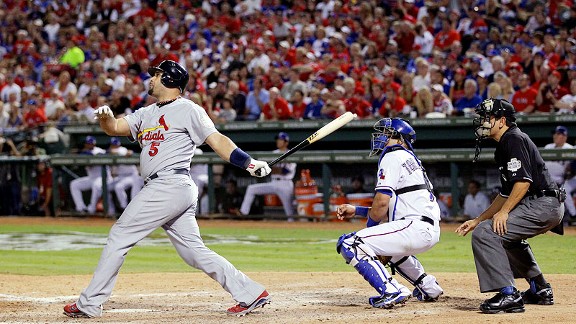
Showing posts with label Albert Pujols. Show all posts

Friday, May 26, 2017

Remembering Ryan Howard

With Howard's career likely over, it's time to do some reflecting (MLB.com)
It's been a couple weeks since the Braves released Ryan Howard from his Minor League contract, effectively bringing an end to the 37-year-old's career. The news didn't come as a shock to anyone who's watched him flail away over the past five seasons, but it's always sad whenever one of baseball's greats is told he can no longer play the game.

It's sadder still when one of those players starred during your childhood. When they retire, it feels like they're taking a small part of it with them. The player becomes great only in your memory, YouTube tributes, and grainy highlight reels. It also makes you realize how much time has passed since you first started cheering for them.

I wasn't a Phillies fan and never owned him in one of my fantasy leagues, so I can't say I truly rooted for Ryan Howard. But I remember the summer he exploded onto the national consciousness, establishing himself as a household name and one of the most feared hitters in baseball.

Bill Simmons once wrote somewhere that sports never matter more than when you're 14 years old. Now 10 (soon to be 11) years removed from that semi-magical age, I have to agree with him. The more I think back on it, the more sports memories I'm able to unearth from that time. It's like I'm drilling for oil, and the summer of 2006 is my Alaskan pipeline.

I think that's because I watched more Baseball Tonight (RIP) in that two-month stretch than I have before or since (this was in the dark ages before MLB Network, mind you). Every night, I'd go down into the basement and flip on BT or Sportscenter (whichever was on, though BT was infinitely better) while working out in preparation for eighth grade football.

So, yeah, I saw a lot of baseball highlights that summer, many of which involved Ryan Howard sending another meatball deep into the night.

By then, it was clear that Howard was having a special season. Expectations were high for him that spring, as they always are for players who've just won Rookie of the Year. Howard's were astronomical, though, given that his rookie numbers projected to 40 homers, 115 RBIs, and 325 total bases over a 162-game season.

Most people thought those numbers were Howard's ceiling. Few could have imagined that he'd blow them away.

Many rookies take a step back in their second season, especially strikeout-prone sluggers like Howard. The league adjusts to them, their weaknesses become exploited, and before long they look lost at the plate. There are strikeouts and pop-ups and growing pains, but it's all part of the process. The MLB learning curve is steep, sometimes taking years to master (just ask Jose Bautista).

Very rarely does a guy come up and rake from the start. A few of the all-time greats did -- Ted Williams, Joe DiMaggio, Albert Pujols -- but many didn't, including Mickey Mantle, Willie Mays, and Mike Trout. Some don't hit their stride until their 30s, like Raul Ibanez or Daniel Murphy.

Not Howard. He took off like a rocket ship, homering off reigning NL Cy Young winner Chris Carpenter on Opening Day and batting over .300 through the end of April. In May he barrelled through the stratosphere, slugging 13 homers and driving in 35 runs, but somehow did not win NL Player of the Month honors. Let me repeat that: A guy hit 13 homers and had 35 RBIs in one month and did not win Player of the Month. Some guy named Jason Bay (remember him?) did, with 12 homers, 35 RBIs, and a 1.090 OPS (72 points higher than Howard). 2006 was a different time.

When Howard didn't slow down in June (nine homers, 21 RBIs, .987 OPS), that's when I really began to take notice. Towards the end of the month, he ripped two homers and drove in all seven of his team's runs in a 9-7 loss to the Yankees while becoming the first player to hit a ball into the third deck in right field at Citizens Bank Park. When I saw his stat line in the box score the following day, I remember wishing the season would end already so I'd know what Howard's final numbers would like. My summer vacation had just started, and I was already pining for October.
Howard became an MVP frontrunner with his stretch run surge (Philly Phever)
A little more than a month later, after he'd been named to his first All-Star team and competed in the Home Run Derby, Howard produced the ultra-rare 0-for-0 stat line while playing a complete game. The Marlins walked him five times -- only once intentionally -- although I'm sure several were of the unintentionally-intentional kind. That was in the first game of a doubleheader. Florida pitched to him in the second game, but Howard made them pay with three hits, including a homer.

The five-walk game (which tied a Major League record) reflected a shift in how Howard was being approached. Prior to the All-Star break, he walked 31 times (five intentionally) in 352 plate appearances. In 352 PA's after the break, he walked 77 times, a whopping 32 of which were intentional. Only three men in baseball history received more intentional walks in a season; Barry Bonds, Willie McCovey, and Albert Pujols.

Seeing fewer strikes did nothing to slow Howard's roll in August, as he slammed 14 homers and drove in 41 runs (the highest monthly total since 1962) to win NL Player of the Month. He did not go more than three games without a tater, and he ended the month with six homers and 17 RBIs -- a great month for most players -- in his final nine games. When the dog days of August drew to a close, he had 49 homers (a new Phillies record) and 128 RBIs.

The Phillies, who had a losing record for much of the summer, had been out of the playoff picture for months by the time September rolled around, but their slugging first baseman continued to mash. After playing both ends of a doubleheader on the 2nd, he smashed three big flies in the first game of a second twin ball the following day and added two hits in the night cap for good measure. Following another multi-homer game on September 8th, he'd amassed 13 homers and 26 RBIs in his previous 16 games. With the season entering its final phase, Howard had found another gear.

And even though he had 56 homers with over three weeks to go, there was little talk of him reaching 60. The once-magic number had been cheapened by Bonds, Mark McGwire, Sammy Sosa surpassing it six times in the previous eight seasons, and fans had become de-sensitized to gaudy home run totals. Thanks to the tireless efforts of Congress and Jose Canseco, they'd recently become aware that America's pastime was teeming with bulked up roiders, causing the home run's once-mythic power to wane considerably in the public's eye. Howard's numbers were undoubtedly impressive, but were met with a collective shrug from the baseball world. Pretty cool, Ryan, but you're still a long way from 73.

Making matters worse for Howard was that, at precisely that moment, opposing pitchers and managers decided to stop pitching to him altogether. With teams battling for postseason berths and September call-ups trying to make names for themselves, no one could afford to get cute with Howard. So they hardly bothered, walking him 28 times (14 intentional) over his final 100 plate appearances. It was the closest thing we'd seen to the Barry Bonds treatment since, well, how pitchers were treating Barry Bonds that year, who was intentionally walked 38 times (one more than Howard) at age 41. The strategy worked, limiting Howard to just two long balls and 11 RBIs over his final 21 games. Despite reaching base 53 times via hit, walk, hit-by-pitch, or error during that span (excluding his two homers), he was driven in a mere eight times, indicating just how little protection there was for Philadelphia's cleanup man.

Howard was named Player of the Month again for September after slashing .385/.562/.750, and when the dust settled on October 1st his final numbers were extraordinary; .313/.425/.659 with 58 homers (the most ever by a player in his second season), 149 RBIs, 104 runs and 108 walks (37 intentional). His home runs and RBIs paced the Major Leagues, as did his 383 total bases. Still, one can only wonder what his stats might have looked like had opponents not waved the white flag in September, or if Charlie Manuel hadn't batted him fifth throughout the first half, thereby costing him several plate appearances. 60 homers, 160 RBIs, and 400 total bases were all within reach. As great as it was, Howard's season could have been legendary.

Even so, it was still pretty monstrous. So blinding were Howard's Triple Crown numbers that he momentarily convinced baseball writers he was better than the reigning NL MVP -- the best hitter in baseball, who also happened to be an elite defensive first baseman. After all it was Albert Pujols, not Howard, who led the Majors in slugging (.671) and OPS (1.102) that year while mashing a career-high 49 homers, winning a Gold Glove and leading St. Louis to a World Series title. Had he not landed on the DL for the first time in his career, he would have surpassed 50 homers as well and possibly 150 RBIs, in which case there would have been no debate as to which first sacker had the superior season.

While Howard followed up his MVP with several more remarkable seasons, he never again reached the heights of 2006. He never came close to batting .313 again, finishing at .258 for his career, and had only one other season with an OBP above .360. He never had another 50-homer season or slugged .600 again, as pitchers soon learned that he could be neutralized with breaking stuff low and away. He quickly became unplayable against left-handed pitchers and his body began to break down. After averaging 44 homers and 133 RBIs from 2006-2011, he was below replacement level in every season except one from that point forward. It was unfortunate that he fell off a cliff as soon as his five-year, $125 million contract extension kicked in, turning him into a punchline during his final seasons.

But even at the end, when his batting average fell below .200 and he could no longer hit lefties to save his life, the power remained. He went deep 25 times in his final season in just 331 at-bats, besting his rookie rate of 22 homers in 312 at-bats. The only difference was that his OPS was 214 points lower, and that he was a 36-year-old at the end of the line than a 25-year-old kid with his whole career ahead of him.

It's a shame Howard never got to DH (his natural position) full-time, as he had the size and strength to keep hitting home runs forever. The Yankees just should have put him in that Stadium and milked a few more seasons out of him for minimal cost. They still can, I guess, especially since he'd make a nice platoon partner for Matt Holliday, but the last thing Brian Cashman wants right now is another aging bat on his roster.

Man, 2006 really was a long time ago...

Saturday, August 15, 2015

Pujols, Teixeira Turning Back the Clock

Teixeira takes another pitcher deep (NY Times)
One of the best sluggers in the American League this year is 35 year-old first baseman who has been hobbled by injuries in recent seasons, injuries that have cut into his into playing time, hampered his power, and left many to wonder just how effective he could be going forward. Recently his giant contract has been deemed among the worst in baseball, but this year he's been worth every penny. He's re-asserted himself as a middle of the order force on a contending team, socking home runs and driving in runs with regularity. Last month he was an All-Star for the first time in years, and now he's adding to his MVP case as the stretch run looms.

I'm talking about Mark Teixeira. I am also talking about Albert Pujols.

Both players, you see, are enjoying unexpected resurgences at the plate. What's funny is that they're going about it different ways. Pujols is being more aggressive than ever before, continuing a trend of declining walk rates since 2009. This is common in older hitters, who start their swing earlier to counteract their diminishing bat speed. He's also tinkered with his batting stance, adjusting his leg kick and load position. His is a classic case of an older player taking on the role of mad scientist, feverishly trying anything and everything in the hopes of recapturing his old glory.

Teixeira, on the other hand, wanted to get back to doing what he's always done: take walks and hit the ball a long way. Rather than experiment with a new approach, he simply sought to return to his old one. His only change was what he put on his plate, which no longer includes sugar and gluten (how somebody can swear off one, let alone both, is incomprehensible to me). Contrary to Pujols, Tex became even more patient. Granted, he's always been a disciplined hitter, but it's noteworthy that his walk rate hasn't been this high since 2010. Given how far the league walk rate has fallen since then, that's really quite impressive.

Once among the best pure hitters in the game, they're essentially all-or-nothing sluggers at this point. Their averages, which used to top .300 with regularity, have settled into the .250s. Pujols is striking out more than at any point since his rookie season, and Teixeira's taken plenty of whiffs, too.

It's the return of their power, however, that's made them elite offensive performers again. Both are sitting on 30 home runs, a benchmark neither has surpassed since 2011 (Pujols hit 30 on the nose in 2012--his first year with the Angels). They're tied for fifth-most in the American League, four behind ML-leader Nelson Cruz. Pujols is sporting his best Isolated Power since 2010, while Teixeira is putting up the best ISO of his career. Pujols is in the league's top-10 for total bases, whereas Tex is in the top-10 for slugging percentage and extra base hits.
Pujols hasn't hit this well since his Cardinals days (ESPN)
Their coinciding comebacks is just the latest parallel in their exceptional careers, which have mirrored each other at every turn. Both were born in 1980, came up in the early 2000s, and raked from the start. They were extremely durable. They hit for good power and high averages. They became multi-Gold Glove winning first basemen.

Both were absolute monsters through around 2009 or so, then they signed huge contracts with new teams and almost immediately began going downhill. Part of it was age, part of it was injuries, and part of it was the league-wide decline in offense that's been happening since these guys turned 30. They both had some years where they got off to absolutely terrible starts, and as you get older those slumps last longer and it becomes harder and harder to come back from them.

They both bottomed out in 2013, when injuries limited Pujols to 99 games and Teixeira to all of 15. They bounced back some in 2014, but nowhere near their pre-injury levels. As they crept into their mid-30s and injuries kept piling up, their careers seemed to be heading south.

Then, just when everyone had written them off, they came roaring back. Fully healthy for the first time in years, they've been able to inflict some serious damage on AL pitching this summer. It was a sight to see both at the Midsummer Classic, something neither had been a part of in half a decade. They looked like dinosaurs alongside National League representatives Paul Goldschmidt and Anthony Rizzo, both of whom are nearly a decade younger.

But every All-Star Game is like that, a bizarre juxtaposition of fading stars and bright up-and-comers. Pujols and Teixeira might not have looked like they belonged, but their numbers said otherwise.

Monday, May 5, 2014

Baseball's Best Number 5's

DiMaggio will always be linked with number five
To celebrate Cinco de Mayo, here are the five best players who wore the number five (for at least five years, which means Hank Aaron and Mel Ott are excluded.

1. Joe DiMaggio
The Yankee Clipper actually wore the number nine (same as future foe Ted Williams) in 1936--his rookie year--because Frankie Crosetti was number five. DiMaggio became five the next year and responded with the best year of his Hall of Fame career (meanwhile, Crosetti became number one). Joltin' Joe became one of the best centerfielders of all-time, winning three MVP awards and leading the Yankees to ten pennants and nine championships in his 13 seasons. His number was retired the year after DiMaggio's final season (1951), meaning no Yankee has worn the number five for over 60 years.

2. Albert Pujols
Pujols has worn the number five in all of his 14 seasons, even after switching teams prior to 2012. "The Machine" is one of the greatest righthanded hitters of all-time and ranks with Jimmie Foxx and Lou Gehrig as one of baseball's best first basemen. The three-time MVP just eclipsed 500 home runs, and at 34 still has plenty of time to ascend the career leaderboards. His career is far from over, but he's already a first-ballot Hall of Famer. The Cardinals, who won two World Series with Pujols, have not given away his number since he left and will likely retire it.

3. George Brett
Widely acknowledged to be the second-best third baseman of all-time behind only Mike Schmidt. Brett was number 25 in his first two seasons, when one-time All-Star Richie Scheinblum was number five, but wore the number five for the remaining 19, all with Kansas City. Brett, of course, was a phenomenal hitter who batted .305 for his career, compiled 3,154 hits (1,119 of which went for extra bases), won three batting titles in three different decades and nearly batted .400 in 1980. A well-rounded player, he also stole 201 bases and played a great (and underrated) third base in his early years, even winning a Gold Glove in 1985. The Royals retired his number in 1994.

4. Johnny Bench
The best catcher of all-time (sorry, Yogi Berra fans) wore number five for all of his 17 years behind the plate with Cincinnati. A ten-time Gold Glove winner who made 14 All-Star teams and slugged 389 home runs, Bench is the best two-way catcher who ever lived. He was at the heart of the Big Red Machine, winning two MVP awards and helping power the Reds to four pennants and two championships in the 1970s. Fittingly, his number was retired in 1984.

5. Jeff Bagwell
Bags donned numero cinco in every one of his 15 years manning first base for the Houston Astros. He isn't in the Hall of Fame yet, but he should be. Though he didn't have the longevity of some of the other guys at the position (Rafael Palmeiro, Tony Perez, Willie McCovey), he crammed enough into his playing days that he still ranks as one of the five-best first baseman of all-time since 1900 (according to JAWs). One of the most complete first-sackers ever, he was an asset on the basepaths (swiping 202 bases) and played solid defense, winning a Gold Glove in 1994--the same year he won the NL MVP award unanimously. One of just three Astros to wear the number (along with Steve Henderson and Hal King), Bagwell will also be the last, for his number was retired in 2007.

Honorable Mention: Brooks Robinson, Hank Greenberg, Nomar Garciaparra

Friday, April 11, 2014

Pujols Not Done Yet

Pujols just passed Lou Gehrig and Fred McGriff on the all-time home run list
I know it's early, but I'm starting to get the feeling that Albert Pujols is back. Yeah, I think the baseball world gave up on him too soon.

Everybody seems to think that Pujols has been a disaster since signing his mammoth contract with the Angels, and that's simply not true. He hasn't been as good as he was before he signed the contract, but we had no reason to expect him to be. Pujols was already past his prime at 32 when he inked his contract and was already on his way down, having suffered declining performance in each of the previous two years. Moving to Angels Stadium, a notoriously tough park for hitters, and a division with pitching friendly venues in Seattle and Oakland, wasn't going to help. Throw in the pressure of signing the third-largest deal in baseball history at the time (behind only the two signed by Alex Rodriguez) and it was pretty much guaranteed that we had already seen the best of Pujols.

It didn't help that Pujols made a bad first impression with his new team. He went homerless in April 2012, knocking in only four runs and batting just .217/.265/.304--easily the worst month of his career up to that point. With Pujols sputtering (and Mike Trout still in the minor leagues) the Angels struggled, going 8-15 and effectively dooming their postseason chances. It goes without saying that had Pujols hit like Pujols and Trout was on the team from the start, the 2012 Angels would have made the playoffs and maybe won the World Series, and if that had happened then people would surely have a much different perception of Pujols's Angels tenure.

Alas, we will never know. Pujols did not break out of his funk until he swatted his first home run of the year on May 16th. But from that point forward, he hit like the Pujols of old, batting .308/.371/.588 the rest of the way.

Though his .285/.343/.516 final line represented career lows in all three triple slash categories, it was still good for a robust 138 OPS+. He reached 30 homers for the 12th consecutive season, topped 100 RBI for the 11th time and had exactly the same number of hits (173) and total bases (313) as the year before. He also cranked 50 doubles--his most since 2004 and one shy of league leader Alex Gordon--and was worth nearly five wins above replacement according to Baseball-Reference.

If anything, Pujols was underrated that year. Though he was one of the league's ten most valuable position players, he did not make the All-Star team and finished a distant 17th in the MVP voting (after never having finished lower than fifth before that) behind the likes of Derek Jeter (2.2 bWAR), Fernando Rodney (3.8 bWAR) and Jim Johnson (2.5 bWAR). All-in-all, it was a pretty good year, though certainly a bit below expectations.

Then came 2013, the year that essentially destroyed Pujols's reputation as one of the game's elite. All because for the first time in his career, Pujols was unable to stay healthy. After averaging 155 games played per year from 2001 through 2012, Pujols played just 99 games in 2013 before he was shut down for the season in late July. Hampered by plantar fascitiis and various lower body ailments, Pujols played in pain the entire season, and it showed in his numbers. He batted a lowly .258/.330/.437, struggled in the field and was a nonfactor on the bases. Hobbled by injuries, Pujols clearly wasn't the same player, and given his age it was fair to wonder whether he would be ever again.

And so people counted Pujols out. They said he was old and washed up. They doubted his abilities. Everyone called his contract an albatross, a horrible mistake. They said he was done. All at once, everyone seemed to lose faith in the greatest hitter of his generation. Once money in the bank, he was viewed as one giant question mark or worse--damaged goods.

The more I think about it, the more I think we all overreacted. Pujols had one bad season, which wasn't even that bad. It was poor by his lofty standards, but really not so terrible otherwise. His OPS, when adjusted for league and park, was still 16 percent better than average. He was on pace for around 25 home runs and 100 RBI before he was shut down. And yet everyone grabbed their pitchforks and treated him like the next Jason Bay, or the next Vernon Wells. So it goes when you're locked into a ten-year, $240 million deal that expects you to earn the bulk of that money in the first few years of your contract.

All the talk about his decline seems premature and exaggerated. Pujols is 34, still young enough that he should have several more good years in him. He's not going to be the monster who won three MVP awards in five years, who like Miguel Cabrera was a threat to win the Triple Crown every year, but he still has the skills to be a very good hitter. He still has power, as he showcased the last couple nights, and he still has that perfect, balanced swing. He doesn't strike out very much. He remains a dangerous hitter, arguably more dangerous now that he has something to prove--that he can still rake.

Pujols still has something left in the tank. Not enough to catch Barry Bonds, but enough to keep climbing up the career leaderboards and cement his status as one of the greatest to ever play the game.

Thursday, February 27, 2014

Trout Gets Much-Deserved Raise

If you just got your salary doubled and became a millionaire, you'd be smiling too
Mike Trout will make twice as much money as he made last year, and he'll still be the best bargain in baseball by a mile.

Consider that over the past two seasons, Trout has scored more runs and stolen more bases than anybody in baseball. He's been worth 20.4 fWAR. Nobody else has more than 15 (Andrew McCutchen). He's totaled more fWAR by himself than all the position players on the Mariners, Marlins, and Astros. In fact, he has more fWAR than all the Miami and Houston position players put together. That's absolutely nuts.

Last year alone, Trout was worth as many wins above replacement as all the New York Yankees position players put together (which is really impressive, or sad, considering Robinson Cano was worth six wins by himself). The Angels got more from Mike Trout than six other teams got from all their position players. He had more fWAR than the Marlins, Astros, White Sox, and Mariners combined.

Teams spent hundreds of millions of dollars to get what Mike Trout has provided for just $1 million over the last two years (and somehow LA missed the playoffs both years, despite allocating $250 million to other players during that time). He'll cost the Angels $1 million this year, which will be the most any team has ever paid for a one-year deal from a player who was not yet arbitration-eligible. Ryan Howard and his current teammate Albert Pujols held the previous record of $900,000.

Interestingly enough, all three were voted Rookie of the Year. Here's what else they'd accomplished at the time of signing:

Pujols:   1,351 PA  71 HR  .321/.399/.586  154 OPS+ 12.7 fWAR, MVP runner-up
Howard: 1,094 PA  82 HR  .304/.399/.624  155 OPS+ 8.2 fWAR, 2006 NL MVP
Trout:   1,490 PA  62 HR  .314//404/.544  166 OPS+ 21.1 fWAR, 2 MVP runner-ups

Trout's clearly the best of the bunch in terms of context-adjusted hitting and overall value. Both his predecessors went on to land monster contracts, so the way Trout's career is shaping up it's only a matter of time before he scores a mega-payday of his own.

But for now, he'll have to settle for $1 million.

Tuesday, January 7, 2014

Ranking Righthanded Hitters

More than 75 years after his last at-bat, Hornsby is still the best righty
With another incredible season under his belt, American League MVP Miguel Cabrera is making a case as one of the best righthanded hitters of all time. But there have been many great players that batted from the right side, so as of now he doesn't even crack the top 10. In my opinion, these are the best righthanded hitters to debut after 1900. That disqualifies Honus Wagner and Nap Lajoie right off the bat, though frankly I'm not sure they would have made the final cut anyways.

For statistical comparisons I used Adjusted OPS,  scaled Runs per Plate Appearance, True Average and weighted On-Base Average to help account for parks and different scoring levels.

1. Rogers Hornsby 175 OPS+ 173 wRC+ .459 wOBA 860 Rbat
Rajah won six consecutive sabermetric Triple Crowns (seven overall), two traditional Triple Crowns, two MVP awards, and led the league in OPS+ a dozen times. The .358 career hitter also eclipsed a .400 batting average three times and batted .382/.460/.637 during the Roaring Twenties.

2. Hank Aaron 155 OPS+ 153 WRC+ .335 TAv .403 wOBA 870 Rbat
The all-time leader in RBI (2,297), total bases (6,856) and extra base hits (1,477), Hammerin' Hank is best remembered for breaking Babe Ruth's career home run record in 1974. Though Barry Bonds has since passed him, Aaron's 755 career dingers are still the most ever by a righty. His combination of consistency and longevity--20 straight seasons with at least 20 homers and and OPS+ over 100 in all but one of his 23 seasons--is unmatched for a power hitter.

3. Jimmie Foxx 163 OPS+ 158 wRC+ .460 wOBA 758 Rbat
One of the most feared hitters of all-time, Foxx led the American League in walks seven times. From 1929-1940, Foxx reached 30 home runs and 100 RBI each year while batting an aggregate .334/.440/.644. He also won three MVPs and a Triple Crown in a career with 534 home runs.

4. Willie Mays 156 OPS+ 154 wRC+ .339 TAv .409 wOBA 805 Rbat
Probably the best all-around player to ever grace the diamond, Mays slammed 660 homers in a career that spanned 22 seasons. He also won five league OPS titles, five slugging titles and four home run championships.

5. Albert Pujols 165 OPS+ 161 wRC+ .337 TAv .420 wOBA 663 Rbat
Through his first ten seasons, Pujols cemented his reputation as one of the best hitters in baseball history by winning three MVP awards (would have been more if not for Barry Bonds) and averaging 41 homers, 123 RBI, 43 doubles and 119 runs scored per season. His career OPS after the 2010 season was 1.050. Though his career appears to be in a state of decline, he's already done more than enough to bank a first-ballot Hall of Fame induction.

6. Frank Thomas 156 OPS+ 154 wRC+ .331 TAv .416 wOBA 688 Rbat
Few players have started their careers better than Thomas, who batted .330/.452/.600 through his first eight seasons and won back-to-back MVP awards, becoming the league's first righthanded hitter to do so in over 60 years. The Big Hurt finished his career with rate stats nearly identical to Mickey Mantle's and 521 home runs, same as Ted Williams and Willie McCovey.

7. Manny Ramirez 154 OPS+ 153 wRC+ .326 TAv .418 wOBA 649 Rbat
Ramirez loafed on defense and never ran out anything, which explains how he never won an MVP award (or even finish second), but his intense focus in the batter's box was unquestioned. For his career he batted .312/.411/.585 with 555 home runs and 547 doubles. ManRam was also an RBI machine, topping the century mark 12 times and driving in as many as 165 in 1999.

8. Frank Robinson 154 OPS+ 153 wRC+ .332 TAv .404 wOBA 726 Rbat
Another candidate for most feared hitter to ever step up to the plate, Robinson led the majors in intentional walks four straight years. He is the only player to win an MVP award in both leagues, winning in 1961 with the Reds and 1966 with the Orioles after winning both the conventional and sabermetric Triple Crowns.

9. Mark McGwire 163 OPS+ 157 wRC+ .333 TAv .415 wOBA 544 Rbat
Big Mac was a feast or famine type hitter, especially early on his career (.250 career average through age 30), but walked a ton and so his career OBP of .394 is actually very good. More importantly, he cranked 583 home runs and owns the best AB/HR ratio of all-time.

10. Tie Hank Greenberg 158 OPS+ 154 wRC+ .453 wOBA 433 Rbat and Joe DiMaggio 155 OPS+ 152 wRC+ .439 wOBA 529 Rbat
Due to injuries, World War II and somewhat early retirements (both called it quits after their age 36 seasons), their careers lasted just 13 seasons. But both men accomplished a great deal in that short time and were overwhelmingly dominant when they did play. Greenberg batted .313/.412/.605 for his career, winning four home run championships, four RBI titles and two MVP awards in the process. He narrowly missed breaking Lou Gehrig's league RBI record and Babe Ruth's single season home run record in successive seasons. DiMaggio's numbers were hurt by Yankee Stadium, but Death Valley didn't stop him from winning back-to-back batting titles and three MVP awards, or from making the All-Star team every year. It also didn't stop him from getting a hit in 56 consecutive games in 1941.

Honorable Mention (in no particular order)
Dick Allen 156 OPS+ 155 wRC+ .330 TAv .400 wOBA
Harry Heilmann 148 OPS+ 144 wRC+ .427 wOBA
Mike Schmidt 147 OPS+ 147 wRC+ .317 TAv .395 wOBA
Gary Sheffield 140 OPS+ 141 wRC+ .314 TAv .391 wOBA
Edgar Martinez 147 OPS+ 147 wRC+ .320 TAv .405 wOBA
Alex Rodriguez 143 OPS+ 143 wRC+ .314 TAv .400 wOBA
Harmon Killebrew 143 OPS+ 142 wRC+ .318 TAv .389 wOBA
Jeff Bagwell 149 OPS+ 149 wRC+ .321 TAv .405 wOBA
Mike Piazza 143 OPS+ 140 wRC+ .314 TAv.390 wOBA
Albert Belle 144 OPS+ 139 wRC+ .310 TAv .396 wOBA
Frank Howard 142 OPS+ 140 wRC+ .313 TAv .374 wOBA
Ralph Kiner 149 OPS+ 147 WRC+ .427 wOBA
Hack Wilson 144 OPS+ 143 wRC+ .421 wOBA
Vladimir Guerrero 140 OPS+ 136 wRC+ .309 TAv .390 wOBA

Maybe someday...
Miguel Cabrera 154 OPS+ 152 wRC+ .324 TAv .407 wOBA
Ryan Braun 146 OPS+ 148 wRC+ .315 TAv 400 wOBA
Mike Trout 166 OPS+ 163 wRC+ .350 TAv .405 wOBA


Sunday, June 23, 2013

Pujols Putting Slow Start Behind Him

Albert Pujols is no stranger to sluggish starts.

Statistically speaking, April and May are the two worst months of his career by OPS. He's not quite Mark Teixeira, but in recent seasons he's looked like a shadow of himself during the spring. For the third year in a row, he slumped so badly out of the gate that many questioned whether we've seen the end of Albert Pujols as we know him--an elite offensive force and one of the best hitters of all time.

Once again, Pujols has proved such talk to be premature. Since June 4th he's belted five home runs, driven home 15 runs, and batted a Pujolsian .338/.400/.631 in 16 games.

He's back, which is hardly surprising. We've seen this movie before, so we know how it ends:

2011
Pujols slumped at the beginning of his walk year after his contract negotiations with the St. Louis Cardinals fell through. The slugger went a month between home runs (April 23rd to May 23rd). Through May 29th was batting just .257/.326/.395 and had already grounded into 16 double plays

Rest of the way .322/.388/.623

2012
Many players struggle immediately after signing a big contract (Carl Crawford, Josh Hamilton, Adrian Beltre), and Pujols was no exception. After signing the third largest deal in baseball history behind Alex Rodriguez's two megadeals, he didn't make a good impression with his new team. Pujols went homerless in April and didn't launch his first big fly of the season until May 6th. Through May 14th he was batting just .197/.235/.275, reminiscent of the brutal cold spells endured by David Ortiz in 2009 and '10.

Rest of the way .312/.374/.589

2013
After hitting well--albeit without much power--in the first few weeks of April, Pujols went into an extended funk that saw his batting line plummet to .243/.315/.408 through June 3rd. There's no denying that age and injuries have diminished the three-time MVP, but he's raked since then, and will probably continue to rake throughout the rest of the summer. His rate stats aren't going to climb back up to his career marks, but he's a good bet to reach 30 home runs (something he's done every season) and 100 RBI (every year except 2011).

Thursday, May 16, 2013

Slow Starts I'm Not Worried About (AL)

Victor Martinez (.215/.272/.306)
The Bad: V-Mart has looked very rusty after missing all of 2012 with a torn ACL. Martinez didn't hit his first home run of the season until May 4th. Despite batting fifth in Detroit's lineup behind Miguel Cabrera and Prince Fielder, he has just 18 RBI on the season. He's striking out more than ever before and has worked only two walks since April 20th. At 34, he's reached an age where most players begin to suffer marked deterioration in their performance.

Why he'll turn it around: That .234 BABiP is bound to come up, as will his 3.5 HR/FB%. His stellar track record suggests he's going to figure things out sooner or later, and when he does he's going to knock in truckloads of runs batting behind Cabrera and Fielder.

Josh Willingham (.205/.378/.411)
The Bad: After a solid opening month, Willingham has seen his power stroke disappear in May. In his past 14 games he has no home runs and just seven hits. He's seeing fewer strikes than last year, so pitchers may be trying to avoid him more.

Why he'll turn it around: High strikeout, feast-or-famine hitters like Willingham tend to be streaky. Let's just chalk his recent slide up to a standard slump and assume the next power binge is right around the corner, especially as the weather starts warming up.

Yoenis Cespedes (.204/.270/.435)
The Bad: Cespedes already spent time on the DL with a thumb injury, which may still be affecting his swing. He has just one multi-hit game in May and hasn't drawn a walk since May 3rd. He fanned 30 times in a 22 game span from April 2nd through May 10th. He stole 16 bases last year, when he finished second in the AL Rookie of the Year voting behind Mike Trout, but has yet to swipe one this year.

Why he'll turn it around: His .203 BABiP is due for some serious correction, especially when his line drive percentage (8.6) starts to climb.

Albert Pujols (.248/.328/.418)
The Bad: Playing on a surgically repaired knee and through plantar fasciitis seems to be taking its toll on the 33 year-old first baseman. His strikeout rate is the highest it's been since his rookie season. He's leading the league in double plays grounded into and is once again a main culprit for LA's sluggish start (though Josh Hamilton is more to blame).

Why he'll turn it around: Pujols was even worse last spring, when he batted just .192/.228/.277 through May 11th. From that point forward he batted .310/.373/.581. He's one of the best hitters of all time, and he's worthy of your patience. His .246 BABiP will rise, as will his 12.0 HR/FB%.

Adam Dunn (.156/.255/.391)
The Bad: There's a lot of bad. Dunn went 34 straight plate appearances without a base hit from April 12th to April 20th. He had just two multi-hit games in April and three overall. His walk rate is way down. His numbers don't look much better than they did in 2011, when he had one of the worst seasons a hitter has ever had. The last place White Sox need more from him.

Why he'll turn it around: After slamming three home runs in his past two games, Dunn may already be emerging from the depths of his early season slump. Given that he's totaled at least 38 dingers in eight of the past nine years, the home runs are going to start coming in bunches. His .155 BABiP has nowhere to go but up.