Showing posts with label Frank Thomas. Show all posts
Tuesday, July 29, 2014
Ten Thoughts on Thomas
Here are ten thoughts on new Hall of Famer Frank Thomas:
1. During The Big Hurt's incredible ten-year run from 1991 through 2000, he walked 363 more times than he struck out. When he peaked during his back-to-back MVP seasons of 1993-1994, he slugged 79 home runs while fanning only 115 times.
2. I'm amazed at how consistent his runs scored totals stayed during the '90s. In his eight straight seasons with over 100 runs from 1991 through '98 he scored between 102 and 110 runs, scoring 106 in back-to-back seasons ('93 and '94) and 110 in consecutive years as well ('96 and '97).
3. Thomas's on-base percentages are just off-the-charts. He was well over .400 in each of his first eight seasons--when his OBP was over .450 every year but one--and 11 times in all. He peaked at .487 in 1994, led the league four times and had four other top-four finishes. His .419 career mark is the 19th highest of all-time and second only to Barry Bonds among players who began their careers in the last 60 years.
4. Like Duke Snider, Thomas managed five 40 homer seasons but never exceeded 43 in any season. What's even more astonishing is that despite five 40 homer seasons, four others with more than 30 and 521 for his career, Thomas never led the American League in long balls. He was runner-up four times, third once and fifth twice, but never tops. It's also just as amazing to me that he knocked in over 1,700 runs and enjoyed 11 seasons with more than 100 but never led the league, despite driving in 125 or more four times including as many as 143 in 2000.
5. It blows my mind that a player who averaged 36 homers, 118 RBI, and a .330 batting average for eight years not only never won the Triple Crown, but came away with zero home run crowns, zero RBI titles and only one batting championship. That's all he would win in a career that produced 521 long balls, 1,704 RBI and a .301 batting average. The '90s were just a different time.
6. I find it pretty amazing that even as a full-time designated hitter at age 39, Thomas still managed to stay on the field for 155 games, blast 26 home runs and drive in 95. It's almost as amazing that the next year he was done at 40, posting the worst OPS of his career and not even playing half a season. When players lose it, especially at that age, it often happens overnight.
7. Funny how his career paralleled that of Ken Griffey Jr. Junior debuted in 1989, one year before Thomas, and both were first round draft picks. They dominated the American League throughout the 1990s, when they were perennial All-Stars and won three MVP awards between them. They had their last truly great season in 2000 before injuries ravaged the second half of their careers, limiting them to sporadic success in their thirties. Both retired following their age 40 season.
Griffey '90-'00 6,813 PA 1,102 R 1,763 H 774 XBH 1,209 RBI .299/.384/.579 65.3 oWAR
Thomas '90-'00 6,799 PA 1,083 R 1,755 H 715 XBH 1,183 RBI .321/.440/.579 65 oWAR
8. One can pretty much draw a dividing line in Thomas's career at the 2000 season. In his 11 seasons before 2001 he bettered a .300 average and .400 OBP ten times and had nine seasons with at least 100 runs, RBI and walks. After 2000 he never again batted .280, scored 100 runs, or made an All-Star team and had only one season with a .400 OBP. He actually became a better slugger in the second half of his career, averaging one home run per 15.4 at-bats after age 32 compared to one every 15.9 before. A career .321 hitter through age 32, he batted just .262 over his final eight seasons and nearly lost his lifetime .300 average a la Mickey Mantle.
Thomas '90-'00 .321/.440/.579 1.018 OPS 169 OPS+ 835/1188 K/BB 15.9 AB/HR 58.7 bWAR
Thomas '01-'08 .262/.376/.507 .884 OPS 130 OPS+ 562/479 K/BB 15.4 AB/HR 15 bWAR
9. I'm shocked that Thomas made only five All-Star teams. How he didn't make it in 1991, when he led the majors in walks, OBP, OPS, and finished third in the AL MVP voting is beyond me. Or how about 1992, he he led the majors in doubles and American League in walks, OBP, and OPS? Or in 2000, when he was MVP runner-up. Thomas did not make an All-Star team in any of his 11 final seasons, even though he eclipsed 100 RBI four times, had a pair of 40 homer seasons and another with 39, and five times posted an OPS over .900.
10. The 1990s had so much power/home runs that Thomas had to slug .729 just to lead the league. He slugged over .600 five other times and never led the league in any of those seasons.
Thursday, January 9, 2014
Three Down, Many More to Go
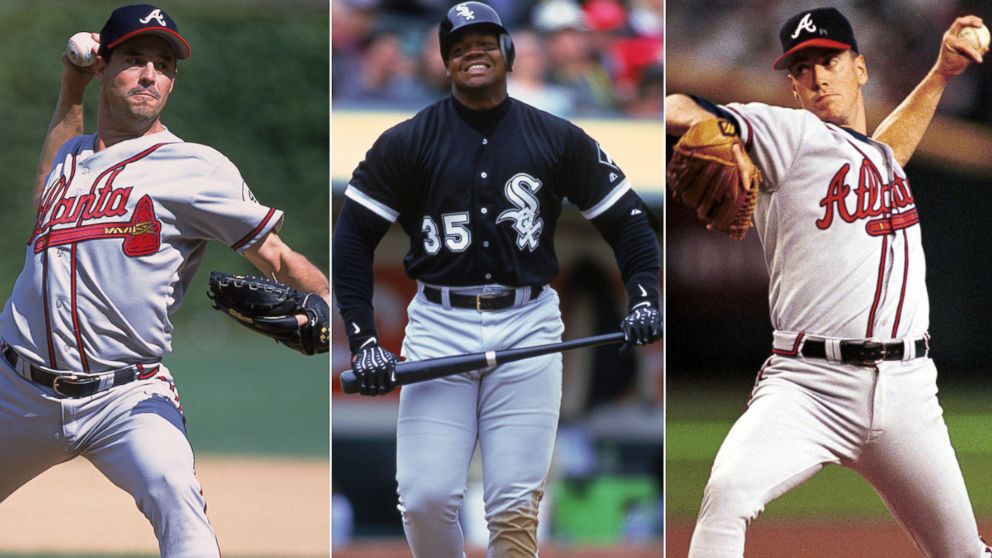
Yesterday a trio of all-time greats--Greg Maddux, Tom Glavine, and Frank Thomas--were voted into the baseball Hall of Fame. They will be officially inducted on July 27th alongside Bobby Cox, Joe Torre and Tony LaRussa, the three unanimous selections from the Expansion Era ballot. Congratulations to all of them for receiving such a well-deserved honor.
But let's not give the BBWAA too much credit. Maddux, Glavine, and Thomas were all slam-dunks (as were the three skippers), and a failure to vote them in would have been incredibly shortsighted. Consider, though, that this Hall of Fame still has yet to induct:
- Barry Bonds--baseball's all-time home run and walks leader, as well as the only player with seven MVP awards (nobody else has more than three)
- Roger Clemens--the only pitcher with seven Cy Young awards (nobody else has more than five) also won seven ERA titles, 354 games and an MVP award
- Craig Biggio--3,060 hits and more doubles (668) than any righthanded hitter in history
- Mike Piazza--the best hitting catcher of all-time
- Jeff Bagwell--a better all-around player than Thomas and only first baseman with more than 400 home runs and 200 steals. Has the fourth highest JAWs score of any first baseman to debut after 1880
- Edgar Martinez--the sport's best DH in the position's 40-year existence as well as one of its best pure hitters with 514 doubles and a .312/.418/.515 career batting line
- Tim Raines--the best percentage basestealer in the sport's history swiped 808 bags with an 84.7 percent success rate and reached base more times than Tony Gwynn
- Mark McGwire--prolific slugger went yard 583 times in his career, broke Roger Maris's single season home run record and owns the best AB/HR ratio of all-time
- Sammy Sosa--609 home runs and the only player to top 60 in three seasons
- Rafael Palmerio--one of only four men with at least 3,000 hits and 500 home runs (the others are Willie Mays, Hank Aaron and Eddie Murray)
- Jeff Kent--MVP with more long balls than any second baseman
- Fred McGriff--one of just ten players to retire with an OPS over .886 in more than 10,000 plate appearances
- Larry Walker--MVP with seven Gold Gloves and .313/.400/.565 career batting line
- Alan Trammell--almost identical to Barry Larkin
- Curt Schilling--best postseason pitcher in history with the best career K/BB ratio since 1900
- Mike Mussina--one of baseball's 25 most valuable pitchers per bWAR
Not to mention...
- Pete Rose--baseball's all-time hit king with 4,256 base knocks
- Shoeless Joe Jackson--Deadball era legend has the third highest batting average (.356) and eighth-highest adjusted OPS (170) of all-time
- Ted Simmons--top ten catcher (per JAWs) who ranks second among backstops in hits, doubles, and RBI
Make no mistake: the system is still broken, and there is much work to be done.
Tuesday, January 7, 2014
Ranking Righthanded Hitters
| More than 75 years after his last at-bat, Hornsby is still the best righty |
For statistical comparisons I used Adjusted OPS, scaled Runs per Plate Appearance, True Average and weighted On-Base Average to help account for parks and different scoring levels.
1. Rogers Hornsby 175 OPS+ 173 wRC+ .459 wOBA 860 Rbat
Rajah won six consecutive sabermetric Triple Crowns (seven overall), two traditional Triple Crowns, two MVP awards, and led the league in OPS+ a dozen times. The .358 career hitter also eclipsed a .400 batting average three times and batted .382/.460/.637 during the Roaring Twenties.
2. Hank Aaron 155 OPS+ 153 WRC+ .335 TAv .403 wOBA 870 Rbat
The all-time leader in RBI (2,297), total bases (6,856) and extra base hits (1,477), Hammerin' Hank is best remembered for breaking Babe Ruth's career home run record in 1974. Though Barry Bonds has since passed him, Aaron's 755 career dingers are still the most ever by a righty. His combination of consistency and longevity--20 straight seasons with at least 20 homers and and OPS+ over 100 in all but one of his 23 seasons--is unmatched for a power hitter.
3. Jimmie Foxx 163 OPS+ 158 wRC+ .460 wOBA 758 Rbat
One of the most feared hitters of all-time, Foxx led the American League in walks seven times. From 1929-1940, Foxx reached 30 home runs and 100 RBI each year while batting an aggregate .334/.440/.644. He also won three MVPs and a Triple Crown in a career with 534 home runs.
4. Willie Mays 156 OPS+ 154 wRC+ .339 TAv .409 wOBA 805 Rbat
Probably the best all-around player to ever grace the diamond, Mays slammed 660 homers in a career that spanned 22 seasons. He also won five league OPS titles, five slugging titles and four home run championships.
5. Albert Pujols 165 OPS+ 161 wRC+ .337 TAv .420 wOBA 663 Rbat
Through his first ten seasons, Pujols cemented his reputation as one of the best hitters in baseball history by winning three MVP awards (would have been more if not for Barry Bonds) and averaging 41 homers, 123 RBI, 43 doubles and 119 runs scored per season. His career OPS after the 2010 season was 1.050. Though his career appears to be in a state of decline, he's already done more than enough to bank a first-ballot Hall of Fame induction.
6. Frank Thomas 156 OPS+ 154 wRC+ .331 TAv .416 wOBA 688 Rbat
Few players have started their careers better than Thomas, who batted .330/.452/.600 through his first eight seasons and won back-to-back MVP awards, becoming the league's first righthanded hitter to do so in over 60 years. The Big Hurt finished his career with rate stats nearly identical to Mickey Mantle's and 521 home runs, same as Ted Williams and Willie McCovey.
7. Manny Ramirez 154 OPS+ 153 wRC+ .326 TAv .418 wOBA 649 Rbat
Ramirez loafed on defense and never ran out anything, which explains how he never won an MVP award (or even finish second), but his intense focus in the batter's box was unquestioned. For his career he batted .312/.411/.585 with 555 home runs and 547 doubles. ManRam was also an RBI machine, topping the century mark 12 times and driving in as many as 165 in 1999.
Another candidate for most feared hitter to ever step up to the plate, Robinson led the majors in intentional walks four straight years. He is the only player to win an MVP award in both leagues, winning in 1961 with the Reds and 1966 with the Orioles after winning both the conventional and sabermetric Triple Crowns.
9. Mark McGwire 163 OPS+ 157 wRC+ .333 TAv .415 wOBA 544 Rbat
Big Mac was a feast or famine type hitter, especially early on his career (.250 career average through age 30), but walked a ton and so his career OBP of .394 is actually very good. More importantly, he cranked 583 home runs and owns the best AB/HR ratio of all-time.
10. Tie Hank Greenberg 158 OPS+ 154 wRC+ .453 wOBA 433 Rbat and Joe DiMaggio 155 OPS+ 152 wRC+ .439 wOBA 529 Rbat
Due to injuries, World War II and somewhat early retirements (both called it quits after their age 36 seasons), their careers lasted just 13 seasons. But both men accomplished a great deal in that short time and were overwhelmingly dominant when they did play. Greenberg batted .313/.412/.605 for his career, winning four home run championships, four RBI titles and two MVP awards in the process. He narrowly missed breaking Lou Gehrig's league RBI record and Babe Ruth's single season home run record in successive seasons. DiMaggio's numbers were hurt by Yankee Stadium, but Death Valley didn't stop him from winning back-to-back batting titles and three MVP awards, or from making the All-Star team every year. It also didn't stop him from getting a hit in 56 consecutive games in 1941.
Honorable Mention (in no particular order)
Dick Allen 156 OPS+ 155 wRC+ .330 TAv .400 wOBADue to injuries, World War II and somewhat early retirements (both called it quits after their age 36 seasons), their careers lasted just 13 seasons. But both men accomplished a great deal in that short time and were overwhelmingly dominant when they did play. Greenberg batted .313/.412/.605 for his career, winning four home run championships, four RBI titles and two MVP awards in the process. He narrowly missed breaking Lou Gehrig's league RBI record and Babe Ruth's single season home run record in successive seasons. DiMaggio's numbers were hurt by Yankee Stadium, but Death Valley didn't stop him from winning back-to-back batting titles and three MVP awards, or from making the All-Star team every year. It also didn't stop him from getting a hit in 56 consecutive games in 1941.
Honorable Mention (in no particular order)
Harry Heilmann 148 OPS+ 144 wRC+ .427 wOBA
Mike Schmidt 147 OPS+ 147 wRC+ .317 TAv .395 wOBA
Gary Sheffield 140 OPS+ 141 wRC+ .314 TAv .391 wOBA
Edgar Martinez 147 OPS+ 147 wRC+ .320 TAv .405 wOBA
Alex Rodriguez 143 OPS+ 143 wRC+ .314 TAv .400 wOBA
Harmon Killebrew 143 OPS+ 142 wRC+ .318 TAv .389 wOBA
Jeff Bagwell 149 OPS+ 149 wRC+ .321 TAv .405 wOBA
Mike Piazza 143 OPS+ 140 wRC+ .314 TAv.390 wOBA
Albert Belle 144 OPS+ 139 wRC+ .310 TAv .396 wOBA
Frank Howard 142 OPS+ 140 wRC+ .313 TAv .374 wOBA
Ralph Kiner 149 OPS+ 147 WRC+ .427 wOBA
Hack Wilson 144 OPS+ 143 wRC+ .421 wOBA
Vladimir Guerrero 140 OPS+ 136 wRC+ .309 TAv .390 wOBA
Maybe someday...
Miguel Cabrera 154 OPS+ 152 wRC+ .324 TAv .407 wOBA
Ryan Braun 146 OPS+ 148 wRC+ .315 TAv 400 wOBA
Mike Trout 166 OPS+ 163 wRC+ .350 TAv .405 wOBA
Friday, December 13, 2013
The Other Frank Thomas
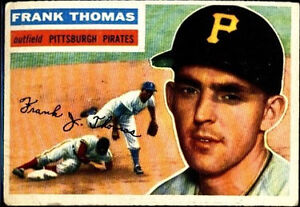
Before there was Frank Thomas--"The Big Hurt" and one of the greatest righthanded hitters of all-time--there was Frank Thomas, another righthanded slugger by the same name.
The original Frank Thomas, if you will, actually put together a pretty decent career. He came up as a center fielder with the Pirates in 1951, but before long he was a corner outfielder and ultimately a first baseman. In 1953, his first full season, he smashed 30 home runs and drove in 102. He made the All-Star team the two years after that, then again in 1958--his final season in Pittsburgh. That was the year he played third base everyday set numerous personal bests, including home runs (35), RBI (109) and OPS (.863). He finished fourth in the MVP race that year behind a trio of guys you may have heard of: Ernie Banks, Willie Mays, and Hank Aaron.
After leaving Pittsburgh (who went on to win the World Series without him in 1960), Thomas seemed to suit up for a different team every year. He spent 1959 with Cincinnati (two years before they won the pennant), 1960 with the Cubs, then got traded to the Braves early in '61. After that he joined the Mets for their inaugural season and was one of the few players to play at the major league level (34 homers and 94 RBI in his last good season). Mercifully, he was dealt to the Phillies midway through 1964, just in time for their infamous September collapse. In 1965 he was traded twice--first to the Astros, then back to the Braves--before returning to the Cubs in 1966 and finishing out his career (two years after his final game, almost to the exact day, Frank Thomas was born).
Astoundingly, he switched teams eight times and played for seven different ballclubs in his 16 years, and not once did he leave the National League. "The Big Hurt" played his first 16 seasons with one team, the Chicago White Sox, and did so in the free agent era, no less. Thomas the first wasn't a bad player, by any means, but pretty much all of his value came from his power and he never really found his natural position. Had he come along a couple decades later, he probably would have been a great DH, just like that other guy named Thomas.
The original Frank Thomas, if you will, actually put together a pretty decent career. He came up as a center fielder with the Pirates in 1951, but before long he was a corner outfielder and ultimately a first baseman. In 1953, his first full season, he smashed 30 home runs and drove in 102. He made the All-Star team the two years after that, then again in 1958--his final season in Pittsburgh. That was the year he played third base everyday set numerous personal bests, including home runs (35), RBI (109) and OPS (.863). He finished fourth in the MVP race that year behind a trio of guys you may have heard of: Ernie Banks, Willie Mays, and Hank Aaron.
After leaving Pittsburgh (who went on to win the World Series without him in 1960), Thomas seemed to suit up for a different team every year. He spent 1959 with Cincinnati (two years before they won the pennant), 1960 with the Cubs, then got traded to the Braves early in '61. After that he joined the Mets for their inaugural season and was one of the few players to play at the major league level (34 homers and 94 RBI in his last good season). Mercifully, he was dealt to the Phillies midway through 1964, just in time for their infamous September collapse. In 1965 he was traded twice--first to the Astros, then back to the Braves--before returning to the Cubs in 1966 and finishing out his career (two years after his final game, almost to the exact day, Frank Thomas was born).
Astoundingly, he switched teams eight times and played for seven different ballclubs in his 16 years, and not once did he leave the National League. "The Big Hurt" played his first 16 seasons with one team, the Chicago White Sox, and did so in the free agent era, no less. Thomas the first wasn't a bad player, by any means, but pretty much all of his value came from his power and he never really found his natural position. Had he come along a couple decades later, he probably would have been a great DH, just like that other guy named Thomas.
Subscribe to:
Posts (Atom)