Showing posts with label Yovani Gallardo. Show all posts

Friday, February 26, 2016

Orioles Get Good Deal on Gallardo

Gallardo gives the Orioles a frontline starter (MLB.com)
Just when you thought the offseason was winding down and rosters were pretty much set, the Baltimore Orioles made a last-minute splash by inking Yovani Gallardo to a two-year, $22 million deal with a $13 million option and coming oh-so-close to signing Dexter Fowler (more on that to come).

It seemed like the Orioles were content to roll out last year's team minus Wei-Yin Chen, which didn't look promising given that a) Chen was their best pitcher and b) they finished .500. But after shelling out $161 million to keep Chris Davis--more money than they'd ever paid anybody before--there wasn't much wiggle room left in their budget to upgrade elsewhere or re-sign Chen, who landed a five-year, $80 million payday from the Marlins.

In Gallardo, however, they essentially replaced Chen at a fraction of the cost. Both are 30 and have produced almost identical results since Chen made his major league debut in 2012:

Chen 2012-15: 706.2 IP 3.72 ERA 110 ERA+ 4.14 FIP 1.25 WHIP 7.0 K/9
Gall. 2012-15: 761.1 IP 3.69 ERA 108 ERA+ 3.94 FIP 1.34 WHIP 7.3 K/9

Chen's the better option because he has more strikeouts, fewer walks, and pitches from the left side, but not so much better that he deserves a substantially better contract. The Orioles shouldn't feel bad about letting him walk, as they got a great consolation prize in Gallardo.

They also have to be encouraged that Gallardo made a smooth transition to the American League last year, compiling the best raw and adjusted ERA of his career despite making half his starts in the brutal Texas heat. Camden Yards is also tough on pitchers, but that shouldn't be a problem now that Gallardo's thrived in two difficult parks to pitch in (the other being Milwaukee).

What the Orioles should be worried about, however, are Gallardo's poor peripherals. He had the worst WHIP of his career in 2015 and his xFIP was 4.31, nearly a full run higher than his ERA and also a career-worst. In addition to getting lucky on his strand and home run rates, he posted a career-low 5.9 K/9 rate--the third straight year in which his strikeout rate declined. That, combined with his pedestrian walk rate, resulted in a career-low 1.78 K/ BB ratio. Those are the numbers of a bad pitcher, not a good one earning eight figures a year.

That said, Gallardo's track record suggests he'll be a good bargain for the O's as long as he stays healthy, which has never been a problem for him in the past (he's started at least 30 games in each of the past seven years). His durability and consistently above average results (only once has he had a below-average league and park-adjusted ERA) have helped him exceed two fWAR every year dating back to 2009. That may not seem very impressive, but dollars-wise it's worth a lot. Gallardo has provided well over $11 million (his current salary) of value every year of his career but one; 2008, when he made just four starts. As long as he keeps converting half of balls put in play against him on the ground, he'll be fine (Baseball-Reference has him pegged for a 3.68 ERA in 171 innings next year).

Gallardo doesn't have the ceiling of a David Price or even a Chen, but he does have a very high floor, and that's what the Orioles are paying him for.

Tuesday, January 20, 2015

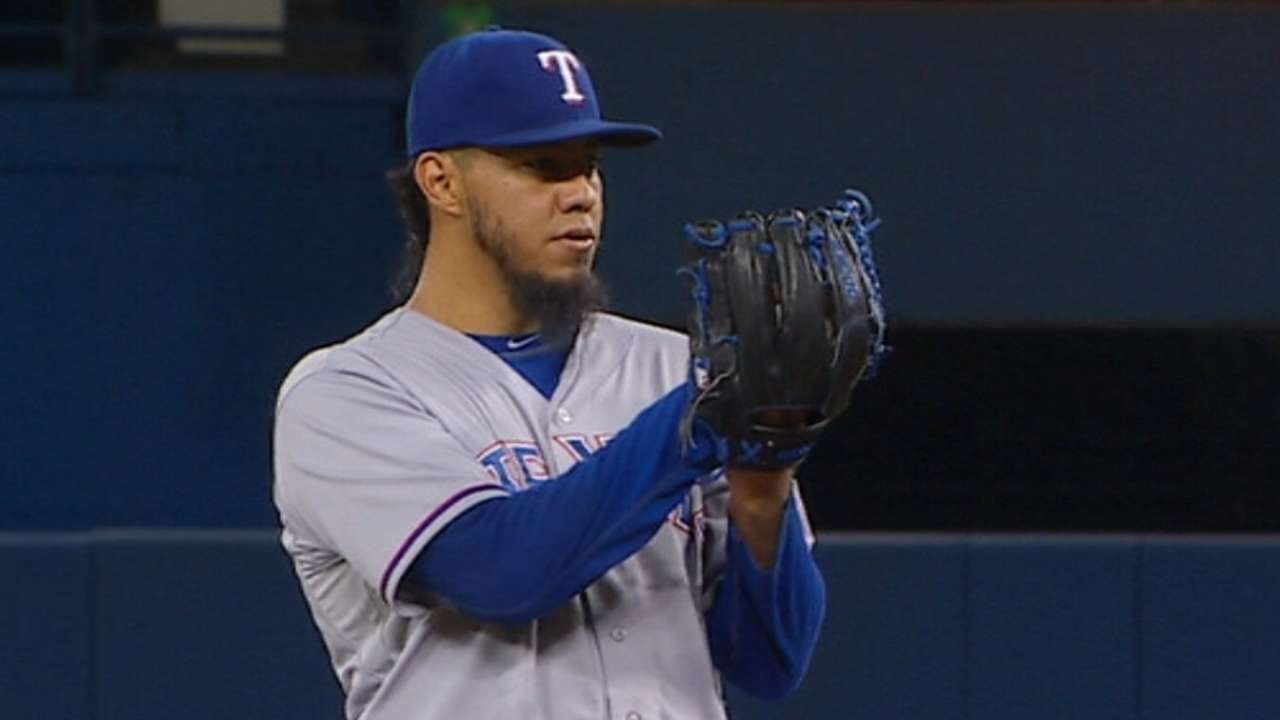
Rangers Get Gallardo

Gallardo's not good enough to survive the Texas run environment (Bases Loaded)
The Texas Rangers made their first major offseason move yesterday (seriously, it's about time), sending three players to the Milwaukee Brewers in exchange for Yovani Gallardo. The Brewers also agreed to cover $4 million of the $14 million owed to Gallardo in 2015, the final year of a five-year extension he signed back in 2010.

Gallardo, a former All-Star, has been one of the steadiest starting pitchers in baseball over the past six years. Though walks have often limited his ability to pitch deep into games, he's made at least 30 starts and completed more than 180 innings every year dating back to 2009. Gallardo's compiled a 3.73 ERA (equivalent to his FIP) during that span, putting him in the same neighborhood as Max Scherzer (3.61), James Shields (3.62), and Dan Haren (3.80).

A very promising pitcher at the start of the decade, the hard-throwing righthander never quite became the ace he was supposed to be. He settled down as a good, if occasionally frustrating pitcher; a fine number two or three but not a number one. With 16 fWAR over the last six years, he's been the 31st most valuable starting pitcher in baseball, near the likes of Matt Cain, Ricky Nolasco, and Jake Peavy.

Gallardo, who's going to be 29 this year, will have to adjust to the American League as well as an incredibly tough park for pitchers in Texas. Such a transition would be difficult for any hurler, especially one whose strikeout rate has gone into free-fall. Since peaking at 9.9 K/9 in 2009, Gallardo's whiff rate has fallen every year since then save 2012, when it remained the same as the year before. Once an elite strikeout artist who fanned at least a batter per inning every year from 2009 through 2012, Gallardo is now below average in that department after making a more concerted effort to pitch to contact, which has resulted in his averaging just seven whiffs per nine in 2013 and 2014 combined.

In spite of his waning whiff rate, Gallardo has remained effective by become more of a ground ball pitcher in recent years, as his ground ball rate has steadily risen every year since 2010 (he added a sinker to his repertoire in 2011). Last year, for the first time in his career, more than half of the batted balls he generated were on the ground. That bodes well for him moving to Texas and a new home park that turns long fly balls into homers. He'll benefit from a superior infield defense with the Rangers, who boast Adrian Beltre and Elvis Andrus on the left side of their infield as opposed to Aramis Ramirez and Jean Segura in Milwaukee, but will lose out on Jonathan Lucroy's magnificent pitch-framing capability.

So how will Gallardo fare in his American League debut? Not great, says Steamer. The projection system predicts continued regression in his strikeout rate and an uptick in his walk rate, which was a career-best 2.5 BB/9 last year. These developments, combined with a spike in home run rate, would likely drive his ERA and FIP over four. Steamer expects his ERA to rise to 4.61, more than a full run worse than his 3.51 mark a year ago. That seems a bit excessive to me, but I agree that his ERA is going to exceed his previous career-worst of 4.18 set two years ago.

Gallardo's just not a great pitcher any more, which makes him vulnerable to the hitter's park in Arlington and more formidable American League lineups. He's an average pitcher at best in this stage of his career, which qualifies as an improvement only because of how horrendous the Rangers' rotation was last year. Of the nine pitchers who started eight or more games, only one--Yu Darvish--had an ERA under 4.35. Texas desperately needed pitching help, and Gallardo will provide some, but his ERA probably won't be much better than that and is far more likely to be worse.

As such, Gallardo is a minor upgrade that won't make much difference for a team that lost 95 games last year. Obviously the Rangers need all the help they can get, and every little bit helps, but Gallardo's not going to move the needle much. The Rangers really need another ace to complement Darvish, and could have used a Jon Lester or a James Shields. Instead, they settled for mediocrity and got Gallardo.