Showing posts with label Milwaukee Brewers. Show all posts

Saturday, November 7, 2015

Ramirez Retires

Ramirez is retiring after 18 seasons (NBC Sports)
Another very good but not quite Hall of Fame level player retired recently as baseball waved goodbye to Aramis Ramirez. Ramirez joined Torii Hunter, who retired last week, in deciding to call it quits.

There are actually quite a few parallels between their careers, besides the fact that they hung up their spikes 10 days apart. Ramirez, like Hunter, finished his career where it started--Hunter with the Twins and Ramirez with the Pirates. Hunter was a lifelong American Leaguer who spent the bulk of his career in the AL Central, while Ramirez never left the NL Central.

Their career arcs are eerily similar as well, as both struggled for a few years before breaking out in 2001. After that they remained excellent players for more than a decade, aging remarkably well and putting up similar numbers year after year. Though both made multiple postseason appearances, neither ever played in a World Series, much less won one.

And just look how close their numbers are:

Hunter: 19 yrs 498 2B 351 HR 1,391 RBI 661 BB .277/.331/.461 (110 OPS+) 4,087 TB
Ramirez: 18 yrs 495 2B 386 HR 1,417 RBI 633 BB .283/.341/.492 (115 OPS+) 4,004 TB

Ramirez debuted with Pittsburgh at 19 in 1998. Predictably, his first few years were rough as he struggled to adjust to major league pitching, but in 2001 he blossomed into one of the best-hitting third-sackers in the game. In his first full season, Ramirez mashed 34 home runs, knocked in 112, and batted a robust .300/.350/.536 (122 OPS+).

Nowadays, such a season would merit serious MVP consideration, an All-Star berth, and a Silver Slugger. But back in 2001, when cartoonishly big sluggers were putting up videogame numbers, Ramirez got no recognition of any kind. That would become a troubling trend for Ramirez, long one of the game's most under-appreciated stars (except when the fans gave him a completely undeserved Hank Aaron award in 2008).

After failing to replicate those numbers in 2002 and the first half of 2003, Pittsburgh sent him and Kenny Lofton to the Cubbies for Jose Hernandez, a minor leaguer, and a player to be named later. It's trades like that which explain how the Pirates went 20 years between winning seasons.
Ramirez was just coming into his prime. He flourished in Chicago, taking advantage of Wrigley's friendly confines (where he was a career .307/.372/.551 hitter) to emerge as an annual 30-100-.300 threat. While he wasn't the most durable player, exceeding 150 games in a season just once after leaving Pittsburgh, he always hit when he did play.

After eight and a half productive years in Chicago, Ramirez signed on with the Milwaukee Brewers before the 2012 season. Following a stellar debut with the Brew Crew, he began to decline as he reached his mid-30s. With Milwaukee rebuilding and his skills eroding, the Brewers had no need for their expensive, over-the-hill third baseman.

So this year, which Ramirez had already acknowledged would be his last, Milwaukee dealt him to a resurgent Pirates franchise, giving him one last shot at World Series glory. Like most last-ditch efforts to procure a ring, this one didn't work out. Ironically, it was Ramirez's former team, the cursed Cubs, that got in the way. In what would be the last at-bat of his career, Ramirez grounded into an inning-ending double play. Somehow, that seems appropriate.
Circling back to Hunter, Ramirez also fell short of a few big milestones. He ends his career 14 homers shy of 400, five doubles short of 500, and 83 RBI away from 1,500. Even so, his numbers are outstanding for a third baseman; he ranks 10th in the position for home runs, doubles, and RBI.

The three-time All-Star never quite got the credit he deserved for being such a tremendous hitter year-in and year-out, probably because he was playing in the shadow of superior third basemen such as Alex Rodriguez, David Wright, Chipper Jones, and Adrian Beltre. In terms of career offensive production at the position, however, few were ever better. 

Tuesday, January 20, 2015

Rangers Get Gallardo

Gallardo's not good enough to survive the Texas run environment (Bases Loaded)
The Texas Rangers made their first major offseason move yesterday (seriously, it's about time), sending three players to the Milwaukee Brewers in exchange for Yovani Gallardo. The Brewers also agreed to cover $4 million of the $14 million owed to Gallardo in 2015, the final year of a five-year extension he signed back in 2010.

Gallardo, a former All-Star, has been one of the steadiest starting pitchers in baseball over the past six years. Though walks have often limited his ability to pitch deep into games, he's made at least 30 starts and completed more than 180 innings every year dating back to 2009. Gallardo's compiled a 3.73 ERA (equivalent to his FIP) during that span, putting him in the same neighborhood as Max Scherzer (3.61), James Shields (3.62), and Dan Haren (3.80).

A very promising pitcher at the start of the decade, the hard-throwing righthander never quite became the ace he was supposed to be. He settled down as a good, if occasionally frustrating pitcher; a fine number two or three but not a number one. With 16 fWAR over the last six years, he's been the 31st most valuable starting pitcher in baseball, near the likes of Matt Cain, Ricky Nolasco, and Jake Peavy.

Gallardo, who's going to be 29 this year, will have to adjust to the American League as well as an incredibly tough park for pitchers in Texas. Such a transition would be difficult for any hurler, especially one whose strikeout rate has gone into free-fall. Since peaking at 9.9 K/9 in 2009, Gallardo's whiff rate has fallen every year since then save 2012, when it remained the same as the year before. Once an elite strikeout artist who fanned at least a batter per inning every year from 2009 through 2012, Gallardo is now below average in that department after making a more concerted effort to pitch to contact, which has resulted in his averaging just seven whiffs per nine in 2013 and 2014 combined.

In spite of his waning whiff rate, Gallardo has remained effective by become more of a ground ball pitcher in recent years, as his ground ball rate has steadily risen every year since 2010 (he added a sinker to his repertoire in 2011). Last year, for the first time in his career, more than half of the batted balls he generated were on the ground. That bodes well for him moving to Texas and a new home park that turns long fly balls into homers. He'll benefit from a superior infield defense with the Rangers, who boast Adrian Beltre and Elvis Andrus on the left side of their infield as opposed to Aramis Ramirez and Jean Segura in Milwaukee, but will lose out on Jonathan Lucroy's magnificent pitch-framing capability.

So how will Gallardo fare in his American League debut? Not great, says Steamer. The projection system predicts continued regression in his strikeout rate and an uptick in his walk rate, which was a career-best 2.5 BB/9 last year. These developments, combined with a spike in home run rate, would likely drive his ERA and FIP over four. Steamer expects his ERA to rise to 4.61, more than a full run worse than his 3.51 mark a year ago. That seems a bit excessive to me, but I agree that his ERA is going to exceed his previous career-worst of 4.18 set two years ago.

Gallardo's just not a great pitcher any more, which makes him vulnerable to the hitter's park in Arlington and more formidable American League lineups. He's an average pitcher at best in this stage of his career, which qualifies as an improvement only because of how horrendous the Rangers' rotation was last year. Of the nine pitchers who started eight or more games, only one--Yu Darvish--had an ERA under 4.35. Texas desperately needed pitching help, and Gallardo will provide some, but his ERA probably won't be much better than that and is far more likely to be worse.

As such, Gallardo is a minor upgrade that won't make much difference for a team that lost 95 games last year. Obviously the Rangers need all the help they can get, and every little bit helps, but Gallardo's not going to move the needle much. The Rangers really need another ace to complement Darvish, and could have used a Jon Lester or a James Shields. Instead, they settled for mediocrity and got Gallardo.

Thursday, May 1, 2014

April Awards

May is here, which means the first month of baseball is in the books. Thus, it's time to hand out some awards.

American League
Player of the Month-Jose Bautista
Joey Bats is back. The slugging rightfielder drew 30 walks last month, most in baseball, to fuel his AL-best .467 OBP and 1.065 OPS. He also went yard eight times, tying Jose Abreu and Justin Upton for the best AB/HR ratio in the sport, scored 24 runs, and reached base more times than any player in baseball.

Pitcher of the Month-Masahiro Tanaka
The highly touted Japanese rookie has been even better than anticipated for the Yankees, asserting himself as the ace of New York's staff. His 2.27 ERA, 2.96 FIP and 0.93 WHIP are all superb, as is his 11.6 K/9 rate and 7.67 K/BB ratio. He's pitched at least seven innings in four of his five starts (all of which have produced a Game Score better than 60) and recorded double digit strikeouts three times. The Yankees have to be satisfied with the early returns on their seven-year, $155 million investment.

Rookie of the Month-Jose Abreu
What a month it was for Abreu, who surpassed Albert Pujols' rookie records for home runs and RBI in the month of April, finishing with 10 and 32, respectively--most in the majors. The Cuban slugger also leads the sport in total bases, AB/HR ratio, and extra base hits, plus has the best slugging percentage in the American League.

Team of the Month-Oakland A's
Led by its dominant pitching staff and potent offense, Oakland rolled to an 18-10 record in April behind the best run-differential in the sport, putting them three wins ahead of every other American League team. Strong starts from Sonny Gray, Scott Kazmir, and Jesse Chavez have picked up the slack for A.J. Griffin and Jarrod Parker (lost for the season), helping Oakland maintain the league's lowest ERA. The lineup, which leads all of baseball in walks and has the second-highest OBP, has been boosted by Josh Donaldson, Jed Lowrie, Coco Crisp, Yoenis Cespedes, and Brandon Moss. The two-time defending AL West champs once again find themselves at the top of the standings and have put themselves in good position to three-peat.

National League
Player of the Month-Troy Tulowitzki
Tulo batted a scorching hot .364/.477/.727 in April to finish the month with the sport's highest OBP, SLG, OPS, and second best batting average (behind teammate Charlie Blackmon). The NL runs scored leader is also tops in bWAR, OPS+. and runs created. He's a big reason why the Rockies are tied with LA for second place in the NL West right now.

Pitcher of the Month-Johnny Cueto
Cincinnati's ace leads both leagues in ERA (with a microscopic 1.15) and innings pitched, as well as complete games, ERA+, and H/9. He also has a 0.77 WHIP, 3.57 K/BB ratio and is striking out more than a batter per inning. He's allowed just six runs in his six starts, all of which have lasted at least seven innings, and his average Game Score thus far is a 76.

Rookie of the Month-Chris Owings
Not a whole lot of NL Rookies contributing right now. Arizona's 22 year-old shortstop is batting a solid .313/.367/.398 with five doubles and four stolen bases. Along with Paul Goldschmidt and Mark Trumbo, he's one of the few bright spots on a disastrous Diamondbacks team.

Team of the Month-Milwaukee Brewers
The Brew Crew boast the best record in baseball at 20-8, largely thanks to their lights-out starting pitching and stellar bullpen work. Four of their five starting pitchers have ERAs below 2.90 (newcomer Matt Garza, at an even 5.00, is lagging behind) with Yovani Gallardo, Kyle Lohse, Marco Estrada and Wily Peralta all pitching like aces. The bullpen's been even better; backed by a perfect Francisco Rodriguez (0.00 ERA in 16 appearances) and near-perfect Tyler Thornburg (0.61 in 14), Milwaukee's 'pen has a 2.45 ERA, 1.04 WHIP and 4.12 K/BB ratio. Offensively, the Brewers are getting production from multiple sources. Ryan Braun and Carlos Gomez are off to MVP-caliber starts, and they're getting plenty of help from Aramis Ramirez, Jonathan Lucroy, and Mark Reynolds.

Wednesday, April 16, 2014

Appreciating Aramis Ramirez

Ramirez is congratulated after his solo home run last night (BeaumontEnterprise)
The Milwaukee Brewers, as you may have heard, are off to a fabulous start. They won nine games in a row before falling to the St. Louis Cardinals Monday (and again last night). At 10-4 they have the best record in baseball (tied with Oakland), and everyone's wondering if this is merely an early season fluke or the first step towards contention for a team that lost 88 games last year and barely finished above .500 the year before.

So with the Brewers firing on all cylinders, I decided not to write about lightning rod Ryan Braun, or likely MVP candidate Carlos Gomez, or up-and-comers Khris Davis/Jean Segura, or the starting rotation, or Francisco Rodriguez. I wanted to talk about Aramis Ramirez for a minute.

The 35 year-old third baseman has been one of the main driving forces behind Milwaukee's early surge. He's played all 14 games thus far and has done his job as the team's cleanup leader, leading the Brew Crew with 12 RBI and driving in at least one run in ten games (eight of which were victories). He's also batting a scintillating .351, which leads the team as well.

And yet nobody seems to talk about Ramirez. He's made only two All-Star teams and has received only one Silver Slugger, which is strange considering he's one of the best-hitting third basemen of all-time. He has more home runs (356) than all but a dozen third basemen, including Dick Allen, Ron Santo, and George Brett. He ranks twelfth in doubles (443--more than Mike Schmidt) and has knocked in more runs (1,288) than Edgar Martinez, Matt Williams and Ken Boyer. His .501 career slugging percentage ranks 11th at the position, just a hair below the .509 career marks of Harmon Killebrew and Eddie Mathews.

(Quick tangent--for reasons I still don't understand, Ramirez was given the NL Hank Aaron Award, which honors the most outstanding offensive performer in each league, in 2008. While his season was very good--.289//380/.518, 27 homers, 111 RBI, 44 doubles--nothing about it qualifies as outstanding. How the award didn't go to Albert Pujols (1.114 OPS) or Ryan Howard (48 home runs, 146 RBI) or Lance Berkman (.986 OPS) is beyond me.)

If he can hang on a few more seasons, Ramirez will likely finish his career with around 500 doubles, 400 home runs, and 1,400 to 1,500 RBI, which, combined with his solid rate stats (.286/.345/.501), would make him one of the ten best offensive third basemen to ever play the game.

He's done so by quietly and consistently producing great numbers for over a decade, first with Pittsburgh, then with the Cubs, now with the Brewers. Starting in 2001, when he was just a 22 year-old kid with the Pirates who batted .300/.350/.536 with 34 home runs, 112 RBI, 40 doubles and 323 total bases, he's averaged 26 home runs and 93 RBI per season. During that span, he hit more home runs and piled up more RBI than any third baseman besides Alex Rodriguez (who was a shortstop until 2004) and Miguel Cabrera (who spent a lot more time at other positions, namely first base and outfield).

In that same span, Ramirez batted over .300 seven times. He topped 25 home runs ten times, exceeding 30 on four occasions. He had seven seasons with at least 100 RBI. He surpassed 30 doubles nine times, clubbing as many as 50 in 2012, when he led the league (his only meaningful black ink, unless you like sacrifice flies, in which case Ramirez was tops in 2002 and 2003). His OPS+ has been over 120 ten times.

(What impresses me most about Ramirez is that in this era of free-swingers, he's had only one season with triple digit strikeouts--100 on the nose in 2001).

Whenever Ramirez has fallen, he always comes back just as strong as before. When he nosedived in 2002 (to a woeful .666 OPS) following his breakout season, be bounced back with 27 home runs and 106 RBI in 2003. When he missed the final 35 games of 2005 with a strained quad, Ramirez rebounded with arguably the best season of his career in 2006 (career high 38 home runs, 119 RBI, and 333 total bases). When his career looked like it was headed south in his early 30s after he missed half of 2009 and slumped in 2010, he revived his bat like fellow Dominican David Ortiz and hit as well as he ever did.

Now in his age-36 season, he's proving he still has something left in the tank after missing 70 games last year. Like always, he's returned to form in the wake of a setback. The resilient Ramirez is doing what he's always done: hit.

Friday, June 14, 2013

Gomez Getting No Love

Gomez belongs in the discussion of baseball's best players
According to Baseball-Reference and FanGraphs, Carlos Gomez has been the most valuable player in baseball this year. More valuable than Miguel Cabrera, Chris Davis, and Joey Votto. A five tool stud, Gomez leads the majors in triples, plays excellent defense in center field, and runs the bases well. In fact, he's on his way to posting almost identical numbers to the ones another great centerfielder--a young man by the name of Mike Trout--compiled last year:

Trout's 2012:   129 runs  182 hits  27 doubles  30 home runs  83 RBI  49 steals .326/.399/.564
Gomez's pace: 103 runs  191 hits  37 doubles  27 home runs  88 RBI  32 steals .326/.366/.594

But even with Gomez doing his best Trout impersonation, the Milwaukee Brewers have been terrible. Poor pitching has sunk them 11 games below .500 with only half a game separating them from the Chicago Cubs and last place in the NL Central.

Because of their struggles (and, to some degree, his unimpressive track record) Gomez isn't getting the attention his stellar first half deserves. Accordingly, he's getting shafted in the All-Star voting. Among National League outfielders he ranks twelfth (!) behind guys like Hunter Pence (6th), Angel Pagan (9th), Matt Holliday (10th) and, worst of all, Gregor Blanco (11th).

Pence (2.7 bWAR) has been good this year--much better than he was last year--but not better than Gomez. Angel Pagan should change his name to "Average" Pagan with his 99 OPS+ and 0.0 bWAR. Holliday's having the worst season of his career. And then there's Blanco, who has yet to hit a home run this season and slugging a pitiful .358.

Give me a break. Gomez will make the team as a reserve, but he deserves to start. Instead, he's going to have to settle for being the other Brewers outfielder (the one not named Ryan Braun) at this year's Midsummer Classic.

But after playing six seasons in relative obscurity, the 27 year-old should be used to flying under the radar. Signed out of the Dominican Republic at 16 and promoted to the Show at 21, Gomez stalled out in the majors when his power failed to develop. His speed was evident from day one, when he outraced Jose Reyes in spring training, but he frustrated the Mets, Twins, and Brewers by producing just 30 home runs and a sub-.300 OBP in his first 1,875 big league plate appearances.

Then, halfway through last year, something clicked. From July 23rd onward, he mashed 14 homers and stole 22 bases (getting caught just three times). He also struck out six times as often as he walked over the same stretch; hardly a recipe for success. Gomez appeared to be another B.J. Upton in the making, but instead he's elevated himself into baseball's elite.

So what's driving his MVP-level performance? The first thing that jumps out his is BABiP, which has skyrocketed 80 points from .296 last year to .376 this season. The rest of his peripherals haven't changed much from 2012 His walk rate has remained the same, and he's striking out a little less.  His contact rate and line drive rate are up a bit, and he's not popping up as much.

What we're seeing is an excellent all-around player finally putting it all together, like Matt Kemp did in 2011 and Andrew McCutchen did last year. He's taking the leap to stardom, even if few people outside Milwaukee seem to notice or care.

Saturday, March 30, 2013

Kyle Lohse Finds a Home

After months of hand-wringing, Kyle Lohse has finally found a home just in time for Opening Day. Lohse landed a three-year, $33 million deal from the Milwaukee Brewers. The Brewers hope he can help anchor a pitching staff that finished near the bottom of the league last year.

Lohse, who is represented by Scott Boras, didn't find a long line of suitors willing to overpay him for a career year. Though plenty of teams displayed interest in him, he refused to sign a one-year deal because he wanted to match or exceed Ryan Dempster's reasonable contract (two years, $26.5 mil from Boston).  Call me crazy, but I don't see how a man who's gone 30-11 over the past two seasons with a 3.11 ERA, 1.12 WHIP and 3.18 K/BB ratio had to wait until the week before Opening Day to secure a job. Surely someone out there could use a pitcher like that.

At 34 he's a bit on the old side, but he doesn't have quite as much mileage on his arm as fellow 34 year-olds Barry Zito, Johan Santana and Mark Buehrle. He doesn't strike many guys out, but neither does Tim Hudson. He doesn't have much of an established track record, but that didn't stop C.J. Wilson from signing a five-year, $77.5 million dollar deal. Lohse may not be the ace his statistics suggest he is, but he's a great rotation stabilizer behind Yovani Gallardo with an uncanny ability to limit his mistakes and locate his pitches. Lohse finds a way to overachieve and is a lot like Ryan Vogelsong in that sense.

I get that he has red flags, like BABiPs that are screaming to be corrected, but which pitcher doesn't? CC Sabathia, Roy Halladay and Felix Hernandez have all taken on big workloads. Stephen Strasburg's mechanics makes him seems like an injury waiting to happen. Tim Lincecum, Josh Beckett, and Jon Lester have all lost some zip on their fastballs. Starting pitchers are inherently a risky bunch, but the hate with Lohse went too far. At worst, he's merely an average starting pitcher/mid-rotation innings eater. At best, he's All-Star caliber hurler worthy of Cy Young consideration. What's so bad about that?

He's not a difference-maker but still amounts to a nice addition for Milwaukee. He looked good in his first start of the spring on Thursday and should be good to go in two weeks. His first start will likely come against the St. Louis Cardinals, his former team, the weekend after next.

Friday, September 14, 2012

Brewers, Phillies Rise from the Dead

For much of the summer, the Milwaukee Brewers and Philadelphia Phillies were considered major disappointments, and rightly so.  After winning their respective divisions a year ago both teams carried losing records deep into the summer.  At the end of July they were sellers in a buyer's market and found ways to unload some of their established talent.  The Brewers shipped former Cy Young winner Zack Greinke to the Angels and Philadelphia parted ways with Joe Blanton plus All-Star outfielders Shane Victorino and Hunter Pence shortly after re-upping Cole Hamels. With their underachieving teams in ruins, both clubs seemed to be waving the white flag.

Six weeks later, they've somehow managed to claw their way back to .500 (Milwaukee is 72-71, Philly is 72-72).  They're closing in on St. Louis (76-68) for the league's second wild card spot, and one of them could wind up making the playoffs if they maintain their torrid pace for three more weeks.

How the hell did that happen?
On Friday the (July) 13th, Philadelphia began the second half at Coors Field with a 6-2 loss to the woeful Colorado Rockies.  Cliff Lee surrendered nine hits while Colorado's Christian Friedrich stymied a Phillies lineup featuring Jimmy Rollins, Chase Utley, Ryan Howard, Carlos Ruiz, Placido Polanco, and the aforementioned duo of Pence and Victorino. The defeat represented Philly's fifth loss in a row, the eleventh in their past twelve, and it dropped them to 37-51 on the season.  A top heavy team that had adopted a stars and scrubs approach, constructed around a nucleus of aging superstars, had been ravaged by injuries and slumps to many of its key contributors (sound familiar, Red Sox fans?).  They were dead.

Except they weren't.  Since then, Philly has gone 35-21 despite continuing to field a lineup that is average at best (losing Pence and Victorino didn't help). They've scored in double digits just once since the beginning of June and lack the firepower necessary to build up big leads.  Every game they play is a tightly contested affair.  Most nights, they barely scrape together enough runs to win.

So if their unlikely resurrection hasn't been fueled by hot hitting, then the answer must lie in improved pitching. As a whole, Charlie Manuel's staff has trimmed its ERA by nearly a full run in the second half. The rotation has benefited from Cliff Lee and Roy Halladay returning to form, supplementing the success of Hamels, Kyle Kendrick and Vance Worley. The other major turnaround came within the bullpen, which has gone from lackluster to dominant in the span of two months.  Philly's relievers went 9-16 with a 4.76 ERA and 1.38 WHIP (essentially Ricky Nolasco) in the first half but are 12-8 with a 3.14 ERA and 1.17 WHIP so far in the second (similar to Hiroki Kuroda) while upping their K rate by more than two batters per nine innings. The team's biggest weakness and fatal flaw has become its main strength. But then again, the pitching was supposed to be good, so it was only a matter of time before they all got on a roll.
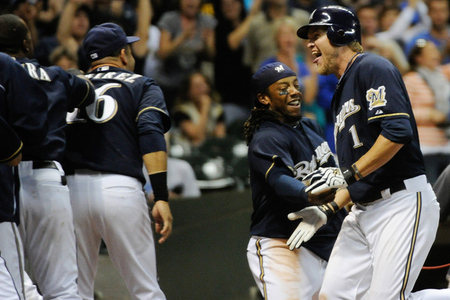
As for the Brewers, their renaissance has taken a different path.  On August 15th, the Rockies bested the Brew Crew 7-6, to cap off a three game sweep at Coors Field.  The Brewers fell to 52-64 on the season, a dozen games below .500 with six weeks to play.  At that point, most teams would have admitted that it just wasn't their year and mailed it in. Call up the reserves in September and start playing for next year.  But the Brewers didn't see it that way.  They looked at their soft schedule, saw a golden opportunity and seized it by the throat.  During the last month Milwaukee has gone 20-7, making the most of their 17 game stretch from August 20th through September 6th in which they played three slumping teams; the Chicago Cubs, Pittsburgh Pirates, and Miami Marlins. The Brewers have lost consecutive games just once--back-to-back losses against Philadelphia over the weekend of August 18th/19th--but have won two or more games seven times and were practically unbeatable at home (11-2), where they've swept the Cubbies, Bucs, and Braves.

The Brewers boast the best lineup in the National League and have feasted off opposing hurlers all season long.  Despite losing Prince Fielder to the Detroit Tigers via free agency, their powerful offense leads the Senior Circuit in runs scored, home runs, and total bases (with so much pop, you'd think they be a station-to-station offense that stands around waiting for somebody to crank a home run, but they're not.  Manager Ron Roenicke is aggressive on the basepaths; his team rates second in the NL in steals). After a quick glance at the starting nine, it's easy to see how Milwaukee's bats have been so prolific.  Ryan Braun is putting together another MVP-caliber season.  Free agent addition Aramis Ramirez has rebounded from a slow start to post his typically strong all-around numbers.  Corey Hart needs just three big flies for his second 30 homer season since 2010.  Backstop Jonathan Lucroy has produced on par with Buster Posey when healthy.  Outfielders Carlos Gomez and Norichika Aoki have been productive.  Even Rickie Weeks, who's looked utterly lost at the plate this year, is salvaging his season with a torrid September.  Top to bottom, this lineup is stacked with heavy hitters. It's been even better in the second half, averaging nearly 5.5 runs per game while seeing a 58-point improvement in their OPS compared to the first half.

So scoring runs isn't an issue for the Brewers, but preventing them is (In this sense they remind me of the 2004 Red Sox before the Nomar Garciaparra trade; they can hit with the best of them, but streaky pitching and abysmal glove work have prevented them from taking off). Their defense is brutal; bringing in Alex Gonzalez to man shortstop couldn't cure that.  Their inefficiency in the field makes the pitching look worse than it is, but the arms have endured their own set of problems, too. The bullpen has been a mess all season long, primarily because John Axford and Francisco Rodriguez have struggled in the late innings--that explains why Milwaukee is just 23-29 in one-run games.  The rotation is solid and has soldiered on without Greinke and Randy Wolf (released), but lacks consistency. Yovani Gallardo and Marco Estrada have been lights out lately, but Mike Fiers and Shaun Marcum are slumping.  If the Brewers are going to have any shot of sneaking into the playoffs this year, the bullpen will need to step up.  Every win counts, and they can no longer afford to lose close games by one run.

After digging themselves in such deep holes early on, the recent surges by both teams will most likely be too little, too late.  There are still substantial challenges to overcome as the season draws to a close, and these roadblocks may prove insurmountable. The Phillies have three more games in Houston (piece of cake), but from then on out they play all their games against their NL East rivals; three each with the New York Mets, Atlanta Braves, and Miami Marlins, but six against the Washington Nationals, who have the best record in baseball and are closing in on 100 wins.  The hope is that with division all but wrapped up, Davey Johnson may begin resting his regulars/aligning his starting rotation as the postseason approaches.  Philadelphia is a combined 10-20 against the Mets and Braves this year, so those match-ups could spell trouble as well.  Expect the Brewers to continue to roll against New York and Pittsburgh, but their ten game road trip looms large for a team that has a .394 winning percentage away from home.  To make matters worse, seven of those games are against the red-hot Reds and Nats.  But if Milwaukee somehow survives that challenge with their playoff chances intact, they can look forward to six cushy games at home against the Astros and Padres to close out the season.

I don't think either one gets in.  The odds aren't on their side; coolstandings.com gives Milwaukee a 6.7 percent chance of reaching the postseason and the Phillies are even bigger long-shots with just a 2.7 percent likelihood.  But they're still breathing.  They're not out of the race.  They still have a chance and, given where they stood a month ago, that is nothing short of miraculous.

I guess the real question is; do you believe in miracles?

Tuesday, December 13, 2011

Brewers Buy New Left Side of Infield

In 2011. Milawaukee managed to come within two wins of a World Series berth despite playing a massive black hole  in the left side of their infield.  Yuniesky Betancourt manned short, and somehow managed to get penciled in for 152 games while owning an underwhelming .271 on base percentage and .381 slugging percentage, numbers completely unacceptable for a player who isn't Ozzie Smith in the field (and Betancourt is an average defensive shortstop at best).  Luckily for him, he redeemed himself in October by hitting .310 with fove extra base hits and 13 runs+RBI over 11 games to give the Brewers some return on his $4.3 million paycheck before skipping town as a free agent.  And while his teammate at the hot corner, Casey McGehee, only made one tenth of that, he struggled even more.  Afer enjoying a nice breakout in 2010 with 23 home runs, 104 RBI and 38 doubles, McGehee fell apart in 2011.  His walk and strikeout rates held steady, but he regressed in every other category and actually cost the Brew Crew a win with his meager .223/.280/.346 rates in 155 games.  Not surprisingly, he rode the pine during the postseason while midseason import Jerry Hairston Jr. took over, denying the incumbent third sacker the chance to make up for his brutal season.

Things haven't gotten much better for the Brewers since they were eliminated from the NLCS: slugging first baseman Prince Fielder hit the open market and franchise player/NL MVP Ryan Braun failed a drug test, meaning he could face a 50 game suspension in 2012.  So Milwaukee needed some help, and yesterday they made two moves to bolster the left side of their infield.  They signed one-time All Star Alex Gonzalez to play short on a one year deal with an option for 2013.  Even though the journeyman will turn 35 in a few months and his on base skills are just as bad as Betancourt's, he's much more reliable in the field and is a safe bet to replicate his predecessor's 15 long balls.

So while the sure-handed Venezuelan marks a slight upgrade over Betancourt, he pales in comparison to Milwaukee's newest addition, Aramis Ramirez.  A-Ram has bashed all of his 315 career big flies during his 14 year career in the NL Central with the Pirates, Cubs, and now the Brewers, for whom he provides a legitimate middle of the order bat.  His durability is always a concern (he's appeared in more than 150 games just twice during the past ten seasons), he's a defensive liability and at 33 the two-time All Star is no spring chicken, but when healthy he's a top five third baseman who can threaten 30-100-.300 in his sleep.  Ramirez undoubtedly benefitted from playing half his games at Wrigley Field, but his career numbers in Milwaukee project to a 50 double, 30 homer, 120 RBI season, which the Brewers will take everyday and twice on Sundays.  He can't replace Fielder, but unless you have Evan Longoria or Adrian Beltre you can't get much more out of your third baseman.

Ramirez expects the reigning NL Central champs to contend again next year, but he'll have to be at the top of his game in order for that to happen.  Milwaukee can't afford another disappointing year from its third baseman.