Showing posts with label 1970s. Show all posts

Thursday, January 1, 2015

Garvey Good Enough for Hall?

Garvey almost never took a day off (RantSports)
Steve Garvey accomplished a lot during a productive career that spanned almost two decades. He made 10 All-Star teams, won four Gold Gloves, and set the National League record for most consecutive games played (1,207). He won an MVP award and finished runner-up one other time, won a World Series and played in four others. He was durable, hit for high averages, and starred in several postseasons (.910 OPS in 55 playoff games). He hit for power, he drove in runs, and he was a smooth first baseman, all while maintaining a squeaky-clean image on the field and off.

No wonder they called him Captain America.

But despite all the accolades, all the awards and big hits and West Coast glamor, despite his immense popularity and movie-star looks and middle-of-the-order presence, despite his many Midsummer Classic and Fall Classic appearances, Steve Garvey is not in the Hall of Fame, nor should he be. 15 times he was on the writer's ballot, and 15 times the BBWAA said no.

In 2013 he was given another chance at induction via the Expansion Era Committee, and once again he did not receive the necessary votes. When I reviewed his case then, I concluded he was not Hall of Fame worthy, something I stand by today.

A good place to start is his career WAR total, which Baseball-Reference and FanGraphs both place at just under 38. That's way below the 60 usually needed to even be in the conversation for Cooperstown, and very weak considering he played in 2,337 games and compiled nearly 9,500 plate appearances. It's less than fellow first basemen Mark Grace, Dolph Camilli, and Bill White, all players who clearly fall short of the Hall's standards. Ditto Fernando Valenzuela and Carl Furillo, the two Dodgers he falls between for career bWAR. As far as I can tell, the only first basemen to be elected with fewer WAR are Jim Bottomley and High Pockets Kelly, both flawed Veteran's Committee selections. WAR also says Garvey was never the best player on his team.

Even if WAR's not your cup of tea (it's not, nor should it be, the end-all be-all method of player evaluation), Garvey still falls short by other metrics. His Black Ink score, which measures how frequently he led the league in something, is 12, well below the established HOF score of 27. His Gray Ink, which scores how often a player appears in the top 10, is closer but still falls short. And by Hall of Fame standards, which sets the bar at 50 for an average Hall of Famer, Garvey is well-shy at 32. He does pass the Hall of Fame monitor (which assesses the likelihood a player makes the Hall, not his worthiness), with his 130 score indicative of a "virtual cinch," but one out of four (six including JAWS and Hall of Stats) ain't too good.

Don't like those metrics? Okay then, but know that Garvey never slugged .500 in any of his 19 seasons, and never had an OBP above .365. He never led the league in home runs, RBI, total bases, OPS, or any meaningful statistic besides hits (twice), games played (seven times), double plays grounded into (twice), and sacrifice flies (once). He never scored 100 runs, clubbed 40 doubles, legged out 10 triples, smacked 35 home runs, or stole 20 bases in any season.

Sure, Garvey got loads of hits--2,599 of them, in fact--but hardly ever walked. Only once did he work even 50 walks in a season, and it was 50 on the nose. He only had one other season with as many as 40, and again it was 40 on the nose. His career walk rate barely cracked five percent (the league average is around 8.5), and when you subtract out his 113 intentional walks (which account for nearly one-quarter of his 479 career walks) that rate plummets below four percent. So really, Garvey wasn't even half as good as the average played at working a walk.

As such, Garvey's career on-base percentage is shockingly bad for someone who almost batted .300 for his career. At .329 it's better than average, but not by much.

Garvey also didn't hit for much power. He only had the one season with more than 30 home runs and managed just 272 for his career, or one every 32.5 at-bats. He hit a good number of doubles, but overall his pop barely stood above league average; his .152 ISO isn't much better than usual league average of .140.
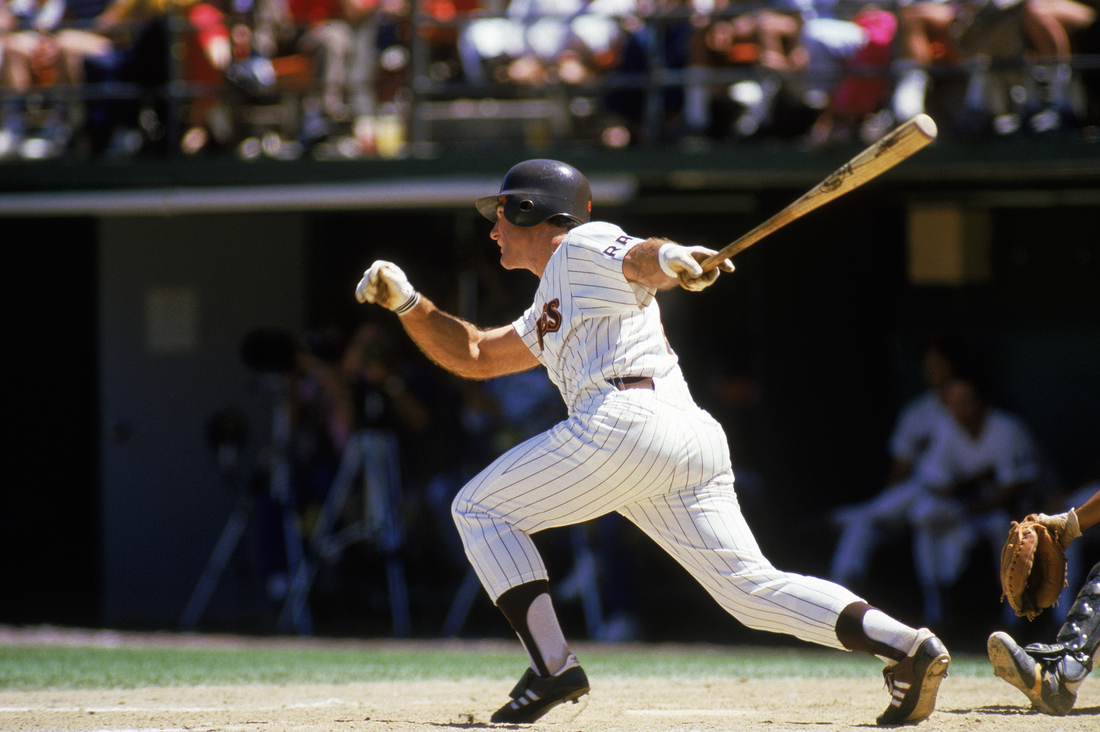
Garvey pictured here with the Padres, with whom he finished his career (SBNation)
Consider that from 1974-1980, when Garvey was at his absolute best, he wasn't even one of the 20 most valuable position players in baseball. He was never one of the NL's five most valuable position players, and only twice cracked the top 10. He did not deserve that 1974 MVP, an award that should have gone to Mike Schmidt or Joe Morgan or Johnny Bench.

By overrated, flawed statistics, Garvey does well. He has lots of hits, RBI, and a high batting average. But in the statistics that really matter--WAR, OPS, runs created--he fares poorly.

Still, it crossed my mind that the voters may have actually undervalued Garvey. He was a righthanded hitter who spent his entire career in pitcher's parks, at a time when the game very much favored pitchers and speed. But his time on the BBWAA ballot coincided with the crazy offensive environment of the Steroid Era, which no doubt made his numbers seem less impressive. It's weird that he debuted with 41.6 percent of the vote and then stalled out, gradually losing support over the years and finishing up with a mere 21.1 percent of the vote in his last year of eligibility. The proliferation of advanced metrics in the early 2000s couldn't have helped his case either.

Sure enough, Garvey's neutralized numbers look much better. His career batting line rises to .306/.343/.463, giving him a 31 point boost in OPS. He has more than 2,800 hits and 1,300 runs, nearly 500 doubles, 300 long balls, and 1,500 RBI. If those were Garvey's actual numbers, I think he might have made it in. Then again, those are Dave Parker numbers, so maybe not.

I'm still saying no to Garvey, though. A first baseman needs great offensive statistics to be Hall of Fame-worthy, and Garvey's resemble more of a really good shortstop's like Derek Jeter or Alan Trammell. Garvey was a nicely packaged ballplayer with good longevity and a solid peak, but didn't do enough of anything to stand out. He didn't hit for enough power, get on base frequently enough, run well enough, or play good enough defense to earn a trip to Cooperstown. He was a lot like Gil Hodges--another classic borderline case and superb all-around first baseman for the Dodgers--only Hodges was better.

Hodges has waited over 50 years for Cooperstown to call his name, and at this point I'm starting to think it never will. Garvey, who never polled as high as Hodges, is an even greater longshot. His place in the Hall of Very Good is secure, but I'll be shocked if he ever sees his day in Cooperstown.

Monday, December 29, 2014

Questionable Rookies of the Year: 1970s

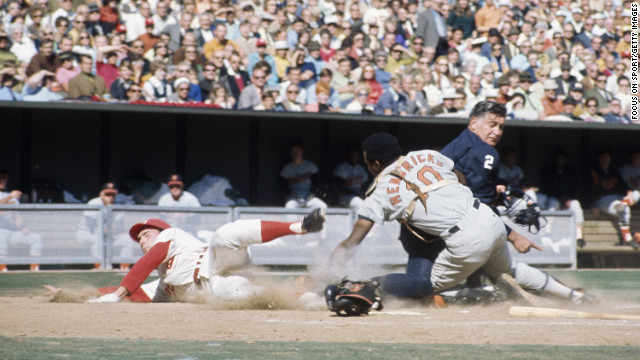
Carbo (left) was robbed despite a monster offensive season (CNN)
1970 NL Carl Morton over Bernie Carbo
Morton made a strong first impression by hurling 284 and 2/3 innings and winning 18 games, but those innings weren't ultra-high quality. He led the league in walks, had a 1.43 WHIP, posted a 114 ERA+, and only struck out 29 more guys than he walked. Carbo, on the other hand, was one of baseball's best hitters on a per-game basis. Besides batting .310/.454/.551 (164 OPS+), Carbo also clubbed 21 home runs, stole 10 bases, and walked 17 times more often than he struck out. Given the depressed offensive environment, Carbo's season (a 1.004 OPS!) was much more impressive and worthy of the award. He also played a key role in helping the Reds win the National League pennant.

1971 AL Chris Chambliss over Bill Parsons
Chambliss would go on to have a fine career, but his rookie season was actually very mediocre, (0.4 bWAR). His nine homers, 48 RBI, and .749 OPS (104 OPS+) were pedestrian for a first baseman. Runner-up Bill Parsons, who compiled a 3.20 ERA over 244 and 2/3 innings, was valued at 3.1 bWAR and would have been my pick.

1976 NL Butch Metzger over Pat Zachry
This one went down as a tie but was a clear foul-up, as Zachry deserved to win outright. For reasons unexplained, voters failed to choose a very good starting pitcher over a decent reliever. Zachry had a superior ERA and WHIP while pitching over 80 additional innings. This disparity was evident in their bWAR totals, as Zachry compiled 3.5--two more than Metzger's 1.5. Zachry also pitched for the World Series-winning Cincinnati Reds, which should have gone in his favor.

1977 AL Eddie Murray over Mitchell Page
Murray wound up with the best career of the 1977 rookie class, but he was not the best rookie in the American League that year. Page, who batted .307/.405/.521 (154 OPS+) with 21 home runs and 42 steals in 47 attempts, was. His raw OPS was 123 points higher than Murray's, which more than made up for the fact that Murray appeared in 15 additional games and logged 110 additional official at-bats. At 6.0 bWAR, Page was nearly twice as valuable as Murray (3.2). Why did Murray win? He played more often, and thus had 27 home runs and 88 RBI to Page's 21 and 75.

1978 NL Bob Horner over Don Robinson
Horner, a slugging third baseman in the mold of Mark Reynolds, won on the strength of his 23 home runs (in just 359 plate appearances) and .852 OPS (124 OPS+). But with a .313 OBP and poor defense at the hot corner, he really wasn't that valuable. Robinson, who placed third, was more valuable in my opinion with his 228 and 1/3 frames of 3.47 ERA-ball. He also had strong periperhals with a 1.14 WHIP, 3.33 FIP, and 2.37 K/BB ratio. Robinson racked up 3.7 bWAR, considerably more than Horner's 2.1.

Wednesday, July 23, 2014

Let Loo-Eee In

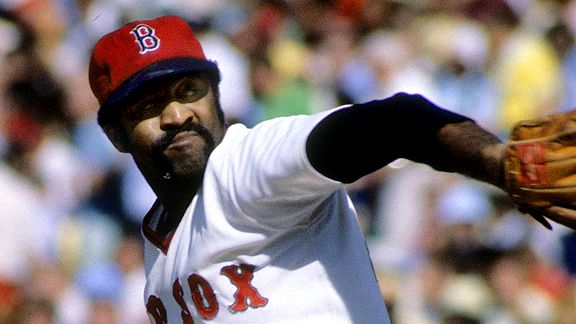
Tiant was one of the best pitchers of his time and all-time (ESPN)
With the Hall of Fame induction ceremony coming up this weekend and the Red Sox playing well (for now), I wanted to take a look at a pitcher who many feel was overlooked by the Hall, a pitcher who would undoubtedly go in wearing a Red Sox cap if he's ever enshrined.

I'm talking, of course, about Luis Tiant, a fan favorite and talented pitcher with Boston for much of the 1970s. El Tiante was a beloved figure in Beantown, where he revived his career in his 30s and emerged as that decade's equivalent of Roger Clemens or Pedro Martinez with the Sox. 

But before I talk about Tiant's brilliant tenure with Boston, I think it's important to remember that he was a great pitcher long before he ever put on a Red Sox uniform. Purchased by the Cleveland Indians for $35,000 in the summer of 1961 (about $279,000 in today's dollars), Tiant earned a midsummer call-up to the Indians three years later. His first start was one of the most impressive debuts any pitcher has ever had, a four-hit shutout of the defending and eventual AL champion Yankees at the Stadium. He outdueled Whitey Ford in the second game of a doubleheader, fanning 11 Bombers (including Roger Maris twice) to earn the first of his 229 major league wins. 

A star was born. The 23 year-old Tiant pitched well down the stretch, finishing his rookie year with a 10-4 record, 2.83 ERA and 1.11 WHIP, good for nearly four wins above replacement. He gradually got better in each of the next four seasons, lowering his FIP and walk rate every year while improving his K/BB ratio. The last of those seasons, 1968, was by far the best of his career.  In addition to going 21-9, he led the American League in ERA (1.60), ERA+ (186), shutouts (9), FIP (2.04), and pitching WAR (8.4). He also had the lowest hit rate in baseball at 5.3/9, limiting opponents to a .168/.233/.262 batting line and posting a 0.87 WHIP. On top of all that, he racked up 264 punchouts in 258-and-a-third stellar innings, part of his 3.62 K/BB ratio. Fun trivia fact: Tiant was the Junior Circuit's starting pitcher in that year's All-Star game. Not so fun fact: Tiant failed to receive a single Cy Young vote that year (but yet finished fifth in the MVP voting).

Tiant's masterful 1968 season is one of the great seasons forgotten to history. Because it coincided with the Year of the Pitcher, a season that saw Denny McLain win 31 games, Bob Gibson compile a 1.12 ERA and Don Drysdale hurl 58 consecutive scoreless innings, Tiant had a hard time standing out above the crowd/making noise for an also-ran Indians team.

Not yet 28 at the end of his big breakout campaign, Tiant had established himself as one of the premier pitchers in baseball. With 23 WAR already under his belt, he'd been one of the American League's five most valuable pitchers since breaking in. Furthermore, he'd done nothing but improve over his first 1,000 big league innings. No one could have foreseen that in three short years, he would very nearly be out of baseball.

1969 was a terrible year for Tiant and the Indians, who went from third place and 86 wins in '68 to 62 wins in 1969. Cleveland finished last in the newly minted AL East, 18 games behind the next-worst team (New York). Tiant tumbled to 9-20, leading the majors in losses, walks, and home runs allowed. Overnight, Tiant had gone from the American League's best pitcher to one of the worst in baseball. 

He was gone before Christmas. The Indians whisked him away to Minnesota along with Stan Williams in return for Dean Chance, Graig Nettles, Bob Miller, and Ted Uhlaender, a trade that would have worked out wonderfully for Cleveland had a) Chance not fallen apart the second he got there and b) they'd held on to Nettles for more than three years. 

Tiant must have been excited to escape the moribound Indians and land with a first place club in Minnesota. He flourished in his new digs, going 6-0 with a 3.12 ERA in his first 10 starts with the Twins before a fractured right scapula derailed his bounce back season. Tiant missed more than two months, and while he returned in time for the stretch run he wasn't quite the same. His first taste of the postseason was a bad one; mop-up duty in Game 2, in which he recorded two outs only after surrendering a two-run homer to Davey Johnson. He did not pitch again in the series, as Minnesota was swept the next day.

The injury that had ruined Tiant's first year with the Twins now jeopardized his once-promising career. After an ineffective and injury-plagued spring training, the 30 year-old was unconditionally released. His playing days appeared to be numbered. A couple weeks later the Braves picked him up for a 30 day trial with their Triple-A affiliate in Richmond, and at the end of the 30 days decided he was not worth a major league roster spot. That two teams had given up on him in the span of six weeks didn't discourage the perpetually pitching-strapped Red Sox from scooping him up two days after Atlanta cur him loose. It turned out to be one of the best decisions they've ever made.


A finally healthy Tiant returned to form in Boston (Bostinno)

Tiant's stint with the Sox lasted eight seasons, during which time he won 122 games with a 3.36 ERA, made two All-Star teams, piled up 36.4 bWAR and finished in the top-six of Cy Young voting three times. It was during this time that El Tiante earned a reputation as one of baseball's best big game pitchers. He was phenomenal throughout the pennant races of 1972, 1974 and 1978, pitching valiantly for Red Sox teams that were always coming up just short. Though Tiant struggled during the one pennant race Boston did win, he was at his absolute best in that year's wild postseason. After firing a complete game shutout against the three-time defending World Series champs in Game 1 of the ALCS, Tiant came back one week later and spun another shutout in the first game of the World Series against the vaunted Big Red Machine. He again went the distance in Game 4 to even the Series. He finally ran out of gas in Game 6, but luckily for him Bernie Carbo, Dwight Evans and Carlton Fisk had some late-game heroics up their sleeves.

After the heartache of '78 Tiant, by then 38 and desperate for a ring, defected to the Yankees via free agency. Nobody could blame him for latching on with the winners of the last three American League pennants and two World Series. The irony, though, is that  the streak ended as soon as Tiant donned pinstripes. New York finished fourth in 1979, Tiant's last good season, and would not win another title until 1996, by which point Tiant was closing in on 56. He was a great old pitcher, but nobody, not even Tiant, could hang around that long. He hung up his spikes for good after 1982 after 19 seasons and nearly 3,500 regular season innings. He has since been inducted into the Red Sox Hall of Fame and Hispanic Heritage Hall of Fame, but still waits for the call from the only Hall of Fame anyone actually cares about, as in the one located in upstate New York.

Now, did what El Tiante accomplish during that time merit a plaque in Cooperstown? The writers voted unequivocally no. Tiant stayed on the ballot for all 15 years of eligibility, but only in his first year did he receive more than 20 percent of the vote. After that, he was never really a serious candidate. Should he have been?

It's easy to make the case that the answer to that question is no, that he was a Hall of Very Good pitcher who was more style than substance. Tiant never won a Cy Young award, finishing no higher than fourth and drawing votes in only three seasons. He made only three All-Star teams. His rate stats are all good but not great. Though Tiant paced AL pitchers in WAR in '68, many would say McLain had the better year, meaning Tiant was never the best pitcher in his league, let alone the game. With only three seasons among the league's five most valuable pitchers, he didn't dominate. And sure, he was great in the postseason, but how many World Series did he win? Mickey Lolich was more or less Tiant's equal, and one doesn't hear many clamoring for him to make the Hall of Fame. In fact, seven of Tiant's 10 best statistical comps are currently outside the Hall and none are currently up for election.Many of his seasons were mediocre, with nine of his 19 years rating between below average to barely above average based on ERA-. 

But Tiant, even if he does fall short on Black Ink, Gray Ink, the Hall of Fame monitor and Hall of Fame standards, does have a strong statistical case. He was the American League's third-most valuable pitcher when he played, behind only Bert Blyleven (Class of 2011) and Lolich, the latter a respected member of the Hall of Very Good. Expand the timeframe from 1951 through 1990, a stretch of 40 seasons, and Tiant still ranks as the league's fifth-best pitcher. Better than Jim Palmer, Gaylord Perry, Catfish Hunter, and the man he beat in his first big league start. What's more, three of his six closest comps are already in the Hall. With over 66 career bWAR, Tiant is very much a viable candidate for Cooperstown. By the standards of the Hall of Stats, he makes it in comfortably.

 JAWS rates him 51st all-time among starting pitchers. Remove the guys who started their careers before 1900, and Tiant's one of the 50 best starting pitchers of all-time. Seeing as how he ranks 21st in shutouts, 39th in strikeouts, and 40th in pitching WAR, I buy that. Though he's a bit below the established standards for peak and longevity, he still comes in ahead of luminaries such as Jim Bunning, John Smoltz, Don Sutton, and Early Wynn. It does concern me that of the 59 starters already in the Hall, including Greg Maddux and Tom Glavine, Tiant outranks just 13 of them. He rates lower than Wes Ferrell, Kevin Brown, and Rick Reuschel, among others. 

The two things I look for in a Hall of Fame case are a peak and longevity. Tiant obviously had good longevity, as he pitched until he was almost 42 and made close to 500 big league starts. He had eight seasons with more than 200 innings, three more than just missed and four others with over 100. 11 times he made 29 or more starts in a season. 

As for peak, well, Tiant technically had two peaks. He had his five-year run with Cleveland, which wasn't so much a peak as it was one amazing season preceded by several good ones. Then there was his second prime, covering his last seven seasons with Boston and his first in New York. In both cases he was one of the league's five-best pitchers for an extended period of time (40 years, in fact, as I noted a few paragraphs before). And as one of baseball's 50 best since 1900, which gets narrowed to 25 if you exclude those who debuted before Jackie Robinson, then it becomes pretty clear that Tiant is indeed Cooperstown-worthy. I'd say there are more-deserving pitchers still waiting to be inducted (Clemens, Curt Schilling, Mike Mussina, and the aforementioned Brown come to mind), but Tiant at least deserves another look from the Veteran's Committee. The BBWAA has not done a great job of electing starting pitchers who aren't slam-dunks, leaving recent generations of pitchers poorly represented in the Hall. It's up to the VC to rectify those mistakes.

I'll admit I wasn't totally sold on the idea of Tiant as a Hall of Famer when I started writing this, but after taking a closer look I think I'd give him a pass. He had five truly great seasons--1968, 1972-1974, and 1976--and enough success in other years (his first few with Cleveland a few more in the late '70s). Throw in his celebrity status in Boston and his track record of success in big games (which, unlike Jack Morris, extended beyond one game) and I think he did just enough to get over the top. 

It's a really tough call though, and if you check back with me tomorrow I might not feel the same way.

Tuesday, January 21, 2014

Parker vs Rice Redux

When people argue for a player's Hall of Fame candidacy, a common tactic they use is to compare said player to lesser players already enshrined in Cooperstown. For example, if Bill Mazeroski and Joe Gordon are in, then Bobby Grich and Lou Whitaker should be no-brainers. If Ron Santo is in, then really Dick Allen should be, too. Gotta put Jeff Bagwell and Fred McGriff in if you're going to have a Hall of Fame with Jim Bottomley and Ray Schalk, right?

Since making it into the Hall of Fame by the skin of his teeth in 2009--his last chance on the writer's ballot--Jim Rice has frequently been used in such arguments. It's no secret that he's generally thought of as one of the weaker players to be inducted in recent memory. JAWS rates Rice as the 27th best left fielder of all-time and below 14 of the 18 that have attained Hall of Fame status. He falls short of decidedly non-HOFers like Jose Cruz, Roy White and Luis Gonzalez, who was just booted off the ballot after tallying a mere five votes in his debut.

For a long time, Rice was a borderline candidate who typically polled in the 50-60 percent range. But once the issues of the steroid era came to light in the mid-2000s, people suddenly had more appreciation for what Rice had done as a natural slugger during the offensively depressed 1970s and 80s. Writers who stuck it to Rice for being such a jerk to the media during his playing days eventually came around, and that was just enough to sneak him into the Hall.

So where am I going with this? Well, now that Jim Rice is in the Hall of Fame, shouldn't Dave Parker? Look how close their numbers are:

Rice: 1,249 R, 79 3B, 382 HR, 1,451 RBI, 670 BB .298/.352/.502, 128 OPS+, 47.2 bWAR
Parker 1,272 R, 75 3B, 339 HR, 1,493 RBI, 683 BB .290/.339/.471, 121 OPS+, 40 bWAR

You'd be hard-pressed to find two players with careers that overlapped so perfectly. Parker broke in one year before Rice did but they both became stars in 1975, when they finished third in their leagues' respective MVP voting (Rice also finished second in the Rookie of the Year to teammate/fellow outfielder Fred Lynn, who took home MVP honors). They fell off a bit in 1976 but were both very good, then embarked upon a three-year stretch of dominance as they came into their primes.

Both were arguably the best players in baseball in the last three years of the 1970s, followed by substantial drop-offs in the early 80s. They bounced back to produce several more good years in the mid-80s, but by the end of the decade they were old and washed-up. Rice retired in 1989, Parker two years later. Neither one was able to match the brilliance of the men they replaced: Yaz in Boston and Roberto Clemente in Pittsburgh.

The similarities don't end there. They each led the league in games played once, hits once, slugging percentage twice, OPS once. Both were named MVP in 1978 and finished near the top on several other occasions (four other top-five finishes for Parker, five for Rice). Parker racked up 3.19 MVP shares, just a hair more than Rice's 3.15.   Rice made eight All-Star teams, Parker made seven. Parker won three Silver Sluggers, Rice received two. It's no wonder Parker rates as the tenth most similar player to Rice on Baseball-Reference.

One key difference is that Parker actually played a bit more than Rice, appearing in nearly 400 more games (about two and a half seasons worth) and logged an additional 1,100 plate appearances. Parker played past his 40th birthday, whereas Rice had his last good season at 33 and retired at 36. Parker's longevity helped him accumulate 2,712 hits, of which 940 went for extra bases. But seeing as how Parker was worth -0.4 bWAR over his last six seasons, he could certainly be accused of hanging on too long a la Craig Biggio.

One point in Parker's favor is that he won two World Series rings, which is two more than Rice ever won. And while Parker's postseason resume is pretty poor (.647 OPS in October), he did bat .345 in the 1979 Fall Classic to help Pittsburgh prevail over the Baltimore Orioles in seven games. In his early years, Parker could run a bit (154 career steals) and earned a good defensive reputation, winning three straight Gold Gloves from 1977-'79 while flashing a powerful arm. Rice learned to play the Green Monster over time, but never mastered it like his predecessor Carl Yastrzemski. He was never a threat on the basepaths either. Rice was the better hitter, but Parker was the more complete player. He was baseball's fourth-most valuable player from 1975-1979, behind only Mike Schmidt, George Brett and George Foster.

So why is one in the Hall of Fame while the other never even got 25 percent of the vote? Rice made enemies in the press, but so did Ted Williams. Writers never gave Mickey Mantle much love in the first half of his career. Time heals most wounds, and Rice's talent was undeniable. Parker's problem was that a combination of injuries, weight problems, and cocaine use sabotaged his career in the first half of the 1980s, when his performance drastically declined (.281/.319/.431 from 1980-84). He got a reputation for not caring about the game, and for squandering his immense potential.

Nothing in life is sadder than wasted potential. The feeling is that Parker needed a few more good years to solidify his case, but that his off-field issues prevented him from doing so. Parker was very much a black mark on the game, and the writers shunned him for it.

My other thought is that Rice has more impressive power numbers, which always catch the eye and confirm the belief that he was one of the strongest and most feared hitters of his era. He also spent his entire career with one team, whereas Parker bounced around during the second half of his career. Rice had continuity in the nation's most baseball-crazed city. Parker played in depressed smaller markets known as Pittsburgh and Cincinnati.

Rice also hit traditional benchmarks more often. He reached 100 RBI eight times, 20 homers 11 times and 200 hits four times. He also batted better than .300 seven times and was a .300 career hitter up until his final season. Parker had just four 100 RBI campaigns, one 200-hit season and topped out at 34 home runs, when Rice reached 39 on four separate occasions. Parker did win two batting titles, but batted just .264 over his last six years and ended up with a lower career average than Rice.

I'm not saying I think Parker should be in the Hall of Fame. Despite what he says, he shouldn't be. JAWS puts Parker 36th among rightfielders, behind the likes of Bobby Bonds, Jack Clark, Brian Giles, Tony Oliva, and Rocky Colavito. He falls short in the position's established standards for peak and career value. He was just up for election on last fall's Expansion Era ballot and failed to get in, and there aren't many people championing his case.

But now that Rice (and Andre Dawson) is in, it's very hard to justify Parker's absence. Rice is a more qualified candidate for the Hall of Fame, but only slightly. Rice's Hall of Fame score is 43 (the average Hall of Famer's is 50), and Parker's is 42. More than any other statistic, that one shows just how close they really were.

Wednesday, January 1, 2014

Questionable Cy Youngs: 1970-1979

1970 AL Jim Perry
Perry won a major league-best 24 games but didn't lead the league in anything else and wasn't even worth four wins. Third-place "Sudden" Sam McDowell was worth more than eight, which makes sense given that he pitched a league-high 305 inninngs with a 2.92 ERA and 304 Ks, most in baseball. Jim Palmer, who finished fifth, pitched just as many innings and had a superior ERA (2.71, though their ERA+ was an identical 134) along with five shutouts, which led both leagues. Since most of their numbers are so close, I probably would have gone with McDowell due to his huge strikeout advantage.

1974 NL Mike Marshall
To be fair, Marshall turned in one of the best seasons a reliever has ever had. Iron Mike set the record for most appearances by a relief pitcher (106) and threw more innings (208.1) than your typical modern day workhorse. Even so, B-R values his performance as worth only 3.1 WAR. His season also loses some its luster considering the second, third, and fourth place finishers averaged 290 innings pitched between them. Runner-up (and Marshall's teammate) Andy Messersmith would have made a fine choice since he threw 84 more innings with the league's best WHIP and an ERA that was only marginally worse (2.59 to Marshall's 2.42). The most deserving candidate was Phil Niekro, who placed third, because he led the league in innings (302.1) and complete games (18) with a better ERA (2.38--second in the NL) than both of them. That quantity/quality combo translated to almost eight wins above replacement, making him the league's second most valuable pitcher behind only Jon Matlack.

1977 AL Sparky Lyle
With a 2.17 ERA, Lyle had the best season of his career, but as a reliever he was only good for 137 innings. Runner-up Jim Palmer logged an AL-best 319 (thanks to his 22 complete games--most in baseball) with a 2.91 ERA, and was thus twice as valuable per bWAR. Third-place Nolan Ryan was arguably better that year. He completed just as many games as Palmer (but threw 20 fewer innings) with a better ERA (2.77) and 341 strikeouts. '77 was also Ryan's best season according to bWAR, of which he produced 7.8.

1978 NL Gaylord Perry
Perry paced the league in wins (21) and winning percentage (.778), but didn't lead the NL in anything else and was worth 4.3 bWAR. Burt Hooton, Vida Blue, and J.R. Richard, who finished second, third, and fourth, had nearly identical seasons in terms of ERA, innings, and overall value, which makes one wonder how Perry won the award in such dominant fashion (with 22 of 24 first place votes). The trophy should have gone to Phil Niekro, who finished a distant sixth. Voters probably held his 18 losses against him, but they should have overlooked that, for Niekro threw more innings (334.1) than anyone else in baseball while maintaining a 2.88 ERA, right in line with Perry's 2.73. Throw in his 248 strikeouts (second only to Richard's 303) and he was baseball's most valuable player worth 10 bWAR.

1979 NL Bruce Sutter
Sutter racked up nearly five wins above replacement: an impressive accomplishment for a reliever. But he barely pitched 100 innings. Third-place J.R. Richard tossed nearly 300, and with a major league-best 2.71 ERA to boot. He also fanned 313 batters, most in baseball, to go along with his league best K/BB ratio, K/9 rate, and H/9 rate. Winning the two most important legs of the pitching Triple Crown should be enough to do the trick, but voters preferred his teammate Joe Niekro, who finished second largely because he won a league-high 21 games (same as brother Phil).

Saturday, February 2, 2013

Best Pitching Season of the 1970s

Thought long and hard about Ron Guidry's 1978 here, but decided to go with the sheer volume of Lefty's statistics.

Steve Carlton 1972 (11.7 bWAR)

Carlton was the first great southpaw to emerge in the National League after arthritis forced Sandy Koufax into early retirement following the 1966 World Series. Known as "Lefty," he quietly developed into a reliable number two starter after arriving on the scene in 1965, though the St. Louis Cardinal was often overshadowed by Bob Gibson.

Almost eight years after St. Louis pulled off what may have been the most lopsided trade in baseball history (Ernie Broglio for Lou Brock), the Cards gave up on a future four-time Cy Young winner just as he was coming into his prime. Owner Gussie Busch ordered Carlton to be traded following a salary dispute, so on February 25th, 1972 the Cardinals dealt him to the Philadelphia Phillies for Rick Wise. Straight up.

Oops.

At the time, the swap looked fair on paper. Carlton had won 77 games (20 of which came the season before) to Wise's 75, and Wise was a year younger. Both were recognized as good pitchers, and Tim McCarver (who caught for both) described the trade as "a real good one for a real good one." Though he pitched well, Wise lasted just two seasons with the Cards before they shipped him up to Boston along with Bernie Carbo in exchange for Reggie Smith and Ken Tatum. The Redbirds won 90 games in Carlton's last season with them, but slipped to 75 and 81 in the two years with Wise on board. It would take a decade before St. Louis made it back to the playoffs.

Carlton made a great first impression in the City of Brotherly Love by debuting with the finest season of his Hall of Fame career. Lefty won the pitching Triple Crown with 27 wins, 310 strikeouts and a 1.93 ERA that translated into the best ERA+ (182) in the majors. His 30 (!) complete games also topped all hurlers, allowing him to amass an NL-best 346.1 innings pitched (over eight innings per start) and rack up those 310 Ks.

His most dominant start of the season came on April 25th in San Francisco against a Giants lineup that featured Bobby Bonds and Dave Kingman. After allowing a leadoff single to Chris Speier, Carlton recorded the next 27 outs without allowing another base hit. He fanned 14 Giants in all, including pinch-hitter Willie Mays and Speier (both looking) to finish a pitching duel in which he got the best of Juan Marichal, who took the complete game loss.

That one-hitter was eventually overshadowed by his incredible streak that ran from June 7th through August 17th, a span of 18 starts in which he won 15 consecutive decisions and posted a 1.51 ERA. This stretch also included a period where he allowed just one earned run in 56 innings.

Carlton cruised to his first Cy Young award, which he won unanimously over the likes of Gibson, Fergie Jenkins and Tom Seaver. He also received the Hickok Belt as the top professional athlete of the year. Despite playing for the last-place Phillies, he still managed to finish fifth in the NL MVP race behind Johnny Bench, Billy Williams, Willie Stargell, and Joe Morgan.

Some more tidbits from his overwhelming 1972 campaign:

  • Opponents batted just .207/.257/.291 off him. Lefties fared even worse, hitting just .197/.233/.258.
  • His average GameScore was a 69
  • Nine starts with double digit strikeout totals
  • Did not surrender a home run during the first 51 and 1/3 innings he pitched that year until the aforementioned father of Barry Bonds took him deep. He allowed just five long balls in his 21 road starts
  • Had three starts in which he completed at least ten frames, including two (July 19th and August 21st) where he finished eleven
  • As most fans know, Carlton won 27 games despite taking the mound for a 59-win team, meaning he was responsible for almost 46 percent of Philadelphia's victories (a modern major league record). Looking at it another way, the Phillies went 29-12 (.707) when he pitched, 30-85 (.261) when he didn't. It's scary to think how bad they would have been without their ace. In the 40 seasons since, no NL pitcher has won 27 or more games
  • Lastly, here is Carlton's earned run breakdown

         0 runs--12 starts
         1 run--9 starts
         2 runs--6 starts
         3 runs--4 starts
         4 runs--8 starts
         5+ runs--2 starts

Best offensive season of the 1970s--Jim Rice (1978)

Tuesday, January 22, 2013

Weaver=Winner


Baseball lost a pair of legends over the holiday weekend when Earl Weaver and Stan Musial passed away. Here are some thoughts on Weaver, who was 82 when he died on Saturday:

Weaver was the best manager the Baltimore Orioles have ever had, and his outstanding track record speaks for itself. He managed 2,541 games--all with Balitmore--over 17 seasons and his teams won 1,480 of them, good for a .583 winning percentage. He presided over five 100-win seasons, four AL pennants, and the 1970 World Series champions. Six times he steered his club to a first-place finish and eleven times his team won at least 90 games. The Orioles were the American League's answer to Sparky Anderson's Big Red Machine always competitive under Weaver's guidance.

Well, except at the end. His only losing season was his last one, 1986, when the O's went 73-89 and finished last in the division. Weaver initially retired following the 1982 season, after Robin Yount and the Milwaukee Brewers crushed Baltimore 11-2 in a one-game playoff for the AL East flag. The front office lured him back in 1985 as the team slid into mediocrity, hoping he'd light a spark under the ballclub. But when Baltimore couldn't turn it around,Weaver walked away. It was good timing, for the Orioles only got worse without him. They dropped 95 games in 1987, then 107 the year after that. It took Baltimore ten years to make the playoffs after Weaver called it quits.

After a brief resurgence in the mid-1990s, the once-proud franchise deteriorated into the doormats of the American League East. The perennial punching bags for the New York Yankees, Boston Red Sox, and Tampa Bay Rays strung together 14 consecutive losing seasons prior to a fluky 2012 in which they made the postseason despite scoring just seven more runs than they allowed during the regular season.

The last quarter century has been filled with lean times for the Orioles, enough to make their glory years feel like they transpired in an alternate reality. But Baltimore was the class of the American League back then, the first dynasty to emerge after the great Yankee run collapsed in the mid-1960s. The O's reaped the rewards of their prolific farm system that churned out waves of multi-talented ballplayers. Weaver, with all his fiery passion, competitive spirit and infamous tirades, was the perfect man to lead a team desperate to escape its losing reputation. No man could erase 60 wasted years in the American League cellar, but damned if this one wasn't going to try.

Of course, it helped that Weaver was blessed with elite personnel throughout his managing tenure. A great manager is only as good as his players, and Weaver had the good fortune of managing a bunch of them. When he first came on the job in 1968 he inherited the core that swept Sandy Koufax, Don Drysdale and the Los Angeles Dodgers in the '66 Fall Classic. was penciling the names of Frank Robinson, Brooks Robinson, and Boog Powell into his lineup cards. Then it was a new crop of stars--Bobby Grich, Don Baylor, Ken Singleton, and Lee May--in the 1970s. His final days at the helm featured Eddie Murray, Cal Ripken Jr., and Fred Lynn.

As for pitching, Baltimore rarely suffered a shortage of quality arms. The Big Three of Jim Palmer, Mike Cuellar, and Dave McNally carried the day, and the 1971 edition featured four 20-game winners (the trio plus Pat Dobson). Players came and went, especially once free agency came into vogue during the mid-'70s, but Weaver remained ever-present.

Weaver wasn't a master tactician or strategist. He didn't know much about pitching. Common managerial maneuvers such as hit-and-runs, sacrifice bunts and stolen bases were foreign to him. And yet, he was one of the winning-est skippers who ever lived. He earned his plaque in the Hall of Fame. He belongs in the pantheon of legendary baseball field generals with the likes of Casey Stengel, Joe Torre, Tony LaRussa, and Bobby Cox.

And even if the Baltimore Orioles revert to their losing ways this year, his legacy as a winner lives on.

Friday, April 20, 2012

MLB All Decade Team 1970s

Notice how almost all the players here were employed by National League teams

C Johnny Bench over his American League counterparts Carlton Fisk and Thurman Munson
1B Willie Stargell
2B Joe Morgan Gets the nod over Rod Carew
3B Mike Schmidt
SS Dave Concepcion
OF Reggie Jackson
OF Bobby Bonds over Lou Brock
OF Reggie Smith over teammates Carl Yastrzemski, Fred Lynn and Jim Rice
DH Pete Rose Nobody played as an everyday DH during their prime a la David Ortiz and Edgar Martinez; the position was typically used for older players at the end of their careers like Orlando Cepeda, Dick Allen, etc.  Rose was a jack of all trades with no natural position, so I'll use the DH as a utility spot
RHP Jim Palmer Edges out Tom Seaver in a photo finish
LHP Steve Carlton
RP Rollie Fingers over Sparky Lyle

Friday, March 16, 2012

Best Offensive Baseball Season of the 1970s

This was an extremely close call because of Joe Morgan's huge 1976 season.  I probably should have just flipped a coin, because they both have their merits.  Sabermetric fans will probably prefer Morgan's season because of his superior OBP, OPS and OPS+, but in the end he just didn't have the counting numbers to compete.

1978 Jim Rice (7.0 bWAR)

'78 marked the middle of Jim Rice's three year peak (he led the league in total bases each season) at the end of the decade, a time when he was unquestionably the best righthanded hitter in baseball as well as the most intimidating slugger in the game.  He'd come up as one of the hyped Gold Dust Twins along with Fred Lynn in 1974, and the following season they finished 1-2 in the Rookie of the Year balloting while leading Boston back to its first World Series since the Impossible Dream team.  Unfortunately, Rice injured his wrist when he was hit by a pitch during the last week of the regular season and missed the playoffs entirely.  Since five of the games against the Big Red Machine during the Fall Classic were decided by just one run, it's fair to say that a player of Rice's caliber probably could have swung the outcome in at least one of them with a timely hit (or home run) and therefore could have ended Boston's World Series drought three decades sooner.  But alas, we will never know how a healthy Rice could have impacted the series.

Fast forward three years, and Rice had established himself as an elite slugger and MVP candidate.  Coming off a monster season the year before, he celebrated his 25th birthday before the season began and was just coming into his prime.  He burst out of the gate and never looked back, helping carry the offensive load for the potent Red Sox lineup hampered by down seasons from Butch Hobson, George Scott and Carl Yastrzemski.  They needed every  little bit that Rice could give them, and he didn't disappoint.  Like Jacoby Ellsbury last year, he did all he could to salvage his team's September collapse but in the end it just wasn't enough; the star-crossed Sox won 99 games but fell to their archrivals during the 163rd game of the season, during which Rice contributed an RBI single.  Although the Bombers got the best of Boston in the standings, the Red Sox slugger edged Yankee ace Ron Guidry (25-3, 8.5 bWAR and a tidy 1.74 ERA) in the American League Most Valuable Player race.  When it was all said and done, Rice ranked first among all major league hitters with 213 hits, 15 triples, 46 longballs, 139 ribbies, a gaudy .600 slugging percentage, and 406 total bases.  His .970 OPS and 157 OPS+ were also tops in the Junior Circuit.

Rice made the cover of Sporting News,
back when that actually meant something
Rice is lucky the voters selected him over Guidry for the MVP award, because I'm not so sure he'd be in the Hall of Fame without it.  Granted, he did finish in the top five on five other occassions, but I feel like he needed the hardware to validate his dominance.  Because he didn't quite have the longevity to hit major milestones (he fell short of 400 homers, 1,500 RBI and a .300 average), the main argument of his case was that for a brief while, he was probably the best hitter in baseball.  That claim would have been tough to back up without an MVP award to reflect his greatness.  Even so, I think he did enough otherwise to merit his enshrinement in Cooperstown;  for a dozen seasons from '75 to '86 he batted .304/.356/.520 and averaged 29 home runs and 106 RBI per season.  Those are some damn good numbers, especially given their context.

Here are some more stats from his masterpiece

-Jim Ed played in all 163 games that season, an achievement that allowed him to compile some truly extraordinary counting numbers.  For example, he topped the majors in plate appearances, with 746, and at-bats, with 677.
-Whiffed a career high 126 times
-Few took advantage of Fenway's friendly confines better than Rice, who slugged 28 home runs and triple slashed .361/.416/.690 there, good for a 1.105 OPS. 
-His 406 total bases were the most by an American Leaguer since Joe DiMaggio accumulated 418 all the way back in 1937.  No American Leaguer has eclipsed 400 total bases since (Albert Belle missed by a measly single in 1998), but Barry Bonds, Sammy Sosa, Luis Gonzalez, Larry Walker, and Todd Helton have all done it in the Senior Circuit.
-Belted 23 homers in each half of the season, but don't let that fool you.  He was a streaky hitter who did the majority of his damage in May and August, and managed to clear the fences just once in July!
-Interestingly enough, he had 13 triples at the All-Star break, but recorded only two afterwards.  While we're talking three-baggers, he recorded 15 the year before, too.  Those are a lot of triples for a slugger, considering Alex Rodriguez (fast enough to steal 46 bases one time) has just 29 for his career, and Albert Pujols has only 15.
-Was a veritable bargain with a $125,000 salary (equivalent to 434 grand and some change in 2012) according to the Bill James Historical Abstract.  The following year, he made more than four times as much
-He was no Yaz in left, but '78 ranks as one of his best seasons with the leather.  He was worth one dWAR and played all three outfield positions.  He also spent 49 games as the Designated Hitter, which undoubtedly kept him fresh enough to play every game