Showing posts with label Pirates. Show all posts

Saturday, November 7, 2015

Ramirez Retires

Ramirez is retiring after 18 seasons (NBC Sports)
Another very good but not quite Hall of Fame level player retired recently as baseball waved goodbye to Aramis Ramirez. Ramirez joined Torii Hunter, who retired last week, in deciding to call it quits.

There are actually quite a few parallels between their careers, besides the fact that they hung up their spikes 10 days apart. Ramirez, like Hunter, finished his career where it started--Hunter with the Twins and Ramirez with the Pirates. Hunter was a lifelong American Leaguer who spent the bulk of his career in the AL Central, while Ramirez never left the NL Central.

Their career arcs are eerily similar as well, as both struggled for a few years before breaking out in 2001. After that they remained excellent players for more than a decade, aging remarkably well and putting up similar numbers year after year. Though both made multiple postseason appearances, neither ever played in a World Series, much less won one.

And just look how close their numbers are:

Hunter: 19 yrs 498 2B 351 HR 1,391 RBI 661 BB .277/.331/.461 (110 OPS+) 4,087 TB
Ramirez: 18 yrs 495 2B 386 HR 1,417 RBI 633 BB .283/.341/.492 (115 OPS+) 4,004 TB

Ramirez debuted with Pittsburgh at 19 in 1998. Predictably, his first few years were rough as he struggled to adjust to major league pitching, but in 2001 he blossomed into one of the best-hitting third-sackers in the game. In his first full season, Ramirez mashed 34 home runs, knocked in 112, and batted a robust .300/.350/.536 (122 OPS+).

Nowadays, such a season would merit serious MVP consideration, an All-Star berth, and a Silver Slugger. But back in 2001, when cartoonishly big sluggers were putting up videogame numbers, Ramirez got no recognition of any kind. That would become a troubling trend for Ramirez, long one of the game's most under-appreciated stars (except when the fans gave him a completely undeserved Hank Aaron award in 2008).

After failing to replicate those numbers in 2002 and the first half of 2003, Pittsburgh sent him and Kenny Lofton to the Cubbies for Jose Hernandez, a minor leaguer, and a player to be named later. It's trades like that which explain how the Pirates went 20 years between winning seasons.
Ramirez was just coming into his prime. He flourished in Chicago, taking advantage of Wrigley's friendly confines (where he was a career .307/.372/.551 hitter) to emerge as an annual 30-100-.300 threat. While he wasn't the most durable player, exceeding 150 games in a season just once after leaving Pittsburgh, he always hit when he did play.

After eight and a half productive years in Chicago, Ramirez signed on with the Milwaukee Brewers before the 2012 season. Following a stellar debut with the Brew Crew, he began to decline as he reached his mid-30s. With Milwaukee rebuilding and his skills eroding, the Brewers had no need for their expensive, over-the-hill third baseman.

So this year, which Ramirez had already acknowledged would be his last, Milwaukee dealt him to a resurgent Pirates franchise, giving him one last shot at World Series glory. Like most last-ditch efforts to procure a ring, this one didn't work out. Ironically, it was Ramirez's former team, the cursed Cubs, that got in the way. In what would be the last at-bat of his career, Ramirez grounded into an inning-ending double play. Somehow, that seems appropriate.
Circling back to Hunter, Ramirez also fell short of a few big milestones. He ends his career 14 homers shy of 400, five doubles short of 500, and 83 RBI away from 1,500. Even so, his numbers are outstanding for a third baseman; he ranks 10th in the position for home runs, doubles, and RBI.

The three-time All-Star never quite got the credit he deserved for being such a tremendous hitter year-in and year-out, probably because he was playing in the shadow of superior third basemen such as Alex Rodriguez, David Wright, Chipper Jones, and Adrian Beltre. In terms of career offensive production at the position, however, few were ever better. 

Thursday, October 8, 2015

Arrieta, Cubs Advance

Arrieta was on top of his game as the Cubs advanced (LA Times)
While I was surprised to see the Yankees flop in Tuesday's AL Wild Card game, I was not at all surprised when the Cubs cruise past the Pirates last night.
 
For one, Jake Arrieta is arguably the best pitcher in baseball this year. And if not the entire season as a whole, then definitely the second half, which was only the greatest any pitcher has ever had. He was better away from Wrigley Field, too, with a 1.60 ERA, 0.88 WHIP, and 5.16 K/BB ratio outside the Friendly Confines. Arrieta's been so ridiculously good lately, I just didn't see him losing this game.
 
That's not a knock on Gerrit Cole, who was tremendous in his own right this year and pitched well the last time he appeared in the postseason. But he was a better first half pitcher this year, with a 1.71 ERA through June 15th and a 3.19 ERA after. That can be attributed to natural aggression, but a small part of me thinks he may have gotten fatigued as he exceeded his previous innings high by 70. But not even first-half Cole was as good as second-half Arrieta.
 
I also figured he'd have some trouble with Chicago's lineup, which might be the scariest in baseball. There's no holes in that offense--not even Arrieta, the rare decent-hitting pitcher. It's a meatgrinder 1-9 with loads of power, which makes the Cubbies very difficult to neutralize. The Pirates, on the other hand, are more top-heavy. If you can get McCutchen out and keep Starling Marte off the bases and not make a mistake to Pedro Alvarez, you'll probably be alright.
 
And with his team shooting for its first World Series title in over a century, Arrieta was more than alright. He was his usual dominant self, carving up the Bucs in his first postseason start. Arrieta allowed just four hits--all singles--and struck out 11 en route to a shutout, the first by a Cubs pitcher in the playoffs since 1945.
 
While Arrieta showed lethal stuff early, racking up six K's through his first three innings, Cole struggled from the start. He put his team in a hole two batters into the game following a pair of singles sandwiched around a stolen base. A double play helped him escape the first without further damage, but Chicago's sluggers got the best of him via home runs in the third and fifth. With Pittsburgh down 4-0 and the Pirates doing nothing against Arrieta he had to come out, and while Pittsburgh's bullpen stopped the bleeding it was too little, too late. Arrieta didn't give an inch, sending the host team home early for the second year in a row.
 
I must say I was amazed at how similarly the two wild card games played out. In both cases the visiting team shut out the home team, smacking two home runs along the way. The better pitcher won in both cases too, with likely AL Cy Young winner Dallas Keuchel getting the best of Masahiro Tanaka and Arrieta--who will win if a Dodger doesn't--topping Cole. The losing pitcher in both games exited after five as well.
 
I feel like the better team won in both games as well, probably because I'm still having trouble figuring out how the Yankees and Pirates made it there. The Yankees were impossibly old, and the Pirates just didn't seem that good to me. It blows my mind that Pittsburgh won 98 games this year--more than any team save the Cardinals. Maybe that's because outside of Cole and Andrew McCutchen, they're sorely lacking in star power. They don't hit a ton of home runs and their number two starter is either Francisco Liriano or A.J. Burnett. They're just a deep, balanced, really well-constructed team, which might be boring but gets the job done--in the regular season, at least.

Friday, February 14, 2014

Burnett Joins Phillies

Burnett's been great for the Pirates. Now Philadelphia's counting on him (NESN)

It took them almost the entire offseason, but the Philadelphia Phillies finally made a move that makes sense and improves their team. By signing A.J. Burnett to a one-year, $16 million deal on Wednesday, the Phillies found a short-term solution that fills the void left in the rotation by Roy Halladay's retirement.

And while Burnett has never come close to matching the dominance displayed by Halladay, a two-time Cy Young winner, Burnett's been the far-better pitcher over the past two seasons (the league's eighth-most valuable pitcher, in fact) and thus represents an upgrade. He's not the kind of ace who can add five or six wins to a team by himself, but then again the Phillies don't need him to be. They need rotation depth beyond Cliff Lee and Cole Hamels. Burnett, a strong number two starer, offers that.

Then again, Burnett is 37, so Philadelphia's banking he can hold off Father Time for one more year. He also didn't fare too well the last time he pitched for an East Coast baseball team with intense fans in the not-so-distant past. So it's definitely possible that Burnett falls apart in 2014. Halladay himself proved how quickly a pitcher can lose it, and Halladay was a much better pitcher than Burnett is, was, or can ever hope to be.

Thursday, February 6, 2014

RIP Ralph Kiner

Even in a brief career, Kiner was one of the best power hitters of all-time
Ralph Kiner, the Hall of Fame slugger and longtime broadcaster, died today. He was 91.

Though Kiner's playing career spanned only ten seasons (1946-1955) because military service delayed its start and a bad back cut it short, he left his mark as one of the greatest sluggers the game has ever seen. During that time he was the fifth most valuable player in baseball behind Stan Musial, Ted Williams, Jackie Robinson, and Pee Wee Reese--all Hall of Famers. Kiner was the top home run hitter during that period, outhomering the next closest guy (Musial) by 80. Kiner was also third in runs scored and third in RBI despite playing on poor teams for much of his career (only twice was he on a winning ballclub). In that time-frame only Ted Williams walked more.

Hell, Kiner averaged 37 home runs, 101 RBI, 97 runs and 101 walks per season for his career. Not many players can say that.

Kiner's prodigious power was evident from the start. He smacked 23 home runs as a 23 year-old rookie in 1946, enough to lead the National League and start a record streak of seven straight home run titles. He also led the league in AB/HR ratio, something he would do seven times in a row as well.

But Kiner was not a finished product when he arrived in the Show. He showed good plate discipline by walking 74 times, but like most rookies he had trouble making consistent contact, an issue reflected in his low batting average (.247, almost 20 points below the league average of .266) and high strikeout total. In fact, his 109 whiffs were far and away the most in the Senior Circuit that year--nobody else had more than 86. Kiner was blessed with raw power, but he needed to polish his skills to become not just a slugger, but a hitter.

Under the tutelage of teammate and future Hall of Famer Hank Greenberg, Kiner honed his craft and emerged as one of baseball's most dominant offensive forces in 1947. He walked 17 more times (98) than he struck out (81) and his batting line jumped to .313/.417/.639, giving him the highest slugging percentage in baseball as well as the league's best OPS (1.055) and OPS+ (173).

But what made Kiner special was the long ball. Learning from Greenberg, a four-time home run champion who hit as many as 58 in a single season, helped Kiner reach his full power potential. He cleared the fences 51 times in 1947 to share the major league lead with Johnny Mize and rack up 361 total bases--most in the bigs. Kiner crushed 28 of those home runs at home--Forbes Field--where he was aided by a short left field porch. Originally dubbed "Greenberg Gardens" by the press, it was quickly renamed "Kiner's Korner" after Greenberg retired following his one year stint with the Pirates. Two decades later, Kiner's postgame show would be named that as well.

With the help of Forbes Field's friendly confines, Kiner was baseball's top home run hitter in each of the next five seasons:

1948: 40 HR, 31/9 Home/Road
1949: 54 HR, 29/25 Home/Road
1950: 47 HR, 27/20 Home/Road
1951: 42 HR, 26/16 Home/Road
1952: 37 HR, 22/15 Home/Road

His string of six straight major league home run crowns is a record, even if he did share a tie in three of those years (with Mize in the first two and Hank Sauer in the last). His five consecutive seasons with at least 40 home runs, equaled by Duke Snider from 1953-1957, stood as a National League record until 2003, when Sammy Sosa reached 40 homers for the sixth straight season.

In 1953 Kiner got off to a slow start, and on June 4th he was traded along with three other players to the Chicago Cubs for six players and $150,000 ($1.3 million in today's money). Pittsburgh's GM at the time, Branch Rickey, reportedly told Kiner that the Pirates, who had lost 112 games and finished last the year before, would have no problem finishing last without him.

That seemed to light a fire under Kiner. He socked 28 home runs over the season's final four months and reached his usual benchmarks--100 walks, 100 runs, and 116 RBI, all for the last time. He was also named to the All-Star team for the sixth and final time. But for the first time since World War II the National League had a new home run king. It was Eddie Mathews of the Milwaukee Braves, who bashed 47 home runs in his sophomore season at the tender age of 21. Six players (including Mathews) outdid Kiner's total of 35 that year, marking the end of his home run reign. He swatted just 22 the next year and tailed off to 18 with Cleveland in an injury-plagued 1955.

Though he was just 32 years old at season's end, Kiner called it quits. His home run totals had declined every year since 1949 and he'd played a career-low 113 games in '55, easily the worst season of his career. When Kiner retired, his 369 home runs ranked sixth all-time. His 14.1 AB/HR ratio was second only to Babe Ruth. Even now, it's still the sixth best mark of all-time, trailing only Mark McGwire, Ruth, Barry Bonds, Jim Thome, and Ryan Howard.

Because Kiner's brilliance was short-lived, it took him a while to get elected into the Hall of Fame. He wasn't inducted until his final year of eligibility in 1975, 20 years after his final game. Kiner barely made it in too, receiving just one more vote than he needed to clear the 75 percent threshold. Writers were probably reluctant to vote him in right away because of his low counting numbers, unimpressive batting average (.279) and zero MVP awards and World Series appearances. His poor defense in left field and lackluster baserunning didn't help his case much, either, but in the end his magnificent peak was deemed spectacular enough to merit a plaque in Cooperstown.

After his playing days were over, Kiner became a broadcaster for the Chicago White Sox in 1961. Chicago wasn't half bad that year: they won 86 games with a roster that featured notables such as Luis Aparicio, Nellie Fox, Minnie Minoso, Roy Sievers, and Al Smith, plus Billy Pierce and Early Wynn in the rotation. But the White Sox finished a staggering 23 games behind the New York Yankees, who of course had Roger Maris and Mickey Mantle chasing Babe Ruth's home run record that summer, plus a stellar supporting cast of Elston Howard, Yogi Berra, and Whitey Ford.

The following season Kiner, along with Lindsey Nelson and Bob Murphy, began broadcasting games for the New York Mets, then in their inaugural season. The Mets were terrible in their early years, losing 120 in their MLB debut and exceeding 100 losses four times in the five years after that. That's what made their 100-win season and World Series championship in 1969 so unexpected, so miraculous. Just the year before, they'd dropped 89 games and finished second to last in the National League. Kiner helped call the '69 Fall Classic, which saw the Mets upset a powerhouse Baltimore Orioles team in five games.

Kiner continued calling Mets games for the rest of his life* even as Bell's palsy affected his speech. He was inducted into the organization's Hall of Fame in 1984 for his work behind the microphone and was honored with Ralph Kiner Night at Shea Stadium in 2007. In 2013, his final season, he was the oldest active announcer in the major leagues, and only Vin Scully and Jaime Jarrin were more tenured.

*Fittingly enough, the Mets were horrible at the beginning of his announcing career and bad at the end. They've endured five straight losing seasons and haven't won a World Series since 1986, which only happened because Calvin Schiraldi couldn't put them away in Game 6.

Kiner spent 53 years in the booth in all, captivating fans with his trademark home run call and by occasionally mispronouncing people's names. But his signature quote came from his playing days, when he declared that "home run hitters drive Cadillacs and singles hitters drive Fords."

Based on Kiner's track record, I'd say he was born to drive Cadillacs.

Tuesday, January 21, 2014

Parker vs Rice Redux

When people argue for a player's Hall of Fame candidacy, a common tactic they use is to compare said player to lesser players already enshrined in Cooperstown. For example, if Bill Mazeroski and Joe Gordon are in, then Bobby Grich and Lou Whitaker should be no-brainers. If Ron Santo is in, then really Dick Allen should be, too. Gotta put Jeff Bagwell and Fred McGriff in if you're going to have a Hall of Fame with Jim Bottomley and Ray Schalk, right?

Since making it into the Hall of Fame by the skin of his teeth in 2009--his last chance on the writer's ballot--Jim Rice has frequently been used in such arguments. It's no secret that he's generally thought of as one of the weaker players to be inducted in recent memory. JAWS rates Rice as the 27th best left fielder of all-time and below 14 of the 18 that have attained Hall of Fame status. He falls short of decidedly non-HOFers like Jose Cruz, Roy White and Luis Gonzalez, who was just booted off the ballot after tallying a mere five votes in his debut.

For a long time, Rice was a borderline candidate who typically polled in the 50-60 percent range. But once the issues of the steroid era came to light in the mid-2000s, people suddenly had more appreciation for what Rice had done as a natural slugger during the offensively depressed 1970s and 80s. Writers who stuck it to Rice for being such a jerk to the media during his playing days eventually came around, and that was just enough to sneak him into the Hall.

So where am I going with this? Well, now that Jim Rice is in the Hall of Fame, shouldn't Dave Parker? Look how close their numbers are:

Rice: 1,249 R, 79 3B, 382 HR, 1,451 RBI, 670 BB .298/.352/.502, 128 OPS+, 47.2 bWAR
Parker 1,272 R, 75 3B, 339 HR, 1,493 RBI, 683 BB .290/.339/.471, 121 OPS+, 40 bWAR

You'd be hard-pressed to find two players with careers that overlapped so perfectly. Parker broke in one year before Rice did but they both became stars in 1975, when they finished third in their leagues' respective MVP voting (Rice also finished second in the Rookie of the Year to teammate/fellow outfielder Fred Lynn, who took home MVP honors). They fell off a bit in 1976 but were both very good, then embarked upon a three-year stretch of dominance as they came into their primes.

Both were arguably the best players in baseball in the last three years of the 1970s, followed by substantial drop-offs in the early 80s. They bounced back to produce several more good years in the mid-80s, but by the end of the decade they were old and washed-up. Rice retired in 1989, Parker two years later. Neither one was able to match the brilliance of the men they replaced: Yaz in Boston and Roberto Clemente in Pittsburgh.

The similarities don't end there. They each led the league in games played once, hits once, slugging percentage twice, OPS once. Both were named MVP in 1978 and finished near the top on several other occasions (four other top-five finishes for Parker, five for Rice). Parker racked up 3.19 MVP shares, just a hair more than Rice's 3.15.   Rice made eight All-Star teams, Parker made seven. Parker won three Silver Sluggers, Rice received two. It's no wonder Parker rates as the tenth most similar player to Rice on Baseball-Reference.

One key difference is that Parker actually played a bit more than Rice, appearing in nearly 400 more games (about two and a half seasons worth) and logged an additional 1,100 plate appearances. Parker played past his 40th birthday, whereas Rice had his last good season at 33 and retired at 36. Parker's longevity helped him accumulate 2,712 hits, of which 940 went for extra bases. But seeing as how Parker was worth -0.4 bWAR over his last six seasons, he could certainly be accused of hanging on too long a la Craig Biggio.

One point in Parker's favor is that he won two World Series rings, which is two more than Rice ever won. And while Parker's postseason resume is pretty poor (.647 OPS in October), he did bat .345 in the 1979 Fall Classic to help Pittsburgh prevail over the Baltimore Orioles in seven games. In his early years, Parker could run a bit (154 career steals) and earned a good defensive reputation, winning three straight Gold Gloves from 1977-'79 while flashing a powerful arm. Rice learned to play the Green Monster over time, but never mastered it like his predecessor Carl Yastrzemski. He was never a threat on the basepaths either. Rice was the better hitter, but Parker was the more complete player. He was baseball's fourth-most valuable player from 1975-1979, behind only Mike Schmidt, George Brett and George Foster.

So why is one in the Hall of Fame while the other never even got 25 percent of the vote? Rice made enemies in the press, but so did Ted Williams. Writers never gave Mickey Mantle much love in the first half of his career. Time heals most wounds, and Rice's talent was undeniable. Parker's problem was that a combination of injuries, weight problems, and cocaine use sabotaged his career in the first half of the 1980s, when his performance drastically declined (.281/.319/.431 from 1980-84). He got a reputation for not caring about the game, and for squandering his immense potential.

Nothing in life is sadder than wasted potential. The feeling is that Parker needed a few more good years to solidify his case, but that his off-field issues prevented him from doing so. Parker was very much a black mark on the game, and the writers shunned him for it.

My other thought is that Rice has more impressive power numbers, which always catch the eye and confirm the belief that he was one of the strongest and most feared hitters of his era. He also spent his entire career with one team, whereas Parker bounced around during the second half of his career. Rice had continuity in the nation's most baseball-crazed city. Parker played in depressed smaller markets known as Pittsburgh and Cincinnati.

Rice also hit traditional benchmarks more often. He reached 100 RBI eight times, 20 homers 11 times and 200 hits four times. He also batted better than .300 seven times and was a .300 career hitter up until his final season. Parker had just four 100 RBI campaigns, one 200-hit season and topped out at 34 home runs, when Rice reached 39 on four separate occasions. Parker did win two batting titles, but batted just .264 over his last six years and ended up with a lower career average than Rice.

I'm not saying I think Parker should be in the Hall of Fame. Despite what he says, he shouldn't be. JAWS puts Parker 36th among rightfielders, behind the likes of Bobby Bonds, Jack Clark, Brian Giles, Tony Oliva, and Rocky Colavito. He falls short in the position's established standards for peak and career value. He was just up for election on last fall's Expansion Era ballot and failed to get in, and there aren't many people championing his case.

But now that Rice (and Andre Dawson) is in, it's very hard to justify Parker's absence. Rice is a more qualified candidate for the Hall of Fame, but only slightly. Rice's Hall of Fame score is 43 (the average Hall of Famer's is 50), and Parker's is 42. More than any other statistic, that one shows just how close they really were.

Tuesday, November 12, 2013

Francona, Hurdle Top Managers

Terry Francona and Clint Hurdle were named Managers of the Year today after leading their respective teams to impressive turnarounds and postseason berths.

Following a one-year hiatus in the broadcast booth, Francona returned to the dugout and guided Cleveland to 92 wins and the American League's top Wild Card spot. Few expected the Indians to contend in the wake of a miserable 2012 that saw them lose 94 games, but Francona's touch (as well as key additions like Nick Swisher, Michael Bourn and Scott Kazmir) helped Cleveland reach the playoffs for the first time since 2007. Francona's 2011 Red Sox famously choked away their all-but-guaranteed playoff spot by going 7-20 in September, but this year he flipped the script. Cleveland went 21-6 in September, winning ten in a row to close out the regular season and nearly catch Detroit in the AL Central. They were unable to carry that momentum into their Wild Card playoff game, however, falling to Tampa Bay 4-0.

This selection was a bit of an upset, as many predicted John Farrell would win the award after taking Boston from worst to first. Farrell did a commendable job in the aftermath of the Bobby Valentine fiasco, but he also inherited a much more talented roster than Francona did. Boston's payroll was roughly twice that of Cleveland, meaning Francona had to make do with far less. Both teams drastically exceeded expectations, but the Indians overachieved more so than the re-tooled Red Sox, who made significant upgrades over the winter (Mike Napoli, Shane Victorino) and enjoyed a good deal of positive regression to the mean (such as healthy years from David Ortiz, Jacoby Ellsbury, and John Lackey). Cleveland finished one game behind the Tigers. Who could have seen that coming?

The National League selection was much easier. Clint Hurdle helmed the Pittsburgh Pirates, a team that had not experienced a winning season since 1992, to 94 wins and the NL's top Wild Card slot. Hurdle oversaw the two most recent of those losing years, both of which were heartbreaking disasters that saw Pittsburgh contend for much of the summer, only to fall flat on its face in August and September.

This time around, Hurdle helped them get over the hump. There was no late-season collapse, no slipping on the banana peel just before the finish line. They battled St. Louis for the division crown all summer long and were in first place as late as September 16th, but settled for the Wild Card when they were unable to hold off the Cardinals. The same thing happened in the NLDS when Pittsburgh took a 2-1 series lead, only to let St. Louis storm back and win the series behind the stellar pitching of Michael Wacha and Adam Wainwright.

Oh well. There's always next year.

Thursday, October 3, 2013

Division Series Preview

Division series play begins tonight, so here's my abbreviated look at the first round of postseason matchups.

Red Sox (97-65) vs. Rays (92-71)
I think Tampa Bay holds the slight edge with their starting pitching, but the well-rested Red Sox should be able to hold their own with Jon Lester, Clay Buchholz, John Lackey, and Jake Peavy. Whatever advantage the Rays hold on the mound is more than made up for by Boston's bats, which scored more runs than every team in baseball this year. That, plus their homefield advantage, should be enough to put them over the top in what will be a hard-fought series between these divisional rivals.

Red Sox in 5

A's (96-66) vs. Tigers (93-69
Not only does Detroit have the best hitter in baseball (Miguel Cabrera) anchoring a top-shelf offense, but they also boast what may be the most fearsome rotation in these playoffs with likely Cy Young winner Max Scherzer, former Cy Young winner/MVP Justin Verlander and AL ERA leader Anibal Sanchez (plus the always-underrated Doug Fister). Better yet, they're not missing any major pieces because of injuries. The Moneyball A's are well-constructed for the regular season (read: super-deep), but the Tigers have so much more talent. Besides, Billy Beane's teams almost always lose in the Division Series.

Tigers in 4

Cardinals (97-65) vs Pirates (94-68)
The Pirates have the better narrative, but St. Louis is clearly the superior team. Their 101-61 Pythagorean Record speaks for itself. They have a devastating lineup that paced the NL in runs, doubles, and OBP, a legit MVP candidate (Matt Carpenter) and a bona fide ace in Adam Wainwright. Pittsburgh has the likely MVP in Andrew McCutchen, but will he have enough help? I don't see Neil Walker, Starling Marte, and the strikeout-prone Pedro Alvarez having much of an impact. I'm not ready to trust either A.J. Burnett or Francisco Liriano, either.

Cardinals in 3

Dodgers (92-70) vs Braves (96-66)
Even without Matt Kemp, Andre Ethier and Josh Beckett, the star-studded Dodgers still have more than enough talent to make a World Series run. Injuries to Kemp and Ethier make the lineup more top-heavy, but it remains dangerous with Yasiel Puig, Hanley Ramirez, Carl Crawford and Adrian Gonzalez. LA's rotation, spearheaded by former Cy Young winners Clayton Kershaw and Zack Greinke, is truly frightening.

Atlanta's all-or-nothing approach at the plate produced the most home runs and strikeouts in the Senior Circuit in 2013, but given that a) the cold weather makes it harder to go yard and b) strikeouts are more prevalent in the postseason due to superior pitching, this trade-off will likely hurt the Braves more than it helps them. And while Atlanta's arms posted the best ERA in the National League, I still prefer LA's big guns on the mound in a short series such as this.

Dodgers in 4


Wednesday, June 5, 2013

Not Buying Pittsburgh's Hot Start

The Pittsburgh Pirates have been getting a lot of ink in the wake of their marvelous May (19-9). Despite dropping four of their past five, they still own the fourth best record in the National League and would make the playoffs as the second wild card team if the season ended today.

All I have to say is this; it's still early, and we've seen this movie twice before.

In 2011, the Pirates were leading the NL Central on the morning of July 26th. They promptly lost 12 of their next 13 and were the worst team in baseball the rest of the way, allowing more runs than every team except the Baltimore Orioles. Pittsburgh skidded to the finish line and wound up with 90 losses.

Last year, the Bucs were 16 games over .500 on the morning of August 9th. They were in second place in the NL Central, 2.5 games behindthe Cincinnati Reds, but held a 3.5 game for the second wild card spot. From that point forward, they were the worst team in the National League, going 16-36 down the stretch and blowing another shot at a .500 season.

The Pirates are no strangers to overachieving for a few months, only to collapse during the dog days of summer and remind the baseball world why they haven't had a winning season since Barry Bonds blew town after 1992.

Here in 2013, the Pirates have a new franchise outfielder--Andrew McCutchen--but the reason they're excelling is their top notch pitching, both in the rotation and in the bullpen. Ace of the staff A.J. Burnett has been the top strikeout artist in the National League, Jeff Locke has been an outstanding number two and Wandy Rodriguez has been a sturdy mid-rotation stabilizer. Francisco Liriano has rediscovered the form that made him an All-Star with Minnesota. Jeanmar Gomez provided solid starts in May before hitting the Disabled List with a strained forearm, joining fellow hurlers Jeff Karstens, Charlie Morton, James McDonald, and Jose Contreras.

In the 'pen, Jason Grilli (Joel Hanrahan's replacement) has emerged as baseball's best closer. His setup man, Mark Melancon, has been lights-out and has clearly put his awful year with Bobby Valentine's Boston Red Sox behind him. Middle relievers Justin Wilson, Vin Mazzaro, and Bryan Morris have all been excellent as well.

Still, I'm wary of Pittsburgh's postseason chances. The offense is mediocre, Locke and Liriano are bound to regress, and the bullpen is going to wear down. During my preseason preview I predicted another losing season for the Bucs, and I'm sticking to it.

Maybe this year will be different. It probably won't be.

Sunday, December 23, 2012

Red Sox Additions

Staying true to their approach this offseason, the Red Sox signed Ryan Dempster for two years and $26.5 million, a carbon copy of the contract David Ortiz signed with the club more than a month ago.

Boston gave Dempster, Big Papi, David Ross, and Jonny Gomes two years, while going three for Mike Napoli and Shane Victorino. In the wake of stupefying megadeals to Carl Crawford, Adrian Gonzalez, Daisuke Matsuzaka and others, Ben Cherington is learning from the mistakes of the past so as not to repeat them. He's clearly playing it safe, which probably isn't the best course of action for a team coming off a 93 loss season playing in the toughest division in baseball. His moves have made the Red Sox better, but not enough to challenge the Yankees, Rays, and suddenly dangerous Blue Jays. I'm glad Boston stayed away from Josh Hamilton and Zack Greinke, and understand why they didn't want elite speedster Michael Bourn after the failed Crawford experiment. But I would have loved to see them get Nick Swisher, who just signed a four-year deal to play for Terry Francona's Cleveland Indians. I'm also sad to see Cody Ross go.

Dempster is a solid addition to a rotation that features Jon Lester, Clay Buchholz, Felix Doubront, John Lackey and possibly Franklin Morales. There are reasons not to like Dempster, starting with his age. He'll be 36 in the spring and has logged more than 2,000 innings on his right arm. Or how about the fact that he's just one year removed from putting up an abysmal 4.80 ERA and 1.45 WHIP? It's also concerning that after spending his entire career in the National League, he flopped in his AL debut by regressing to a 5.09 ERA and 1.44 WHIP that look suspiciously similar to the ugly numbers he put up the season before. He was up and down in his brief stint with Texas and will probably hit his share of bumps in the road with Boston, too.

Dempster, like a right-handed Mark Buehrle, is consistently good but rarely great. Since putting together a phenomenal 2008 that garnered Cy Young consideration, he's settled down as a solid mid-rotation starter. Over the past five years he owns a 3.74 ERA (114 ERA+), 1.30 WHIP and more than 2.5 strikeouts per walk while averaging nearly 200 innings per season. Moving to the AL East and Fenway Park, I'd expect him to be a league average pitcher over the next two years, with an ERA around four.

Every year it seems like the Red Sox trot out a new shortstop, and 2013 won't be any different. With Mike Aviles traded to Toronto for John Farrell and defensive whiz Jose Iglesias still not ready for major league pitching, Boston signed Stephen Drew to a one-year deal worth $9.25 million.

Like his older brother J.D. Drew, who spent the last five years of his career with Boston, the soon to be 30 year-old shortstop is an above average big leaguer who's dealt with injuries and falls short of the greatness scouts once expected of him. It's easy to forget now, but before a broken ankle ruined his last two seasons he was a pretty good shortstop in Arizona. He's probably not that same player who averaged an .800 OPS from 2008-2010, but he's still a great guy to bat in the bottom of the order because he gets on base at a decent clip, hits for some pop and can inflict more damage than your typical 8 or 9 guy these days. If he stays healthy, he has a good shot to bounce back and replicate Aviles' production from last year, albeit with a much higher OBP. He's a serviceable short term solution given the dearth of available shortstops, and if he gets hurt again the Sox have Iglesias or Xander Bogarts waiting in the wings.

The Red Sox are also reportedly close to a trade that would net Joel Hanrahan, closer for the Pittsburgh Pirates. Andrew Bailey's inability to stay healthy and the team's unwillingness to thrust hard-throwing Daniel Bard into the closer's role (the job he was born to do) opens the door for Hanrahan to close next season. Hanrahan's been exceptional in his past two seasons with the Bucs, ringing up 76 saves with a 2.24 ERA and a strikeout per inning while making the All-Star team each year. He's one of the more underrated relievers in baseball and would be a great addition to Boston's bullpen.

Saturday, September 22, 2012

Melky Cabrera Forfeits Batting Title

Thanks for giving up the batting title, Melky. How about that All-Star Game MVP?
In an unprecedented but well-received gesture, Melky Cabrera voluntarily disqualified himself from the 2012 National League batting race.  The All-Star Game MVP is currently serving a 50 game suspension triggered when he violated the MLB drug policy by testing positive for performance enhancing drugs. His .346 average leads the major leagues, and he was poised to join another cheater--Barry Bonds--as the only members of the San Francisco Giants to win a batting crown in this millennium.

The battle for the batting title now becomes a two man race between MVP candidates Andrew McCutchen and Buster Posey, Cabrera's partner in crime.  Pittsburgh's centerfielder leads San Francisco's backstop .338 to .335, but there is still a week and a half of baseball yet to play.  At the moment, these two seem to be trending in opposite directions. McCutchen was batting as high as .373 on August 1st, but since then has batted an uninspiring .263 as his Pirates plummeted out of the playoff picture.  Over that same span, Posey batted a robust .370 and is showing no signs of slowing down.  There's history to be made here; he's trying to become the first National catcher to capture a batting title since Ernie Lombardi did it in 1942.  Besides Lombardi, Bubbles Hargrave is the only other Senior Circuit receiver with a batting title under his belt.  Johnny Bench, Gary Carter, and Mike Piazza never won one (and Piazza batted .362 one year, for crying out loud, albeit at the height of the Steroid Era. A Coors Field-aided Larry Walker edged him in both the batting race and the MVP race that year).

Obviously this competition could go either way, and will likely be decided by a handful of hits.  It could come down to a single base knock--who legs out that infield single or bloops a flare in front of a charging outfielder. I'm tempted to think Posey will continue his torrid second half and pass McCutchen, as Miguel Cabrera did to Adrian Gonzalez last year. Nevertheless, I'm putting my money on 'Cutch.  He's started to heat up again in September, and even though he probably won't see too many good pitches to hit I think he can hold off Posey down the stretch.  Like Mike Trout, Posey has been so hot for so long that I feel like he's due to hit a speed bump sooner or later.  And, since he has fewer at-bats than McCutchen, an 0-for-4 day at the plate has a greater impact on his batting line (by that some token, so does a 4-for-4).

I'm just glad Cabrera was wise enough to step down and allow a (presumably) clean player to capture the batting title.  He made the correct call by accepting the consequences of his actions. It would have been wrong for him to accept a "tainted" award for an enhanced performance, just as it would have been wrong for Ryan Braun to keep his 2011 MVP trophy had he been forced to serve his own 50 game suspension in the spring (Matt Kemp deserved it anyways, but Braun's going to get screwed over in this year's voting, so it evens out).

Cabrera can't undo what he did, just as he can't take back all the runs he scored or all the games he helped the Giants win.  But give him credit for changing the outcome of something he could still control.

Friday, September 21, 2012

McCutchen Mashing Way to MVP

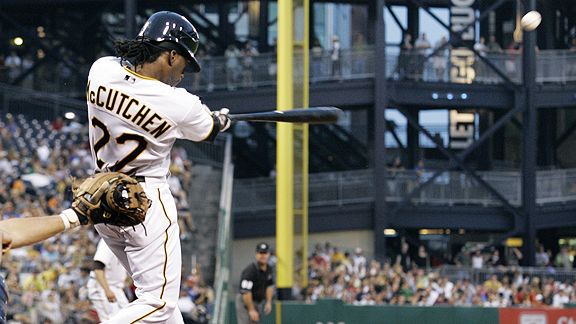
McCutchen struggled in August but has gotten his groove back (ESPN)
For much of the summer, Andrew McCutchen seemed to have a stranglehold on the National League MVP race.  His Pirates were winning, his stats were off the charts, and he was unquestionably the best player in the Senior Circuit.  From May 8th through August 8th, a span of 81 games (exactly half a season) he batted .393, belted 23 home runs, and slugged .700 (by comparison, Mike Trout batted .335 with 19 home runs and a ..611 slugging percentage during that same timeframe). The dread-locked five tool stud had developed into this year's Matt Kemp, a beast at the plate, on the basepaths and in the field.  This stellar all-around performance helped push Pittsburgh into the playoff hunt, for they led the second wild card with less than two months to go.


But then McCutchen cooled off, and the Bucs followed suit.  Over the next month 'Cutch batted a miserable .231 with only one home run, a summer swoon that may end up costing him his Most Valuable Player trophy.  Meanwhile the Pirates sputtered, enduring another late season collapse as the wheels came off their once promising season.  16 games above .500 as recently as six weeks ago, they're now saddled with losing record for the first time since late May.  They have been the worst team in the National League over that span and yes, that means even the lowly Houston Astros have outplayed them.  As a result, Pittsburgh's playoff chances have plummeted to half a percent.  They trail St. Louis for the second wild card by 5.5 games with 13 left to play, and barring some last-minute divine intervention will fall short of the postseason.  Now all the Bucs can do is try to avoid their 20th consecutive losing season dating back to the departure of Barry Bonds.

While the Pirates continued to fade in September, McCutchen is doing everything he can to keep their slim playoff hopes alive.   After that lengthy power outage the 25 year-old has re-emerged and once again looks locked in at the plate.  With six home runs in his previous eleven games, the Pirates center fielder has vaulted himself back into the MVP race with Ryan Braun and Buster Posey.  He now leads the National League in runs (102), hits (185) and bWAR (6.8--tied with Yadier Molina).  The two-time All-Star smacked his 30th home run of the season in yesterday's 9-7 loss to Milwaukee with a three-run jack off Mike Fiers, putting him on track to reach the century mark in RBI by the end of the season (he has 92).  Heck, with a strong finish he could still potentially wrestle the batting title away from Melky Cabrera, whom he trails .346 to .339.

Like Kemp last year, McCutchen clearly deserves the hardware based on his magnificent individual performance. The question is, will the voters overlook his team's horrific play during the season's most crucial  stretch?  Kemp was victimized by the Dodgers' lackluster record last season, but hopefully McCutchen will not suffer the same fate.  Unlike Los Angeles, the Pirates were in contention for much of the year, and that should still count for something even if they end the year with a losing record.

Besides, stiffing McCutchen would just add insult to injury for the Pirates and their fans, who have been forced to watch the same bad movie two seasons in a row. Last year they watched their team surge into first place in late July.  It didn't matter that their success was unsustainable, or that they lacked the pitching depth and offensive firepower necessary to survive the dog days of August. It made for great drama, and PNC park filled up with fans hoping the Pirates could at least   They were the talk of the town, the feel good story of the summer. And then, suddenly, they weren't.  After dropping a 19 inning marathon in Atlanta, the Pirates turned into pumpkins.  They were the worst team in the National League from July 25th onward as they skidded to a 72-90 record.  They never again won more than two games in a row.  The magic show was over.

And as their season went south, so did McCutchen's.  Following an impressive first half (.894 OPS), he disappeared after the All-Star Break.  Opponents took advantage of his weak supporting cast and pitched around him, but an impatient McCutchen abandoned his plate discipline and started going fishing.  You could see the face of the franchise pressing, trying to save Pittsburgh's season single-handedly. The pressure of trying to keep a sinking ship afloat seemed to wear him down.  The budding superstar limped to the finish line, batting an anemic .216/.330/.392 while striking out in more than a quarter of his at-bats.

This time around, McCutchen is ending his season on a high note.  It probably won't be enough to salvage Pittsburgh's season, but it should be enough to push him over the top in the MVP race.
.