In past years I've looked at where writers went wrong in determining MVP and Cy Young winners. Now I re-examine their missteps in the Rookie of the Year races.
2000 AL Kazuhiro Sasaki over everyone else
Of the nine American Leaguers who received votes, Sasaki ranked seventh in bWAR with 1.3. He had a nice season with a 3.16 ERA (146 ERA+), 1.17 WHIP, 11.2 K/9 rate and 37 saves in 40 attempts, but hardly a great one (4.30 FIP, 2.52 K/BB ratio). I'm more impressed by third-place Mark Quinn, who hit .294/.342/.488 with 20 home runs in a tough hitter's park in Kansas City, and runner-up Terrence Long, who batted .288/.336/.452 with 18 homers and 104 runs in an even tougher park in Oakland. Meanwhile, Sasaki benefited enormously from Safeco Field, where he had a 1.60 ERA and 0.92 WHIP as opposed to a 4.97 ERA and 1.45 WHIP everywhere else. I'm generally opposed to relievers winning awards because they pitch so infrequently and can't impact games nearly as much as position players. There are exceptions, of course, of a reliever has a truly outstanding season or if it's a weak year for position players, but Sasaki's year definitely doesn't qualify as "outstanding"; he wasn't even one of the top 60 relievers per fWAR.
2002 NL Jason Jennings over Austin Kearns
Jennings might be the most mediocre Rookie of the Year in recent memory. How he won with a 4.52 ERA, 4.68 FIP, and 1.46 WHIP is beyond me (think it had something to do with that 16-8 record of his?). Granted, he pitched half his games at Coors Field during the height of the steroid era, so his numbers weren't quite as bad as they seemed, but they're still very mediocre. Outfielders Brad Wilkerson and Austin Kearns, who finished second and third, respectively, had better cases. Wilkerson whacked 20 home runs, scored 92 runs, and worked 81 walks while slashing .266/.370/.469 (117 OPS+) and playing 153 games for the Montreal Expos, including 73 in center field. Kearns, a right fielder, only played 107 games but raked when he suited up, batting .315/.407/.500 (134 OPS+) with 13 home runs. Those are huge rate stats for a rookie, even after adjusting for the era. Seeing as how Kearns was worth 4.1 bWAR for Cincy while Wilkinson was only worth 1.2, the former deserved to win (Jennings was worth 2.7, for what it's worth).
2003 NL Dontrelle Willis over Brandon Webb
Remember them? Willis and Webb were two tremendous young pitchers who flamed out before they were 30. Both debuted in 2003 with incredible promise, culminating in the Rookie of the Year going to Willis while Webb finished third. Looking, back, it's clear Webb should have won. Not only did he pitch 20 more innings than Willis, but his ERA was nearly half a run lower despite pitching in a much better park for hitters. As such, Webb's 165 ERA+ dwarfed Willis's 127 mark. Webb also held a sizable advantage in pitching bWAR (6.2 to 3.9) and WHIP (1.15 to 1.28) with slight edges in FIP, strikeout rate, and K/BB rate. So why did the writers choose Willis? He went 14-6 while Webb was barely above .500 at 10-9, primarily because he played for a better team. Willis won because of narrative, as he helped pitch his Marlins to the postseason and World Series glory while Webb starred for a .500-ish D-backs squad. Furthermore D-Train, an electric 21 year-old southpaw, was more exciting to watch than Webb, who was three years older and more polished.
2006 AL Justin Verlander over everyone else
Not sure why Verlander was the runaway winner here when Jonathan Papelbon and Francisco Liriano both had better cases. I think it's because the hard-throwing Verlander went 17-9 and pitched the previously mediocre Tigers to the World Series, even though his other numbers weren't really anything special (1.33 WHIP, 4.35 FIP, 2.07 K/BB ratio). Jonathan Papelbon, the runner-up, was literally unhittable, what with his 0.92 ERA (that's not a misprint) and 517 ERA+, not to mention a 0.77 WHIP, 2.14 FIP and 5.77 K/BB ratio. He had a five-win season, which is nearly impossible for a reliever to attain given their workload. Third-place Francisco Liriano was also way better than Verlander on a per-inning basis and pitched more than twice as many innings as Papelbon, albeit still 65 fewer than Verlander. Even so, His 2.16 ERA (208 ERA+), 1.00 WHIP, 2.55 FIP and 4.5 K/BB ratio all put Verlander to shame. Even though Liriano made just two starts after August 1st, he was still worth more than Verlander per bWAR (as was Papelbon). It's true that Verlander pitched wire-to-wire while Liriano and Papelbon made only one appearance in September, but if anything his late season performance should be held against him, as he faltered down the stretch with a 5.86 ERA over his final nine starts. Had Liriano just stayed healthy, I think he beats out Verlander.
2010 AL Neftali Feliz over Austin Jackson
The 22 year-old Feliz was a top 10 reliever, finishing a league-high 59 games with a 2.73 ERA (165 ERA+), 2.96 FIP, 0.88 WHIP, and 40 saves in 43 chances. He also struck out more than a batter per inning and totaled nearly four times as many strikeouts as walks. While Feliz was more dominant compared to his fellow relievers, Jackson was more than twice as valuable with 5.1 bWAR to Feliz's 2.3. Jackson, a top 10 center fielder, batted .293/.345/.400 (102 OPS+), scored 103 runs, and stole 27 bases in 33 attempts in addition to his strong defense at a premium position. I suspect the writers dinged Jackson for his meager four home runs and 41 RBI, but I'll take the everyday center fielder and leadoff man over a one-inning reliever any day.
Showing posts with label 2000s. Show all posts
Showing posts with label 2000s. Show all posts
Friday, December 26, 2014


Tuesday, October 28, 2014
The Dubious History of the Hank Aaron Award
Yesterday's post about Giancarlo Stanton and Mike Trout winning this year's Hank Aaron awards got me thinking about past award winners and whether or not they were deserving. I was surprised to find that in many years the winner was not truly the most outstanding offensive performer, as voters were oftentimes seduced by big home run and RBI totals. See for yourself:
(It's worth noting that the voting procedure for this award has changed constantly since its inception in 1999. See a detailed history here).
1999 NL Sammy Sosa over everyone else
Slammin' Sammy's 397 total bases and 89 extra base hits led all of baseball, but with 5.0 oWAR he was barely one of the NL's ten best offensive performers. Larry Walker, winner of baseball's sabermetric Triple Crown, would have made a better choice, as would have Mark McGwire, the major league leader in home runs (65) and OPS+ (176). NL MVP Chipper Jones would have been a good one as well with his league-leading 7.9 oWAR and 165 runs created. Sabermetricians would have preferred Jeff Bagwell, the NL-leader in walks, runs, and times on base. I'm torn between Bags and Big Mac, but in either case it's clear Sosa should not have won.
2001 AL Alex Rodriguez over Jason Giambi
With his league-leading 52 home runs, 393 total bases, 87 extra base hits, and 9.2 oWAR, Rodriguez was absolutely worthy. But to me, at least, it's pretty clear that Giambi was more deserving. Giambi was right behind him in oWAR with 8.7, had just as many extra base hits, and was third in total bases. But that's just the tip of the iceberg, because Giambi paced the AL in many categories. He was first in OBP (.477) and slugging (.660), resulting in a whopping 199 OPS+ and 1.137 OPS that was almost 100 points higher than the next-closest American Leaguer (Jim Thome). Giambi was also tops in doubles with 47, walks with 129, runs created with 171, and times on base with 320. The counting stats favor Rodriguez slightly, but the rate stats say Giambi was way better, especially after taking into account their home ballparks (A-Rod in Texas and Giambi in Oakland).
2002 AL Alex Rodriguez over Jim Thome
Rodriguez once again posted monster numbers with Texas, leading the major leagues with 57 home runs, 142 RBI, and 389 total bases. But as in 2001, there was a slugger with similar counting stats and far better rate stats who deserved the award. This time, it was Jim Thome, the American League leader in slugging (.677), OPS (1.122--more than 100 points higher than A-Rod's), OPS+ (197), walks (122), and runs created (155). The advanced stats say Thome was better, and I'm inclined to agree with them.
2003 AL Alex Rodriguez over Carlos Delgado
For the third year in a row, Rodriguez enjoyed a tremendous offensive season but was not the best in his league. This time he was outdone by Delgado, who won the award in 2000. Delgado, then with the Toronto Blue Jays, posted the league's second-highest OBP (.426), slugging (.593), oWAR score (6.5), home run total (42), and walk total (109), plus topped the Junior Circuit in OPS (1.019), OPS+ (161), RBI (145), runs created (152), and times on base (300). Very close here, as Rodriguez did lead in runs, homers, slugging, oWAR, and AB/HR, but Delgado had the better year from an offensive standpoint.
2003 NL Albert Pujols over Barry Bonds
With all apologies to Prince Albert, who had a hell of a season, this award should have gone to the man who batted .341/.529/.749 (a 1.278 OPS!) with 45 home runs, 148 walks, and 8.6 oWAR, even if he was taking performance enhancing substances.
2005 AL David Ortiz over Alex Rodriguez
One look at the leaderboards this year tells you all you need to know. Ortiz led the league in RBI (148), extra base hits (88), and a trio of advanced metrics (WPA, RE24, and REW). A-Rod led in just about everthing else. For starters, his league-leading 9.4 oWAR dwarf's Ortiz's, which didn't even crack the top 10. Rodriguez also topped the Circuit in slugging (.610), OPS (1.031), OPS+ (173), runs (124), homers (48), runs created (163), and times on base (301) while finishing second in a bunch of other categories (AB/HR, Power-Speed, total bases, batting average, and OBP). A-Rod beat out Big Papi in the league MVP voting, and he should have done the same here.
2005 NL Andruw Jones over Derrek Lee
Jones had the flashier power numbers with a league-leading 128 RBI and ML-best 51 big flies, but with a .263 batting average and .347 OBP was hardly worthy of the honor. He didn't even finish in the league's top 10 in runs created, OPS, or oWAR. Lee's 46 homers and 107 RBI weren't quite as splashy, but his overall body of work was much stronger that year. He was undoubtedly the best hitter in baseball, topping the bigs in doubles (50), batting average (.335), slugging (.662), OPS (1.080), OPS+ (174), total bases (393), extra base hits (99) and runs created (167). He also led the National League in hits (199) and oWAR (7.2).
2006 AL Derek Jeter over David Ortiz
Jeter led the league in oWAR and times on base, with 7.1 and 295, respectively, but his season was nowhere near as dominant as Big Papi's. Ortiz led the league in a host of categories, winning two-thirds of the Triple Crown with 54 dingers and 137 RBI while batting .287/.413/.636, giving him the league's second-best slugging percentage, seventh-best OBP, and third-best OPS. He also led the league in walks with 119, total bases with 355, runs created with 152, and AB/HR with 10.3. He also placed second to Jeter in times on base and second to Grady Sizemore in extra base hits. Seeing as how this was the year Justin Morneau walked away with MVP honors, it was a tough season awards-wise.
2007 NL Prince Fielder over Matt Holliday
In a redux of the 2005 vote, Fielder won on the strength of his huge power numbers (including a league-best 50 homers) even though Holliday had the superior all-around numbers. Cecil Fielder's son only led the NL in one other category--WPA--while Holliday placed first in several, such as batting average (.340), hits (216), doubles (50), total bases (386), RBI (137), extra base hits (92), and runs created (151). Fielder was better than Jones in '05 and Holliday wasn't quite as good as Lee, but even after dinging Holliday for Coors Field he still comes out ahead.
2008 AL Kevin Youkilis over Alex Rodriguez
Not sure what happened here, as Youkilis did not lead the American League in a single offensive statistic. Rodriguez, meanwhile, was tops in oWAR (6.5) and slugging (.573) while placing second in OPS (.965) and OPS+ (150) as well as power-speed, adjusted batting runs and wins, and offensive win percentage. A-Rod wasn't the clear favorite, as one could make a case for Josh Hamilton, Milton Bradley, and Joe Mauer as well, but he was definitely better than Youk.
2008 NL Aramis Ramirez over Albert Pujols
This has to be one of the most questionable selections in the history of the award. Ramirez had a fine season, batting .289/.380/.519 with 27 home runs and 111 RBI, but failed to lead the league in any significant statistic. Pujols, the National League MVP, had perhaps his best offensive season. All the Machine did was bat .357/.462/.653 and lead the major leagues in slugging, OPS (1.114), OPS+ (192), total bases (342), oWAR (7.4), runs created (160), and times on base (296). Pujols should have been a no-brainer, and the fact that he didn't win that year blows my mind.
2009 AL Derek Jeter over Joe Mauer
Jeter was magnificent in 2009, batting .334/.406/.465 with 212 hits and 30 steals, but he was not the best offensive performer in the American League that year. Not by a long shot. Jeter didn't lead the league in anything besides times on base (289), and wasn't even the best hitter on his own team (Mark Teixeira, the MVP runner-up, was). League MVP Joe Mauer should have been an easy choice after he won the Junior Circuit's sabermetric Triple Crown with his .365/.444/.587 line, making him the only American Leaguer with a four-point OPS. Mauer also paced the league in oWAR (7.6), OPS+ (171), and runs created (138), too name a few. This is just another example of Jeter being overrated. Mauer Power was robbed.
2010 AL Jose Bautista over Miguel Cabrera
Joey Bats was not the American League's top offensive performer in spite of his major league-leading 54 big flies and 351 total bases. Cabrera didn't hit as many bombs but still had the superior offensive season, with his 1.042 OPS (just two points shy of Hamilton for the league lead) clocking in at nearly 50 points higher than Bautista's .995 mark. Furthermore, Miggy led the league with his 126 RBI, 420 OBP, 178 OPS+, 141 runs created, and 272 times on base. He was also second in extra base hits, total bases, runs scored, slugging, and batting average.
2012 NL Buster Posey over Ryan Braun
I was all in on Posey for MVP that year, but I don't think he was the league's top offensive performer despite leading the majors in batting average (.336) and OPS+ (171). I believe Braun, who topped the Circuit in runs (108), homers (41), OPS (.987), total bases (356), extra base hits (80), runs created (142), and power-speed #, was.
That's 14 of the 32 selections to date--not a very good success rate. As you can see the awards have been more accurate over the past five or so years, which hopefully means the iffy years of the award's early history are behind us. One thing's for certain; at least Derek Jeter will never steal another one of these awards from a more deserving player ever again.
Sunday, August 3, 2014
Thome Retires with Tribe
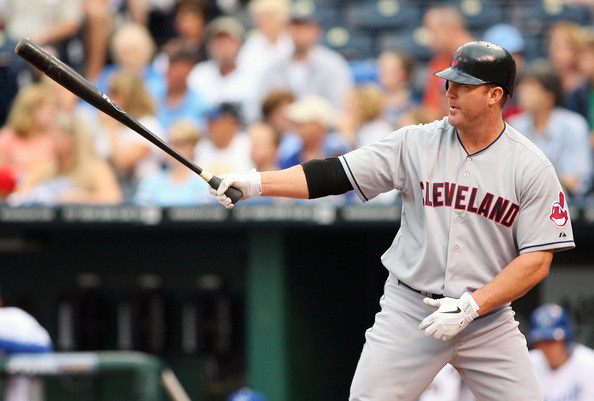
Jim Thome, the most recent member of baseball's 600 home run club and eighth to join, announced his retirement yesterday after signing a one-day contract with the Cleveland Indians, marking the end of his incredible 25 year baseball journey.
Thome, who last played in 2012, came full circle by going out with Cleveland, the team that drafted him in the 13th round of the 1989 amateur draft. Two years later he was in the big leagues for a cup of coffee, a September call-up who on October 4th launched the first of his 612 career home runs, taking Steve Farr of the Yankees deep at the Stadium.
It didn't take long for Thome's trademark power and batting eye to emerge, and by 1994 he was the club's everyday third baseman. Despite the player's strike he still managed to pop 20 homers, something he would do in every season but one through 2010. A key member of the great Indians squads of the 1990s, Thome won his first and only Silver Slugger at the hot corner in 1996 before moving across the diamond the following year to accomodate Matt Williams. Thome responded with his first 40-homer season and All-Star appearance, the first of six and five, respectively.
While more than half of Thome's regular season home runs would come in an Indians uniform (his 337 with Cleveland are a franchise record, nearly 100 more than second place Albert Belle's 242), all of his postseason long balls benefitted Cleveland. A dynasty that never was, the Tribe made the playoffs six times from 1995 through 2001, reaching the World Series twice but losing both times. A driving force behind those great teams, Thome compiled some impressive playoff statistics along the way. The 6'4, 250 pound behemoth cranked 17 home runs (tied with David Ortiz for seventh all-time) and knocked in 36 over the course of 11 different postseason series with Cleveland, showcasing his monster power on the game's biggest stage. Unfortunately for him and through no fault of his own, the Indians were unable to win the big one. Thome would go on to play in four postseasons after leaving Cleveland, but never again would he come to bat in the World Series or go yard in a playoff game.
Thome left Cleveland after the 2002 season--the best of his career--in which he batted .304/.445/.677 with 52 homers, 118 RBI and 122 walks, good for 7.4 bWAR, a league-high 197 OPS+ and a seventh place finish in the AL MVP voting. Thome capitalized, parlaying those monster numbers into a six-year, $85 million deal with the Phillies. He continued to produce huge power numbers in Philly, tying Alex Rodriguez for the major league lead in home runs with 47 in 2003 and belting 42 more the year after that. In 2005 he had his first off year, starting slow out of the gates and then getting hurt before he was shut down for the season in August. His replacement, a young but equally large slugger named Ryan Howard, came up and smashed 22 big flies in roughly half a season, enough to win NL Rookie of the Year honors and convince Phillies management he was the first baseman of the future.
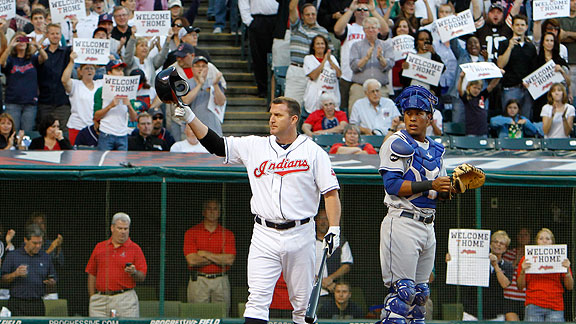
Thome was traded to the White Sox, where he won AL Comeback Player of the Year and made his last All-Star appearance in 2006, reaping the benefits of the homer-friendly U.S. Cellular Field. Late in the 2009 season he was traded to the Dodgers, who were seeking a big bat for the stretch run. He did nothing with LA, bounced back to have one last big season in 2010 with Minnesota (25 home runs, 1.039 OPS), and after that was basically a spare part. He played his last game as a member of the Baltimore Orioles, with whom he crushed his 612th and final career home run on September 26th, 2012 at the age of 42. Though Thome was limited to part-time duty in his final few seasons, he remained an effective hitter to the end because of his power and on-base ability. After his disastrous 2005 season, Thome's OPS+ never dipped below 112.
After spending his first dozen seasons with Cleveland Thome bounced around a lot, changing teams seven times in the second half of his career and even returning to the Rock and Roll Capital of the World briefly in 2011. Nevertheless, he left a tremendous legacy with his original team, where he's tops in home runs and walks and top-five in most offensive categories.
But Thome is more than one of the greatest Indians of all-time: he's one of the best sluggers in baseball history. An offensive force for two decades (think Harmon Killebrew with longevity), Thome is absolutely a first-ballot Hall of Famer. There are the 612 home runs, of course (not including the 17 he hit in the postseason), a record for first basemen and seventh-most all-time. He knocked in nearly 1,700 runs and scored almost 1,600 others. He reached base 4,144 times, more than Jimmie Foxx, Rod Carew, and Reggie Jackson. His .956 career OPS is the 18th-highest mark in baseball history. He ranks 24th all-time in slugging percentage and RBI, 23rd in runs created, and 20th in extra base hits. His 13.8 AB/HR ratio has been bettered by three men; Mark McGwire, Babe Ruth, and Barry Bonds.
Still not convinced? He had eight seasons with at least 30 dingers and 100 runs, walks, and RBI, two more than Albert Pujols and Stan Musial combined. From 1994, Thome's first full season, through 2012, he outhomered everyone not named Alex Rodriguez (an admitted steroid user) and walked more often than anyone besides Barry Bonds (also juiced). Only Rodriguez and Manny Ramirez, both busted PED offenders, piled up more RBI. A-Rod, Derek Jeter, Johnny Damon, and Chipper Jones were the only ones to score more runs. Per JAWs, Thome's one of the ten-best first basemen of all-time, with virtually the same number of bWAR that Frank Thomas accumulated in his career. The Big Hurt, who actually spent more time as a DH, just sailed into the Hall on his first try with over 90 percent of the vote.
Thomas is actually a very good comparison for Thome and comes up as his second-best comp after Sammy Sosa. Their careers overlapped for many years and they both reached the 500 home run milestone in 2007, each without a whisper of PED use despite their huge power numbers in the heart of the steroid era. Thome had better luck with injuries and so he lasted a little longer, but as you can see their numbers are very similar:
Thomas 1990-'08: 10,075 PA 521 HR 1,704 RBI 1,667 BB .301/.419/.555 156 OPS+ 73.7 bWAR
Thome 1991-'12: 10,313 PA 612 HR 1,699 RBI 1,747 BB .276/.402/.554 147 OPS+ 72.9 bWAR
Thomas was better than Thome, but only by the slimmest of margins. In Fact, JAWs has Thomas as the ninth-best first baseman of all-time and Thome barely behind him at tenth. So if Thomas truly is a deserving first ballot Hall of Famer (which he is), then Thome has to be, too. He's just as worthy of that honor as he is of the new eight-foot bronze statue at Progressive Field.
Monday, June 9, 2014
Vada Damon or Johnny Pinson?
 |
| Pinson (left) pictured with Reds teammates Gus Bell and Frank Robinson |
Pinson: 2,469 G, 9,645 AB, 2,757 H, 485 2B, 127 3B, 256 HR, 1,169 RBI, 4,264 TB, 54.1 bWAR
Damon: 2,490 G, 9,736 AB, 2,769 H, 522 2B, 109 3B, 235 HR, 1,139 RBI, 4,214 TB, 56 bWAR
Then there are their batting lines, which mirror each other almost perfectly. Pinson batted .286/.327/.442, good for a .769 OPS and 111 OPS+. Damon batted .284/.352/.433, compiling a .785 OPS and 104 OPS+. Pinson was worth 54.7 oWAR, less than one win behind Damon's 55.4 oWAR. FanGraphs also has their career offensive values nearly even, with scores of 144.4 for Pinson and 131.7 for Damon.
Here are some more similarities:
- Both were talented all-around centerfielders who threw lefthanded and batted from the left side.
- Both wore uniforms that were red and white. They also donned Pinstripes.
- Both spent time with the Cleveland Indians and the Kansas City Royals. They also played for an American League team based in California; Pinson with the Angels and Damon with the A's.
- Both played partial seasons in their rookie years, then became regulars in their second seasons.
- Both were exceptionally durable. Damon played at least 140 games in 16 straight seasons, while Pinson eclipsed 130 in 14 consecutive seasons.
- Both had a dozen seasons with double digit home run totals, topping out at 24. Though they had good power, they were destined to be overshadowed by slugging teammates such as Frank Robinson, Manny Ramirez, David Ortiz, and Alex Rodriguez.
- Both had one season with more than 40 doubles.
- Both were fast runners and great basestealers, with Damon swiping over 400 and Pinson exceeding 300. Damon had 10 seasons with at least 20 steals, Pinson had nine. Pinson was caught 122 times to Damon's 103.
- Neither walked all that much, and so neither one attained an OBP higher than .390 in any season.
- Pinson was punked 54 times, Damon was hit by 50 pitches.
- Damon dropped 57 sacrifice hits, Pinson laid down 52. Pinson had 78 sacrifice flies, Damon had 71.
- Both players led the major leagues in runs one time each; Pinson with 131 in 1959 and Damon with 136 in 2000 (narrowly beating out Alex Rodriguez's 134). Since both spent the bulk of their careers batting at or near the top of the order, they scored lots of runs (1,365 for Pinson, 1,668 for Damon).
- Pinson drew MVP votes five times, Damon four.
- Damon batted better than .300 five times, Pinson four.
- Pinson had an OPS+ over 100 12 times, Damon did so 11 times.
- Both were fine defenders in their early years but ultimately had negative defensive value over the course of their careers.
- Neither one ever struck out 100 times in any season, but both had several close calls (three seasons with 90+ K's apiece). Pinson fanned 1,196 times, whereas Damon whiffed 1,257 times.
Not surprisingly, Damon rates as Pinson's second-most similar player (after Steve Finley), and Pinson is Damon's closest comp. In my mind Pinson's power edge made him a better player at their respective peaks, and even though Damon did it longer I'd still take Pinson by a nose. Pinson at his best was comparable to Andrew McCutchen or Roberto Clemente: a legit MVP candidate and hit third in Cincinatti's loaded lineup. In his prime he was better than Damon, who was more of a complementary player and table setter.
But to Damon's credit, few players have been as steady or consistently good as he was, and that counts for something too.
| Damon won a World Series and established his career high in home runs with NY |
Thursday, January 17, 2013
Best Pitching Season of the 2000s
 |
| Martinez was at the top of his game in 2000 (FanNation) |
The 2000s will be remembered for performance enhancing drugs and high levels of run-scoring, but the truth is that there were a host of incredible pitching performances during the aughts as well. Randy Johnson, Johan Santana, Zack Greinke, Tim Lincecum and Roy Halladay, to name a few, all put up some remarkable numbers. But none of them can hold a candle to the maestro who spoiled the Fenway Faithful with his electrifying starts.
2000 Pedro Martinez (11.4 bWAR)
I feel pretty comfortable saying that during the late 1990s and first few years of the new millennium Pedro Martinez was the best pitcher on the planet. I would even go so far to claim that, during his prime, he was the best pitcher in baseball history. Better than Sandy Koufax, Greg Maddux, Tom Seaver. More dominant than Roger Clemens, Nolan Ryan, and Justin Verlander. Given the context--Fenway Park as his home field, in a leaue with the Designated Hitter, during the highest offensive period in baseball history when steroids helped hitters put up videogame numbers--his performance represents the highest peak for any pitcher in baseball history. Needless to say, Martinez should be a first ballot Hall of Famer when he comes up for election in 2015.
In the year Y2K, Martinez secured his third Cy Young award in four years, earning a unanimous vote (as he did the year before) for what I believe is the greatest season a pitcher ever had. He led the league in just about every category that matters and was the most valuable player in baseball that year according to bWAR. In many ways this season was even better than his masterful 1999 campaign, for Martinez had a lower ERA and WHIP, more bWAR, threw more innings, and maintained a higher K/BB ratio in 2000. The numbers are staggering, and they back me up:
- Pedro posted the ninth highest single season bWAR total of any starting pitcher since 1900, including the fourth highest in the integrated era behind Steve Carlton (1972), Roger Clemens (1997) and Wilbur Wood (1971)
- His 0.74 WHIP rates as the best of all time, as does his 291 ERA+ (discounting Tim Keefe's 1880)
- Became the only pitcher in history to have more than twice as many strikeouts (284) as hits allowed (128)
- is 8.88 K/BB ratio ranks as the fourth best mark in the modern era, trailing Bret Saberhagen (11.0 in 1994), Cliff Lee (10.3 in 2010) and future teammate Curt Schilling (9.6 in 2002), but rates as the best mark for an American League pitcher while his 5.3 H/9 also ranks fourth
- On April 15th, his streak of ten consecutive starts with at least ten strikeouts, a major league record, came to an end when he whiffed nine Oakland A's. Interestingly, the streak originated against them on August 19th, 1999
- Recorded double digit strikeouts in 15 of his 29 starts, and had 9 six other times
- The Red Sox went 21-8 (.724) when Martinez pitched, 64-69 (.481) when he didn't. Somehow, he failed to receive a single first place MVP vote and finished fith behind sluggers Jason Giambi, Frank Thomas Alex Rodriguez, and Carlos Delgado
- In his six losses, Martinez averaged eight innings per start and had a 2.44 ERA, 0.79 WHIP, and 60/8 K/BB ratio
- On May 6th, Martinez came up on the short end of a 1-0 pitching duel with Steve Trachsel (the pitcher Mark McGwire took deep to break Roger Maris's home run record two years earlier) but fanned 17 Tampa Bay Devil Rays while going the distance. His next time out Martinez fired another complete game, this time wracking up 15 Ks in Baltimore as he two-hit the Orioles. His 32 whiffs in consecutive starts tied Luis Tiant's American League record set in 1968, the Year of the Pitcher
- His average GameScore was a 73
- Held opponents to a .167/.213/.259 triple slash line. The batting average and OBP set new modern records
- His best performance of the year came at the end of the summer in Tampa Bay. Facing the league's worst offense, albeit one that featured potent bats in Fred McGriff, Greg Vaughn, Jose Guillen and Aubrey Huff, Pedro began the game by plunking Gerald Williams. Williams charged the mound and dropped Martinez before Jason Varitek tackled his pitcher's assailant. Martinez got back up, dusted the dirt off his shoulders and proceeded to mow down the next 24 batters in a row. He took a no-hitter into the bottom of the ninth, only to lose it to John Flaherty, of all people, when the backstop roped a leadoff single with two strikes
- A road warrior, Martinez went 12-1 outside of Fenway's friendly confines
- Outside of a three-start stretch in the middle of the summer when he served up seven gopher balls, he allowed just ten home runs in his other 26 starts
- His 1.74 ERA was the league's lowest since 1978, when Ron Guidry also posted a 1.78 ERA. Martinez's mark is truly remarkable considering the park-adjusted league ERA was 4.97. His ERA was nearly two full runs higher than second place Roger Clemens' 3.70 and never rose higher than 1.81 that year
- Had just two starts all year--June 25th in Toronto and August 24th in Kansas City--when he allowed more than three earned runs. Look at his earned run breakdown:
0 runs--10 starts
1 run--7 starts
2 runs--5 starts
3 runs--5 starts
4+ runs--2 starts
Monday, December 31, 2012
NBA All Decade Team 2000s
PG Steve Nash--Edges out Jason Kidd, Chris Paul, and Tony Parker
SG Kobe Bryant--Over Manu Ginobili, Allen Iverson, Dwyane Wade, Ray Allen and Vince Carter
SF LeBron James--In a class by himself, but Carmelo Anthony, Tracy McGrady, and Paul Pierce are worthy of consideration as well
PF Tim Duncan--Really tough call between him, Kevin Garnett and Dirk Nowitzki. Pau Gasol's been great, too.
C Shaquille O'Neal--I'll take the former Superman over the current one (Dwight Howard) and Yao Ming, who just couldn't stay healthy.
Sunday, April 15, 2012
MLB All Decade Team 2000s
C Joe Mauer, Jorge Posada was just never as dominant
1B Albert Pujols
2B Chase Utley Also gave some thought to Jeff Kent
3B Alex Rodriguez didn't start playing third until 2004 but still edges Chipper Jones, David Wright and Adrian Beltre
SS Derek Jeter
OF Barry Bonds
OF Ichiro Suzuki Thought about the criminally underrated Bobby Abreu and Andruw Jones here, but the latter totally fell apart after 2006
OF Manny Ramirez over Vladimir Guerrero and Carlos Beltran
DH David Ortiz
RHP Roy Halladay
LHP Randy Johnson Gets the nod over Johan Santana and CC Sabathia
CL Mariano Rivera No contest, although Trevor Hoffman deserves to be in the conversation
Subscribe to:
Posts (Atom)