Showing posts with label Hank Aaron. Show all posts

Saturday, April 25, 2015

Baseball's Elite Eight

PED use aside, Bonds (left) and A-Rod are two of the greatest living ballplayers (NYPost)
So MLB.com is letting fans determine the four greatest living players in baseball history (a title Joe DiMaggio proudly but wrongly held from 1969 until his death in 1999). Only not really, because voters are selecting from a ballot of eight candidates, several of whom shouldn't be there. Several writers, Joe Posnanski chief among them, have already pointed out the lunacy of Sandy Koufax's inclusion, and by extension Pedro Martinez (who was a lot like Koufax, only with better developmental seasons and a handful of years tacked on at the end of his career). Johnny Bench seems to be an odd choice as well, and I probably wouldn't have given Tom Seaver much thought.

If I were in charge of creating the ballot, these are the eight guys I'd put on there:

Barry Bonds
Nobody had a career anything close to the one that Bobby Bonds's son did, which is why the most similar batter to him has a similarity score of only 761 (fun fact: it's his godfather). He leads the world in home runs and walks, has more MVPs than anybody, stole 514 bases, and was the best (or nearly so) defensive left fielder of all-time. 2000-2004 Bonds was the closest anyone has come to dominating the game like Babe Ruth since, well, Babe Ruth.

Roger Clemens
The pitching equivalent of Bonds is, in all likelihood, the best pitcher to ever grace this earth (check back with us in 15 years, Clayton Kershaw).  The crazy thing about Clemens is how he was so good for so long. He won his first Cy Young award and was named MVP in 1986 at age 23; He won his seventh and final Cy Young in 2004 at 41, was the major league ERA champion the next year, and had a 2.30 ERA (194 ERA+) the year after that.

Hank Aaron
Aaron may have ceded his title as the Home Run King to Bonds, but he's still number one all-time in RBI, total bases, and extra base hits. What blows my mind about Aaron is that he was so good for so long, drawing MVP votes every year from 1955 through 1973, but came away with only one MVP award. He finished third six times, but for some reason I'm just really surprised by that, especially since he kept raking even as offense disappeared in the 1960s.

Willie Mays
At his best, Mays was the best all-around ballplayer there ever was. He had 50-homer power, 40-steal speed, was a threat to win a batting title, and played center field better than anyone not named Andruw Jones. It's scary to think what he could have accomplished had he not lost two full seasons to military service and played in one of the worst possible offensive environments (Candlestick Park in the '60s) imaginable.

Randy Johnson
The Big Unit also had a Koufax-esque run for the ages in the late '90s/early '00s, earning four straight Cys and five in all. The nine-time strikeout champion punched up more K's than everyone besides Nolan Ryan, won over 300 games, and staked his claim as the best southpaw to ever take the bump (apologies to Koufax, Kershaw, and Lefty Grove).

Greg Maddux
Mad Dog matched the peak of Koufax (four consecutive Cys, 2.15 ERA over a seven-year stretch) while remaining healthy and durable enough to complete more than 5,000 innings. Think about it--that's averaging 250 innings per year for 20 years. Nobody today, not even of Mark Buehrle, is capable of that.

Rickey Henderson
Henderson may not have the as great as he thought/proclaimed he was, but he was still pretty damn good. Man of Steal stole more bases and scored more runs than anybody in baseball history, reached base over 5,200 times, swatted nearly 300 home runs, and swiped 100 bags or more in a season three times. Henderson, who maintained a .401 OBP over 25 seasons and 13,346 plate appearances, was also exceptional into old age, leading the league in walks and steals at 39 and batting .315/.423/.466 at 40.

Alex Rodriguez
If nothing else, Rodriguez is reminding us this year of the incredibly gifted player once considered the best all-around talent in baseball. From his Mike Trout-esque beginnings in Seattle to his towering seasons in Texas to his continued dominance in New York, Rodriguez has been a force in major league baseball for two decades now. He's done some incredible things along the way, like win five home run crowns and three MVP awards while playing top-shelf defense and stealing hundreds of bases. The sad thing is that he probably still could have done all those things without PEDs.

Of these eight, I'd vote for Bonds, Aaron, Mays, and Clemens. If the ballot could have stretched to 10 I would have included Mike Schmidt and probably Seaver, with Frank Robinson just missing the cut.

Friday, October 31, 2014

Youkilis Retires

Youkilis shows off hi bizarre hitting style (NYTimes)
After one season in Japan, former Red Sox corner infielder Kevin Youkilis is calling it a career.

Youkilis, known simply as Youk to Fenway Faithful, enjoyed a 10-year major league career, spending the first eight and a half of those seasons with Boston. Drafted by Dan Duquette in the eighth round of the 2001 draft, the disciplined third baseman received a new nickname--"Greek God of Walks"--from Billy Beane's Oakland A's organization. That patience would serve him well in the big leagues, where he maintained a robust .382 OBP and 12.2 BB%.

Youkilis arrived on the scene in 2004, just in time to help the beleaguered BoSox end their 86-year championship drought. He was a solid reserve on that team and the following year's squad, backing up Kevin Millar at first and Bill Mueller at third. Both left following the 2005 season, allowing Youkilis to inherit the everyday first baseman job with the Red Sox acquiring Mike Lowell, an All-Star third-sacker, in their trade for Josh Beckett.

Already 27 by that point, Youkilis was more than ready. He batted .279/.381/.429 in his first full season along with 42 doubles and a career-high 91 walks and 100 runs scored. He was even better the following year, improving from a three win player to a five win stalwart and earning his first and only Gold Glove.

More importantly, Youkilis sparked Boston to another World Series title that year. A non-factor in the '04 run with just two at-bats, he was one of the team's best hitters in '07 and proved crucial to their victory. Youk was especially lethal during Boston's come-from-behind ALCS victory over the Cleveland Indians, batting .500/.576/.929 with 14 hits, three home runs, seven RBI, and 10 runs scored. Against Colorado in the Fall Classic he capped off a terrific postseason in which he batted .388/.475/.755 with 19 hits in 14 games.

The following year, 2008, would be the best of Youk's career. He enjoyed a power breakthrough with 29 home runs--equaling his output from the previous two seasons combined--43 doubles, 306 total bases, and 115 RBI, all career highs. He also hit .312/.390/.569, made his first All-Star team, won the American League Hank Aaron Award, and finished third in the MVP race behind teammate Dustin Pedroia and Justin Morneau. Youkilis was instrumental in helping the Red Sox reach the postseason again, and enjoyed another monster LCS (1.008 OPS), but it was not enough as the Sox were outdone by the Rays in seven games.

Statistically, 2009 was just as good for Youkilis, who posted a .961 OPS and was worth 6.6 bWAR while making the All-Star team again and finishing sixth in the MVP polling. He was on track for similarly great numbers in 2010 when a torn abductor muscle in his right thumb ended his season at the beginning of August. The injury effectively marked the end of Youk's brief reign as one of the best players in baseball.

The final year of Youk's career were frustrating and tumultuous (CBSSports)
His career started heading south in 2011, his last full season with the Sox. He moved back to third base to accommodate Adrian Gonzalez but the position change likely did more harm than good, as Youkilis was again plagued by injuries during the second half. He missed 42 games in all and appeared in just 22 from August 1st on, batting a reduced .190 over that time. Had he been able to stay healthy or hit more effectively down the stretch, Boston likely would have won at least one more game and thus been spared the humiliation of its great September collapse.

In the wake of said meltdown, Youkilis lost the trust of his teammates due to suspicion that he had leaked the chicken and beer information to the press. 2012 quickly turned out to be a nightmare for him and the team, as he got off to a slow start, had his effort questioned by new manager Bobby Valentine, and spent more time on the Disabled List. In his absence rookie call-up Will Middlebrooks excelled, making Youkilis expendable in the eyes of the organization and giving them a convenient excuse to trade him away. Ben Cherington did just that, dealing Youkilis for two nobodies in return. In a fitting finale, Youkilis had two hits, including a triple, in the last game he ever played for the Red Sox.

He moved on to Chicago, where he hit better with the White Sox but not well enough to convince anybody that his glory days were coming back. That led to his signing a one-year deal with the Yankees, which turned out to be a huge bust when he got hurt yet again and appeared in just 28 games. Nobody wanted him when his contract expired, and he took off for Japan.

The end came hard and fast for Youkilis, as it does for many athletes in their early 30s. Youk was an All-Star at 32, cast-off at 33, and done at 34. It wasn't surprising he tailed off so fast given his physique and unmatched intensity. Nobody played the game harder or with more passion than Youkilis, and like a shooting star he burned out quickly. Injuries took their toll as well, but he was a great player when he did play and had a Hall of Fame peak, even if it was short-lived (three years). Though he didn't play much (barely 1,000 games) or for very long, he accomplished a hell of a lot during his all-too-brief career.

And he did it with one of the most unorthodox batting stances I've ever seen.

Tuesday, October 28, 2014

The Dubious History of the Hank Aaron Award

Yesterday's post about Giancarlo Stanton and Mike Trout winning this year's Hank Aaron awards got me thinking about past award winners and whether or not they were deserving. I was surprised to find that in many years the winner was not truly the most outstanding offensive performer, as voters were oftentimes seduced by big home run and RBI totals. See for yourself:

(It's worth noting that the voting procedure for this award has changed constantly since its inception in 1999. See a detailed history here).

1999 NL Sammy Sosa over everyone else
Slammin' Sammy's 397 total bases and 89 extra base hits led all of baseball, but with 5.0 oWAR he was barely one of the NL's ten best offensive performers. Larry Walker, winner of baseball's sabermetric Triple Crown, would have made a better choice, as would have Mark McGwire, the major league leader in home runs (65) and OPS+ (176). NL MVP Chipper Jones would have been a good one as well with his league-leading 7.9 oWAR and 165 runs created. Sabermetricians would have preferred Jeff Bagwell, the NL-leader in walks, runs, and times on base. I'm torn between Bags and Big Mac, but in either case it's clear Sosa should not have won.

2001 AL Alex Rodriguez over Jason Giambi
With his league-leading 52 home runs, 393 total bases, 87 extra base hits, and 9.2 oWAR, Rodriguez was absolutely worthy. But to me, at least, it's pretty clear that Giambi was more deserving. Giambi was right behind him in oWAR with 8.7, had just as many extra base hits, and was third in total bases. But that's just the tip of the iceberg, because Giambi paced the AL in many categories. He was first in OBP (.477) and slugging (.660), resulting in a whopping 199 OPS+ and 1.137 OPS that was almost 100 points higher than the next-closest American Leaguer (Jim Thome). Giambi was also tops in doubles with 47, walks with 129, runs created with 171, and times on base with 320. The counting stats favor Rodriguez slightly, but the rate stats say Giambi was way better, especially after taking into account their home ballparks (A-Rod in Texas and Giambi in Oakland).

2002 AL Alex Rodriguez over Jim Thome
Rodriguez once again posted monster numbers with Texas, leading the major leagues with 57 home runs, 142 RBI, and 389 total bases. But as in 2001, there was a slugger with similar counting stats and far better rate stats who deserved the award. This time, it was Jim Thome, the American League leader in slugging (.677), OPS (1.122--more than 100 points higher than A-Rod's), OPS+ (197), walks (122), and runs created (155). The advanced stats say Thome was better, and I'm inclined to agree with them.

2003 AL Alex Rodriguez over Carlos Delgado
For the third year in a row, Rodriguez enjoyed a tremendous offensive season but was not the best in his league. This time he was outdone by Delgado, who won the award in 2000. Delgado, then with the Toronto Blue Jays, posted the league's second-highest OBP (.426), slugging (.593), oWAR score (6.5), home run total (42), and walk total (109), plus topped the Junior Circuit in OPS (1.019), OPS+ (161), RBI (145), runs created (152), and times on base (300). Very close here, as Rodriguez did lead in runs, homers, slugging, oWAR, and AB/HR, but Delgado had the better year from an offensive standpoint.

2003 NL Albert Pujols over Barry Bonds
With all apologies to Prince Albert, who had a hell of a season, this award should have gone to the man who batted .341/.529/.749 (a 1.278 OPS!) with 45 home runs, 148 walks, and 8.6 oWAR, even if he was taking performance enhancing substances.

2005 AL David Ortiz over Alex Rodriguez
One look at the leaderboards this year tells you all you need to know. Ortiz led the league in RBI (148), extra base hits (88), and a trio of advanced metrics (WPA, RE24, and REW). A-Rod led in just about everthing else. For starters, his league-leading 9.4 oWAR dwarf's Ortiz's, which didn't even crack the top 10. Rodriguez also topped the Circuit in slugging (.610), OPS (1.031), OPS+ (173), runs (124), homers (48), runs created (163), and times on base (301) while finishing second in a bunch of other categories (AB/HR, Power-Speed, total bases, batting average, and OBP). A-Rod beat out Big Papi in the league MVP voting, and he should have done the same here.

2005 NL Andruw Jones over Derrek Lee
Jones had the flashier power numbers with a league-leading 128 RBI and ML-best 51 big flies, but with a .263 batting average and .347 OBP was hardly worthy of the honor. He didn't even finish in the league's top 10 in runs created, OPS, or oWAR. Lee's 46 homers and 107 RBI weren't quite as splashy, but his overall body of work was much stronger that year. He was undoubtedly the best hitter in baseball, topping the bigs in doubles (50), batting average (.335), slugging (.662), OPS (1.080), OPS+ (174), total bases (393), extra base hits (99) and runs created (167). He also led the National League in hits (199) and oWAR (7.2).

2006 AL Derek Jeter over David Ortiz
Jeter led the league in oWAR and times on base, with 7.1 and 295, respectively, but his season was nowhere near as dominant as Big Papi's. Ortiz led the league in a host of categories, winning two-thirds of the Triple Crown with 54 dingers and 137 RBI while batting .287/.413/.636, giving him the league's second-best slugging percentage, seventh-best OBP, and third-best OPS. He also led the league in walks with 119, total bases with 355, runs created with 152, and AB/HR with 10.3. He also placed second to Jeter in times on base and second to Grady Sizemore in extra base hits. Seeing as how this was the year Justin Morneau walked away with MVP honors, it was a tough season awards-wise.

2007 NL Prince Fielder over Matt Holliday
In a redux of the 2005 vote, Fielder won on the strength of his huge power numbers (including a league-best 50 homers) even though Holliday had the superior all-around numbers. Cecil Fielder's son only led the NL in one other category--WPA--while Holliday placed first in several, such as batting average (.340), hits (216), doubles (50), total bases (386), RBI (137), extra base hits (92), and runs created (151). Fielder was better than Jones in '05 and Holliday wasn't quite as good as Lee, but even after dinging Holliday for Coors Field he still comes out ahead.

2008 AL Kevin Youkilis over Alex Rodriguez
Not sure what happened here, as Youkilis did not lead the American League in a single offensive statistic. Rodriguez, meanwhile, was tops in oWAR (6.5) and slugging (.573) while placing second in OPS (.965) and OPS+ (150) as well as power-speed, adjusted batting runs and wins, and offensive win percentage. A-Rod wasn't the clear favorite, as one could make a case for Josh Hamilton, Milton Bradley, and Joe Mauer as well, but he was definitely better than Youk.

2008 NL Aramis Ramirez over Albert Pujols
This has to be one of the most questionable selections in the history of the award. Ramirez had a fine season, batting .289/.380/.519 with 27 home runs and 111 RBI, but failed to lead the league in any significant statistic. Pujols, the National League MVP, had perhaps his best offensive season. All the Machine did was bat .357/.462/.653 and lead the major leagues in slugging, OPS (1.114), OPS+ (192), total bases (342), oWAR (7.4), runs created (160), and times on base (296). Pujols should have been a no-brainer, and the fact that he didn't win that year blows my mind.

2009 AL Derek Jeter over Joe Mauer
Jeter was magnificent in 2009, batting .334/.406/.465 with 212 hits and 30 steals, but he was not the best offensive performer in the American League that year. Not by a long shot. Jeter didn't lead the league in anything besides times on base (289), and wasn't even the best hitter on his own team (Mark Teixeira, the MVP runner-up, was). League MVP Joe Mauer should have been an easy choice after he won the Junior Circuit's sabermetric Triple Crown with his .365/.444/.587 line, making him the only American Leaguer with a four-point OPS. Mauer also paced the league in oWAR (7.6), OPS+ (171), and runs created (138), too name a few. This is just another example of Jeter being overrated. Mauer Power was robbed.

2010 AL Jose Bautista over Miguel Cabrera
Joey Bats was not the American League's top offensive performer in spite of his major league-leading 54 big flies and 351 total bases. Cabrera didn't hit as many bombs but still had the superior offensive season, with his 1.042 OPS (just two points shy of Hamilton for the league lead) clocking in at nearly 50 points higher than Bautista's .995 mark. Furthermore, Miggy led the league with his 126 RBI, 420 OBP, 178 OPS+, 141 runs created, and 272 times on base. He was also second in extra base hits, total bases, runs scored, slugging, and batting average.

2012 NL Buster Posey over Ryan Braun
I was all in on Posey for MVP that year, but I don't think he was the league's top offensive performer despite leading the majors in batting average (.336) and OPS+ (171). I believe Braun, who topped the Circuit in runs (108), homers (41), OPS (.987), total bases (356), extra base hits (80), runs created (142), and power-speed #, was.

That's 14 of the 32 selections to date--not a very good success rate. As you can see the awards have been more accurate over the past five or so years, which hopefully means the iffy years of the award's early history are behind us. One thing's for certain; at least Derek Jeter will never steal another one of these awards from a more deserving player ever again.

Monday, October 27, 2014

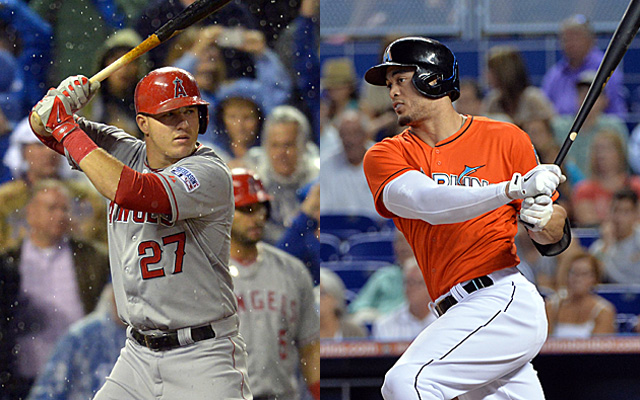
Stanton, Trout Deserved Hank Aaron Award

Trout (left) and Stanton earned some much-deserved hardware (SportsPyder)
While MLB awards season is not quite yet underway, there was some notable hardware handed out the other day. Before Game 4 of the World Series, Mike Trout and Giancarlo Stanton were named the 2014 winners of the Hank Aaron Award, presented by none other than Hammerin' Hank himself. Aaron votes for the award, as do the fans and a panel of Hall of Famers comprised of Roberto Alomar, Johnny Bench, Paul Molitor, Eddie Murray, Frank Thomas, and Robin Yount.

The award, which serves to recognize the best offensive performer in each league, was an easy call in the Junior Circuit. Trout was once again the most valuable position player in baseball, leading the sport in WAR and oWAR for the third straight year. His 137 runs created and 8.7 oWAR led both leagues, as did his 115 runs, 338 total bases, and 84 extra base hits. In addition to his American League-leading 111 RBI, he also swatted 36 home runs and 39 doubles to go along with his .939 OPS, good for a 167 OPS+. He unseated two-time defending champion Miguel Cabrera and should do the same in the MVP award as well.

Stanton was not quite as dominant as Trout but still had a phenomenal season in his own right, posting the fourth-highest OBP, SLG, and OPS in baseball. His 37 home runs, .555 slugging percentage and 299 total bases were tops in the National League, as were his 14.6 AB/HR ratio, 69 extra base hits, and 24 intentional walks. Per Baseball-Reference, only Andrew McCutchen--Stanton's closest competition for the award--had a higher Adjusted OPS+, more runs created, and a higher oWAR total than Stanton among National Leaguers. Had he not been beaned in the face with 17 games still remaining on the schedule, Stanton would have likely finished the season with around 40 home runs, 120 RBI, 100 runs and walks, and well over 300 total bases--gaudy totals that reflect just how dominant a year Stanton was having at the time of his injury.

One could certainly make the case that McCutchen was slightly more deserving in the Senior Circuit, but the numbers say they're a virtual toss up. Both FanGraphs and Baseball-Reference rate McCutchen as the slightly more valuable offensive player, and since he played just one more game than Stanton it's not like that difference can be chalked up to Stanton's injury. And while McCutchen only led Stanton by two points in OPS, the former's OPS was significantly more valuable after adjustments for league and park (eight point difference in OPS+, nine in wRC+) and when OBP and SLG are properly weighted (with 'Cutch ahead in wOBA .412 to .403). In terms of baserunning they come out about even, so that doesn't move the needle either way.

All things considered, McCutchen was probably more deserving by the slimmest of margins, but he and Stanton are so close that I can't blame the voters for being seduced by the latter's titanic big flies and monster power figures. Those kinds of numbers, especially in today's offense-challenged climate, are impossible to ignore. Stanton's season definitely felt more dominant, and with the benefit of a healthy September I think he beats McCutchen by a nose.

Just to wrap things up quickly here, Stanton and Trout are first-time winners but are likely to repeat given their age. Stanton is not yet 25 and Trout is just 23. Two of the most exciting talents in the game, both appear to have many fine seasons ahead of them.

Sunday, April 13, 2014

Can Anyone Catch Bonds?

Bonds's home run record will likely stand for a long time (NPR)
All this talk about Hank Aaron and Barry Bonds last week got me thinking: is there anyone in baseball right now who might finish his career as the all-time home run king? I took a look at the players I feel have the best chances, with their career home run totals in parentheses (not including today's games).

Alex Rodriguez (654)
A-Rod is closest, needing 108 round-trippers to tie Bonds, but that doesn't seem likely to happen for a variety of reasons. First, it's unclear whether Rodriguez will ever play again after missing the entire 2014 season because of his PED suspension. He turns 39 over the summer, and age combined with failing health (88 games per season over the past three) will make it difficult to return to his previous level of his excellence. Plus, nobody has ever hit 108 home runs after turning 39, though Bonds and a few others (Darrell Evans, Carlton Fisk) came close.

Albert Pujols (494)
Pujols is 34 but should have his 500th home run by the end of next month (he's currently sitting on 494, having just passed Fred McGriff and Lou Gehrig). In a vacuum Pujols appears to be in a good spot, since only Rodriguez, Jimmie Foxx and Sammy Sosa hit more home runs through age 33. However, it's highly unlikely that he'll hit the 268 home runs (as many as Brooks Robinson and Joe Morgan had in their entire careers) needed to catch Bonds seeing as how his home run totals have gone down every year since 2009. Bonds and Aaron are the only players that have done what Pujols needs to do, but whereas Aaron got a late kick from Atlanta's launching pad stadium and Bonds, um, got his late kick from something else, Pujols is stuck in a pitcher's park that's only going to take home runs away from him.

Miguel Cabrera (366)
Cabrera's been so good for so long (a decade of sustained excellence) that it's surprising how far he still has to go to catch Bonds. Off the top of my head, I would've guessed that Cabrera was past 400 already, but in reality he still may not be at 400 by the end of this season (he has 366 currently). That means he still needs to hit almost 400 home runs which, given his age (31 on Friday) is going to be virtually impossible. After turning 31, only Bonds and Babe Ruth have hit the number of home runs that Cabrera needs to hit to catch Bonds. Put another way, he needs to hit as many home runs as Joe Carter did in his whole career, which probably isn't going to happen.

Prince Fielder (285)
Cabrera's former teammate has 285 taters through his age 29 season, but that still leaves him almost 500 short of Bonds. With a body type that doesn't age well, Fielder won't have the longevity to approach 700 even if he becomes a full-time DH.

Jay Bruce (166)
Bruce, who just turned 27, had more home runs through his age 26 season than Babe Ruth, Reggie Jackson, Mark McGwire, Manny Ramirez, Lou Gehrig, Barry Bonds, and Frank Thomas. He's helped by the fact that he broke in at 21 and showed power immediately, blasting 21 home runs that year (2008). His home run totals increased each year through 2012, peaking at 34 before dropping slightly to 30 in 2013. It also helps that he plays in a homer-friendly park and has been durable. Bruce is on track for 500-600 home runs, but 700 is going to be a challenge unless he can string together a few 40-50 homer seasons, which may be tough to do given how streaky and strikeout prone he is.

Giancarlo Stanton (121)
Just 24 and with 121 big flies under his belt, Stanton seems to have a good shot. He had the tenth-most home runs through age 23, but he would rank a lot higher on that list if he hadn't missed an average of 40 games per season in his first four years. In 2012, for instance, he slammed 37 home runs in just 123 games, which works out to be a 48-homer pace when projected out over 162 games. Stanton's light-tower power is well-documented and makes him a great candidate to break the record, but for a serious run at Bonds he has to stay healthier. It also wouldn't hurt if he could away from Miami's mammoth outfield dimensions.

Mike Trout (65)
Through age 21, only Mel Ott, Tony Conigliaro, Eddie Mathews, Frank Robinson, and Alex Rodriguez went deep more often than Trout. Including Conigliaro, whose career was tragically cut short by Jack Hamilton's beanball, the group's average home run total is 485.6. Ott and Mathews finished with near identical career totals (511 and 512, respectively) while Robinson reached 586 and Rodriguez is at 654 (and possibly still counting). That puts Trout in some pretty impressive company. Playing half his games in Anaheim hurts, but perhaps he will land a massive contract somewhere more hitter-friendly when his extension runs out.

Bryce Harper (43)
Harper hit 22 bombs as a 19 year-old and 20 more as a 20 year-old. Only Ott and Congiliaro homered more through the same age. Like Stanton, Harper has demonstrated massive power that should only improve as he reaches his prime years, but also like Stanton he must do a better job of staying healthy if he wants the all-time home run record.

Tuesday, April 8, 2014

Aaron's Anniversary

40 years ago today, a new home run king was crowned. Hank Aaron, 40 years old at the time took Al Downing deep for the 715th home run of his career, breaking Babe Ruth's record. In the four decades since only one other player--Barry Bonds--has hit as many in his career. Bonds, of course, would up with 762, seven more than Aaron.

Both needed late career surges to get there. Bonds averaged 52 home runs per year from age 35 through 39, belting 258 in all. Aaron averaged 41 per season over the same age span, adding 203 to his career total. Ruth was not far off, hitting 192 from age 35 to 39, though his run followed a more natural age pattern as his home run totals dropped every year, falling from 49 at 35 to 22 at 39.

(Ruth was very nearly matched by the ageless Rafael Palmeiro, who cranked 190 big flies from ages 35 to 39 and has the fourth most home runs in that age bracket. I never would have guessed who was fifth: none other than Andres Galarraga)

It's not surprising that the three greatest home run hitters of all-time were also the three best home run hitters from age 35 to 39. Most sluggers begin to experience a power drop-off in their early 30s, so anyone who can average 40-50 home runs in his late 30s is truly remarkable.

I guess my point is that in order to have what can be considered one of the best careers of all-time, you have to remain elite into your late 30s. It's not enough to be great when you're young because almost all great players are great when they're young. What separates the best from the rest is the ability to stay healthy and retain your skills as you approach 40. Most players fall apart and retire. The best keep plugging along without skipping a beat.

Aaron always said the home run chase was incredibly draining and took a lot out of him. Based on his numbers in the years leading up to his achievement, you wouldn't have thought so. But I do find it interesting that after Aaron broke the record, he got old very quickly. He hit 20 home runs in 1974--half as many as the season before--and posted the second-lowest batting average, OBP, slugging, OPS, and OPS+ of his career. The Braves, perhaps sensing he was slipping, traded him to the Brewers so he could finish his career in Milwaukee. In his time with the Brewers he was merely a shell of his former self--not even DHing could revive his bat--and he called it quits at 42. Starting the day after he broke Ruth' record, Aaron hit .244 and slugged .397 over the remainder of his career. I guess even the best old players get too old at some point.