Showing posts with label Barry Bonds. Show all posts

Saturday, April 25, 2015

Baseball's Elite Eight

PED use aside, Bonds (left) and A-Rod are two of the greatest living ballplayers (NYPost)
So MLB.com is letting fans determine the four greatest living players in baseball history (a title Joe DiMaggio proudly but wrongly held from 1969 until his death in 1999). Only not really, because voters are selecting from a ballot of eight candidates, several of whom shouldn't be there. Several writers, Joe Posnanski chief among them, have already pointed out the lunacy of Sandy Koufax's inclusion, and by extension Pedro Martinez (who was a lot like Koufax, only with better developmental seasons and a handful of years tacked on at the end of his career). Johnny Bench seems to be an odd choice as well, and I probably wouldn't have given Tom Seaver much thought.

If I were in charge of creating the ballot, these are the eight guys I'd put on there:

Barry Bonds
Nobody had a career anything close to the one that Bobby Bonds's son did, which is why the most similar batter to him has a similarity score of only 761 (fun fact: it's his godfather). He leads the world in home runs and walks, has more MVPs than anybody, stole 514 bases, and was the best (or nearly so) defensive left fielder of all-time. 2000-2004 Bonds was the closest anyone has come to dominating the game like Babe Ruth since, well, Babe Ruth.

Roger Clemens
The pitching equivalent of Bonds is, in all likelihood, the best pitcher to ever grace this earth (check back with us in 15 years, Clayton Kershaw).  The crazy thing about Clemens is how he was so good for so long. He won his first Cy Young award and was named MVP in 1986 at age 23; He won his seventh and final Cy Young in 2004 at 41, was the major league ERA champion the next year, and had a 2.30 ERA (194 ERA+) the year after that.

Hank Aaron
Aaron may have ceded his title as the Home Run King to Bonds, but he's still number one all-time in RBI, total bases, and extra base hits. What blows my mind about Aaron is that he was so good for so long, drawing MVP votes every year from 1955 through 1973, but came away with only one MVP award. He finished third six times, but for some reason I'm just really surprised by that, especially since he kept raking even as offense disappeared in the 1960s.

Willie Mays
At his best, Mays was the best all-around ballplayer there ever was. He had 50-homer power, 40-steal speed, was a threat to win a batting title, and played center field better than anyone not named Andruw Jones. It's scary to think what he could have accomplished had he not lost two full seasons to military service and played in one of the worst possible offensive environments (Candlestick Park in the '60s) imaginable.

Randy Johnson
The Big Unit also had a Koufax-esque run for the ages in the late '90s/early '00s, earning four straight Cys and five in all. The nine-time strikeout champion punched up more K's than everyone besides Nolan Ryan, won over 300 games, and staked his claim as the best southpaw to ever take the bump (apologies to Koufax, Kershaw, and Lefty Grove).

Greg Maddux
Mad Dog matched the peak of Koufax (four consecutive Cys, 2.15 ERA over a seven-year stretch) while remaining healthy and durable enough to complete more than 5,000 innings. Think about it--that's averaging 250 innings per year for 20 years. Nobody today, not even of Mark Buehrle, is capable of that.

Rickey Henderson
Henderson may not have the as great as he thought/proclaimed he was, but he was still pretty damn good. Man of Steal stole more bases and scored more runs than anybody in baseball history, reached base over 5,200 times, swatted nearly 300 home runs, and swiped 100 bags or more in a season three times. Henderson, who maintained a .401 OBP over 25 seasons and 13,346 plate appearances, was also exceptional into old age, leading the league in walks and steals at 39 and batting .315/.423/.466 at 40.

Alex Rodriguez
If nothing else, Rodriguez is reminding us this year of the incredibly gifted player once considered the best all-around talent in baseball. From his Mike Trout-esque beginnings in Seattle to his towering seasons in Texas to his continued dominance in New York, Rodriguez has been a force in major league baseball for two decades now. He's done some incredible things along the way, like win five home run crowns and three MVP awards while playing top-shelf defense and stealing hundreds of bases. The sad thing is that he probably still could have done all those things without PEDs.

Of these eight, I'd vote for Bonds, Aaron, Mays, and Clemens. If the ballot could have stretched to 10 I would have included Mike Schmidt and probably Seaver, with Frank Robinson just missing the cut.

Sunday, April 13, 2014

Can Anyone Catch Bonds?

Bonds's home run record will likely stand for a long time (NPR)
All this talk about Hank Aaron and Barry Bonds last week got me thinking: is there anyone in baseball right now who might finish his career as the all-time home run king? I took a look at the players I feel have the best chances, with their career home run totals in parentheses (not including today's games).

Alex Rodriguez (654)
A-Rod is closest, needing 108 round-trippers to tie Bonds, but that doesn't seem likely to happen for a variety of reasons. First, it's unclear whether Rodriguez will ever play again after missing the entire 2014 season because of his PED suspension. He turns 39 over the summer, and age combined with failing health (88 games per season over the past three) will make it difficult to return to his previous level of his excellence. Plus, nobody has ever hit 108 home runs after turning 39, though Bonds and a few others (Darrell Evans, Carlton Fisk) came close.

Albert Pujols (494)
Pujols is 34 but should have his 500th home run by the end of next month (he's currently sitting on 494, having just passed Fred McGriff and Lou Gehrig). In a vacuum Pujols appears to be in a good spot, since only Rodriguez, Jimmie Foxx and Sammy Sosa hit more home runs through age 33. However, it's highly unlikely that he'll hit the 268 home runs (as many as Brooks Robinson and Joe Morgan had in their entire careers) needed to catch Bonds seeing as how his home run totals have gone down every year since 2009. Bonds and Aaron are the only players that have done what Pujols needs to do, but whereas Aaron got a late kick from Atlanta's launching pad stadium and Bonds, um, got his late kick from something else, Pujols is stuck in a pitcher's park that's only going to take home runs away from him.

Miguel Cabrera (366)
Cabrera's been so good for so long (a decade of sustained excellence) that it's surprising how far he still has to go to catch Bonds. Off the top of my head, I would've guessed that Cabrera was past 400 already, but in reality he still may not be at 400 by the end of this season (he has 366 currently). That means he still needs to hit almost 400 home runs which, given his age (31 on Friday) is going to be virtually impossible. After turning 31, only Bonds and Babe Ruth have hit the number of home runs that Cabrera needs to hit to catch Bonds. Put another way, he needs to hit as many home runs as Joe Carter did in his whole career, which probably isn't going to happen.

Prince Fielder (285)
Cabrera's former teammate has 285 taters through his age 29 season, but that still leaves him almost 500 short of Bonds. With a body type that doesn't age well, Fielder won't have the longevity to approach 700 even if he becomes a full-time DH.

Jay Bruce (166)
Bruce, who just turned 27, had more home runs through his age 26 season than Babe Ruth, Reggie Jackson, Mark McGwire, Manny Ramirez, Lou Gehrig, Barry Bonds, and Frank Thomas. He's helped by the fact that he broke in at 21 and showed power immediately, blasting 21 home runs that year (2008). His home run totals increased each year through 2012, peaking at 34 before dropping slightly to 30 in 2013. It also helps that he plays in a homer-friendly park and has been durable. Bruce is on track for 500-600 home runs, but 700 is going to be a challenge unless he can string together a few 40-50 homer seasons, which may be tough to do given how streaky and strikeout prone he is.

Giancarlo Stanton (121)
Just 24 and with 121 big flies under his belt, Stanton seems to have a good shot. He had the tenth-most home runs through age 23, but he would rank a lot higher on that list if he hadn't missed an average of 40 games per season in his first four years. In 2012, for instance, he slammed 37 home runs in just 123 games, which works out to be a 48-homer pace when projected out over 162 games. Stanton's light-tower power is well-documented and makes him a great candidate to break the record, but for a serious run at Bonds he has to stay healthier. It also wouldn't hurt if he could away from Miami's mammoth outfield dimensions.

Mike Trout (65)
Through age 21, only Mel Ott, Tony Conigliaro, Eddie Mathews, Frank Robinson, and Alex Rodriguez went deep more often than Trout. Including Conigliaro, whose career was tragically cut short by Jack Hamilton's beanball, the group's average home run total is 485.6. Ott and Mathews finished with near identical career totals (511 and 512, respectively) while Robinson reached 586 and Rodriguez is at 654 (and possibly still counting). That puts Trout in some pretty impressive company. Playing half his games in Anaheim hurts, but perhaps he will land a massive contract somewhere more hitter-friendly when his extension runs out.

Bryce Harper (43)
Harper hit 22 bombs as a 19 year-old and 20 more as a 20 year-old. Only Ott and Congiliaro homered more through the same age. Like Stanton, Harper has demonstrated massive power that should only improve as he reaches his prime years, but also like Stanton he must do a better job of staying healthy if he wants the all-time home run record.

Tuesday, April 8, 2014

Aaron's Anniversary

40 years ago today, a new home run king was crowned. Hank Aaron, 40 years old at the time took Al Downing deep for the 715th home run of his career, breaking Babe Ruth's record. In the four decades since only one other player--Barry Bonds--has hit as many in his career. Bonds, of course, would up with 762, seven more than Aaron.

Both needed late career surges to get there. Bonds averaged 52 home runs per year from age 35 through 39, belting 258 in all. Aaron averaged 41 per season over the same age span, adding 203 to his career total. Ruth was not far off, hitting 192 from age 35 to 39, though his run followed a more natural age pattern as his home run totals dropped every year, falling from 49 at 35 to 22 at 39.

(Ruth was very nearly matched by the ageless Rafael Palmeiro, who cranked 190 big flies from ages 35 to 39 and has the fourth most home runs in that age bracket. I never would have guessed who was fifth: none other than Andres Galarraga)

It's not surprising that the three greatest home run hitters of all-time were also the three best home run hitters from age 35 to 39. Most sluggers begin to experience a power drop-off in their early 30s, so anyone who can average 40-50 home runs in his late 30s is truly remarkable.

I guess my point is that in order to have what can be considered one of the best careers of all-time, you have to remain elite into your late 30s. It's not enough to be great when you're young because almost all great players are great when they're young. What separates the best from the rest is the ability to stay healthy and retain your skills as you approach 40. Most players fall apart and retire. The best keep plugging along without skipping a beat.

Aaron always said the home run chase was incredibly draining and took a lot out of him. Based on his numbers in the years leading up to his achievement, you wouldn't have thought so. But I do find it interesting that after Aaron broke the record, he got old very quickly. He hit 20 home runs in 1974--half as many as the season before--and posted the second-lowest batting average, OBP, slugging, OPS, and OPS+ of his career. The Braves, perhaps sensing he was slipping, traded him to the Brewers so he could finish his career in Milwaukee. In his time with the Brewers he was merely a shell of his former self--not even DHing could revive his bat--and he called it quits at 42. Starting the day after he broke Ruth' record, Aaron hit .244 and slugged .397 over the remainder of his career. I guess even the best old players get too old at some point.

Monday, June 17, 2013

Baseball's Best Father-Son Combos

Like father, like son
In honor of Father's Day, here are my choices for the five best father-son duos in baseball history:

1. Bobby Bonds and Barry Bonds
Both Bonds blended power and speed better than anyone since Mickey Mantle and Willie Mays. The elder Bonds slugged 332 home runs and stole 461 bases. Barry inherited those abilities and took them to another level, stealing 514 bags and smashing 762 big flies to break Hank Aaron's career home run record. The Bonds hold the record for most individual 30/30 seasons with five apiece.

2. Ken Griffey Sr. and Ken Griffey Jr.
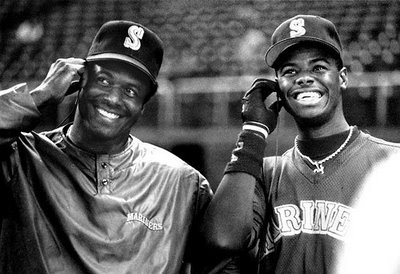
Griffey Sr. was a fine outfielder, compiling over 2,000 hits in a big league career that spanned 19 seasons. However, when it came to power he couldn't hold a candle to his son, who slammed 630 home runs and led the league four times. Griffey Jr. also won 10 straight Gold Gloves and made 13 All-Star teams in his 22 seasons. Both Griffeys played together on the Seattle Mariners in 1990 and 1991, playing 51 games together and even hitting back-to-back home runs off Kirk McCaskill on September 14th, 1990.

3. Gus Bell and Buddy Bell
Gus starred for the Cincinnati Reds during the 1950s, making four All-Star teams and driving in 100 runs four times. His son, Buddy, was also good with the stick but earned a reputation as one of the best defensive third baseman to ever play the game. Buddy received six straight Gold Gloves for his work at the hot corner and played long enough to amass more than 2,500 hits.

4. Cecil Fielder and Prince Fielder
"Big Daddy" starred as the game's premier power hitter during the early '90s, smashing 51 homers in 1990 and 44 the following year while finishing second in the MVP voting both times (to Rickey Henderson and Cal Ripken Jr., respectively). In 2007, his son emerged as an elite slugger by blasting 50 home runs at the tender age of 23. Prince has since joined Miguel Cabrera in Detroit to form one of the scariest slugging tandems in modern times.

5. Felipe Alou and Moises Alou
Both played 17 seasons and accumulated over 2,100 base hits. Felipe made three All-Star squads and twice led the majors in hits. His son Moises was a bit more accomplished, making six All-Star teams, slugging 332 home runs and batting .303/.369/.516 for his career.

Honorable mention: Mel Stottlemyre and Todd Stottlemyre, Ray Boone and Bob Boone, Sandy Alomar Sr. and Roberto Alomar

Sunday, March 18, 2012

Best Offensive Baseball Season of the 1950s

Like Barry Bonds in the 2000s edition of this series, there was no debate over who the player would be.  Instead, the only question was which year, and even that wasn't a difficult choice.

1956 Mickey Mantle (12.9 bWAR)

Mantle was already a household name and a top player by '56, the year his production finally satisfied the lofty expectations that had burdened him since his rookie season five years earlier.  His career had been following a smooth upward trajectory, bearing an eery resemblance to Ken Griffey Jr.'s early seasons.  Even though he put up big numbers in '55, there was a gnawing suspicion that Yankee fans still hadn't seen the best of this kid, the one who was supposed to be on par with Babe Ruth, Lou Gehrig, and his predecessor in center, Joe DiMaggio.   Although he was only 24 years old, he was a very accomplished player; he had already played in four World Series (three of them against Snider's Dodgers), winning three of them, had made four straight All-Star squads, and earned a pair of top-five MVP finishes (getting robbed the previous year, when voters inexplicbly preferred teammate Yogi Berra over Mantle's 9.5 bWAR).

At the time he was locked in a three-way battle with Willie Mays and Duke Snider for the title of best centerfielder in the city, but in '56 he was able to separate himself from the pack. After doubling his salary from the year before, Muscles sprinted out of the gate by blasting a pair of home runs on Opening Day, putting up enormous numbers in May and holding his average above .400 into early June. He was keeping up with Ruth's record-setting home run pace for much of the season, entering September with 47 home runs.  Unfortunately Mickey slumped down the stretch; the season's final month was his worst by far and he managed to clear the fences just five more times.  Five years later he would challenge the Babe once again, teaming up with Roger Maris in a mesmerizing home run chase that wouldn't be replicated until the Mark McGwire/Sammy Sosa race at the end of the century.  The Mick would finish with 54 four-baggers (a career high) after a hip infection knocked him out of the race late in the season, leaving Maris to ultimately rewrite the record books.

Mantle won the major league triple crown after his "favorite summer," leading the Show with 52 home runs, 130 RBI and a .353 batting average (nobody in the Junior Circuit came within 20 of his home run total, but he didn't shake Ted Williams in batting average until the final week of the season and Al Kaline finished with just two fewer RBI). His 132 runs, .705 slugging percentage, 1.169 OPS, 210 OPS+ and 376 total bases also ranked first among all big leaguers.  The Commerce Comet set career highs in almost every category and helped lead the Bombers to 97 wins and another World Series flag.  He slugged three home runs against their crosstown rivals, the Brooklyn Dodgers, in a rematch of the previous year's Fall Classic (when the Boys of Summer finally got the best of their American League nemesis).  In the offseason he captured his first MVP award, and did so unanimously by receiving all 24 first place votes. He also received the Hickok Belt as the top professional athlete of the year, was recognized as Associated Press Male Athlete of the Year  and was named ML Player of the Year by Sporting News. On the strength of this monster year, Mantle nearly doubled his salary for the 1957 season.

Some more stats from Mantle's banner year:

-Also led the American League in bWAR, extra base hits, runs created, adjusted batting runs, adjusted batting wins, times on base, and offensive win percentage
-The switch hitter batted .342/.459/.737 from the left side, .375/.474/.642 from his natural right side
-He didn't ground into any double plays in May and June, and bounced into just four all year long (one in each month except for May and June), a match of his 1955 total.  He did not hit into any twin-killings at home that season.
-Batted an otherworldly .444/.582/.861 with runners in scoring position.  With runners in scoring position and two outs, his batting average was an even .500.  It was no surprise, then, that all six of his intentional walks came with men in scoring position
-His BABiP (.353) matched his batting average
-Stole ten bases, marking the first time in his career he cracked double digits.  He was caught stealing just one time, and went on to swipe at least a dozen bases in each of the following five seasons
-Inflicted the majority of his damage in May and August, when he socked a combined 29 home runs and piled up 88 of his 188 hits.

Tuesday, March 13, 2012

Best Offensive Baseball Season of the 2000s

I got the idea from ESPN's March Madness-style "Greatest Season Ever" bracket that used online voting to determine the greatest offensive baseball season of all time.  Over 700,000 total votes were tallied and Babe Ruth's 1921 masterpiece ended up defeating Ted Williams memorable 1941 season (70 percent to 30).  I thought it would be fun to look back and pick out the best season from each decade.  When I finish the series I will do the same for starting pitchers.
The two greatest hitters of all-time
For the first edition in the series, the only serious competition this particular player had was himself.  The Who? was never in doubt, but the When? certainly was.

2004 Barry Bonds (12.4 bWAR)

During the year that Bonds turned 40, he enjoyed what was arguably his finest season that capped off a five year stretch of utter dominance.  I picked his 2004 over 2001, when set single season records for home runs, slugging percentage, walks, and won a record fourth MVP award, because many of his numbers in '04 were just as good, if not better.  For example, he walked more, struck out less, had a higher batting average, OBP, OPS, and OPS+.  If you look past the shortfalls in the sexier home run and RBI departments, it becomes clear that Bonds was an even better hitter in 2004 than he was in 2001.  Check out some key stats from his monster season.

-Broke his own single season records for walks (232), intentional walks (120), on base percentage (.609), and OPS (1.422) while also setting a record for most consecutive seasons, thirteen, with at least 30 home runs (Alex Rodriguez would tie his mark in 2010). 
Bonds didn't swing often, but  when
he did, he made it count
-For the first and only time in his career, he finished a season with more longballs (45) than whiffs (41).  That same year, Adam Dunn swatted one more home run but fanned 195 times!
-Tied a career high with 129 runs scored, a total he reached in 1993, 2000 and 2001
-Won his second NL batting title in three years with a .362 mark. Ichiro Suzuki took the major league crown with his .372 average, fueled by a single season record 262 base hits.
-Blasted 39 home runs before the All-Star break to set a new record.  2011 NL MVP runner-up Matt Kemp needed the whole season to hit 39 home runs, as did Mark Teixeira
-Slugged .812, the fourth highest figure of all time behind himself (.863 in 2001) and Babe Ruth's 1920 and 1921 campaigns (when the Bambino slugged .847 and .846, respectively)
-His adjusted OPS+ was 263, just short of his own major league record of 268 set two years prior
-Homered once every 8.3 at-bats
-Batted .412/.638/.962 in 74 home games...and I last time I checked the Giants played in a pitcher-friendly venue
-Want consistency? His second half OPS matched his first half figure
-Passed Willie Mays for third place all-time on the home run list early in the season and smashed his 700th career dinger in September
-He netted his seventh National League Most Valuable Player award, his fourth in a row, but was denied a unanimous vote because Adrian Beltre (10.1 bWAR)received six first place votes for the year of his life while Albert Pujols (9.4 bWAR) and Scott Rolen (9.2 bWAR) snagged one apiece for their contributions to a Cardinals juggernaut that won 105 games (only to be swept by my Red Sox in the World Series!).  He was also named to the All-Star team (duh) and took home a Silver Slugger, the NL Hank Aaron Award, and the Sporting News ML Player of the Year award.

Bonds was still going strong at age 40, long after many of his peers had retired