Showing posts with label Lance Berkman. Show all posts

Friday, January 31, 2014

Young Bows Out

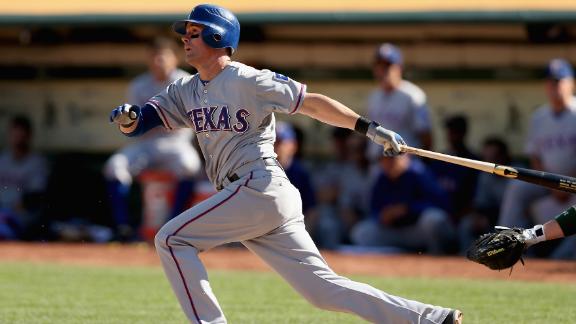
Young is leaving the game before his performance starts to suffer (ESPN)
It's fitting that two days after Lance Berkman called it quits, Michael Young is following him out the door. Fitting because they were both gifted hitters who made their names playing 257 miles from each other in Texas: Berkman in Houston and Young in Arlington.

Born eight months apart in 1976, they retired just two days apart in 2014, each at the age of 37 after enduring back-to-back disappointing seasons. But whereas Berkman was more or less forced out by injuries, Young is choosing to leave the game on his own terms after playing 147 games for the Phillies and Dodgers last year and batting a respectable .279 with a 102 OPS+.

Even still, their careers overlapped pretty well, which is funny considering how different they were as ballplayers. Berkman was a native Texan and a lumbering, switch-hitting slugger who played first base and left field, while Young hailed from California and was more of a slap-hitting shortstop. It's surprising, then, just how well some of their career totals match up:

Berkman: 1,879 G, 1,146 R, 422 2B, 86 SB, .293 Avg, 3,485 TB, six All-Stars
Young: 1,970 G, 1,137 R, 441 2B, 90 SB, .300 Avg, 3,491 TB, seven All-Stars

And here are some other similarities:

-Berkman debuted in 1999, one year before Young played his first big league game
-Both played at least 100 games at four different positions (not counting DH) and were very poor fielders
-After having somewhat down years in 2010, both bounced back for one last big season in 2011, when each made the All-Star team. Berkman finished seventh in the NL MVP voting while Young placed eighth in the AL race
-Both were traded away from their Texas teams and finished their careers elsewhere (though Berkman eventually made his way back to Texas to play for the Rangers)
-Neither won an MVP or Silver Slugger
-Both played in two World Series, including the 2011 Fall Classic when Berkman's Cardinals beat Young's Rangers in seven games

But that's enough about Berkman. I haven't written extensively about Young since he got his 2,000th career hit back in the summer of 2011--his last great season. He batted .338 with 106 RBI--both career highs--while sharing the major league lead for hits (213) with Boston's Adrian Gonzalez. At the time, he seemed to have an outside chance at 3,000 hits.

Then the following year, at age 35, his numbers dropped dramatically. His batting average plummeted more than 60 points, his OBP nearly 70, and his slugging by more than 100. Sensing the end was near, Texas traded him to the Phillies with cash for a pitching prospect (Lisalverto Bonilla) and a nothing reliever (Josh Lindblom).

There was hope that Young might be able to revive his career in Philadelphia, but all he did there was round out an aging infield of washed-up stars that already included Jimmy Rollins, Chase Utley and Ryan Howard. Young's numbers were almost identical to his 2012 production, and at the end of August the Phillies dealt him to the Dodgers for a pitching prospect (Rob Rasmussen) with a 6.46 ERA in Triple-A. Young was lucky to jump off the sinking Phillies ship and climb aboard the contending Dodgers just in time for the playoffs, but his last shot at that ever-elusive World Series ring was derailed by an old nemesis (St. Louis) in the NLCS. Young didn't do much to help matters there, coming up empty in all seven of his plate appearances.

So rather than hang around to pad his hit totals and chase a ring, Young called it a day. He can protect his .300 career batting average and leave long before he hits rock bottom. It's better this way.

A couple months from now Derek Jeter may have wished he'd done the same thing. I bring up Jeter in part because he is another shortstop in his late 30s (soon to be 40, actually), but also because I want to call attention to just how similar they were for a full decade. Check out how close they were from 2002--Young's first full season--through 2012--Jeter's most recent (and probably last) full season.

Jeter: 7,644 PA  1,153 R  2,105 H  336 2B  156 HR  .309/.376/.435  .811 OPS 114 OPS+
Young: 7,616 PA  1,028 R  2,134 H  396 2B 166 HR .304/.350/.447 .796 OPS 106 OPS+

I'm really surprised Jeter doesn't show up as one of Young's comps on his B-R page. They were very durable. They also struck out a good amount and bounced into a lot of double plays. Defensively they were about the same, with Young costing his team 8.6 wins and 126 runs with his glove while Jeter cost the Yankees 7.8 wins and 160 runs. Jeter, of course, was a much better baserunner with almost three times as many steals, and compensated for Young's power edge by getting on base more often. The point is that Young was very nearly Jeter's equal as a hitter for a long time. Take away 2002 (when Young had a .690 OPS) and 2012 (.682), and he comes out ahead.

That said, it can not be ignored the degree to which Young's numbers were enhanced by playing half his games in Texas. Like many hitters, Young got a big boost from his home ballpark. He batted a George Brett-esque .320/.368/.479 in Arlington, and if he had hit that well everywhere else we'd probably be discussing him as a serious Hall of Fame contender. As it were, his road OPS is more than 100 points lower.

For that reason (and others), Young was simply not as good as his numbers suggest. FanGraphs and Baseball-Reference agree he was worth around 25 WAR for his career, which leaves him well short of the Hall of Fame. JAWs has him as the 92nd best shortstop of all time, which seems baffling considering a lot of his counting numbers rank within the position's top 20. On the surface, a .300 career hitter who played the vast majority of his games at shortstop, second base and third base (all premium positions) would appear to be a very valuable player. Where was the disagreement between perception and reality coming from?

For starters, Young's offense really wasn't worth that much--about 60 runs for his career according to FanGraphs. Taking everything into account, that makes sense. Yes, Young got a lot of hits (six seasons with more than 200) and hit for some power (almost 700 extra base hits), but he didn't walk that much (typically around 50 times per season) so his on-base percentage of .346 is merely good, not great. Most of his power was in the form of doubles which obviously are not as valuable as home runs, so his career .141 ISo and .342 wOBA aren't very impressive either.

When he did get on he was a slightly above average baserunner, but any value he provided there was canceled out by his propensity for grounding into double plays. He also struck out quite a bit for somebody who never hit 25 home runs in a season. Throw in his friendly home park and the high-scoring era in which he played, and his numbers aren't anything special, as his .265 True Average and 104 wRC+/OPS+ indicate. He was only 61 runs better than the average hitter over the course of his career, which works out to be about 4.36 runs above average per year.

Then add to the mix his subpar glovework (2008 Gold Glove notwithstanding) which subtracts about a win per season from his value (two in his later years), and we're left with a slightly better than average hitter who has some nice counting numbers.

I don't mean to take anything away from Young. He was a good player for many years, a batting champion who set Rangers franchise records in numerous categories. But he's not a Hall of Famer (even though five of his ten best statistical comps are, and he probably would have been had he played in the 1920s or 30s), and not as good as some of his numbers suggest. Young is a perfect example of how advanced metrics and analysis can paint a more complete picture than those old-school statistics (like hits, RBI and batting average) ever can.

Thursday, January 30, 2014

Ranking the Best Switch-Hitters

Mantle is the gold standard for switch-hitters (SI)
Reviewing Lance Berkman's career got me thinking about the best switch-hitters in baseball history. Here's what I came up with:

1. Mickey Mantle 172 OPS+ 170 wRC+ .354 TAv .428 wOBA 802 Rbat
An obvious choice. Though the Mick was devastating from the left side, injuries hampered his southpaw swing later in his career and he would have been better off never having learned to switch-hit at all. He batted .330/.416/.575 from the right side compared to .281/.419/.546 from the left.

2. Chipper Jones 141 OPS+ 141 wRC+ .319 TAv .397 wOBA 557 Rbat
His favorite player was Mickey Mantle, which is interesting given that he was born four years after Mantle's final season. Jones is the only switch-hitter with a career .300 average and at least 400 home runs, something Mantle would have accomplished as well had he retired before 1968.

3. Eddie Murray 129 OPS+ 127 wRC+ .299 TAv .365 wOBA 389 Rbat
Steady Eddie leads all switch-hitters in RBI and ranks second in home runs to Mantle. He is one of only four players to eclipse 500 home runs and 3,000 hits, the others being Hank Aaron, Willie Mays and Rafael Palmeiro.

4. Pete Rose 118 OPS+ 121 wRC+ .289 TAv .354 wOBA 368 Rbat
The Hit King.

5. Lance Berkman 144 OPS+ 144 wRC+ .318 TAv .400 wOBA 420 Rbat
His OPS was better than .900 in 10 of his 15 seasons and his .943 OPS ranks 26th all-time. He holds the National League record for most home runs (45--tied with Jones) and RBI (136) by a switch-hitter in a single season (2006).

6. Tim Raines 123 OPS+ 125 wRC+ .294 TAv .365 wOBA 290 Rbat
Even after removing all of Raines' steals from the equation (for they have nothing to do with hitting), his offensive resume is still an impressive one. The Rock batted .294 for his career and was the 1986 NL batting champion. He also led the league in OBP that year, one of 11 times he reached base more than 39 percent of the time.

7. Reggie Smith 137 OPS+ 137 wRC+ .306 TAv .379 wOBA 309 Rbat
One of the most underrated ballplayers in baseball history, Smith was a phenomenal talent who's numbers were depressed by the era in which he played as well as Dodger Stadium. His neutralized career batting line of .296/.377/.505 is quite good.

8. Mark Teixeira 130 OPS+ 131 wRC+ .298 TAv .381 wOBA 245 Rbat
Teixeira has been ridiculed so much during his time in New York that it's easy to forget just how great he was before joining the Yankees. He had eight straight seasons with at least 30 home runs and 100 RBI from 2004 through 2011 and set the major league record for most single-season RBI by a switch-hitter with 144 in 2005. His future is in doubt after wrist problems limited him to just 15 games last year, and it's possible that his power may never return. That would be a shame considering nobody has homered from both sides of the plate in the same game as often as Teixeira, who's done so 13 times to date.

9. Bernie Williams 125 OPS+ 126 wRC+ .292 TAv .373 wOBA 295 Rbat
Williams was a Yankees legend who played in 25 postseason series across 12 Octobers, during which time he compiled the most RBI in playoff history. He also ranks second in hits, doubles, home runs, total bases, and runs scored. Williams was no slouch during the regular season either, batting above .300 every year from 1995 through 2002 and winning the batting title in 1998 on his way to a .297 career average.

10. Carlos Beltran 122 OPS+ 122 wRC+ .296 TAv .365 wOBA 249 Rbat
The only switch-hitter with more than 300 home runs and stolen bases. He's also the best postseason hitter for all-time, for what it's worth.

11. Roberto Alomar 116 OPS+ 118 wRC+ .284 TAv .359 wOBA 240 Rbat
A career .300 hitter, Alomar had good power for a second baseman with over 500 doubles and 200 home runs.

12. Frankie Frisch 110 OPS+ 112 wRC+ .370 wOBA 158 Rbat
His .316 career batting average is still the highest ever for a switch-hitter, so it should come as no surprise that he and Chipper Jones are the only switch-hitters to bat above .300 from both sides of the plate (min. 5,000 plate appearances).

Honorable Mention: Ted Simmons, Jorge Posada, Chili Davis

Wednesday, January 29, 2014

Bye-Bye Berkman

Berkman was an outstanding hitter before his body gave out (SportingNews)
Lance Berkman announced his retirement from baseball today. The soon-to-be 38 year-old is leaving the game after a pair of injury plagued seasons in which he played just 105 games and batted .246.

But Berkman accomplished a lot during his 15 big league seasons, the first 11 and a half of which were spent with the Houston Astros. During that time he made his mark as one of the greatest switch hitters ever (more on that to come).

I already wrote a good deal about Berkman's career when he signed with the Texas Rangers last winter, but even then I don't think I realized just how impressive some of his numbers were. His 293/.406/.537 triple slash stats are tremendous, nearly identical to those of one-time teammate Jeff Bagwell (.297/.408/.540). His career .943 OPS has been bettered by only 25 men and is the 14th best mark for players who debuted after World War II. His 144 OPS+ is tied for the 48th best mark of all-time.

Perhaps most surprising was how well he rates by Baseball-Reference's advanced statistics. He has the 29th best Win Probability Added of all-time, which suggests he was good at coming through in tight spots. He also rates inside the top-35 in Base-Out Runs Added (31st), Situational Wins Added (33rd) and Base-Out Wins Added (34th). The traditional numbers bear this out too: he batted .311/.432/.550 with men on base and posted a .963 OPS in high leverage situations.

Because Berkman's prime years overlapped with Albert Pujols's (and Barry Bonds' ridiculous run) he  never won an MVP, but did finish third twice and in the top-10 four other times. He never won received a Silver Slugger despite enjoying an eight year-stretch from 2001 to 2008 where he was worth 40.6 bWAR, averaging 33 home runs and 110 RBI per season in addition to his .303/.417/.564 batting line. FanGraphs rates him as the sixth most valuable position player during the 2000s, behind Alex Rodriguez, Pujols, Bonds, and a couple of other phenomenal switch-hitters--Chipper Jones and Carlos Beltran.

But that decade is pretty much the entirety of Berkman's career. He played just 34 games before it and struggled with age and injuries after it. Because of the relatively short length of his career (fewer than 8,000 plate appearances and not even 6,500 official at-bats), his counting numbers are a bit lacking. He failed to reach 2,000 hits and 400 homers, for instance.

Actually, some of Berkman's numbers are almost indistinguishable from those of another great hitter who recently retired: Todd Helton. Both were pure hitters who walked a lot, drove in tons of runs, hit for power and posted high batting averages.

Berkman 1999-2013: 366 HR  .293/.406/.537  .943 OPS  six All-Star appearances
Helton 1997-2013: 369 HR  .316/.414/.539  .953 OPS  five All-Star appearances

But while Helton is a deserving Hall of Famer (though not by much), Berkman is not (but also not by much). By all established Hall of Fame standards (JAWS, Bill James, Hall of Stats), Berkman falls a tad short. His numbers aren't strong enough for a corner outfielder/first baseman who was a liability in the field and on the basepaths. Berkman's peak was Cooperstown quality for sure, but he didn't do enough after leaving Houston and so his 52 career WAR don't cut it. He needed at least two or three more quality seasons, but unfortunately injuries essentially finished him after his age 35 season.

Big Puma, like most sluggers of his ilk, simply wasn't built to last. Players like him rarely age well, especially when they play more games in the outfield than they do at first base. Had Bagwell not blocked first until 2005, perhaps Berkman would still be playing. Maybe he would have fallen apart anyways, since he didn't become serious about his conditioning until it was almost too late. The point is that both were great players, and the Astros were lucky to have them.

Saturday, January 12, 2013

Can Berkman Bounce Back?

Berkman's getting older, but he can still hit (KeyeTV)
The Texas Rangers, suddenly short on offense after the free agent departures of Josh Hamilton and Mike Napoli, replaced some of their lost firepower by signing Lance Berkman to a one-year contract worth $10 million plus a vesting option for 2014. The six-time All-Star will serve as his new team's Designated Hitter in the wake of Michael Young's being traded to the Philadelphia Phillies last month.

Berkman may never get another major league contract, so if this is the end of the line for him then his career has come full circle. This deal brings the Texas native back to the Lone Star State, where he was born, raised, and educated before the hometown Houston Astros drafted him out of Rice University in 1997. Berkman debuted with the big club two years later and spent the first dozen seasons of his big league career as an Astro. One of Houston's Killer B's along with Craig Biggio, Jeff Bagwell, Carlos Beltran and Derek Bell, Berkman helped lead the team to four playoff appearances during his time there, including the franchise's only World Series appearance in its 50-year history. The starstruck 'Stros were no match for the Chicago White Sox, who took a cue from the Red Sox and ended their own interminable championship drought with a Series sweep. Berkman was one of the few Astros who offered any resistance, batting .385 and knocking in six of the 14 runs his team scored in the series.

The nucleus of that team aged out and Houston hasn't been to the playoffs since. Bagwell never played again. Biggio deteriorated into a replacement level player and hung on just long enough to get his 3,000th career hit. Roger Clemens and Andy Pettitte stuck around for another year before returning to the Yankees. Morgan Ensberg fell apart in his thirties, as so many ballplayers do.  But has his team crumbled around him, Berkman soldiered on.  He inherited the first base job from Bagwell, one of the finest to ever man the position, and continued to be a force in Houston's lineup until 2010.

That summer, with Berkman scuffling and the team trying to go in a different direction, Astros GM Ed Wade dealt him to the New York Yankees the day of the trading deadline even though NY had its own switch-hitting first baseman in Mark Teixeira. Berkman followed Roy Oswalt, who'd also been sent packing to the northeast (Philadelphia) two days earlier, out the door. The trade was bittersweet for Berkman, who desperately wanted to win but had spent his entire career with Houston up to that point. But the Astros were going nowhere, headed for another losing season, and the Yankees were just nine months removed from winning the World Series.  Berkman never seemed comfortable in the Big Apple and his offensive woes persisted.

Trading Berkman and Oswalt marked the onset of a rebuilding process in Houston. In the time since, the club's front office bulldozed the roster by unloading the rest of their established veterans (Michael Bourn, Carlos Lee, Wandy Rodriguez, Hunter Pence, and Brett Myers). In their two full seasons without Berkman, the Astros are the worst team in baseball and have lost twice as many games as they've won.

Many wrote him off after 2010, when he looked finished at the age of 34 and endured the worst full season as a professional. He struggled mightily at the plate, hitting just .248 with 14 home runs and 58 RBI between the Astros and Yankees. Some doubted he'd be able to find a job for 2011.

But after accepting a one-year, eight million dollar contract from the Cardinals (nearly a 50 percent pay cut), and moving to right field out of respect for Albert Pujols, Big Puma committed himself to improving his fitness routine over the offseason.  Noticeably trimmer and in the best shape of his life, Berkman returned to form in 2011. He got off to a great start with his new team and never looked back, finishing the season with a .301/.412/.547 triple slash line that produced the third highest OPS+ in the league (behind league MVP Ryan Braun and runner-up Matt Kemp). The NL Comeback Player of the Year also belted 31 homers, plated 94 runs, scored 90 times and drew 92 free passes while protecting Pujols and Matt Holliday in the Cardinals lineup. He finished seventh in the MVP race and went on to play an integral role in the team's World Series championship that fall. Berkman delivered several key hits and was especially lethal in the Fall Classic, batting .423/.516/.577 as St. Louis prevailed over Texas in seven games.

Not surprisingly, the Redbirds picked up his $12 million option for 2012, but Berkman went bust when he took four separate trips to the Disabled List and appeared in just 32 games. Once again, his future looked uncertain. When he grounded out in his final at-bat on the last day of the regular season, it seemed very possible that we had seen the last of Lance Berkman in a major league uniform. He was left off the Cardinals postseason roster. He watched from the sidelines as St. Louis came within one win of returning to the Series, only to squander their 3-1 lead over the eventual World Series champions and go home empty handed. He considered retiring.

Now, in a twist of irony, Berkman will suit up for a team still chasing its first World Series championship in part because of the damage he inflicted on them two Octobers ago. Funny how that happens in sports.

Berkman will be 37 in February, the same age Bagwell was in his injury-wracked final season, an age when most players are deep into the twilight of their careers. It goes without saying that he may not have much left in the tank. He's playing on a bum right knee that required two surgeries last year, adding to the host of leg issues that have prevented him from reaching 500 at-bats in a season since 2008. Given his age and injury history, at this stage in his career he's all but guaranteed to miss a good chunk of time.  Even if he manages to avoid the Disabled List, the Texas heat figures to wear him down over the course of a long season.

Signing Berkman is a calculated risk, but could prove to be a massive bargain if he has another renaissance season. Moving to the most hitting-friendly venue outside of Colorado will boost his numbers, or at least offset some of his age and injury-related decline. DH'ing full time should limit his injury risk and keep his body fresh. Plus it's always nice batting in the heart of a loaded lineup. Ron Washington has already said he's going to bat his new DH third to replace Hamilton's spot in the order. That means he'll have plenty of RBI opportunities with Ian Kinsler and Elvis Andrus setting the table for him. He'll also have Adrian Beltre, Nelson Cruz, and possibly Justin Upton (?) batting behind him. Berkman's primed for a comeback.

So what can the Rangers (and fantasy owners) expect from Berkman in 2013? His age definitely worries me, but not enough to label him "washed up." 37 is old in baseball years, but not too old to be a productive Designated Hitter, as Paul Molitor, Jim Thome and Edgar Martinez have proven. Father Time catches up to everyone at some point, but Berkman was a beast at 35 and hit well enough in limited action last year to suggest that his skills are still intact.  Even taking his age and medical issues into account, I feel confident saying he will rebound this year if his body holds up.

Still, it's tricky trying to forecast what Berkman will do in 2013. Bill James projects him to play 134 games, club 21 home runs and bat .273/.389/.485 (.369 wOBA).  FanGraphs is equally optimistic, predicting him to sock 19 dingers and bat .279/.384/.470 (.366 wOBA) in 123 games. Texas has to be thrilled if it can squeeze that kind of production out of Berkman. Last year, the team's DHs (mainly Napoli and Michael Young) batted a disappointing .265/.323/.432 with 18 homers and 78 RBI. If healthy, Berkman is a good bet to reach or exceed those numbers. I'll split the difference and peg him for 20 bombs, 80 RBI, and a .275 batting average. His ceiling is 2011 and his floor is 2012; I'm guessing he winds up somewhere in the middle.

He's definitely worth a spot in AL-only leagues and I'd take a flier on him in mixed leagues. Offense is hard to come by these days, and you need to get it where you can. Even if it's in the form of a 37 year-old playing on one leg.