Showing posts with label Derek Jeter. Show all posts

Sunday, August 21, 2016

Jeter was no A-Rod

The numbers don't lie: A-Rod was much, much better than Jeter (Complex)
My friend and I got into a contentious Facebook argument the other day debating the merits of the recently retired Derek Jeter and the even more recently (but not officially) retired Alex Rodriguez. My buddy -- a lifelong Jeter disciple -- posed a simple question: Who is a better all-time player, Jeter or A-Rod?

My response: https://www.youtube.com/watch?v=HvkKd572vCw

To which my friend replied, "It's closer than you think..."

Actually, it's not, I thought to myself. But, wanting to end the debate right then and there, I waited until I got home so I could log on to Baseball-Reference and provide the overwhelming statistical evidence proving that while Jeter was a great player, he wasn't even in A-Rod's league. I wanted to hit him with some truth, Kenny Powers-style.

Sure enough, when I clicked over to B-R's handy WAR leaderboard, I found the unassailable proof I was looking for. Nestled in 12th place, between Ted Williams and Lou Gehrig, is Alex Rodriguez. Scroll further down the list, and you'll find Jeter lodged at 58th, between Harry Heilmann and Rafael Palmeiro. That should tell you all you need to know about their respective places in baseball history.

The difference between them is exactly 46 WAR, which is a lot. It's more than several Hall of Famers totalled in their careers, as well as near Hall of Famers such as Gil Hodges, Dave Parker, and Omar Vizquel. Current players with less include Jimmy Rollins, Joey Votto, Matt Holliday, and Ryan Braun -- all of whom have been playing at a high level for at least a decade. Add their careers to Jeter's, and you still don't have A-Rod's career.

Looking at it another way, a five-win season constitutes an All-Star caliber year. That means you could add nine All-Star seasons to Jeter's resume, and he'd still fall short of Rodriguez.

Like I said, not even close.

Even if WAR's not your bag, it still shouldn't be hard to see why A-Rod was the better player. As a hitter, he holds the edge in almost every meaningful category except for batting average, which is negated by his slight edge in OBP. Rodriguez was also a much better power hitter: Jeter had good power for a shortstop, but A-Rod was one of the best sluggers of all time (and the greatest slugging shortstop ever).  He places in the top 10 all time in runs (8th), runs created (8th), total bases (6th), extra-base hits (6th), home runs (4th), and RBI (3rd), Jeter does not have a top-10 ranking in any of those categories. The only one he does is hits (6th), which is largely a function of all the at-bats he received (7th-most all time) and singles he recorded (5th-most).

A-Rod was also the superior baserunner, though not by an overwhelming margin. FanGraphs credits him as being worth 35 baserunning runs during his career, while Jeter checks in at just a shade under 24. That's the difference of roughly a win over the course of their careers, which is pretty negligible. Baseball-Reference has them dead-even with 56 baserunning runs apiece, but I'm inclined to split the difference based on their base-stealing records. Rodriguez swiped 329 bases at an 81.2 percent success rate, whereas Jeter made 358 thefts at a 78.7 percent clip. A-Rod also grounded into 26 fewer double plays despite batting with many more men on base.

And then there's the issue of defense, which is muddled somewhat by Rodriguez's transition to third base midway through his career. Still, anyone claiming Jeter was a better shortstop is delusional. Jeter didn't win any Gold Gloves until after Rodriguez, already a multi-Gold Glove recipient with Texas, changed positions and helped Jeter cover the left side of New York's infield. Had Rodriguez stayed at shortstop, he likely would have added to his trophy case and denied Jeter the chance of ever winning.

That's might be speculation on my part, but the numbers back it up. As with hitting, every defensive metric under the sun rates Rodriguez ahead of Jeter. FanGraphs has A-Rod's final defensive value at plus-64 runs, while Jeter's is negative-29.7. The figures compiled by Baseball-Reference are even more disparate; Rodriguez saved his teams 25 runs in the field whereas Jeter cost his a whopping 246--approximately 25 wins.

Ouch.

Anyone who watched Jeter play on a regular basis knows this to be true, as he was so inept at reaching balls his to his left (up the middle) that fans frequently referred to him as "Pasta," as in "past a diving Jeter." He was great at going into the hole, and his gravity-defying jump-throws will live on as one of baseball's enduring images, but in the aggregate he hurt Yankee pitchers much more than he helped him.

My friend pointed out that Jeter won five Gold Gloves, which are voted on by coaches and managers. Well, just because Jeter won them does not mean he deserved any of them. I don't want to get sidetracked by digressing into why Gold Gloves fail to recognize the best fielders (basically, they're influenced too much by reputation and are susceptible to bias by the voters, who only see opponents play a handful of times every year), but I would just like to point out that Rafael Palmeiro received a Gold Glove in 1999 despite spending 128 games as a designated hitter. So yeah, maybe don't mention Gold Gloves, especially since Jeter wouldn't have any had he changed positions to accommodate Rodriguez in 2004.

But no, it was Rodriguez who moved to third base despite winning the two previous Gold Gloves at shortstop (which he did not deserve either, but at least he was above average defensively, whereas Jeter clearly was not). If Jeter was such a great teammate, how come he didn't do what was best for the team and shift to the hot corner? Granted, the Yankees never asked him to do this (as far as we know), but they shouldn't have had to. History is filled with great players changing positions (Ernie Banks, Cal Ripken Jr., and Robin Yount all moved off shortstop, for instance), but Jeter never did, even when it became apparent in his final seasons that his defense was actively harming his team. There were opportunities to move to second base and center field as well, but Jeter did not step forward and thus stayed put.
A-Rod and Jeter weren't particularly close as friends, or as ballplayers (NY Post)
As our war of words heated up, my friend never tried to make an informed statistical argument on Jeter's behalf. Jeter fans never do, because they know it is a lost cause. As incredible as Jeter's numbers are, they simply don't measure up to A-Rod's. Jeter fans have always known this and always accepted this, because Jeter's contributions extend beyond the box score. "Sure, Rodriguez has better numbers," they say, "but...(insert comment about Jeter being more clutch, a better teammate, and/or a winner)."

Not surprisingly, my friend made that exact argument.  "Jeter made everyone around him better," he informed me. "A-Rod did not."

There it was. No longer was our argument over WAR and postseason performance and Gold Gloves that may or may not have been earned. My blood immediately began to boil.

First of all, there is absolutely no way to quantify this mythical teammate effect, which works both for and against the argument. On the one hand, I can say that being a good teammate is meaningless given the number of jerks throughout sports history who nevertheless made their teams better through their mere presence (Manny Ramirez, Reggie Jackson, Barry Bonds, and Roger Clemens come to mind). On the other hand, my friend can say Jeter added five or ten wins to the Yankees every year through his intangibles, and I can't definitively prove him wrong. There's no stat measuring leadership, unfortunately.

My buddy failed to explain how Jeter made his teammates better or why Rodriguez didn't. He didn't have to, because we both knew what he meant. Jeter was "The Captain," a calming presence in the clubhouse and, above all else, a "winner." Rodriguez was captain of the Rangers for about a day before they shipped him away to New York, where he immediately became a perceived choke-artist and a constant source of distraction and controversy for his team. The Yankees would have followed Jeter off a cliff and wouldn't have hesitated to shove A-Rod off one.

That's the perception, at least, but by all accounts Rodriguez was a great teammate. He led by example with his tireless work ethic, and mentored young players everywhere he went. Michael Young and Mark Teixeira credit A-Rod for showing them the ropes in Texas, while it's no secret that Rodriguez took Melky Cabrera, Robinson Cano and others under his wing in New York. If A-Rod didn't make his teammates better, then surely the Yankees wouldn't be letting him stay on in an advisory role. And how come Jeter doesn't have a similar title? Then again, I don't seem to remember him doing much tutoring on the side during his playing days.

But that's all besides the point, because what does any of that have to do with making your teammates better? You know what makes your teammates better? Getting on base for them so they have guys to drive in. Knowing when to take your walks and pass the baton but also knowing when to expand your strike zone for the sake of getting runners home, and by taking the extra base. Playing sound defense in the field, so that your teammates have less ground to cover and your pitchers aren't afraid of pitching to contact. You know, stuff that actually helps teams win ballgames.

Rodriguez did all of these things better than or just as good as Jeter, making him a much more valuable player. Going by the above WAR differential, we see A-Rod contributed two more wins to his teams than Jeter did every year on average. A-Rod's superior value came across in MVP results as well as earnings, with Rodriguez earning three MVPs to Jeter's none (apparently Jeter's leadership couldn't have been too valuable) and making more money from his age-33 season onward than Jeter made in his entire career.

But I want to get back to the teammate thing for a second, because I have a real axe to grind there. First of all, it has been my humble opinion that Jeter's intangibles have always been grossly overrated. Yes, Jeter's teams always won, but a big reason why was because he happened to be in the right place at the right time. He debuted with the Yankees in 1995, just as the  franchise was emerging from its dark days of the 1980s and early '90s. While their first championship since 1978 coincided with his Rookie of the Year campaign in '96, he didn't transform them into winners overnight. They were leading the AL East when the players' strike cut the season short in 1994, and they reached the postseason with him playing all of 15 games the following year. Andy Pettitte, Jorge Posada, Mariano Rivera and Bernie Williams were already there, supplementing talented veterans such as Paul O'Neill, David Cone, Wade Boggs, Don Mattingly, Darryl Strawberry, Ruben Sierra and John Wetteland. The Yankees would have still be stacked without Jeter; they probably don't win four rings in five years without him, but they still win at least a few.

And what if Jeter hadn't been a Yankee at all? What if one of the five teams that passed on him in the 1992 draft had taken him instead? He could have been an Astro, or an Indian, or even an Expo. Can you imagine how different his career would have been had he spent the first half in Montreal? Jeter was incredibly lucky, which isn't a knock on him because all careers require some amount of luck, but try to picture him in a Reds uniform or an Orioles uniform. You can't. He was born to wear pinstripes.

But also, think about what that means for a second. Five teams had the chance to draft Jeter, but thought they'd be better off taking someone else. That was never the case with A-Rod, who was the consensus number one draft choice a year later. Scouts looked at him as a high schooler and saw a superstar. Five teams looked at Jeter and said, "pass." A-Rod was always better than Jeter, and considerably so.

Anyways, back to the notion that Jeter made his teammates better. While he may have helped his teams overachieve in the first half of this career, there's no doubt that New York underachieved during the second half of his career, when he was surrounded by an absurd amount of talent. If Jeter was able to will his teams to championships, how come the titles suddenly stopped coming once the Yankees started running out the highest payroll in baseball every year? If you want to give him credit for everything that happened pre-A-Rod, fine, but you also must acknowledge everything bad that happened under his watch, too. How come he didn't get A-Rod in line? He failed to rally those super-teams together and clearly lost control of the clubhouse, which should have never happened if he was the great captain that people make him out to be.

And lastly, if Jeter was such a great teammate, he never would have continued playing shortstop and batting second long after it became clear he shouldn't have been doing either. Sabermetrics has identified the two-hole as the most important slot in the lineup, the spot where managers should bat their best hitters. For most of his career, Jeter was not New York's best hitter, but he was still a very good one. Over his last five seasons, however, that was no longer true, as he batted an empty .283 with a .713 OPS and a 94 OPS+. He was especially bad during his final year, when he slashed .256/.304/.313. Jeter should have been batting eighth or ninth during those years, not second. The Yankees had no problem dropping Rodriguez to eighth during a playoff game or benching him outright when he wasn't hitting, but God forbid Jeter take a day off or move down in the order.

My friend's friend made a good point in comparing Jeter to Brett Favre, saying both are overrated for being good guys who played at an above-average level for a long time. I think that's spot-on. Jeter led the  league in hits twice and runs once, but he never won a batting title or an MVP award. He never hit 25 homers in a season or led the league in WAR, and he knocked in 100 runs only once. He was usually very good -- sometimes great -- but never the best.. A-Rod was right to call him a complementary player back in 2001, even if that comment ultimately destroyed their friendship.

Rodriguez, on the other hand, did things no player has ever done before or since. He holds the single-season records for big flies by a shortstop and a third baseman. He was the  youngest player to 300, 400, 500, and 600 home runs. He recorded the most consecutive seasons of at least 30 homers and 100 RBIs, and he also owns the all-time grand slams record. He's the only infielder to go 40/40. And of course, he signed the two biggest free agent contracts in sports history (Giancarlo Stanton's was an extension).

Granted, A-Rod had pharmaceutical help while Jeter, as far as we know, did not. But steroids don't explain how he hit 436 more home runs or drove in 775 more runs. They don't explain the 113-point difference in OPS. And they don't explain how, despite having the world against him and its weight on his shoulders, Rodriguez still managed to blow away Jeter's production year after year after year.

Tuesday, September 9, 2014

Jeter Rage

Jeter's final season has been one to forget (NewsDay)
Barring a ridiculously hot finish the New York Yankees, five games out of the second wild card with 21 to play, aren't going to make the playoffs this year. The irony is that Derek Jeter, a leader and key contributor on all the great Yankee teams of the last two decades, is a big reason why. Not the only reason, of course, because when a team fails to reach the postseason there's always a bunch of reasons, but a pretty big one. With his punchless bat and shoddy defense at a premium position, he's done more harm than good.

It should come as no surprise that Jeter allowed himself to become such a detriment for his team. Because for all the praise showered on his leadership abilities, he has never been one to demote himself. Like Joe DiMaggio, he has too much pride and cares deeply about his image.

This was evident when Jeter did not offer to change positions to accommodate Alex Rodriguez when the Yankees traded for him in 2004, even though everyone knew that A-Rod was superior defensively. Rodriguez graciously shifted to third, even though he'd just won two straight Gold Gloves and was among the game's slickest-fielding shortstops at the time. Jeter did not want to defer to Rodriguez, to admit he was the inferior shortstop, so he remained at the infield's glory position. The following offseason, when Bernie Williams was in decline and New York needed a center fielder, Jeter's name was brought up, but once again he stayed put.

Now, ten years later, Jeter is still entrenched at shortstop long past his expiration date. 40 year-olds aren't supposed to play short on a regular basis, especially when they were never that good there to begin with. Jeter's defense has been statuesque for awhile now, his already iffy range demolished by recent ankle injuries, rendering him too immobile to man the most important infield position. One need not look at his range factor--by far the worst of his career--to know that he's not getting to many balls hit his way.

This all could have been avoided before the season. When Rodriguez was suspended and Robinson Cano departed via free agency, two less challenging positions opened up. Jeter did not volunteer to fill them, leaving the Yankees to settle  for doomed-from-the-start alternatives Kelly Johnson and Brian Roberts. Had Jeter volunteered to switch, New York could have at least found a quality shortstop replacement in Jhonny Peralta or even Stephen Drew, who remained a free agent until late May. Drew's been terrible this year as well, but five months ago he looked like a much better player than either Johnson or Roberts (Jeter too, for that matter).

Jeter's done even more harm with his bat, which has produced an empty .260/.308/.311 batting line thus far. Adjusted for league and park, his .618 OPS is 23 percent below average. Throw in his mediocre baserunning, and Jeter's offense has been worth 17 runs below average, or almost two wins.*

*Two wins might not sound like a big deal, but when you're in the playoff hunt at this stage in the season two wins can mean the difference between life and death. Credit New York with two wins and remove two losses, and suddenly they trail Seattle by just three games for the second wild card, and their playoff chances look much, much better.

That wouldn't be so bad if Jeter was hitting eighth or ninth, where his poor bat would be minimized and not really a liability compared to the production most teams are getting from the bottom of their order. But Jeter, as you know, is not buried at the bottom of New York's star-studded lineup. He's batting second--the most important spot in the lineup--because that's where he's always hit, and because Joe Girardi has too much respect for Jeter to move him down (even though Joe Torre had no problem batting Alex Rodriguez--a much much better hitter than Jeter--eighth in a playoff game).

And Jeter, being Jeter (passive), has not volunteered to hit lower in the order, even though the Yankees would be better served by batting just about anyone else second.  A table-setter with a league average OBP and no pop or speed is a problem, especially when he has the third-most plate appearances on the team (only Jacoby Ellsbury and Brett Gardner have more).

When you have a flaw like Jeter or, more accurately, an offensive black hole, you're supposed to hide him, not expose him. Minimize your weaknesses and maximize your strengths, not the other way around. Jeter's 40 years old and is in his 20th big league season. He had to know he wasn't the same hitter he used to be, and that batting second was going to hurt the Yankees more than help them. He should have made it clear from the get-go: I'm going to try to play as much as I can and do what I can to help the team win, but realistically I'm limited and shouldn't be batting second.

Jeter did not do this. He did not do what was so clearly obvious for the best of the team. He left it up to the manager, knowing full well that Girardi would not have the gumption to slot the game's biggest icon and most popular player down in the order. Jeter was not proactive. He did not take the initiative. He wasn't, you know, a leader.

I take nothing away from Jeter as a ballplayer, because he's been a great one for many years. It just really makes my blood boil when people start going on and on about how what a great leader Jeter is and what great intangibles he has and how he's a winner. Great leaders know when to lead and when to defer to others, and in this regard Jeter has to be considered a failure. He is not the selfless saint that people make him out to be, and lately his teams have suffered as a result.

So when the playoffs start next month and New York is on the outside looking in, and fans and media are looking for someone to blame, they ought to point a finger at their beloved Captain.

Sunday, July 6, 2014

Revisiting Nomar vs Jeter

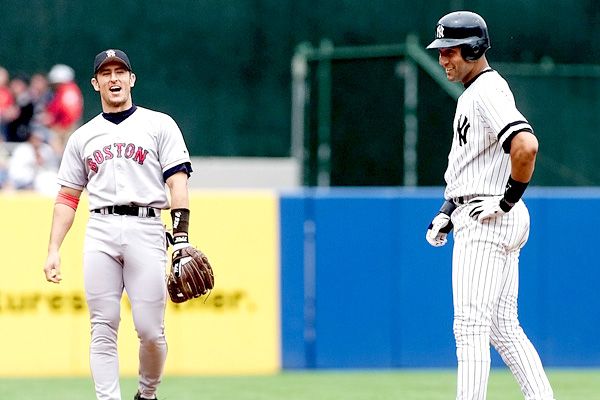
Garciaparra (left) was better than Jeter before injuries ruined his career
Reading this wonderful piece by Leigh Montville led me to revisit a recent but now irrelevant debate between two of the greatest shortstops from the past 20 years: Nomar Garciaparra and Derek Jeter.

Just as Red Sox and Yankee fans debated the merits of Ted Williams and Joe DiMaggio during the 1940s, their grandchildren argued at length about Derek Jeter and Nomar Garciaparra around the turn of the 21st century. What made this argument even better was that the two played the same position. Williams and DiMaggio had both been outfielders, but the Splendid Splinter was stationed in left and DiMaggio manned the more-challenging center. This could not be ignored, for while Williams was obviously the better hitter, DiMaggio deserved credit for playing a tougher position, and playing it spectacularly well at that.

No such concessions were needed for this rivalry. Born less than a year apart, both were immensely popular, multi-talented shortstops and first round draft picks who broke in around the same time, with Jeter winning the AL Rookie of the Year award in 1996 and Garciaparra taking home the honors the following year (both unanimously). Because they played in the same division just as their clubs' century-long rivalry was being renewed, they were often pitted against each other for the the most intense, high-stakes games. Jeter, like DiMaggio, was a "winner" with the rings to prove it. Garciaparra was statistically superior, the better hitter and rangier defender, but like Williams was destined to never win a World Series in his career.

While neither one was quite on the level of Alex Rodriguez, Garciaparra and Jeter were not far behind. More importantly, they were close enough to each other that one could reasonably compare them without sounding like a delusional homer. Anyone who said Jeter was better than A-Rod was clearly an idiot, but saying Jeter was better than Garciaparra, while misguided, was at least more defensible and understandable. They were both five-time All-Stars from 1997 through 2003 and won the same number of Gold Gloves (0) and MVP awards (also 0). Garciaparra at least won a Silver Slugger, something Jeter wouldn't do until 2006.

From a statistical standpoint, however, it's impossible to conclude anything other than what every Red Sox fan and informed baseball follower knew ten years ago: Garciaparra was better, before 2004, that is.

From 1997 through 2003 (excluding 2001, when Garciaparra missed virtually the entire season):

Jeter:    890 G 707 R 1,160 H  175 2B 96 HR 456 RBI 1,685 TB 137 SB 32.2 bWAR
Nomar: 883 G 661 R 1,186 H 267 2B 165 HR 645 RBI 2,036 TB 77 SB 40.5 bWAR

Even including 2001, when Garciparra played just 21 games to Jeter's 150, Nomar still comes out way ahead in doubles, home runs, RBI, total bases, and WAR. And that's with spotting Jeter almost an extra full season.

In 2004, however, their careers began heading in opposite directions. Garciaparra got hurt again, was traded away from Boston and was really never the same. He bounced around, couldn't stay healthy, and played his last game in 2009, a year in which Jeter secured his fifth World Series ring and finished third in the AL MVP voting. Jeter would continue to produce long after Garciaparra had faded away, leading the major leagues in hits in 2012 at the age of 38 and playing past his 40 birthday. Jeter's going into the Hall of Fame on his first try, whereas Garciaparra has almost no chance of getting inducted (off the writer's ballot, anyways) due to the brevity of his career.

Still, it's worth remembering that for a while in the late 1990s and early 2000s, Garciaparra was better than Jeter. For nearly a decade they were equals, before Garciaparra broke down and faded away. Here's a year-by-year breakdown to prove it:

1997 Nomar
No sophomore slump for Jeter, who proved his Rookie of the Year campaign was no fluke by posting the same OBP and swatting just as many home runs as the year before, not to mention totaling more runs, hits, doubles, triple, walks, steals, total bases, and wins above replacement. With decent defense and 23 steals, he was somewhere in the neighborhood of four to five WAR (FanGraphs has him at four exactly, B-R rates him at 4.9).

Garciaparra, however, was worth close to six and a half after authoring one of the greatest rookie seasons of all time. In addition to leading the American League with 209 hits and 11 triples, Garciaparra racked up 122 runs, 44 doubles, 30 homers, 98 RBI, 22 steals and 365 total bases, making him the unanimous choice for AL Rookie of the Year honors. He also earned his first All-Star selection and won his only Silver Slugger award.

While Jeter's season was in many ways an improvement on his rookie campaign, he was simply not as outstanding as Garciaparra. Nomar outproduced DJ in virtually every offensive category, swatting three times as many home runs and posting an OPS 100 points better than his Yankee counterpart's .775 mark, all while playing superior defense and stealing one fewer base.

Garciaparra's superiority was reflected in that year's MVP voting, where he scored an eighth place finish, though he should have been in the top five and probably would have had Boston not stumbled to a 78-84 record that year.  Jeter's did not fare as well, finishing a distant 24th in the MVP balloting even though his Yankees won 96 games and made the playoffs. Both should have finished higher than they did, but the voters correctly recognized that Garciaparra was significantly more valuable than Jeter.

1998 Nomar
Jeter took a significant step forward in his third full season, nearly doubling his home run output, adding almost 90 points to his OPS and becoming a much more efficient basestealer. He topped 200 hits and 300 total bases for the first time, paced the American League in runs scored with 127, and enjoyed one of his finest seasons defensively. Baseball-Reference rates him at 7.5 bWAR that year, a tremendous number, while FanGraphs and Baseball Prospectus have him around six.

Garciaparra was right there with him, topping seven WAR by both B-R and FG's calculations while falling just short of seven according to BP. Garciaparra also made a big leap from his previous season, raising his OPS more than 70 points, establishing career highs with 35 home runs and 122 RBI, and cutting his strikeout rate from 12.5 percent to 9.5 percent. His defense remained exceptional, worth close to two wins by itself.

Based on WAR, choosing between the two comes down to splitting hairs. The voters must have felt the same way that year, as Garciaparra finished second (to an undeserving Juan Gonzalez) with Jeter taking bronze in that year's maligned MVP vote. Nomar did receive five first place votes to Jeter's two, however, an impressive feat considering Jeter's Yankees won 114 regular season games that year, or 22 more than the Boston Red Sox. Jeter hit .324, Garciparra hit .323/ Jeter got on base at a better clip, but Garciaparra outslugged him by over 100 points and played better defense. In the end, that's enough to swing the pendulum in Garciaparra's favor.

1999 Jeter
Jeter continued to improve in 1999, the finest season of his storied career. Not only did Jeter bat. 349, a personal best, but he also drew 91 walks--also a career high--to fuel his .438 OBP, the third-highest mark in the American League that year behind Edgar Martinez and Manny Ramirez. Nobody matched his major league leading hit total of 219.

Jeter would have won his first batting title were it not for Garciaparra, who eclipsed the Yankee's .349 mark by batting .357 to take the crown. But because Nomar walked 40 fewer times than Jeter, his OBP was significantly lower at a still-great .418. Garciaparra, as he normally did, compensated by hitting for more power. Though his 27 home runs and 104 RBI barely surpassed Jeter's 24 and 102, Garciaparra's .603 slugging percentage was over 50 points higher than Jeter's .552 mark. Both players slipped defensively and came out practically even, negating Garciaparra's previous advantage there. They both posted identical OPS+ scores of 153, indicating that Jeter's bat was Garciaparra's equal after adjusting for league and park. Nomar was slightly better on the bases, with 14 steals in 17 attempts compared to Jeter's 19 out of 27, but not enough to tip the scales either way. Garciaparra outhit Jeter in their first postseason meeting that year, which New York won in five games, but Jeter had a great series in his own right and I'm not going to put much stock in five playoff games.

Another very close call here, which again was apparent in the MVP voting. Jeter finished sixth, one spot ahead of Garciaparra. BP favors Garciaparra, but BR and FanGraphs both give the edge to Jeter. So shall I, for Jeter played 23 more games than Garciaparra and thus made more of an impact. Plus he also led the loop in two very important sabermetrics: runs created and times on base. This time, it's Jeter by a nose.

2000 Nomar
Jeter regressed following his career year in 1999, turning in a season that was still great but not elite. All his numbers except for steals and strikeouts were down compared to the year before, and his defense continued to slide as well. The result was that Jeter's value plummeted by three to four wins.

The same cannot be said of Garciaparra, who enjoyed his finest season in the first year of the new millennium. Not only did he bat .372, the highest mark in the American League that year as well as his career, but he also walked a career-best 61 times (20 intentionally) to post a .434 OBP, also a career high. With 51 doubles, 21 long balls and a .599 slugging percentage, his power remained elite as well, not to mention better than Jeter's 31, 15, and .481, respectively. And while Garciaparra essentially became a nonfactor on the bases with only five steals, he bounced back defensively with a season on par with his first two. With Jeter so far below average and Garciaparra so far above average, the difference between them in glovework alone was worth anywhere from three to four wins. Throw in Nomar's big offensive edge, and this one's not nearly as close as the MVP ballot would suggest. I'm surprised that for the third straight year they finished next to each other in the MVP polls. Nomar pulled a ninth place finish while Jeter came in tenth, maybe because their teams finished so close in the standings (New York edged Boston by two games to win the division).

2001 Jeter
No contest here, for Jeter produced a typical Jeter season while Garciaparra played only 21 games because of a wrist injury that unfortunately ended his days as an elite hitter.

2002 Nomar
Garciaparra bounced back to play 156 games, a career high, and amass almost seven bWAR despite losing more than 150 OPS points off his 2000 production. His .880 mark was still nearly 90 points better than Jeter's OPS, which dipped below .800 for the first time since his sophomore season. Garciaparra outhit Jeter .310 to .297, and while Nomar's OBP was considerably lower (.352 to Jeter's .373), he made up for it by slugging 107 points higher. In nine fewer at-bats, Garciaparra collected 30 more doubles, five more triples, six additional home runs, 45 more RBI, and 64 more total bases. Garciaparra's defense was considerably better as well, thereby negating Jeter's clear edge on the basepaths. Whereas Jeter did not appear on a single MVP ballot that year, Garciaparra finished 11th tied with David Eckstein even though New York won the division and Boston missed the playoffs altogether.

2003 Nomar
Garciaparra's final full season in Boston was another great one, contributing approximately six wins above replacement for a colorful Red Sox team that won 95 games and the AL Wild Card. His OPS slipped ever so slightly to .870, down ten points from the year before, but his counting numbers remained impressive with 120 runs, 198 hits, and 19 steals--all his most since his sterling rookie season--plus 28 homers, 105 RBI, and 345 total bases. Jeter, who made his first trip to the DL after an Opening Day collision with Blue Jays backstop Ken Huckaby at third base, was limited to 119 games and so his numbers paled in comparison. On a per game basis, though, Jeter was just as good as Nomar, batting .324/.393/.450 (to Garciaparra's .301/.345/.524) while scoring 0.73 runs per game and compiling a slightly better adjusted OPS than Garciaparra, a performance that added up to about four wins.

Had Jeter not gotten hurt, it's likely his numbers would have been right there with (and possibly better than) Nomar's, but we'll never know. What we do know is that Nomar played 37 more games with way more power (almost three times as many home runs and more than twice as many RBI), better defense and superior baserunning, thus making him the more valuable player that year. Accordingly, there was a wide gap between them in the MVP voting, with Garciaparra finishing seventh (his last time in the top-ten) and Jeter much further down at 21st. Neither player shined in that year's unforgettable (thanks to Aaron Boone) ALCS, both notching seven hits in the seven games with sub-.700 OPS's.

2004 Jeter
2004 amounted to another lost season for Garciparra, who didn't take the field until June 9th and appeared in only 81 games that year. While solid offensively, Garciaparra pouted his way out of Boston with numbers that were down across the board and defense that had slipped precipitously. At best he was worth maybe two wins above replacement. Jeter was worth four in a year where he played a full slate of games (154), cracked 23 home runs, stole 23 bases, and won the first of many Gold Gloves he did not deserve. Though the formerly cursed Red Sox went on to stun their arch-rivals in the ALCS and win their first World Series title in 86 years, they did so without the help of Garciaparra, who played 38 games for them before he was dealt to the Cubs in a trade deadline deal that shored up Boston's leaky infield defense by bringing former Gold Glovers Orlando Cabrera and Doug Mientkiewicz to Beantown.

The rest is history. From that point forward, there would never again be a time when Garciaparra outproduced Jeter or when anyone could even claim that they were on the same level. Nomar would enjoy one more good season, with the Dodgers in 2006, but by then he was a first baseman. He was unable to sustain the peak that made him look like a surefire Hall of Famer in his 20s. In terms of career value, Jeter has him beat by a long shot. But if you narrow the window to Garciaparra's Boston days, he comes out on top. It's just too bad things turned out the way they did, that he didn't amount to much after leaving Beantown, because while he was here he was more celebrated than any Red Sox player ever, save maybe Carl Yastrzemski.

Now, he's nothing more than a distant memory, the sad story of a promising career unfulfilled. I see so much of him in Troy Tulowitzki, another supremely talented but injury-plagued shortstop, and I can only hope he avoids the same fate.

Saturday, June 28, 2014

Jeter Just Doing Enough

Jeter's not contributing much, but his performance hasn't flatlined (IBTimes)
Derek Jeter turned 40 on Thursday, which unfortunately for him was an off-day for the Yankees. Jeter is a born-winner, but even he can not win a game that isn't played.

So last night must have been the next best thing, then, as New York trampled their longtime rivals from Boston 6-0 at Yankee Stadium. With Toronto losing and Baltimore splitting its doubleheader against Tampa Bay, the victory moved New York to within two games of first place and just half a game out of second. Despite age, injuries, and underperformance, the banged-up Bombers have battled their way into contention and, with better luck in the second half, could very well walk away with a winnable division.

Jeter has not done much to help the Yankees this year*, but he isn't killing them, either. He went 2-for-4 with a run scored last night, raising his batting line to .271/.327/.330. With only two home runs, 11 extra base hits, 17 RBI and a slugging percentage not much better than his career batting average, Jeter's not providing much power. But then again, nobody expected him to. With three stolen bases in four attempts he's not providing much speed, either, but few 40 year-olds do.

*One thing Jeter hasn't been is clutch. With only two go-ahead hits to date, hes batted .105/.244/.158 in late and close situations, .133 with no extra base hits when there've been runners in scoring position with two outs, and .170/.278/.213 in high leverage situations. If you're a Yankees fan, Jeter's not the guy who want at the plate when the game's on the line.

Jeter has hit for a solid average and gotten on base at a decent clip, which is all anybody could have really asked for. He's also been incredibly consistent, with a .660 OPS in April, .670 OPS in May, and a .635 OPS thus far in June. As steady as ever, Jeter's gone two straight games without a hit only twice this year, and never three. Joe Girardi shouldn't be batting Number Two second of course, but Jeter's held his own offensively and has remained reliable, if nothing else. He's avoided anything resembling a slump, which at his age is truly remarkable.

Also, Jeter's defense has not been nearly as bad as many (myself included) expected it to be. It's not good, obviously, as his range is still terrible (the worst of his career), but on the whole it could be worse. FanGraphs acutally gives him a positive defensive rating, while Baseball-Reference estimates that he's saved only four fewer runs than the average shortstop. Jeter's still making the plays on the balls he can get to, with a .973 fielding percentage that's right in line with his career .976 mark and slightly better than the league average of .971. Like I said, steady as ever.

Throw it all together and Jeter's been a hair above replacement level, which is about where he was the three seasons before last year. That might not be the winning Mariano Rivera-esque comeback story some were hoping for, but he's played as well as we could have reasonably expected him to. His performance has been far from great, but he's not embarrassing himself either. He's holding on.

Friday, June 13, 2014

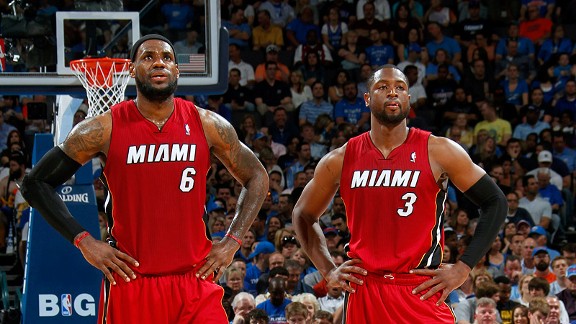
D-Wade: the NBA's Derek Jeter

If the Heat lose, it will be Wade's fault, not LeBron's
The more I think about it, the more I believe the dynamic/relationship between LeBron James and Dwyane Wade is the basketball version of the one between Alex Rodriguez and Derek Jeter.

I already knew that LeBron shares a lot in common with A-Rod, but I hadn't thought about how much Wade shared with Jeter.

Wade, like Jeter, was a winner before their more talented teammates decided they wanted out from their mediocre Midwestern franchises and wanted a ring. Jeter and Wade were already established stars and proven winners. Both were captains of their respective teams, and were approximately the same ages when their new teammates arrived. Wade was 28, Jeter was 29, both slightly older than LeBron and Rodriguez (Jeter has more than a year on A-Rod, while Wade has nearly two on LeBron).

It had been four years since the Heat had last been champions, and four years since the Yankees were World Series champions. Wade, who was drafted the same year as LeBron and debuted the same year (2003), had seen his career overlap perfectly with LeBron's. Both were high first round picks, with A-Rod and LeBron going first and Wade taken fifth/Jeter sixth. Jeter's breakout season--1996 when he won AL Rookie of the Year--paralleled A-Rod's breakout/MVP runner-up, and both had been stars ever since.

While LeBron took his game to another level with the Heat, improving his post moves as well as his three-point shot, Wade remained essentially the same player. He never bothered to add the three-point shot to his arsenal, even though it would have made him and his team much better. Wade, apparently not driven to be the best player he can be, decided he could live with his flaws and so has remained a league average free throw shooter and a subpar three-point shooter. A shooting guard who wasn't a particularly good shooter.

While Rodriguez effortlessly learned a new, demanding position, Jeter maintained the status quo. He did not move to third so that Rodriguez could play shortstop, even though that would have been the best for the team. He did not improve his power stroke, cut down on his strikeouts, take more walks or steal more bases. His defense, always his greatest flaw, remained so. He did make a concerted effort to improve his defensive positioning late in his career, but by then his range and arm strength had diminished too much to make much of a difference. Forget his Gold Gloves; Jeter rates as the worst defensive shortstop in baseball history.

The irony is that even though Wade and Jeter were clearly less talented and contributed less to their teams' successes than James and Rodriguez, both were able to avoid or deflect most of the flak whenever things turned sour. For instance, when the Heat fell to the Mavs in 2011 and when they inevitably lose to the Spurs in the next few days, much of the blame was placed on LeBron's shoulders. He was ripped as a passive, unclutch choker while Wade, because he was a lesser player, coasted. Even though Miami's stars and scrubs structure dictates that Wade plays well in order to win, he has never caught as much heat as LeBron has (which I suspect is related to Wade being less visible and more likable). Wade defers to LeBron, and so when the game is on the line it's usually James's to win or lose. Wade can throw up a stinker like he did last night, and all anyone's going to remember about this series is how LeBron cramped up in Game 1.

Ditto Jeter, who's always walked on water in New York and has always been above criticism there. Nobody blamed him when the Yankees choked to the Red Sox, even though Jeter batted a measly .200/.333/.233 in that series with just one extra base hit (a double). People looked the other way in 2007 when he hit into as many double plays (3) as base knocks against the Indians in the ALCS. No one said a word in 2010 or 2011, when he batted .250 in both postseasons with sub-.290 OBPs in each and a combined .344 slugging percentage. Has there ever been any mention of the fact that Jeter hasn't hit a postseason home run since October 19th, 2009, a span of 146 plate appearances?

Granted, as a complementary player/table setter, Jeter has different expectations than Rodriguez, a middle-of-the-order run-producer. But Jeter plays the more valuable defensive position and bats higher in the order, so his role is just as valuable. And yet, since the start of the 2004 playoffs, both have performed virtually the same in the postseason:

Jeter --287 PA   7 HR  28 RBI  24 BB  56 K 5 SB  .814 OPS
A-Rod 269 PA 10 HR  33 RBI  36 BB  59 K 7 SB  .807 OPS

You wouldn't know it by reading the newspapers.

Wade and Jeter have skirted criticism, skating by while their more talented teammates took the brunt of the criticism because they were more polarizing, but also because more was expected from them. Wade and Jeter were left mostly untouched, and from the relative safety of dry land neither ever made much of an effort to do anything about it. Their attempts to defend James and Rodriguez were halfhearted at best, non-existent at worst.

Wade is the Robin to James's Batman, as Scottie Pippen was to Michael Jordan and Pau Gasol was to Kobe Bryant. That's why they've clicked. Jeter should have been Rodriguez's Robin, but always maintained that the Yankees were his team, which in turn created a great deal of tension and friction in the Yankee clubhouse. It's incredibly disappointing that Rodriguez's ten-year tenure with the Yankees yielded only one championship. It may have had something to do with the fact that Jeter was more like Joe DiMaggio, for better and for worse, than we realize.

It's fitting then, that he's retiring a year after what could be Rodriguez's final game. It wouldn't surprise me one bit of Wade and James do the same some day. That is, if Wade can actually stay on the court.
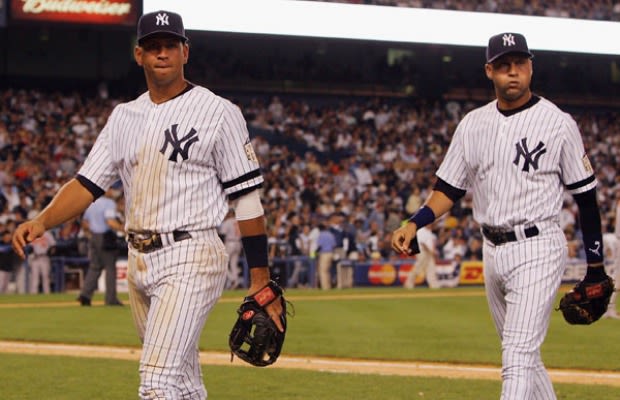
A-Rod and Jeter didn't achieve their full potential as teammates (BronxBaseball)

Thursday, February 13, 2014

What to Expect From Jeter?

An old, hurt, and washed-up Jeter has reached the end of the line (CBS)
Yesterday Derek Jeter sent shock waves through the baseball world when he announced the 2014 season will be his last. Like Mariano Rivera and Chipper Jones before him, Jeter will get to have a great farewell tour in his last go-round through the big leagues, giving fans everywhere one last opportunity to celebrate him before he heads off into retirement.

The news got me thinking: how is Jeter's final season going to play out on the diamond?

I see 2014--Jeter's 20th season--following one of two possible scenarios for him and his Yankees. The first has him playing well and New York making the playoffs, because that's what has happened most years of Jeter's career. The Yankees have missed the postseason just twice since he debuted in 1995, and maybe it would have only been once if Jeter was healthy last year and New York didn't have to lean on fill-ins Eduardo Nunez (-1.5 bWAR) and Reid Brignac.

As for Jeter's individual performance, don't forget how good he was the last time he was healthy. He's only one year removed from hitting .316/.362/.429 and leading the majors with 216 hits. Jeter probably isn't that player anymore, even if he was in the not-so-distant past. Still, expecting a strong closing act from Jeter isn't that far-fetched. It could happen. Just last year, Rivera came back from a torn ACL to pitch brilliantly at age 43. Surely Jeter's hoping to end his career on a high note as well.

But most players don't, and it's unlikely that Jeter will be one of the rare exceptions. He's going to turn 40 in June and played only 17 games last year. Plus he was terrible in those 17 games, hitting .190/.288/.254. He's at an age when even the best shortstops cease to be effective, and given last year's injury woes it's hard to predict some combination of Jeter staying healthy and productive in 2014. The projection systems on FanGraphs expect him to play around 120 games while hitting .270/.340/.375, well below his career norms, and even those estimates might be too generous.

The optimist in me wants to believe the Captain can keep stinging line drives and using that inside-out swing to dump singles into right field for one more summer, that he can hit something close to his .312 career average and not be a complete disaster at shortstop and lead New York deep into October. I'm a Red Sox fan, and I'd still love to see him craft the fairy-tale ending to his storybook career.

But the logical side of me--the part that knows better--sees Jeter struggling to survive his last season as a shell of his former self. We've seen it happen too many times in every sport, even to the greatest Yankees like Babe Ruth, Lou Gehrig, Joe DiMaggio, and Mickey Mantle. Father Time catches up to everyone at some point, which is why so few athletes go out on top. Not everyone gets to hit a home run in his final at-bat like Ted Williams did.

So we shouldn't expect Jeter to, especially since he's averaged only eight home runs per season over the last four years.

Friday, January 31, 2014

Young Bows Out

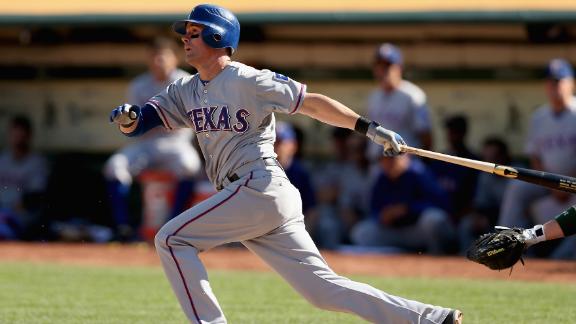
Young is leaving the game before his performance starts to suffer (ESPN)
It's fitting that two days after Lance Berkman called it quits, Michael Young is following him out the door. Fitting because they were both gifted hitters who made their names playing 257 miles from each other in Texas: Berkman in Houston and Young in Arlington.

Born eight months apart in 1976, they retired just two days apart in 2014, each at the age of 37 after enduring back-to-back disappointing seasons. But whereas Berkman was more or less forced out by injuries, Young is choosing to leave the game on his own terms after playing 147 games for the Phillies and Dodgers last year and batting a respectable .279 with a 102 OPS+.

Even still, their careers overlapped pretty well, which is funny considering how different they were as ballplayers. Berkman was a native Texan and a lumbering, switch-hitting slugger who played first base and left field, while Young hailed from California and was more of a slap-hitting shortstop. It's surprising, then, just how well some of their career totals match up:

Berkman: 1,879 G, 1,146 R, 422 2B, 86 SB, .293 Avg, 3,485 TB, six All-Stars
Young: 1,970 G, 1,137 R, 441 2B, 90 SB, .300 Avg, 3,491 TB, seven All-Stars

And here are some other similarities:

-Berkman debuted in 1999, one year before Young played his first big league game
-Both played at least 100 games at four different positions (not counting DH) and were very poor fielders
-After having somewhat down years in 2010, both bounced back for one last big season in 2011, when each made the All-Star team. Berkman finished seventh in the NL MVP voting while Young placed eighth in the AL race
-Both were traded away from their Texas teams and finished their careers elsewhere (though Berkman eventually made his way back to Texas to play for the Rangers)
-Neither won an MVP or Silver Slugger
-Both played in two World Series, including the 2011 Fall Classic when Berkman's Cardinals beat Young's Rangers in seven games

But that's enough about Berkman. I haven't written extensively about Young since he got his 2,000th career hit back in the summer of 2011--his last great season. He batted .338 with 106 RBI--both career highs--while sharing the major league lead for hits (213) with Boston's Adrian Gonzalez. At the time, he seemed to have an outside chance at 3,000 hits.

Then the following year, at age 35, his numbers dropped dramatically. His batting average plummeted more than 60 points, his OBP nearly 70, and his slugging by more than 100. Sensing the end was near, Texas traded him to the Phillies with cash for a pitching prospect (Lisalverto Bonilla) and a nothing reliever (Josh Lindblom).

There was hope that Young might be able to revive his career in Philadelphia, but all he did there was round out an aging infield of washed-up stars that already included Jimmy Rollins, Chase Utley and Ryan Howard. Young's numbers were almost identical to his 2012 production, and at the end of August the Phillies dealt him to the Dodgers for a pitching prospect (Rob Rasmussen) with a 6.46 ERA in Triple-A. Young was lucky to jump off the sinking Phillies ship and climb aboard the contending Dodgers just in time for the playoffs, but his last shot at that ever-elusive World Series ring was derailed by an old nemesis (St. Louis) in the NLCS. Young didn't do much to help matters there, coming up empty in all seven of his plate appearances.

So rather than hang around to pad his hit totals and chase a ring, Young called it a day. He can protect his .300 career batting average and leave long before he hits rock bottom. It's better this way.

A couple months from now Derek Jeter may have wished he'd done the same thing. I bring up Jeter in part because he is another shortstop in his late 30s (soon to be 40, actually), but also because I want to call attention to just how similar they were for a full decade. Check out how close they were from 2002--Young's first full season--through 2012--Jeter's most recent (and probably last) full season.

Jeter: 7,644 PA  1,153 R  2,105 H  336 2B  156 HR  .309/.376/.435  .811 OPS 114 OPS+
Young: 7,616 PA  1,028 R  2,134 H  396 2B 166 HR .304/.350/.447 .796 OPS 106 OPS+

I'm really surprised Jeter doesn't show up as one of Young's comps on his B-R page. They were very durable. They also struck out a good amount and bounced into a lot of double plays. Defensively they were about the same, with Young costing his team 8.6 wins and 126 runs with his glove while Jeter cost the Yankees 7.8 wins and 160 runs. Jeter, of course, was a much better baserunner with almost three times as many steals, and compensated for Young's power edge by getting on base more often. The point is that Young was very nearly Jeter's equal as a hitter for a long time. Take away 2002 (when Young had a .690 OPS) and 2012 (.682), and he comes out ahead.

That said, it can not be ignored the degree to which Young's numbers were enhanced by playing half his games in Texas. Like many hitters, Young got a big boost from his home ballpark. He batted a George Brett-esque .320/.368/.479 in Arlington, and if he had hit that well everywhere else we'd probably be discussing him as a serious Hall of Fame contender. As it were, his road OPS is more than 100 points lower.

For that reason (and others), Young was simply not as good as his numbers suggest. FanGraphs and Baseball-Reference agree he was worth around 25 WAR for his career, which leaves him well short of the Hall of Fame. JAWs has him as the 92nd best shortstop of all time, which seems baffling considering a lot of his counting numbers rank within the position's top 20. On the surface, a .300 career hitter who played the vast majority of his games at shortstop, second base and third base (all premium positions) would appear to be a very valuable player. Where was the disagreement between perception and reality coming from?

For starters, Young's offense really wasn't worth that much--about 60 runs for his career according to FanGraphs. Taking everything into account, that makes sense. Yes, Young got a lot of hits (six seasons with more than 200) and hit for some power (almost 700 extra base hits), but he didn't walk that much (typically around 50 times per season) so his on-base percentage of .346 is merely good, not great. Most of his power was in the form of doubles which obviously are not as valuable as home runs, so his career .141 ISo and .342 wOBA aren't very impressive either.

When he did get on he was a slightly above average baserunner, but any value he provided there was canceled out by his propensity for grounding into double plays. He also struck out quite a bit for somebody who never hit 25 home runs in a season. Throw in his friendly home park and the high-scoring era in which he played, and his numbers aren't anything special, as his .265 True Average and 104 wRC+/OPS+ indicate. He was only 61 runs better than the average hitter over the course of his career, which works out to be about 4.36 runs above average per year.

Then add to the mix his subpar glovework (2008 Gold Glove notwithstanding) which subtracts about a win per season from his value (two in his later years), and we're left with a slightly better than average hitter who has some nice counting numbers.

I don't mean to take anything away from Young. He was a good player for many years, a batting champion who set Rangers franchise records in numerous categories. But he's not a Hall of Famer (even though five of his ten best statistical comps are, and he probably would have been had he played in the 1920s or 30s), and not as good as some of his numbers suggest. Young is a perfect example of how advanced metrics and analysis can paint a more complete picture than those old-school statistics (like hits, RBI and batting average) ever can.

Wednesday, February 20, 2013

13 Bold Predictions for 2013

1. The Boston Red Sox make the playoffs
Why this is bold: The Red Sox lost 93 games last year and haven't won a postseason game since 2008. They improved during the offseason but failed to land the kind of high-impact player capable of adding six or seven wins to a roster by himself.

2. The New York Yankees miss the playoffs
Why this is bold: The Bronx bombers are October mainstays, having reached the postseason 17 times in the past 18 years. They won 95 games last year and enter 2013 with the highest payroll in the American League, a deep starting rotation and a veteran lineup loaded with All-Stars at almost every position.

3. B.J. Upton goes 30/30
Why this is bold: Upton's combination of power and speed is tantalizing, but he's yet to put together a 30/30 season. His power is trending upward but the fact remains that he's averaged just 18 home runs per season over the last five. Furthermore, his stolen base totals have decreased in each of the last two years, falling from 42 in 2010 to 36 in 2011 and 31 in 2012. I'm probably picking the wrong Upton.

4. Mariano Rivera leads the American League in saves
Why this is bold: The greatest closer of all time spent most of 2012 recovering from knee surgery after shredding his ACL while shagging fly balls during batting practice. Signed a one-year deal worth $10 million to return in 2013, but he's 43 years-old and Father Time is going to catch up to him at some point.

5. The Seattle Mariners and Cleveland Indians both have winning records
Why this is bold: Neither team had a winning record last year (or in 2011, or 2010, for that matter). The Mariners face stiff competition in the AL West, arguably the toughest division in baseball with LA, Oakland, and Texas all capable of winning 90+ ballgames. Furthermore, the two clubs haven't enjoyed winning seasons in the same year since 2007.

6. Dan Haren wins 20 games
Why this is bold: Haren's career high for wins is 16. Also, he's 32 years-old and coming off his worst full season as a pro.

7. Nick Swisher hits fewer than 20 home runs
Why this is bold: Since becoming an everyday player in 2005, Swish has never failed to smack less than 21 home runs in a season (averaging 26 per year). He's one of just six players who can claim that; the others are  Albert Pujols, Miguel Cabrera, Alfonso Soriano, Mark Teixeira, and David Ortiz.

8. Michael Young bats over .300
Why this is bold: Young is 36 and coming off his worst season in over a decade after batting just .277/.312/.370. He's batted below .285 in two of the past three years and seems to have entered the decline phase of his career. It certainly doesn't help that he's leaving the Ballpark in Arlington, where he batted .320 as opposed to .283 everywhere else.

9 Zack Greinke wins the NL Cy Young award
Why this is bold: Since winning the 2009 AL Cy Young in a landslide, Greinke's compiled a 3.83 ERA and has failed to receive a single vote for the award. Plus, he has formidable competition in his own rotation in the form of Clayton Kershaw.

10. Jim Johnson and Fernando Rodney combined have fewer saves than the AL saves leader
Why this is bold: Johnson led the major leagues with 51 saves last year, and Rodney was right behind him with 48.

11. Bryce Harper is better than Mike Trout
Why this is bold: The AL Rookie of the Year outproduced the NL Rookie of the Year in almost every conceivable metric last year.

12. Derek Jeter plays in fewer than 100 games
Why this is bold: Jeter may not be Cal Ripken Jr., but he's borderline indestructible. The Yankee legend has averaged 151 games played per year since winning the AL Rookie of the Year award in 1996, playing at least 148 games every year except for two (2003 and 2011).

13. The Toronto Blue Jays won't win the World Series
Why this is bold: Everyone's picking the bolstered Blue Jays to win the Fall Classic after a busy offseason in which Toronto added R.A. Dickey, Josh Johnson, Jose Reyes, Mark Buehrle, and Melky Cabrera without giving up any of their established talent.