Showing posts with label Ryan Braun. Show all posts

Monday, February 25, 2013

Who's Number One?

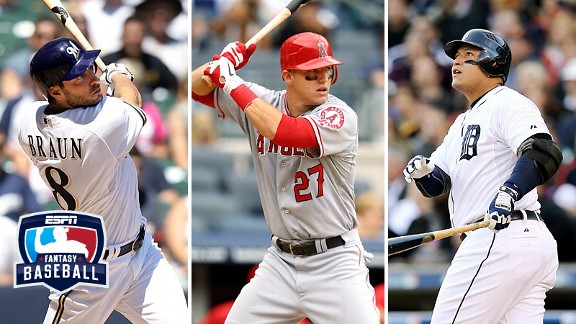
Mike Trout, Ryan Braun, and Miguel Cabrera (in that order) were the top three fantasy baseball players in 2012 according to ESPN's Player Rater. Which one deserves to be the first name off the board in your fantasy draft?

The Case for Braun
  • A true five category stud, Braun's average season yields 102 runs scored, 34 home runs, 107 RBI, 21 steals, and a .313 batting average
  • Braun's batted over .300 in five of his six big league seasons and owns a .313 career average
  • Few can match his combination of power and speed: Braun was the only player to go 30/30 in both 2011 and 2012
  • Milwaukee's offense paced the National League in runs scored last year, meaning Braun should have plenty of opportunities to score and drive in runs.
  • Fantasy owners need not worry about injury risk. Braun's averaged 154 games per season over the past five and is one of the safest investments in fantasy
Reasons to think twice
  • Braun's name has been linked to baseball's latest PED scandal and he once again finds himself embroiled in controversy. While it's highly unlikely Braun gets suspended, his performance will once again endure intense scrutiny from fans and media alike
  • After trimming his strikeout rate every year from 2008-2011, in 2012 Braun posted the worst whiff rate since his sophomore season
  • The spike in strikeouts may have something to do with the fact that he offered at 36.8 percent of pitches outside the strike zone, easily the highest mark of his career
My Projections: 104 runs, 36 home runs, 110 RBI, 31 steals, .318 batting average

The Case for Cabrera
  • Whereas outfield is the deepest position in fantasy for hitters, third base tends to be more volatile. It's not as thin as in years past, but many players (Pablo Sandoval, Kevin Youkilis, Chase Headley) have question marks
  • Starting in 2004, Cabrera's average season has produced 102 runs scored, 34 home runs, 118 RBI, 4 steals and a .321 batting average
  • A career .318 hitter and two-time batting champ, Cabrera has batted below .320 just once in his past eight seasons
  • He has Prince Fielder and Victor Martinez, two of baseball's top RBI men, protecting him in Detroit's lineup
  • Surprisingly durable for his size, Cabrera has appeared in at least 157 games each year since 2004. He's one of those players you pencil in on Opening Day and don't touch for the rest of the season
Reasons to think twice
  • Cabrera turns 30 in April, and his weight has been an issue throughout his career. Let's just say he won't be posing shirtless on magazine covers anytime soon
  • His OPS has declined in consecutive seasons
  • His walk rate plummeted from a career-best 15.7 percent in 2011 to 9.5 percent last year, probably because he adopted a more aggressive approach with Fielder batting behind him
  • With just 33 stolen bases to his name, Cabrera is a not a five category monster like Trout and Braun. Owners seeking speed will have to look elsewhere
My Projections: 112 runs, 37 home runs, 124 RBI, 2 steals, .333 batting average

The Case for Trout
  • At the tender age of 20, Trout delivered one of the greatest all-around seasons in baseball history. Assuming he follows a normal aging curve, he should only get better 
  • Despite spending the season's first 20 games in Triple-A, he went on to lead the major leagues with 129 runs, 49 stolen bases, and 10.7 bWAR last year. In addition, the Millville Meteor slugged 30 home runs, finished runner-up to Cabrera for the batting title and posted the AL's highest OPS+
  • If Mike Scoscia continues to bat him leadoff, he's going to score a truckload of runs setting the table for Albert Pujols, Josh Hamilton, and Mark Trumbo.
Reasons to think twice
  • Trout cooled off considerably in the season's final third. From August 1st forward, he batted .287/.383/.500 while striking out in a quarter of his plate appearances. Perhaps pitchers adjusted. Maybe he wore down over the course of his first full major league campaign. Perhaps it was simple regression to the mean. Most likely, all three factors played a role in his late-season slide.
  • Batting leadoff limits a batter's RBI opportunities, so Trout is going to be hard-pressed to reach the century mark in ribbies no matter how successful he is with men on base
  • Trout lacks the distinguished track records of Braun and Cabrera. The sample size is too small to make confident predictions about how he's going to perform in 2013 and beyond...
  • His .383 BABiP ranked third behind Dexter Fowler and Torii Hunter last year. Trout's fast, but he'll probably bat closer to .300 than the .326 mark he posted last year
  • Is the power legit? After all, we are talking about a guy who managed just 23 home runs in more than 1,300 minor league plate appearances
  • Could he possibly be any better than he was last year? Can he avoid the dreaded "sophomore slump" that plagues many of the sport's best young talents? Eric Hosmer, Brett Lawrie and Jason Heyward, all billed as superstars-in-the-making, struggled mightily in their second seasons. While they weren't anywhere close to Trout's level, they displayed how growing pains are part of the game. He won't fall off a cliff, but will probably dip a bit the same way Alex Rodriguez, Ted Williams and Pujols (already Cooperstown caliber players at Trout's age) did
My Projections: 123 runs, 24 home runs, 79 RBI, 52 steals, .306 batting average

The bottom line: if you score one of the first three picks in your draft, you're sitting pretty. Don't agonize over the decision too much, because you can't go wrong. Cabrera and Braun are money in the bank. Taking Trout is more of a calculated risk, albeit one that could also reap the biggest rewards. If the 21 year-old wunderkind somehow improves upon his historic rookie year, watch out.

I prefer to play it safe, so I'd put Braun at number one, Cabrera second and Trout third. How about you?

Monday, November 19, 2012

MVP Reaction

The debate between Mike Trout and Miguel Cabrera has been raging for months, and by this point it's been analyzed to death. I don't want to beat a dead horse, so I'm just going to say this. Mike Trout deserved to win the American League Most Valuable Player award. So did Miguel Cabrera. Trout deserved it more. He should have been the third player to win both Rookie of the Year honors and the MVP award in the same season (Fred Lynn and Ichiro Suzuki are the others).

I don't mean to bash Cabrera here, because he had a monster season. He really did. Besides leading the league with his .330-44-139 produciton, he also led the majors with his .999 OPS and 377 total bases. Hands down the best hitter in baseball this year. No disrespect to Cabrera, but his numbers weren't that special (they look like your typical Manny Ramirez year, or something out of Jim Rice's prime). Trout had one of the greatest seasons of all time. There is no compelling argument for why Miggy should have won over Trout, especially by such a huge margin;

-Cabrera won the Triple Crown, which is cool. Nobody had done it since Carl Yastrzemski's magical 1967 season. But Trout became the first player ever to score at least 125 runs, hit 30 homers and steal 45 bases.

-Cabrera hit better down the stretch (August and September), but Trout was better in May, June, and July. Last time I checked, a win in May counts just as much in the standings as it does in September.

-Sure, the Tigers made the playoffs and the Angels didn't, but LA actually won one more game in Detroit despite playing in a much tougher division. While Detroit got to beat up on the Twins, Royals, and Indians, LA had to duke it out with Oakland and Texas all summer long. The Halos missed the playoffs because Pujols had the worst April of his career, Mark Trumbo disappeared after the All-Star Break, Ervin Santana fell apart and Dan Haren had the worst full season of his career. How is any of that Trout's fault? If the team hadn't kept him buried in the minors for most of April it probably would have reached the postseason. And I'm sick of the notion that the MVP has to come from a playoff team (it cost Matt Kemp the award last year). The best player deserves to win. Period.

-Trout had the best season by a 20 year-old has ever had. Better than Alex Rodriguez's 1996, Ted Williams' 1939 and Ty Cobb's 1907. Cabrera didn't even have the best season of his career (his last two years were better).

-Trout was the best defensive centerfielder (forget Adam Jones winning the Gold Glove, Trout won the Fielding Bible Award) and the best baserunner in baseball. Cabrera "sacrificed" by moving back to third base to make room for Prince Fielder, but he is average at the hot corner and average on the basepaths.

-Cabrera hit better with runners on base, but he also had 138 more men on base than Trout did over the course of the season and also grounded into two dozen more double plays. Besides, WPA (the best statistic for measuring "clutch") shows that Trout was superior in high leverage situations.

-Forget the batting title. Every baseball fan worth his salt knows OBP is more important, and Trout's .399 mark tops Cabrera's .393.

-Last but not least, Trout was worth 10.7 bWAR, the most any position player has had since Barry Bonds ten years ago. Cabrera was worth 6.9, becoming the first Triple Crown winner not to lead his league in in WAR. You tell me who was more valuable.

As for the National League, it was a foregone conclusion that Buster Posey would win the award after his monster second half helped San Francisco reclaim the NL West. Even though his counting numbers paled in comparison to Ryan Braun's, Posey's 7.2 bWAR led the league. The Giants backstop posted the best batting average and OPS+ in the majors. He cut down more would-be basestealers than any catcher in baseball. Put it all together and Posey became the first NL catcher to win the award since Johnny Bench took home the trophy in 1972 (looking at Mike Piazza's player page it's a wonder he never won.)

I was happy to see Braun get the credit he deserved for another phenomenal season. The 2011 NL MVP paced the Senior Circuit in runs, homers, OPS, total bases, and extra base hits while finishing second in hits, slugging, RBI. He was the only player in the league to go 30/30, something he did last year as well.  He was undoubtedly the top hitter in th NL this year, and had the Brewers made the playoffs the vote would have been much closer. As it is, he finished a distant second but still received ten first place votes. I thought the BBWAA would punish him for his testosterone red flag last October, but they gave him a fair shake. Andrew McCutchen (third) and Yadier Molina (fourth) took the remaining pair of first place votes, while NL RBI leader Chase Headley rounded out the top five.

Other notes of interest:
The AL  truly was a two-horse race. Cabrera and Trout received all 28 first place votes. I'm a little surprised that Robinson Cano or Josh Hamilton didn't get any.

Justin Verlander, the Cy Young runner-up, finished four spots higher than David Price, who won the award.

Albert Pujols wound up 17th, the first time in his career he missed the top ten. Before this season he'd made the top five every year from 2001-2011 except 2007, when he finished ninth.

Nobody on the Boston Red Sox received MVP consideration, and rightfully so. Can't remember the last time that happened.

Hunter Pence made his way onto the ballot despite skidding to the finish line with a .253/.319/.425 batting line and 0.8 bWAR. I'm guessing someone was impressed with his 24 home runs and 104 RBI.

Chipper Jones received consideration for the 13th and final time in his career.

And who in God's name voted for Raul Ibanez? (probably the same guy who threw David Robertson a vote last season; the man needs to be stopped). Ibanez batted .240/.308/.453 and was worth a paltry 0.3 bWAR. I can think of many players more deserving of that vote; Curtis Granderson, David Ortiz, Chris Davis, Billy Butler, Alex Gordon, and the biggest snub; Austin Jackson. A-Jax led the league in triples, maintained a .377 OBP and scored 103 runs setting the table for Prince Fielder and the MVP.

Friday, September 14, 2012

Brewers, Phillies Rise from the Dead

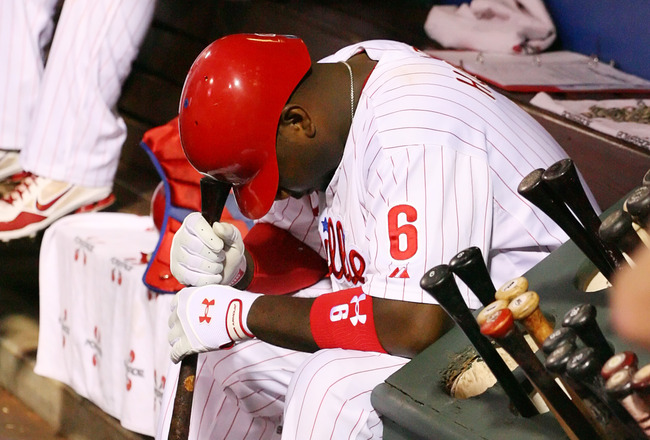
For much of the summer, the Milwaukee Brewers and Philadelphia Phillies were considered major disappointments, and rightly so.  After winning their respective divisions a year ago both teams carried losing records deep into the summer.  At the end of July they were sellers in a buyer's market and found ways to unload some of their established talent.  The Brewers shipped former Cy Young winner Zack Greinke to the Angels and Philadelphia parted ways with Joe Blanton plus All-Star outfielders Shane Victorino and Hunter Pence shortly after re-upping Cole Hamels. With their underachieving teams in ruins, both clubs seemed to be waving the white flag.

Six weeks later, they've somehow managed to claw their way back to .500 (Milwaukee is 72-71, Philly is 72-72).  They're closing in on St. Louis (76-68) for the league's second wild card spot, and one of them could wind up making the playoffs if they maintain their torrid pace for three more weeks.

How the hell did that happen?
On Friday the (July) 13th, Philadelphia began the second half at Coors Field with a 6-2 loss to the woeful Colorado Rockies.  Cliff Lee surrendered nine hits while Colorado's Christian Friedrich stymied a Phillies lineup featuring Jimmy Rollins, Chase Utley, Ryan Howard, Carlos Ruiz, Placido Polanco, and the aforementioned duo of Pence and Victorino. The defeat represented Philly's fifth loss in a row, the eleventh in their past twelve, and it dropped them to 37-51 on the season.  A top heavy team that had adopted a stars and scrubs approach, constructed around a nucleus of aging superstars, had been ravaged by injuries and slumps to many of its key contributors (sound familiar, Red Sox fans?).  They were dead.

Except they weren't.  Since then, Philly has gone 35-21 despite continuing to field a lineup that is average at best (losing Pence and Victorino didn't help). They've scored in double digits just once since the beginning of June and lack the firepower necessary to build up big leads.  Every game they play is a tightly contested affair.  Most nights, they barely scrape together enough runs to win.

So if their unlikely resurrection hasn't been fueled by hot hitting, then the answer must lie in improved pitching. As a whole, Charlie Manuel's staff has trimmed its ERA by nearly a full run in the second half. The rotation has benefited from Cliff Lee and Roy Halladay returning to form, supplementing the success of Hamels, Kyle Kendrick and Vance Worley. The other major turnaround came within the bullpen, which has gone from lackluster to dominant in the span of two months.  Philly's relievers went 9-16 with a 4.76 ERA and 1.38 WHIP (essentially Ricky Nolasco) in the first half but are 12-8 with a 3.14 ERA and 1.17 WHIP so far in the second (similar to Hiroki Kuroda) while upping their K rate by more than two batters per nine innings. The team's biggest weakness and fatal flaw has become its main strength. But then again, the pitching was supposed to be good, so it was only a matter of time before they all got on a roll.
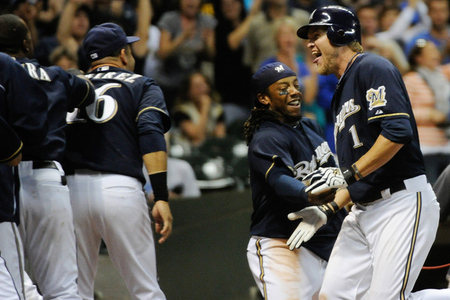
As for the Brewers, their renaissance has taken a different path.  On August 15th, the Rockies bested the Brew Crew 7-6, to cap off a three game sweep at Coors Field.  The Brewers fell to 52-64 on the season, a dozen games below .500 with six weeks to play.  At that point, most teams would have admitted that it just wasn't their year and mailed it in. Call up the reserves in September and start playing for next year.  But the Brewers didn't see it that way.  They looked at their soft schedule, saw a golden opportunity and seized it by the throat.  During the last month Milwaukee has gone 20-7, making the most of their 17 game stretch from August 20th through September 6th in which they played three slumping teams; the Chicago Cubs, Pittsburgh Pirates, and Miami Marlins. The Brewers have lost consecutive games just once--back-to-back losses against Philadelphia over the weekend of August 18th/19th--but have won two or more games seven times and were practically unbeatable at home (11-2), where they've swept the Cubbies, Bucs, and Braves.

The Brewers boast the best lineup in the National League and have feasted off opposing hurlers all season long.  Despite losing Prince Fielder to the Detroit Tigers via free agency, their powerful offense leads the Senior Circuit in runs scored, home runs, and total bases (with so much pop, you'd think they be a station-to-station offense that stands around waiting for somebody to crank a home run, but they're not.  Manager Ron Roenicke is aggressive on the basepaths; his team rates second in the NL in steals). After a quick glance at the starting nine, it's easy to see how Milwaukee's bats have been so prolific.  Ryan Braun is putting together another MVP-caliber season.  Free agent addition Aramis Ramirez has rebounded from a slow start to post his typically strong all-around numbers.  Corey Hart needs just three big flies for his second 30 homer season since 2010.  Backstop Jonathan Lucroy has produced on par with Buster Posey when healthy.  Outfielders Carlos Gomez and Norichika Aoki have been productive.  Even Rickie Weeks, who's looked utterly lost at the plate this year, is salvaging his season with a torrid September.  Top to bottom, this lineup is stacked with heavy hitters. It's been even better in the second half, averaging nearly 5.5 runs per game while seeing a 58-point improvement in their OPS compared to the first half.

So scoring runs isn't an issue for the Brewers, but preventing them is (In this sense they remind me of the 2004 Red Sox before the Nomar Garciaparra trade; they can hit with the best of them, but streaky pitching and abysmal glove work have prevented them from taking off). Their defense is brutal; bringing in Alex Gonzalez to man shortstop couldn't cure that.  Their inefficiency in the field makes the pitching look worse than it is, but the arms have endured their own set of problems, too. The bullpen has been a mess all season long, primarily because John Axford and Francisco Rodriguez have struggled in the late innings--that explains why Milwaukee is just 23-29 in one-run games.  The rotation is solid and has soldiered on without Greinke and Randy Wolf (released), but lacks consistency. Yovani Gallardo and Marco Estrada have been lights out lately, but Mike Fiers and Shaun Marcum are slumping.  If the Brewers are going to have any shot of sneaking into the playoffs this year, the bullpen will need to step up.  Every win counts, and they can no longer afford to lose close games by one run.

After digging themselves in such deep holes early on, the recent surges by both teams will most likely be too little, too late.  There are still substantial challenges to overcome as the season draws to a close, and these roadblocks may prove insurmountable. The Phillies have three more games in Houston (piece of cake), but from then on out they play all their games against their NL East rivals; three each with the New York Mets, Atlanta Braves, and Miami Marlins, but six against the Washington Nationals, who have the best record in baseball and are closing in on 100 wins.  The hope is that with division all but wrapped up, Davey Johnson may begin resting his regulars/aligning his starting rotation as the postseason approaches.  Philadelphia is a combined 10-20 against the Mets and Braves this year, so those match-ups could spell trouble as well.  Expect the Brewers to continue to roll against New York and Pittsburgh, but their ten game road trip looms large for a team that has a .394 winning percentage away from home.  To make matters worse, seven of those games are against the red-hot Reds and Nats.  But if Milwaukee somehow survives that challenge with their playoff chances intact, they can look forward to six cushy games at home against the Astros and Padres to close out the season.

I don't think either one gets in.  The odds aren't on their side; coolstandings.com gives Milwaukee a 6.7 percent chance of reaching the postseason and the Phillies are even bigger long-shots with just a 2.7 percent likelihood.  But they're still breathing.  They're not out of the race.  They still have a chance and, given where they stood a month ago, that is nothing short of miraculous.

I guess the real question is; do you believe in miracles?