Friday, September 19, 2014

Longoria: Above the Nettles

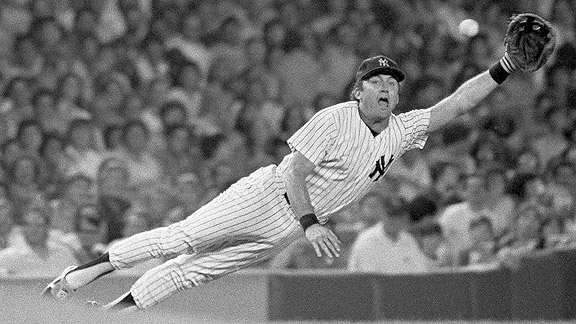
Longoria is following in Nettles's footsteps (ESPN)
The more I think about it, the more Evan Longoria seems like a modern-day Graig Nettles to me, or at least a superior version of Nettles.

Think about it: they're basically the same player. Neither one hit for great average or had much speed, but both have above average on base skills because they walk a good amount. Both have good power, typically settling for around 20 homers and 90 RBI per season. Both have seen their numbers stifled by the pitching-dominated environments in which they play: Nettles spent most of his 22-year career in a wasteland for hitters (1967-1988) while Longoria has been victimized by the new Deadball Era, not to mention played half his games in the offense-suffocating Trop. For the most part they've been pretty durable, too.

Defensively, both are terrific. Nettles won two Gold Gloves and probably deserved a lot more, seeing as how B-R says his glove was worth nearly 21 wins over the course of his career (FanGraphs more or less agrees and has him at 18), though he was overshadowed by Brooks Robinson early in his career. Longoria also has a pair of Gold Gloves and has accrued the most defensive value of any third baseman since 2008, the year he broke in. His slick fielding combined with his elite bat has made him the best all-around third sacker during that span. He's been better than Adrian Beltre even, something I feel that most people don't appreciate.

Nettles had two top-six finishes in the MVP voting. Longoria also has two top-six finishes, though with admittedly more time to add more. Both came up with big hits in the postseason though their overall playoff numbers aren't great.

Nettles, of course, was a great player for a very long time; a borderline Hall of Famer. Longoria, with almost 40 bWAR through his age 28 season, is well on his way.  Though this year's been a bit of a struggle for him, he's remained healthy enough to play everyday and so his numbers will turn out alright. He was so good so young anyways that he really only needs a couple more big seasons to cement his Hall of Fame case, and seeing how he's signed through 2022 that shouldn't be too hard to do.

Nettles was very nearly a Hall of Famer, and Longoria's better than him. Few players play past 44, as Nettles did. But health and luck permitting, Longoria won't turn out to be the next Scott Rolen.

Thursday, September 18, 2014

The Other Martinez

Martinez has been a force since the calendar flipped to June (CBS)
A lot of praise has been showered on Victor Martinez for his MVP-caliber season, and rightly so. He's been one of the best hitters in baseball this year, putting up monster numbers in the face of sagging offensive production across the sport.

Just don't forget about the "other" Martinez on the Tigers, an unheralded Spring Training pickup who's having an outstanding season in his own right. I'm talking about J.D. Martinez (no relation), this year's Jose Bautista or Adam Lind.

Martinez was virtually unheard of before this year, but so it goes when you're a bad player on an awful team. You see, Martinez was a corner outfielder who didn't hit much or play much in his first three big league seasons, averaging just 84 games per campaign after arriving as a late-July call-up in 2011. Martinez actually hit decently that year with a .274/.319/.423 batting line (104 OPS+) and numbers that, when projected out over 160 games, worked out to be around 40 doubles, 18 home runs and 105 RBI. Martinez, just 23 years-old at the time, was a mild success on an abysmal Astros club that lost 106 games.

2012 wasn't any better for Houston, which lost 107 games, or Martinez, who struggled in his first taste as an everyday player. Despite a strong start his batting line shrunk to .240/.311/.375 (86 OPS+), leaving him below replacement level at -0.6 bWAR. On the plus side he showed a bit more patience and his power held steady, but didn't build off his solid debut so much as he took a step back from it.

2013 marked continued decline for Martinez, who batted an anemic .250/.272/.378 and was worth a full win below replacement despite barely playing half a season (86 games). Whatever strides he'd made in plate discipline the year before had disappeared, as he posted an abominable 82/10 K/BB ratio. The 25 year-old was supposed to be coming into his prime, but instead was merely treading water as a below average player. With minimal contributions in power, speed, and fielding, Martinez was a liability even the horrid Houston Astros couldn't afford to keep around.

So, in March of this year, with Spring Training drawing to a close, the Astros cut him. Based on what they'd seen from him--a .251 batting average, .300 on-base percentage, and sub-.400 slugging percentage in nearly 1,000 plate appearances--they were totally justified in doing so. Most teams would have given up on Martinez as well, I suspect.

The Tigers didn't. They scooped him up two days later, signing him to a minor league contract. Given his age (26) it wasn't entirely unreasonable for them to bank on a breakout, or at least hope he could be a productive fourth outfielder. But I'm guessing not even in their wildest dreams would they ever have expected Martinez to become a full-blown star.

An improved swing has led to better results at the plate (Boston Herald)
That's what happened in June, when Martinez mashed to the tune of .345/.367/.702 with nine doubles, seven home runs and 21 RBI. Given his spotty track record, one would have expected him to cool off sooner or later, but it hasn't happened. He's continued to rake since then and has been especially hot lately with 22 hits, six home runs and 17 RBI already in September. With the Tigers trying to fend off Kansas City, that barrage couldn't have come at a better time.

In Detroit Martinez has not only resurrected his career, but he's also emerged as one of the best hitters in baseball with his .398 wOBA, 157 wRC+, and .928 OPS. With his remade swing he's hitting well over .300, which makes up for his iffy on-base skills (only 25 unintentional walks) but is also completely tied to his .382 BABiP--a ridiculous number given his average footspeed that becomes even harder to explain after seeing only a slight uptick in line drive rate and considerable drop-off in ground ball rate.

But what's been most surprising has been his power. After managing just 24 home runs in his first three seasons (averaging one every 37.5 at-bats) he's already slugged 23 this year, going yard once every 17.6 ABs. He has as many home runs as Miguel Cabrera and his ISo is twice what it was last year. Power progression is to be expected as a player reaches his mid-20s, but seemed unlikely given his shift from a great home run park for righties in Houston to a much tougher one in Detroit. He's hit a few more fly balls than last year, but not enough to explain how he more than doubled his home run frequency.

Rather, that can be explained by his HR/FB ratio, which has more than doubled from last year's 9.5 percent to over 21 percent this year. There's probably some luck in there, as according to the ESPN home run tracker eight of his bombs just barely got out, but even if you take all those shots away he'd still have 15 on the year--a career high.

Martinez has noticeably improved against almost every type of pitch, but none more so than fastballs. After posting negative values against the heater in each of his first three seasons, he's been worth more than 21 runs above average against them this year. That, combined with better success against curveballs, sliders, and changeups, have made him a much more effective hitter.

And that's been huge for the Tigers this year, who've need every one of the four wins above replacement he's provided for them. If Detroit does hold on and win the division, Martinez's breakout season will be a big reason why.


Wednesday, September 17, 2014

Birds, Nats Clinch

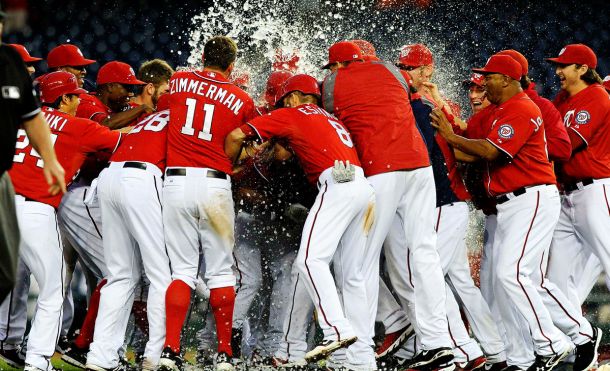
Washington won its second division title in three years (Vavel)
Last night was a great night to be a baseball fan from the D.C. metro area. In Atlanta the Nationals blanked the Braves 3-0 to clinch the NL East for the second time in three years. In Baltimore the Orioles won their first division title since 1997, bludgeoning the Blue Jays 8-2 in front of a celebratory home crowd of 35,000-plus.

But while both of the nation's capital's baseball teams ended up in the same place--at the top of their division and postseason-bound--how they got there turns out to be two very different yet similar stories

It's impossible to talk about this season without first mentioning 2012, when both teams shed their also-ran status by making the playoffs. Washington was the best team in baseball that year, winners of 98 games and clear favorites to win the National League. The former Montreal Expos had been more or less irrelevant since moving to Washington after the 2004 season, never winning more than 81 games and finishing last in their division five times, but thanks to an influx of young talent and a killer pitching staff that had changed practically overnight. For the first time since 1933, there was playoff baseball in our nation's capitol.

That same year, the Baltimore Orioles also came out of nowhere to make the playoffs, winning 93 games and the AL Wild Card. The once-proud franchise had endured 15 straight losing seasons prior to its magical turnaround, going from a 69-93 last-place finish in 2011 to two games out of first the following year.

The Nationals were a veritable juggernaut. The Orioles were a Cinderella story, a good team that overachieved due to extraordinary luck in one-run games. And yet they both met the same fate: eliminated from the Division Series in five games, with Baltimore falling to their mighty division rivals from New York and Washington losing to the defending World Series champion St. Louis Cardinals.

Still, 2012 was a banner year for the Nats, who were poised to be the crown jewel of the Senior Circuit for the foreseeable future. That season marked not just the beginning of a new era in Washington baseball, but also appeared to signal a changing of the guard in the NL East, a transition away from the Braves dynasty and Phillies mini-dynasty. With their tantalizing core of young position players (Bryce Harper, Ian Desmond, Wilson Ramos) and plentiful pitching (Stephen Strasburg, Jordan Zimmermann, Gio Gonzalez), Washington was armed and ready be kings of NL East for years to come.

For the first time since Clinton's presidency, the O's are AL East champs (Baltimore Sun)
The Orioles, on the other hand, were treated as a fluke. There was no such talk of a repeat performance in 2013, much less the next Orioles dynasty. They had an outstanding core of in-their-prime position players (Adam Jones, Matt Wieters, Nick Markakis, J.J. Hardy), but not nearly enough arms to match their competitors in the AL East. Everyone knew that with natural regression they'd likely be a .500-ish team in 2013, and that's basically what happened. They won 85 games and fell back to the pack, finishing tied-for-third with the Yankees behind pitching-rich Boston and Tampa Bay. Nobody saw Baltimore as underachievers that year, but rather a club that played to its true talent level.

Not so with the Nationals, the preseason favorites to win the World Series. Washington was shockingly irrelevant last summer, 16 games out of first and four below .500 on the morning of August 20th. A late surge pushed them 10 games over .500 but still left them 10 back of the Braves and out of the playoffs. Almost the exact same results as the Orioles, one might notice, but drastically different expectations led to the Nationals' season being viewed as a massive disappointment, if not an outright failure.

Both responded with significant roster upgrades over the winter--Baltimore inked Nelson Cruz and Ubaldo Jimenez while Washington stole Doug Fister from Detroit--and have come back strong. The Nationals reclaimed their status as the top dog in their division and, as of this writing, the National League. Not that they had much competition--Atlanta was the only other rival with legitimate postseason hopes and now sits below .500--but first place wasn't guaranteed until mid-August, when Washington won 10 in a row and 12 out of 13 to wrap up the division. They've continued to roll since, breaking away from the pack and building their lead up to its high-water mark of 12.5 games.

Baltimore, on the other hand, wasn't given a snowball's chance in hell to win the AL East before the season began. The Orioles were widely viewed as one of the two weakest teams in the division, with the other being the Blue Jays. Boston, New York, and Tampa Bay were expected to duke it out for the top spot. Nobody gave Baltimore a second thought.

So when the Orioles were in first place for a good while in May, nobody thought it would last. And while they were only a few games over .500 for most of June, that was enough to stay near the top of the division. In early July they made their move, winning 10 of 13 leading up to the All-Star break to finish the first half 10 games above .500 and with a four game lead in the AL East. They've been in first place every day since, putting away the division with a torrid second half. Since the last day of June they've gone 49-21. That's a .700 winning percentage, folks, spanning almost half a season.

It's fitting that both teams ran away with their divisions around the same time, and that they'll likely finish the season with similar records. Because for the second time in three years, both teams will be playing in October, vying for the chance to compete in the first-ever all-DC area Fall Classic (a Beltway Series, I guess?). While I'd rather see a Freeway Series between the more exciting Dodgers and Angels (Yasiel Puig, Clayton Kershaw, and Mike Trout on the game's grandest stage? Yes please), that would be a pretty good series in its own right.


Monday, September 15, 2014

Martinez MVP?

Martinez has had an MVP-caliber season, but does he deserve the hardware? (zimbio)
Now that the Tigers are back in first place there's been some talk about Victor Martinez for AL MVP recently. Setting aside the fact that this award has been Mike Trout's to lose for months now, I want to talk about his candidacy for a minute.

For starters, Martinez is absolutely a legitimate MVP candidate. I think it's pretty safe to say that he's been one of three best hitters this year. He has the third-best wRC+ (162) in baseball, tied with Andrew McCutchen and behind only Trout and Jose Abreu. He's second in wOBA (.407) to Abreu. also has the best OBP (.400) in the majors as well as the second-best batting average and OPS, third-best slugging percentage and adjusted OPS, and a top-10 spot in basically every hitting statistic you can think of.  He's done everything you could ever ask of a hitter: hit for average and power, get on base, drive in runs, and rarely strike out. By old and new-school stats, Martinez has been phenomenal.

But as great as V-Mart's been with the bat this year, he's not the American League's most valuable player. FanGraphs rates his total contributions at about four wins above replacement--a terrific number, but hardly MVP-worthy (behind a couple teammates as well). Baseball-Reference is a bit more generous and has him at 4.7 bWAR--again a great number, but outside the top-10 when looking at position players.

In fact, both sites rate Martinez's value on par with that of teammate Miguel Cabrera, the two-time defending MVP who won't be making it a three-peat due to a pretty substantial decline in offensive production. Though Martinez has been the better hitter this year, Cabrera closes the gap with his defensive value even though there isn't much of it.

So while Martinez has clearly been one of the best hitters in baseball this year, that's not enough to earn MVP honors because he's primarily a DH, having played just 36 games in the field thus far. I don't mean to say that a DH can never be an MVP (Don Baylor won in 1979 while David Ortiz and Edgar Martinez have come close), but rather think winning should be more difficult for them. When it comes to offensive statistics, they should be held to a higher standard than players who have to field a position for nine innings every day.

In my opinion, to win an MVP a DH must have substantially better numbers than anyone else in the league. He has to lap the field, blow everyone else away. He needs to have the best numbers and lead by a considerable margin. When your contributions come solely from your bat (and legs, but most DH's don't run very well, which is often why they're there to begin with), you better have some otherworldly numbers to make up for sitting on the bench the rest of the time.

And Martinez's numbers, great as they are, aren't head and shoulders above everybody else's. Abreu's are equally awesome, and so are Mike Trout's. Jose Bautista's aren't far behind. Martinez might be the best hitter in the American League this year, but not by much
Now if he were hitting around .350 with a four-digit OPS and more power, that would be a different story. He'd have a real case then.

I'll readily concede that Martinez, despite what WAR says, has been the most valuable position player on the Tigers this year. He's been huge out of the cleanup spot for them, providing consistently tremendous production all season long (from both sides of the plate, to boot). I think he should finish in the top five, maybe even the top three if he goes on one last tear. But he's not the American League MVP; that's been Mr. Trout for a few years now.


Tuesday, September 9, 2014

Jeter Rage

Jeter's final season has been one to forget (NewsDay)
Barring a ridiculously hot finish the New York Yankees, five games out of the second wild card with 21 to play, aren't going to make the playoffs this year. The irony is that Derek Jeter, a leader and key contributor on all the great Yankee teams of the last two decades, is a big reason why. Not the only reason, of course, because when a team fails to reach the postseason there's always a bunch of reasons, but a pretty big one. With his punchless bat and shoddy defense at a premium position, he's done more harm than good.

It should come as no surprise that Jeter allowed himself to become such a detriment for his team. Because for all the praise showered on his leadership abilities, he has never been one to demote himself. Like Joe DiMaggio, he has too much pride and cares deeply about his image.

This was evident when Jeter did not offer to change positions to accommodate Alex Rodriguez when the Yankees traded for him in 2004, even though everyone knew that A-Rod was superior defensively. Rodriguez graciously shifted to third, even though he'd just won two straight Gold Gloves and was among the game's slickest-fielding shortstops at the time. Jeter did not want to defer to Rodriguez, to admit he was the inferior shortstop, so he remained at the infield's glory position. The following offseason, when Bernie Williams was in decline and New York needed a center fielder, Jeter's name was brought up, but once again he stayed put.

Now, ten years later, Jeter is still entrenched at shortstop long past his expiration date. 40 year-olds aren't supposed to play short on a regular basis, especially when they were never that good there to begin with. Jeter's defense has been statuesque for awhile now, his already iffy range demolished by recent ankle injuries, rendering him too immobile to man the most important infield position. One need not look at his range factor--by far the worst of his career--to know that he's not getting to many balls hit his way.

This all could have been avoided before the season. When Rodriguez was suspended and Robinson Cano departed via free agency, two less challenging positions opened up. Jeter did not volunteer to fill them, leaving the Yankees to settle  for doomed-from-the-start alternatives Kelly Johnson and Brian Roberts. Had Jeter volunteered to switch, New York could have at least found a quality shortstop replacement in Jhonny Peralta or even Stephen Drew, who remained a free agent until late May. Drew's been terrible this year as well, but five months ago he looked like a much better player than either Johnson or Roberts (Jeter too, for that matter).

Jeter's done even more harm with his bat, which has produced an empty .260/.308/.311 batting line thus far. Adjusted for league and park, his .618 OPS is 23 percent below average. Throw in his mediocre baserunning, and Jeter's offense has been worth 17 runs below average, or almost two wins.*

*Two wins might not sound like a big deal, but when you're in the playoff hunt at this stage in the season two wins can mean the difference between life and death. Credit New York with two wins and remove two losses, and suddenly they trail Seattle by just three games for the second wild card, and their playoff chances look much, much better.

That wouldn't be so bad if Jeter was hitting eighth or ninth, where his poor bat would be minimized and not really a liability compared to the production most teams are getting from the bottom of their order. But Jeter, as you know, is not buried at the bottom of New York's star-studded lineup. He's batting second--the most important spot in the lineup--because that's where he's always hit, and because Joe Girardi has too much respect for Jeter to move him down (even though Joe Torre had no problem batting Alex Rodriguez--a much much better hitter than Jeter--eighth in a playoff game).

And Jeter, being Jeter (passive), has not volunteered to hit lower in the order, even though the Yankees would be better served by batting just about anyone else second.  A table-setter with a league average OBP and no pop or speed is a problem, especially when he has the third-most plate appearances on the team (only Jacoby Ellsbury and Brett Gardner have more).

When you have a flaw like Jeter or, more accurately, an offensive black hole, you're supposed to hide him, not expose him. Minimize your weaknesses and maximize your strengths, not the other way around. Jeter's 40 years old and is in his 20th big league season. He had to know he wasn't the same hitter he used to be, and that batting second was going to hurt the Yankees more than help them. He should have made it clear from the get-go: I'm going to try to play as much as I can and do what I can to help the team win, but realistically I'm limited and shouldn't be batting second.

Jeter did not do this. He did not do what was so clearly obvious for the best of the team. He left it up to the manager, knowing full well that Girardi would not have the gumption to slot the game's biggest icon and most popular player down in the order. Jeter was not proactive. He did not take the initiative. He wasn't, you know, a leader.

I take nothing away from Jeter as a ballplayer, because he's been a great one for many years. It just really makes my blood boil when people start going on and on about how what a great leader Jeter is and what great intangibles he has and how he's a winner. Great leaders know when to lead and when to defer to others, and in this regard Jeter has to be considered a failure. He is not the selfless saint that people make him out to be, and lately his teams have suffered as a result.

So when the playoffs start next month and New York is on the outside looking in, and fans and media are looking for someone to blame, they ought to point a finger at their beloved Captain.