Monday, February 16, 2015

Top Shortstops for 2015

Tulowitzki is far and away the best shortstop in baseball (Denver CBS Local)
Thinking about Ernie Banks and his place among shortstops all-time got me thinking about the best shortstops in the game today. Here's the list I came up with.

1. Troy Tulowitzki
There's no doubt that when healthy, Tulowitzki is one of the best all-around players in baseball. "When healthy" is the key phrase there, as Tulo has played 130 games once in the past five seasons, but even last year when he missed 71 games he was still worth 5.5 bWAR. The four-time All-Star turned 30 last October and is still in his prime, as evidenced by last year's ridiculous first half. He also gets to play half his games in Coors Field.

2. Ian Desmond
Quick, name the only player to go 20/20 in each of the past three years. It's not Mike Trout, Andrew McCutchen, or Carlos Gomez. It's Desmond, who's earned the NL Silver Slugger award three years running. Hard to believe it's the same guy who batted .262/.304/.387 (87 OPS+) through his first three seasons and 1,300 big league plate appearances. Desmond did regress a bit last year, whiffing 183 times as his batting line fell to .253/.313/.430, but at 29 that power-speed combo probably isn't going anywhere.

3. Jose Reyes
Reyes isn't the game-changing stolen base threat he was during his younger days, but he's still a very good one (30/32 in stolen base attempts last year) and has retained his double-digit home run pop. He hasn't been a plus defender for a while now, but he does enough as a table-setter (gets on, steals, scores runs) to be an elite shortstop when healthy.

4. Starlin Castro
Castro's coming into his prime at 25 and is already a three-time All-Star. He rebounded from an abysmal 2013 to bat .292/.339/.438 (114 OPS+) with 14 home runs last year, putting him back on the Hall of Fame track. Castro's defense remains atrocious, but he might be the only shortstop not named Tulowitzki capable of batting .300 with 15-20 homers.

5. Alexei Ramirez
Ramirez flies under the radar despite playing everyday and having good power/speed numbers for a shortstop. He's hit at least 15 home runs in four of his six seasons and notched double digit steals every year except one. The result is a durable, decent defensive shortstop with close to league average power/on-base skills and solid speed. That might not be sexy, but it's a pretty good ballplayer, even if he is 33.

6. Jhonny Peralta
Peralta played outstanding defense last year in addition to popping 21 home runs, clubbing 38 doubles, and hitting .268/.336/.443 (116 OPS+). He was rewarded with MVP consideration for the first time in his 12 seasons. His bat and glove have both held steady with age, which is why I don't predict a major drop-off coming in his age-33 season. Peralta's also surprisingly durable for someone of his size and build, as he's played at least 140 games in all but one of the past 10 seasons.

7. J.J. Hardy
Hardy has a great glove (three straight Gold Gloves) and solid bat (96 OPS+), though his stick might be slipping if last year's power outage was any indication. He's already 32, so I wouldn't bank on him bouncing back to his 25-homer days, but 15 or so should be reasonable in that ballpark. If he's truly a single-digit home run guy from now on, though, that doesn't bode well for the Orioles, as he's just a .260 hitter who hardly walks and strikes out a fair amount. Given his age the defense is probably headed south soon as well, but for now he's still a comfortably above average shortstop.

8. Andrelton Simmons
Winner of back-to-back NL Gold Gloves, Simmons is hands-down the best defensive shortstop in the game, but his bat slipped from usable in 2013 to a black hole last year (.617 OPS). His glove makes him an asset no matter how poorly he hits, but if he can just be mediocre at the plate rather than cringe-worthy, he'll be a borderline All-Star.

9. Erick Aybar
Aybar's another one who doesn't stand out but consistently plays well. He's as steady as they come, a lock to bat .280 with around 20 steals and 30 doubles despite playing in a tough hitter's environment. Throw in decent defense and you've got yourself a capable if uninspiring shortstop.

10. Jimmy Rollins
Now 36, Rollins refuses to break down. He was worth almost four bWAR last year after socking 17 homers, stealing 28 bases in 34 tries, and putting up a 101 OPS+. He also played not terrible defense, which is always a pleasant surprise from a veteran shortstop in his mid-30s. His bat might finally crumble now that he's moving from a hitter's heaven in Philly to a pitcher's paradise in LA, but it seems equally likely that Rollins will just continue to roll on.


Honorable Mention: Alcides Escobar, Jed Lowrie, Xander Bogaerts, Elvis Andrus

Giambi Goes Out With Whimper

Yep, that guy played major league baseball last year (Rant Sports)
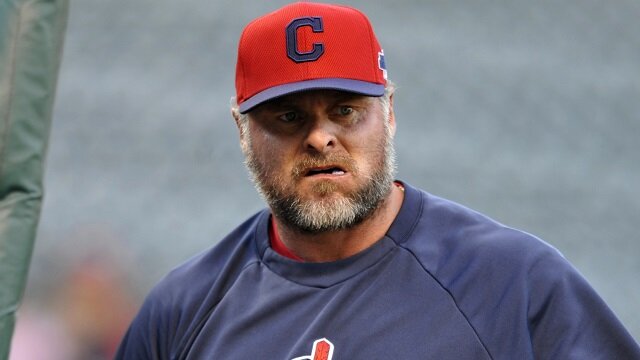
Jason Giambi finally announced his retirement today at the age of 44.

I say finally because it seemed like Giambi retired years ago. He became a part-time player after leaving the Yankees via free agency in 2009 and, save for a brief resurgence with Colorado in 2011, was never again the impact hitter that he was during his days in Oakland and New York. Giambi played so sparingly over the past five seasons that it was just easy to forget about him unless you were a die-hard Rockies or Indians fan. Every now and then I'd see his name in the box score and think What? That guy's still playing?

Giambi hung around long past his expiration date, but he was hardly the first to do so. I'm just surprised a bat-first/only guy on the wrong side of 40 who couldn't hit, run, or field kept finding work.

And while those final years didn't add much to his counting stats, they did help him achieve several milestones. Giambi notched his 2,000th career hit on September 8th, 2013 against the New York mets. Leading off the bottom of the ninth, Giambi represented the tying run and was promptly removed for a pinch-runner. He cracked his 400th double the same year. There were also moments like these.

That's how the last act of Giambi's career played out; a lot of pinch-hitting and DH-ing and even more time spent on the bench. But during his heyday during the late 1990s and early 2000s, at the height of the steroid era, Giambi was an absolute terror. He had a beastly four-year peak from 1999-2002 when he batted .326/.452/.612 (177 OPS+) with a .448 wOBA. He was in the top-eight of the MVP voting every year, winning outright in 2000 and finishing runner-up to Ichiro Suzuki the following year. There were only two position players more valuable than Giambi during this time (according to fWAR): Barry Bonds and Alex Rodriguez.

Like Frank Thomas, another burly slugging first base/DH type, Giambi remained effective throughout his 30s but slipped as his body began to break down (probably a result of his admitted steroid use). Perhaps seduced by Yankee Stadium's short right field porch, he became more of a three-true outcomes kind of guy, especially once teams began employing defensive shifts against him. His BABiP, which had been above .310 every year from 1996-2002, fell below .295 in every one of his last dozen seasons, during which time Giambi batted a mere .238. Pretty shocking considering he nearly beat out Ichiro for the batting title in 2001.*.

*The same thing has more or less happened with Mark Teixeira, a first baseman who, like Giambi, signed a big long-term deal with New York, only to follow up a monster first season with several very good years before injuries, shifts, and a pull-happy approach wrecked him. 

Giambi's time in New York overlapped with the seven years where they failed to win the World Series. He signed on with them six weeks after Mariano Rivera's Game 7 meltdown in Arizona, only to depart the winter before New York hoisted its 27th championship banner. Giambi played 20 years, all in the wild card era, without ever winning a title, albeit through no fault of his own. He hit well in the postseason, flashing a .290/.425/.486 line with seven homers and 19 RBI in 45 games.

Interestingly, Giambi retires as the active leader in walks and hit by pitches. Few players had a better batting eye than the five-time All-Star, who led the league in free passes four times and posted a 15.3 BB% for his career. He also knew how to take one for the team, which he did 180 times throughout his career. In fact, only 10 players have ever been hit by more pitches.

Giambi, of course, was also a phenomenal power hitter and run producer. He topped 40 homers three times, 30 eight times, and 20 11 times. He went yard 440 times in all, good for 41st on the all-time list. He also came close to knocking in 1,500 runs, settling at 1,441 with seven seasons over the century mark (and another at 96). That's why Steinbrenner and Cashman paid him the big bucks.

Giambi's star may have faded away, but he had a damn good career, on par with David Ortiz, Carlos Delgado, and Jim Rice in terms of overall value. Had he been able to remain productive throughout his late 30s like Ortiz or if his peak had extended a few more years in either direction, we'd be talking about a legitimate Hall of Fame candidate. Instead, Giambi must settle for the Hall of Very Good, but that's still a pretty great place to be.

MLB Offseason Losers

The Giants will not be repeating in 2015 (Live4SportNetwork)
Earlier today I weighed in on the teams that I felt improved the most this winter. Now it's time to look at the ones that really dropped the ball.

Atlanta Braves
The Braves slumped from 96 wins in 2013 to 79 wins last year, then promptly blew up their team. Gone are three of their top position players--Jason Heyward, Justin Upton, and Evan Gattis--as well as Ervin Santana. Good thing they shelled out $44 million for Nick Markakis, though.

Kansas City Royals
The Royals celebrated their first postseason trip since 1985 by blowing three years and $33 million on Alex Rios and Edinson Volquez--a fourth outfielder and poor starting pitcher. A small market team like Kansas City can't afford to burn money like that, especially considering they weren't even really that good last year (pythag W-L was 84-78). They also lost James Shields, easily their best starting pitcher. Expect the Royals to finish closer to 80 wins than 90 this year.

New York Mets
The Mets were almost a .500 team last year without Matt Harvey, and with a few key upgrades could have established themselves as the clear no. 2 team in the NL East behind the Nationals (who are absolutely stacked, by the way). Instead, all they did was sign Michael Cuddyer, which is probably going to work out about as well as those Jason Bay and Curtis Granderson signings did. The Mets may play in a big market, but they certainly don't act like it.

Philadelphia Phillies
The Phils traded Jimmy Rollins, which was a start, but have failed to trade either Ryan Howard or Cole Hamels. Howard's a tough sell, but Hamels would net Philadelphia a bevy of prospects. So would Cliff Lee. The Phillies still have too much veteran talent for a team in desperate need of a rebuild/youth movement/whatever you want to call it when a team needs to make itself worse in order to get better.

San Francisco Giants
The Giants didn't do much besides re-signing Jake Peavy and Sergio Romo. Being inactive would typically be forgivable considering they just won it all (again), but there's a big difference between a 98-win powerhouse and an 88-win wild card team, which is what the Giants were last year. With Los Angeles and San Diego both getting better, San Francisco really couldn't afford to stand pat, especially after overtaxing their best pitcher (the one and only Madison Bumgarner) during their championship run and losing one of their best hitters in Pablo Sandoval afterwards. They also missed out on James Shields, Jon Lester, and everyone else they were in on this winter. I'd bet a lot of money that they miss the playoffs next year.

Dishonorable Mentions: Colorado Rockies, Arizona Diamondbacks, Pittsburgh Pirates, Milwaukee Brewers

MLB Offseason Winners

The Padres added a ton of talent this winter (UT San Diego)
With spring training just days away, it's time to take stock of what teams did over the past few months and crown this winter's winners and losers. Here are the five most-improved teams in my opinion.

Boston Red Sox
The Red Sox added a lot of punch to what was a woefully thin offense last year, inking two of the market's top hitters in Pablo Sandoval and Hanley Ramirez. They also overhauled their rotation, trading for Rick Porcello and Wade Miley in addition to signing Justin Masterson. After losing 91 games and finishing last in the AL East in 2014, Boston's back to being one of the best teams in baseball.

Chicago Cubs
An 89-loss team last year, the youthful Cubbies enter 2015 on the brink of contention. Their abundant young talent is about to bloom, and they brought in a good deal of veteran talent by landing Jon Lester, bringing back Jason Hammel, and trading for Dexter Fowler as well as Miguel Montero. Look for Chicago to make a big leap forward this year and challenge St. Louis for the NL Central crown.

Chicago White Sox
The White Sox made several good moves this winter that should at least get them over .500 after dropping 89 games a year ago. The Jeff Samardzija trade gives them a formidable top of the rotation alongside Chris Sale and Jose Quintana, and the offense should be better with Melky Cabrera and Adam LaRoche on board. I don't like the White Sox as much as their crosstown rivals, but both teams project to be relevant for the first time in a while.

San Diego Padres
No team upgraded more this offseason than the Padres, who signed James Shields last week to cap their busiest winter in recent memory. Shields should thrive in Petco Park and the offense looks dynamite after trades for Matt Kemp, Justin Upton, Wil Myers, Derek Norris, and Will Middlebrooks. Yes, their outfield defense looks terrible and their infield might be atrocious, but San Diego should be able to take advantage of a relatively weak NL West outside of the Dodgers.

Toronto Blue Jays
The Blue Jays committed to their win-now approach by signing Russell Martin--a top-five catcher--and trading for Josh Donaldson--one of baseball's best players period. Both should benefit from the homer-friendly conditions in Toronto and will join with Jose Bautista, Edwin Encarnacion, and Jose Reyes to form an incredibly lethal lineup. The Jays have underachieved the past two years, but I think this is the year they finally break through and make some noise in the AL East.

Honorable Mentions: Houston Astros, Los Angeles Dodgers, Miami Marlins

Tuesday, February 10, 2015

San Diego Signs Shields

Shields solidifies what was already a strong rotation in San Diego (Sports Talk Florida)
The San Diego Padres put the exclamation mark on their whirlwind offseason by landing big-name starting pitcher James Shields this week.

San Diego fetched Shields, the last remaining member of this winter's hallowed free agent starter trio, for considerably less than his asking price. Shields, 33, sought a five-year deal worth upwards of $100 million. When nobody ponied up for a pitcher on the wrong side of 30 who's logged more innings than anyone else over the last eight years, Shields was forced to settle for the more modest but still lucrative sum of approximately $75 million over four years.

I wouldn't have gone over nine figures for Shields (and am glad the Red Sox didn't), but that price is much more reasonable. Consider that Victor Martinez, a 36 year-old DH, got roughly the same deal (4/68), and Shields looks like a pretty good bargain, especially now that the former catcher just underwent knee surgery.

"Big Game James" looks like a steal compared to Jon Lester, who netted twice as much, and Max Scherzer, who tripled Shields's haul. Lester, who debuted alongside Shields in 2006, has outWAR'ed the latter by roughly six wins over the course of their careers, a difference of less than one win per season (in Lester's defense, though, he is two years younger, throws lefty, and has an actual track record of postseason success). Since 2008, when Scherzer came into the league, Shields has been only four and a half wins less valuable than the new National, which again works out to be less than a one win difference per season (though Scherzer won a Cy Young and is only 30). Shields is the worst and oldest of the three, but not substantially so, and I would have been thrilled if Cherington brought him to Boston at that price.

But it was San Diego who won the Shields sweepstakes and, in my opinion, the offseason. Remember the flurry of moves they made back in December? The Padres completely overhauled their offense by trading for Matt Kemp, Wil Myers, Justin Upton, Derek Norris, and Will Middlebrooks. After fielding a historically punchless lineup last year, San Diego projects to have one of the scariest batting orders this year.

On paper, the Padres appeared to have a pretty good rotation as well, comprised of Tyson Ross, Andrew Cashner, Ian Kennedy, Odrisamer Despaigne, and either Cory Luebke or Brandon Morrow at the back end. The addition of Shields gives San Diego a strong front three with him, Ross (an All-Star last year), and Cashner (2.87 ERA over his last 300 innings), with Despaigne (a prime breakout candidate) and Kennedy rounding out the rotation.

That's a good team. I still like Los Angeles to win the NL West again, but San Diego looks like the second-best club in that division right now. They look significantly stronger than the Giants, who didn't do squat this winter, while the Rockies and Diamondbacks are still a joke. A 77-win team in 2014, San Diego should improve by at least 10 wins, which would put them in contention for a wild card berth. That's a big step for the Padres, who have had just one winning season out of the last seven and haven't reached the postseason since 2006.

Who knows: they might even exceed 90 wins for the first time since 1998. That would be quite a feat.