Friday, November 13, 2015

Players Who Powered Up in 2015

Pujols proved he still has plenty of pop left in his bat (LA Times)
Throughout baseball history, 40-homer seasons have been incredibly rare, usually reserved for superstars and all-or-nothing sluggers. Ted Williams only reached the benchmark once, and Stan Musial never did (though he nearly did in his otherworldly 1948 campaign). Jim Rice, Joe DiMaggio, and Frank Robinson only did it once. Eddie Murray and Fred McGriff have as many 40-homer seasons as you and me.
 
Then the steroid era happened, and all of the sudden 40-homers weren't so special. 50 became the new 40, and 70 became the new 60. A record 17 players socked 40 in 1996, four more than did so during the entire 1980s.
 
It wasn't a fluke; it was the start of a trend. At least a dozen players cleared 40 every year from 1996-2001--the height of the steroid era. Things got a little less crazy after that as the strike zone became better regulated and PED testing was put into place, but 40-homer seasons were still commonplace. No fewer than eight men crossed the threshold every year from 2002-2006, bearing in mind again that just nine did so in the '80s (excluding the juiced-ball year of 1987, when four players whacked 40).
 
The past decade has seen a marked reduction of offense across baseball. The strike zone is bigger, pitchers throw harder, and hitters aren't juicing (as much). Home run rates have fallen considerably, to the point where 40 homers has become a special feat again. In 2008 only two players hit 40--the fewest for a non-strike-shortened season since 1992. 
 
It wasn't a fluke. That number remained the same in 2010, 2011, and 2012. In 2014, just one player hit 40 homers and nobody else had more than 37. That special creature was Nelson Cruz who, funnily enough, remained unsigned that year until spring training was already underway. He slugged 40 on the nose, meaning baseball nearly had its first season without a 40 home run hitter since 1982. Once again, 40 homers was the hallmark of a great slugger.

In 2015, however, that downward trend reversed. Scoring increased over the previous two years, largely thanks to elevated run totals in August and September. The surge was primarily fueled by a big increase in homers, which spiked 17.3 percent year-over-year.

The added long balls were especially noticeable at the top of the home run leaderboards, as a whopping nine players topped 40 homers (with a tenth--Edwin Encarnacion--just missing). That's the most since 2006 and as many as the previous three seasons combined.

So I wanted to know--was this a fluke because several guys had career years, or can we expect to see a similar number of 40-homer hitters next year. Here's a look at this year's 40 home run club and whether I think they'll do it again.
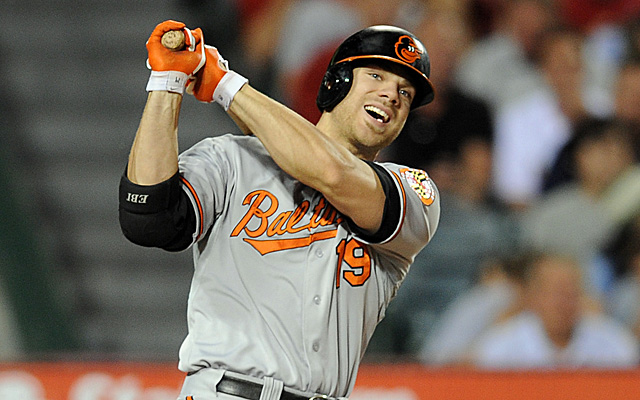
 
Davis re-established himself as the game's premier power hitter (CBS Sports)
Davis is one of the best sluggers in the game, so it was not surprising that he paced the majors in dingers this year (or strikeouts, for that matter). He's going to be 30 next year--still in the heart of his prime--but his free agency makes him tough to project, as moving to a pitching-friendly venue could cost him some long balls. It's worth noting that 92 of his 159 homers over the past four years (58 percent) came at Camden Yards, so leaving Baltimore might put a bit of a dent in his tater totals. That said, if I had to bet on one player launching 40+ moon shots next year, he's the guy.

Nelson Cruz (44)
Given that Cruz was the sole player to surpass 40 bombs last year, it shouldn't have been a shock that he did so again. Except that it was, because it's really hard to hit 40 home runs when you're in your mid-30s, have a lengthy injury history, and move to one of the most pitching-friendly parks in baseball. None of that hindered Cruz, who made good in his first season with the Mariners. His numbers would have looked better had he signed almost anywhere else, for 27 of his 44 bombs came away from Safeco. Who would have guessed that an injury-prone slugger like Cruz would not only develop into one of the best hitters in baseball, but that he would do so after leaving Arlington? I doubt Cruz ever hits 40 again, but he's proved me wrong before.
 
We all knew Harper had a season like this in him--it was only a matter of time and health. Playing time was not a problem for him this year, as he suited up for a career-high 153 games. It was surprising, however, to see him realize his power potential so soon--in his age 22 season--and to such an extreme (he nearly doubled his previous personal best of 22). My main concern with Harper is that he gets pitched around so much now--he had 25 homers on the Fourth of July and barely made it to 40--but like Barry Bonds he makes the most of the few strikes he does see. He'll definitely hit 40 again, just maybe not in 2016.
 
Far and away the most unlikely member of this year's 40 home run club is Mr. Arenado. When he debuted in 2013, he looked like a slick-fielding Andrelton Simmons type. With just 10 home runs and a .138 ISO that year, Arenado showed no hint of becoming a 40-homer slugger within two seasons. Last year his power improved considerably, as he slugged .500 with 54 extra base hits (18 homers) in just 432 official at-bats, but that projected to be 25-homer power. It was a complete surprise, then, when he tied Harper for the NL home run league and paced the majors in RBI (130) and total bases (354)--obliterating his previous career highs in the process. Those numbers are off the charts, even for a guy playing half his games at Coors Field. He's a big guy (6'2, 205) and only 24, so I wouldn't be surprised if he cranks 40 again.
 
As with Harper, it was inevitable that Trout would one day exceed 40 homers, especially after bulking up and trading some of his speed for power. After establishing a new career high with 36 big flies last year, he hit for even more power this year with 41 taters and an AL-best .590 slugging. I see several more years like this in his future.
 
How appropriate is it that Donaldson, Trout's top competition for AL MVP honors, finished with the same number of long balls as him? Trout's accomplishment is considerably more impressive after accounting for park effects, but one can't fault Donaldson for taking advantage of his new digs after losing lord knows how many home runs in Oakland's Coliseum the last few years. Donaldson had never reached 30 before, however, so 41 was somewhat unexpected. He's about to turn 30, but like fellow late bloomers Encarnacion and Joey Bats I think he'll keep this up into his next decade.
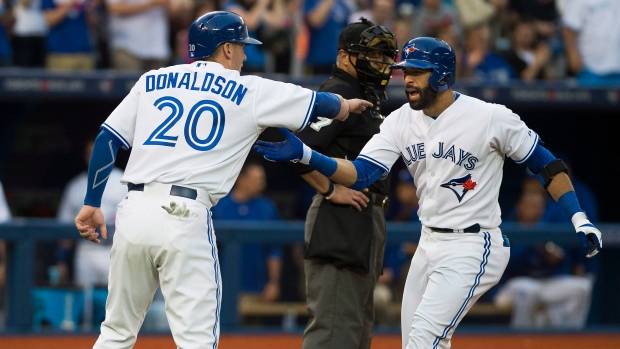
 
Donaldson and Bautista both eclipsed 40 homers (CTV News)
Health has been the only thing stopping Bautista from doing this every year since 2010. Had he not gotten hurt in 2012 and 2013, this might have been his fifth 40-homer season in the past six years. As it were, he still has three, which is pretty good, although this is his first since 2011. Seeing as how he turned 35 a few weeks ago, it might very well be his last...
 
...Then again, maybe not. I definitely thought we'd seen the last 40-homer effort from Pujols, given that he hasn't been the same since signing with the Angels due to injuries, age, and their brutal ballpark for hitters. Since leaving St. Louis he had yet to exceed 30 homers in a season, making his 40-homer year especially unlikely. What he gained in power, though, he lost in batting average, as he slumped to a career-worst .244 BA--73 points below his career average coming into the season. Looks like he might be the new right-handed Adam Dunn or Mark Teixeira.
 
We have two Angels, two Blue Jays, and now two Rockies to round out the list. Plagued by injuries over the last several years, CarGo had come nowhere near matching his high in home runs (34) set in 2010. This year he finally stayed healthy, playing a career-high 153 games. And rather than wear down, as one might expect, he enjoyed a prodigious second half, totaling 30 home runs after Independence Day.
 
Here are a few guys who might do it next year:
 
In the right ballpark, Cespedes could absolutely do it. He was a monster last year despite splitting time between Comerica and Citi Field, so depending on where he signs this winter he could have a real shot at 40 next year.
 
Probably more of a Joey Votto clone, meaning that his selectivity might prevent him from realizing his power potential, but he's proven he can hit 30 in his sleep. All he needs is for the winds at Wrigley to nudge a few more doubles over the ivy and voila! 40 homers.
 
At his age, in that ballpark, after topping 30 twice in the past three years, I'd be shocked if he doesn't do it. Then again, he won't get much to hit unless the Diamondbacks add some talent around him.
 
Could have a Harper-esque explosion next year.
 

Thursday, November 12, 2015

2016 Hall of Fame Ballot Newcomers

Griffey's going into the Hall of Fame next summer (Yahoo Sports)
This year's Hall of Fame ballot was released on Monday, adding 15 newcomers to the list of 17 holdovers. While the incoming class isn't as strong as previous years, which saw three first-timers inducted in both 2014 (Greg Maddux, Tom Glavine, Frank Thomas) and 2015 (Randy Johnson, Pedro Martinez, John Smoltz), by my count there's still a pair of surefire Hall of Famers as well as a couple more with very strong cases for induction. Let's take a look:

Hall of Famers
How could you note vote Ken Griffey, Jr. into the Hall of Fame? For the first half of his career he was Willie Mays, and while he was more like Mickey Mantle in the second half (the late-career version of Mantle), he still did enough to wind up with tremendous counting stats. His 630 long balls and 1,836 RBI are second only to Mays among center fielders, and his 83.6 bWAR (77.7 by FanGraphs) place him comfortably above the Hall's standards.
Few players were ever as good as peak Griffey, a dazzling center fielder and .300 hitter with 50-homer power and 20-steal speed.  Looking at his numbers, especially the late '90s ones, it's hard to believe he won only one MVP (at least it was unanimous). Even so, he was one of the decade's most decorated players. An All-Star and Gold Glove winner every year during the '90s, he also won seven Silver Sluggers and that MVP in '97, which he won unanimously despite a 1.067 OPS from Frank Thomas and a 12-win season by Roger Clemens (wins above replacement, that is).
Griffey dominated the '90s, a decade in which he hit more home runs than anyone not named Mark McGwire, drove in more runs than anyone besides Albert Belle, and compiled more fWAR than every position player who wasn't Barry Bonds. Despite beginning the decade as a 20 year-old, losing time to the strike in '94 and getting hurt in '95, he still averaged 38 homers, 109 RBI, and 6.7 bWAR per season during the '90s. Junior was already a Hall of Famer before he left Seattle in 2000; the only question was whether he would be able to challenge Hank Aaron's home run record. Injuries and normal age-related decline prevented him from doing so, though he did end up with more dingers than all but five men in baseball history.
 
No, he wasn't Mariano Rivera, but there's no shame in being the second-greatest closer of the wild card era. A seven-time All-Star, Hoffman compiled a 2.87 ERA (141 ERA+) despite pitching his entire career during an inflated era for offense. That wasn't a fluke, either, as he punched out more than a batter per inning and maintained a 1.06 career WHIP.
 
While Hoffman had many great seasons, his best was undoubtedly 1998, when he finished runner-up to Tom Glavine in the NL Cy Young race (Hoff would also finish second in 2006, behind Brandon Webb). In the year that Mark McGwire smashed 70 homers, Sammy Sosa slugged 66, and balls were flying out of ballparks at dizzying rates, Hoffman had a microscopic 1.48 ERA (265 ERA+) and 0.85 WHIP to go along with his major-league leading 53 saves. Perhaps more impressively, he allowed just two home runs that year in 73 innings of work.
 
That was the middle year in a five-year stretch where Hoffman was the best reliever in baseball. He sustained his success nearly a decade beyond that, keeping his ERA under three in all but two seasons during the 2000s. He had his last great year in 2009, posting a 1.83 ERA (226 ERA+) and 0.91 WHIP at age 41. He hung on in 2010 to get his 600th save and retired as the all-time saves leader with 601, a record that lasted just one year before Rivera broke it. Still, there's no question Hoffman was one of the best relievers of all-time, and for that he deserves first-ballot induction.
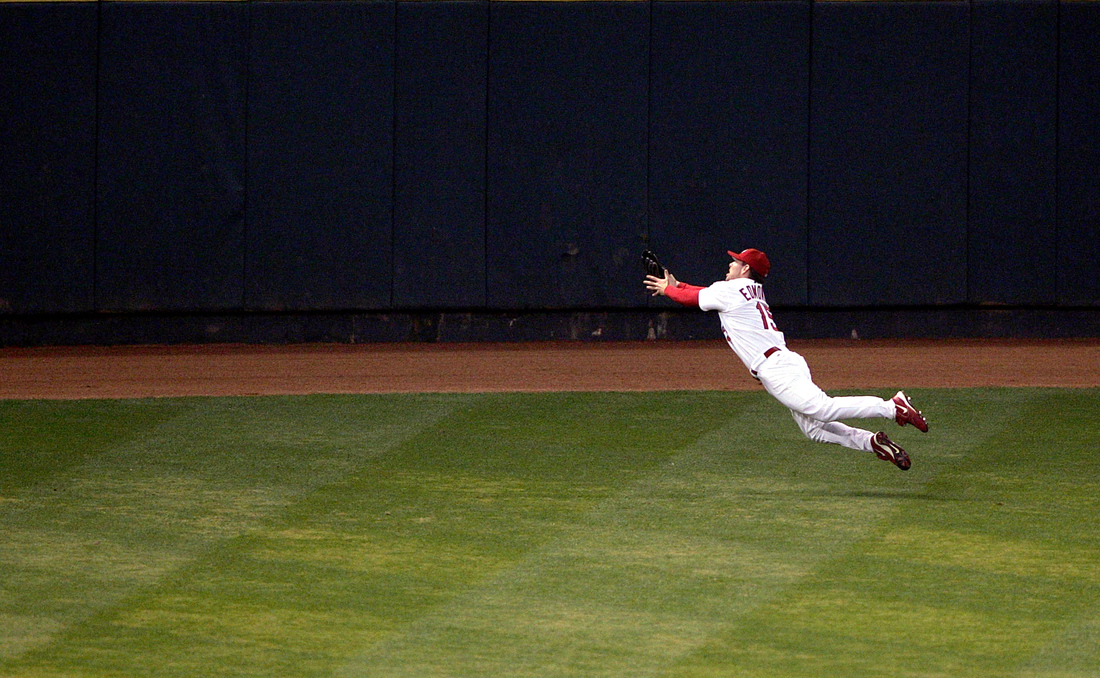
Edmonds made too many highlight-reel catches to count (SB Nation)
On the Fence
 
Edmonds has an interesting Hall case. With 60.3 bWAR and 64.5 fWAR, he's right on the bubble (60 WAR is the low end for a Hall of Famer). In fact, he has a very similar Hall case to another player on the ballot, a former teammate of his.

Jim Edmonds: 17 yrs 2,011 G 393 HR 1,199 RBI 132 OPS+ 64.5 fWAR
Larry Walker: 17 yrs 1,988 G 383 HR 1,301 RBI 141 OPS+ 68.7 fWAR

Edmonds earned eight Gold Gloves, Walker won seven. Walker made five All-Star teams, Edmonds four. Not surprisingly, Walker rates as Edmonds' seventh-most similar batter while Edmonds is Walker's fifth-closest comp.

Both had several phenomenal years and fantastic rate stats, but they rarely played full seasons and thus ended up with good-not-great counting stats. Both were excellent fielders, Edmonds more so since he played center, though Walker was a better baserunner. It would also seem that Walker was the better hitter since his raw OPS is 62 points higher, but I honestly believe that if Larry Walker had never played in Coors Field, he would have had the same career as Jim Edmonds.

Sure enough, if you neutralize Walker's numbers...

Walker 1,159 R 1,994 H 444 2B 348 HR 1,129 RBI .289/.373/.522 (.895 OPS) 1,325 RC

Then compare those to Edmonds' actual numbers:

Edmonds 1,251 R 1,949 H 437 2B 393 HR 1,199 RBI .284/.376/.527 (.903 OPS) 1,199 RC

There you have it. Edmonds is Walker, and Walker is Edmonds. I feel Walker's Hall-worthy, so therefore I feel that Edmonds is as well. Unfortunately, Walker's barely polled 10 percent the last two years, so that doesn't bode well for Edmonds. I think he'll get a little more credit since he was such a great center fielder, but I'd be shocked if he gets more than 15-20 percent.
 
When I first saw Wagner's name on the ballot, I immediately dismissed him as a serious candidate for Cooperstown. Then I took a closer look, and, well, I think he deserves a close examination
 
For starters, Wagner was way more dominant than Hoffman, with an ERA (2.31) that was more than a half run lower as well as a superior WHIP (1.00), strikeout rate (11.9), and K/BB ratio (3.99). Hoffman had more longevity, which helped him rack up 179 additional saves, but saves are a silly stat to begin with. Hoffman pitched about 180 more innings than Wagner, which amounts to roughly three extra seasons worth, but I'm guessing Wagner was so much better when he did pitch that his peak offsets Hoffman's longevity.
 
Lo and behold, Wagner's bWAR was 27.7, while Hoffman's was 28 on the nose. A vote for Hoffman is also a vote for Wagner, so I'd say yes to both.
 
We're Not Worthy:
 
Everyone Else. Jason Kendall had a Joe Mauer-ish start to his career but fell off a cliff after 30. Troy Glaus and Mike Sweeney had some huge seasons but not enough of them, kind of like Nomar Garciaparra. Mike Lowell was a very good player, but nobody's idea of a Hall of Famer. Garrett Anderson had a good run there in the early 2000s and a Tino Martinez-esque career, but that's not getting him into Cooperstown anytime soon. Luis Castillo and Randy Winn had better careers than you might remember, but they were nothing more than good complementary players. As for the rest, well, I guess you could say the same about them.

Saturday, November 7, 2015

Ramirez Retires

Ramirez is retiring after 18 seasons (NBC Sports)
Another very good but not quite Hall of Fame level player retired recently as baseball waved goodbye to Aramis Ramirez. Ramirez joined Torii Hunter, who retired last week, in deciding to call it quits.

There are actually quite a few parallels between their careers, besides the fact that they hung up their spikes 10 days apart. Ramirez, like Hunter, finished his career where it started--Hunter with the Twins and Ramirez with the Pirates. Hunter was a lifelong American Leaguer who spent the bulk of his career in the AL Central, while Ramirez never left the NL Central.

Their career arcs are eerily similar as well, as both struggled for a few years before breaking out in 2001. After that they remained excellent players for more than a decade, aging remarkably well and putting up similar numbers year after year. Though both made multiple postseason appearances, neither ever played in a World Series, much less won one.

And just look how close their numbers are:

Hunter: 19 yrs 498 2B 351 HR 1,391 RBI 661 BB .277/.331/.461 (110 OPS+) 4,087 TB
Ramirez: 18 yrs 495 2B 386 HR 1,417 RBI 633 BB .283/.341/.492 (115 OPS+) 4,004 TB

Ramirez debuted with Pittsburgh at 19 in 1998. Predictably, his first few years were rough as he struggled to adjust to major league pitching, but in 2001 he blossomed into one of the best-hitting third-sackers in the game. In his first full season, Ramirez mashed 34 home runs, knocked in 112, and batted a robust .300/.350/.536 (122 OPS+).

Nowadays, such a season would merit serious MVP consideration, an All-Star berth, and a Silver Slugger. But back in 2001, when cartoonishly big sluggers were putting up videogame numbers, Ramirez got no recognition of any kind. That would become a troubling trend for Ramirez, long one of the game's most under-appreciated stars (except when the fans gave him a completely undeserved Hank Aaron award in 2008).

After failing to replicate those numbers in 2002 and the first half of 2003, Pittsburgh sent him and Kenny Lofton to the Cubbies for Jose Hernandez, a minor leaguer, and a player to be named later. It's trades like that which explain how the Pirates went 20 years between winning seasons.
Ramirez was just coming into his prime. He flourished in Chicago, taking advantage of Wrigley's friendly confines (where he was a career .307/.372/.551 hitter) to emerge as an annual 30-100-.300 threat. While he wasn't the most durable player, exceeding 150 games in a season just once after leaving Pittsburgh, he always hit when he did play.

After eight and a half productive years in Chicago, Ramirez signed on with the Milwaukee Brewers before the 2012 season. Following a stellar debut with the Brew Crew, he began to decline as he reached his mid-30s. With Milwaukee rebuilding and his skills eroding, the Brewers had no need for their expensive, over-the-hill third baseman.

So this year, which Ramirez had already acknowledged would be his last, Milwaukee dealt him to a resurgent Pirates franchise, giving him one last shot at World Series glory. Like most last-ditch efforts to procure a ring, this one didn't work out. Ironically, it was Ramirez's former team, the cursed Cubs, that got in the way. In what would be the last at-bat of his career, Ramirez grounded into an inning-ending double play. Somehow, that seems appropriate.
Circling back to Hunter, Ramirez also fell short of a few big milestones. He ends his career 14 homers shy of 400, five doubles short of 500, and 83 RBI away from 1,500. Even so, his numbers are outstanding for a third baseman; he ranks 10th in the position for home runs, doubles, and RBI.

The three-time All-Star never quite got the credit he deserved for being such a tremendous hitter year-in and year-out, probably because he was playing in the shadow of superior third basemen such as Alex Rodriguez, David Wright, Chipper Jones, and Adrian Beltre. In terms of career offensive production at the position, however, few were ever better. 

Monday, November 2, 2015

Royals Rally to Win Championship

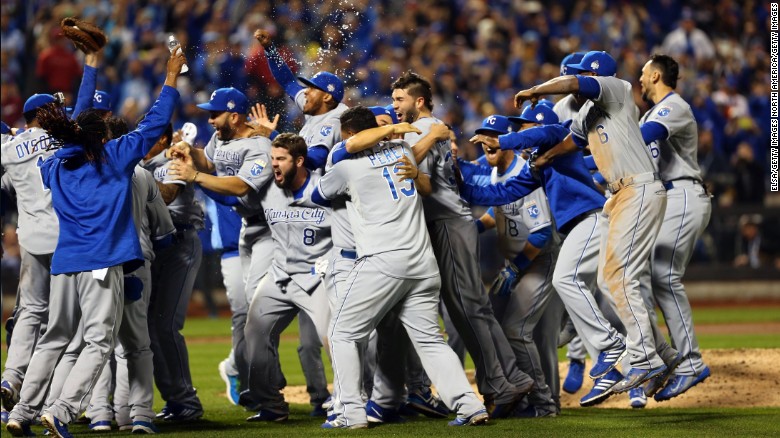
Three of Kansas City's four wins in this series were come-from-behind (CNN)
It is easy to envision a scenario in which the New York Mets, and not the Kansas City Royals, were the ones celebrating their first championship in three decades yesterday.

In Game 1, the Mets took a 4-3 lead into the bottom of the ninth. After Jeurys Familia, who had been lights-out all year, got Salvador Perez to ground out, New York's chances of winning stood at 89 percent. The Mets were two outs--two stinking outs--away. They should have won this game. Alex Gordon homered, however, and the Royals ultimately prevailed in 14 innings.

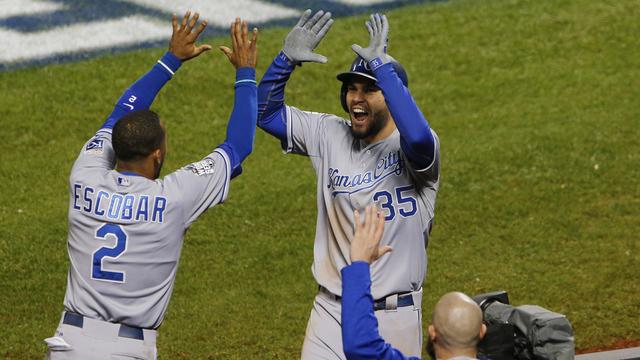
In Game 4, the Mets looking to even the series at two games apiece after winning Game 3. They led 3-2 through seven. After Alcides Escobar grounded out to lead off the eighth, New York's odds of victory improved to 82 percent. Then Tyler Clippard (a mess all playoffs) issued two consecutive walks, bringing Familia into the game, and since Familia was clearly cursed this week of course things went south from there.

Familia got Eric Hosmer, the other hero of Game 1, to tap a slow-roller towards Daniel Murphy at second. Murphy came charging in, reached down to scoop it with his glove...and came up with nothing but air. Ben Zobrist scored, a sure out had been lost, and the game was tied. Back-to-back singles followed, giving Kansas City a 5-3 lead. The Royals, in case you hadn't noticed, don't blow 5-3 leads in the eighth inning or later. Like, ever. And they didn't.

As painful as those two losses were, both paled in comparison to the gut-wrenching defeat New York suffered in Game 5. With the Mets one loss away from elimination and Edinson Volquez throwing gas, they needed a gem from Matt Harvey. They got one, as he fired eight shutout innings, allowing just four hits and one walk while striking out nine. In the biggest game of his life, a game his team absolutely had to win, he'd been almost perfect.

Harvey walked off the mound after needing just nine pitches to get through a 1-2-3 top of the eighth. Citi Field's roaring applause followed him to the dugout, where he exchanged handshakes and high-fives with his teammates and coaches before collapsing onto the bench. Though the temperature had dropped into the 50s by that point, his face was covered in sweat.

While the Mets were batting in the bottom of the eighth, pitching coach Dan Warthen came over to inform Harvey that he was coming out of the game.

"No way," Harvey said. "No way, no way, no way."

Warthen was still talking, trying to tell the pitcher what a great job he did, but Harvey wasn't listening.

"No way," he repeated. "No way." In this moment, Harvey's vocabulary had been reduced to two words. He wouldn't take no for an answer.

Warthen hadn't finished talking yet when Harvey walked away, down the bench in search of Terry Collins. When he found him, he repeated what he'd said to Warthen.

"No way," Harvey said again. "No way am I coming out of this game."
Collins lets Harvey convince him to remain in the game (NY Post)
When Murphy struck out to conclude the eighth, Harvey hopped out of the dugout and strolled back to the pitcher's mound, much to the crowd's surprise. This was his game to win, or lose. He had gotten the Mets 89 percent of the way there, recording 24 of 27 outs. He only needed to get three more.

Players will say the last three outs of a ballgame are the toughest to get. History says otherwise, but against the Royals that is 100 percent accurate. For whatever reason, Kansas City has a knack for late game heroics. Just when it looks like you're about to finish them off, they jump back from the ropes and deliver a haymaker to the temple. Or, more appropriately, straight to the stomach.

It also helped that this time, Terry Collins was having a Grady Little moment. He'd sent a tired ace back out after throwing 102 pressure-packed pitches, not to mention 216 innings--postseason included--in his first year back from Tommy John surgery (the recommended limit is 160-180). The situation called for Collins to bring in his closer to finish out he game, which entailed facing Kansas City's 3-4-5 hitters, but Collins let Harvey have his way. Maybe he was spooked by Familia's meltdowns in Game 1 and Game 4. Maybe he was as mesmerized by Harvey as the Royals had been. Maybe he was swayed by Harvey's passionate plea to let him stay in. All we know is in that moment, he did not make the move he would have made in any of the 175 games that preceded this.

In all likelihood, it wouldn't have mattered. These Royals were a team of destiny, and they would have rallied no matter who Collins chose to pitch the ninth. But their odds were greatly improved by the presence of a gassed Harvey as opposed to a fresh reliever out of the 'pen. While their odds of winning were technically only six percent, they suddenly seemed much greater.

Any Red Sox fan could tell you what happened next. Harvey lost Lorenzo Cain on a full count and walked him, driving his pitch count up to 109. On pitch number 110, Cain stole second. On pitch 111, Hosmer launched a double down the left field line, scoring Cain and cutting New York's lead in half.

Collins had seen enough, and did what he should have done two batters beforehand. He took the ball out of Harvey's hands and summoned Familia.

The decision to let Harvey stay in looked even worse when Familia got three consecutive groundouts, the second of which scored a run only because there had been a man on second when he entered the game. Had he been allowed to start the inning, obviously, that would not have been the case.

And so the last game of the World Series, like the first one, went to extra innings. Not surprisingly Kansas City, with its superior bullpen, came out on top again. For the third time in a week, the Royals had come back to win a World Series game where they'd trailed in the eighth inning or later. For the third time in a week, the Mets had blown a game they had at least an 80 percent chance of winning.

And that is how we'll remember the 2015 World Series. The Mets faltering late in games, committing costly errors and not getting the big outs when they needed to, and the Royals, once again, proving they are impossible to kill.

Unless you have Madison Bumgarner.

Sunday, November 1, 2015

New York Needs a Miracle

Kansas City came back to win Game 4 (CBS Sports)
After yet another comeback win, the Kansas City Royals are one victory away from winning the World Series. The New York Mets, on the other hand, need to win three more times--in a row, including twice on the road--to capture the flag. Simple math would seem to favor the Royals.

But while the Mets are down, you can't say they're out. Not when they have Matt Harvey pitching tonight, Jacob deGrom going on Tuesday, and Noah Syndergaard starting Game 7 if needed. Those three rank among the best, hardest-throwing pitchers in baseball. When you have them lined up like that, you have a fighting chance against anybody.

It's just weird that the Mets find themselves in this position. After never trailing in the NLCS, New York has been playing catch-up this whole series, or at least since they lost Game 1. I felt at the time that their inability to hold onto that ninth inning lead would come back to haunt them, and sure enough, it has completely altered the Fall Classic's dynamic. If Alex Gordon flies out to the track there, or even hits it off the wall, the Series would be tied at two rather than 3-1 Royals. But in a best-of-seven, you can't afford to make those mistakes. Teams wins 95 percent of games they lead going into the ninth inning. During the most important games of the year, you better not have one of those 5 percent games, but the Mets have basically had two in five days.

Tonight's game will be a rematch between Game 1 starters Edinson Volquez and Matt Harvey, who compiled nearly identical stat lines in the Series opener. Volquez has been tough since suddenly finding an extra foot on his fastball, but Harvey's still the superior pitcher. He's had one very good start sandwiched between two decent turns this postseason, but he'll have to be at his absolute best tonight. When your team is one loss away from being eliminated, there's no margin for error.