Showing posts with label Jason Heyward. Show all posts

Tuesday, December 15, 2015

Cubs Team to Beat

The revamped Cubs could win 100 games next year (CBS Chicago)
The Chicago Cubs didn't have to make any major splashes this offseason. They could have consolidated after winning 97 games last year, banking on improvement from youngsters like Kris Bryant and Kyle Schwarber to cover decline from aging veterans and departing talent. The Cubs would have been completely justified in making a few minor tweaks and leaving their roster as is, letting their young core blossom into perennial contenders..

Instead, Chicago has been the most active team in free agency thus far. They dipped their toe into this year's deep talent pool by poaching John Lackey away from the Cardinals. Then they stole Ben Zobrist from a market that underrates his skills.

But those deals were mere appetizers for the main course, which was served last Friday. Chicago capped a whirlwind week by picking St. Louis's pocket yet again, wooing Jason Heyward from their division rivals.

In just one week, the balance of power shifted not only in the NL Central, but all of baseball. The Cubs have established themselves as the team to beat next year, a team with 100-win potential. That's why Heyward turned down more money to play elsewhere. He wants to be on the World Series favorites.

I already wrote about how much I like the Lackey deal--a short-term bet on one of the game's better starting pitchers--so now please indulge me as I examine the Zobrist and Heyward deals.

At four years and $56 million, Zobrist is a veritable bargain in spite of his age (he'll be 35 in the spring). Consider that last year, Victor Martinez got more money over the same number of years despite being a) one year older when he signed his contract and b) a full-time designated hitter. Nelson Cruz, another DH-type, got virtually the same contract, and while his has worked out so far it will get ugly fast if his home run power disappears, which can happen overnight for a player his age.

Zobrist has been much better than either of those guys and is younger, He's quietly been the fifth-most valuable position player in baseball over the past seven seasons, out-WAR'ing all but the game's truest superstars (Mike Trout, Miguel Cabrera, Joey Votto, and Andrew McCutchen). While his defense went south last year and he didn't make the same impact on the bases that he usually does, at least part of that can be blamed on his midseason knee surgery. His balky knee didn't slow his bat, however, which remained as robust as ever despite injuries and a midseason trade to Kansas City.

Even if his defense and baserunning never recover, Zobrist will earn his paycheck as long as he keeps hitting like last year, when he was worth $16.4 million basically on his bat alone. If his hitting starts to slow too, however, then he'll be a bust. But seeing as how he's showed no signs of slowing down at the plate, the Cubs have no reason to worry just yet.

It was fitting that the deal for a long under-appreciated player was soon overshadowed by a monster contract attached to a much bigger name. Jason Heyward has been a breakoit candidate ever since scouts compared his likeness to Ken Griffey, Jr. during his rookie season. Heyward has failed to live up to those lofty expectations, instead settling into something just shy of a superstar. Skill-wise, he falls into the same category as Zobrist and Alex Gordon, but with the added benefit of being much, much younger.

Heyward is the rare free agent whose prime years are just about to begin rather than come to an end. So if Zobrist--the former type of player--is a bargain, Heyward's an absolute steal. Heyward has been one of the dozen-best position players in baseball since beginning his career in 2010 (notice the player right above him on that list). He's an excellent baserunner, a three-time Gold Glove winner, and a solid hitter. It's not worth discussing whether he'll be worth the eight years and $184 million (spoiler alert: he will be) because he'll opt out by the end of the decade, but when he does you can bet it will be for as much as or more than what he just accepted.

What's funny is that Zobrist and Heyward are essentially the same player. They both walk a lot, hit for medium power, have a bit of speed, and are plus defenders. While not great at any one thing, they are good at everything, and that's what makes them so valuable. Zobrist has played every position save pitcher and catcher, while Heyward can play anywhere in the outfield.

The Cubs seem likely to install the latter in center field, where he's only played sporadically. Still, Heyward can't be much worse than the man he's replacing out there--Dexter Fowler, who's provided positive defensive value just twice in his eight year-career according to Baseball-Reference. Thanks to his youth and athleticism, Heyward's one of the few corner outfielders capable of making the transition to center, as usually players go the other way.

So forget the Royals; the Cubs are baseball's model franchise. Their whip-smart front office has assembled a juggernaut around solid drafting, saavy free agent signings, and great trades. As for their latest spending spree, the rest of baseball should take note. If you're going to spend close to $300 million on free agents, this is the way to do it. Not, you know, how the Red Sox do it.

Monday, November 17, 2014

St. Louis Steals Heyward, Walden

Heyward helps the Cardinals considerably (USAToday)
Needing a short-term, last-minute fix in right field following the tragic and untimely death of Oscar Taveras, the St. Louis Cardinals sacrificed a pair of former first-round draft picks to acquire Jason Heyward, probably the best right fielder in the game not named Giancarlo Stanton. The Cardinals also received a plus reliever in Jordan Walden, who was an All-Star closer for the Los Angeles Angels in 2011. Walden should bolster the Redbirds' bullpen based on his career 3.10 ERA and 10.8 K/9 rate over five big league seasons.

But Walden's just icing on the cake, really, because St. Louis clearly got the best player in this deal. Heyward hasn't developed into the Ken Griffey Jr. clone people thought he'd be during his first season, when he was an NL All-Star and Rookie of the Year runner-up to Buster Posey, but he's still a phenomenal player. A true all-around talent, the two-time Gold Glove recipient has twice stolen 20 bases or more in a season and once hit as many as 27 home runs (in 2012). He also owns a rock-solid .351 OBP for his career, during which time he's been worth 24.5 bWAR and rated as the third-best rightfielder in baseball behind Jose Bautista and Ben Zobrist. Plus, he's only 25, though he will be free agent-eligible after next year.

In return the Braves landed Shelby Miller, who's only one year younger than Heyward but won't be eligible for free agency until after the 2018 season. Miller, a starting pitcher, finished third in the 2013 NL Rookie of the Year award to Jose Fernandez and Yasiel Puig after going 15-9 with a 3.06 ERA and 169 strikeouts in 173 and 2/3 innings. His 3.67 FIP and 1.21 WHIP suggested regression was coming, however, and sure enough Miller was merely a league average starting pitcher last year. His record fell to 10-9, his ERA swelled to 3.74, and his strikeout rate plummeted from 8.8 K/9 in 2013 to a paltry 6.2 K/9 last year. His walk rate increased as well, resulting in a 4.54 FIP that says he was very lucky in 2014. Miller may not completely unravel next year, but he seems doomed for more regression and won't have a very long career if he doesn't improve his command. There's just too much uncertainty about his effectiveness going forward, and right now the signs point to bad.

Atlanta's also getting Tyrell Jenkins, a 22 year-old pitching prospect who has yet to pitch above High-A. It's much too early to tell what kind of impact he'll have if and when he reaches the majors, as he'll likely need a few more years of seasoning before he's ready.

So yeah, clear win for the Cardinals here. They get at least one year of Heyward and two years of Walden for four years of Miller and a complete unknown in Jenkins. A six-win player last year, Heyward could very well end up creating as much or more value in 2015 than Miller does over the next four years, especially if the former finally puts it all together to produce that superstar caliber season we've been waiting for. Walden's already an established big league reliever, while there's a good possibility that Jenkins never throws a pitch in the Show.

This trade makes the Braves considerably worse for 2015, which is not the direction they want to go in after losing 83 games last year. St. Louis, on the other hand, remains a safe bet to win 90-plus games again en route to a third consecutive division title. If you're Atlanta, you have to do better than a league-average starting pitcher/likely project and a raw prospect for an elite outfielder such as Heyward. If you're St. Louis, you deserve a giant pat on the back.


Wednesday, February 5, 2014

Braves Extend Heyward, Freeman

The Braves are smart to bet on their young talent 
The Atlanta Braves had a mostly quiet winter until yesterday, when they committed almost $150 million to two of their franchise centerpieces--Jason Heyward and Freddie Freeman.

The lion's share of that money is going to Freeman, who received an eight-year, $135 million contract extension that is the longest commitment the Braves have ever made to a player, topping the six-year, $90 million deal signed by Chipper Jones in 2000. It is also the most expensive on an annual basis, beating B.J. Upton's five-year, $75 million agreement. Freeman's extension will keep him with the Braves through 2021--his age 31 season.

The two-year pact with Heyward will cover his 2014 and 2015 (age 24 and 25) seasons at a cost of at least $13.3 million, with additional performance and award bonuses that could push his 2015 salary higher.

It's interesting how drastically different those contracts were since both debuted in 2010, are essentially the same age (Heyward is a month older), and have very similar career numbers so far:

Heyward: 2,170 PA  489 H  99 2B  73 HR .259/.352/.443  115 OPS+  18.4 bWAR
Freeman: 1,908 PA  481 H  93 2B  68 HR .285/.358/.466  123 OPS+   9.3 bWAR

(They have also each made an All-Star team and were NL Rookie of the Year runner-ups: Heyward in 2010 and Freeman the year after).

Though Freeman is the better hitter (but not by much), Heyward's been almost twice as valuable because he runs well and plays a great right field. All of Freeman's value is tied up in his bat, which is better than Heyward's but not enough so that he can compensate for Heyward's advantages in defense and baserunning. As an all-around player Heyward is clearly superior to Freeman.

So if Heyward has been twice the player that Freeman has, then why did Freeman get a contract that run six years longer and pays ten times as much as Heyward's?

The answer is timing. Heyward is coming off a disappointing and injury-plagued campaign. An emergency appendectomy and fractured jaw (courtesy of this pitch from Jonathon Niese) combined to limit him to just 104 games--a career low--with the former necessitating an early season DL stint that undoubtedly contributed to his slow start (.142/.283/.246 with two homers and eight RBI through June 1st).

Heyward rallied to bat .297/.376/.500 the rest of the way, and his final batting line of .254/.349/.427 was right in line with his career figures. Even with those disastrous first two months, Heyward was still worth around three and a half wins and showed signs of improvement, such as trimming his strikeout rate from 23.3 percent in 2012 to 16.6 percent--the best mark of his career--in 2013. He also bumped his walk rate up from 8.9 percent to 10.9 percent, which helped produce the second best OBP of his career.

So based on his strong finish to the season, Heyward looks like a good bet to rebound in 2014 (assuming good health) and could perhaps be ready to take the leap to superstardom that's been expected of him since he burst onto the scene in 2010. Steamer projects better things to come in 2014, expecting Heyward to be worth close to five wins and hit 21 home runs with a .367 wOBA and 135 wRC+. I'd say that sounds reasonable, maybe even a bit conservative.He's about to enter his prime years and should prove to be a massive bargain over the next couple seasons, especially if his career continues on its current trajectory (the top two similar batters through his current age are Jack Clark and Barry Bonds).

So whereas Heyward did not live up to expectations in 2013, Freeman exceeded his by a fairly substantial margin. Freeman finished fifth in the NL MVP voting after what was easily the finest season of his career to date, one in which he smashed 23 home runs, drove in 109 and batted a robust .319/.396/.501--all career highs. He also set personal bests in hits (176), walks (66), and total bases (276) in addition to posting the best walk and strikeout rates of his career, a performance that was worth approximately five wins.

Steamer predicts more of the same from Freeman this year: 23 home runs and similar rate stats. It's probably wise to expect some decline seeing as how his BABiP was .371 last year, which was the fifth highest mark in the majors and isn't likely to be repeated given Freeman's lack of speed.

But outside of some batting average regression, there's no reason to expect that Freeman will fall off in other areas. Whereas Heyward has alternated good years with bad years, Freeman has been remarkably consistent in his first three full seasons. Working backwards, he's played 147, 147 and 157 games and smacked 23, 23 and 21 home runs. His 2011 and 2012 seasons are virtually indistinguishable from each other, and while his raw OPS shot up by about 100 points in 2013 his counting numbers pretty much remained the same.

It's fitting, then, that Freeman's best comp at his present age is Eddie Murray, who of course was known as Steady Eddie. He's also earned flattering comparisons to Orlando Cepeda and John Olerud. If Freeman's career plays out like theirs did--landing him in Cooperstown or not far from it--then the Braves are going to get plenty of bang for their buck.

Thursday, June 13, 2013

Braves Outfield Disappoints

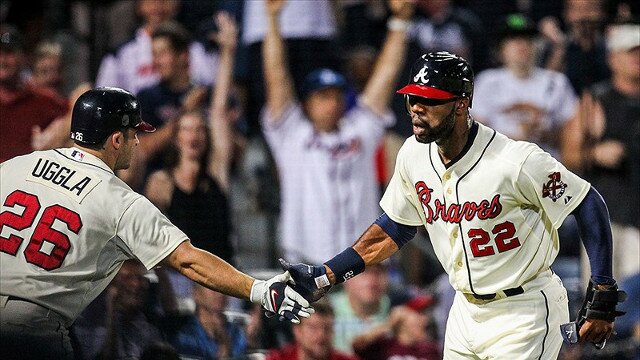
Dan Uggla greets Heyward after a long home run
Hopes were high for Jason Heyward and the Atlanta Braves coming into the 2013 season. After winning 94 games last year while ushering Chipper Jones into retirement, the Braves went out and signed B.J. Upton to the largest free agent contract in franchise history. Two months later, they fleeced the Arizona Diamondbacks for Justin Upton, scoring a 25 year-old superstar-in-the-making who won't become a free agent until after the 2015 season.

Adding the Upton brothers to its incumbent right fielder gave Atlanta one of baseball's best outfields. All three are young, athletic ballplayers projected for greatness long before they ever set foot on a big league diamond. Blessed with power and speed, the trio of former first round draft picks are three of the game's brightest talents.

So why aren't they playing like it?

More than two months into the season, the outfield that was supposed to lead Atlanta back to the postseason has gone bust. elder Upton's been a train wreck at the plate, striking out in one-third of his plate appearances and showing no semblance of the power stroke that helped him blast 28 home runs last year. Justin carried the Braves with his monster April  but hasn't done much lately, batting just .222/.343/.326 since April 28th.

And then there's Heyward, who's slow start to the season was exacerbated by an emergency appendectomy that forced him onto the Disabled List in late April and caused him to miss 23 games (the same operation derailed Adam Dunn early in 2011, and we all know how that turned out). Since returning to action on May 17th, it's taken Heyward a couple weeks to get his timing back and regain his footing at the plate.

But with both Uptons still dragging their feet in June, Heyward has shown signs of life at the plate. After going 2-for-5 with a double last night, Heyward now has hits in each of his last 10 games--including seven multi-hit efforts--to push his batting line up to .215/.324/.362.  He's been squaring up the ball better and making hard contact more consistently. These improvements are reflected in his improved strikeout rate, which he's trimmed from 18.8 percent before June 2nd to 12.8 percent since.

Credit Fredi Gonzalez for sticking with his slumping 23 year-old, batting him second even as his batting average languished below the Mendoza line into early June. Many managers would have dropped Heyward down in the lineup or benched him in an effort to help get him going, but such moves can end up doing more harm then good. They reflect a lack of faith on the manager's part and can end up damaging the ballplayer's already diminished confidence. Gonzalez's long leash has served him (and Heyward) well.

Even after getting swept by the San Diego Padres, Atlanta still leads the NL East by six games. The Braves are a first place team in spite of their vaunted outfield, not because of them. The rotation's remained healthy and everybody's pitching well. Evan Gattis and Chris Johnson are picking up the slack on offense. The defense is as good as expected.

Still, one can only imagine how strong the Braves will be once Heyward and the Uptons start doing what they're capable of.