Monday, October 12, 2015

NL Awards Preview: Can Kershaw Repeat?

Who deserves the NL MVP? That's a clown question, bro (CBS Sports)
First let me apologize, for the title and picture above are a little misleading. While technically an awards (plural) preview, 90 percent of this piece is devoted to the controversial Cy Young race. Whereas all three AL races are virtual toss-ups, the only tight one in the NL is for the Cy Young award, though it might be the closest I've ever seen. The MVP award has belonged to Bryce Harper since May, and Kris Bryant pulled ahead of Joc Pederson for rookie of the year honors months ago. That leaves us with the NL Cy Young, which could go to one of three candidates, two of whom are teammates.

You could argue any of them for MVP as well, but you really have to bend over backwards to find a way not to elect Bryce Harper. Because let's face it; Harper has been the league's undisputed MVP since Memorial Day. Head over to the NL leaderboards, and you'll see Harper's name in numerous top spots. Baseball-Reference and FanGraphs both rated him as the most valuable player in baseball per wins above replacement, which you might have figured based on his major league-leading .460 OBP, .649 slugging, 1.109 OPS, and 195 OPS+. The Nats were massive busts, they don't stay in contention into September without Harper's monster season.

The Rookie of the Year is also a foregone conclusion, having been Kris Bryant's to lose since his big league debut. Joc Pederson hung with him throughout the first half, only to tail off after the All-Star Break as his flaws became exposed. His 26 home runs, .346 OBP, and .206 ISO are nothing to sneeze at for a rookie center fielder, but his defense leaves a lot to be desired and he doesn't have make an impact with his legs the way most center fielders do (Mike Trout he is not).

Bryant's OPS was nearly 100 points higher than Pederson's, still a sizable advantage even after accounting for their home parks. Like Pederson he struck out a lot, but unlike Pederson he did more than just hit home runs when he made contact. He would have knocked in 100 runs had he been given his rightful place on the Opening Day roster, played a solid third base, and was actually a really good baserunner--with 13 steals and nearly a win's worth of value on the basespaths. More than just a slugger, he turned out to be a well-rounded player.

So yeah, if you choose anyone other than Harper and Bryant for these two awards, then you need to have your head examined. But the NL Cy Young race is the closest one in recent memory. Often times two candidates have very similar numbers, as Felix Hernandez and Corey Kluber did last year or Clayton Kershaw and R.A. Dickey did in 2012, but it's quite rare that a trio of pitchers post nearly identical stat lines, as Kershaw, Zack Greinke, and Jake Arrieta did this year. They finished top-three in WAR, ERA, and WHIP, among several other advanced stats. How on earth do you choose?

Joe Posnanski's right; I think who you vote for here says something about what you value in pitchers. If you value wins and strong second half performances, then Arrieta's your guy. If you stress run prevention and keeping runners off the bases, then you go Greinke. If you're all about defense-independent metrics, i.e. strikeouts and FIP, then awarding Kershaw his third straight Cy.

Wins are a garbage stat, so while it's cool that Arrieta racked up 22 of them, that honestly doesn't mean a thing to me. He could have won 12 and his candidacy wouldn't change in my eyes. I also don't buy into the whole reward someone for a big second half thing, since every game counts the same regardless of when it's played (in the regular season, that is). So while it's neat that he had the lowest second-half ERA ever, that doesn't strengthen his case in my eyes.

Where I do think Arrieta's being underrated is that he had the lowest hit and home run rate in the majors despite contending with Wrigley's friendly confines in half his starts. That's damn impressive given the way the ball flies there during the summer. It's equally impressive that his ERA was virtually identical to Greinke's, considering that a) Greinke calls Dodger Stadium home and b) the NL Central was the toughest division in baseball this year with three 90 win teams. Arrieta's environment was much more conducive to offense, and yet he allowed runs at nearly the same rate as Greinke. Arrieta also logged more innings, racked up more strikeouts, and compiled a lower FIP.
Still the best pitcher on the planet, Kershaw deserves his fourth Cy (My Weekly Sports)
According to FanGraphs, the only pitcher more valuable than Arrieta was Greinke's teammate Kershaw. That's because FG makes pitcher valuations based off DIPS, whereas B-R assesses pitchers based on how well they prevented runs. Since we know the latter is largely beyond a pitcher's control, influenced by a multitude of factors such as the weather, ballpark, hit sequencing, bad hops, defense behind him, and relievers that come in after him, I don't feel comfortable relying on ERA as a guide. I give more weight to stats like FIP and xFIP, which judge pitchers based on things they have more (but not total) control over; home runs, walks, and strikeouts.

By those measures, Kershaw comes out on top. His 1.99 FIP was the best in the majors, and his xFIP was right in line with last year's. Part of the reason both were so good was that he struck out 301 batters, becoming the first pitcher since 2002 to exceed 300 K's in a season. He also led the majors in innings pitched--an underrated stat--as well as complete games and shutouts, which I value because those are almost always wins.

As Jonah Keri wrote yesterday, the most useful stat in settling this whole debate is probably Deserved Run Average (DRA), created by the folks over at Baseball Prospectus. An all-encompassing stat similar to pitcher WAR (but better), DRA captures a pitcher's overall contribution to his team. By that metric, Kershaw is number one, though it's awfully close.

No matter how you slice it, it's a ridiculously tough call. There really should be a three-way tie, because they're all equally worthy. To pick one you have to split hairs, and depending on which hairs you split you'll get your answer. Mine is Kershaw, but yours probably isn't, and that's okay. I'm not trying to tell you why Greinke and Arrieta are the wrong choices, because they're not. There is no wrong choice. I just happen to think Kershaw's the best choice, and only by the slimmest of margins.

Thursday, October 8, 2015

Arrieta, Cubs Advance

Arrieta was on top of his game as the Cubs advanced (LA Times)
While I was surprised to see the Yankees flop in Tuesday's AL Wild Card game, I was not at all surprised when the Cubs cruise past the Pirates last night.
 
For one, Jake Arrieta is arguably the best pitcher in baseball this year. And if not the entire season as a whole, then definitely the second half, which was only the greatest any pitcher has ever had. He was better away from Wrigley Field, too, with a 1.60 ERA, 0.88 WHIP, and 5.16 K/BB ratio outside the Friendly Confines. Arrieta's been so ridiculously good lately, I just didn't see him losing this game.
 
That's not a knock on Gerrit Cole, who was tremendous in his own right this year and pitched well the last time he appeared in the postseason. But he was a better first half pitcher this year, with a 1.71 ERA through June 15th and a 3.19 ERA after. That can be attributed to natural aggression, but a small part of me thinks he may have gotten fatigued as he exceeded his previous innings high by 70. But not even first-half Cole was as good as second-half Arrieta.
 
I also figured he'd have some trouble with Chicago's lineup, which might be the scariest in baseball. There's no holes in that offense--not even Arrieta, the rare decent-hitting pitcher. It's a meatgrinder 1-9 with loads of power, which makes the Cubbies very difficult to neutralize. The Pirates, on the other hand, are more top-heavy. If you can get McCutchen out and keep Starling Marte off the bases and not make a mistake to Pedro Alvarez, you'll probably be alright.
 
And with his team shooting for its first World Series title in over a century, Arrieta was more than alright. He was his usual dominant self, carving up the Bucs in his first postseason start. Arrieta allowed just four hits--all singles--and struck out 11 en route to a shutout, the first by a Cubs pitcher in the playoffs since 1945.
 
While Arrieta showed lethal stuff early, racking up six K's through his first three innings, Cole struggled from the start. He put his team in a hole two batters into the game following a pair of singles sandwiched around a stolen base. A double play helped him escape the first without further damage, but Chicago's sluggers got the best of him via home runs in the third and fifth. With Pittsburgh down 4-0 and the Pirates doing nothing against Arrieta he had to come out, and while Pittsburgh's bullpen stopped the bleeding it was too little, too late. Arrieta didn't give an inch, sending the host team home early for the second year in a row.
 
I must say I was amazed at how similarly the two wild card games played out. In both cases the visiting team shut out the home team, smacking two home runs along the way. The better pitcher won in both cases too, with likely AL Cy Young winner Dallas Keuchel getting the best of Masahiro Tanaka and Arrieta--who will win if a Dodger doesn't--topping Cole. The losing pitcher in both games exited after five as well.
 
I feel like the better team won in both games as well, probably because I'm still having trouble figuring out how the Yankees and Pirates made it there. The Yankees were impossibly old, and the Pirates just didn't seem that good to me. It blows my mind that Pittsburgh won 98 games this year--more than any team save the Cardinals. Maybe that's because outside of Cole and Andrew McCutchen, they're sorely lacking in star power. They don't hit a ton of home runs and their number two starter is either Francisco Liriano or A.J. Burnett. They're just a deep, balanced, really well-constructed team, which might be boring but gets the job done--in the regular season, at least.

Wednesday, October 7, 2015

Astros Bomb Bombers

The upstart Astros finished off the Yankees last night (San Diego Tribune)
It took the Yankees three years to get back to the playoffs--an eternity for baseball's most impatient organization and fan base--but just three hours to get knocked out.

New York losing last night's wild card contest completed their September collapse. Just a half-game out of first on September 8th, they went 10-16 the rest of the way, finishing six games back of the Blue Jays. With a slumping offense, leaky bullpen, and diminished rotation, New York limped to the finish line, losing six of their last seven to inferior Red Sox and Orioles teams. Had they won last night and advanced, they would have been easy prey for the well-rested Royals.

The Astros, on the other hand, were red-hot, having won 9 of their last 14 to close out the season. If LA's last-ditch comeback worried them, they didn't play like it. Houston had the look of a young, energetic team eager to move on, while the tired Yankees looked like they were ready to go home.

And so the surging 'Stros aswaggered into Yankee Stadium and blanked the Bombers, advancing to an ALDS date with Kansas City. Houston grabbed an early lead when Colby Rasmus led off the second inning with a home run and never looked back. The Astros added another in the fourth when Carlos Gomez, who'd done nothing of consequence since coming over in a deadline deal with the Brewers, also went yard, then tacked on an insurance run in the seventh. New York never recovered, making that 3-0 deficit look like a 13-0 hole by the end of the night.

Though both teams were top-five offenses in terms of runs scored and home runs, neither showed much signs of life last night. The oldest lineup and the youngest combined for just three runs and eight hits between them, and if two of those hits had stayed in the yard than it could have been a 1-0 game.

I'm still surprised New York lost, as everything leading up to this game pointed to a Yankees victory. New York was at home with its ace on the mound, facing a pitcher on short rest who'd been far less effective on the road. All the Yankees needed was six solid innings from Masahiro Tanaka and a big fly from one of their boppers, then they could turn the game over to their lights-out bullpen and take it from there.

Instead Tanaka was gone after five, yanked by Joe Girardi after just 83 pitches. Rather than take his chances with a tiring Tanaka, Girardi deployed stud relievers Justin Wilson, Dellin Betances, and Andrew Miller to keep the Astros at bay. Tanaka hadn't done much to warrant staying in the game, throwing just 49 of his 83 pitches for strikes and recording just one punchout after the first inning. Plagued by the long ball all year, he surrendered two more in the first four innings. Facing an Astros lineup that spanked 230 during the regular season in a park that favors the four-bagger, it was only a matter of time before Houston made Tanaka pay for at least one of his mistakes.

They didn't make him pay for loading the bases following the Rasmus homer--a couple hits there drives him from the game and gives Dallas Keuchel an early cushion. Not that the likely Cy Young winner needed it, as he was simply marvelous. Keuchel allowed just three hits--all singles--and one walk across six shutout innings while fanning seven. There were questions about his ability to pitch on the road (his road ERA was over two runs higher than his home mark) and on three days' rest, but he answered them both by silencing New York's bats.
 
The Yankee offense had been quiet lately--averaging just 3.73 runs per game over their final 26--but it had been nearly two months since they'd been shut out at home. To wit, it seemed as though their aging stars simply ran out of gas. It's clear that going forward, New York will need to start phasing out some of its older players and develop (or buy) more young talent in order to compete for a championship. Because as currently constructed, they're just too old to survive a long, grueling baseball season, which still has another month to go.
 
The Astros, meanwhile, remind me of last year's Royals. They're young, hungry, and while not the most talented, certainly have enough to get by. It wouldn't surprise me if they upset the Royals and possibly the Blue Jays on their way to winning the AL pennant. The future is bright for this Houston team, in October and beyond.

Tuesday, October 6, 2015

AL Award Race Preview

The All-Star teammates are now going head-to-head for AL MVP (Bleacher Report)
On this tense day leading up to tonight's American League wild card game, we might as well lighten the mood by handing out some hardware to this year's top performers. Today I'll tackle the AL races before previewing the NL field tomorrow.

Let me just say that I don't envy the voters this year. This season's award races were some of the closest I can recall, with the AL awards all virtual toss-ups and there being no easy answer to the NL Cy Young conundrum. While I've spilled many words in this space criticizing poor BBWAA choices throughout the years, there will be no such backlash from me this year. I could stare at the numbers until I go blind and I still don't think I could give a definitive answer, so I certainly won't blast a writer for going with his gut on this one.

Anyways, on to the awards:

AL MVP
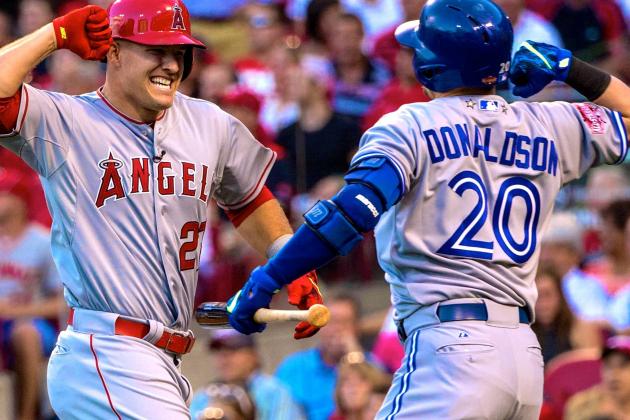
Last year Trout won in a landslide (unanimously, actually), but if he wins again this year it will be by the skin of his teeth--even though this season was superior to last's by almost every conceivable metric. Although he led all American Leaguers in WAR (both B-R and FanGraphs versions) and posted the league's highest OPS (and OPS+, and slugging percentage), he's once again at a disadvantage because his team failed to make the playoffs. Trout nearly dragged them there, though, keeping the Angels in contention until the season's final day. After a dreadful August slump by him and teammates, he recovered in September to post a 1.078 OPS over the season's final five weeks. It's not Trout's fault LA's bullpen imploded during Game 162, or that nobody besides him and Albert Pujols made a peep against Cole Hamels. One guy can only do so much in baseball (see Joey Votto), and in the end it just wasn't enough.

I won't hold that against Trout, but others might. One of the reasons Trout finished behind Miguel Cabrera in the hotly contested MVP races of 2012 and 2013 was that Cabrera's team made the playoffs while Trout's didn't. When he finally won last year, the Angels winning 98 games and the AL West was definitely a factor. This year they really had no business being in contention after their awful August, but like I said Trout nearly willed them to October.

For those seeking to reward the best player on a playoff team, they'll find few legitimate MVP candidates on the Yankees, Astros, Rangers, and Royals. That leaves the Blue Jays, who are loaded with them. Votes will undoubtedly be cast for big boppers Jose Bautista and Edwin Encarnacion as well as staff ace David Price, but the team's top player this year was clearly Josh Donaldson, a slick-fielding third baseman who also paced the Junior Circuit in runs, RBI, total bases, and extra base hits.

Already an MVP-caliber player his last few years in Oakland, Donaldson exploded his first year in Toronto. Many credit him for helping an underachieving Blue Jays squad snap its 22 year playoff drought--the longest in professional American sports. Not only was he the best hitter in a stacked lineup, but he also played a demanding defensive position and played it well.

So did Trout, which makes this such a close call. Their offensive numbers are eerily similar and they both play tough positions. Up until about three weeks ago I would have said Donaldson, but his late-season slump and Trout's strong finish was enough to sway me back to Team Trout. I think Toronto still makes the playoffs without Donaldson (though probably doesn't win the division), while Los Angeles is a losing team without its star center fielder.

Furthermore, Trout was simply the better player this year. He was a better hitter, especially after accounting for their ballparks (Trout's OPS and OPS+ led the AL). Donaldson played half his games in the Rogers Centre, a launching pad that significantly inflated his statistics. He hit three-fifths of his doubles and home runs there, batted 67 points higher there, and slugged 160 points higher there. It was a given that the move from the Coliseum's suffocating offensive environment to a more generous one in Toronto would boost his numbers, but no one could have foreseen him taking such extreme advantage of his home park.

Trout, however, did not enjoy the same home field boost. Anaheim is a better park for pitchers than hitters, which is evident in Trout's splits. He batted 35 points higher and increased his slugging percentage by almost 70 points on the road. He also had more home runs, more RBI, and nearly twice as many doubles on the road as he did in Anaheim. Had he played in even a neutral park, his numbers would look considerably better. That he still equaled Donaldson's dinger total and led the league in slugging percentage, then, is very impressive.

Bottom line: Donaldson had a great season, but Trout was just a little bit better.
Price positioned himself to win another Cy with his huge second half (Fox Sports)
AL Cy Young award
This one's another tough call. Sonny Gray was the frontrunner for much of the season with a 2.13 ERA and sub-1 WHIP through the end of August, only to falter in September by allowing 20 earned runs over his final five starts. His ERA ballooned more than half a run, costing him the ERA title that may have netted him his first Cy.

Meanwhile, David Price continued mowing down batters in Toronto, putting the finishing touches on what could be his second Cy in four years. His numbers were stellar across the board; first in ERA and fWAR, second in FIP, bWAR, and ERA+; third in innings pitched, fourth in strikeouts,, and fifth in WHIP--all while spending time in two of the tougher parks for pitchers.

He wasn't the American League's best pitcher this year, though; that would be Houston's Dallas Keuchel. The AL's lone 20-game winner finished a close second to Price in raw ERA but led the loop in ERA+. He was also tops in pitcher bWAR, WHIP, and innings pitched. Considering their run-prevention skills were dead-even, the tiebreaker goes to Keuchel for tossing an additional dozen innings--or roughly two extra starts' worth. That was huge for the Astros, who won the second wild card by one game over the Angels.
 
Both were part of compelling narratives after helping pitch their respective teams into the postseason, though obviously Houston misses the playoffs without Keuchel while Toronto probably still makes it in. Price is the bigger name but Keuchel's numbers are a touch better. He deserves to win by the slimmest of margins, so expect a repeat of last year's photo finish between Corey Kluber and Felix Hernandez (neither of whom are serious contenders again this year, by the way).

AL Rookie of the Year Award
What's interesting about the American League race is none of the best candidates played full seasons. Promoted throughout the summer, their campaigns were abbreviated, which makes these comparisons both easier and more difficult. They are easier in the sense that their playing time was roughly even, but more difficult due to their numbers being awfully close.

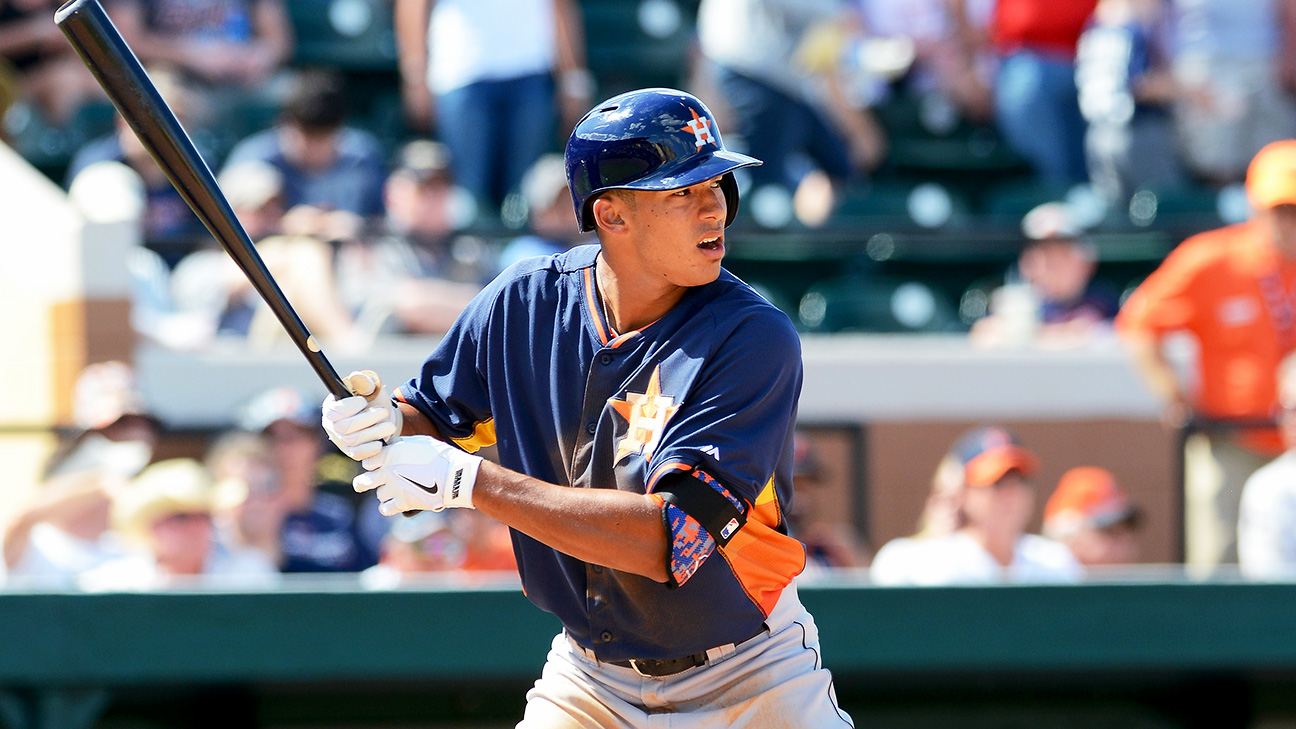
Carlos Correa's counting numbers--22 home runs, 68 RBI, 14 stolen bases, 4.1 bWAR--would have been phenomenal for a full season, but they're borderline insane considering he played barely three-fifths of one. We can only wonder what he could have accomplished had he debuted before June 8th. His full season numbers project to 36 home runs, 112 RBI, and 23 steals, which for a rookie shortstop is simply ridiculous. Even more ridiculous is that he just became old enough to legally buy a drink two weeks ago.
Correa's already earning comparisons to Alex Rodriguez (News Locker)
But wait, not so fast. What about the other wunderkind shortstop who played 99 games this year? Just 10 months older than Correa, Francisco Lindor was equally spectacular for the Indians, batting .313/.353/.482 (128 wRC+) with a dozen homers and steals. While his bat wasn't quite as potent, it was nearly so, and he was a considerably better defender. They were about even as baserunners, with the slight edge going to Correa. Baseball-Reference has them within half a win of each other in WAR, but FanGraphs gives Lindor a significant edge of more than one win.

I'd be remiss if I didn't mention Minnesota's Miguel Sano, who quietly enjoyed a monster season with the Twins. He was unquestionably the American League's best-hitting rookie, what with his .269/.385/.530 batting line, 151 wRC+, and .392 wOBA--not to mention his 18 home runs and 52 RBI in 80 games. Extrapolate his numbers over a full season and they're nearly identical to Correa's, But whereas Correa plays the most important non-catching position on the diamond, Sano hardly plays the field at all as a DH, making his production far less valuable. Had he played all year and amassed upwards of 30 homers and 100 RBI this would be a different conversation, but there's no reasonable explanation for choosing him over Correa or Lindor.

On the pitching side, Correa's teammate Lance McCullers made a good impression with a 3.22 ERA (80 ERA-), 3.26 FIP (79 FIP-), and over a strikeout per inning. Had he logged a full season, that performance might have merited the trophy, but it covered 22 starts and 125 innings. Two-thirds of a season is only slightly more than the three-fifths that Correa and Lindor played. Both were more dominant relative to their peers, as good-hitting shortstops are once again a rare commodity. In today's offensive environment, I bet most GMs would rather have the shortstop capable of hitting .300 with 20/20 potential rather than a midrotation starter.

So it comes down to Correa and Lindor. Lindor's the better all-around player at this point, but Correa is already showing Troy Tulowitzki-like prowess at the plate. With the margin between them so minute, I'm leaning towards the guy with the better offensive numbers. I think Correa made a little more of an impact in the games he played, and it also helps that he sparked his team to the postseason. Without him, the Astros are watching from home this year, so I think his outstanding performance in the heat of a pennant race deserves to be recognized.

When you get down to it, all of these awards are essentially two-horse races. Trout and Donaldson, Price and Keuchel, and Correa vs. Lindor. They're all so evenly matched you really can't go wrong with any of them. If it was me, I might just skip the analysis-induced headaches and flip three coins.

Monday, October 5, 2015

Sox Season Recap

Boston faded fast after its strong start (Boston Globe)
With yesterday's 3-1 loss to the Cleveland Indians, the Red Sox rollercoaster ride is over. Though they finished last again, they only lost six more games than they won and were one of the best teams in baseball for roughly half the season.

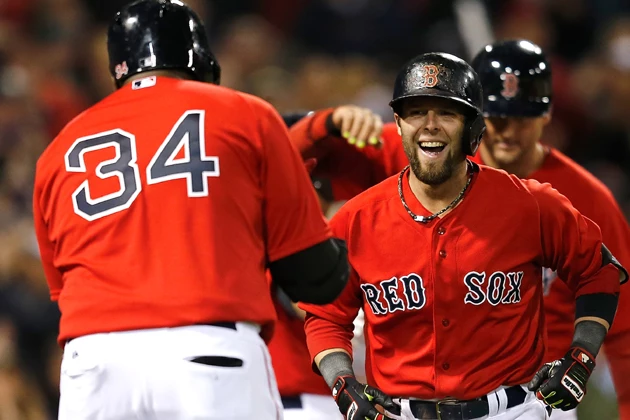
Of course, that's half a season less than what was expected from them this year. Following an active offseason in which they added a pair of high-impact bats and remade their starting rotation, the Red Sox were pronounced favorites to win the American League. For the first month or so they looked the part, with newcomer (who was really an oldcomer) Hanley Ramirez anchoring the offense, Mookie Betts becoming a human highlight reel, and a healthy Dustin Pedroia playing his best baseball in years.

But as the calendar flipped to May, it became evident that Boston's biggest weakness entering the season--starting pitching--was not up to snuff. Despite outscoring every team save the Blue Jays through April 29th, the Sox still finished April with a negative run differential. The blame fell on pitching coach Juan Nieves, who lost his job barely a month into the season. It was around the same time that Ryan Hanigan, the team's backup catcher-turned starter after Christian Vazquez underwent season-ending Tommy John surgery, went down with a fractured right hand. The Sox were forced to promote rookie backstop Blake Swihart much sooner than anticipated, and sure enough the 23 year-old struggled. With a raw receiver and new pitching coach, Boston's cobbled-together rotation fell into disarray.

Or at least that's what the Red Sox will have you believe, pointing to Hanigan's injury as the primary reason for the team's summer swoon. In reality, Boston's pitching improved drastically in May and June, trimming a full run off its April ERA. It wasn't until the weather warmed and injuries cropped up that the staff hit the skids in July and August.

The problem, then, was Boston's hitting, which completely disappeared in May. After averaging 5.14 runs per game in April, the Sox managed a meager 2.83 in May. As a result they lost a bunch of close games--nine of their 19 losses in May were by two runs or less--games that could have been won with timely hitting. Incredibly, it took what was supposed to be the best offense in baseball more than two months to score in double digits, and of course when they did they still lost anyways.

And so the Red Sox, a first-place team for much of April, found themselves in last place at the start of June. That's where they stayed for the rest of the year, briefly climbing into third place during the season's final week before returning to the AL East basement. That's also when frustration began to boil over, as Wade Miley and John Farrell got into a dugout shouting match (which, take note Nationals, did not escalate into choking), several players were ejected for arguing with umpires, and Pablo Sandoval rode the bench for perusing Instagram during a mid-game bathroom break.

A seven-game losing streak in mid-June proved to be a major setback, one from which Boston spent the next month recovering. The Sox caught fire leading into the All-Star Break, closing to within five games of first and positioning themselves for a second-half run, especially if Ben Cherington could fetch Cole Hamels or Johnny Cueto at the trade deadline.

The Red Sox were unable to maintain that momentum following the Midsummer Classic, however, as the death knell sounded for them in late July once again. This time it was an eight-game losing streak that did them in, dropping them a dozen games below .500 and the same number out of first. They thus found themselves in the awkward position of being sellers at the deadline with nothing to sell, and so July 31st came and went without much excitement.
Boston's strong finish offers hope for 2016 (929 The Ticket)
But Boston being Boston, the Red Sox didn't stay dormant for long. August was the most tumultuous month of the season, beginning with Larry Lucchino's announcement that he was stepping down as team president and CEO. That was followed in short order by John Farrell's stunning cancer diagnosis, which was soon overshadowed by the news that Dave Dombrowski had been hired as president of baseball operations and that Ben Cherington, general manager of four years, resigned after 16 years in the organization.

The most cruel blow to Red Sox fans, at least, was the departure of beloved NESN play-by-play man Don Orsillo, whose contract was not renewed for a 16th season with the team. Orsillo had not become a worse announcer, but the team he called games for was getting worse by the day. NESN wanted to re-engergize the broadcasts, and since they can't fix the Red Sox they figured it was time for some fresh blood up in the booth. Dave O'Brien--Orsillo's replacement--is great, but he'll never be Don (though Dave and Jerry does have a nice ring to it).

Lost amidst all the controversy off the field was that on the field, the Red Sox were turning their season around. All of the sudden everyone was hitting, even Jackie Bradley, Jr., and the pitching had finally settled down. Boston quietly enjoyed its best month of the season in August, only to play even better in September, which concluded with a season-high six-game win streak. From July 29th on Boston was the fourth-best team in the American League, winning nearly 60 percent of its games.

So for three months out of the year, the Red Sox were the team everyone expected them to be. During the three months in between, however, they were 13 games below .500. It was an incredibly frustrating and disappointing season to be sure, but there were lots of positive signs, especially over those final two months. Rather than play out the string, the Sox played their best baseball of the year.

If nothing else, Boston's strong finish proved Dombrowski has a strong foundation for his 2016 club in place. He has young, exceptional talent up the middle in Swihart, Pedroia, Betts/Btadley, and Xander Bogaerts. Young guns Henry Owens and Eduardo Rodriguez should be mainstays in the rotation for years to come, Joe Kelly pitched much better after being demoted to Pawtucket, and Rick Porcello's second half  (3.58 ERA after Independence Day) suggests he may live up to his fat contract after all. David Ortiz remained one of the best hitters in the game at 39, and whatever negative regression he endures next year will likely be offset by positive regression from Ramirez and Sandoval--two of the worst everyday players this year. Farrell and loyal bench coach Torey Lovullo will return, providing continuity in the dugout.

That's a good start, but expect another busy winter for Boston. The Sox need to overhaul their bullpen and desperately need more starting pitching, particularly the ace that has eluded them since they traded Jon Lester two summers ago (hello, David Price?). They also have to find a new left fielder with Ramirez moving to first base, although Travis Shaw deserves an extended look after his Will Middlebrooks-esque debut. They still have to figure out what on earth they want to do with Rusney Castillo as well as their surplus of catchers. If Bradley's batting woes return next year and Betts moves back to center, they'll need a right fielder, too.

After going worst-to-first in 2013, the Red Sox were unable to repeat the trick in 2015. With another aggressive offseason and the right pieces to complement their nucleus, perhaps they will in 2016.